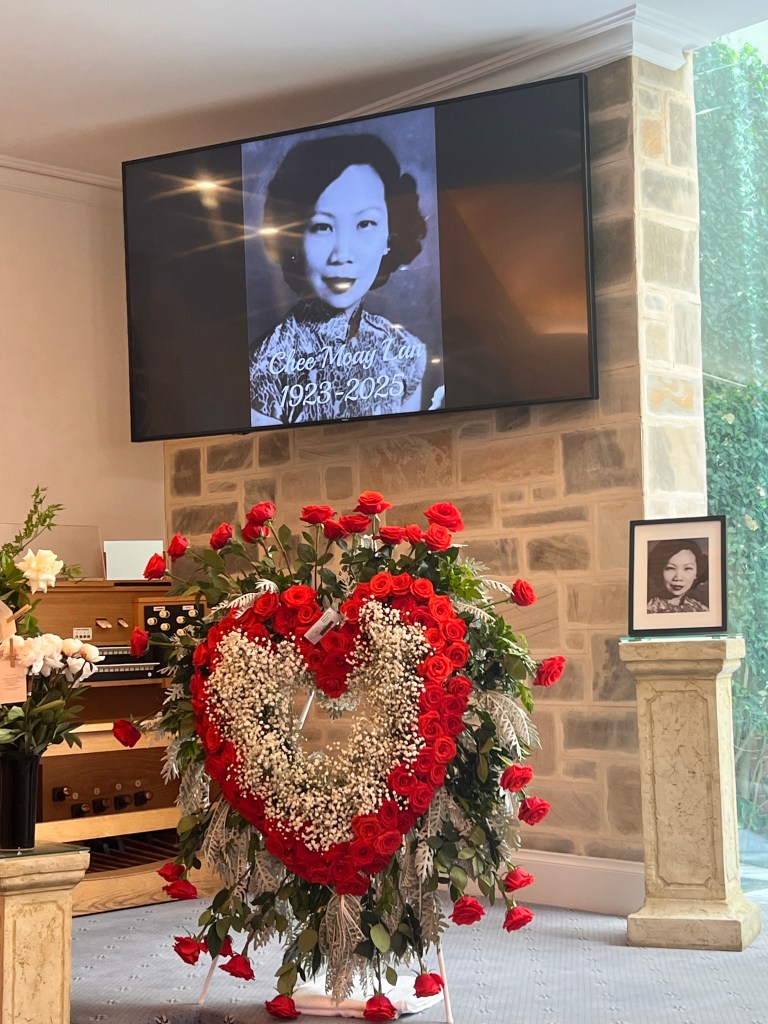
A Homage, Still My Home

Doe-doe, in that lecture hall light

Economics, Law and Accounting day and night

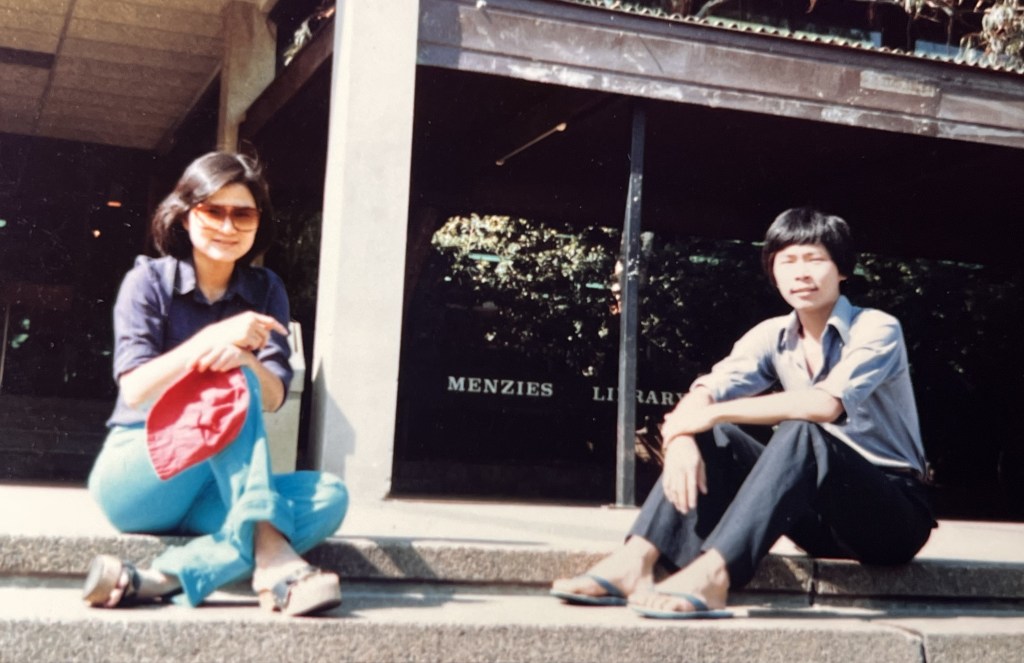
At Uni New South Wales, side by side

You from Maroubra Bay, a beachside

Me from working class Kingsford, walking home

Young hearts making busy roads our own

Top girl in school, a soul pure white

You wore your grace like summer light

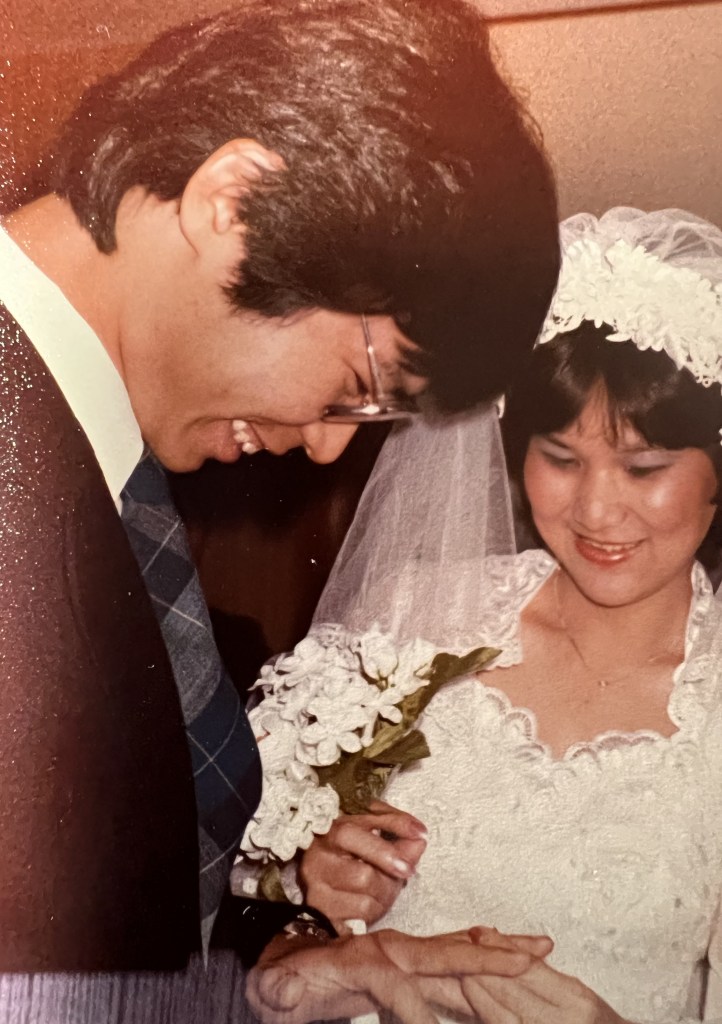
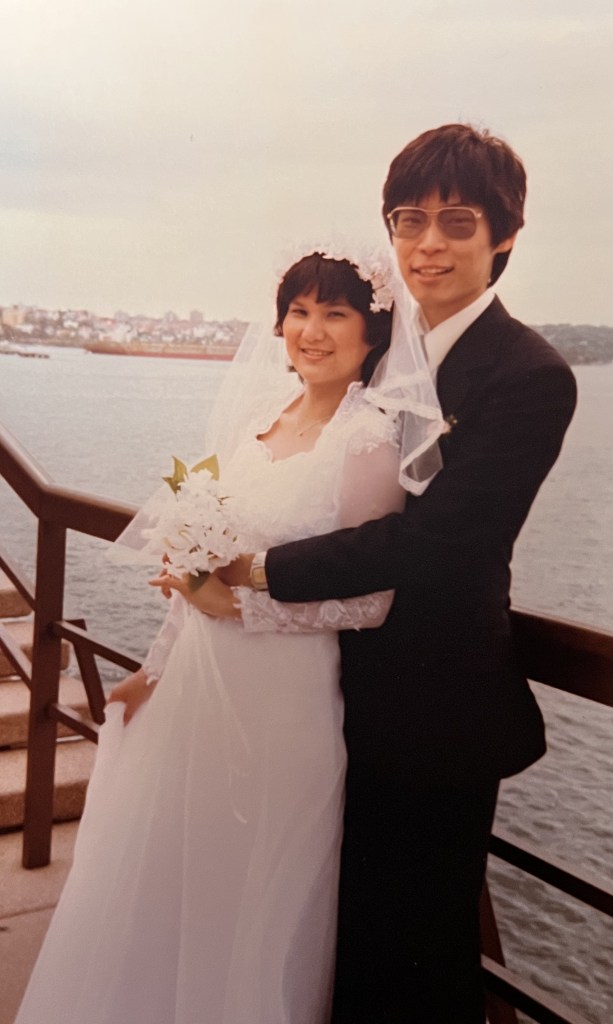
From bachelor dreams to a wedding vow

We found forever in our now

And every road kept leading to

A life I only knew with you

Doe-doe, you are my steady flame

The quiet truth beneath my name

Through every year, through joy and strain

You make my world feel whole again

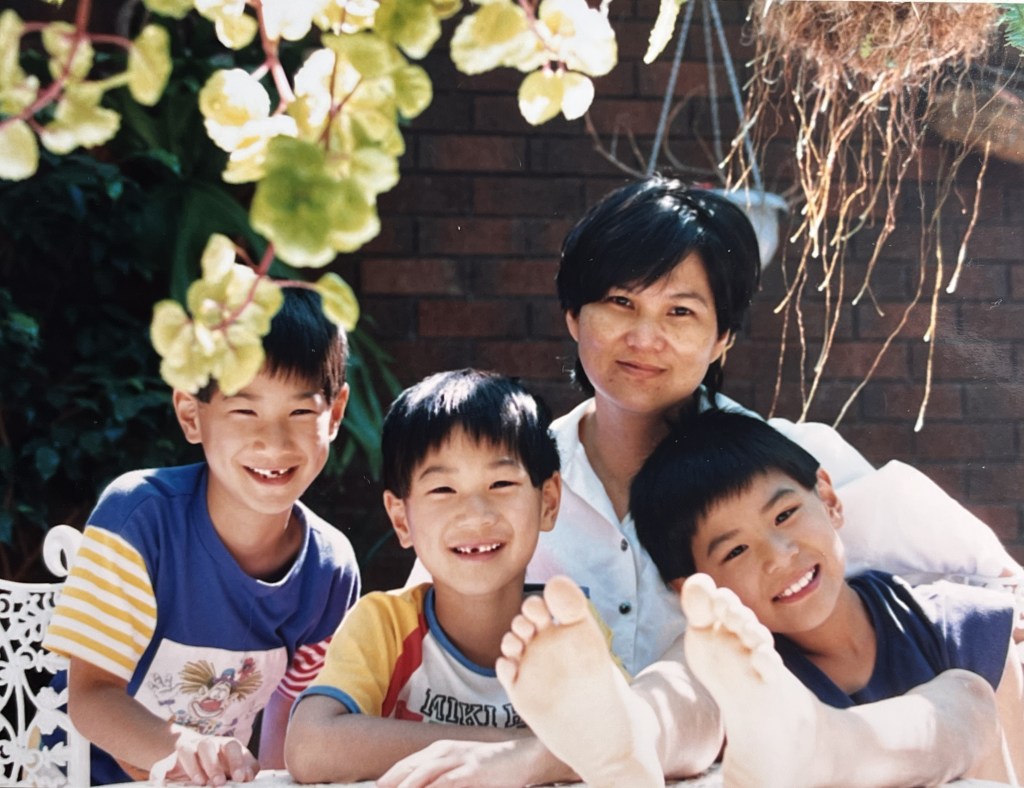
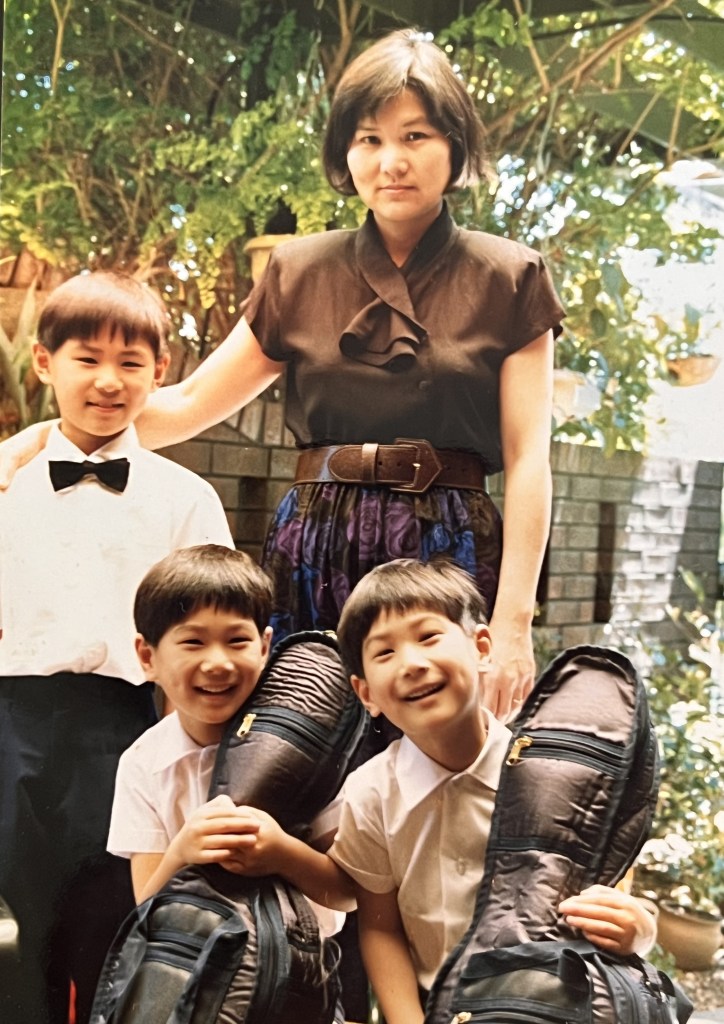
Mother of my three brave sons

You are my home, my only sense

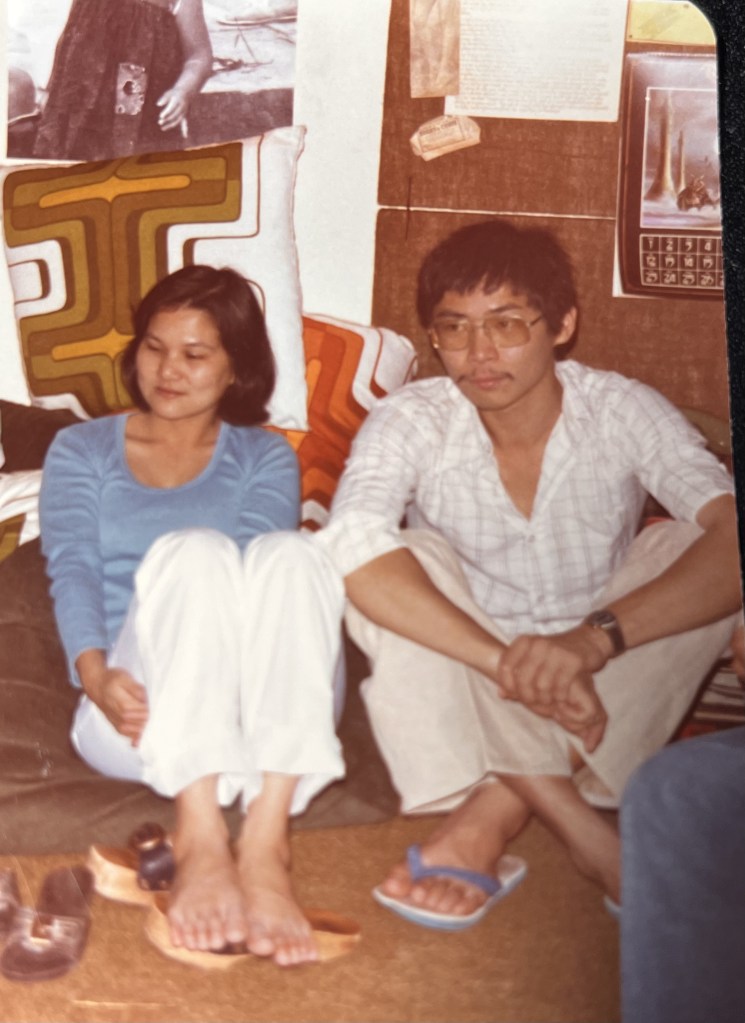
We married, moved down to Coogee

Mahjong at Koo’s till dawn, so happy

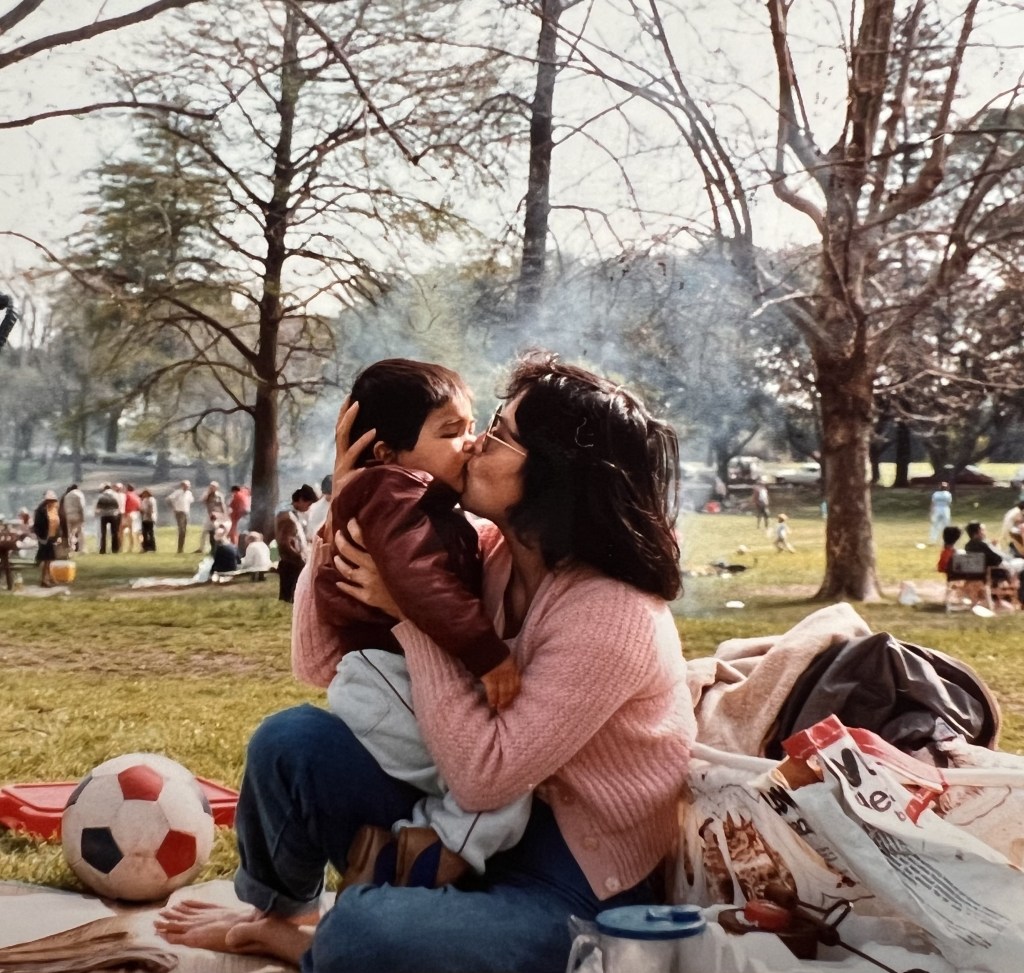
Centennial Park blue skies on Sundays

The calm inside my restless days

Doe-doe, you’re the heart of me

Forty-eight years, and still you move me

Three months in, you smiled and said

Buy that test kit, I am late

Morning came, then time slipped by

We checked after lunch, didn’t expect to cry

Teary eyed, we held each other till five

Shocked that we had created a new life

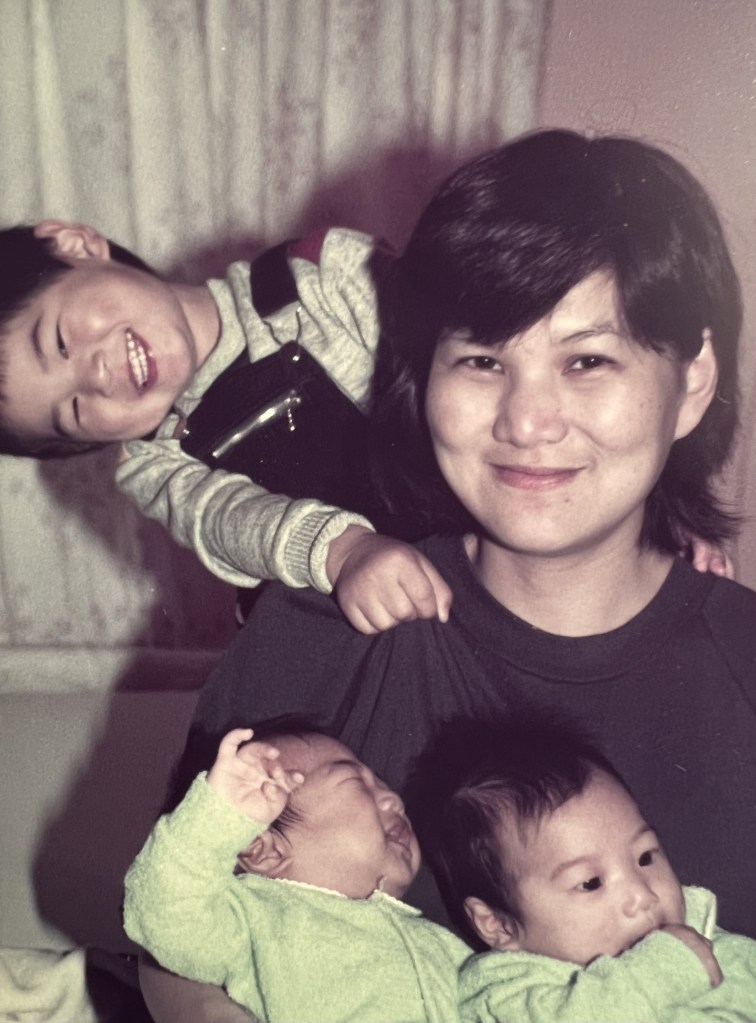
Then two years on, surprise again

Twin little heartbeats like music in the rain

We held on tight through happy tears

Love doubling up before our fears

And in your arms our future shone

Like morning finding its way home

Doe-doe, you are my steady flame

The quiet truth beneath my name

Through every year, through joy and strain

You make my world feel whole again

Mother of my three brave sons

You are my home, my only sense

Adelaide foothills and parks became our nest

Cheaper roofs, big rooms and the rest

Violin and cellos sang, life ain’t bleak

While you cooked love into the week

You got your Miri folks to our door

And still kept giving more and more

Doe-doe, you are my steady flame

The quiet truth beneath my name

Through forty eight long hard years

You held our joy, you held our tears

Mother of my three brave sons

You are my home, my only sense

Don’t Skip a Beat, Here’s a Skip.

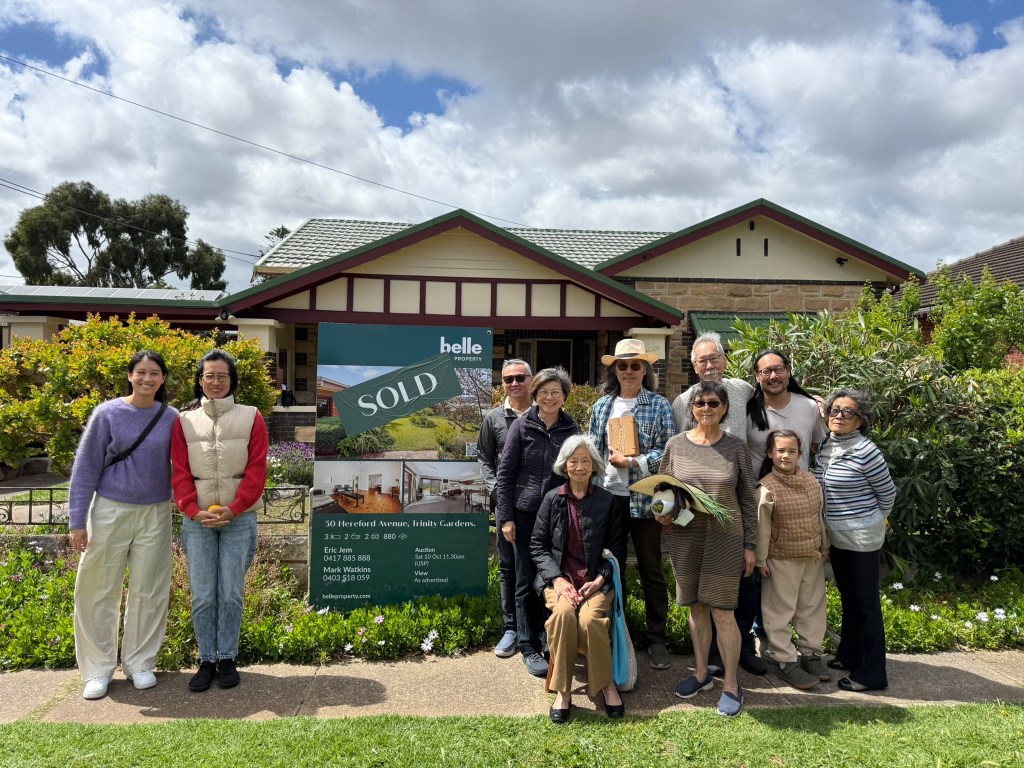
It has been three quarters of a year since our mother left this world. She left us at the end of spring or the beginning of summer, taking with her a lifetime of quiet authority and presence. It is spring again but very early spring in Adelaide. Most days it feels like winter still—grey skies, dark pregnant clouds that rain heavy tears on us to prove the weather forecasters wrong, again and again. Perhaps, the climate is being sympathetic to our grief and sorrow, even the swallows haven’t made their appearance yet.

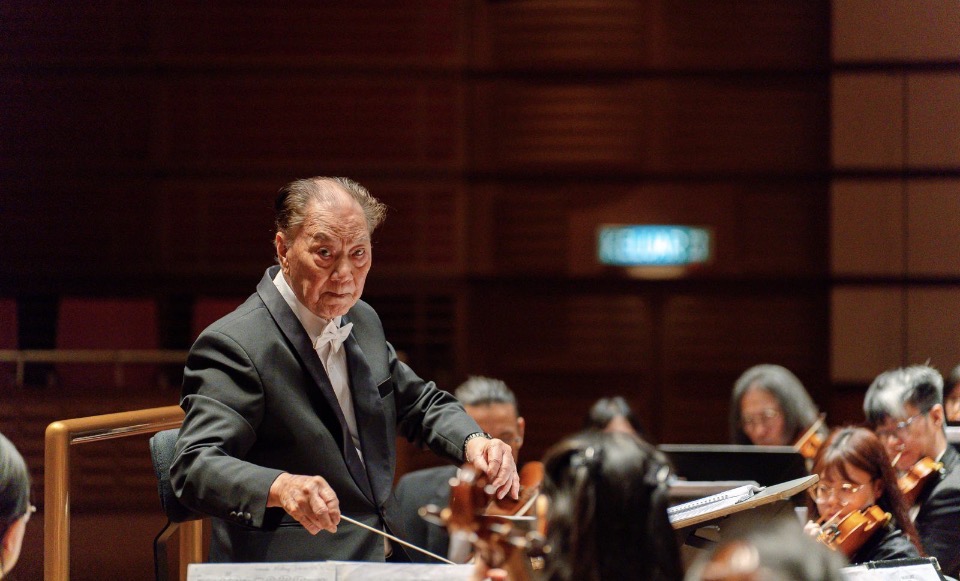
The skip in my steps since my successful stint with the Penang Symphony Orchestra for their 45th anniversary celebration had transformed from the bouncy, energised gait that it was into a heavy drag as soon as I stepped back into the cold reality here in Adelaide. The buzz from the concert highs at the majestic Dewan Filharmonik Petronas in Kuala Lumpur had quickly dissipated, almost as quickly as the coach bus that left Kuala Lumpur for Penang soon after the performance finished. There was no time to celebrate with the orchestra, no time for celebratory drinks or shared recollections of the performance. We all split up after packing away our instruments and music, after taking some selfies and group photos, after offering congratulations to our maestro, Dato’ Woon Wen Kin, and saying our final goodbyes.

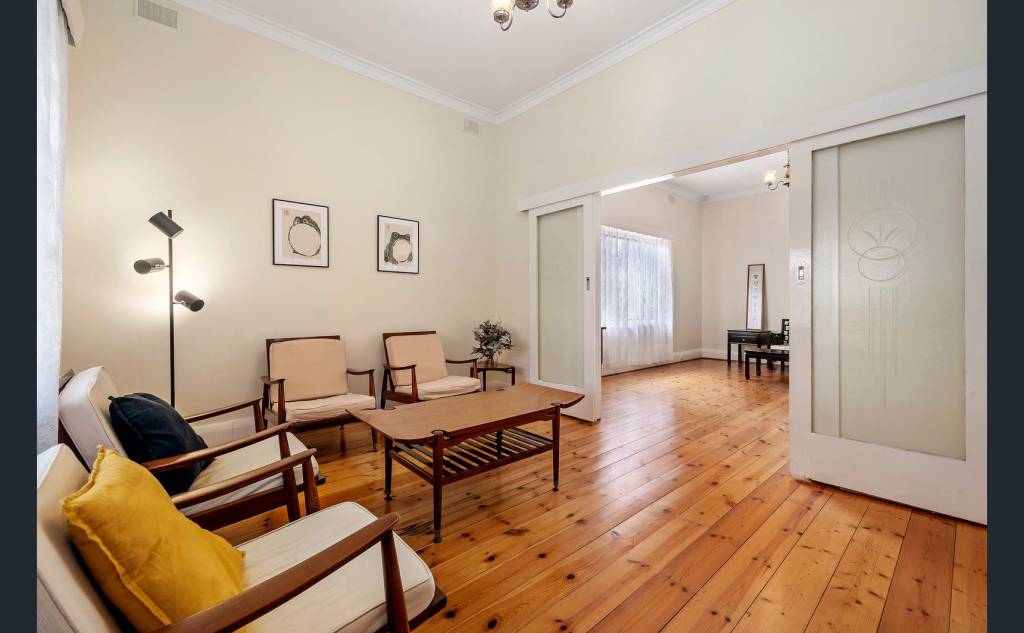
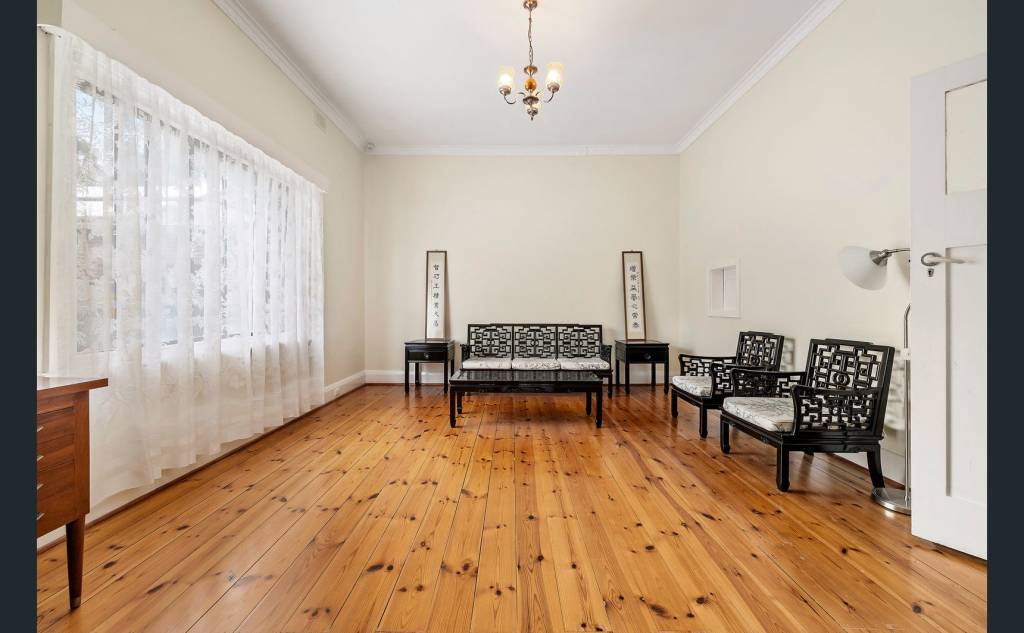
The dourness that hung over me wasn’t just a product of Adelaide’s dismal wintry conditions, though they stood in stark, unforgiving contrast to the comforting humidity, tropical heat, and the sweet relief of late-afternoon breezes drifting in from the Andaman Sea. Rather, the heaviness settled deeper following a weighty pronouncement delivered by one of my siblings. They informed us that our eldest sister had finally resolved to pull up stumps, sell the family home, and call it quits. At 83 years of age, she still theoretically has a good few years left if she is to reach the remarkable century mark that our mother achieved, or even the solid 91 years our father lived to see. Her current plan is to transition into a smaller, far cosier residence—one accompanied by a modest, easily manageable garden—or perhaps to take up residence with one sister, another sister, or a niece.

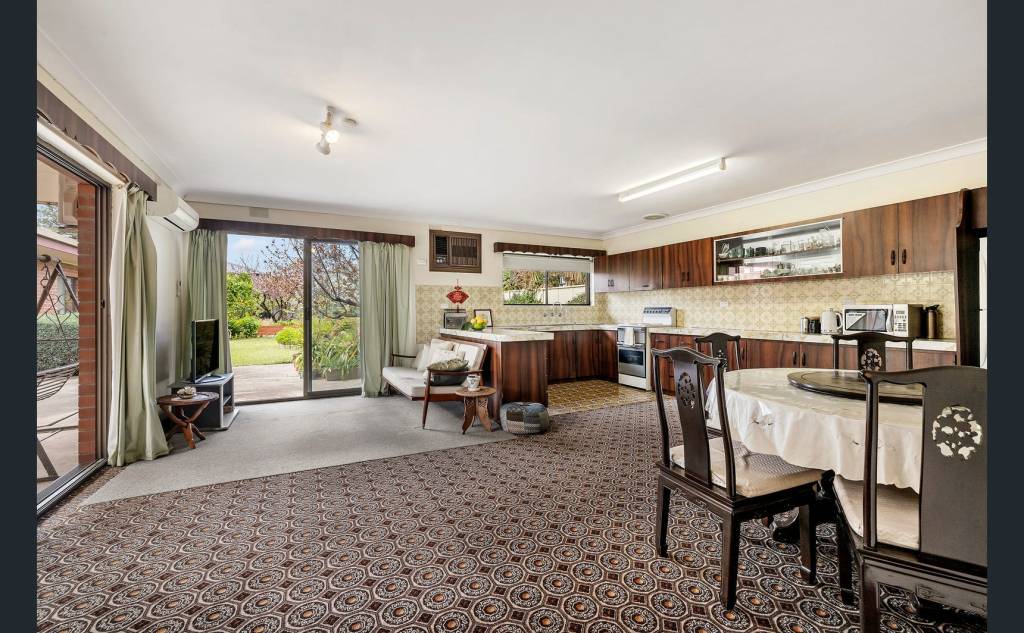
In the privacy of my own thoughts, I immediately deemed this a very wise and sensible decision. Naturally, I kept that judgment strictly to myself and didn’t voice it aloud to anyone else, having learned long ago that offering unsolicited opinions rarely yields positive outcomes. It was, without a doubt, a sound choice, albeit one that arrived after a painfully lengthy delay. Once upon a time, years ago, I had personally urged her to sell the family property and move into a modern, low-maintenance home alongside our mother. In such a place, the two of them could have spent their golden years enjoying contemporary conveniences and a truly comfortable lifestyle where every appliance operates seamlessly and every domestic detail contributes to peace of mind. They would no longer have had to endure chronic plumbing leaks, alarming structural cracks crawling up walls and cornices, unsightly, scarily sagging ceilings, stubborn windows stuck fast in their frames, or a hyper-sensitive security system that triggered false alarms without rhyme or reason.

Yet back then, such a move was simply impossible. Our eldest sister found herself completely unable to make a life-changing decision of that magnitude as long as our matriarch retained absolute authority over the household. Our mother insisted on having the final, unquestioned say in every single matter. Her micro-management extended even to the daily culinary routine, strictly dictating which specific vegetables and meats were to be prepared first each day. This ritual required a painstaking, close inspection of individual packages in the fridge and pantry to identify which items were slightly older. Under her unyielding rule, whatever was deemed less fresh had to be consumed first to prevent waste. Consequently, the household lived in a paradoxical state of forever eating food that was past its prime. Compounding this dynamic was my sister’s own deep-seated emotional attachment to her accumulated possessions; the daunting prospect of parting with Mother’s cherished belongings—most of which held sentimental value but were otherwise financially worthless—proved far too overwhelming to bear. Thus, the family dynamic remained trapped in a permanent gridlock. So long as Mother wielded her ultimate veto right, no decision to sell the house or relocate could ever be realised.

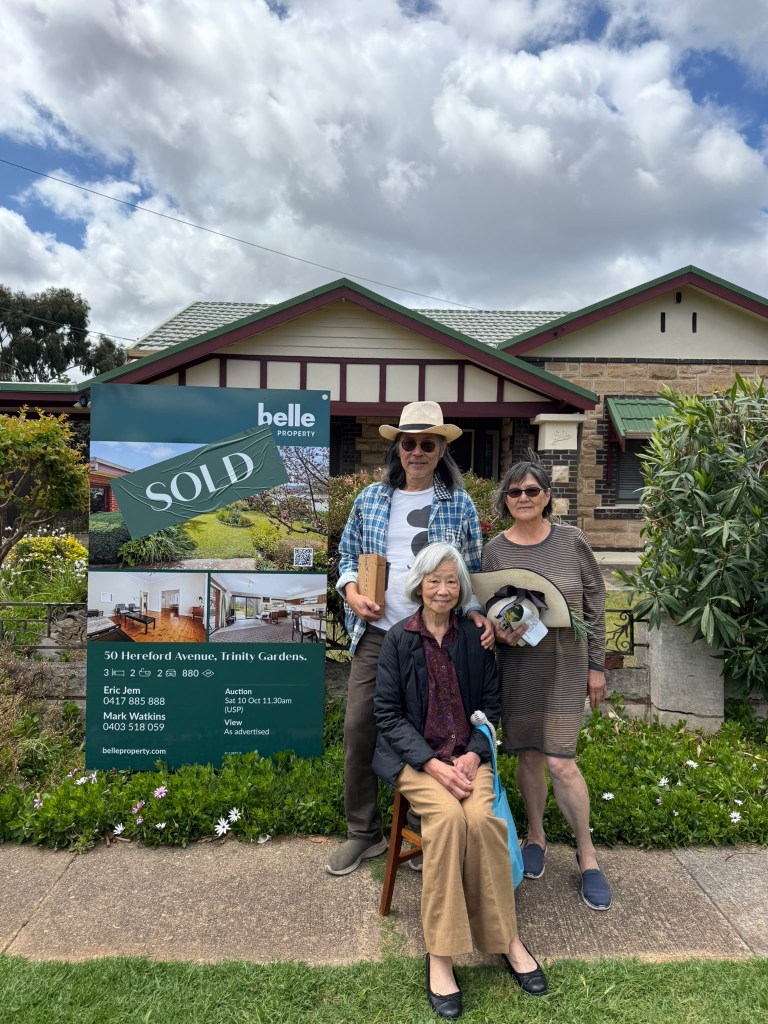
Our mother passing (I still can’t use the word death) brought an end to an era defined by her unyielding, final veto rights. Eldest Sis finally decided it was time to let go, move on, and put the long-standing family home on the market. The family home was acquired by our late father at a public auction, where he asserted his formidable presence over the entire room. With every ambitious bid, he punctuated his resolve by striking his heavy walking cane firmly against the ground, THUD, THUD, THUD, —bypassing standard thousand-dollar increments to boldly raise the price by ten, and ultimately, calling out loudly twenty thousand dollars above the previous competing offer. With that final bid, he dramatically silenced the whole room. Eldest Sis recalled that everyone stopped breathing as the auctioneer slammed his gavel and went to shake father’s hand.


Good for her, I thought. It’s her house now, and she has the ultimate say in what she wants—or perhaps more importantly, what she doesn’t want. Yet, only a few weeks passed before another inevitable sibling gridlock formed over the exact timing of the sale. She had brought in a few siblings to assist with the logistics, which quickly led to conflicting strategies and maybe even the birth of new veto rights. One sibling strongly advocated for spending time to fix up the property properly and putting it up for sale in February or March. Others vigorously disagreed, countering that spring was the prime season. They argued that lush green gardens, spring blooms, perfect weather, and longer days would draw more prospective buyers into the market, especially families looking to settle down before the start of the new school year. The debate remained stalled until the sibling proposing a summer sale departed for a three-week holiday in Europe. In her absence, the remaining siblings quietly conspired, and the decisive call was hastily made: they would sell immediately! Throughout this entire tactical maneuver, I remained completely silent—primarily because I was kept entirely in the dark about the ongoing discussions and intentions, which thankfully spared me from making unnecessary comments.

I only discovered the finalised decision after being retroactively added to a dedicated WhatsApp chat group intended to monitor and coordinate preparation tasks following the signing of the sale contract. As I systematically reviewed the lengthy list of chores required before hosting public open inspections, I mentioned to the sibling who brought me in that, since my assistance was requested, I felt obligated to offer my candid observations and raise critical questions, if any. I carefully parsed the contract clauses and double-checked the project timeline. After raising several pertinent points regarding the documentation, I received a prompt clarification and a polite apology from Eric, the designated real estate agent managing the listing. Though his apology was gracious, it was largely unnecessary; it turned out a minor paragraph on marketing was missing from my specific copy while present in theirs. It left me wondering whether it had been accidentally omitted during distribution or if it was simply a technical glitch in the system.

“What about all that accumulated junk clogging up the granny flat at the back of the property?” I asked during our conversation, pointing out the sheer volume of clutter that had been gathering dust for years. “There’s a massive backlog of dead stock, obsolete items, and slow-moving inventory sitting in there that needs to be cleared out before any serious buyers come through. If you want my help, I’ll dump the whole lot for you to get the place presentable.” However, despite my straightforward offer, my willingness to assist was instantly misinterpreted as some sort of transactional, conditional clause.

“Nah, I am definitely not going down that family war path with her,” my sibling shot back immediately, shaking her head in refusal. “All those items belong to our other sister who is currently away. It’s her responsibility, and she can come back and clear her own stuff out once the property has officially finished its marketing and sale campaign and we actually need to provide vacant possession to the new buyers.”

“Wouldn’t it be far easier and far less stressful for Eldest Sis to just take the initiative now and tell her firmly that those things have to go?” I reasoned, attempting to offer a practical, friction-free workaround. “We could simply pay her $2,500 directly out of the eventual sale proceeds to compensate her or cover the disposal costs. Eldest Sis would be so much better off getting the granny flat completely cleaned up right away, turning it into a presentable, cosy space that actually adds value to the entire estate during inspections.”

“Oh gosh, listen to you! You just ain’t helping at all,” my sibling exasperatedly replied, throwing her hands up in frustration. “This entire house has been practically crying out for basic maintenance and help for years—and you brothers ain’t handy whatsoever and haven’t stepped up to help with a single thing, have you? Now we are finally down to the very last stretch of work that needs doing, and suddenly it’s your way or the highway! I don’t even know why I bother… Ah, don’t worry about it. It’s obvious you don’t actually wanna help us. I guess we just can’t do anything about it,” she sighed loudly and deliberately.

“The reason we brothers don’t step in to do anything is because the high-level decision-making in this family was always monopolised strictly by the daughters,” I responded, voicing what I genuinely considered to be a sensible, and long-overdue explanation. “Why on earth should we be expected to blindly execute labour or jump into tasks that we fundamentally disagree with in the first place?”

“You honestly don’t even realise how difficult you are being or how you’re behaving,” the sibling continued, her tone tightening. “Even the simple act of including you in the WhatsApp group has completely disrupted and changed the whole collaborative nature of our working dynamics with Eric.”

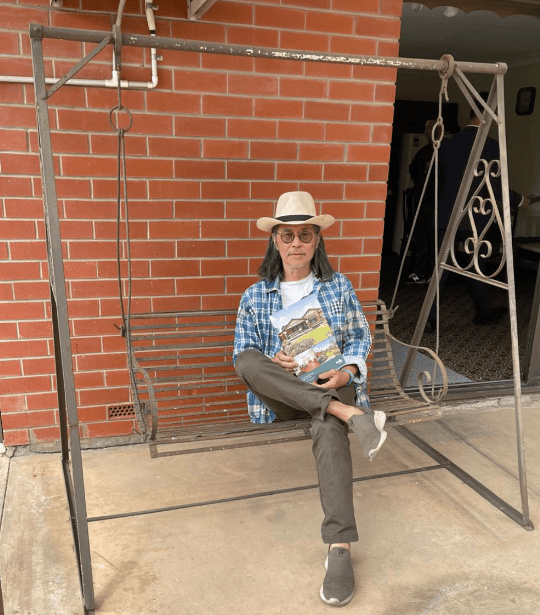
She paused for a brief moment to catch her breath before launching into the daunting laundry list of manual labour remaining on the schedule. “The old carpet and worn-out underlay throughout the house all need to be ripped out entirely. We have to pull all of that gross padding up from the subfloor. Tomorrow is another exhausting day—I’ll have to help her carefully pack away all the fragile kitchenware, roll up the heavy carpets, and completely re-position the furniture in the family room. On top of all that, I still need to somehow find a way to remove her heavy sewing machine, the bulky study table, that old broken washing machine, the spare wardrobe, the rusty garden swing set out back, and heaps of accumulated garden refuse…”

I was completely nonplussed by her sudden hostility; I had no idea that raising sensible, pertinent questions about the real estate agreement and the marketing timeline could be construed as disrupting the so-called frank and friendly dynamics with the agent. In my view, performing basic due diligence before committing to a major financial undertaking was simply common sense, not an act of hostility.

“Ok, let’s be entirely realistic here,” I said, attempting to ground the conversation in perspective. “Many of my close friends have already dropped dead over the last few years. Money simply isn’t my primary worry or top concern anymore. Eldest Sis will be cashed up very soon once this property settles. What is all that accumulated wealth actually for if not to make her day-to-day life significantly easier and better right now? What prevents us from simply hiring a team of capable professionals to purge the clutter and show the property in its finest light? Why insist on enduring backbreaking manual labour ourselves when time is creeping up on us and we are all well into old age?  Does endlessly pinching pennies and hoarding every last cent truly equate to being wise and prudent? Who are we even preserving this money for at our time in life?” I asked.

“You are just damn difficult to talk to,” she shot back, her voice dripping with irritation. “With you, it’s just relentless confrontation after confrontation. Honestly, it’s no wonder your wife struggles with you sometimes. Anyway, finding reliable trade people to do heavy work is an absolute nightmare at the moment. If you think it’s so easy, you go find someone yourself. You go tee up the skip hire, and let’s just hope the rusted swing set magically works its own way into the skip, and that heavy old wooden trolley rolls itself right in there too,” she sneered, or so I vividly imagined from the sharp edge in her tone.

“It is crystal clear that you won’t be lifting a single finger to assist us with the heavy lifting. So we shall just leave it at that and drop the subject,” she added dismissively.

“Look, I’m almost 70 years old,” I replied calmly, standing my ground. “Sure, I’m not about to throw my back out doing backbreaking physical labour when we can afford to hire professionals to handle it. I am more than happy to pay out of my own pocket for Eric’s team to come in if it makes you feel any better, but you’re entirely right about one thing: I will not risk my physical health, back, or overall wellbeing for work we can easily outsource. You’re acting exactly the same as our other sister—labelling me as confrontational simply because I disagree with your opinions.”

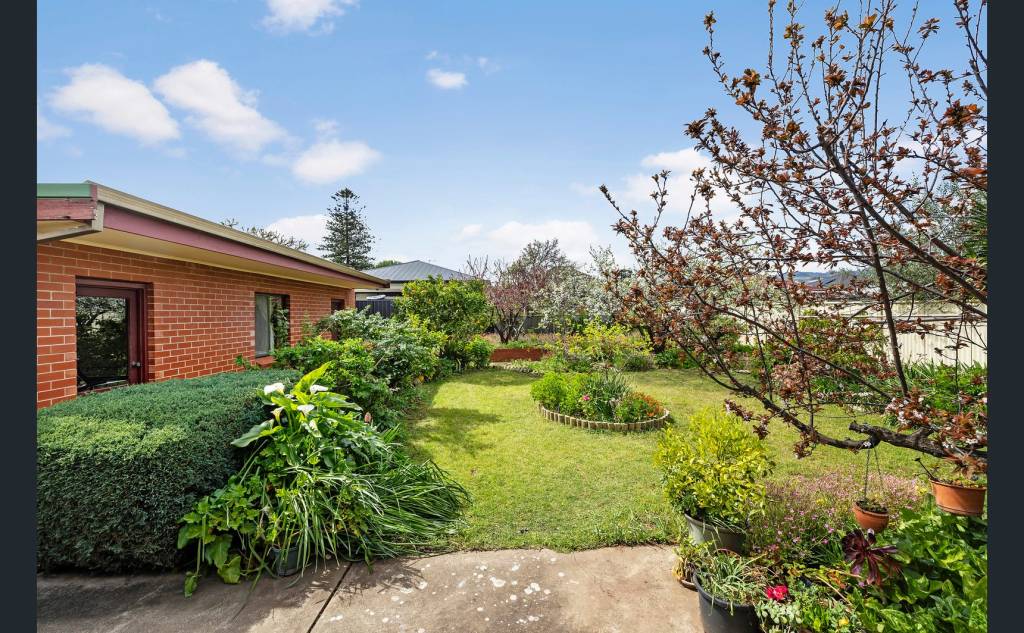
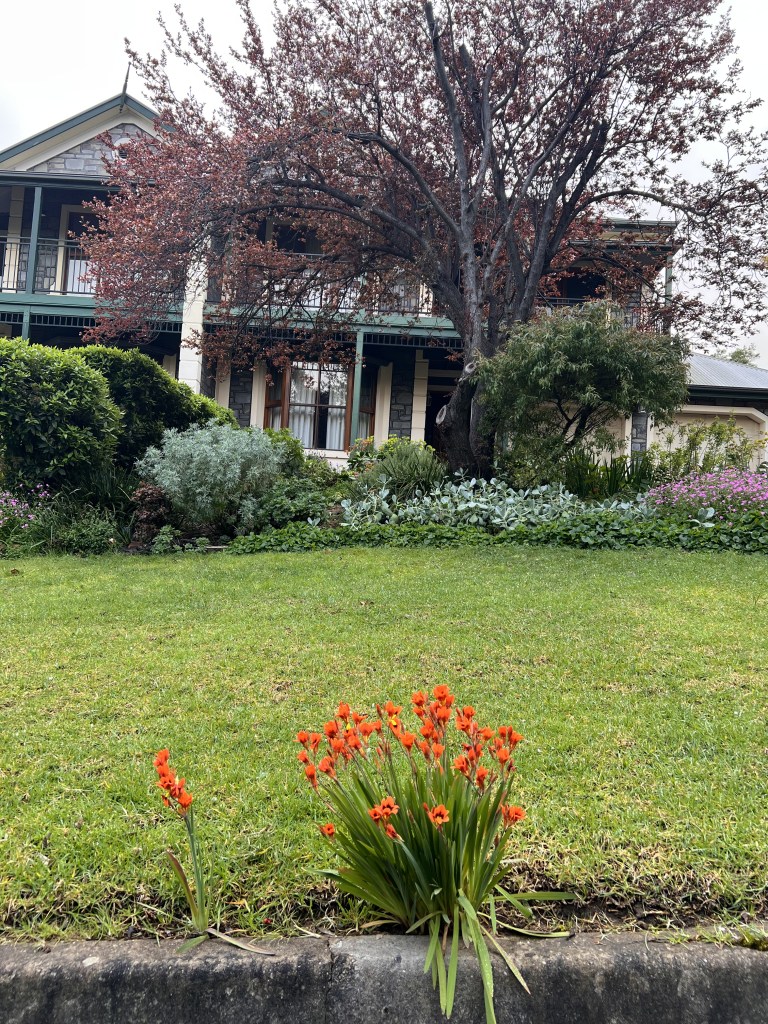
That tense, unnecessary exchange took place last weekend, and a full seven days have quietly passed since. Rather than remaining bogged down in endless debate, I took matters into my own hands: I asked Eric to order a massive 9-cubic-meter skip bin to be delivered directly to the driveway. It turned out it wasn’t that big after all. With the invaluable help of my old, trusted friend, John Scalzi, we spent Friday hauling out the accumulated debris and bulky items and filling the skip right to the absolute rim. On Saturday, we turned our focus entirely to the long driveway and garden. The outdoor space had suffered from long periods of neglect, with wildly overgrown edges, unkempt lawns, and unruly bushes creeping over the pathways. Methodically, we set to work tidying up the perimeter, carefully edging the lawn, pruning back the straggly hedges, and prettying up the garden beds until the entire exterior of the property looked pretty and immaculate, just like how a cottage garden should be.

The verbal sparring from the prior week was forgotten. Working under the open sky, there was no lingering stress, no petty conflict, and no unnecessary pressure weighing on us. Working quietly side by side, we trimmed back dead branches, mowed down the tall turf, raked up dead leaves and twigs, swept down the paved walkways, and systematically gathered and stacked the abundant green waste. By the end of the day, we had accumulated a colossal pile of garden refuse that would easily amount to another full skip bin, all accomplished efficiently and smoothly without skipping a single beat. But, we were both totally buggered by then. John Scalzi, I should mention, is already in his 70s.

The property isn’t quite ready for open inspections yet. There remain a myriad of collectibles and collections that are impregnated with sentimental value and fond memories. Every room in the family home holds decades of accumulated treasures, each tied to a specific time, place, or loved one. What will Eldest Sis do with them? Is the item of any real monetary value, or is its worth tied entirely to nostalgic significance? Is the sentimental value worth more than the monetary value? Who should she give them to? Will the intended recipient even want it or have the space to store it? What about the preserved olives and plums sitting in glass jars? What about the vast piles of vintage books and yellowed music sheets? Who gets to keep the family piano? What about the delicate jewellery and collections of old coins? Who should get our father’s favourite Chinese painting of a cat? What about the sturdy wooden bed bases and timber frames? Don’t forget the heavy antique furniture, including the massive 9-piece rosewood dining suite. Sorting through, deciding on, and distributing every single item is another massive gridlock that will severely challenge the strict marketing timeline set by Eric’s real estate team.

When Mother suffered the stroke that consigned her to a nursing home for the final six months of her life, all she could take with her was a small suitcase of clothes and basic personal effects. Even those few items she did not fully use in the end. It serves as a stark reminder of how little we ultimately retain when life draws to a close. Don’t skip a beat. Almost everything we own, gather, and cherish over a lifetime will inevitably end up in the skip.

Yet, much like a patch of roadside wildflowers pushing through pavement cracks, beauty and grace can somehow flourish despite poor soil, a careless gardener, or a harsh drought, blooming with quiet resilience against all odds. Even amidst the inevitable friction of sibling disputes, the daunting burden of accumulated clutter, and the gentle heartache of saying goodbye to a home steeped in nostalgia, surprising moments of serenity and beauty manage to anchor themselves. They remind us that while material possessions will eventually fade or end up in a skip, the love and acceptance of family, and quiet warmth from enduring friendships remain the glue that makes life beautiful, if not meaningful.

Why Straighten My Bow? It is Straight.

Where do I begin?

From the ending, I suppose.

My Mrs does the same whenever we sit down for a show. She rarely will watch a mini-series sequentially from the start to the end. More often than not, she will impatiently skip the early chapters and rush ahead to find out how the story ultimately ends. Will her hero survive? Will the damsel in distress be saved in the nick of time?

So, indulging that same instinct, let me get to the end first.

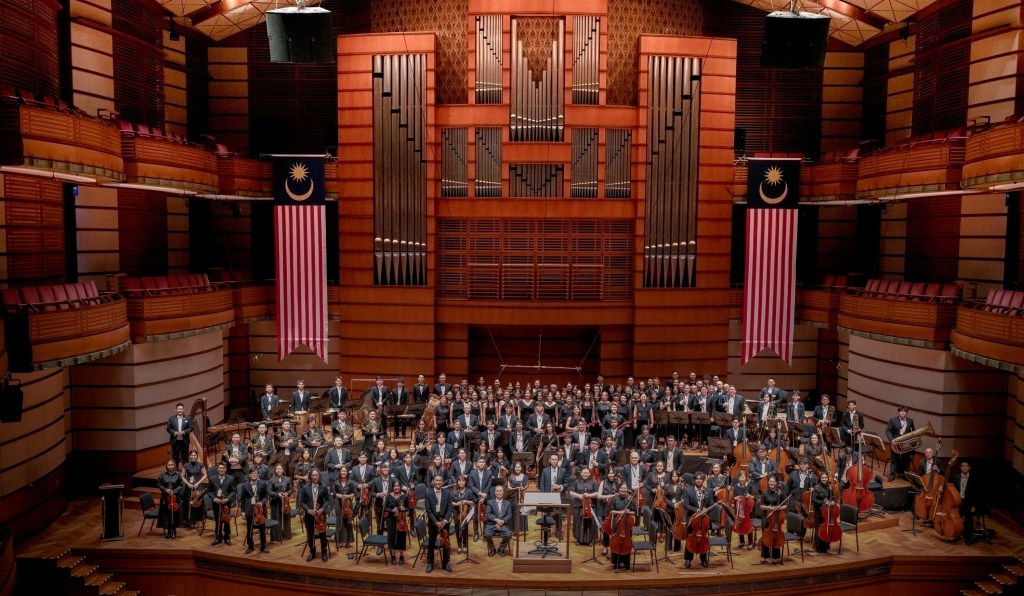
It was on a memorable Sunday afternoon. In Kuala Lumpur, Malaysia. Right at the majestic KLCC complex, to be precise. Inside the world-class Dewan Filharmonik Petronas (DFP), in fact—the prestigious home to the acclaimed Malaysian Philharmonic Orchestra.

I was there, not merely taking in the performance as an anonymous audience member, but as an active performer standing on stage, no less! Standing on that magnificent stage and soaking in the overwhelming warmth of the applause in such a hallowed hall was an unforgettable experience like no other. Yet beneath the excitement and sparkle, I recall feeling somewhat  disappointed in myself. I felt I had not played to the absolute best of my ability. My intonation in the Windsor Overture—the opening piece of our ambitious program—was unusually suspect, and my bowings felt frustratingly timid at times. As the applause reverberated across the tiers, I berated myself for the shaky start. Later, in the quiet, wee hours of that night, I had to gently remind myself to be kind to myself. It ought not be about my individual flaws or ego at all. The Penang Symphony Orchestra (PSO) as a whole thoroughly deserved every bit of the accolades and the thunderous applause that filled the hall that afternoon. The entire orchestra had performed amazingly well together.

The maestro, Dato’ Woon Wen Kin, a giant in the Malaysian classical music industry, continually impressed me with his musicianship, strong leadership, and a seemingly inexhaustible supply of artistic energy and drive. Over almost six decades of dedication and drive, he had led the transformation of what was once a classical music desert into a vibrant oasis for Penang and beyond, paving the way for future generations to appreciate and cherish the timeless beauty and greatness of classical music.

“Straighten your bow,” Lee Chye Guan, our concertmaster, leaned over and urged me amidst the applause. The audience’s applause was thundering throughout the hall and showed no signs of stopping anytime soon. Unable to catch his exact words over the din, I looked back at him in complete confusion and simply shrugged my shoulders.

“Straighten your bow!” Kar Ying, standing directly in front of me as the no. 3 player, echoed over her shoulder.

I checked the bow and violin I was holding in my left hand as the audience continued with their exuberant clapping and hollering. My bow is straight, the tip pointing almost vertically at the beautiful timber floor.

“Why? My bow is straight!” said I.

“Your bow tie!” Chye Guan replied loudly.

The Penang Symphony Orchestra’s 45th Anniversary Concert at the DFP.

The concert started at 3pm, on 16 August 2026. I was already very tired by then. We were told to have our breakfast at 7 that morning. Two words on the time slot of our itinerary for the day caught my attention. MUST EAT. So, I ate, even though I am accustomed to fasting till noon or thereabouts. In Malaysia, do what the Malaysians do. Just go with the flow. There’s no need to stand on one’s ground, fight the good fight out of principle. Just relax, no hard and fast rules and everything will be alright.

It was kinda weird initially. Cars double parking, sometimes, even triple parking, drivers oblivious to blocking the traffic just because they have to wait for the street hawker to prepare their orders. But, no one gets flustered. Give and take, compromise, being rigid, being a stickler for rules doesn’t work in a densely populated city. Relax. All will be well. So, I ate my breakfast. Instant coffee, kaya toast and fresh fruits. A breakfast I would have declined at home, especially the instant coffee. I, a coffee snob, calmly sipped inferior coffee. It was so unlike me. But a me whom I was beginning to like. I was relaxed, easy-going and unfettered by things that would normally have made me curse. Malaysia can. Malaysia Boleh. Just smile and everything will be alright. Just a smile, I reminded myself. I was beginning to not recognise the new me. I was beginning to like the new me.

A rather likeable me. I could tell, because normally I was not. People in the orchestra treated me with genuine respect. I was a founding player, 55 years ago. A pioneer. I never thought of myself as being a pioneer of anything. But, the penny suddenly dropped. When I told my story to some of the members, someone observed that. “You’re a pioneer!” he said. So, they see me as someone who contributed, albeit a very insignificant one, to the birth of classical music life in Penang and in doing so, also helped to spread the gospel of Beethoven, Bach and Brahms et al in Malaysia.

The young members of the orchestra helped me with everything – with changes to the bowings, separate bows instead of long slurs, spiccato instead of saltando, and so on. They made sure I got my lunch and even lugged my luggage in and out of the concert hall. It was a cultural surprise. I left Penang, my birthplace, in ’77. Almost 50 years ago. I was unaware the old Asian culture was still being adopted in which the elderly are respected simply because of their age. A purity in the practice of respect I imagined that had been long abandoned by a new generation chasing a modern way of life, a materialistic society in which monetary success overshadows everything else. Strangely, although I do not see myself as elderly, I am already viewed and treated as an old man.

I was invited to go back to Penang and help celebrate the 45th anniversary of the PSO. The maestro was my violin teacher. Dato’ is a title conferred to him for his lifelong dedication to promoting classical music in Malaysia. Dato’ Woon’s voluminous achievements in the classical music genre are indeed something to be celebrated. To achieve what he has, in the era when he began, required more than mere ambition and ability. He possessed incredible passion, energy, persistence, tenacity and the art of making things happen – a charm and disarming persuasiveness to raise support and funding from philanthropy. People are creatures of habit, and so, out of habit, I shall refer to him as Mr Woon instead.

Mr Woon, his sister Nen Kin, and her best friend – my eldest sister – were flatmates in London from ’63 to ’67. The two friends attended Trinity College together. Both returned to Penang and became the premier piano teachers of their generation. They both picked the cello as their second instrument. I was instantly enthralled by the cello when I saw her return home with one on her back and declared that I wanted to learn to play the cello. My sister diverted my interest to the violin instead. She told me the cello was simply too big for me to learn. I was already nine but I believed her, not knowing then that Jacqueline du Pré began cello studies at age four! She could have told me it was quite impossible to buy a 1/4 size cello in the ’60s in Penang. Perhaps, she wanted to support Mr Woon. He too had returned to Penang, in 1968, to teach the violin and needed to quickly establish himself. The best way to do that was to find students to teach. So, I was one of his first students. I was ten when I began my lessons and about thirteen by the time I joined Penang’s first orchestra. He began as the concertmaster under the conductor, Master Chye Pak Loong.

I learned from Mr Woon till 1975. He advised me to learn German and dangled the rosy picture of me furthering my violin studies in Vienna. But, I did not enrol to study German. I guess I had made up my mind that I wasn’t good enough to be a violinist. Taking 8 years to obtain Grade 8 meant I had no prodigious talent. In 1975, I was more interested in playing football than playing the violin. I was still playing football most afternoons in my school field despite Mr Woon having arranged for me to play a violin solo in a students’ concert. I was the closing act but I did not know the importance of that. Neither was I concerned where the concert venue was. I had assumed it was just a room in some nondescript school hall. So, I continued to play football and thought nothing about the concert. When my big day came, on August 5 1975, I was horrified to be driven to the Dewan Sri Pinang, at the time, the most prestigious concert hall in Penang. “What? I’m playing in this monster of a building?!” I asked my sister, as I hesitated to leave her car.

I had attended just a single violin lesson with Brother Michael in school before quietly switching over to Mr Woon. Crucially, I had done so without ever informing the imposing white man in the flowing white robe that I was quitting his class. Right at that overwhelming moment on stage, looking out into the audience, I suddenly regretted my silence and lack of courtesy. His fierce, glaring eyes and heavily knotted, bushy white eyebrows seemed focused directly on me, churning my young conscience with guilt. Prior to my departure for Australia in 1977, a remarkably pretty Eurasian girl reached out and asked me to meet her at a mutual acquaintance’s house, where she presented me with a cassette tape containing a live recording she had personally taken of that memorable concert. She was so stunningly beautiful that I found myself completely tongue-tied, failing to even ask for her name before we parted ways. Decades later, a thoughtful sister-in-law arranged to have that fragile old recording digitised for me. Listening back to it now, for the record, my performance of Monti’s Czardas would undoubtedly have benefited from far fewer afternoon football games and a good deal more dedicated practice time.

Exactly a week prior to our high-profile DFP performance in Kuala Lumpur, the PSO performed a celebration concert in Penang, hosted inside the school hall of Aik Hua Primary School in Relau. I had extended a warm invitation to my good pal Greg to attend the show, but he instantly declined. Unlike the majority of my old cousins and schoolmates from over 50 years ago, Greg didn’t decline out of fear that he would doze off during a classical music rendition. Instead, he politely demurred because he surmised that a primary school hall equipped with badminton courts was far better suited for shuttlecocks and rackets than high-brow orchestral music.

As it turned out, Greg was completely wrong. The badminton courts unexpectedly proved to be an exceptionally fine venue for hosting the PSO’s landmark 45th anniversary celebration. The hall, despite its distinctly cheerful pink decorative motifs and utilitarian pink plastic chairs, transformed into a truly grand setting for a grand occasion. The lighting and sound production systems were modern, sophisticated, and of true professional-grade quality. From my vantage point on stage, I found the natural hall acoustics to be refreshingly clear, balanced, and honest. My only lingering wish from that night was that the stage technicians hadn’t shoved a prominent microphone directly in front of my face—a daunting sight that made me tense up with sudden nerves just seconds before we struck our first notes!

By this point, any particularly attentive reader should have picked up on an obvious chronological inconsistency regarding the timeline of this year’s anniversary celebrations. Earlier, I mentioned that I was approximately thirteen years old when I first joined the orchestra, and that I was ten years old in 1968 when I commenced formal violin lessons from Mr Woon. Following that timeline, Mr Woon’s very first ensemble would have been established around 1972—which was roughly 54 to 55 years ago. The current ensemble, the PSO, officially formed 45 years ago, is therefore not technically the exact same organisation in which I served as a founding pioneer! That earlier inaugural ensemble established by Mr Woon was known as The Penang Philharmonic Orchestra & Choir, I think. The most senior surviving original members from that historic precursor to today’s PSO are Mr Woon himself, his sister Ms Woon, and Judy Oh, who served as my very first concertmaster. Among that pioneering cohort, I believe I rank as the fourth oldest surviving member, now standing at 67 years of age.

In truth, I felt hopelessly underprepared for the demanding and expansive repertoire that Mr Woon had ambitiously programmed for these milestone concerts. Under standard, ideal circumstances, my personal practice routine demands a solid 9 to 10 weeks of focused, daily practice to properly digest, understand, and comfortably execute the intricate violin parts required for a full-length symphonic program—a lineup that typically features a brisk opening overture, a major instrumental concerto, and a grand, multi-movement romantic symphony following the intermission. For these PSO anniversary concerts, however, my preparation timeline was drastically compressed and severely delayed. I was unable to even open the sheet music or begin studying the pieces until returning home from an extensive four-week vacation across Asia—visiting Kaohsiung, Taipei, Chengdu, Chongqing, Guangzhou, and Penang—which only wrapped up in late June. That left me with an uncomfortably tight three-week window to tackle and practise the formidable orchestral parts entirely on my own at home, before boarding my flight from Adelaide on 22 July.

My goal was to give myself at least 3 formal rehearsals with the full orchestra to find my footing. Rehearsals were scheduled every Friday night, meaning those three sessions required a full 3-week stay in Penang. To my relief, my very first rehearsal with the PSO went far better than I had dared hope. I had anticipated a much harder ordeal—navigating a foreign environment, unfamiliar faces, noticeably faster tempos across several passages, and adjusting to a new conductor. During the session, Mr Woon formally re-introduced me to the ensemble, teasingly telling everyone that I was a “very old player”. I immediately interjected to correct him on the spot, jokingly assuring the orchestra that he obviously meant I was a “very good player”! My initial impressions of the orchestra were immensely positive. The violin section was good – I could hear almost every player. I could even hear my own playing most of the time.

However, they had modified the bowings in numerous sections—swapping long slurs for separate bows, or employing down-up-up patterns instead of standard down-up-down—which meant I had to painstakingly review all my sheet music to annotate the adjustments. Naturally, this threatened to throw off my fragile muscle memory, whatever little I had. The rapid, intricate passages were also taken at a much brisker pace than I had hoped for, forcing me to fudge and fake some notes, ok, many notes. Fake it till I make it. Yet, despite these challenges, I didn’t feel like an outsider for a single moment. The orchestra members were exceedingly warm, polite, and welcoming—perhaps showing a gentle deference to an elderly veteran. In fact, several musicians warmly stayed behind well past 10:30 pm just to chat with me.

The concertmaster for our KL concert, Lee Chye Guan, very kindly and generously held an impromptu strings sectional on my first Sunday there. He guided us through the more challenging passages, ensuring our intonation, bowing directions, and phrasing were fully unified across the section. So, by the time we performed at Aik Hua Primary School, I had three formal rehearsals, one strings sectional, and one dress rehearsal under my belt. For the KL concert at Dewan Filharmonik Petronas, we were fortunate to have an extra rehearsal in Penang and a dress rehearsal at the DFP to fine-tune our balance and adapt to the hall’s magnificent acoustics.

The harsh problem with ageing, however, is that everything we used to take for granted can no longer be relied upon – my eyesight has become unreliable when reading dense orchestral scores, my fingers are no longer as flexible or nimble on the fingerboard, and my memory is defective so that whatever technical progress I achieve today seems lost tomorrow. In Penang, to compensate for these physical limitations, I had to resort to practising rigorously for 3-4 hours every single day. Rigorous practice for the elderly, however, does not give us a linear return in positive outcomes; physical fatigue sets in much faster, and pushing through the strain often brings diminishing returns rather than perfection. Practice does not make perfect. It is only perfect practice that makes perfect.

On the day of our Penang concert, I proudly bragged to my fellow musicians about the thick, hardened calluses that had built up on the fingertips of my left hand after weeks of intense, continuous practice. But, by the time I had changed into my formal concert attire, I realised my fingers were so severely overworked and fatigued that they began to cramp the more I struggled to loop and tie my bow tie. Unable to maneuver the fabric, I finally gave up when my left fingers completely seized up although without pain. It was an enormous sense of relief that my hands slowly recovered from the intense stiffness and spasms by the time my  Grab car arrived at Aik Hua Primary School about an hour later.

Unusually, we were required to wear our full performance clothes during the dress rehearsal itself. Perhaps that strict requirement was precisely why the term “dress rehearsal” was originally coined in the first place. Following the rehearsal, we had about two hours to rest, unwind, and enjoy a lovely dinner that was generously provided by the orchestra before the evening concert officially began. There were quite a number of cute, pretty young girls performing in the PSO—all enthusiastic musicians, yet delightfully harsh with their unbridled, unfiltered honesty. During our group dinner, they curiously asked me how they should properly address me. I jokingly suggested “Gung-gung” (granddad). Without missing a beat, they immediately started calling me Gung-gung for the rest of the tour. Ah, sigh. Lesson learned: never joke around with young girls, as they will hold you to it with complete sincerity!

I had a tremendous time in Penang during those three weeks. Childhood schoolmates happened to be in Penang – Swee Fuan for his medical appointments and Johnny Yong, a recently retired GP from Houston was visiting his brother. Both began their school life in SXI with me in 1965. So, we became the three food musketeers, gallivanting to all corners of Penang Island in search of the best street foods that the island paradise is famous for. Other days, the three food musketeers became the Magnificent Seven in food heaven, with the addition of Theng Lye, Aloysius, Ban Leong and Gilbert Chin. Ban Leong fell sick, presumably from the food, and was replaced by Hock Cheng from Bukit Mertajam. Gilbert’s wife even cooked me her favourite Beehoon Kerabu. Food, glorious food, glorious indeed when someone’s wife would bring me food. Penangites are such warm people.

To work off the extra carbohydrates we were consuming during our culinary adventures, Johnny and I established a regular routine for our morning walks, spanning 4 to 5 hours each time, twice a week at the Botanical Gardens. Intrigued by the rich local history surrounding the Moon Gate, we were particularly curious to locate the hidden ruins of Yu Yi Yuan, a grand mansion constructed before 1891 by a wealthy businessman from China. Over the course of three determined attempts, we asked numerous hikers along the trails, most of whom had no idea these historic remnants even existed; nevertheless, I dare say we successfully managed to discover the overgrown ruins ourselves.

We made it a cherished post-walk ritual to end our trek at the small fruit and vegetable stall near the Indian temples, where we would refresh ourselves with cold young coconuts. On one memorable occasion, we even treated ourselves to a delicious, highly prized Penang Hill durian. Sadly, our subsequent visits yielded no further sign of the King of Fruits, as the local durian season had come to an unexpected and abrupt end. Each time we visited the stall, I made it a personal point to purchase fresh eggs or farm veggies to deliver to my Ahyi (my youngest maternal aunty), who resides nearby.

The three weeks flew by, far too quickly. One of the greatest delights of indulging in street food in Penang is that I never had to inquire about the prices before I order the food; if a local kopitiam or hawker stall is bustling with patrons, you can guarantee the price is right and the quality is exceptional. My friend Fuan knows no moderation when it comes to eating—he only knows fun and full bellies! On one particularly ambitious food tour, we set out to eat the famous Ayer Itam laksa, but not before stopping at Cecil Street to feast on Duck Koay Teow Th’ng (keh liao, with all the extra toppings), Toktok Mee, crispy roast pork, tender Charsiew, and smoky Bak Kwa (traditional Hokkien salty-sweet dried pork slices). For dessert, we cleansed our palates with herbal Guilinggao jelly, Woong Kee’s silky Taufu Fa, and a sweet longan soup. And before I forget, we also made a late-night pilgrimage to the Old Green House stall for Char Horfun, deeply flavourful Hokkien mee (again, keh liao), and piping hot Bakut Teh. Crikey! I almost left out what was arguably the absolute best Char Koay Teow cooked with a rich duck egg, accompanied by a bigger-than-my-palm curry puff stuffed with red onions and a bowl of aromatic Siam Laksa at Under the Tree!

Unsurprisingly, this relentless quest for Penang’s finest street foods soon caused a rather troubling silhouette to appear in the bathroom mirror. I had originally arrived in Penang with a flat stomach—it was genuinely as flat as the jaded wooden washboard my mum used to clean our clothes when I was a child. I was well aware that I had put on a few pounds, but when your belly visibly wobbles while drying your hair with a towel, it comes as quite a rude shock to the system. To be honest, it wasn’t a problem a cummerbund can’t fix except our performance clothes did not include one. I strictly chided myself never again to towel-dry my hair so vigorously. After all, as any proper hair care routine dictates, the secret is simply to squeeze out excess water and gently dab with a soft towel!

Beyond the incredible food and the deeply nostalgic reunions with old friends and family, two distinct cultural moments stood out as true highlights of my trip: an enchanting oboe recital at the Penang Harmony Centre during which I witnessed the quality of local star players and their impressive biographies. The other highlight was an emotional screening of the tear-jerking film, Dear You. Dear You presents a profoundly moving story that left me feeling completely fragile by the time the credits rolled. My own father was one of those early pioneers who sacrificed so much, sending monthly letters and modest portions of his meager earnings back home to support his mother and siblings. Watching the film made me reflect on my own writing, and I felt a pang of regret for not delving deeper into this poignant narrative in my book, Urghhlings, The Brotherhood of the Marsh—specifically the profound emotional pain, sacrifice, and heartache that drove characters to leave their homelands for Nanyang in search of a better life.

All too suddenly, the trip was drawing to a close, and I found myself saying reluctant goodbyes to my dear friends. However, I simply didn’t have the heart to say a proper goodbye to my Ahyi; when I visited her in my final week, she was in immense distress from severe pain in her right hip. I suspected it might be a minor fracture rather than an exaggerated cry for attention or sympathy. Fortunately, my cousins acted quickly and took her straight to the hospital for proper medical evaluation, despite her having just visited the clinic for a routine checkup three days prior. It was indeed a fracture.

The following day marked my penultimate day in Penang. As if on cue, the skies opened up and poured persistent rain across Penang Island all day and through the night.

Contemplating the downpour, I asked, “Could it be that the heavens are reflecting the bittersweet sorrow I feel about leaving my beloved hometown once again?”

My Mrs, bless her soul, brought me back to reality with a quick and abrupt thud. 

“You are overthinking, as usual. The weather has nothing to do with your coming and going. Rain is a natural phenomenon.”

The rain was wonderful. It cleansed the island, renewed life and gave the surroundings a fresh scent for the people to enjoy from the petrichor. I was soon on my way to KL. I had to be up by 6 in the morning to pack the final few things into my bag – toothbrush, toothpaste, a comb and power cords. By the time I had thrown out the rubbish and cleared the floor of any signs an old man with long hoary hair had stayed there, the Grab car was already waiting downstairs for me. The pick up point for the two coaches to take the orchestra to KL was at Han Chiang High School. To be among so many school students and young people was a buzz for me. I had not experienced such a scene for a very long time. The last time was in 1999 when I waited for my three sons to come out from school to fetch them home. This was my first orchestra tour! Soon, we were off by coach to KL, where we would be staying at a hotel together and travelling together. Mingling with young people gave me a long lost perspective, they were energetic, positive, full of fun and above all, happy. Being with young people keeps us young – I do believe this to be true. 

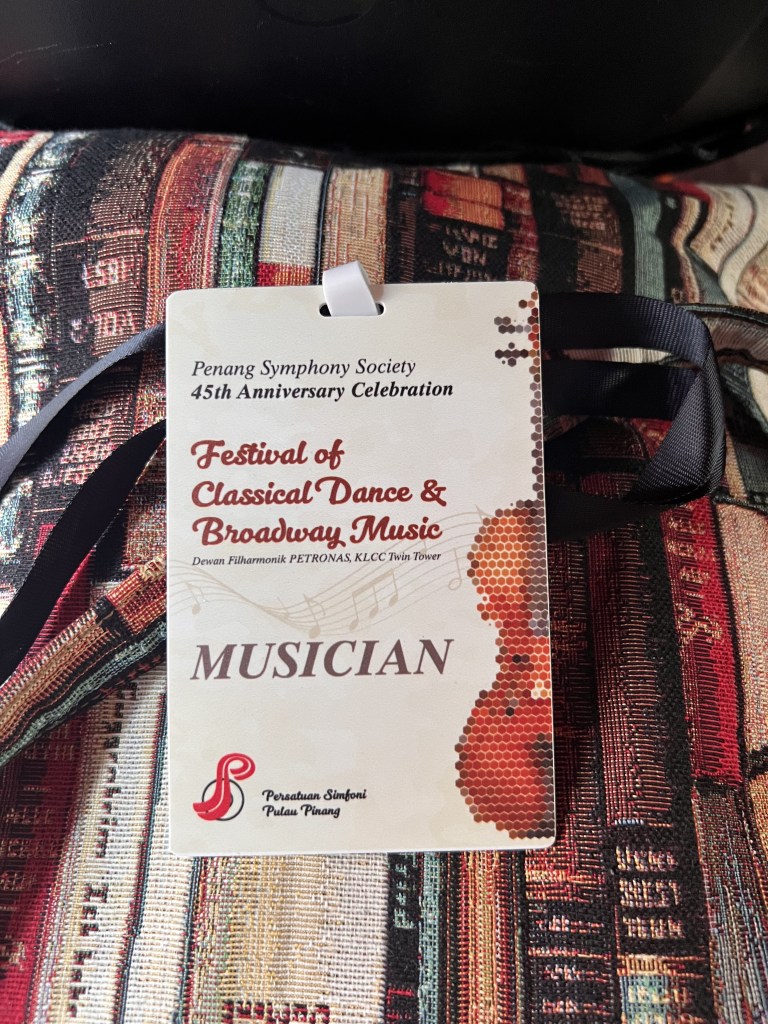
On the coach, we were handed a tag that we had to wear to access the DFP. In caps, was the word MUSICIAN. 

Wow. I am a musician! I stared at that word that was applicable to me and a nice warmth washed over me. Why did I not ask myself this very question carefully all those years ago – to be or not to be a musician? I like being a musician. I should have taken up Mr Woon’s advice and gone to Vienna!

A musician’s life is rather different, I find. They celebrate life much more wholesomely, infusing every shared moment with a spirit of camaraderie and creative vitality. I found I was being transformed into a happier, fun-loving, light-hearted bloke, almost a larrikin, I think. Nothing fazes me anymore in the company of other musicians. They are a genuinely happy bunch, possessing a deep emotional sensitivity that allows them to connect profoundly with their craft and one another, making them exceptionally responsive to subtle aesthetic features and artistic beauty. Musicians tend to celebrate life far more readily, turning even ordinary gatherings into memorable occasions. In Penang, surrounded by such warm and passionate colleagues, I was beginning to behave like one of them too. I was always ready to “let my hair down” and celebrate any moment that merited a hearty meal together, enjoying good conversation or partaking in fine wine late into the night (except I find very few Malaysians drink wine).

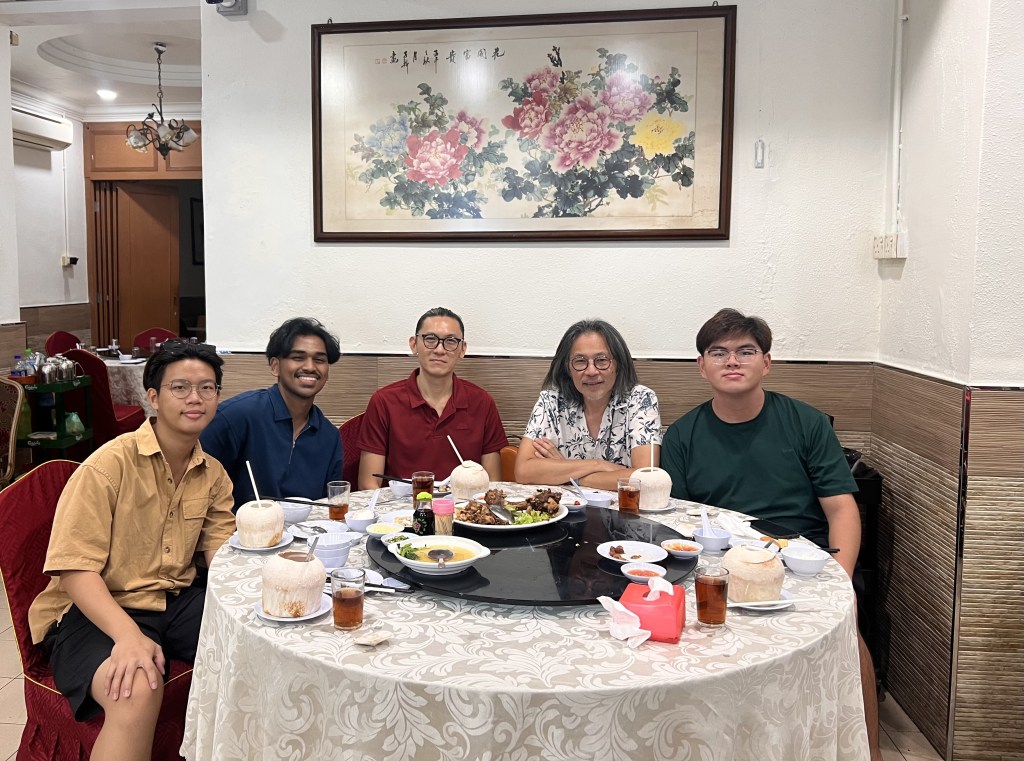
L to R: Yu Zhe (double bass), Saimon (cello), Chye Guan (Concertmaster), Old Man (violin), Wei Hong (clarinet).

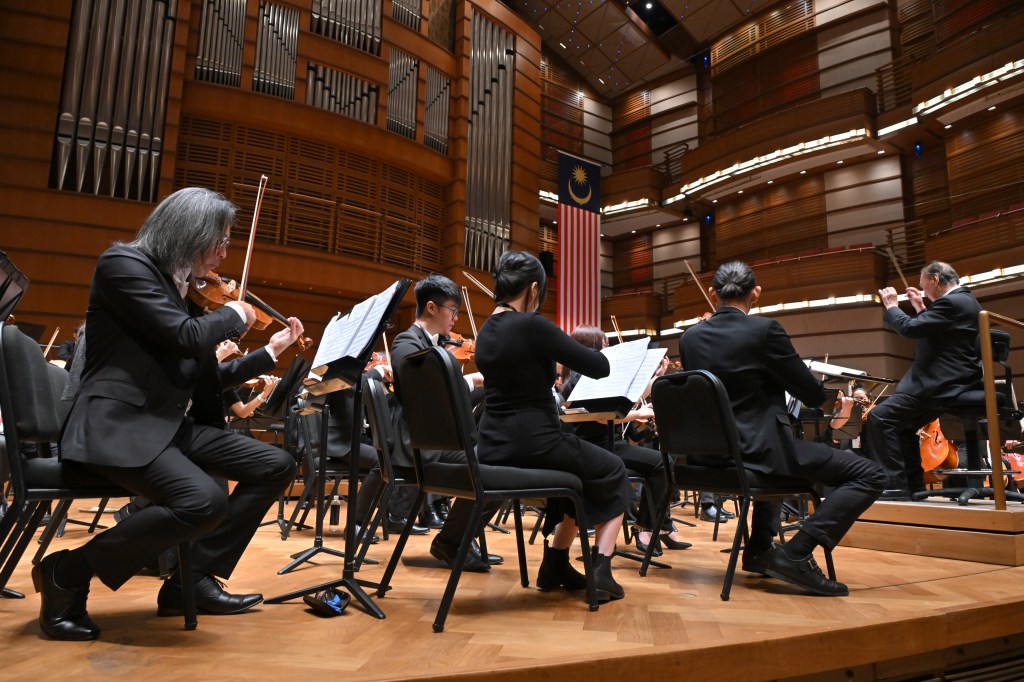
There was a palpable buzz in the bus as conversations hummed and anticipation grew. The DFP website had closed ticket sales for our concert! Could tickets be sold out?!! The thought was both exhilarating and scary! Suddenly, I felt a slight trepidation creeping in. I wasn’t prepared to be playing in such a grand, world-class venue – not after having stopped playing the violin for 49 long years and only picking it up again just 4 years ago. When Mr Woon invited me to return to the orchestra to help celebrate its 45th anniversary, I immediately said yes without hesitation. But, knowing my limitations, I asked to play in the Second Violins. He said the orchestra already had enough seconds and firmly insisted he wanted me to play in the First Violins instead. I agreed, but requested to be seated in the back row so that I would not injure a current player’s ego should I take over someone’s regular chair. The reason for that request was half true. The real, unvarnished truth was that I desperately wanted to remain unseen in the back, sheltered from the spotlight. Hidden yet heard. Instead, I later discovered to my quiet dismay that he had assigned me as the no. 5 player, seated on the right side of the third desk, fully exposed to the gaze of the entire audience. 

The number 5 player in the first violin section sits on the outside of the third desk. (Photo by Foo Jinn Seng)

My son in Singapore gave me a sweet surprise. He had previously mentioned that he would try to attend my concert, but he gave me no assurance that it was a certainty, as it would be very rushed for him to make it after having his own gig the night before. As I was walking into the KLCC for the very first time, his message suddenly arrived on my phone. 

It read, “I have landed in KL!” Instantly, the slight trepidation I had felt earlier began to grow rapidly. Deep down, I want my sons to be proud of me for accepting this assignment. Showing them photos of me during and after the performance would have been enough to impress them. The world-class venue as a prop would have lent me a lot of credence, and playing on such a stage is a kudos very few of my friends, if any, could ever hope to receive. But having an astute, sharp, experienced, and celebrated musician such as my own son sitting in the hall meant he would instantly see and hear every single one of my flaws.

GULP. The slight trepidation was no longer slight.

His aunty wrote, “After all the hard work and perseverance, you’re finally going to be on stage playing with the orchestra. Enjoy every moment—you’ve earned it. We are so happy for you!

Jia yu!”

His brother’s girlfriend also sent me good wishes, “Good luck! We hope you have an amazing time and enjoy every moment. We’re so proud of you and really wish we could be there with you today. Hopefully next time!”

Thanks, guys. What a rare moment for me to play on such a rarefied stage! This was well beyond my expectations and surely well beyond what I deserve! But I shall take it! I should remind myself I’m just an amateur and should not push myself beyond my abilities.

My Mrs reassured me with a gentle, grounding smile, I imagined across the seas. “Yes, just tell yourself you are just an amateur. Very amateur!” Her words were a necessary antidote to my spiraling nerves, a reminder to embrace the joy of the moment rather than the weight of expectation.

Over the years, my travels have taken me to the hallowed stages of the world’s most iconic music halls—from the intimate, wood-paneled warmth of Wigmore Hall and the historic grandeur of Carnegie Hall to the operatic splendour of La Scala and the acoustically brilliant auditoriums of the Adelaide Town Hall and the Esplanade and Victoria Concert Hall in Singapore. I’ve sat in the hushed, expectant silence of the Mariinsky Theatre and the storied halls of Prague’s Rudolfinum, absorbing the echoes of masters past. It’s a long list including Royal Albert Hall, Auditorium Parco della Musica Ennio Morricone, Teatro San Carlo, The Concertgebouw, Sydney Opera Hall and all other major concert halls in Australia. Yet, despite the prestige of these global temples of music, none could replicate the electric, singular thrill of performing on the stage at the Dewan Filharmonik Petronas in Kuala Lumpur. That stage wasn’t just wood and lights; it was a bridge back to a very old, albeit brief love for music-making, a homecoming of the soul. For that unforgettable privilege, I owe a debt of profound gratitude to Mr. Woon for extending the invitation to return. More deeply, I am humbled by the warmth of the Penang Symphony Orchestra, whose members—young, talented, and fiercely passionate—welcomed me not as an ageing visitor, but as one of their own, an integral part of their harmonic tapestry.

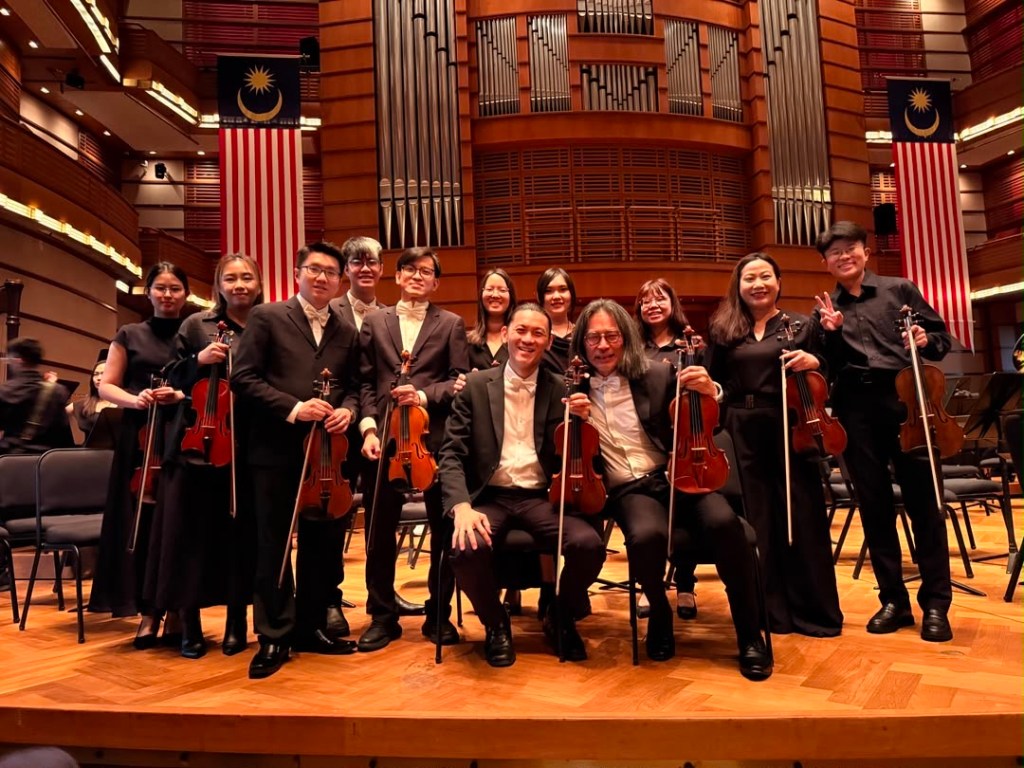
First Violins of the PSO at the DFP, 16 Aug 2026. PS. Comments about me requiring a cummerbund aren’t welcome! (Photo by Francis Koh)

Music keeps us young.

– Woon Wen Kin

Mr Woon, at the helm and I, in the First Violins. This reconnection, this reunion, brought me back to the distant past, over half a century ago. What a privilege. What an euphoric windfall! Thank you from the bottom of my heart, Mr Woon. (Photo by Foo Jinn Seng)

Rash About a Rash

Feeling not the least homesick twenty days into my Asian holiday, I’m on the plane from Chongqing to Guangzhou. Chengdu and Chongqing each have a population of about 30 million. I expected to be overwhelmed by a mountain of people and a sea of tourists (人山人海)yet it was surprisingly pleasant and orderly in both cities. China has amazingly modernised in leaps and bounds. Their great leap forward indeed has been realised in the four decades since Deng Xiaoping opened up China to become the factory of the world, so the technological advances today give us a glimpse of what the future for mankind will be. This rapid evolution is visible in every corner, from the seamless integration of digital payments to the high-speed rail networks, like the G8609 first-class service from Chengdu East to Shapingba, that link these sprawling megacities. The sheer scale of development is difficult to comprehend until you witness the efficiency with which these urban centers operate, balancing massive populations with a level of urban planning that makes many Western cities feel antiquated in comparison. This efficiency was evident throughout our mainland China itinerary, which included private chauffeur services and English-speaking guides facilitating our visits to landmarks like the Wuhou Temple and the Sanxingdui Museum.

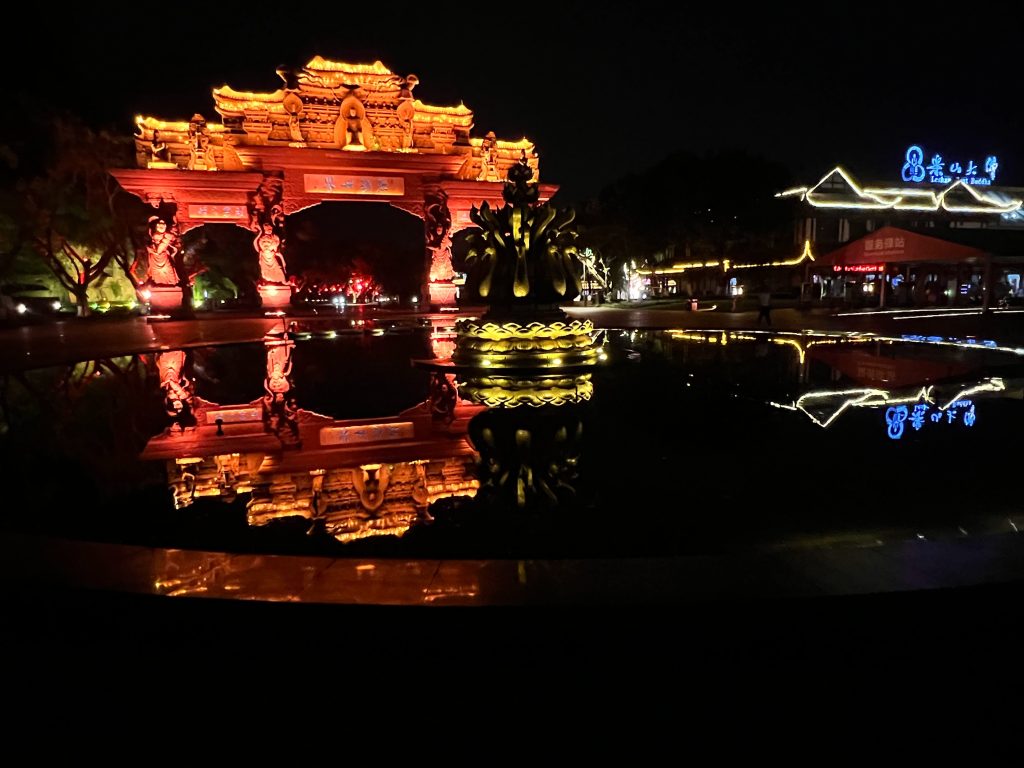
In Le Shan not far from the Giant Buddha, a place I would not mind to spend my retirement days.

So much has happened, the highlights in Taiwan are becoming blurred by the exciting revelations in Chengdu and Chongqing. Each new experience in the mainland seems to layer over the previous memories of Taipei, Taichung, and Kaohsiung. While Taiwan offers its own unique charm and cultural nuances, the sheer momentum of China’s “tier one” cities creates a sensory overload that demands one’s full attention. The contrast between the familiar, slightly worn aesthetic of Taipei and the neon-drenched, futuristic skylines of the mainland—exemplified by the 180° luxury river views from our hotel in Chongqing—is stark, making the trip feel like a journey through different eras of development simultaneously.

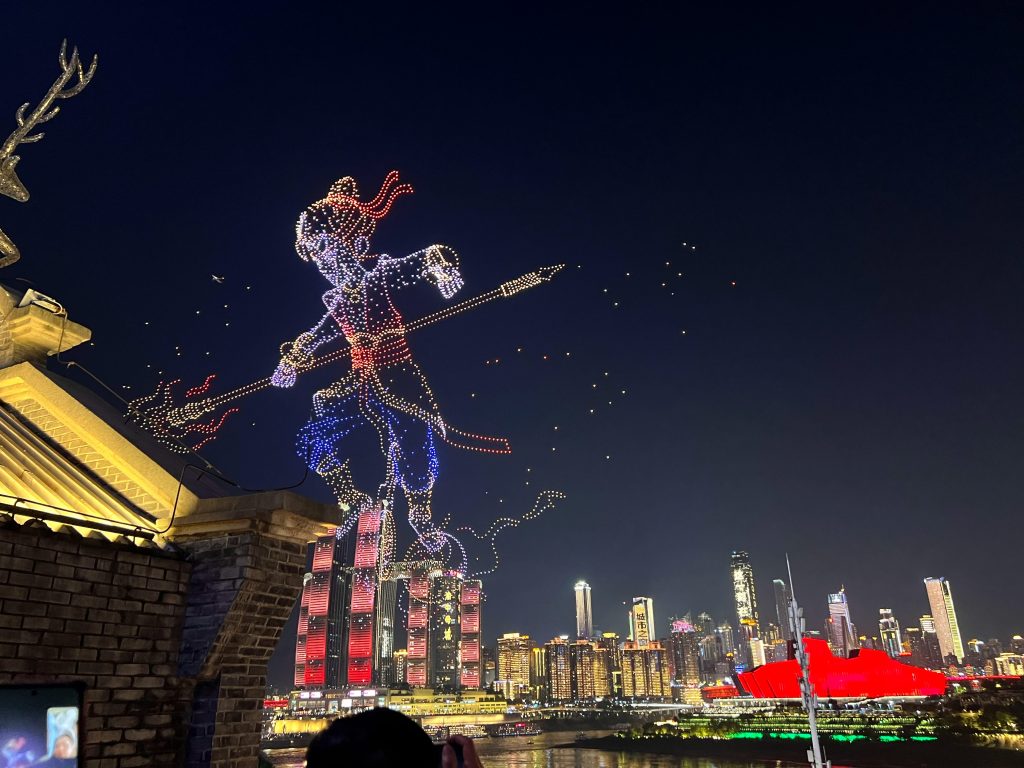
The reunification of Taiwan with the mainland felt like an inevitable conclusion of history. While some metrics suggest a GDP growth outstripping its giant neighbour, the visual reality is one of stagnation; there is a palpable lack of fresh architecture or infrastructure compared to my visit a decade prior. Conversely, Chengdu and Chongqing have morphed into living tableaus from Blade Runner. In these megacities, the future has arrived prematurely, manifested by a youth culture sporting bizarre attire, unconventional hairstyles, and cosmetic choices that render gender a mystery—unless, of course, they are draped in the traditional elegance of Hanfu. Our exploration of these futuristic centers included visits to the Li Ziba monorail platform, where the train famously passes through a building, and the stunning LED arrays at the Hongyadong Folk Customs Area.

In stark contrast, the architecture of Taipei remains trapped in a weary, monochromatic grey, appearing almost neglected against the gleaming, neon-drenched spires of the mainland’s tier-one urban centers. As twilight descends, these Chinese towers ignite with such a hypnotic array of LED brilliance that any concerns regarding energy consumption or environmental impact are swept into the shadows of irrelevance. This modern vibrancy extended to our travel experience, staying in 4-diamond properties like the RIGEL Deep Space Hotel in Chongqing, which provided a front-row seat to this technological spectacle that included a drone show.

The Mrs’ long-standing infatuation with Taiwan—cultivated, no doubt, by her obsession with local podcasters—was brutally dismantled on our very first morning in Taipei. The dissolution began mere minutes after exiting our hotel in search of caffeine, accompanied by two of our sons fresh from their concert performances. 

Our youngest had dispatched his brother to seek out the “preeminent barista in Taipei” while he and his uncle pursued fried onion pancakes. 

“The coffee alone justifies the journey,” he had claimed with the infectious enthusiasm of a coffee aficionado. This optimism would soon be tested by the stark reality of the service culture in Taipei, a sharp contrast to the upcoming guided experiences of our mainland tour.

When they eventually returned, clutching their freshly made breakfast with triumphant smiles and laughter, the atmosphere they encountered immediately signaled that something had gone terribly awry.

The coffee-seeking party stood empty-handed, their countenances a mixture of agitation and utter bewilderment.

“Where is our caffeine fix?” the younger son inquired, his brow furrowing.

“There shall be no coffee today!” his brother snapped back, his face flushed a deep crimson—not from the Scottish spirits he’d grown accustomed to in Glasgow, but from the raw heat of the fierce morning sun and that of the barista’s unprovoked hostility.

The Mrs eventually recounted the ordeal. Their party had ventured into a café situated directly opposite our lodging, the rather ostentatiously named Premier Metropolitan. The procurement process for caffeine was remarkably convoluted, requiring patrons to select ice cream paddle sticks emblazoned with specific coffee varieties and pair them with their respective cups.

Such an arduous undertaking seemed entirely excessive for the morning during which standing still in the shade would result in uncontrolled perspiration. The establishment’s inventory of paddle sticks was promptly exhausted, as the staff had failed to anticipate a sudden, collective demand for six simultaneous long blacks. 

“This is an absurd amount of labour merely to secure a cup of coffee!” the older son loudly complained to his aunt.

“Indeed, there aren’t enough sticks for our requirements!” she countered.

“Is a conventional ordering process simply out of the question?” he inquired, his logic as sound as his volume was elevated.

“But it yields a saving of five TWD!” the Mrs interjected with her customary pragmatism—a sum representing a grand total of approximately ninety Australian cents.

Ultimately, as they finally reached the head of the queue and his aunt prepared to present the hard-won paddle sticks, the elder son found himself enticed by the pastries shimmering within the glass display. 

“Pray, seokuku, might we add some Canelé to our order?” he requested, addressing her in their familiar Ningbo tongue, gesturing toward the confections with a meticulously French articulation—Khan-lei.

It was at this precise moment that the barista usurped the cashier’s position, interjecting with cold authority: “On this island, we converse exclusively in Mandarin”.

The elder son, his patience predictably piqued by such a dismissal, retorted with sharp finality, “In that event, you may simply strike my caffeine from our order”.

The barista, seemingly relishing the prospect of a linguistic skirmish, persisted in his aggressive posturing. 

“Be advised, I possess the sovereign right to deny service to any patron; therefore, deem your entire transaction nullified!” he proclaimed in Mandarin with unwavering resolve.

“Mercy! He has just explicitly cancelled our order!” the Mrs explained, her voice tinged with disbelief.

Reeling from this display of visceral animosity, the party retreated from the coffee shop, their dialogue a frantic attempt to decipher the bizarre sequence of events that had just unfolded.

“Good heavens! Such unmitigated rudeness is simply beyond belief!” his aunt exclaimed, her composure thoroughly rattled.

“What triggered such a response?” the elder son mused. “He is a veritable Coffee Nazi, just like Seinfeld’s Soup Nazi!”

Their collective indignation continued to simmer on the pavement until the barista, seemingly eager to extend his initial victory, charged toward them. 

“Ni you wenti ma?” he challenged, his voice dripping with malice. “Do you possess a grievance? Speak up!” he demanded, physically encroaching upon the elder son’s personal space.

“Be gone with you! We don’t want to talk to you!” the elder son retorted in English, his patience finally depleted.

The barista, evidently intent on orchestrating a public altercation, positioned himself aggressively in a posture of physical confrontation.

In an instinctive display of maternal protection, his aunt extended her arms, shielding her charges as if they were vulnerable chicks under threat.

“Leave us alone!” she commanded, shooing the man away with the same dismissive energy one might reserve for a persistent and loathsome pest.

“I remained absolutely quiet during the heated exchange,” the Mrs said, thwarting her habitual instinct to escalate matters whenever aggrieved. She knew any further spark would cause an explosion of sorts that morning.

Upon their eventual return to our hotel, as the harrowing narrative was recounted to me, the linguistic catalyst suddenly became luminously clear.

“He undoubtedly perceived your request for Canelé—that meticulously French ‘Kan-lei’—as a grievous personal insult,” I remarked.

“For the uninitiated,” I clarified, “it sounds not too dis-similar to  ‘Kan ne leh’ which is a common profane expletive in the Taiwanese dialect”.

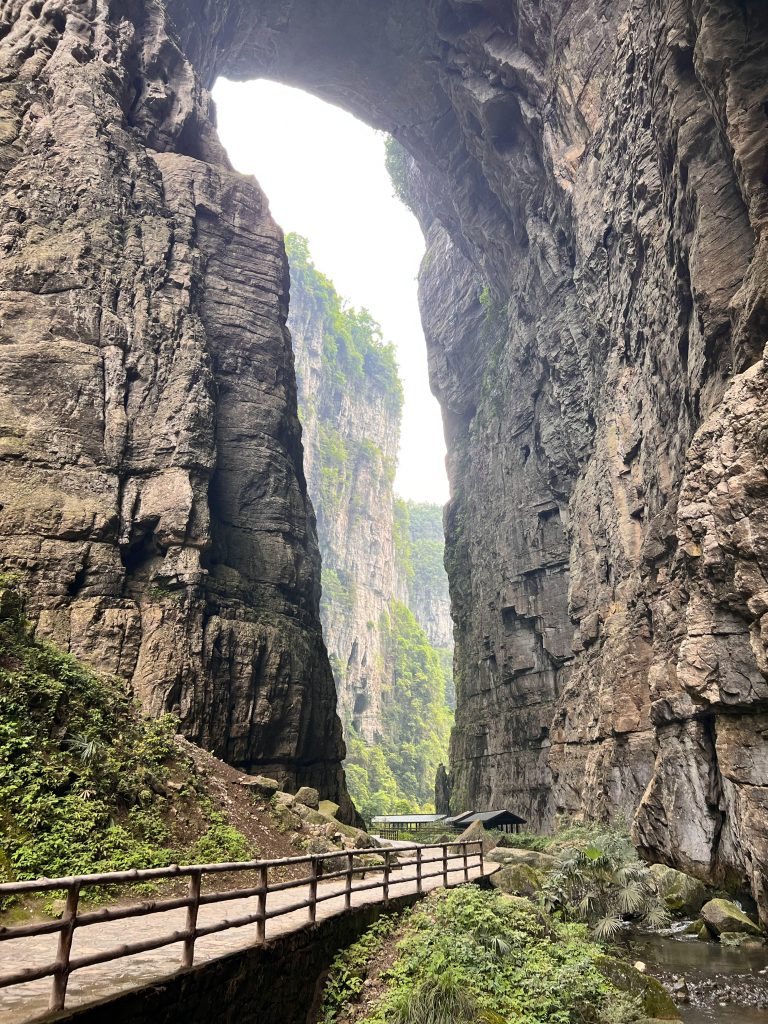
En route to Guangzhou, I found myself engaged in a relentless, involuntary battle with my own skin. The local mosquitoes at Fairy Mountain and the Wulong Caves had evidently marked me as their primary quarry, leaving behind a legacy of irritation. Despite the ethereal nomenclature, Fairy Mountain offered no mythical encounters; instead, I was met with a rather underwhelming mix of livestock—cows, horses, and even llamas—navigating a landscape liberally punctuated by animal excrement. My disappointment was obvious but only because such a pretty sight is rather common in Australia. Fortunately, other destinations proved more faithful to their titles. The Grand Buddha at Leshan was a truly majestic spectacle, a colossal figure hewn from the living rock during the Song Dynasty—an engineering feat of such antiquity that its execution without contemporary machinery remains a source of profound wonder. Similarly, the Three Bridges at Wulong offered a breathtaking display, not of timber and stone, but of natural limestone arches so cinematic in scale they served as the backdrop for Transformers 4 and Curse of the Golden Flower.

Can you see the “jumping fish” at the Qinglong Bridge?

The psychological burden of these bites only served to amplify their physical intensity, as my limbs erupted in a constellation of crimson welts. Coupled with a waistline that had expanded with reckless abandon due to a fortnight of gastronomic indulgence in Kuala Lumpur, Singapore, Taipei, Chengdu and Chongqing, I was fast approaching the silhouette of a common ogre. It was a humiliating irony; while I had sternly instructed Murray, my son’s canine companion to resist the urge to worry about its own ailments from an unknown food allergy, I possessed no such discipline when it came to my own miserable, soul-consuming itch.

The Mrs told me to apply Tiger Balm on the small reddish papules that littered my limbs. The memory of a previous reaction to Tiger Balm loomed large, that from applying it to an injury from a Covid shot —a revolting mass of blobs reminiscent of my boyhood pus-filled wounds and scabs that had once littered my limbs after typical childhood misadventures.

Anyway, what the Mrs proscribe, I must follow, for her word carries the weight of law in our household. So, in my desperate and literal rash to contain my physiological rash, I obediently applied the pungent red Tiger Balm all over my arms and legs. It briefly soothed my skin with its cooling menthol heat, but the reprieve was a cruel illusion; the itchiness soon returned with a terrifying vengeance.

For the following few nights, my sleep was entirely sacrificed to the urgent, primal need to scratch myself. At times, the scratching was so vigorous that I shook the entire bed with a continuous, rhythmic motion for long periods. Did the Mrs think I was doing something else to relieve myself in the dark? Undoubtedly! But I was merely relieving myself of the terrible, soul-consuming itch.

The end result was a disaster of dermatological and hotel housekeeping proportions: a bedsheet permanently stained with the rust-colored grease of red balm, and a left arm that has become distorted with alien circles of a scale-like layer, all surrounding a central, planet-like scab composed of dead cells.

It is a painful lesson learned far too late: never be rash about a rash.

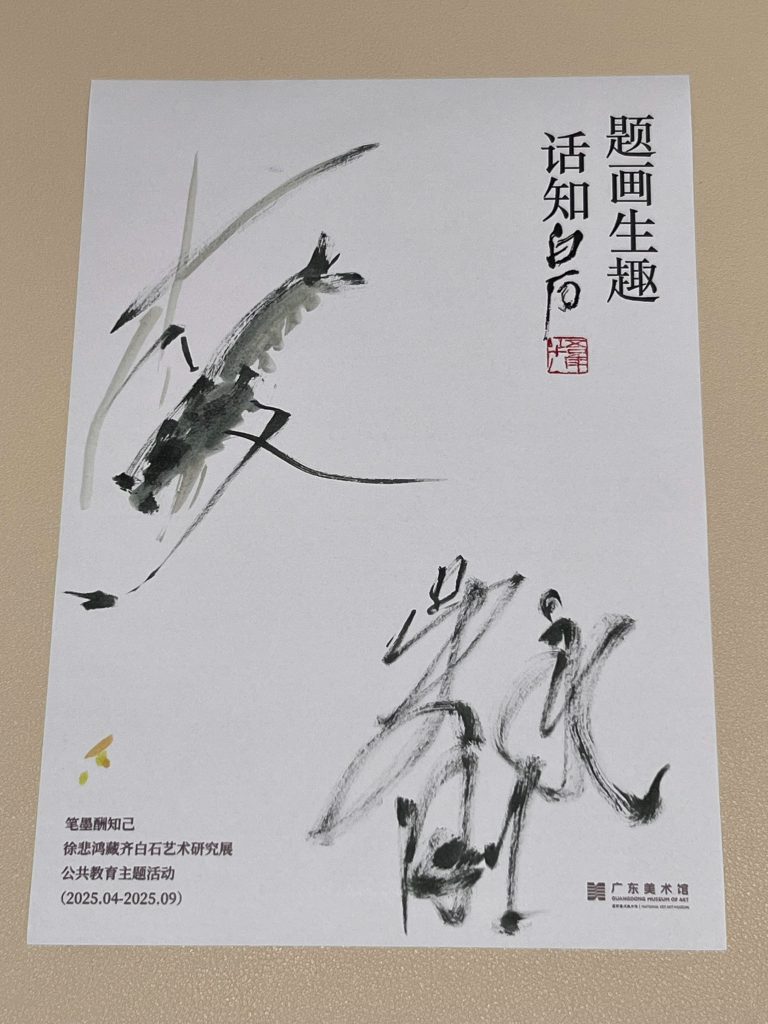
At the “Kindred Spirits: Selected Works of Qi Baishi from Xu Beihong’s Collection” held at Guangdong Museum of Art, I was given the opportunity to paint in the style of Qi Basishi. Not bad for a first-timer, right?

Sebby’s Birthday Saves the Day

The pale light of an early afternoon sun struggled to penetrate the pervasive gloom of this particular Sunday, a week removed from the solemn observance of Easter Sunday, the day Christians worldwide commemorate the ultimate sacrifice (albeit for a mere three days) and subsequent triumph of Jesus. Yet, as I contemplated the central tenet of the resurrection—the supposed restoration of faith and the promise of a renewed creation—I found my heart utterly unresponsive. The disillusionment that had been a silent companion for years showed no sign of lifting, much like the relentless march of time reflected in my own body. My receding hairline, a physical manifestation of my rapid ageing, only served to widen my forehead, an unwelcome emphasis on the years slipping by.

I find myself in complete agreement with my Mrs’ deep-seated aversion to the concept of rebirth. The very thought of enduring another arduous sojourn through the trials and tribulations of this life, once my current tenure is complete, is profoundly unappealing. Why would anyone willingly queue up for a second, or third, chance at existence after finally achieving the quietus of death? Death, to my mind, is the ultimate promise of eternal peace, a sanctuary finally free from the incessant suffering and the multitude of troubles—or “challenges,” as the modern parlance insists, in its desperate attempt to affix a positive spin to profound misery—that define the human condition. If, against all my wishes, I were somehow compelled to return, my ideal reincarnation would be utterly devoid of consciousness and responsibility: a simple pebble nestled in the cool, gentle embrace of a creek, lulled by the natural, uncorrupted symphony of birdsong, the croaking of frogs, the playful dance of koi fish and the steady rush of a waterfall. That, and only that, represents my vision of true serenity.

My thoughts often drift back to the departed. Just nine days ago, I marked the painful milestone of my mother’s fourth month since her departure from this world. And only two days prior, I performed the familiar ritual of lighting a joss stick for my father, who crossed over nineteen years ago. My biggest childhood fear, a haunting spectre in my young mind, was the prospect of becoming an orphan. It seems like a lifetime has passed since those days, yet in a strange, poignant way, so many elements of my life remain stubbornly fixed. The same faded family photograph, captured when I was a mere five-year-old, still holds its place on the living room wall. My parents’ wedding photo continues to preside over the half-moon table in the dining room. I hold onto their images in my memory, forever youthful in my mind, as if they were still vibrant in their 50s.

The very idea of being reborn into this current epoch is a source of genuine dread. Why choose to return to this new era of Artificial Intelligence, a time where the very foundations of reality are being eroded? We can no longer trust the authenticity of the photos and videos that flood our social media feeds. The relentless tide of misinformation, disinformation, blatant white lies from the White House, and sophisticated propaganda overwhelms our cognitive defences until the line between verifiable fact and manipulated fiction is rendered utterly indistinguishable. AI, the much-vaunted, technological marvel, ridiculously valued by Wall Street, now threatens the viability of virtually every profession. Even my niece, an incredibly successful oncologist, has been forced to concede that AI represents the undeniable future of the medical industry, poised to revolutionise and perhaps render obsolete many human roles. 

Who in their right mind would wish to inhabit a future world where the majority of the population is deemed economically redundant, where the primary purpose of life is reduced to mere survival on a universal basic income, or simply existing to fill the hours without any meaningful, productive goal? I suppose, for some, this bleak prospect might still seem a marginally better alternative than the crushing reality of the daily grind—what amounts to modern-day slavery: the relentless treadmill of slogging through years of school and college, only to end up working punishing 12-hour shifts in a workplace, yet still unable to afford the fundamental human dignity of owning one’s own home.

Furthermore, who would volunteer for rebirth into an era where fundamental freedoms and inalienable rights are increasingly and systematically trampled upon? The news from the UK today provides a stark example: in London’s historic Trafalgar Square, 523 individuals were arrested for the simple act of protesting against a horrific genocide currently being perpetrated in the Middle East. Among those detained were elderly citizens, physically carried away by police officers. Their sole crime? Holding placards that voiced opposition to the genocide and expressed solidarity with the oppressed Palestinians. 

The chilling precedent of financial censorship is equally alarming. Who would want to risk having their bank accounts and credit cards instantly frozen merely for holding a strong political conviction that runs counter to the prevailing narrative, as was the experience of Jacques Baud, a former colonel with the Swiss Federal Intelligence Service, following his vocal opposition to the Ukraine War?

The future promises an even more insidious form of control with the proliferation of central bank digital currencies and stable coins. Who would choose to be born into a world where a wrong political stance, an ill-considered tweet, participation in an unauthorised street protest, or even a simple proclivity for consuming steaks or taking air travel—activities potentially frowned upon by powerful climate change legislators—could result in the instantaneous freeze or seizure of all your digital money?

The timeless, chilling maxim of Henry Kissinger rings with particular prescience in this context: “Who controls the food supply controls the people; who controls the energy can control whole continents; who controls money can control the world.”

And finally, who would desire to live in a world where the very justice system appears compromised? A world where convicted child rapists, known paedophiles, sex traffickers, and alleged evil-doers involved in activities as depraved as cannibalism and child sacrifices seem to be protected by powerful lobbies and the justice department itself, resulting in millions of files incriminating them being heavily redacted or permanently kept under wraps, hidden from the public eye?

This dark introspection of mine was interrupted by a simple, unexpected lifeline. It was my old friend who also hails from Penang, Richard Koo, who inadvertently prompted me to break an almost three-month writing hiatus. He simply sent me a brief, unadorned text message:

“How have you been? Haven’t seen a blog from you for a long time.”

The quiet act of being held in someone’s thoughts is deeply soothing. The feeling of being remembered is equally pleasing. And to know that my sporadic attempts at honest reflection, my blogs, were actually missed by someone, is especially rewarding. So, thank you, Richard. Thank you for this small, crucial reminder that the world we inhabit is not an absolute monochrome of despair. Even amidst the overwhelming bad, there is always goodness; amidst the prevalence of evil, there remains kindness; and in the shared values of friendship, one can still find the green shoots of hope when the darkness of animosity and conflict seems utterly insurmountable.

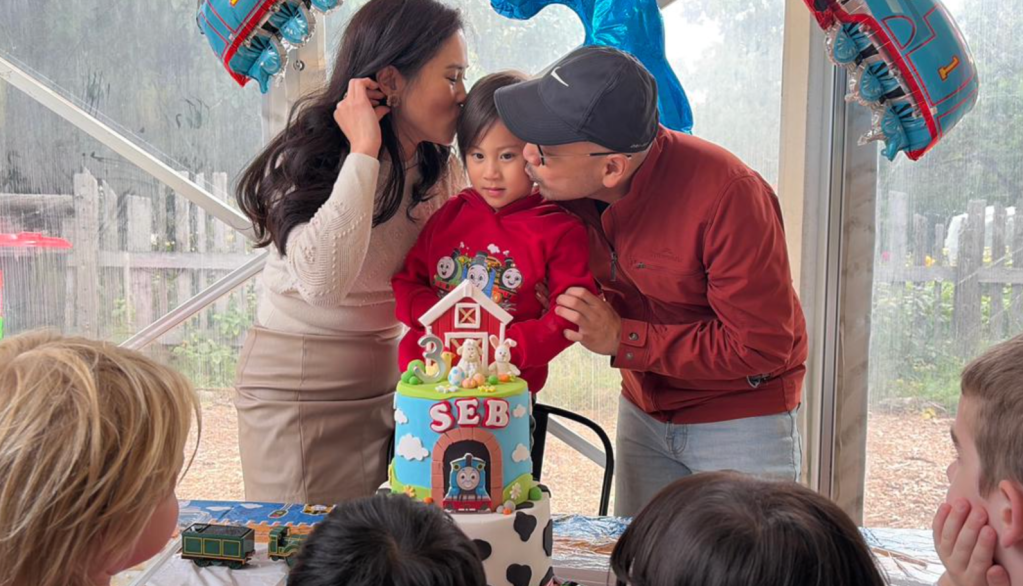
It was Sebby who saved my day, in the end. The gloom that had settled over me, a thick, suffocating blanket of creative despair, was unexpectedly lifted by a surge of pure, innocent joy from a three-year-old. Sebby, my grandnephew, had turned three yesterday, and the happy celebrations in an animal farm in Victoria arrived right on time this morning, finally cutting through the silence of my writer’s block with a digital cacophony.

I was hunched over my desk, the cursor blinking mockingly on the blank document, utterly consumed by an empty mind that felt like a permanent cement wall. My creative juices demanded something uplifting, an observation of human goodness, but my well of inspiration was dry. The world outside my French door seemed muted, and my internal monologue was a loop of cynical sighs. I had nothing to write about; nothing happy or inherently good seemed substantial enough to commit to words. A thick layer of self doubt had caked over my whole being.

Then, my phone which I had relegated to the periphery in my desperate attempt to produce a good blog, began to buzz. A healthy flow of photos and videos streamed in, chronicling every moment of Sebby’s third birthday party. I tried to ignore it, to force myself back to advance the blinking cursor on my screen, but curiosity, and my love for the little rascal, won out. I picked up the phone.

The screen filled with vibrant images: a ridiculously oversized cake decorated with his name and his favourite Thomas the Tank engine sitting on a base with a white and brown cow motif; missing were colourful birthday balloons that must have escaped the marquee, and a chaos of bright colours and tiny, excited faces. But it was the videos that truly broke the spell. I watched a clip of Sebby, crowned with long lightish brown hair freely blowing in the wind, receiving a lovely embrace from his parents. He looked up, not in confusion or demand, but with an expression of sheer, luminous bliss. it was as if a powerful current of energy passed from the screen to me. With a smile that reached all the way to the crinkles around his sparkling, laughter-filled eyes, he conveyed a powerful, silent message. It was a vision of a future not defined by the current anxieties or the creative drought I was experiencing, but one filled with simple, enduring hope and an abundance of joy and love.

The message was unmistakable, delivered through a burst of pure, innocent happiness: Everything will be alright. Sebby’s message wasn’t just a fleeting moment of distraction; it was a monumental shift in perspective. The heavy wall of the mental block crumbled. I put down my phone, straightened my keyboard, and finally, with a heart surprisingly lightened, began to type. The gloom had lifted, replaced by the unexpected but undeniable truth delivered by a three-year-old: joy persists, hope is eternal.

Happy Birthday, Sebby!

Let the Rest Do the Rest

A break in the emotional cloud that had enveloped my whole being came later that night when my son reached out from Scotland. I had just held the first New Year’s Eve party without my mother who passed away earlier that month. He sent a message that, despite its utter simplicity, resonated deeply with the fragile state of my soul and the turbulent mood of the world. He wished me a “good 2026.” The phrasing struck me with startling perspicuity; it felt appropriate, realistic, and profoundly correct in a way that conventional well-wishes never could. It wasn’t a superficial ‘happy new year,’ which felt laughably optimistic given the circumstances. It wasn’t an overly ambitious ‘prosperous one,’ suggesting material gains while the emotional ledger was deep in the red. Nor was it burdened with the hollow, inevitable broken promises of new year resolutions.

Just good.

Good, I realised with a sudden gratitude, was enough. Good, in fact, was perhaps the highest aspiration one could genuinely hold. Good was, arguably, even hard to achieve, given the escalating, visible fractures in the once-solid political bedrock of Europe and the strained, essential unity of NATO. The global landscape was a cauldron of relentless turmoil, driven primarily by the increasingly destabilising Trumpian edicts of “might is right”—a cold, brutish doctrine in which the concept of a traditional ally or perceived or manufactured foe is rendered utterly meaningless, of no consequence whatsoever to the wannabe dictator’s sweeping, aggressive land-grab hallucinations.

In this shifting, cynical environment, the West’s much-vaunted “rules-based order” had become an irrelevance, a casualty of its own hypocrisy. Its effective death occurred the moment the supposedly compliant vassal states—the smaller nations reliant on the framework—realised with chilling clarity that their own complicity in using this convenient slogan was backfiring spectacularly on them. The sickening, undeniable realisation dawned that it wouldn’t be just the traditional third-world countries subjected to modern-day colonisation or resource exploitation; they, the so-called loyal allies, too, would be strategically targeted, destabilised, or dismantled if they possessed any resource or geographical advantage of value that the declining hegemon desired. The rules, it turned out, only applied to those without the capacity to break them.

Amidst this gloomy contemplation of personal loss and international decay, the accompanying photograph he sent served as a calm, visceral anchor. It captured him raising his glass to me—a silent, digital toast—in front of the perfectly cooked plate of steak he had just prepared. The image, warm with domestic light and the simple effort of a son caring for his father, improved my mood instantly. It offered a simple, grounding counterpoint, a tangible reminder of caring and love that stood in defiant opposition to the cold, abstract anxieties of political collapse and the heavy, pervasive shroud of recent loss. The personal, I recognised, was a necessary outpost against the gathering, gloomy threats of the political world.

“Three minutes each side, right, and rest it for three minutes?” I asked, revealing the method I would have cooked the steak.

“One minute 20 secs, each side on hot pan, then under foil and cloth to rest,” he replied.

“Rest about eight to ten minutes,” he added.

“Let the rest do the rest,” he suggested.

I looked at his photograph again. His face reflected a deep calmness that soothed me. His countenance was a study in profound peace, a mirror of serenity that belied their recent sorrow. A calm reflection of enviable contentment radiated from him, an almost transcendent acceptance of the circular world, death follows life and then, rebirth. This tranquility was his silent, yet powerful, message to his father: a solemn assurance that the current of life would continue, and with it, a reminder for his father to rest his troubled mind and weary body.

Let the rest do the rest.

The arrival of 2026 was marked not by jubilant expectation, but by a quiet, profound acknowledgement that “good enough” would have to suffice, a concession made in the wake of a loss that had reshaped my new reality. My mother’s demise, occurring less than a month before the arbitrary turning of the calendar page, had cast a long, tender shadow over the new year.

The preceding weeks had already been a brutal initiation into a world without her physical presence, culminating in the first Christmas and the first New Year’s Eve—celebrations historically anchored by her warmth and energy—that now felt strangely hollowed out. Yet, these were only the beginning. The year ahead would stretch out, a series of painful yet necessary “firsts” waiting to be encountered, each a fresh reminder of her absence: the first Chinese New Year gathering, where her gentle smiles and laughter and delight to clink wine glasses would be sorely missed; the first Easter, stripped of the joy she brought to family gatherings; the first birthday celebrations, where her presence and unwavering attention would be a poignant gap; and, most heartbreakingly, the first Mother’s Day, now a commemoration of a life that was.

She was more than just a family member; she was the indisputable matriarch, the strong, unwavering pillar upon which generations had leaned. Her loss was not just personal grief, but the shattering of a lineage milestone—she was the first and, to this point, the only centenarian in our family, and now, a memory to a life lived fully, rich with experience, wisdom, and boundless love. Stepping into 2026 meant stepping into the immense space she had left behind, navigating the quiet echoes of her life could bring more bouts of emotional outpouring.

The outward expression of loss, the public mantle of mourning and death, was but the surface layer. Yet, beneath this visible grief, a deeper truth was struggling to be revealed. Like the technique of pentimento—where earlier images or brushstrokes, long painted over, begin to show through the succeeding layer of paint—so too did the faint, true picture of her great personal stories begin to emerge. The layer of recent sorrow was thin enough to allow the essential, underlying canvas to be seen: a life that was richly and deliberately painted with the indelible colours of motherly love and profound personal sacrifice. This was the enduring masterpiece, the genuine portrait of a mother’s love that time and death could not diminish. It was the legacy that persisted beyond the grave, offering comfort to the living and a final, peaceful farewell.

The sense of her enduring presence was recently heightened by a visit, a few nights ago, during the last half hour of her final day in this realm—the 49th day of her passing. Almost asleep, a sudden, unmistakable whiff of fragrance jolted me from my stupor – that of her favourite white flowers from our childhood home in Penang. This fragrance, similar to the orange jasmine here in Adelaide, typically blooms in spring or early summer, and a check the following morning confirmed the neighbour’s plants were not in bloom. Furthermore, the scent was definitively internal, as the Mrs insists on tightly shut windows to eliminate dust.

Let the rest do the rest. This simple phrase now carries a profound message, suggesting a necessary surrender to the natural process of grieving and healing.

Ahma, may you rest in eternal peace.

77 (七七, qi qi) equals 49

The silence of my home was a deafening counterpoint to the turmoil in my whole being when I finally returned, a long ten days after Ahma, my beloved mother, had passed. The guilt was a physical weight, pressing down with every step I took across the threshold of my house. How could I have chosen a four-week holiday, knowing with absolute, sickening certainty that the odds of seeing her alive again were heavily stacked against me? The logic I had employed before leaving, while seemingly sound and unequivocal, now felt like a desperate, flimsy shield. She was 102, a veteran of life but now a prisoner of severe dementia. Another stroke was a constant, looming threat, poised to further reduce her mental and physical faculties, or worse, another episode of end-of-life considerations was inevitable. Any of her aged organs could decide to simply shut down, or perhaps, the most heartbreaking thought, she might simply surrender her will to fight on and live. She had gone for ten days already, yet I had not seen her since that chilling day. How did she die? Did she have a peaceful death?

A frightening question haunted me: did my absence contribute to her giving up? Did she know I was missing from her routine? The answer, when it came through my brother’s retelling, was a thunderous confirmation that rocked my fragile sanity. Yes, she knew, I told myself.

I had departed on a Wednesday. That Saturday night, the very first shift I missed—my regular, sacred time to visit and feed her—she had rejected my brother, who had taken my place. “No same,” she had mumbled, refusing his care. Then, with a clarity that belied her condition, she had uttered the phrase, “mak deh wo” – no egg yolk. It was such a small, seemingly minor detail, yet the egg yolks were a simple pleasure she enjoyed tremendously, a treat I had never once failed to serve her during the last five months she lived, no, existed, in the nursing home after a stroke took away her ability to eat solid foods. Her comment was a direct acknowledgment of my absence, as if a sorrowful message that pierced the barrier of her dementia.

My house, a monument to my recent dereliction of duty, looked precisely as I had left it. It felt the same, too, imbued with the familiar chaos of my life. Untidy, messy, and the air hung stale and heavy, an expected consequence of having every window and door sealed for a long stretch. The stately Tasmanian oak dining table, a piece of furniture I cherished, was barely visible beneath a chaotic mess of newspapers and magazines, some unread, others half-finished, strewn haphazardly across its surface.

As I moved past the antique half-moon table, my eyes fell upon the framed black-and-white photograph of my father, resting just behind a simple copper incense holder. The image had faded somewhat—an unsurprising consequence, considering I had printed it eighteen years ago after his death so I could establish a place to pray to him. A cold, certain knot formed in my stomach: I knew, with the kind of knowledge that requires no thought, that I would soon have to print a similar photo for Ahma.

My immediate, non-emotional concern was for my chooks. Had they been fed adequately? Was their water supply fresh? Was their coop still the impregnable fortress it needed to be against the wily fox? Was the auto-door still functioning with reliable precision? The chore list was clear: roll up the blinds, unlock the rear sliding door, and go straight to the backyard to check on my feathered charges.

As I closed the sliding door behind me, my attention was snared by a strange, almost unsettling sight—an army of ants, unlike any I had encountered before, marching relentlessly upward. They followed the exact edge of the door frame, heading for a small, barely perceptible hole in the wall above. It wasn’t the mere presence of ants that was odd, but these ants. They were pale brown, almost translucent, and possessed a strangely clear hue. They moved with unsettling speed, yet their appearance suggested a morbid fragility, almost as if they were already dead. The sight conjured a brief, terrible memory of the ants that had hastened the death of one of my chooks some months prior, but these newcomers bore no resemblance to those aggressive, dark black attackers.

I finally reached the chicken run and was greeted by a joyful cacophony of rushing chooks. A genuine, small wave of relief washed over me. Phew, all good. All alive (a small victory that immediately triggered a fresh wave of grief for my mother, and I shed a few silent tears). After tossing them a handful of fresh veggies from the garden, I paused to confirm the auto-feeder was still stocked with plenty of seeds and grain. The garden looked wild and untended but at least it hadn’t died from the summer heat. My neighbourly duty then called me to the adjoining yard to check on their pond. The fish, looking noticeably leaner, rushed toward me, associating my presence with food. It was a comforting detail that they still recognized me—they had lost weight, but I, ironically, had put on an extra layer of fat around my waist. Ah, the sheer vicissitude of circumstances; gaining weight in the wrong parts of my body, I thought with a grimace, was the price one paid for a relaxing cruise to the Mediterranean.

The time was well past 8:30 that night. Yet, there would still be light for another good half-hour, a delightful feature of a summer evening in Adelaide. I walked back toward the house and was brought up short by the locked sliding door. Why? I asked myself in mounting frustration. I knocked loudly on the glass and called out to my wife, the “Mrs,” demanding an explanation.

“Why lock the door? You know I’m outside!” I scratched my greying hair, long but now so sparse the length made me look stupid.

She was preoccupied, busy unpacking the remnants of our trip from her travel bags piled in the middle of the dining room. Her response was a simple shrug of the shoulders—she couldn’t hear my words through the glass, but the frustrated, impatient expression plastered on my face clearly conveyed that I was locked out. With a sigh of her own, she removed the metal bar that had been securely wedged between the door and the wall—a simple, effective mechanism to prevent the door from being slid open. She then rolled up the blinds, unlocked the door, and, with an air of innocence, asked me why the door had been locked. I should have been asking her that question, but all I managed to say was that the door should not have been locked. I chose not to point out the blinds should have already been rolled up or that the metal bar should never have been wedged there in the first place, not after I had just opened the door.

Later, the Mrs headed upstairs to take her shower. In the blessed solitude of her absence, I lit a joss stick to pray to Ahma. I craved this time for solitary reflection, a moment to articulate my apology to my mother for not being present in her final days. As I was deep in prayer, a distinct sound reached me—the clear, unmistakable clink of a cup being placed onto the cold, granite countertop of the kitchen behind me.

I knew, with profound certainty, that it was my mother. The concept of 77 (七七, qi qi), the seven by seven, or 49 days, was true, I was sure of it. The Chinese believe in it deeply, and Buddhists especially follow this ritual of mourning for the deceased for 49 days. They hold the belief that the spirits of the deceased will linger in this realm we call our world for 49 days before finally departing. The sound of a cup was not scary; it was, rather, deeply reassuring. It was my mother, letting me know, in the simplest of ways, that she was still around.

“Ahma, I love you,” I prayed, pouring my heart into the words, hoping desperately that she would hear me.

That night, I sought refuge in sleep earlier than usual. As my head sank into the pillow, I couldn’t help but observe the unusual, intense darkness of the night. It wasn’t merely dark; it was a deep, pervasive, deathly kind of darkness. The timber wooden door, a piece of craftsmanship whose patterns and grain I often admired, was now a featureless black expanse, swallowed by the total absence of light. The Mrs, also noticed the strange, unusual darkness. She got up and checked to see if the street lights outside had failed. No, she could clearly see they were on, their white light twinkling faintly through the leaves of the plum tree in our front yard. The stars in the sky were also brightly twinkling around a silvery gibbous moon. Yet, despite these external light sources, not a single ray managed to penetrate the window pane. The bedroom was enveloped in complete, suffocating darkness, and the accompanying silence was truly weird. No insects singing their nocturnal chorus, no frogs mating in the nearby pond, no sign of the gully winds rustling through the trees, and no sounds of dry leaves sweeping the road.

“Ahma, I love you,” I prayed again into the void, a desperate whisper, hoping she would hear me. The nights since have been dark. A weird darkness.

The following morning, I got downstairs as soon as I woke up. I did not forget the deathly-looking ants and so, armed with a full can of Raid Max Ant Killer, I went outside to kill them. To my shock, there was no trace of them! They either knew I was going to destroy them and fled or they never really existed. Unless… Ahma got rid of them for me.

I’m glad Ahma died in her sleep, a peaceful end to her suffering. Her face had a radiant glow, according to a sibling who was first to arrive at the nursing home.

Goodbye is the Hardest Word

Ahma lived to 102. I had written many stories about her, a sixty-five minute read actually. But, I was asked to be brief, to distill a century into a mere five minutes. So, Ahma, forgive me for being brief.

Ahma’s name is Xu Mei Lan anglicised as Chee Moay Lan. Each character is a mirror reflecting her soul. Xu means slowly and gently, like the flow of a stream. Mei is the plum flower and Lan is grace and elegance. Anyone who knew her will know how perfectly her name described her life.
She did not take our father’s surname, out of filial piety, to her own family—a Confucian tradition she carried with quiet dignity. To many, she was Mrs Chee. To us, she was simply Ahma.

She married Ahpa at seventeen, in 1940. She was beautiful—porcelain skin, swan-like poise—always elegant in her cheongsam, even though her roots were humble. She was not born in Shanghai or Ningbo, as many assumed, but on a rubber plantation in Bagan Datoh, where her father worked as a dhobi man. Refinement, for Ahma, was not cultivated. It was innate.


She survived war, poverty, displacement, and loss. These shaped her lifelong frugality. I remember following her to the wet market as a child, where she would haggle fiercely over the smallest denomination—a single cent. Vendors would visibly brace themselves when they saw her coming. With eight children, one apple was sliced into eight equal pieces—and if one slice was thicker, a sliver would be cut off to restore fairness.

Yet this same woman sent all her children overseas for education—sometimes against her husband’s wishes. In the years after World War II, this was extraordinary. She believed education was the only way out of poverty, and she made it happen for her children.

Ahma had little formal schooling—only eight months in Malaya and two years in Ningbo—but she possessed a formidable mind. Her memory was astonishing. She remembered birthdays, anniversaries, grocery prices, historical events such as dates when her children first left home and when they returned, and the weather. Long before weather apps, she was our weather girl. Her memory was precise, immutable—like a blockchain ledger that never lost a record.

Ahma was the eldest child in her family. She had hoped to be a teacher. At the time, anyone with five years of education could become a teacher; she was halfway to reaching her ambition. But, all hopes of that died with Ngagung, her dad. In February 1936, Ngagung contracted Typhoid and passed away. In those days, when the sole provider of a family dies, usually hope dies too for those left behind. She was only thirteen years old.

She was meticulous, a perfectionist, right to the end. Earlier this year, I watched her cut a piece of cold toast into six perfect squares, carefully brushing crumbs aside before taking a bite. Her mantra was balance: not too hot, not too cold, not too fast, and certainly, never wasteful.
“Ok, ma, let’s go. Slowly and carefully,” I said to her as she rearranged the crumbs on her plate, she replied simply, “I can only be slow.” Perhaps that slowness was her secret to living to a hundred and two—with hardly any medication at all.

She endured unimaginable, silent grief. In 1948, she suffered a miscarriage at six months. In 1949, she miscarried twice more and lost a newborn son who survived just long enough to offer his parents a smile. In her mind, they were always part of the family. She remembered them on every anniversary, faithfully, quietly.

Her greatest joy in life was her eight children, seventeen grandchildren, and twelve great-grandchildren. Any gathering brought her immense happiness. She loved parties and the clinking of wine glasses, which was why we regularly took her to her favourite restaurant, The Empress, almost every weekend. At 99, she outlasted many of us at a New Year’s Eve celebration and did not want to leave well after midnight.

Ahpa and Ahma were married for sixty seven years until his death in 2007. He affectionately called her his “lor tha bo,” his “old woman,” with a chuckle. Surprisingly, theirs was not a match-made alliance. She chose Ahpa—a lanky, handsome man with a dry-cleaning shop two doors down from her uncle’s dhobi shop.The other candidate was from Fujian, a rice farmer with ten acres of land. Asked why she picked Ahpa, she replied,  “I saw myself slaving away in the rice field, rain or shine. Hard life.”
“The other was tall and handsome. Fair-skinned. Ambitious. Skilled in a good trade.”

She avoided the Japanese attack on China just before WW2 but was caught in the terror when they bombed Penang. My generation, which has never experienced war firsthand, is ignorant of the sheer tenacity required to survive years of hunger and hardship. Ahpa survived twelve brutal days in a Japanese jail; Ma endured those days alone, with great anxiety, fear and vulnerability yet, with mental resilience and maintained a low profile and composure in public.

The habits of survival die hard. Right up until her final days before moving into the nursing home, Ahma would enthusiastically “clean” her dinner plate at the dining table. Due to the length of time she needed to consume a meal, the minutest crumbs and dried-up sauce would often coat her plate. Every speck would be lifted by a small amount of water or soup, before being scooped up gently with a spoon. Every drop was consumed purposefully. She was fundamentally incapable of being wasteful—a thriftiness none of us truly understood, because none of us had lived through the war that forged it.

She lasted almost seven months in the nursing home, bed-bound with no hope of a miraculous recovery. Her question to me, posed in her native Ningbo dialect, “Yu so beh fa?” – is there any other option? – revealed a poignant awareness, a flicker of understanding regarding her circumstances, despite the severe dementia she was suffering from. In that question was awareness, acceptance, and grace. I told her she was loved, that she was cared for, that her children loved her very much. I held her hand—the same hand that had fed us, clothed us, protected us—and I whispered, “Goodnight, Ahma.” I could not bring myself to say goodbye on my last visit just before my trip to Europe.

While wandering along the side streets of La Rambla in Barcelona, I paused to read the words on my phone. I shouted to my sister who was meters in front, “Sufong, Ahma just passed away!”

Death is not the end; it is a quiet transition into another world – like sunset giving way to night. Some of us hold the deep conviction that we will be reunited with Ahma and Ahpa one day. There is dignity, serenity and love, not sadness or despair.

Ahma did not seek greatness, yet she embodied it. She did not lead nations or make scientific discoveries, but she raised generations through sheer sacrifice, unwavering fairness, incredible resilience, and unconditional love. To me, she was the greatest mother anyone could have.
And though her life here has ended, the legacy she bestowed upon us will never be diminished.

Gluck’s The Dance of the Blessed Spirits, the flute piece which was played earlier, was about peace, purity and release. Serenity, actually. It evokes a mother’s gentleness – care, tenderness, and watchfulness.

Later, you will hear Strauss’s Im Abendrot. As the poet writes, after a long journey, one may finally rest and ask, not in fear but in peace, “Is this perhaps death?” I think it aligns with my closing thought that death is a transition, not an end.

Strauss asks, “Is this death?”

Gluck answers, “This is peace.”

Ahma, as you go beyond mountains and rivers, may you rest in peace.

Alak ho chong ai nong.


Providence in Aix-en Provence

The journey from Toulon to Aix-en-Provence was immediately defined by an atmosphere of inescapable confinement and auditory discomfort, a stark contrast to the promised idyllic escape. On the crowded bus, the old man, a keen participant in the excursion, found himself a captive audience to a cacophony of bodily noises. It is not considered impolite in many social settings to excuse oneself from a room or a dinner table when plagued by proximity to aggressive sneezing or coughing. Yet, on this moving coach, escape was an impossibility.

The initial discomfort came from the back of the bus—the loud, rhythmic snoring of an old bloke that began almost as soon as the journey commenced. This noise was, perhaps, less surprising than the absence of the advertised scenery. The brochure had painted a compelling picture of a “verdant patchwork of meadows filled with countryside flowers and bucolic valleys of noble heritage.” From the perspective of a bus hurtling along a freeway, however, the landscape remained stubbornly mundane.

This general hum of annoyance was soon intensified by the sounds of illness and poor manners. Coughing, initially a distant, manageable sound from the front and rear, became acutely personal when a man in a dirty red jacket took a seat just two seats to the old man’s right and joined the chorus. As if this respiratory distress were not worrying enough, the lady directly in front of him began to emit startlingly loud burping noises. These were not discreet, sharp sounds, but “ginormous and long noises,” emanating from a woman who, with her elegant appearance, seemed beautiful and sophisticated. Her dignity, however, was rapidly eroded as her involuntary expulsions were exacerbated by the gentle sway and gyrations of the moving bus. She was prone to seasickness on the boat but this was such a gentle bus ride by comparison! The sounds were as uncouth and jarring as the “uncontrolled farts” that two elderly passengers had released earlier during the effort of heaving themselves up the steps to board the vehicle.

The general unpleasantness of the journey was, in a sense, a microcosm of the entire trip’s frustration. Such annoyances, the old man reasoned, were often to be expected when travelling with a large group of elderly folks on a Mediterranean cruise ship’s shore excursion. But the trip itself, advertised as a five-hour opportunity to explore Aix-en-Provence, felt like a calculated deception—a “real con.”

The old man’s participation was entirely an impulse decision, ignited by the practicality of economics. He had initially intended to hire a private taxi, but when his fellow travellers decided not to join him and only informed him of their decision during breakfast, the cost became prohibitive. The cruise excursion was his only alternative and he had only twenty minutes to find the booking office and pay for the ticket, if indeed there were any tickets left for sale. The leaflet that lured him focused heavily on one major attraction: the promise of ample personal time for tourists to “retrace the steps of Cezanne by visiting his studio, where he painted some of his largest and most ambitious works including The Woman with the Coffee Pot.” Feeling abandoned, the rest of his companions bar one followed suit, everyone of them cursing under their breath for the abrupt way he left their breakfast table without as much as an explanation or convincing them to join him on the excursion.

The five-hour excursion was, inexplicably, immediately cut by 30 minutes, likely under the pretense of ensuring all passengers returned in time for the boat’s evening departure. With 90 minutes dedicated to the outward journey to Aix-en-Provence and another 90 minutes for the return, this left the tourists with a meagre 90 minutes of free time to wander the historical town, founded by the Romans in 122 BC.

As the group was being guided through the “labyrinth, stone-paved streets” of Aix-en-Provence’s beguiling Old Quarter, the old man finally voiced his specific reason for being there, asking the guide where Cezanne’s studio was located.

“Ah, that’s easeely an howeur’s walk away, hoh!” she replied, her words heavy with a thick French accent, confirming his rising suspicion.

The old man silently swallowed his profound disappointment. There was no point in drawing attention to being swindled. It was better, he thought, not to let the world know he had been scammed.

In truth, his mind had already travelled far beyond the fraudulent Cezanne tour. Less than half an hour after leaving Toulon, he and his sister, who was travelling with him, had received an urgent text message from a sibling back home, informing them of a sudden and severe decline in their mother’s condition.

The news was a profound shock, knocking the breath from him and causing him to curse his decision not to cancel the entire cruise holiday a fortnight earlier. The trip up to this point had been almost preternaturally perfect. It was the final leg of their cruise holiday before their ultimate destination, Barcelona, and they had experienced the best of everything they could have hoped for: perfect weather, no squalls, no miserable fights among themselves, intense mahjong games, wonderful food, and genuine laughter. In fact, the old man had experienced an unusual level of attention, which now, in retrospect, seemed ominous. Strangers compared him to John Wick; a couple from Hong Kong, Bernard and Joanna called him “Yao Yeng Si”—a Cantonese term they translated for him as “cool dude.” Bernard later called him “Keanu,” a nickname he had heard before in Istanbul. An old lady admired his glasses, another loved his old tee shirt, and many complimented his jacket. Many smiled or waved to him as they passed him on the boat or on land. Some even acknowledged his presence with a nod. The perfection, he realized, had been “too good to be true.” He morbidly concluded that these seemingly random, positive interactions had been a kind of gentle preparation for the terrible news he was about to fully absorb in Aix-en-Provence.

The details of the message were agonisingly clinical and raw:

“Her breathing is very laboured and she’s heaving very hard during the few seconds that she’s conscious and when she’s unconscious she doesn’t appear to be breathing at all. When she’s awake, her face is very contorted, she’s digging her nails into my hand or she will pull at the bedcovers or she will scratch at her head. And then her face becomes relaxed again briefly before she loses consciousness again. It’s quite distressing to watch, so I won’t send you any videos. I think it’s time to give her the morphine. She really is not getting anything out of this existence, whether or not she’s in pain. I don’t want her to suffer anymore.”

The family had already made the heartbreaking, collective decision to consent to initiate her “end of life” pathway.

The old man wrote back, each word a physical burden on his mind: “Thank you for your observations. I agree with you. It’s now suffering without any hope. It may be just a matter of hours before she won’t regain consciousness. Play soothing music for her please. Barriere’s Adagio for two cellos, was what I played for Ahpa [our father].

Not long after, a nurse from the nursing home attempted to call him. Due to the bus’s poor internet connection, he missed the call, and in a state of growing panic, he frantically asked his older brother to ascertain if it was an emergency. All the while, the bus was passing the long, dramatic stretch of limestone hills in the distance. Cezanne was entirely forgotten; his mother’s comfort and well-being were the only matters occupying his mind.

He and his younger sister were still on the bus as it meandered toward the town centre when their phones rang simultaneously. His sister managed to ask their siblings to call back in a few minutes when they could step away from the other passengers and have a private conversation.

When he finally had a chance to speak to his mother, he found himself incapable of speech. She had briefly regained consciousness, but all he could manage to utter was his name and “Ahma, it’s me,” before the sudden, crushing weight of grief constricted his throat, reducing him to an emotional mess. He felt a big heavy stone in his throat.

He used the time his younger sister spent speaking to their mother to collect himself. He was now certain his mother could only hold on for a few hours more. He had to speak or risk the eternal regret of having been unable to find his voice to say his final goodbye.

“Ma, we are all ok and will look after ourselves well; It’s time to be calm and peaceful and know that Pa will be waiting for you. Go in peace, know that we all love you and that we are all safe and well,” he said, forcing the words out, gulping down his tears, and holding his voice steady and clear.

Immediately after, he walked quickly away, seeking solitude to allow the tears to fall. In Aix-en-Provence, the place of the artistic scam, he searched for a deeper providence for his mother, deeply certain she would not wait for them to return home to Adelaide. Later, on the bus ride back to Toulon, a realization settled over him: his mother had already found providence for a very long time. The loving and tender, benevolent care that he and his siblings had given her for most of her life had to be a profound gift from a great power.

Less than 24 hours later, the old man was wandering along the side streets off La Rambla in Barcelona. After a light lunch of tapas and Sangria, he paused, reading the words that appeared on his phone. A deep, raw shock came over him before he finally shouted, his voice cracking with finality, to his sister, who was some seven meters ahead with the rest of their companions, “Hey sis, Ahma just passed away!”

They had, just moments earlier during lunch, raised their glasses and made a toast to the grand old dame, entirely unaware that she had passed away approximately half an hour earlier.

Rest in Peace, Ahma. 3 Sep 1923 – 3 Dec 2025

The Sommelier From Somalia

The old man, caught in the agonising vice of filial piety for his dying mother and the tender duty owed to his long-suffering wife, wrestled desperately with an impossible decision. To embark on the planned Mediterranean cruise, or to stay. To go or not to go, that was the question that tormented him. He had over half a year of lead time, but as the months bled into weeks, the remaining days accelerated, collapsing upon themselves with inexorable speed. His windows of opportunity to cancel the trip and secure a refund or credit vanished entirely. Ultimately, it was his own paralysing indecision that made the choice for him. With a finality that brooked no debate, he resolved to go on the cruise with his Mrs., left only with the fervent hope and silent prayer that his mother would not pass away during his absence.

Their journey began not in Europe, but in Kuala Lumpur. This stopover was intended as a taste of all things Malaysian before the three-week European holiday commenced. The sojourn in KL offered him jarring glimpses of how much he, and indeed everyone in his orbit, had aged since his last visit to Malaysia two years prior. It was here, during dinner, that his sister-in-law, Eva, recounted her recent, mortifying tale of mistaken affection in Miri. While admiring oil paintings in a hotel lobby, she had reached for the hand of a man she presumed to be James, her husband, holding it sweetly and romantically for several minutes. She was on the verge of whispering loving words into his ear when a sudden recognition—the man’s body scent was utterly foreign—jolted her. She recoiled instantly, freeing her hand and desperately attempting to mask the faux pas, despite the man’s handsome and elegant appearance.

The aging process continued to manifest its toll on their attention to detail and spatial awareness later that same evening at a charming Nyonya restaurant. After their meal, James, ever the adept and dapper hero to his wife, confidently strode across the street toward his car, a white Volvo XC60. He instructed the group to wait safely under the restaurant’s alcove, protecting Eva from the few sprinkling raindrops. The others could only watch as James light-footedly, almost quick-footedly, walked further down the street after failing to unlock the car door he had approached. Their attention was then abruptly drawn by the loud, blaring horn of a car about three or four yards away from him. James, in his panic, had accidentally triggered the panic button on his remote. To Eva’s utter surprise, James managed to open that car’s door—another white Volvo XC60—and jumped inside just as the horn ceased its deafening protest. The three witnesses under the alcove erupted in silent laughter, yet agreed immediately to feign ignorance of his comical mistake. A white Volvo, they tacitly agreed, did not automatically confer ownership, even if one’s own car was also a white Volvo. The suave and seemingly unflustered James cranked up the Volvo’s engine and smoothly revved away with his three passengers, without further comment.

The next morning, their holiday group was completed by the arrival of two additional travellers, Sue and Chris. All were sexagenarians, but the sight of them dragging heavy baggage and cabin bags through KLIA was anything but “sexy.” They looked grey and burdened. The exception was the old man, who maintained an upright, tall, and lithe figure. He carried a 10kg Osprey green backpack and used an old Laucke bread mix bag as his cabin luggage. His fellow travellers offered him a torrent of unsolicited advice, though he couldn’t discern if it was borne of genuine concern for his well-being or simple badgering for his unconventional choice of luggage.

“You’re gonna compress your discs,” warned one.

“Watch out, your 3rd and 4th vertebrae will be damaged,” cautioned another.

“Oh dear, aren’t you worried about straining your neck? Look, you’ll end up with a bad posture,” chimed in a third member of the group.

By the time they boarded the plane, the accumulated stress of travel—checking in bags, navigating customs, scanning luggage with the frustrating inconsistency of requiring electronic devices out or allowing them to remain, removing watches, phones, belts, and sometimes shoes (releasing the resultant odors of dirty socks), enduring long waits, and searching for the correct gate—had utterly exhausted them. They looked dishevelled the old man’s Mrs especially was dragging her feet heavily as if desperately needing her usual afternoon nap.

As they stepped onto the aircraft bound for Doha, en route to Istanbul, the PA system announced that a watch had been found on one of the conveyor belts. The old man glanced at his naked wrist and quickly raised his hand for attention, his crooked yellow teeth exposed in a frantic yelp.

“S’cuse me, that would be my watch,” he declared.

As a flight attendant began the difficult walk towards him, sidestepping other passengers, the old man absentmindedly checked his Laucke flour bag. His eyes widened in a moment of recognition.

“Ooops, sorry. I have my watch here,” the old man mumbled, suddenly looking far older than the 67 years he thought his long hair helped to conceal.

Their itinerary for Istanbul was packed, a must-do list that included the Hagia Sofia and the Blue Mosque. Once one sees the famous duo, the subtle differences between them can quickly blur into confusion. The Topkapi Palace, however, was not to be missed, offering a rather interesting insight into the life of the Ottoman sultans—a world administered by hundreds of eunuchs and entertained by an equally large number of female slaves and concubines in the harem. They learned the fascinating history of Mehmed II, who defeated the Romans and ended the Byzantine Empire by a brilliant, audacious manoeuver: lifting some 70 of his ships over land into the Golden Horn, a major waterway, thereby bypassing a massive defensive chain over the water and bombarding the city from inland with cannons mounted on board their ships. The Spice Bazaar proved to be rather boring unless one had a passion for spices, but the Grand Bazaar offered a stark lesson in local economics, demonstrating that the inhabitants’ deep love for gold was a pragmatic safe store of wealth to escape the country’s debilitatingly high inflation rate of 33% per annum.

At Istanbul’s Spice Bazaar

During a ferry ride towards the Black Sea, Chris and Sue suggested Bebek to be a worthwhile stop, and the old man, expressing concern about getting “too perilously close to Ukraine,” agreed to disembark there. Bebek, a wealthy suburb, was characterised by roads congested with Mercedes-Benz and BMWs, offering a glimpse into the lifestyle of the upper crust—a society that was fundamentally distinct from the downtown Istanbul traders who had to constantly hassle and hustle for business. In nearby Kadikoy, the old man knew exactly what he wanted to do: symbolically kick the bronze posterior of the famous bull statue, which had failed to deliver the bullish rise in Bitcoin in November, as had been confidently predicted (or promised) by various self-proclaimed Bitcoin sages.

Dinner that evening was at a roof-top restaurant in Fatih. The excuse for the exorbitant evening was to celebrate Eva’s birthday although the actual date had since passed a fortnight.

Happy birthday, Eva!

The old man couldn’t help but notice a British man in his 30s at the adjacent table who offered a smile and a nod every time their eyes met. The Brit was merely having drinks with two friends all evening. Toward the end of the night, the Brit subtly gestured to one of his companions. A moment later, the old man noticed that bloke furtively take a quick shot of him with his phone. Was it a case of mistaken identity? When the three men finally stood up to depart, the Brit gave the old man one final, significant nod. It was a strange exchange indeed.

Being the only member of the group who seemed to receive constant attention, the old man often bore the brunt of his fellow travellers’ mild annoyance. At the customs desk for re-entry to the ship in Istanbul, the officer said she remembered him and, perhaps suffering from a shared delusion with others, cheerfully added, “You’re famous!” This was perhaps the same kind of delusion that had afflicted the lovely lady in the Spice Bazaar who had called out loudly to him, “Hey John Wick, come! Come, try my Viagra tea!” The old man didn’t purchase the tea, but she insisted on offering him a free sample anyway. He later confessed to me that the tea was “very good!”

One day into the cruise, a strong gust had forced them to miss the ancient site of Troy. Helen must wait. But on the second day, they strolled the ancient marbled streets of Ephesus, the remarkable Roman city that stands today as Turkey’s archaeological showpiece. Undoubtedly, they would have walked upon the very steps of St. John at the Basilica of St. John and seen the ruins of the Temple of Artemis.

On the second night, a blonde, svelte American woman approached the old man at the barista lounge on level 5 of the ship. With a wide smile and twinkling eyes, she announced, “Hello, I am Janet and you’re hot! I told my friends to look out for you!” As if that wasn’t enough to cause a stir, she walked over to the rest of his travelling group and loudly echoed the same complimentary words about him. That cup of macchiato will long be remembered as the best by a long shot for the old man. So sweet, even without sugar. The old man’s Mrs. responded glumly later, “Nothing to crow about, she must be vision-impaired since she’s easily in her 80s.” It turned out that Janet possessed some prophetic powers, for the old man did indeed catch a bug and was feverish the following evening.

Despite the inconvenience of a mild form of food poisoning, the old man was soon back on his feet the next morning. On the island of Mykonos, named after the grandson of Zeus, the old man smiled, pinched himself, and said to his Mrs, “Finally, I’ve been touched by the beauty and salt water of the Aegean Sea.” Mary, an elderly woman he had previously met on the cruise, walked up to him from among the disused windmills and told him his tee shirt looked “real nice” on him. The shirt was an old, worn top that one of his sons had left at home—too good to discard but too worn to be brought back overseas as a ‘good’ shirt.

The Aegean Sea without its usual aqua blue colour

“I’ve never had so many old ladies like anything and everything about me, even down to the old tee shirt I was wearing,” the old man later shared with his sons on social media.

Praying to Athena, at her temple, the Parthenon at the Acropolis
Around the middle of the park was where citizens of Athens gathered to rise up against tyranny and supported Cleisthenes who proposed the idea of democracy as their system of governance in 508 BC

That night, with the effects of the Viagra tea apparently waning, they dined out at the Polo Grille Restaurant. The most popular dish ordered was grilled Maine lobster, which was cooked and served with a sense of ceremony in a massive silver tray with a dome-shaped lid. As if this wasn’t decadent enough, the old man’s party each ordered a rib-eye steak, making it a true surf ‘n’ turf night. The sommelier introduced himself to the table, describing himself as a brutish ex-UFC fighter who had turned to the finer art of wine service. The Mrs looked at his burly black frame, strong square jaw, and powerful muscular arms and somehow misheard or misunderstood, concluding that he must have hailed from Somalia.

Kunle, the friendly sommelier.

The old man concluded his reflections with a final, wry observation: “One thing to remember about cruises… lots of elderly folks, they tend to get the directions and facts wrong!”

Sadly for the old man, he did not realise he too had become one.