
In the old days, it was common practice for couples to be match made. A matchmaker was as sought after as a doctor in a village or town. How would society in those days continue if not for the roles played by them? They both concerned themselves with bringing life or maintaining life in their society. Without a matchmaker, how else would a couple marry and bear children? There were few opportunities for the youths to meet and fall in love. Youths, they were, for many girls were married off in their teens to lessen the burden on the family budget. 嫁出去的女兒,潑出去的水 Young girls were therefore looked upon as water in a wash basin that must be discarded after use. Once married, they belonged to their husband’s family. In hard, dour times and without effective contraception, it was no cause for celebration should another baby daughter be born in the family. Even today in China, we hear of the phenomenon of brothers pressuring their sisters to get married and move out of the family home so as to stop their daily expenditures from eroding their inheritance which commonly still go to the male heirs.
In the Water Margin, there were some cases of arranged marriages too. Song Jiang’s was a nightmare; he ended up killing his partner. Wu Dalang’s was worse, she ended up killing him. Yang Xiong’s marriage to the fifteen-year-old widow, Pan Qiaoyun, was also a farce. Yang Xiong was a prison warden and executioner in Jizhou. Nicknamed after Guan Suo who was the third son of Guan Yu, the legendary warrior in the Three Kingdoms, Yang Xiong had a pale complexion and a yellowish face. ‘Sickly Guan Suo’ was highly respected for his fighting skills and bravery in battle. Pan Qiaoyun, the daughter of a butcher, was married off to Wang Yasi, her first husband, for money and status. The disappointed Pei Ruhai who fancied her became a monk instead. How Wang Yasi died within a year of his marriage to Pan Qiaoyun was not important, but instead of marrying Pei Ruhai with whom she had an extramarital affair later, a deal was arranged for her to marry Yang Xiong. Their two-year marriage was probably not consummated and the virile highly hormone charged teenage girl turned to the monk instead for sex. In an earlier chapter, we found out that her guts and internal organs were hung from a tree when her infidelity was discovered by Yang Xiong. In Song dynasty days, there was no compassion for a young woman deprived of marital intimacy.
There was a perfectly arranged marriage though, that of Wang Ying and Hu Sanniang’s. They were both elite martial arts exponents but fighting for opposite sides. Wang Ying was a member of the Liangshan Marsh Brotherhood whereas Hu Sanniang, daughter of Squire Hu, fought for the tripartite clans of Hu, Li and Zhu. She defeated Wang Ying but was ultimately captured by Lin Chong whilst pursuing Song Jiang whose shambolic retreat showed a weakness in his leadership. In captivity, Hu Sanniang tended to Song Jiang’s elderly father and was subsequently converted to their cause. Their matrimonial pairing, arranged by Song Jiang, was a blissful one. Unfortunately, the couple was killed in the battle of Muzhou against Fang La.
It was actually the perfectly arranged marriage of another couple that reminded me of Wang Ying’s marriage to Hu Sanniang. Sum Tuck Hoong had shared with me his parents’ story – how they were betrothed to each other without even a glimpse of what the other looked like. Needless to say, it was a deal made with well-meaning intentions by other adults on their behalf and without a need for them to say anything about the matter. They just had to turn up on their wedding day and meet each other for the first time.

“They were match made and made a beautiful couple. Married in 1948, dad was twenty eight, mom was twenty,” Sum said.
“Twenty was quite old in those days,” I said, revealing a curiosity about why she was not married off earlier. The world war had ended three years earlier; that they required the extra time to accumulate enough resources to fund a wedding made sense.
Some say the sum of a man’s life is his output – what he has built or amassed in his lifetime. But, having listened to Sum’s story, it is obvious to me it isn’t the possessions but what a person has built to mould their character and moral compass that sums up their life.
A man is the sum of his actions, of what he has done, of what he can do. Nothing else.
John Galsworthy
Born in 1920, Sum’s dad, Sum Theam Chew, was handsome and generous. Usually quiet, he was honest and friendly. He wasn’t tall but neither was he short. At approximately six inches shorter than six feet, he stood tall on his wedding day. Chiselled with a high bridged nose and deep set eyes below a pair of eyebrows that were thick and black, his smile revealed a healthy set of white teeth. He was quite tanned but his rented white suit made him appear fairer. He was born into a wealthy family.
Yehyeh, Sum’s grandpa was a man of substance in the society, successful and benevolent and a major donor to the hospital that was being built in Penang in 1924. His donation of five hundred dollars towards the Penang Adventist Hospital represented a lot of money then. Rental for a shophouse was five dollars a month in 1940. A bunch of veggies was two cents during the Japanese occupation. Yehyeh was in the construction business. The row of three storey houses in Campbell St was built by him. He was so wealthy he owned a couple of houses along Muntri street also. Yehyeh’s name was Sum Chee. He was a migrant from Guangzhou who left China just before the turn of the twentieth century as it declined into chaos following two heavy defeats in the Opium Wars against the Brits and the French. The port city of Guangzhou suffered massive destruction during the wars and also sustained immense hardship during the Taiping Rebellion; it was Guangdong where the Yue Bandits 粵匪 originated from.
“Yehyeh had a son and two daughters from his first wife. The first wife was from a wealthy family, with the surname Szeto, and when she passed away, he married my grandma, Porpor, who was sixteen at the time,” Sum said.
“Porpor gave birth to my father followed by five more sons and two daughters,” Sum added as I worked out in my head that his Yehyeh had eleven children in total.
The start-up capital for his construction business probably came from the Szeto family. Porpor, Kok Poh Kheng, wasn’t just the matriarch of the family. She was the boss. It was intriguing that Porpor was the head of the family, especially in those days when men were masters and women were their chattels. Perhaps it was due to her circumstances that forced her to take charge.
“Human proposes, God disposes,” Sum summarised.
Yehyeh was diagnosed with renal failure and died in 1935. He spent a fortune treating his illness and as his life ebbed away, his business empire also collapsed due to the financial strain.
Sum’s dad was fifteen when Yehyeh died a poor man. Being the eldest, he had dropped out of school at age thirteen to support the family. Porpor had to wash clothes with the help of her daughters to supplement the family income. In pre-war times, the majority of children were deprived of education. Sum Theam Chew received a full education in Primary School and was naturally streets ahead of many others during his time.
“He did all kinds of jobs and eventually went to work on a cargo ship,” Sum said of his father in an endearing voice.
Eventually, Sum’s dad got to be trained as a mechanic and he later worked in engineering at United Engineers.

“My mom, eight years younger than my dad, got the worst deal as she was subservient and very tolerant in order to avoid any conflict,” Sum said.
Hor Choy Farr was a timid and kind woman who chose to be accommodating at all times rather than to confront. Beautiful and alluring on her wedding day, the twenty-year-old vowed to make her marriage to the strange man a beautiful and blissful one. They were strangers but strangers do fall in love. Just slightly shorter than her husband, she was attractive and owned slightly broad hips that advertised her fertility. As promised by her hips, she was soon pregnant. Even when she was nauseous from morning sickness and lethargic during her pregnancy, she would immediately get up to start her daily work routine as soon as Porpor called out her name. She could have easily stayed in bed and complained of being unwell but she persevered and worked all day like a maid. She was the eldest daughter-in-law and so it was her duty to cook, wash and care for everyone of her husband’s siblings who were all single at that time. Porpor’s reign as matriarch was long. She died in 1992, aged 87.
“I guess I inherited this part from her,” Sum said nonchalantly, as if being accommodating was a strength rather than a weakness that others would see and take advantage of.
“I remember the room we lived in, when my mom and sisters needed to change, they would draw a curtain from which my dad had fixed a wire across a quarter of the room,” Sum said, as I listened with a baffled look.
“The room you all lived in?” I asked in disbelief.
The family lived at 9, Klang Street. Klang Street was a narrow dead end street. So cars had to reverse or make a three point turn to leave. At the end of the road was a convalescence and funeral parlour home. The dying, waiting for their time to come, were kept upstairs. Sum’s timidity during his boyhood years was not from his Porpor’s DNA but his fear of ghosts developed growing up in that eerie environment. When the sun began to set and the weak streetlights had not taken over their role fully, he would be the first to return home. From the road, he could see the dead lying in their caskets in the parlour. The coffins were as scary as any you would see in old Chinese horror movies.
“Whenever I was woken up by the blast of trumpets and suona with the Sai Kong, I would find my mom to hug,” Sum said, as he fidgeted with his glasses absent-mindedly over his nose bridge.
When the cardboard houses and cars and paper servants with stacks and stacks of hell money were brought out on the street, the kids knew there would be a fire jumping event that night by the Sai Kong. Sum would help his neighbours’ kids ready their chairs on the street to watch the show. During the day of the funeral, they would marvel at the paid performers dressed as the Monkey King, Pigsy, Sandy and Tripitaka and others. Such street scenes have long disappeared and are now only folklore. Even I had lost touch with some of the traditions. I had to ask Sum who Sai Kong was. Sum gave me a surprised look before replying.
“A taoist priest,” he said.
Life in Klang Street was carefree for the kids. The games they played were seasonal and it was usually the bigger kids who changed the seasons from spinning tops, to kites, to fighting fish or fighting spiders. The houses along the street were never locked as everyone would whizz in and out as though they were public property. They cycled to catch spiders or go fishing.
“Life was simple, we ate what mom cooked and never complained or asked for more,” Sum said, his voice filled with love and adoration for his mother. “Mom loved Kopi O. She would make us her favourite ‘coopa’, her term for coffee, and we would sit and drink together,” Sum said, quivering his lips before adding softly, “We loved her so much.”
“Tell me about this room you lived in,” I asked, to change the topic. I could see Sum in some distress and he seemed to have left the room, spiritually. Memories of our departed loved ones can transport us away from the present and I was not willing for Sum to stop his stories.
“It’s a double-storey house with four bedrooms. Three families shared the living quarters there. Porpor occupied one room. An uncle and his wife with two sons occupied another. Another uncle and two daughters and a son lived in the third. My parents, two elder sisters, two younger brothers and I shared the last room,” Sum said, after I had repeated my question.
“Measuring ten feet by ten feet, it was our bedroom, our study, and our recreation space. Each family had a designated stove and larder in the kitchen. We lived there from birth,” he added.
They were all born at the public maternity hospital. Their mode of transport from the hospital to home was a pickup truck that their father’s friend used to transport chickens to the wet market. Growing up together in close proximity for most of their growing up years made a bond so special the siblings shared a closeness few would understand. All seven of them, including their parents, spent countless hours together in that small room. Their father slept on a canvas sofa, whilst his wife shared the bed with their two youngest sons. The rest used a tatami mat made of coconut fibre.
“When dad passed away, mum took over the sofa,” Sum said.
His dad was killed in a motorbike accident in 1980. Sum was twenty two and still living in that room with his brothers and mother. His elder sisters had married and left a few years earlier, so the small room felt spacious suddenly with only four of them sharing it. Porpor joined them for dinner right throughout her remaining years although she did briefly have her meals with Sum’s Third Uncle. The arrangement turned sour quickly when Third Aunt started complaining she had lost her freedom. So, Sum’s mom without any fuss, resumed the duty that was always hers anyway. Sum’s mom was a placid and kind woman who made herself a willing wife to a stranger who became her husband on the day they met. They were match made but she made them a beautiful couple. She was the sixth child in her family. Her parents had both passed away when she married.
“Mom’s dad is my gong-gong. Gong-gong and his wife had four sons and three daughters,” Sum said, turning his story to his mother’s side of the family.
Gong-gong raised his family selling Chinese herbal tea from a pushcart. He would begin his day by stopping at Thou Yuen for a dimsum breakfast but the waiter knew he was there only for a pot of Chinese tea. Once he had finished his tea, he would pack up the tea leaves in a bag and bring home to dry for another round of tea after work. His children all grew up in Penang and had good jobs. The eldest son was a clerk in the army, the second son was a traditional Chinese medicine salesman and the third son worked in the water works department.
“Oh, all except my Tua-ee,” Sum said, jolted by his memory.
His eldest aunty suffered brain damage after a nasty fall when she was still a baby. She was cared for by her eldest brother who assumed responsibility for her well-being after Gong-gong passed away. Eldest Uncle unfortunately was hit by a car while crossing the road and died in hospital. He wasn’t the only one in the family to die from a traffic accident. Second Uncle died before him, also in the general hospital, after being knocked off his bicycle at Dato Keramat near the Brown Gardens area. He was using a pedestrian crossing when a car knocked him down.
Sum’s dad was also killed in a traffic accident. Left brain damaged, he passed away in the hospital. Sum had joined his dad three years earlier in his foundry business that catered for jewellery stores in Penang. He left SXI midway through Lower Six Arts 1 in 1976 to help support the family after his conscience had bothered him to the point that he could no longer ignore his father’s daily struggles as their sole provider. He worked as a clerk for about six months, a feat Porpor was immensely proud of. She expressed her dismay when Sum left that cushy job to join his dad in the business. She could not see any wisdom in swapping a job that you’d go home with clean hands to one that involved sweat, grease and grime. After his dad passed away so suddenly, Sum was glad he made the right decision or his dad’s business would have folded without a successor. A few years later, a younger brother asked to join him in the business and being the closely knit family that they were, Sum did not hesitate to give his brother half ownership of it.
“That’s incredibly generous, why did you do the right thing?” I asked.
“Because that’s the right thing to do,” Sum simply summarised.
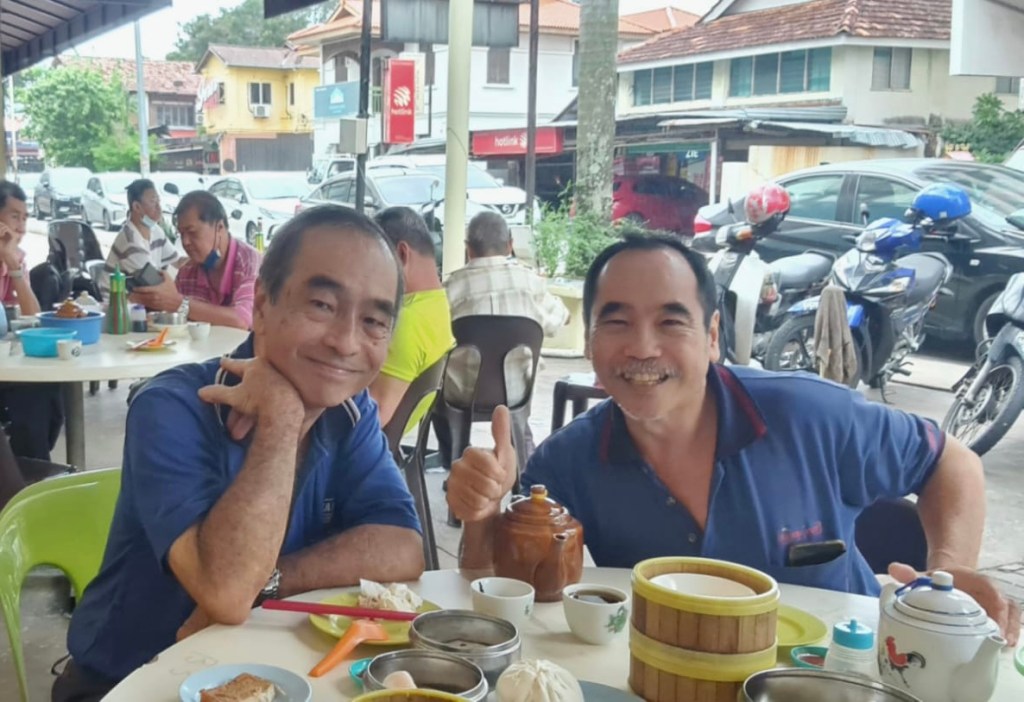
Sum married at thirty three in 1991, a son was born a year later and a daughter three years after that. His son is a pilot with AirAsia and the daughter works in Japan as a clerk.
Others may abandon us but we cannot abandon ourselves
Sum Tuck Hoong
 Urghhlings