
The old man said it was just twelve months ago since he picked up his violin to play, after a lapse of forty nine years. I didn’t correct him; it wasn’t to save him from embarrassment, it was only because I too had misremembered it was actually over two years ago since he marked his debut as a second violin tutti player. Timid and quiet as a church mouse, he was there physically, but not audibly, for his first orchestral rehearsal at the Burnside town hall. It wasn’t his intention to mislead his son when told he would benefit greatly if he took violin lessons from a proper teacher. He had bragged to the outstanding young man whom he still called “Boy” that he had improved in leaps and bounds in just a year of solid practice and strict discipline when in fact, he had taken two years to brush away the cobwebs in his fingers and unlock the stiffness in his bowing movements. His bow hold was still wrong, somehow holding it like how a cellist would rather than how a violinist does. Not only had Boy outgrown, outsmarted and outpowered his dad, he even outsourced the family’s online retail business to a third-party logistic firm to handle all the mundane physical work.
“It’s just a hobby, I don’t need lessons. I’m musical enough, old enough, mature enough, intelligent enough and I still remember how to practise properly,” he said. “I’m teaching myself,” he continued to brag. His three sons had gotten together and found a good teacher who agreed to teach their dad but he showed utter disrespect towards the teacher he didn’t know.
“I don’t need a teacher!” he exclaimed, eschewing wasteful spendings.
“We have paid for the first three lessons, Ba, so don’t waste it,” Boy said.
“Didn’t I teach you guys never to prepay for services? You’ll never get full value once you have paid for it!” the old man said with some annoyance in his tone, instead of thanking them for such a lovely birthday present.
“Ba, just give it a try! If you get just one thing from one lesson, it is already worth it,” Boy replied and stopped himself from chiding his father for being insufferably frugal.
Although visibly annoyed with her husband’s belligerence, his Mrs agreed with him.
“Your dad is improving lots, cancel the lessons and get your money back,” she advised, having decided there were better ways to spend the money.
I was never uxorious, so she won’t need to be generous with me. The old man thought to himself.
The old man procrastinated for over a month before he finally turned up at the teacher’s house in South Plympton for a lesson. Since Covid, he rarely drove his car. So, the half hour journey to the other side of town was a bit of a drab for him. A few of the major roads he used to use daily in his previous life as a shopkeeper in Westfield Marion had become unrecognisable to him, widened into multi laneways, they allowed the traffic to be fierce and frantic despite being off peak. Google Maps took him to back roads and side streets but he would have been better off using the roads he was familiar with without the GPS, as the technology was not advanced yet to tell him some of the streets were under repairs and the diversions meant he did not arrive as early as he wanted to mentally prepare for his first lesson.
“This is my first violin lesson in fifty years,” he unnecessarily divulged to Mr Bramble, the teacher whose main profession was Associate Principal, Second Violin of the ASO, Adelaide Symphony Orchestra. It was his way of preparing the teacher for a mediocre student. He needn’t have worried. Mr Bramble knew as soon as the old man asked for a chair.
“No, violinists play standing up,” Mr Bramble said.
“Not in an orchestra!” the taciturn old man argued.
After he had played the G Major scale, the old man was taken aback by his posture, that of a boxer about to attack an opponent, a stance that Mr Bramble had just demonstrated to him.
“I thought I was relaxed, standing straight and upright,” the bad student said, before offering the excuse that he had always sat to play, whether at home or at orchestra rehearsals. Charged by the hour, he knew not to make small talk but he could not help showing off his Paolo Vettori violin – a copy of the ‘Ole Bull’ by Guarneri del Gesu and a Pierre Guillaume Sakura bow. Mr Bramble knew better, he made a few broad sounds when asked to examine and try the violin and returned it to his student without any more than a word. “Good,” he said, and gestured for the old student to retry the G Major scale but to do it slower with better intonation from the left hand and with a more flexible right hand the way a hand would paint a wall with a brush.
It was merely an inconsequential lesson for a hobbyist who treated the music-making purely as a pursuit for self satisfaction and not a pursuit for a career or for happiness. That he had some butterflies in his belly and awkward moments when he tensed up on familiar passages in Beethoven’s Ode to Joy confused him. Why did he feel the tinge of nervousness and tension in his body when it was of no importance to him how well or how badly he played? For those competing in a gruelling prestigious International competition or vying for a spot as a student in a masterclass or auditioning for a position in an orchestra, understandably, the pressure would be incredibly intense, both on the body and on the mind. But, for the old man, he was just having fun.
There’s no need to be tense. He reminded himself.
At the end of the lesson, the old man was quite chuffed with himself, with the way he extricated himself from a disastrous start. He felt a sense of achievement after prevailing over an arduous passage of semiquavers and awkward rhythmic changes, sudden changes in key signatures and syncopations whilst trying to bring out the phrasing, the dynamics and inner voices of the music to support the first violins without breaking down. The repetition, precision of tempo and intonation, and evenness of movement in the sempre l’istesso tempo in the final movement of Beethoven’s 9th Symphony was a test of muscular endurance in the bow arm and fingers, while also testing the mental strength; staying mentally engaged to avoid fatigue was quite strenuous on the old man. He felt especially pleased after his teacher told him it was one of the audition pieces for the ASO’s Second Violin.
That was on a Friday morning. Two days later, the old man was performing Beethoven’s 9th Symphony with the Burnside Symphony Orchestra at the Elder Hall, University of Adelaide. Built in 1900 in the middle of the CBD, the freestone building was designed in the Florentine Gothic style. It was a venue that he used to drop his kids for their weekly rehearsals some twenty odd years earlier. It was also the venue he used to take his parents to attend Friday’s Lunch Hour Concerts whenever his kids performed. In the limelight, on stage, as he peered up into the rows of seats at the back of the hall, he literally felt the need to pinch himself.
I must be dreaming! Wake up!
Never in his wildest dream did he imagine he would be on stage – the stage he had stood on only to congratulate his sons after their sold-out concert almost a decade before. He had arrived early to roam the corridors of Elder Hall, to smell the dust of yesteryears, to feel the presence of history of great pedagogues, to peer into the students’ practice rooms and revisit the Green Room that his sons used all those years ago. When it was his turn to perform on stage and to have a big choir, the Adelaide University Choral Society, on full throttle soaring to great heights behind the orchestra, the awesome privilege to be performing great music in a hall with such a rich history in front of a big appreciative audience did not escape him. Oh, what a joy indeed it was to perform Beethoven’s Ode to Joy in front of his family and friends. He asked me to give a shout-out to his nieces, Corinne and Stephanie, for badgering him to join the orchestra. Without them, he would have remained languid and missed out on such dopamine laden moments.
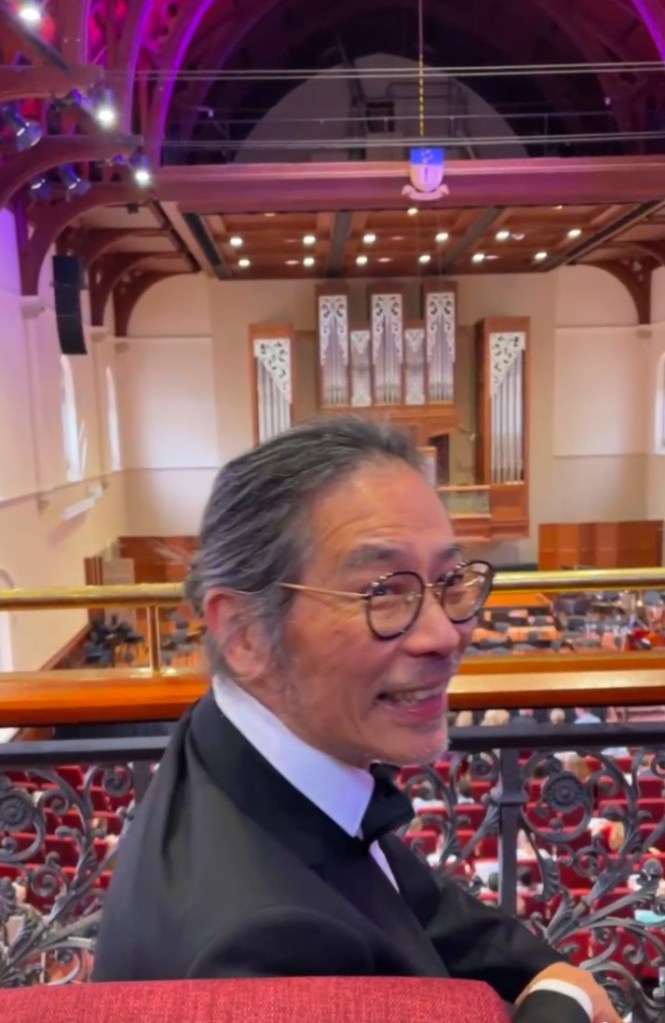
Beethoven, never anodyne, will calm the irascible, awaken the languid and thrill the despondent
Wu Yonggang
“How was it? I asked, long after the audience had left the building.
“I can disclose I was this close to stuffing up in the final maniacal passages of the fourth movement,” he confided, and gestured with his thumb and forefinger at a fraction of an inch apart.
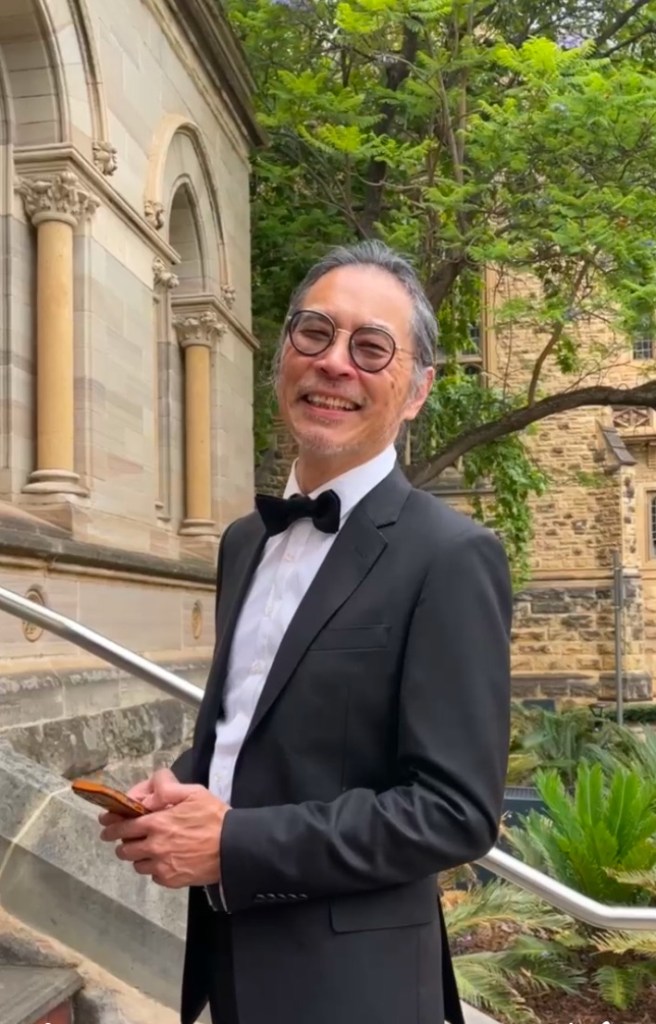
 Urghhlings