
Only seven of his hens greeted him yesterday morning. The hungrier ones, a restless flurry of feathers, paced impatiently behind the fence. One even attempted a desperate take-off, her clipped wings a cruel testament to humanity’s disruption of nature’s delicate balance. While quantum mechanics might unravel the mysteries of bird migration, the fundamental mechanics of flight, requiring strong, unclipped wings for lift and thrust, were evident to any observer.
His mind, however, was consumed by the whereabouts of the eighth hen. He optimistically anticipated finding her in the coop, proudly laying an egg, ready to crow with self-satisfaction. But a cold dread began to creep in. Had she been too slow to enter the coop before the automated gate closed for the night? Had she wandered off in search of a warmer sleeping spot? Or, the most chilling thought, had a cunning fox claimed her?
The old man, his heart pounding with a mixture of hope and fear, quickened his pace. He strode into the sun-baked run, the dry, crusty ground crunching under his shoes. October had almost finished, yet spring hadn’t quite defeated winter. To keep the other hens from underfoot, he scattered their food strategically away from the coop. His gaze, however, was fixed on the flight of steps leading to the coop’s entrance. There, perched atop them, his heart sank. It was her, the prettiest of them all, the oldest, yet still adorned with a coat of feathers that would be the envy of any young pullet. Fluffy, thick, and worn with a certain pomposity, her plumage spoke of years of comfort.
He approached, murmuring a gentle “good morning,” but her appearance immediately signaled she was unwell. Her heavy eyelids flickered open, revealing ancient, amber-colored dinosaur eyes, before settling back into a doze. He carefully cradled her, carrying her out into the morning sun, which offered a welcoming warmth to the cool air. He placed her amongst her flock, hoping the familiar presence of her companions would rouse her. But they, oblivious to her plight, were entirely engrossed in the scattered seeds and beads of corn. She, in turn, showed no interest in them or the food, drifting off to sleep once more.
He had long known that her days were numbered, not in the sense of being destined for the soup pot, but rather that she had well surpassed her prime. She had ceased laying eggs more than two years prior, living a comfortable, albeit unproductive, existence. He estimated she had reached the average hen’s lifespan of around six years. While some, he knew, lived to a ripe old age of ten, he had always strived to create a “blue zone” of longevity for his flock with proper care and hygiene. This sanctuary included a spacious run for scratching for worms and slugs, a double-story coop with three nests, an automated water system fed by a rainwater tank, and, of course, the automated door to deter predators.
“Being old isn’t bad, but ageing is sad,” the old man murmured, his voice laced with a gentle sorrow, as he carefully released the old hen from her open-air prison – finally, in the vast backyard, she was free to roam. But, she lacked the energy to explore or scratch, choosing instead to stand motionless, basking in the sun’s comforting rays.
“You’ll just grow old, but you won’t suffer from ageing,” he promised her, his words flowing with a soothing rhythm through his crooked teeth. “No dementia for you to worry about, no long periods of incapacity, no boredom in a bed-ridden state, no gum disease, no lingering effects from strokes,” he continued, a wistful note entering his voice as his mind drifted to his own mother’s plight in her nursing home.
“Being old isn’t sad, but ageing is bad,” he blurted out, his voice now shaky, as his thoughts returned to the nursing home in Parkside. There, he pictured his mother, old, very old at 102. Being old, he mused, wasn’t inherently sad; in fact, it could be good. Old songs, cherished memories, enduring friendships, comfortable habits – these brought solace and security. He found comfort in his old home, his familiar neighborhood, in his daily routines, in re-watching old movies, re-reading old books, and poring over old photographs. Old age, in itself, didn’t bring him sadness. It was the immense suffering his mother endured that truly pained him. Ageing, he concluded, was indeed bad. It brought with it aches and pains, a litany of diseases, strokes, heart attacks, falls and broken bones, paralysis and incapacity, dementia and the cruel loss of mental acuity, arthritis, diabetes, cancers, the diminishment of vision and hearing, and ultimately, major organ failure. Ageing was undeniably bad when she could no longer recall his name or acknowledge him as her son. Ageing was bad when she could no longer savour her favourite cashews and pistachios, or consume normal food without it being painstakingly mashed. Ageing was bad when one could no longer even reside in their own home.
As the sun began its slow descent behind the hills, painting the sky with hues of orange and purple, the old man returned outside to check on the old Isa Brown. She was no longer standing. She had found a peaceful corner, nestled beside a small, errant patch of white African daisies, as if she had resigned herself to lie there and await death’s embrace. The insistent buzzing of blowflies, an almost prophetic hum, seemed to sense the imminent arrival of death, disturbing her fragile peace. A regiment of black ants, their advance swift and determined, followed the call of their recon group, hastening her end. The old man gently stroked her head, and in a soothing voice, explained that he would take her to a safer place, up on a garden bench, where the ants would take much longer to rediscover her.
The old Isa Brown, surprisingly, did not die that evening. The old man, in his unwavering care, left her on the bench overnight. He had rugged her up in his worn flannelette pyjamas, and a sheet of a 20kg plastic chook food bag served as a makeshift shelter, draped over a rose bush. He even spoke to the fox, an unspoken plea carried on the wind, asking it for leniency, to bypass his property that night. “Allow her a good sleep,” he whispered, his words clear, carried by the night air to the unseen predator.
Early the next morning, he rose quickly. Although the sun had not yet warmed the air, he knew it was past the time when the fox typically conducted its neighbourhood inspections. From a distance, he could see that the temporary shelter remained undisturbed. A wave of relief washed over him at the thought of no blood, no scattered feathers, no headless chook to be found. His steps quickened, his anticipation growing that she might, just might, be feeling better. She was old, he reasoned with a surge of positivity, but she wasn’t hindered by the cruelties of ageing.
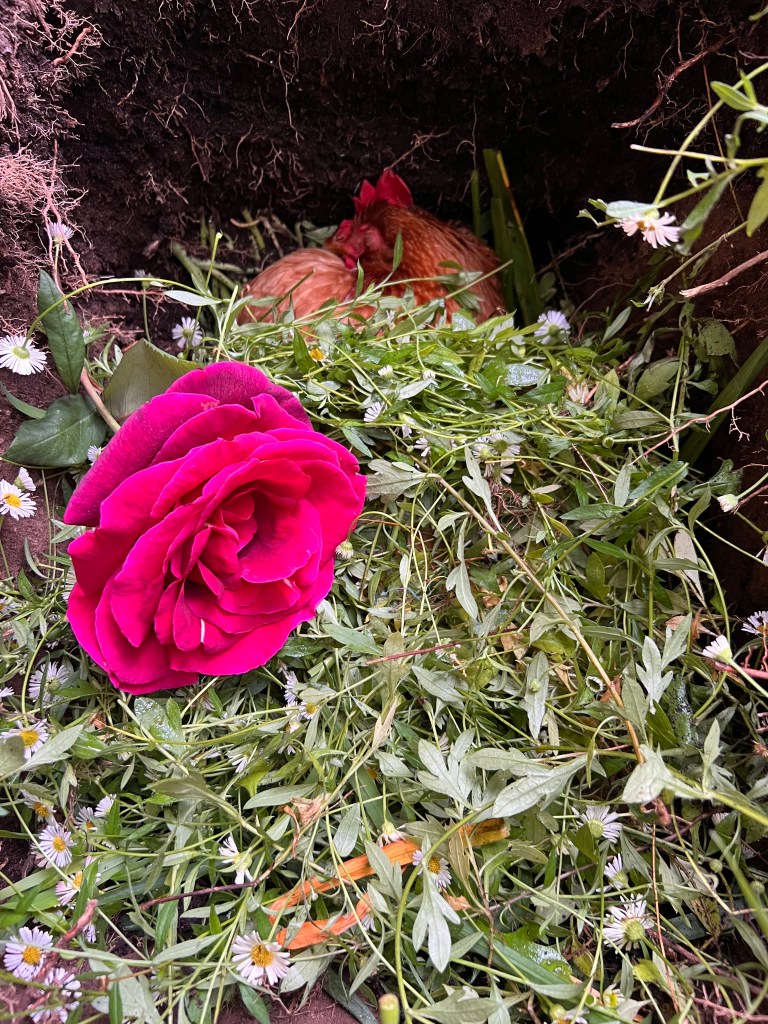
He lowered his body to a squat, his eyes fixed on the hen. She had tucked her head further under the yellow flannelette, but her comb was visible, a reassuring splash of healthy red – a vibrant sign of life! His heart lifted. Gently, he lifted the flannelette to reveal her face, pleased to see she looked peacefully asleep. A whitish fawn-coloured eyelid covered her eye. He made soft sounds to rouse her, but there was no movement, no sudden shake of her head to shoo away flies. But then, he remembered, it was far too early for flies to be out searching for food. His heart soon sank as he saw no signs of her body heaving in sync with the labored breaths she had taken the day before. He stroked her head and feathers a bit harder, but there was no reaction. Her scaly feet looked stiff, soiled with dried dirt, clenched, but the sharp claws no longer held any threat. He was quite certain she had died during the night. He gently carried her to the freshly dug hole, which he had lined with soft white African daisies the day before. As he placed her on the bed of flowers and leaves, a sudden pang of grief pierced him, and he began to cover her with a thick layer of daisies.
Thankful that she had experienced a quick and peaceful death, he silently wished the same for his own mother when her time will inevitably come. When there is little meaning left to live for, and when hope no longer exists, it is indeed better to leave the world in peace, surrounded by love and kindness, without further pain and suffering. He had just begun to place a bunch of Mr. Lincoln roses on her final resting place when, to his astonishment, the Isa Brown’s eyes opened. She gave him a long, unwavering look, so lasting that he leapt with an uncontrollable surge of joy.

“She’s alive!” he breathed loudly, his voice echoing, and he turned to share the miraculous news with her friends behind the fence.
The two of them looked at each other for a few precious moments, but then, she closed her eyes again, this time for the last. This time, he knew. He felt it in his very core. She was truly gone. He would wait until her comb had turned pale, a clear sign of passing, before finally burying her.
“Life is suffering,” so taught the Buddha. Her suffering was now no more. He told her she had earned good karma, having provided him with eggs for over three years. May her good karma pass on to her next consciousness. The Buddha’s profound teachings illuminate the concept of impermanence, emphasising that there is no permanent self. What, then, connects one moment of mind to the next, or indeed, from one life to the next? Behind our thoughts, actions, and words lies our intention – that is our karma. Wholesome actions invariably lead to wholesome results, while unwholesome intent, driven by the poisons of greed, hatred, delusion, divisiveness, and mockery, inevitably lead to pain and suffering. Upon death, our individual consciousness may cease to exist in its current form, but our accumulated karma does not simply vanish. Instead, it is passed on to the next consciousness, much like the energy of a lit candle transferring its flame to another. It is not the identical flame, yet it is the same energy, a continuous thread woven through the fabric of existence.
 Urghhlings