Park Moon’s Park On The Moon

This year’s Mooncake Festival was celebrated on 21 September, or the 15th day of the 8th month of the Chinese lunar calendar. It is also known as the Mid-Autumn Festival although it is definitely Spring here in Australia. Celebrated by most Chinese, Korean, Japanese and Vietnamese communities world-wide, I was surprised to receive a tin of mooncakes this year from my bank manager. He did not understand the story behind mooncakes, so he asked me. Luckily, I had Googled the night before our meeting and impressed him with my knowledge. There is the legend about beautiful Chang’e flying to the moon after stealing the elixir of immortality from her husband, the archer Hou Yi. He was the hero who saved the world from global warming by shooting down nine suns. The other legend about mooncakes originated during the end of the Yuan Dynasty when Ming guerrillas communicated with one another through hidden messages in their mooncakes. The messages would then be eaten with the mooncakes to destroy any incriminating evidence. I was hoping to link this custom to the Water Margin, but unfortunately the Ming uprising occurred a hundred years after the civil wars of the Water Margin.
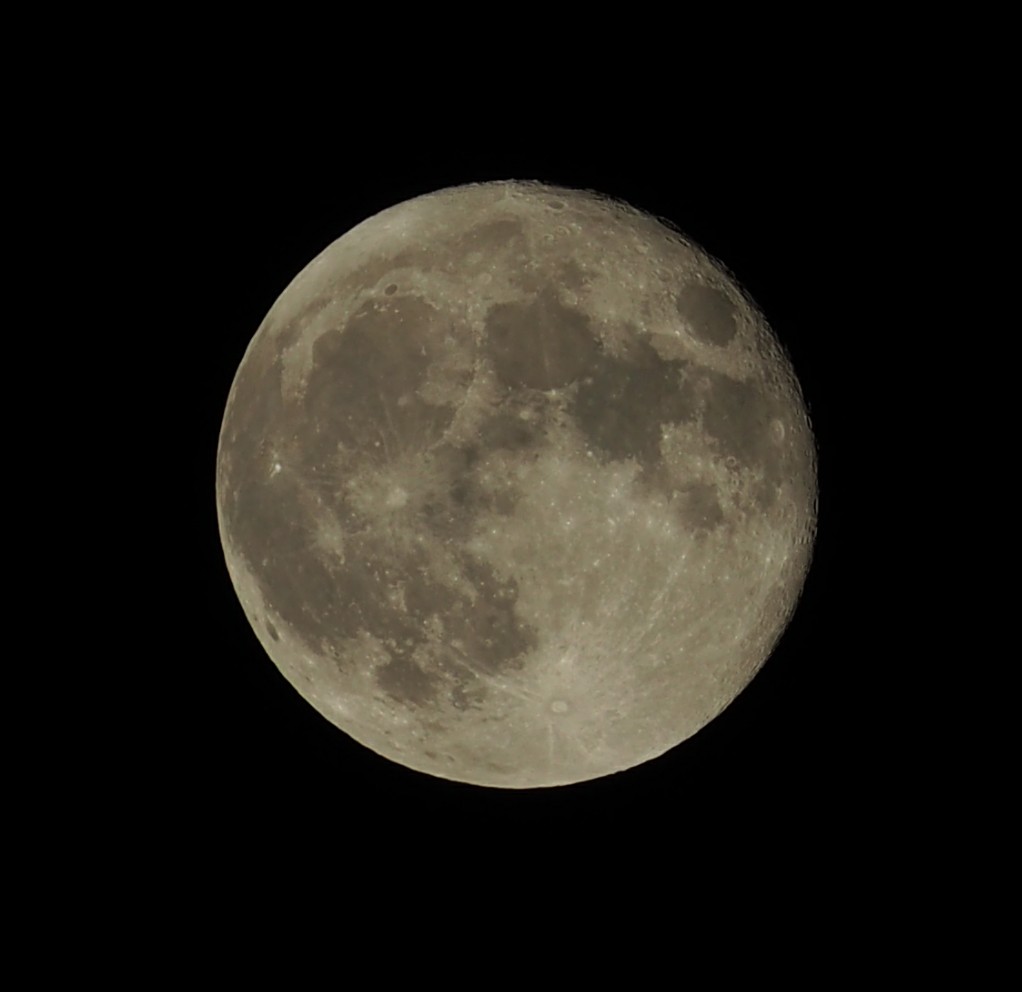
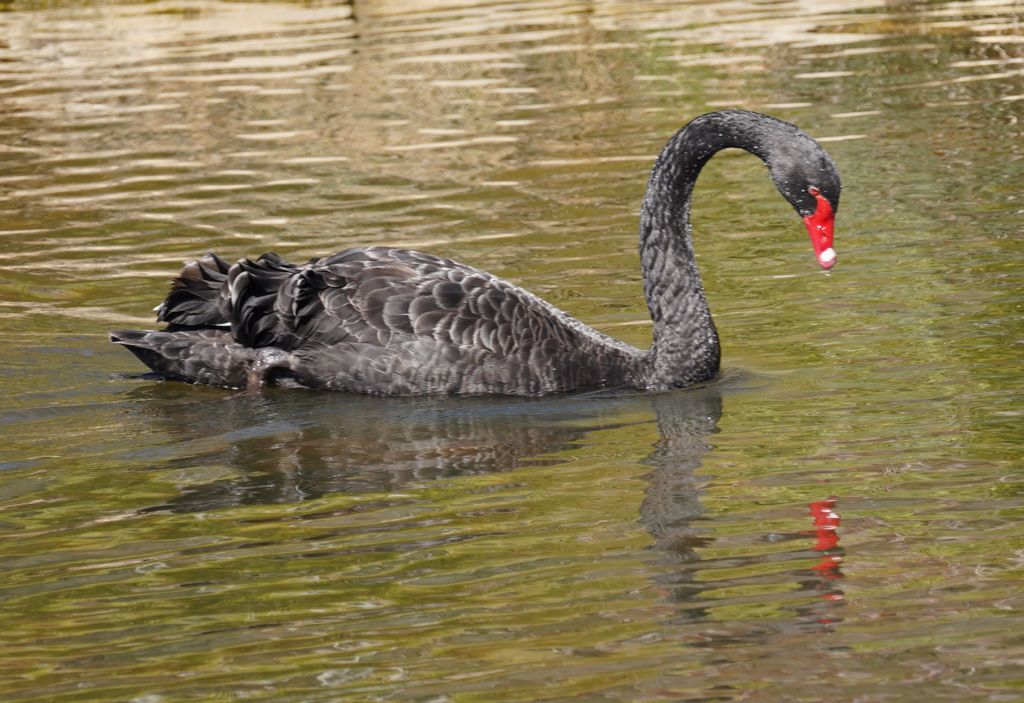
Could the greenish areas be parks on the moon? Photo by SY Rees

It was Wu Yong’s wife who first told him the story about Wu Gang, on account they both share the same name. “Why are you so “bo uak tang?” (not lively in Hokkien) she asked Wu Yong many years ago. “Why aren’t you like Wu Gang?” she added, unaware he was seething silently. Wu Yong’s other name is Wu Gang, it is common for a Chinese to have two names and a surname. The Wu Gang who lives on the moon is famous for his tireless attempts to chop down an osmanthus tree. We know that if such a tree can exist in nature, it won’t be just a single tree. It would be a park full of trees that produce white and orange blooms with the alluring scent of ripe peaches. Little did Wu Gang know that the osmanthus tree he is tasked with cutting down is a self-healing tree. Wu Gang was sent to the moon during the Tang Dynasty in the 7th century – apparently to achieve immortality. It is somewhat annoying to learn that the story about Wu Gang isn’t real. For that, we ought to blame Neil Armstrong and his Apollo 11 crew. That’s one small step for man, one giant blow to Wu Gang. A futile toil in a park on the moon. That was how I thought of Park Moon, the next hero in my Urghhling Marsh brotherhood.

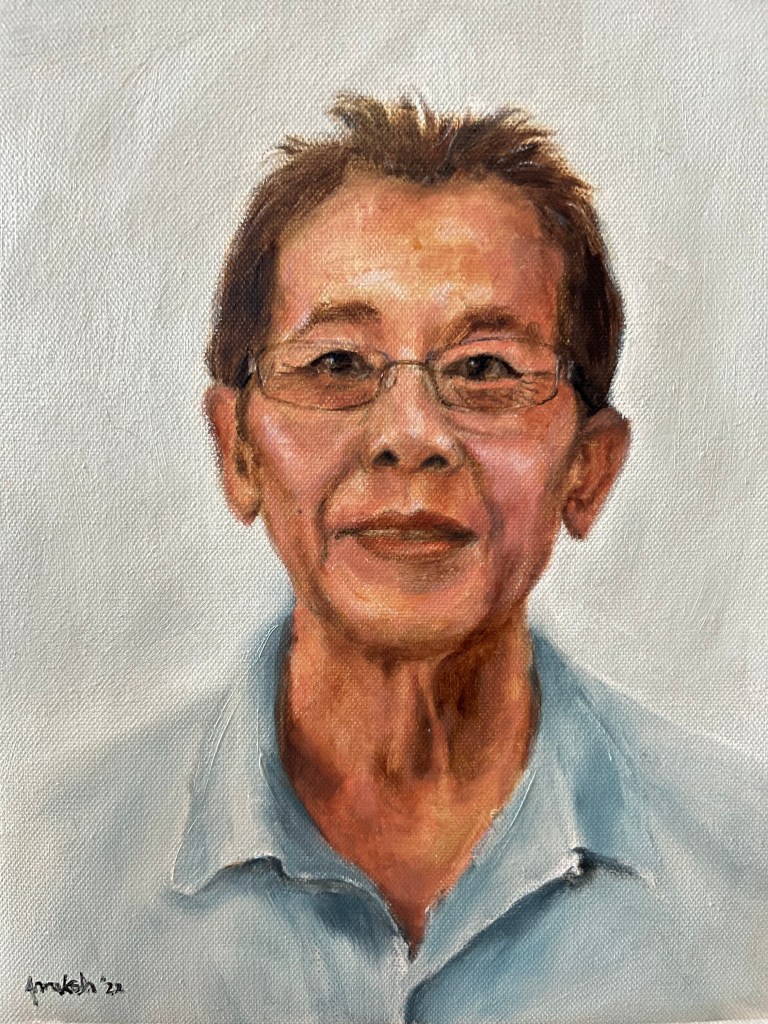
Park Moon is fairly tall with a somewhat fair complexion. A handsome man with meticulously groomed hair, his face is broad but it is not a moon face. It isn’t round and it isn’t pock-marked with crater-like depressions like those on the moon. For a top-tier executive who had served his employer globally for over three decades, he does not have the coldness of a bank manager or the sneering scowl of an art critic. He is a kind man who cherishes his parents’ love and upbringing and acknowledges the big part his teachers helped shape his destiny. A loyal friend, he remains true to his schoolmates and work colleagues, some of whom he continues to mentor. Park Moon’s surname is Moey. On one of his business class trips to Europe, the air stewardess referred to him as Mr. Money. Park Moon placed his forefinger to his thin lips and told her the “n” is missing in his surname which was why he had to go earn some money. It was this quest to pursue his lofty ambitions to be a successful man with loads of money that reminded me of the futility of Wu Gang’s mission on the moon. All the money in the world may get us all the consumer goods we want but as John Lennon said, all we need is love. Park Moon paid a big price for pursuing his dreams. His marriage to a Singaporean lady ended in divorce and he lost touch with their son, a smart young man who graduated from NUS as a Chemical Engineer.

Today, Park Moon has mellowed and is more content with life. Happily remarried to a Convent Datuk Keramat girl who was once his ex-neighbour, he has two lovely daughters with her – one is a doctor and the other is in the biotech field. “I am exchanging money and perks for happiness as well as to prolong my life with less stressful work. Stepping down from a high position to a lower post can be painful and discomforting initially, especially in terms of pride,” he said. He is right. No good being Wu Gang for the osmanthus tree cannot be chopped down; all the rewards and status cannot buy us happiness and health. “This is one of the best decisions that I have made in my life,” he said, in a serious voice.

Happiness is my new rich, inner peace my new success. Health is my new wealth and kindness is my new cool.

Moey Park Moon

Park Moon’s grandfather spent a year or two in the US working on the railroad. He was smuggled into the country as the Chinese Exclusion Act was enforced in 1882. To avoid detection and capture, he had to wear socks only, to keep the noise level down. Movements and hikes were done strictly in the dark. With the money saved, he went back to China and built his house. His second attempt to re-enter the US a few years later was foiled and he was forced to return to China. That was when he and his four older brothers had their sights on Malaya. They arrived in Malaya in the early 1900s, and settled in the Kulim-Machang Bubok-Bukit Mertajam area. They were from Toishan, a county in the Pearl Delta area of Guangdong. Park Moon’s grandpa was in the woodworking / carpentry trade.

Park Moon’s father, Moey Hua Cheng, was born in 1921 in Kulim, Kedah. He was the second son, but from the father’s second wife. “One of my sisters told me that after he had passed away,” Park Moon said, divulging a once tightly-held family secret. His father’s mother was chased out of the house by the matriarch, the first wife. Hua Cheng was brought up by his stepmother. He studied till Standard 3, which was a big deal in those days in Malaya. When he was in his late teens, he was employed to work in a goldsmith and pawn shop, then partly owned by a distant cousin. “He married mum in 1940,” Park Moon continued. They moved to Penang after the war where he worked as a shop assistant for Cheong San Goldsmith at 43 Campbell Street. “Dad worked there till he retired at 72,” Park Moon said, an acknowledgment that it was the norm in those days for a person to work only for one boss in a lifetime. Despite his short time in school, he could speak, read and write Mandarin very well. He was talented at Chinese calligraphy and was the go-to person if anyone required proper Chinese writing for a big occasion. He was also fluent in Malay and could write Jawi well, and as he was also trustworthy, he helped retain a sizeable repeat business from the Malay community. They were mostly farmers who happily spent all their earnings after their harvest, and then a few months later would return to the shop to pawn their jewellery for needed cash; a cycle they repeated every year.
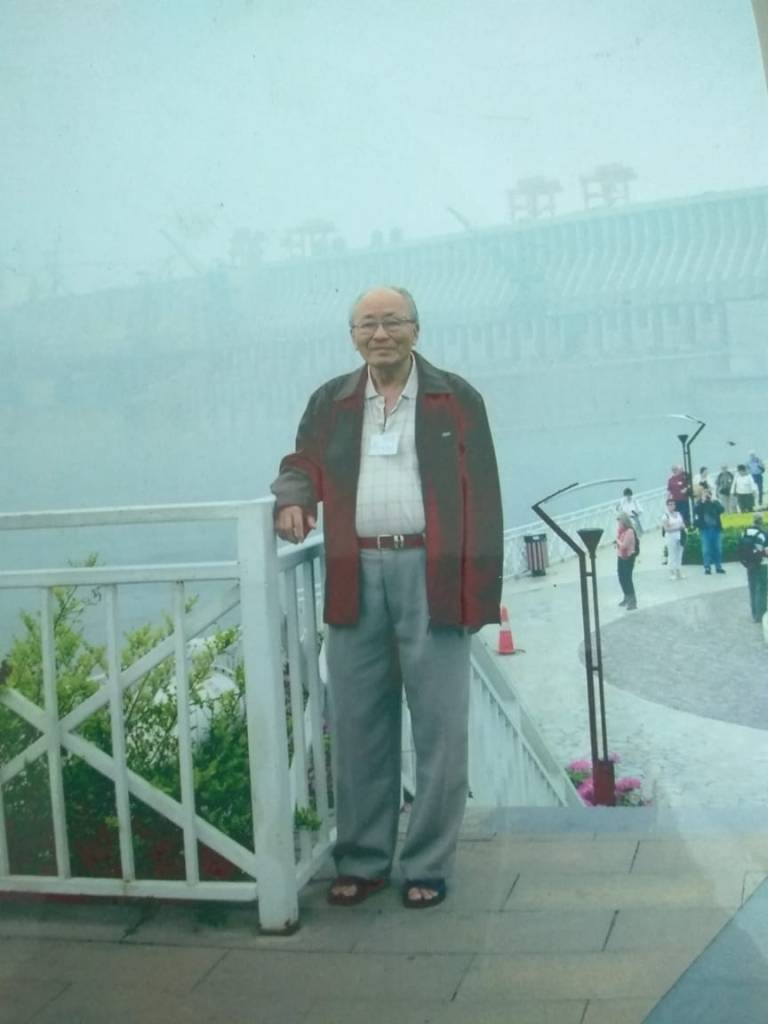
Moey Hua Cheng: ‘Be nice to people on your way up as you do not know who you will meet on the way down’.

Park Moon’s mother, Kong Kui Yon was a foster child raised by a Hakka family. A year younger than her husband, her marriage to him was match made. She was eighteen, of child-bearing age and therefore much sought-after. By the time she was forty in 1962, she had borne eight children. She used to talk about her real mum but never mentioned her father and her other real siblings. In those days, they treated birth parents and siblings as real, adopted ones weren’t. Probably she never knew them. She was brought up in the Kulim-Lunas-Machang Bubok area but didn’t attend school. Her role then was to do the housework and tap rubber for the foster family. Despite her illiteracy, she learned to read some Mandarin. She was a mentally strong and capable woman, pulling the family together through her skills as a fantastic homemaker -juggling the meagre budget and making sure that there was always food on the dining table and clothes for her children to wear. “The clothes were hand-me-downs from good neighbours and friends that mum somehow was able to alter and make good again,” Park Moon said. Besides helping her husband make gold bracelets till late at night, she also supplemented the family income by washing clothes for others. Once or twice a week, she would join a group of women in washing the Penang ferries as well as cutting or removing the overhang threads from jeans produced by a knitwear factory near their neighbourhood. Park Moon fondly remembers his mother’s excellent yong tau foo (Hakka stuffed tofu) and other Hakka delicacies as well as fantastic Cantonese dishes and soups.

Park Moon’s mum with his 4th Sis in 2014.

It is fine to wear old clothes that need mending. The important thing is that we did not steal them.

Kong Kui Yon

As a shop assistant, Hua Cheng earned about $150 per month. This was never enough to feed his family of eight children. The eldest is a boy, born in 1941, followed by four girls and then three boys. Park Moon is the sixth in the family. Before 1964, they all lived in a rented room in a house occupied by three other families who were also tenants at Lorong Susu (off Macalister Road). The room was so small the older kids had to sleep in the common corridor, which still left many young ones sharing the bed with their parents. How Hua Cheng and Kui Yon continued to satisfy their sexual needs without waking up the children deserved annual accolades. In 1964, Hua Cheng and his younger brother managed to pay a deposit for the purchase of a single-storey terrace house in Green Lane area, with the $2000-$3000 given to them by their stepmother as “a token of goodwill” upon her death.

Education is the only way out of poverty. Have a good life, be respectful and kind.

Moey Hua Cheng

Hua Cheng drummed into his children that education was the only way out of poverty for poor families like them. Unfortunately, to his big disappointment, the four eldest children were not so good in their studies. They attended Chinese-medium schools due to his patriotism for his father’s motherland. Mao Zedong could do no wrong in his eyes and he did not want his children to lose sight of their culture. But, being from the Chinese stream, they ended up working in local companies run by Chinese families and were therefore lowly paid. Hua Cheng began to believe that children in English-medium schools had better career opportunities, thus sending his next four children to be taught in English. He was very strict with them. Getting 80 marks in weekly tests was never good enough. A score of 90 would only earn the question “why not higher?” Like many kids in those days, Park Moon did not attend kindy and therefore could not read or write at all when he began his school life. Despite the poor start, he came ninth in class overall and that secured him in the top class from Standard 2 to Form 3. Throughout school he was an average student except he got a duck in his Form 1 English test. A student’s mark would begin at 40 out of 100, for one mistake. A second grammatical or spelling mistake earned a 20 point deduction. Park Moon’s command of the English language improved in leaps and bounds after that trauma. He did not tell me but I suspect his dad caned him. The good thing about being an average guy was that he could get along with both the more academically inclined classmates as well as the mischievous and street-wise types who were known as the “kwai lan kia”. Park Moon’s class nickname was “panjang” (long in Malay) because his scrawniness made him seem taller than most even though he was not the tallest. 

Park Moon was a reasonably well-behaved boy who kept a low profile, yet he was caned three times by the headmaster, Brother John. One of the canings was rather frivolous – he was called out for walking on the grass even though there was no “Do not walk on grass” sign. The other two occasions were for being at the wrong place at the wrong time. Things got a bit rough among the boys playing marbles during recess and he was punished for their transgressions. But the one incident that Park Moon will never forget was his detention by his Standard 2 Form teacher for not understanding her instructions to complete a workbook exercise despite her numerous explanations. So she lost it, grabbed his hair and banged his head hard against the desk. The poor boy was too shocked to cry and too afraid to tell his father whose unshakeable belief was “Teachers are always right”. In school, Park Moon was known as the History King, being the top student in the subject. He got into SXI’s Form 4 Science 1 after better than expected results in the LCE. Science 1 boys were daunting to mix with. He perceived them to be smarter. He did not require his sense of inferiority to be the excuse to leave SXI for the Technical Institute (TI). His father saw technical education as his path to a better future. So, he pleased his father and enrolled in TI instead. Like most of his friends, he failed Bahasa Malaysia in the MCE and had to repeat it. Upper 5 was his St. Paul’s moment. He started attending church and eventually became a Christian. He passed his MCE this time with flying colours. After a year in Lower 6 Form, he arrived in Sydney, Australia with $3,000 in his pocket. It was all the money his father had. “So, make it last till you find a vacation job,” Hua Cheng said to his son. But to young Park Moon, it sounded like “swim or drown”.

Park Moon appreciated the gravity of his situation and was very careful with his finances during his matriculation and first year in Uni. For lunch, he survived on a 250ml carton of milk and a meat pie. Every day. I did not tell him but Wu Yong, another brother of the Urghhling Marsh lived on a 250ml carton of milk and a strawberry jam sandwich. Every day. Park Moon’s room was spartan. Book shelves, a study chair and a single bed with faulty springs were bought from The Smith Family which sold donated or used goods to raise money for children’s charity. During a hot and dry summer in his matriculation year, he had a difficult four weeks – knocking on factory doors from Rosebery to Parramatta looking for a job, feeling more and more desperate by the day. Then out of the blue, an Indonesian senior whom he barely knew introduced him to Fritzel & Schnitzel, a restaurant in Hunter Street for a kitchen hand job. The restaurant had just been taken over by a Lebanese family who fled the civil war. Within two weeks, he became the second chef because the owner and his Lebanese chef got into a very serious argument and the chef stormed out in a huff. In his second summer, he got a job in Rosebery – assembling one-armed bandits. The factory workers were migrants and refugees (Vietnamese, Chileans, Croatians, Serbs, Greeks, Italians, Turks, etc). The Croats didn’t like the Serbs, the Greeks hated the Turks and everyone called the Italians wogs. Working in hot and crammed conditions with them was torture. They were mostly bigger, taller and smellier than Park Moon, whose nostrils were just at the right armpit height of his garlic-loving colleagues who seemed to skip their daily baths. A Vietnamese shared his horrifying experience fleeing the country by boats deemed unseaworthy and the many obstacles and traumatic experiences exacted by pirates before they were able to reach Australia. 

In his third summer, he got a job at an ice factory at the Pyrmont fish market. It was a one-man show, but would have been a physically demanding job even for two. In the morning, he had to make three to four runs per hour to the fish auction market, delivering five pallet loads of ice each time, using a manual lifter. The pallets loaded with ice were stacked up to his chin level. When the auction hours were over, typically by 12 noon, he then had to bag party ice and store them in the freezers, and when they were full, he stored them in a 40-ft container parked outside the factory. A typical day started at six in the morning – catch the no. 273 bus from Randwick to Pitt Street, then a ten-minute brisk walk to Pyrmont. His day finished at 10 at night. Sunday was the only rest day. He got paid well, for a uni student, but he also got stomach ulcers for missing his meals. It did not make sense why the boss would employ a weak-looking Asian boy for such a physical job. “Why me and not one of the stronger white guys who were in the queue?” he asked his boss. “Because you were the hungriest,” he said simply. In his fourth summer, he was required to do his industrial training at one of the shires in NSW which was quite close to the Queensland border. It was a good experience staying with an Aussie family. The family would drive him to ‘nearby’ Inverell on Saturday which was a good two hours drive away, and in return, Park Moon would cook a Chinese lunch for them the next day. He also tutored the family’s daughter who was in Year 6 or 7. The father would reciprocate and teach him golf and lawn bowling while the son, who was about seventeen years old, taught him archery.

With best mates from uni days. Albert Tan (left), Torng Maw (middle)

In December 1983, Park Moon completed his double-degree course in Science and Engineering at the University of Sydney. He was promptly recruited by Singapore’s Mass Rapid Transit Corporation to work on their new MRT system. After six years there, he felt he had learned enough field work in civil and tunnel construction stuff and electrification works. He then moved on to the insurance industry, and was trained as a Risk Engineer with FM Global. He loved the opportunities to travel worldwide. “With full perks, executive suites in 5 or 6-star hotels and always Business Class!” he said candidly. One day, he could be at a Newmont mining site in remote Indonesia and the next day, in a super dust-free room like in a TSMC semiconductor wafer fab in Taiwan. Essentially the job exposed him to all kinds of industries – power plants, semicon fabs, pulp and paper mills, etc. More importantly through all this, he got a global network of friends. As his father used to say, “Why make enemies when you can make friends?” His first trip to China was in the winter of 1991. The feeling was unreal the moment the plane touched down in Beijing – somehow it felt like a home-coming for him even though that was the first time he stepped on the land where his grandfather was born. “I was joyous, I could feel the tears in my heart,” he said. There were no streetlights in Beijing- only the light bulbs in the shops gave some dim light. The main shopping area was however full of people. The drive from Beijing to Tianjin was uneventful. The roads were very wide, but empty of cars.

Instead, there were miles and miles of people in drab grey clothes on their bicycles being passed by a few tractor driven carts. The country was poor, the countryside dismal. Beggars trudged the streets pitifully, those without limbs sat on the roadsides, busily swatting at flies. He could see people carving blocks of ice from the frozen rivers and ponds. When he arrived at Tangshan which was hit by a huge earthquake in 1976 with the highest number of casualties on record, the factory had put up banners at the main gate to welcome him. Once the main gate was opened, as if prompted by a conductor, the factory employees started clapping and singing “Huan ying, huan ying” like a 1000-strong choir of sixteen voices. Park Moon found out later that the plant was hardly producing anything.

On his second trip to China, Park Moon got into trouble with the local authorities. It was in January 1993, during one of the harshest winters there. He was smuggled up the train from Changchun to Harbin without a train ticket. The plant manager had either forgotten or could not buy the ticket. Having boarded the train at the depot one stop from the train station, Park Moon thought he was provided with a spacious First Class cabin. But, when the train stopped at the train station, he soon realised he was in a six-person cabin and he was the seventh without a ticket. The temperature outside was minus 20 degree Celsius. The icy cold conditions motivated Park Moon to rustily argue in poor Mandarin with the train conductor whose strong Manchurian accent provided his errant passenger with a good excuse to plead ignorance and feign being insulted. The other six passengers relented after a rowdy few minutes and made room for the non-paying guest. The compromise was good enough for the conductor to extricate himself from the cabin without injuring anyone’s pride. With a little whimper, Park Moon bowed respectfully and said “Xie, xie, thank you.”
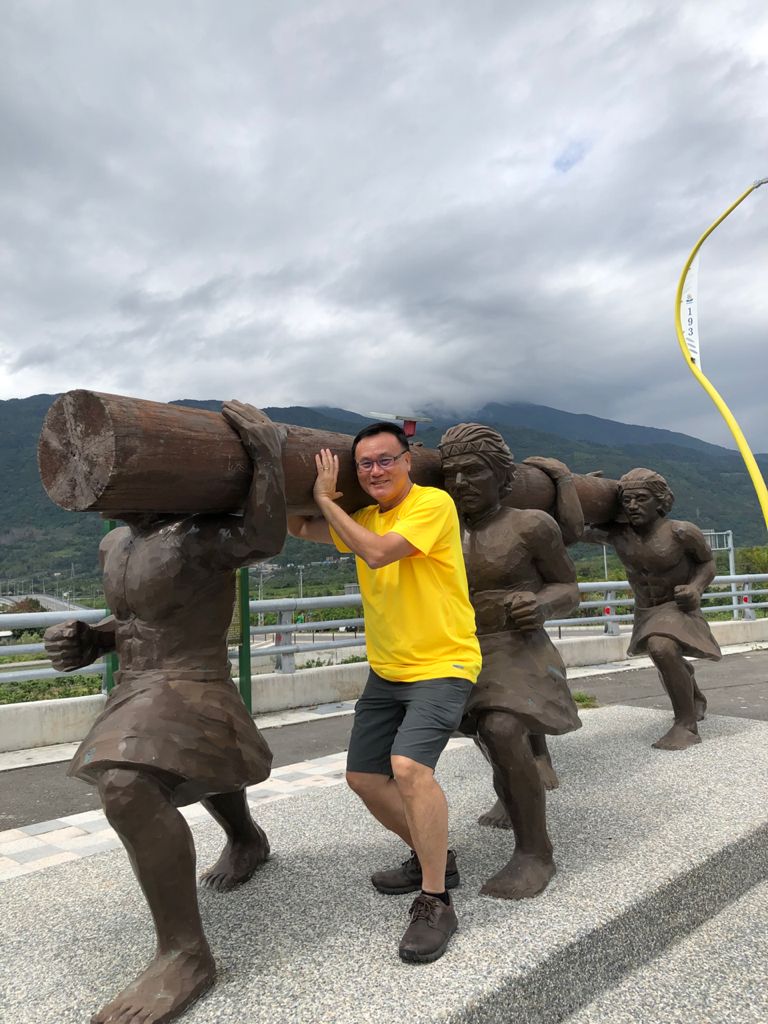
Park Moon, one of the nicest heroes in the Urghhling Marsh Brotherhood.

Park Moon is one of the nicest guys I know from my school. In 1996, as he was waiting for a table at the Red Lobsters Restaurant in Toronto, an elderly man came up to him and asked if he could share his table. Park Moon turned around and saw a man with a noble face and a bad posture. He looked decent enough and smelt clean, although his jacket looked slightly threadbare and his pants were clearly in need of a hot iron. “Sure, fine,” Park Moon replied and signalled to the waitress to set the table for two instead. When asked for his order after being given enough time with the glossy menu, the old man told the waitress he was with Park Moon, and to let Park Moon order for him. A free rider! Park Moon thought to himself.

“Would you like a glass of red wine?” he asked his uninvited guest. “I’m ordering a T-bone steak for you,” he said in a soft warm voice.

“I will have a lobster,” Park Moon said to the waitress and smiled sweetly as he closed the menu.

When their meals arrived, the elderly man did not hesitate to pounce on his steak. He ate the medium-rare meat like a man who had just disavowed his vegetarianism. Meat, glorious meat,” he seemed to be humming to himself as he emptied his plate in a blink of an eye. He placed his steak knife and fork side by side at the 4 o’clock position, signifying he had finished his meal. But, Park Moon had barely started pulling at his succulent eight hundred gram Maine lobster. Suddenly, the elderly man leaned forwards and yanked a claw from the lobster with his deformed fingers that were riddled with arthritis. The meaty claw flew off the table to Park Moon’s dismay and utter shock. Park Moon stepped off his side of the table to pick up the claw. As he bent down, he noticed the restaurant’s carpet, once freshly laid and springy to the feet, were discoloured and heavily-trodden with many small but visible bare patches. Park Moon returned to his seat with the claw pincered by his right thumb and forefinger. The elderly man asked if he could still have the claw. He broke into a radiant smile when his host offered him the whole lobster instead. Park Moon had lost his appetite.

He left his position as Engineering Manager after ten years with the company when Marsh (a major global insurance broker listed in NYSE) came calling. Park Moon became the Managing Director of the risk consulting business unit covering Asia. The company was flying high, so to speak, and he was doing exceptionally well personally, until Spitzer (a US attorney in NY) came along and started to haul-up brokers for non-compliance on financial and accounting misdeeds. As they say, all good things must come to an end and the company came under a lot of pressure from shareholders and market analysts. He called it quits after ten years with Marsh and joined their competitor, AON, also as the Managing Director of risk consulting. He stayed just three years with them and re-joined Marsh in his old role for another five years. By then, he had grown stale in the business after almost three decades in the same field. Today, Park Moon works on a retainer with international German insurer, HDI Global.
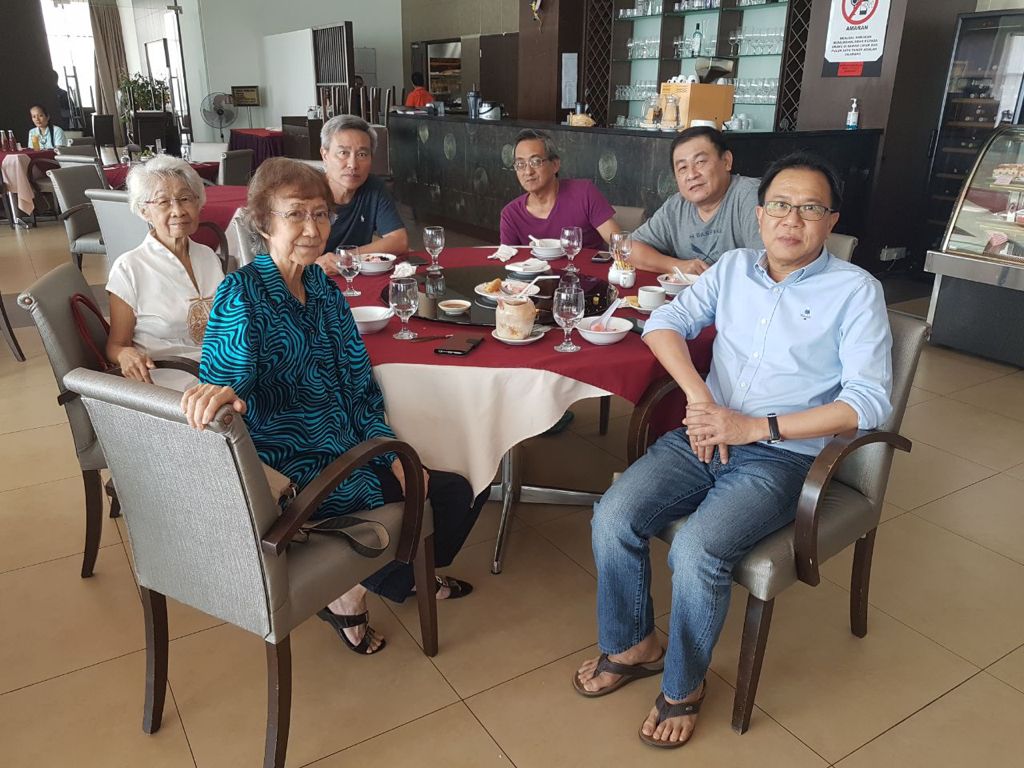
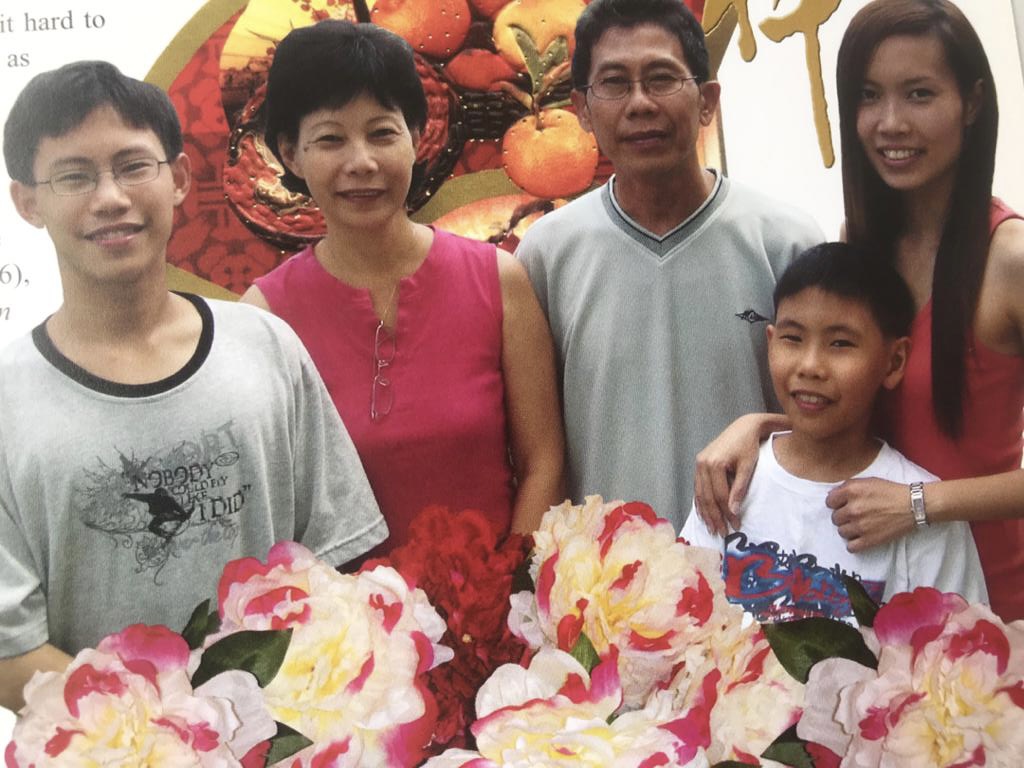
This group of teachers and friends helped shape Park Moon’s life. From left, Sally Lam, Lesley Samson, Johnny Phun, Wilson Gan, Yoke Pheng and Oh Teik Soon.
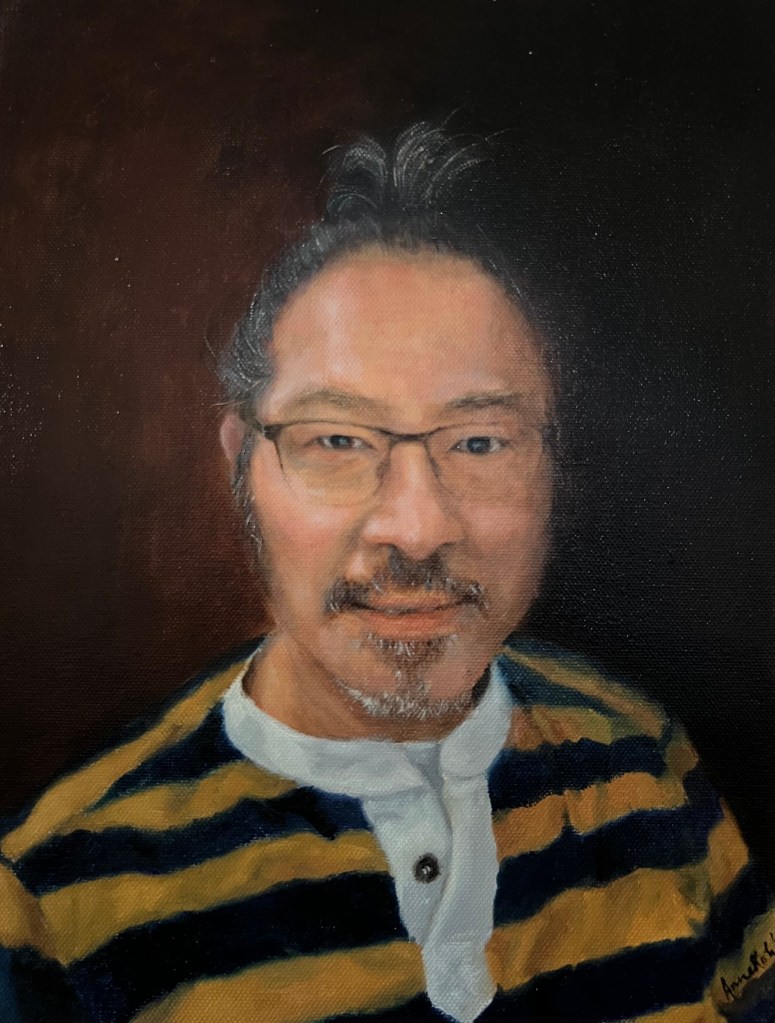
Portrait of Park Moon by Anne Koh, 2022

Zero Hero, Write About Nero

Typhoon, a hero in the Urghhling Marsh brotherhood suggested I write about Nero, since there is no new hero to write about. It has been a disappointing few weeks. My project to write a book based on fellow schoolmates from our childhood is stalling. We call one another ‘brothers’. It started so well. The excitement this project created was palpable. The brotherhood from school of course, pales into insignificance when compared with the heroism of the 108 heroes of Liangshan Marsh in the Water Margin story. We were after all merely kids who grew up in a very safe town environment – we did not have to survive the carnage of wars or overcome insidious plots by corrupt officials of the court or fight tigers in the forests. I stand accused of being grossly ridiculous to even try to compare the sharp vicissitudes of fortune many of these heroes of the Song dynasty suffered to the ordinary struggles we experienced in the 20th century, yet I felt sure our forefathers may have had their own heroic stories to tell, uprooting themselves early in their mostly wretched lives to seek greener pastures in faraway lands. Their quest, although without any of the virtuous deeds of the Liangshan bandits such as rebelling against corrupt officials, or staging civil unrest against the emperor’s rule, was still admirable for the sheer bravery and pioneering spirit to seek fortune in unknown lands.

In the Water Margin, I could almost feel the likes of Song Jiang’s and Lin Chong’s searing pain as they had their faces branded in Chinese characters that condemned them as criminals. Or, smell the foul breaths of Wu Song and Li Kui who were both often so drunk the former killed a tiger with his bare hands once and the latter’s wrath and maniacal violence made him a fearsome character. Often, it was taking justice into their own hands that turned these heroes into outlaws. Due to corrupt magistrates, justice was seldom properly served. “Taking justice into their own hands” meant only one thing. A bloody killing. There is the story about Inspector Lei Heng aka The Winged Tiger who cracked Bai Xiuying’s skull, spilling her brains on a street, for abusing and assaulting his feeble mother. Bai was a songstress who won favours and protection from a lustful magistrate using her beauty and sexual prowess. Also as gory was the story about Yang Xiong who upon discovering his wife had been adulterous with a monk in their own bedroom, plunged his sword into her breasts and pulled out her heart, spleen, liver, kidneys and lungs, and hung them up on a tree. Wu Song similarly ripped open Pan Jinlian’s blouse and sank his dagger into her breasts. With both hands, he removed his sister-in-law’s heart, spleen, liver, kidneys and lungs, and displayed them at his murdered brother’s altar table. Later, he fought and killed Ximen Qing, her lover, at a nearby inn. He chopped off both their heads and placed them at his brother’s memorial tablet as a gesture of respect and justice served. I swear, these gruesome murders were so palpable I could smell their blood and feel their pain. But then again, it could be just the chronic pain I am suffering that I feel.

For two weeks now, there has been no positive reply from any schoolmate for me to write their story. In a few cases, there was simply no reply. Silence. If only silence is consent. I could write about this friend whom I held in high esteem as a young boy. For me back then, he was as heroic as Superman. Nothing could defeat him or his mind, at least. He travelled fast, in his sister’s Honda N360. At the time, most of us were still negotiating the back alleys on our bicycles. My childhood best friend, I knew his idiosyncrasies well. Born with leadership qualities, he outshone me in just about anything or with anyone. The girls flocked to him like bees to honey. He could do the cha-cha as well as John Travolta. Slick. Smooth. Suave. Stylish, with four-inch high clogs and sixteen-inch bell-bottoms sweeping the dance floor. I can still see him with his unbuttoned pink shirt and sharp winged collars. High fashion then, nostalgia now. He was the performer, the star, the soloist on stage. I was the stagehand, in the background, in the dark. No spotlight on me with him around. I knew his parents well. Both jolly and round. The kindest folks around me in my teens. I enjoyed many meals in their cosy home. His mum would not take no for an answer. Maybe I never said no. Her food was wonderful but not plentiful. Yet, there was always some for me. I have no doubt they treated me like a son. His mum was so concerned about the girl I was dating she went to my mother to warn me. Apparently, the girl had a “reputation”. I did not know this story until just last week. My mother would not elaborate apart from saying I was stupid. Did I use the past tense? Sorry, my mother still thinks I am “ben-ben” i.e. somewhat stupid. I still do not know whether to agree or disagree. I suppose that makes her right.

With zero hero in the midst, I am asked to write about Nero instead. Why Nero, I asked. “Oh, he fiddled whilst Rome burned, of course,” Typhoon said. Apparently, this was just a myth. Ancient Rome was a slum full of poor quality housing. Wooden houses burned easily. Some 70% of the city was destroyed in a great fire during Nero’s reign in the first century. But, we know the violin was not invented until the early 16th century, according to recorded history anyway. The oldest violin is made by Amati of Cremona, around 1565. Ok, maybe Nero fiddled on a viol instead. The viol has two C-shaped sound holes instead of the F-holes of the violin. It has six or seven strings instead of the four strings. But, Nero could not have played on a viol, because it was invented some fifteen hundred years later! It later dawned on me that perhaps Typhoon was being sarcastic. To say that Nero played music whilst his city burned has a second meaning. It describes decadence, detachment from reality or worse, decay and disregard for his people’s suffering. Rome was in moral decline. Nero was reviled for his excessive indulgence in pleasure, debauchery and luxury. Conspiracy theorists believed he ordered the fire started, to grab land for his Golden Palace and pleasure gardens. Maybe he wanted an excuse to persecute the Christians and kill off the then obscure religious sect.

According to Typhoon, Nero was like a hero to the Roman commoners though in fact he was a cruel leader. He was a stepson of Claudius and became Emperor at age seventeen, attaining heroic status at a very young age. He was devoted to poetry, art and music, he fiddled the lyre, obviously he didn’t “lyred” the fiddle whilst Rome burned. He even participated in the Olympics and won every contest he participated in. In the chariot race, he was thrown from his chariot and yet was crowned winner on the basis that he would have won had he completed the race. What a hero!
At age thirty one, he fled Rome and committed suicide after he learned that the Roman elites had tried him in absentia and condemned him to death for being public enemy number one. Strange that, he almost got away with uxoricide and matricide for which he was never charged. From hero to zero, that was Nero.

Did Typhoon imply that I was out of touch with reality? Fiddling with my violin whilst friends were wrecked with economic hardship? At a time of huge suffering during a pandemic, how dare I bother them about writing their stories? There are more urgent matters to tackle, warring against a virus and putting food on the table as The Cook needs to do daily. Too many matters to think of than worry about giving me stories to retell. Blue Eyes has been back to Edmonton and then back again to the blue waters of Panama. Four Eyes, suddenly with factional wars to quell in his workplace. The Mayor, running for re-election, busily recruiting pretty young girls to wave his banners. Prez our President, running around like a chook without its head, garnering support for the hawkers and the needy in his township. Lord Guan, that towering hero of the brotherhood, still wishing to escape to Hong Kong where a white pleasure yacht full of flowing champagne and a bevy of young beauties is parked on a once fragrant harbour awaiting his arrival. Besides, there is climate change to worry about. Look at the billions of syringes, vaccine vials, face masks, plastic food packaging being dumped daily.

When I run out of heroes to write about, I can always turn to Wu Yong. He is the least popular of the heroes in my Urghhling Marsh stories. To me, it is his many annoying characteristics that make him unpopular and therefore one of the most interesting to relate to. Wu Yong learned the violin in school, from Brother Michael. He attended just a lesson or two before switching to a private teacher, Mr Woon. Br Michael was an authoritarian. He ruled the school with a long cane which he hid inside the long sleeves of his dazzling white long dress. He prowled the school grounds like a tiger prowling his territory. Any straggler in school to him was like an intruder to a tiger. To be pounced upon and attacked. Any boy who dared defy his instructions and rules would be swiftly caned. Wu Yong did not feel comfortable learning from “Lau Hor”, nicknamed ‘the white tiger’ on account of his race, his white robes and his fierce demeanour. Wu Yong failed to turn up for the school orchestra’s rehearsals after one session. Such was his disdain (or was it fear?) for the Lasallian educator. A school is only as good as its teachers, that is true. But why did they have to be violent? Why did they exact punishment on little kids with such voracious fierceness and unrestrained fury? Did they not know violence begets violence? Wu Yong wondered how many students went on to become violent adults themselves, although many thousands more turned out to be exemplary members of the school alumni.

Wu Yong played the violin rather badly for eight years, although he was convinced he was good enough to apply for a music degree in Vienna. “I knew I would not be good enough to be a performer, but I could become a music teacher,” he reckoned. But, he was honest with himself. He knew he spent more time on the football field than in his music ‘room’ – the 6 ft x 3 ft tiled landing just in front of the toilet and bathroom. He wasn’t cut out to be a footballer, and even less as a teacher. He wanted to be a dentist instead but he failed in that too.

Wu Yong vowed to join his local district’s symphony orchestra this year. At an age where many of his peers have already retired, he knew he should pick up his German-made violin again before his eyes start failing and his fingers become too stiff to dance along the strings. He gave himself one season to hone his skills before applying to join the orchestra. “Well, it is already a new season,” I said. “Have you enrolled?” I persisted. Wu Yong got visibly upset with me. His eyebrows knitted up, his forehead wrinkles scrunched even more. His scowl menacing, his beady eyes cold like steel. I immediately knew I had struck a chord with him, pardon the pun. A raw nerve, actually. “I am suffering from a frozen shoulder,” Wu Yong said icily. “I have not been able to pick up my violin since my last practice in late July; I showed so much improvement too,” he added. Wu Yong blames his incapacity on the recent vaccine jabs he had. He had a winter flu jab on the 1st Aug and his first COVID-19 jab nine days later. He suspects the two jabs so close together had caused him untold joint pain, general muscle pain and a severe frozen shoulder. Only now does he fully understand why they call it a frozen shoulder. At rest for a short while, his shoulder would feel like a slab of meat in a freezer so cold and dead it is; and when he moves it, the pain is so severe and agonising he sometimes wishes he is dead instead. He has not had a good night’s sleep since the COVID-19 jab eight weeks ago. That was fifty six sleeps ago! The intense and prolonged pain is making him into a gloomy and moody person which in turn is affecting his general health. Wu Yong reported to his doctor that his condition may be a case of “Subacromial-subdeltoid bursitis” following COVID-19 vaccination. But, his doctor casually pointed out that his frozen shoulder was on the opposite side, not immediately above the injection site.

“Ok, that may mean it is not a case of SIRVA! So?” Wu Yong protested. “Just because it is not a shoulder injury related to vaccine administration does not mean my agony is not due to the vaccine, right?” Wu Yong countered, “I had no history of such prolonged joint pain, and no chronic shoulder injury.” “Is it a mere coincidence that I am in such constant agony?” he asked, still convinced the symptoms of adhesive capsulitis occurred a day or two after his vaccination.

Although without any medical knowledge, he firmly believes his injury is a case of arthritis from a COVID-19 vaccination. As expected, his doctor dismissed Wu Yong’s amateurish diagnosis. Anyone would. Everyone did. Maybe he thinks he has stumbled onto an “eponymous disease” such as Alzheimers, Chrohn’s, Parkinson’s, Hodgkin’s, Guillain-Barré, Tourette’s syndrome. Will he call it Wu Yong’s? What is Tourette syndrome, you ask? It involves a sufferer making uncontrolled repetitive movements such as shrugging one’s shoulders, blinking or making unwanted sounds repeatedly. An example in the brotherhood would be Blue Eyes whose uncontrolled outbursts of the various versions of “pharque” and “pharquer” make it colourful reading in our chats. If he is not careful, I fear Wu Yong will be expelled from the Urghhling Marsh brotherhood. He just isn’t cut out to be a hero. With his frozen shoulder, he can’t even repeatedly shrug his shoulders.

Wisteria is in full bloom but it is doom and gloom for Wu Yong. How will he sweep up the fallen petals with his frozen shoulder?

Barramundi, Calamari and Verdi

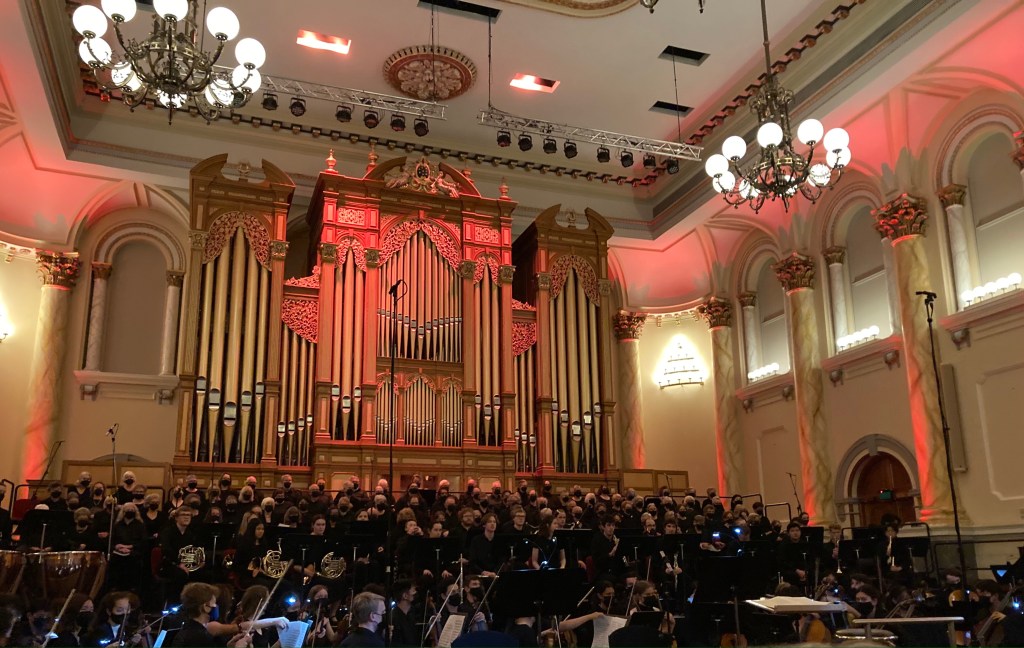
What pandemic? What lockdown? I was in the Adelaide Town Hall last night, attending a special preview performance of Verdi’s Requiem, and the whole place was buzzing with people. “Are you a VIP?” a pretty usher asked me. Well, I no longer felt important after that. “This section is reserved for VIPs only,” she continued to hurt my ego. I smiled, said “yes” and walked right past her. I knew she would not have the audacity to check the veracity of my answer. So, why even bother to ask, right? Don’t they know VIPs do not like to be asked if they are important? We damn well know we are! A special preview event for invitees only but due to the actual concert being sold out tonight, they decided to open up the rest of the hall for sixty paying guests. We are very lucky to live in this part of Australia. What pandemic? Life has been pretty normal apart from two very brief lockdowns. We have lived with zero cases and zero deaths from Covid-19 for much of this year. Live with the virus? Why, we here live normally without it. Alright, it has not been so “normal”. I get it. It is mandatory here to wear masks too and I am so used to social distancing that big crowds do worry me. That said, last night was the first time this year that I had no uneasiness about shaking hands and hugging people.

I will be 63 next month, yet there were still so many tasks that required my attention before I could leave home for the concert last night. “When will it slow down for me?” I asked myself. There were the three chooks to feed and their poo to sweep; the nine fish to feed and their poo to scoop from the pond. There was the adorable puppy to bond with. Yes, not play with or look after but a close bonding with my best pal. He is virtually glued to me. If he could talk, he will say I am his shadow. Before the chores were done, I went inside the house to check if The Mrs was getting ready. Surreptitiously, for it is dangerous to be perceived to be hurrying her. Retirees somehow lose their punctuality. She was so efficient and time-poor she was always on time. Not anymore! Secretly, I am envious of her freedom to do as she pleases, say what she likes and lose any sense of time. “No need to rush,” she will say. Rushing to get ready for the concert, I borrowed a rather “expensive-looking” jacket from my youngest son’s wardrobe. Knowing this son, it won’t just look expensive. The jacket has been hanging in there for many years. That, I am well aware of. “Such a waste,” I convinced myself it ought not be wasted. Fashion changes – it was a present from his aunt, The Mrs’ sister from eight years ago (at least). I have seen him wore it once. Never mind. He won’t know if I borrowed it, I decided. The Mrs said I should not tie up my hair. She said long hair suits the jacket. Wow. For years, she had grumbled how ridiculous I look with long hair.

I had not ventured out at night for a long while except occasionally to my favourite local restaurant, The Empress. Honestly, they do make feel like the emperor, so important do they make me feel. Besides, they never ask if I’m a VIP! What pandemic? The roads last night were full of cars, all jammed up snarling and blowing fumes. Electric cars can’t come quick enough. Yet, the governments here insist on levying a road user tax for EV’s. Go figure. I used to think Aussies are smart. After circling the Town Hall three times, I dropped off The Mrs right at the front of the hall, as she commanded unnecessarily. I know her so well words are no longer required. You’d think by now she would know I already know what she wants. There would be no free parking, I decided. Normally, my luck would deliver me a vacant car space when I needed one. After another futile round of hunting for a free parking bay (the thriftiness learned by all Penang people), I drove into a carpark nearest the venue, unaware of the stress it would cause me later.

I paused to admire my jacket in the reflection on the Town Hall glass door before I sauntered in, feeling like a young Bruce Lee. It is a phenomenon I should examine one day – how good clothes make us feel good, and how special clothes make us feel special. “Are you one of the musicians?” a very pleasant young lady asked. Maybe I have a violinist’s long strong fingers but it was a strange question nonetheless. “No,” I said and beamed her a smile without showing my teeth, which my dentist had reminded two days earlier “are quite badly stained.” She just wanted extra business, I told myself and ignored the obvious response she was looking for. No, you will not whiten my teeth! Who goes around asking people if they are musicians or professional photographers? Somehow, I get asked that a lot. Even at the Metropolitan Museum of Art in New York once. There was an exhibition by a Japanese photographer, and one of the lady ushers excitedly asked me if I was the celebrity photographer. I think she was poised to hand me a programme for my autograph.

The Mrs immediately had to go to the loo, declining a glass of wine in the process. I pounced on a red. Wine, I mean – the waitress was a blonde. We arrived early, yet the room was already full. The night’s programme informed me there would be 70 minutes of catering and beverages. Free booze and barramundi. Party time! A waitress approached me as if I was fresh air and offered me some deep fried stuff. I am normally disinclined to partake in such unhealthy stuff, but why decline free food, right? I used my two fingers like pincers and zeroed in on the golden round ball. Lightly crumbed calamari, I assumed. “I’ll grab one more, for my wife,” I said to the vivacious girl holding the round tray of food. “Yes, I am sure she is here tonight,” she said with a twinkle in her eye. Ah, humans are all the same. She must be so used to guests wanting a quick second serve, pretending to reserve a second morsel for their absent wives. With a glass of red on my left hand and a calamari on my right hand, I stood there observing the crowd. People are nice when they believe we are all A-list guests. Suddenly, there is no class, creed or race to divide us. We are all the same. We belong to the VIPs. I think that is how the urghhlings can become better earthlings. Just treat everyone as important. Listen, we are all A-listers and the world will be a better place. A couple just in front of me were making small talk between themselves. They angled their bodies differently and created a slightly bigger distance between them. Ah, an open invitation for me to step in and make them less conspicuous. I used to dislike such functions in my early years as an accountant. Having to make small talk, smile sweetly and be watchful not to make myself sound like a fool. A bean counter must project himself as dour, grey and boring – isn’t that what an old saying suggests? Never mind, I have been comfortable in my own skin for a very long time. I have no qualms about being alone in a big room full of well-dressed patrons. I am well-dressed too. It is amazing how my son’s jacket transformed me! Anyway, the couple turned to smile at me, as if pleading for me to enlarge their circle. Some couples can’t make small talk between themselves! I was quite contented to keep to myself, observing people from a distance is a kind of voyeurism. Maybe. Anyway, I stepped forward and said hello to them. He was a good-looking Italian gentleman, a State champion once upon a time in ballroom dancing. That was how he met her, a woman from Suzhou with typical Chinese looks but her skin was deliciously smooth like silken tofu. Flat face, flat nose, small eyes on a round wide face that showed a lack of discipline with her diet. She wore a scarf that was multi-coloured with patterns that mainland Chinese love. I did not have to ask where she came from to know. Her accent later confirmed it. “Hello, I am Jing,” she introduced herself. The Mrs had just joined us and asked, “Are you Korean?” Sigh. Koreans do not wear scarves that look designed for mainland Chinese. As soon as The Mrs found out Jing was from Jiangsu Province, her inhibitions vanished and instantly, the two women were behaving like long-lost friends, chatting away in mandarin with ever increasing tempo and volume. Somehow, the mutual friendliness gave The Mrs licence to talk freely about me. I pulled the Italian man slightly away from them so that they did not appear rude. His name was Carmen -not Spanish as I believed. “Carmine-red was a very common colour for soldiers’ uniform,” he said. Red coats apparently were popular to hide the blood of wounded soldiers so that their comrades would not be demoralised.

The sweet smiles of the waitress approached me again. This time, I was not going to let her go. “Ah, barramundi for me please,” I said. “And my wife is right here,” I gestured to The Mrs who seemed in another world by then. After offering the food to The Mrs and her new best pal, the waitress said, “here, another piece for your girlfriend,” she chuckled as she waltzed away. There is a reason why I am born with two ears. One to listen to the boring man in front of me and the other to catch some of the chatter from the ladies. “He’s good looking?” “No, the father is so much more handsome! Like Gregory Peck!” The Mrs disagreed loudly with her companion. “I told my husband, in our next life, don’t flirt with me. Don’t say a single word to me. Don’t catch the same bus. Pretend you don’t know me,” she continued. “I’d rather be a pebble than marry him again,” she said. At that point, I jumped into their conversation, and offered this logic to Jing. “We have been married for over 40 years, Jing,” I started. “Ask my wife why she is still with me if I am such a lousy husband!” Luckily, I was saved by the clinking of glasses. Speech time. Phew. And then it was concert time. On the way to our seats, another usher asked me, “Are you VIP? The first four rows are for VIPS only.” I replied, “Yes, I know that.” As I was sitting down, I saw a violinist from the Adelaide Symphony Orchestra. “How are you?!” I asked excitedly. He looked at me, somewhat puzzled. “Oh, maybe you don’t remember me,” I said. “Of course, I remember you,” he said. “You’re so-and-so’s (son’s name) father,” he exclaimed. Somehow, in that split second, I lost my own identity. Maybe he recognised my son’s jacket.

Verdi’s Requiem was awesome. That is one word I seldom use. ‘Awesome’ is normally reserved for the universe. That kind of greatness. The youthful exuberance from the orchestra was especially a joy to witness. I could tell they were playing on cheap instruments, but their playing was superb and amazing for their age. The Adelaide Youth Orchestra, or ADYO gave an insight into the health of the musical world in Adelaide. I am happy to report the doom and gloom expressed a few years ago by some observers is incorrect. We have a lot to look forward to, if last night was any hint. Powered by a full orchestra and a 100-strong choir, last night’s Requiem was thrilling to witness. It was a wonderful event. The concert was awesome, the orchestra impressive and the choir magical. The soloists, simply divine. Bravo! At the interval, I went and congratulated the conductor, Keith Crellin. He looked at me blankly but shook my hand anyway. I had to mention my son’s name, as he did not recognise his jacket. “Ah, you’re his father!” Keith exclaimed. I definitely lost my own identity last night.

ADYO’s Verdi Requiem

After the concert, the sadness of the music followed me all the way back to the carpark. A requiem or mass for the dead. Why would anyone write for the dead? It is as defeatist as an artist painting about death or a landscape of rubbish in a landfill. “Who on earth would want to display it on their wall?” I asked The Mrs after she showed me her painting of rubbish last year. Her painting wasn’t rubbish of course – it was just about rubbish.

Rubbish. This painting is not rubbish, it is about rubbish.

Anyway, we had a big scare when we got to the carpark. Our ticket would not scan properly to open the entrance door to the building that was locked up at 7pm on the dot. After a long wait on the phone, the AI that was manning the phone failed to show any intelligence. In the cold, we were getting desperate and I was on the verge of calling a cab when a car turned into the driveway and the boom gate opened noisily to let it into the carpark. “Hurry up!” I hurried The Mrs to keep up with me as we quickly followed the car inside. Although the machine failed to read my ticket earlier, it did not fail to charge me $29 for the parking. With the new ticket that it spat out, we proceeded to Level 4 to our car. The Mrs was cursing under her breath as by then she was getting tired and cold. My fear was soon realised – my car was not where I thought it would be. After a short frantic search, I realised the white car in the corner was mine after all. I had been looking for her blue car instead. When we got to the boom gate, the new ticket would not open the roller door. The message read “Unreadable ticket.” “Are we in a third world country?” I asked. “Nothing seems to work tonight,” I said. It felt as if the dead had been awoken by Verdi. Luckily, I persisted and tried another boom gate instead of assuming the same ticket would be unreadable by all scanners. The boom gate opened and I stepped hard on the pedal to the metal and my car screeched out before the boom gate came back down.

Le Cares About le Carré

It is said that the young should not read the Water Margin. With the heady tales of heroism, sacrifice and gallantry, it can be to the chagrin of a government to have to suppress the rebellious youths who can become highly vocal and violent in their criticism of corrupt officials and do-nothing high-salaried bureaucrats. Laced with youthful enthusiasm and armed with Confucian ideals such as virtue, loyalty and brotherhood, this sense of inspiration and glory is viewed in certain quarters as a cocktail to upend peace and stability in a society if such rebellious sentiments are left unchecked. The right to rebellion, after all, is the most dangerous of all Confucian values.

The Water Margin is a 12th century epic based on righteous men who turned outlaws in the Song Dynasty. Despite its claim that “within the four seas, all men are brothers”, the setting of the stories is wholly located in China and Liangshan Marsh the epicentre of the outlaws’ domain. In the Urghhling Marsh stories however, there is no such geographical boundary. The brotherhood is indeed global. In this chapter, we have a hero whose origin is Hanoi in Vietnam. The Chinese called it, amongst many names, Thang Long or “Soaring Dragon” as far back as 1 A.D. when it was part of Han China. The Chinese didn’t turn Vietnam into a tributary state until the 10th century, some two hundred years before the Water Margin heroes’ final battle against the Fang La rebels. That the Liangshan outlaws, upon receiving their amnesty from the emperor would quell a peasant revolution for the emperor, worried Mao Zedong enough to criticise Song Jiang and the leaders of the brigands. He did not want the Cultural Revolution to be opposed during his rule by what he called “capitulationism”. Whether Song Jiang did capitulate is not clear but our Vietnamese hero evidently waved a white flag to his promises to his parents and banished himself from returning to his homeland.

Le Nguyen was born in a village in Hanoi, in 1917. His family was not destitute for they rented a piece of land big enough to rear pigs and subsist on vegetables from their own farm. Le was the second eldest in a family of seven but the only one to complete primary school education, a remarkable achievement then. His parents were proud of him and hoped he would focus on the land. But Le had his own dreams and ambitions. He wasn’t interested in toiling the land.

Vietnam was a colony of France from the 1800’s till 1954 when they suffered a shattering defeat by  the Viet Minh. The French were impressed with the abundant natural resources in the French Indochina territories, enjoying the economic boom at the expense of the local people. Le  was not hopeful of ever leaving the brutal rule of the French. “It would be nice to see the world,” he thought as he applied for the post in Paris that required a Vietnamese translator. As a Buddhist, he firmly believed in destiny and karma, and was not dismayed when he failed to get the overseas posting. In his late teens, he became an apprentice to learn the art of engraving in a reputable French-owned jewellery company in Hanoi. He worked hard and within two years, he earned a once-in-a-lifetime opportunity to travel overseas when the company’s engraver in Penang passed away. His dreams of venturing abroad finally came true. He burst into tears as he accepted his boss’s offer, grabbing it like a lifeline. Le’s parents, on the other hand, were apprehensive and did not share his enthusiasm. But Le was in a state of euphoria. Nothing anybody said or did could change his mind. His parents had good reasons to be worried, they were reliant on his income to help with the family’s budget. But, they eventually acquiesced to him leaving after he steadfastly promised to send money home regularly and assured them he will return home as soon as he made his fortune.

On 15 September 1937, Le, a skinny 20-year-old lad, boarded the steamship in Hai Phong with the same exuberance as a wide-eyed kid in a toy shop. He was oblivious to his father’s discomfort and his mother’s red puffy eyes as he bade them farewell to them. “Will I ever see you again, my son?” his mother asked silently in between sobs.

Upon his arrival in Penang, Le was surprised to feel right at home. A big Teochew community welcomed him with open arms. The Teochew clans originated from the Chaoshan region in Guangdong and the familiarity of their food and customs further comforted him. But over time, the struggles of living alone made him homesick and he began to miss his family and friends in Hanoi much more than he imagined. He kept to his promise and sent money home regularly at first but once he succumbed to drowning his sorrows with alcohol, there wasn’t much cash left for anyone else. He became a regular patron of a bar near his home in Georgetown at the time.He enjoyed the company of a few fellow revellers who were particularly attracted by the skimpily dressed dancers who prowled the scene nightly. Le contemplated going back home to Hanoi, but  he decided not to let his parents see him as a failed adventurer.

Le’s life changed dramatically when he fell in love with a local woman named Emma whom he married very soon after. Emma was a petite woman, quite fair and very pretty. She liked to dress in the traditional kebaya, and sometimes in the cheongsam; those outfits showed off her ample hourglass figure. Her father died when she was young leaving her mother to live off his paltry pension.The lack of a bread-winner at home meant she never finished Primary School. She brought her only sister to live with them after her mother died a couple of years after their marriage. Le and Emma had two beautiful girls before the Japanese occupation.

In 1940, Le’s company closed down its operations in Penang due to the looming war. The firm was already bleeding financially as stiff competition from the local Chinese and Indian jewellers affected sales. All of a sudden, Le felt lost, confused and afraid. Losing his job meant losing his self-esteem and the ability to support his own family and a sister-in-law. Le’s employer had no pension plans or retrenchment benefits for its employees. The company hired and fired at will. Workers in those days there were not unionised; sycophancy and obedience did not guarantee an iron rice bowl. Le’s exquisite handicraft also didn’t deliver him guaranteed job security.

Le could not afford to return to his homeland with his young family because he did not have enough savings. He was neither thrifty nor spendthrift, and he was not a habitual saver. A fortune teller had already warned him years before. “Press them tightly! Together!” she almost shouted. Yet, his fingers won’t close tightly together. “I am sorry to say,” she concluded. “ but with these fingers, you will never keep money in your pockets.” In despair, he turned to the bottle even more but drinking only exacerbated his problems. The broken man often got home late at night, utterly drunk. It was not abnormal for Emma to find Le sleeping outside on the pavement. He would be so zoned out he could not find his way home, and even if he did, he would not be able to find the key to the house. Le never laid a finger on his wife or daughters when he was sober, but it was a different story when he was drunk. Emma’s ugly long scar on her thigh was a permanent reminder of one especially violent night. A nine-day-old daughter given away to save her from certain harm was another direct result of his fury when totally inebriated. Emma never forgave Le for that. This period was incredibly turbulent and tumultuous for Emma and their daughters. She realised she had to find other means to supplement the family’s income or their family would break up. She teamed up with her sister and started making nasi lemak to sell to passers-by.

Eventually, Le sobered up and rented a small shop not far from the Indian quarter of Georgetown. The market may be small for a skilled engraver, but he had no other skill and therefore no other choice. The morning he opened his own shop was the moment he realised he was not going back to his homeland. Instead of celebrating his entrepreneurial ability to be his own boss at the young age of twenty three, he squatted on the floor of his shop and screeched like an animal being skinned alive. He knew he had broken both promises to his parents.

War came swiftly and took many by surprise despite the many whispers in the media. In December 1941, Japanese troops invaded Malaya. They conquered with a speed that shocked their staunchest critics, much like what the Taliban did recently in Afghanistan. Georgetown came under heavy aerial bombardment, albeit for just a short few days. Le’s whole family crammed together in the bathroom surrounded by buckets of water to douse flames if necessary. Everyone was scared out of their wits. The two girls sobbed and shrieked but the exploding bombshells drowned out their screams.Their mother prayed to every God she knew and even to those she did not. After a sustained silence, they rushed out of their hiding place when they heard people laughing and celebrating down on the streets. All prayers were answered, there was no unbearable pain and no deaths in the family. It was a blessing that the fighting ended quickly. A prolonged bombing would have been a terrible outcome; no one wanted the unnecessary loss of more wealth, property, and innocent lives.

Le’s business surprisingly was brisk during the Occupation. The majority of his customers were Japanese soldiers who wanted mementos of their swords, belt buckles, emblems, and other artefacts engraved. “How many heads were severed by the sword I am holding in my hands?” he asked himself. Haunted by the ghosts in his mind, he became fervently religious and frequently visited the temple. Le transformed into a serious person who prided in his workmanship and vowed never to go back to the bottle after finding a neighbour so drunk he drowned face down in a small puddle of rainwater. The dead man was a Hakka man. An intelligent herbalist who wrote the most exquisite calligraphy so beautiful that he was paid to write the shop banners for his local community. He was a drinking buddy who took to the bottle to drown his sorrows also.

The Japanese replaced the Straits Settlements currency with what the locals sarcastically called “banana notes” on account of the Banana tree on the ten dollar note. The new money prompted Le to improve his savings, believing in the permanent sovereignty of legal tender. But as the months rolled by, the Japanese administrators were secretly printing more and more notes as the Allied Forces disrupted the economy in Japan. Counterfeiting was rampant also. Most of the notes did not have serial numbers. Hyperinflation inevitably caused the massive devaluation of the currency, yet his Japanese customers objected to any price increases for his services. A Japanese corporal vented his wrath on him for attempting to increase his price. “You are disrespecting our currency, you traitor!” the soldier yelled. “I should cut off your head this instant. Baka-yarou!” Le was quite traumatised by the event.

In August 1945, Japan surrendered, but the Japanese did not leave until the arrival of Commonwealth troops. One day, a Japanese soldier who spoke good English brought a bottle of sake to Le’s shop and invited him to drink. The recently traumatised Le was too afraid to turn down the request. The soldier was in a down-trodden mood and shared his sad feelings with Le. “Oh, how I miss my family! I don’t even know if my parents are still alive,” he moaned. Gulping down more sake, he continued, “Will I ever see them again? I didn’t even write them a single letter!” he cried out. Le did not utter one word in the entire monologue but felt sorry for the soldier. The soldier was a victim of fate or from his own choices in life, much like Le and the Hakka buddy were. Le felt if the man weren’t an enemy soldier, they would have been close friends.

Le started to regret leaving his parents all those years ago. The “banana notes” Le accumulated were worthless although they were once part of the $120 million that was in circulation as legal tender. Le contemplated his bad luck. What had he done that was so wrong in his past reincarnations to deserve such karma? He was broke a few years earlier when he did not know how to save. Now that he had learned to save, he was still broke. He was firmly stuck in a rut no matter which choices he made. Le also faced a new crisis in his business. Most of his customers had left or were leaving Penang. The soldiers were being marched to E&O Hotel and shipped out of the island. He became a devotee of his religion, blaming his luckless soul on his previous lack of commitment to religious duties. Emma however believed it was God’s will. “God is constantly testing us,” she taught their daughters. “God loves us and all we need to do is believe in Him,” she added. She wasn’t pious but believed that God would somehow watch over those who do not steal, cheat, harm others, or make false accusations.

Between 1945 and 1957, Le fathered four children with Emma. His business did not grow, but the income was sufficient to feed his growing family. He worked seven days a week and had little time for anything else. Often he spent the night in his workshop and resumed work early the following day. Family picnics, outings or birthday parties for his children were alien to him. His wife maintained discipline in the family and managed the family budget. Le valued education and knowledge and despite his earlier waywardness with money, he saved enough to buy a set of Encyclopedia Britannica for his kids. His eldest daughter wanted to skip school to work, but Le insisted she complete her secondary education. The family lived a simple life; the only electrical appliances they owned was a rediffusion set and a ceiling fan. The ceiling lights consisted of 10W incandescent globes and therefore were not considered as appliances. Emma bought fish and vegetables from the wet market daily, circumventing the need for a refrigerator. Meat dishes were a luxury and were only served during religious festivals or on special occasions. On the rare Sunday that he did not have to work, his wife prepared his favourite dish – Vietnamese Pho noodles. “It’s good pho me,” he used to joke.

Le ceased talking about Hanoi, his parents, his family, or even his old friends there. He had stopped corresponding with his parents since he lost his job seventeen years earlier. It was as though the man wanted to erase that part of his life. Maybe he thought of himself as a failure, for he had broken the two promises he made to his parents. In his thirties, Le wondered how life would have been if he hadn’t gone to Penang. The company he worked for was still in business in Hanoi. If he had stayed home, he would have been in a senior position with an income sufficient enough to lift his entire family out of poverty. Yet, he went to Penang to make his fortune and failed. “But that’s water under the bridge,” he consoled himself. His immediate concern was providing his children with a good education and preparing them for the challenges of a rapidly changing world.

One day in December 1957, John was busily trying to finish a customer’s order when an ex-colleague appeared at his workshop. “Hey bro, I met a Vietnamese guy at a bar a couple of weeks back. He is the current tenant of the house you lived in,” he said. “He asked me if I knew of a Le Nguyen, and when I said yes, he handed me this letter,” the ex-colleague continued. The letter was addressed to that house and bore a postage stamp from Vietnam. Le’s hand shook uncontrollably and turned icy cold as he took hold of the envelope. It was from his younger brother. Le’s heart sank into an abyss when he read the contents. His whole family was worried about him, the letter said. “We have never stopped praying for you and for years, baba and mama wondered why you stopped writing,” his brother’s words cried out. The news that hurt him most was learning both his parents had passed away. Le’s wife then was pregnant with their seventh and last child. The letter was dated 15 September 1957, exactly twenty years to the day he boarded the steamship at Hai Phong. Overwhelmed with emotions, Le did not know what to do. He felt deep remorse for being absent from his parents’ lives and tremendous guilt for failing to be the filial son that he promised to be. It suddenly dawned on him that his weakness and his quick surrender to his own plight had made his parents feel forsaken on their deathbeds. It may be incomparable in terms of importance and grandeur but his quick resignation from his oaths to his parents were similar to Song Jiang’s capitulation of his ideals by not continuing his brotherhood’s struggle for virtue and honour in a period of grinding poverty, societal disarray and moral collapse. Eventually, Le found the strength to reply, offered lame excuses for his long silence, and then begged for forgiveness.

The correspondences between the two brothers became regular. Le’s older children found jobs and considerably eased his financial burden. His eldest daughter had married a RAAF officer and moved to Sydney. With the regular remittances from Australia, the family’s quality of life improved. They finally enjoyed a television, a radio and a refrigerator for the first time. Le moved his business to a new shop in Bishop Street, just off Pitt Street. He had some savings but refused to buy a house despite the numerous opportunities to buy one at a bargain. No one could understand his aversion to owning his own house. Maybe, Le was afraid his children would fight over it one day. After his brother’s death, the link with Hanoi was broken forever. The war in Vietnam offered him the excuse for his continued self-exile from his homeland. His various personal problems and relentless commitment to work eventually took a toll on him. He greyed at an earlier age. Le of average height, and of average build carried a beer belly since his forties due to habitual drinking and lack of exercise. His skin was yellowing and part of his face especially around his eyes had dark patches. The numbness in his feet and trembling hands revealed the damage to his body from the years of heavy drinking. Despite the telltale signs of yellow teeth and receding gums, he continued to smoke cheroot, a locally made cigar. Le wore the smell of cheroot like a perfume. People would know he was approaching before they could even see him. Le was a kind person known to everyone, a hero in his community. He had an easy-going personality and his readiness to help when called upon was legendary. Le loved John Le Carré’s novels. He absorbed himself in the espionage stories and would never be caught sitting in a coffee shop with his back to the entrance. “This is not what a spy would do,” he taught me. Similarly, he would never open a door by touching the door handle or leave his finger prints on a wine glass. In 1988, he and Emma gave away their business to a Teochew friend. Le, as he did as a twenty-year-old, packed his belongings and left his home once more, this time for Sydney to join his daughter and her growing family. It would be the last time he set his eyes on Penang. Le passed away in 2007. Some ten years later, I watched the Night Manager, Le Carré’s post-Cold War novel which was made into a miniseries. I could not help but hope Le was watching it with me.

Le’s youngest son, Tranh visited me recently. He loved my rose garden and assumed I had nothing to do with it. “No, it is all Mother Nature’s work. All I do is add poo to it,” I said. Le’s investment in education paid off handsomely as all his children born after the war received tertiary education, either in the UK, New Zealand or Australia. It is through Le’s tribulations that Tranh developed a strong and wise character for himself. As far as Tranh knows, his good life and success can be all attributed to his father’s immense sacrifice and his mother’s complete dedication to the family. Tranh Nguyen, representing his father Le, is a worthy addition to the Brotherhood of the Marsh.

Addendum: Although a true story, the names and places in this chapter have been changed as the Xaverian brother had a change of heart and did not want his name published.

A rose for Le. Lest we forget.

The Cook’s Got The Looks

Li Kui, The Black Whirlwind, walked into Song Jiang’s room uninvited and was upset to find a doctor attending to the removal of Song Jiang’s face tattoo. In a rage, he accused his leader of being more preoccupied with his looks than the healthcare for his men. “Why do you waste the good doctor’s time when he could be tending to our men’s wounds and illnesses?” the loyal henchman asked. He wasn’t aware that Song Jiang, under the pretext of visiting the capital to enjoy the annual Lantern Festival celebrations in a few days’ time, was actually planning to arrange a meeting with the Emperor to gain an amnesty for all Liangshan outlaws. In the Song Dynasty, every convicted felon bore a red tattoo on their face with the nature of their crime marked permanently in words. It would not do for a criminal to be flashing his crime on his face as he roamed the streets of the capital let alone meeting the Emperor with one. So, An Daoquan the Divine Physician was asked to conduct what was a very early form of ‘laser tattoo removal’. An Daoquan, you may recall, first appeared in the chapter about The Sickly General. Li Kui has a killer’s looks – fierce, brutish and is most of the time, ungroomed, unwashed and uncontrollable. The Cook in Urghhling Marsh on the other hand, has got killer’s looks. Beautiful damsels, distressed or otherwise, are known to ask for his name and other vital details. Li Kui cares less about impressing anyone by presenting himself well or speaking intelligently. He prefers to let his twin cleavers do the talking, pointing to an old violent tribal past as the way to sort any conflict. The Cook, suave and impeccably attired, will suffocate those he won’t suffer with his quick-witted diatribe instead. We will look at The Cook’s looks in detail a bit later.

In the Water Margin, there are not many female characters that we admire. Pan Jinlian, although truly a beauty, is tainted as a goddess of fornication and prostitution. Unfairly, I might add. After all, it is surely forgivable for a siren whom Pan Jinlian is most definitely one, to fall for a strong and handsome hero such as Wu Song, the ‘Pilgrim’ who boasts of killing a man-eating tiger with his bare hands. Even my father was impressed with him, so much so that he watched that particular episode on VHS tape every day for the rest of his life in the nursing home. Pan Jinlian’s story is a very sad one. Born in a wealthy family, she was sold to a wealthy landlord as a maid when her family became bankrupt. The landlord could not resist her beauty and tried to rape her. When she reported the sexual assault to the perpetrator’s wife, instead of being looked after or compensated, she was given to a dwarf as punishment for refusing his sexual advances. The dwarf is no other than Wu Dalang, Wu Song’s ugly and much older-looking brother.

Pan Jinlian and Dalang’s is not a romantic story like Beauty and the Beast, although it is true she is the beauty and he, although not a beast, toils daily like a beast of burden bearing the heavy weight of a long wooden bar from which hang two baskets laden with home-made buns for sale on the streets. He is heard in his usual corner, offering his white steamed buns, be it pelting down with cold rain or shining with the warmth of a mild sun under a blue sky. 賣包 啊! 賣包! “Mai bao ah! Mai bao!” The screams from his dwarf-sized lungs are no match for the boy selling pears next to him. Pan Jinlian is the object of ridicule in her town, described as a flower planted in cow dung, a thing so beautiful and fragrant that is wasted on something that is odoriferous and odious, 一朵鮮花插在牛糞上. So, is it fair that we judge her harshly and condemn her for being awakened sexually by her brother-in-law’s masculinity and charm? Can we not allow a most unfortunate lady the respite of a brief encounter that tantalises her senses and fuels her sexual imagination? A respite that temporarily frees her from a forced loveless marriage which offers only a mundane life of ridicule and boredom. To lose her head from losing her self-control is too high a price.

The other villainous female in the Water Margin is Yan Poxi. Also a beautiful young woman in her prime, she had a sad life prior to being killed by Song Jiang. Her father died from a plague leaving Madam Yan and her 18-year-old daughter to fend for themselves. Madam Yan, a pimp, could only sell Poxi to the one man she knows is single and rich enough to afford a mistress, Chief Clerk Song Jiang. Was it so wrong of Yan Poxi to want more than the status of mistress, a much lesser status than concubine? She discovers incriminating evidence of Song Jiang’s close connection to the outlaw Chao Gai in his purse which he had left hanging on the bed rail after a tiff had made him hurriedly leave their house. It is understandable for her to want to cement her status as tenable and respectable as the wife of a well-respected man in their community. When he returns to retrieve his purse, she threatens to use the evidence against him unless he marries her. In his eagerness to avoid the attention of the law, Song Jiang agrees to take her as his wife before she comes up with a second demand – that her husband-to-be hands her the one hundred gold bars she mistakenly believes Chao Gai had given him. He kills her to silence her when his pleas fall on deaf ears. How can a woman who asks for money from her future husband be justifiably killed? If we look at the big picture, we ought to be thankful for Yan Poxi. Without her, we would be without Song Jiang, the leader of the Liangshan outlaws. Would we even have the Water Margin to read and discuss? In this regard, I suggest Yan Poxi’s character is much more important than Hu Sanniang even though Yan is not a member of the marsh brigands.

Nicknamed ‘Ten Feet of Blue’, Third Sister Hu or Hu Sanniang is not only beautiful but her martial arts skills are so good she even defeated her eventual husband Wang Ying, a notoriously lustful man. Song Jiang, who although virtuous and noble, is contemptible and beyond understanding to match-make the pair. Hu Sanniang would have been better off with the hero who defeated and captured her – Lin Chong, a most honourable warrior. In those days, young women were married off early since their status in the family is lower than a stool, mere chattels that they were. Hu Sanniang is treated no differently, a heroine she may be, and a daughter of well-to-do Squire Hu. During the battle at the Zhu Family Village, all Hu Sanniang’s family members were slaughtered by Li Kui who only received a verbal reprimand by Song Jiang for the gruesome and unnecessary killings. The irrepressible Li Kui also hacked off the head of Sanniang’s betrothed husband, the ambulant man was being carted to Liangshan headquarters. Yet at Liangshan, not only does Sanniang not harbour any malice or shun revenge, she dotes on her captor who is Song Jiang’s old father and dutifully becomes his god-daughter. Bless her soul, she has such a remarkable forgiving heart!

The topic of beautiful girls came up during a chat amongst fellow marsh brothers The Cook, Chip the Blue Chip, Wu Yong, Typhoon, and Four Eyes. They were gathered in the realms of their virtual universe earlier this week. Wu Yong was very quiet that day and his mind seemed another universe away. Lucky Law who normally attends their afternoon siestas was absent as well.

“Our days in Upper Five were mostly fun but some days we were filled with self pity, so despondent were we about being left behind,” The Cook said.

“You see, most of our friends had moved on to Form Six or overseas for further education. Our own school, SXI, didn’t welcome us back and instead, we were sent to a godforsaken Chinese-medium school,” The Cook, seemingly still wounded, whined.

“Why don’t we change the subject?” Chip the Blue Chip suggested something more upbeat.

“Talk about BTC?” Wu Yong asked, suddenly awoken from his slumber. Recently, he has been excited about recent price hikes in some of the crypto coins that have caught his imagination. Wu Yong who does not ‘play’ in the sharemarket that has seen a jaw-dropping longest ever bull run (twelve years and counting) likes to play with words instead.

“Siapa ada Ada ?” he asks in the Malay language.

“Who has either Ether or Ada ( both crypto coins) or neither?” he continued playfully.

“O’Susanna, who has Solana (Sol, another crypto token)?”

But, none of them took any notice of Wu Yong who is accustomed to blab to himself.

“We went on group dates. I remember we went to see a show and we sat upstairs in the movie theatre…I was next to her and….” The Cook said, changing the subject yet again, but his voice trailed away amidst the loud roars of a passing truck.

“Four Eyes will remember we went camping overnight with a bunch of girls at this abandoned building during Upper Five. But, the building was actually a fair distance from Penang Hill proper. So we had to take the train and then hike up the steep slope,” The Cook said.

“Abandoned building…. was that the best backdrop for a night of ghost stories to bring the girls to sit closer to you lot?” Wu Yong asked.

“The girls didn’t sit closer, they were hugging us!” The Cook gleefully replied.

“One classmate, a cute girl missing two front teeth, was very interested in Four Eyes, after she learned he represented State and Country in swimming meets,” The Cook continued, but it was clear no one was paying much attention to his stories.

The Cook suddenly thought of his daughter Chloe. “Chloe would surely be a great female character in the Urghhling Marsh story,” The Cook unabashedly voiced his bias.

“Surely not a Yan Poxi or a Pan Jinlian?” Typhoon suddenly showed interest.

“No! Those two are sluts!” Blue Chip exclaimed, unknowingly showing his knowledge of the Chinese classic.

“Chloe Ung Shu Yun, if I’ve done nothing right in my life, I hope I’ve done right by my daughter,” The Cook suddenly spoke in a serious tone.


“I chose her name Chloe for the character in Uncle Tom’s Cabin. I wanted her to be good, to be faithful,” he said.


A quick search on Google also reveals her to be a Greek goddess of the harvest, an epithet of Demeter.


“When I chose it, Chloe was nowhere near being a popular girl’s name. In occasional use it is not now; I think it has moved up from obscurity then to being in the Top Ten girl names today,” The Cook said.

“I suppose this is why you keep telling us you’re clairvoyant,” Typhoon suggested.

We could sense The Cook suddenly preening himself, totally in agreement.


“Her Chinese name was chosen by a sister’s Mandarin teacher, who being an educator, chose Shu (meaning book) as her middle name,” the proud father continued. “I wanted her to be well read too, so I agreed it was appropriate to use ‘book Shu,’” The Cook said without stopping.


“It was not meant to be. ‘Book’ was changed to ‘poetry’ by another well-meaning sister who thought ‘book’ sounded too much like ‘lose’ in Hokkien.”


“And so it turns out that a name does indeed influence a person’s character for she is more into the arts than she is into books,” The Cook continued, turning the group chat into a soliloquy.


“She sings and dances very well, something I can’t do to save my life.”
“She started ballet when she was very little, about four years old, and trained under the umbrella of the Royal Academy of Dance. She is a beautiful dancer, her movements and graceful Pirouettes more than reflect her Grade 8 and Advanced Intermediate level.”

“I bet she impressed like a swan in a lake,” Chip the Blue Chip chipped in, hinting at his knowledge of Tchaikovsky’s magical ballet.

Chip the Blue Chip’s version of Odette. Photo by Yeoh Chip Beng

“Chloe is a good swimmer too. She’s not fast but she’s stylish and technically proficient. She makes it look so easy.”
“When she was younger I’d arrange for her to be at the pool as folks arrived at the agreed time to consider the swimming courses I was selling.”
“She would dip into the pool and swim up and down without breaking the water and without a wake behind her.”
“‘My daughter’, I would casually add,” The Cook said.

Most were sold the swimming courses on offer.

“Chloe likes to remind me that it was either Chloe or Eloise (I wrote it down somewhere and she found it). She’s glad that it’s Chloe,” The Cook said.

Wu Yong didn’t interrupt but he told me later he thought it was strange a father would leave the list of names for the child lying around for her to find it later in life.

“Chloe wasn’t studious but she peaked at the right time, during her college days at the most competitive Chinese University college, TAR College.
Her MCE results were a little better than mine. As a reward, we sent her to the UK to top up her degree and she didn’t disappoint, returning with her honours degree!”

“Your beautiful Chloe is as beautiful as Hu Sanniang,” Wu Yong finally interrupted the soliloquy.

“From the way you adore her in your conversations, Chloe is no doubt as dutiful and loving. We have a lot to thank Confucius for his teachings on filial piety,” Wu Yong added.

Portrait of The Cook’s Odette, truly his Princess. Artist, Anne Koh.

“You’re wrong, Wu Yong,” quipped Typhoon. Four Eyes agreed, “Chloe is so much prettier and more attractive!”

“I told you she’s beautiful!” The Cook exclaimed with increasing excitement in his voice. Isn’t she a beautiful white swan who turns into a gorgeous Princess?” the proud father asked.

It is a leading question, of course. A reminder for me to write about The Cook’s good looks. The aura he emits comes from within. The years of observing a healthy diet and his strict adherence to Intermittent Fasting is paying huge dividends. There is a shine or glow on his skin that broadcasts his discipline for healthy living, and a glint in his eyes that cannot hide his secrets to good health. The Cook’s Eurasian looks would have been passed down from his grandfather’s trysts with the Eurasian lover of Dutch and Indonesian blood. Here is a man still in his prime, fit as a raging bull despite his sixty three years. With his hazel green eyes, high bridged nose, light-coloured curly hair and iron-man physique, the handsome man has often made a few in the brotherhood feel somewhat reticent and diffident with his selfies. Inadequate, even. In the Ughhling Marsh, The Cook ranks best in looks and is the undisputed master of the marsh kitchen.

The Cook is unaware he makes some of us self-conscious with his selfies.

Wu Yong Wu Cuo. 吴永误错!Wu Is Yong, Not Wrong.

In The Water Margin, Wu Yong is also known as ‘The Inquisitive Scholar’, the brigand’s chief strategist. A resourceful man, he is described in the book as fair in complexion, possessing the two typical physical attributes of a scholarly and sophisticated Chinese from the beginning of the Ming Dynasty in 1368 – a handsome face and long beard. Wu Yong first made his appearance when he helped his long-time good friend Chao Gai assemble a team of seven men to commit a daring heist of gold, pearls and other valuables worth one hundred thousand strings of cash coins. A convoy travelling from the Northern Capital to Dongjing, the Eastern Capital protected the birthday presents from Grand Secretary Liang to his father-in-law Prime Minister Cai Jing. In these few chapters, Wu Yong, whom I believed  was ‘without mistakes’ (wu cuo) made two serious ones. It took me a second reading to realise that. The first mistake was to accept that what they planned to do was not morally wrong, since “the presents were ‘ill-gotten’ loot obtained by immoral means anyway”. “Even if Heaven knows of the matter, our act will not be regarded as a crime,” was how they cleansed their own conscience of any guilt. Wu Yong’s second mistake was more serious; it could have caused the death of Song Jiang, the eventual leader of the Liangshan Marsh outlaws.

Song Jiang was sent to prison after he confessed to the murder of his mistress, Yan Poxi who blackmailed him following her discovery of his purse hanging on their bed rail. In it was a letter from Chao Gai who explained that he was fleeing to Liangshan Marsh after being incriminated in the heist. Anyone who associates with an outlaw risks losing his head. Yan Poxi wrongly assumed Song Jiang would grant her the gift of one hundred gold bars mentioned in Chao Gai’s letter, disbelieving Song Jiang that he accepted only one of the gold bars. In a moment of desperation, he killed her in their bedroom as she screamed for attention. In prison, Song Jiang, having bribed the head jailer, enjoyed the freedom to frequent a local inn. One day, he got himself so drunk he wrote a seditious poem on an upstairs wall of the inn. If proven as a rebellious plot, this would be a death sentence. Wu Yong devised a plan to fake a letter from Prime Minister Cai Jing which included a forged stamp of his prime ministerial seal. The letter required Prefect Cai, the son of Cai Jing, who was holding Song Jiang in Jiangzhou’s prison to cart the prisoner to the Eastern Capital for the Emperor to personally interrogate the suspected rebel. Wu Yong’s plan was for the outlaws to rescue the prisoner during his transfer to the Capital. Wu Yong Wu Cuo, Yong who is not wrong, realised the grave mistake he made. The Prime Minister does not ever use his official seal in his letters to his family. Prefect Cai ordered Song Jiang’s dispatch to the town square for immediate execution following the discovery of the fake letter. Until the universe is unmade, contumacy will always trump obedience to lawful authority in a band of outlaws. The outlaws stormed the procession, killed all the guards and rescued the prisoner.

The other Wu Yong, the cur from Urghhlings Marsh, is not scholarly and not a master-planner, unlike Wu Yong of Liangshan Marsh fame. He has been known to say he’s Yong, not wrong. Wu Yong calls himself ‘The Cur’. I called him today and asked him why. It seems odd that anyone would call himself a mongrel or an inferior dog. Another meaning of ‘cur’ comes from an old Norse word meaning to grumble or growl. In that context, a cur is a surly bloke. Suspecting that Wu Yong meant he was the latter, a grouch who complains incessantly, I was taken aback that he said he was born in the year of the dog, and there was nothing wrong with a dog.

A dog has magnificent qualities that many humans lack!!

After all, a dog is a man’s best friend. “So, what is wrong to call oneself a cur?” he asked.

The more I got to know people, the more I love my dog.

Mark Twain

In Curse The Curs, we learned that Wu Yong was unpopular, misunderstood and therefore often picked on. His mother said she has always known him to be foolish and rash. It did not surprise her to hear that people think he “blows dog farts” whenever he speaks. I was astonished to see how fast he has aged. It was only last year that I had the opportunity to take a long look at him and study his movements. His long mane has turned dry, wiry and hoary, gone are the shiny black strands. The gait is more that of a clumsy old man’s – missing are his sure steps that, once upon a time, reminded me of a mountain goat. The evanescent wrinkles on his forehead are now deep and long, and permanently etched. His wife finds his unrestrained farts indecorous and annoying in bed. So, I gather he fails miserably in that department, even though as a young man he read the 1972 edition of ‘Joy of Sex’. She disagrees that his coquetry with the waitress in their favourite restaurant is simply harmless behaviour. But, she isn’t the least concerned. He is a scrawny chap with a wan complexion and puny arms. It seems more than a coincidence that he is suffering from a frozen shoulder since his Covid flu jab from five weeks ago. His doctor laughed at his suggestion that somehow the vaccine had caused inflammation to flare up in his left arm. His partial physical impairment is becoming obvious as I look at his ever-shrinking biceps and the stiffness in his arm movement. His arms look pencil straight, gone are the toned mounds of muscles.

“Just as well I don’t wear a bra,” he confided to me today, as he demonstrated with the partially paralysed limb. He failed to take off his imaginary bra.

His miserable forlorn voice added to the dolorous story of his misery and pain in the bathroom where he struggles daily to undress himself.

“I am not wrong,” he said adamantly.

He pointed to the Google results of ‘adhesive capsulitis’ from his search for “side effects of flu vaccines”. Wu Yong, I think is not wrong!

I became interested in why Wu Yong The Cur needed to assure everyone he is not wrong or ‘without mistakes’. Is he not aware that such self-justifications can become weak excuses that are not only unnecessary and tedious, especially to someone who doesn’t actually care, but worse, they reflect poorly on his own insecurities? Trying to appear right all the time will only show his own fragile ego. Does he not know respect is earned and not demanded? Pretending to be right when he is wrong will only hasten the damage to his diminished status. A “know-it-all” in any gathering will suck the fun out of the party. We lose the friendly banter and the innocence of our silliness whenever we have two guys in a room who must be right.

“Why do you have to be so defensive?” I asked him in an interview for this story.

“So what if they mock you or belittle your comments?” I prodded him for his answer.

Most people do not invest their time and emotions in a silly debate anyway. It takes a wise one to be the spectator or simply walk away. There is no need to prove we are right when there is no point to prove. I teased at his wounded pride like how a surgeon would carefully pull out a cancerous growth from a patient’s organ.

It began as early as when Wu Yong was no more than nine years old. He was dabbing his lips with the soft damp towel his mum had given him to wipe his face. His mum shouted at him from across the main work area of their shophouse on Penang Road. The workers in the room, hunch-backed from years of ironing clothes from a bench too low for the height, looked up from their charcoal irons and cast their dull eyes on the boy who was being yelled at by ‘Towkay-Soh’ (boss’ wife). Their eyes lit up in unison, awoken by the surprise entertainment. The young Wu Yong, embarrassed by the unwanted attention, protested loudly.

“My mother was accusing me of cleaning my teeth with the towel,” Wu Yong said.

The louder he squealed, the angrier his mother got. “FEI KOR PHIWO!” (DO NOT LIE TO ME in Ningbonese)!” she threatened as she chased him around the office desk with a bamboo cane. The boy was too fast and agile for his mother, which made her even more furious. “I was telling her the truth,” he said. Wu Yong reckoned from that day on, he had the need to say he is not wrong when he is right. “I am Yong, not wrong” would ring loudly like a temple bell in his mind whenever he felt wronged.

Portrait of Wu Yong by Anne koh.

Wu Yong calls the other event that moulded his character to defend himself strenuously “The Missing Note”. I assumed he must have been ‘out-of-sync’ during an orchestral rehearsal after missing a note, or perhaps made his violin teacher, Mr Woon, scream at his carelessness for misreading the music.

“No, it was the missing ten dollar note,” Wu Yong said.

He was in Upper Secondary by then. Every afternoon after school and every Saturday after Boy Scouts meetings, he had to rush home to their shophouse to man the dhoby shop. His parents were beginning to enjoy some respite from the long hours of their laundry and dry-cleaning business.

“That’s why a son is more useful than a daughter,” Wu Yong whispered in my ear.

His job was to serve customers who dropped off their dirty clothes to clean or to retrieve them from the bank of tall glass cupboards that displayed the cleaned and crisply ironed clothes awaiting collection. Wu Yong was adept at folding and packing the clothes into paper bags, beaming with self-satisfaction every time he received praise from the customers who were mostly Europeans. Unfortunately, the till was short of a ten dollar note one day.

“Ma accused me of stealing from the till,” he said.

“Why would I? I had the freedom to buy lunch from the Mamak stall,” he continued.

For a dollar or a dollar fifty, Wu Yong could fill himself up with a plate of rice and curry chicken. The fifty cents would have been for one hard-boiled egg dipped in curry and some veggies.

“Whatever food I spent on, I recorded the expense in the journal, but somehow that day, I was short ten dollars,” Wu Yong said.

He never checked the till’s float before starting his shifts, such was the accuracy of his work. His mother flew into a rage when he dared suggest the float was short ten dollars before he started his shift.

“Yeah, Yong, not wrong,” I quickly sympathised with him.

Wu Yong related this story to his mother last night during her 99th birthday celebration. The grand old dame said she does not remember such an incident occurred.

“Maybe she meant she wouldn’t have flown into a rage; such a lack of control isn’t lady-like at all,” I suggested to Wu Yong.

Another childhood incident that flawed his character has to be the one about ‘the slaughter of his pet hen’. The family kept some hens in the back lane immediately behind the row of twelve shophouses. The private lane was protected from the outside by a twelve-foot-high brick wall which had a crown of razor-sharp jagged glass. The square heavy duty metal grid cage, cleverly situated above a small open drain whereby their poo could be easily hosed straight into, was quite ‘palatial’ for the three or four chooks which were more accustomed to being crammed in small wicker baskets used by the chicken-seller in the wet market. There was a particularly beautiful bird which the young boy fancied. He made it known to his mother and the family maid, Yung Jie, that the bird was his pet and “not to be touched”(by the chopper).

On the eve of Chinese New Year just after he had turned thirteen or fourteen years old, he discovered his hen had gone missing. Yung Jie’s hand was pulling out the entrails of a defeathered chook when he confronted the woman who was in high spirits. Chinese New Year meant not just a few ‘angpows’, red envelopes containing money for everyone and one day of gambling and feasting but also tins of kueh kapek, peanuts and assorted lollies plus crates of F&N Orange and Sarsi drinks to enjoy. Yung Jie would not confirm that the chook she had just killed was Wu Yong’s pet. Her awkward chuckles and nervous denials raised the boy’s suspicions who went rummaging through the metal rubbish bin that was once a tall biscuit tin. Recognising the drab scalded feathers as his pet’s proud colourful plume, he burst into tears and started accusing poor Yung Jie of animal cruelty. He poured so much guilt on the poor woman that she also burst into tears and started wailing about her miserable life. To this day, Wu Yong has not been forgiven by some of his siblings who accuse him of bullying their servant whom they all remember fondly.

“I was not wrong!” he shouted

He remains defiant that they should not have killed his pet although he deeply regrets wounding Yung Jie’s kind heart.

It does feel like the night talking to the day with Wu Yong, or more appropriately in this case, a chicken talking to a duck. Sometimes, I just have to agree to disagree with him.

Three days earlier, another episode triggered off Wu Yong into another flashback about being wronged when he wasn’t wrong. “Wu Yong, wu cuo!” he protested. He is Yong, not wrong. We get that now.

Over the winter he had been pruning his neighbour’s roses, getting them ready for a big show in mid-Spring. It was a rather wet and cold winter, and with a crooked arm, he did not quite complete his task. As luck would have it, a retired horticulturist – a former lecturer in Horticulture and Landscape Design who was also once a curator of Lae Botanic Gardens for over twenty years, stopped by and walked up to the house. He had been admiring the garden for quite some time, he informed Wu Yong. But, he could not restrain himself that afternoon and decided to offer his services to prune the roses “properly”. Wu Yong’s neighbours, having been stuck overseas during the whole of the pandemic, were quick to agree to the offer from the expert. Upon seeing the result of his work, the neighbour’s wife exclaimed, “Oh, you have been pruning them wrongly, Wu Yong!”

Wu Yong, wu cuo!

Wu Yonggang
Better late than never, late pruning in Spring
Can you hear the Galahs laughing at Wu Yong’s mistakes? Photo taken by Yeoh Chip Beng

Bang Bang And A Gang. How Wang Became Ang.

Wang Lun in the Water Margin, was the first chief of Liangshan Marsh. His band of outlaws was small then. When assembled, they formed only two lines. Wang Lun, “The White Clothes Scholar”, was not the academic type. Having failed the government examination at the Eastern capital, he went to stay at Squire Chai Jin’s estate for a few days. He was somewhat beholden to the Squire who also gave him some silver for travelling expenses when he left to continue his journey. Drill Master of the Imperial Guards, Lin Chong by chance also met Squire Chai Jin after he escaped from jail following his troubles with Master Gao Yanei. Gao, the foster son of lecherous Marshall Gao Qiu, implicated Lin Chong of crimes he did not commit so that upon his banishment, he could marry Lin Chong’s beautiful wife. She hanged herself after being pressured to marry the despicable ugly young man. Lin Chong’s admirers, reviled by the injustices, lured Gao Yanei to a hut and cut off his penis but kept his testicles intact. This left the obnoxious character with intense sexual desires that were permanently unsatisfied. But, I shall not deviate from the story about Wang Lun, a chief of the stronghold on the hill with no special abilities. The squire handed his letter of introduction to Lin Chong recommending him to join the gang. “Present my letter to the chief, and he will welcome you like a brother,” he said. Although he was obligated to satisfy Squire Chai Jin’s request, Wang Lun still insisted on seeing Lin Chong’s ‘membership application’. “Ok, do you have paper and ink for me to write one?” Lin Chong asked, unaware that a membership required a man’s freshly severed head to be presented to the chief before he could be welcomed into the brotherhood.

The next hero, Ang-not-Wang, in The Urghhling Marsh story is a fourth generation Malaysian. His great grandparents on his paternal side fled Tang Aun village in Fujian during the decade-old Xinhai Revolution which ended over two thousand years of imperial rule in China. By the time Sun Yat Sen became ‘Father of the Nation’, Great Grandfather Wang had already settled in Penang, Malaya as a poultry seller. Due to a clerical error at the Registry of Birth, Death and Marriages and a lackadaisical attitude to incorrect spelling, Wang became Ang. The sixth of fourteen children, Ang Iok Hun (1904-1998), was famous as the first station master of the Penang Hill Railway. Iok, pronounced as ‘Yok’ is the Chinese translation for the biblical name ‘John’. He started his career as a “checker” in 1922, overseeing the construction of the railway after passing his Senior Cambridge at the Anglo-Chinese school. A year later, he was promoted to station master, a position he held till his retirement in 1961. Despite historical records stating that the construction workers were ‘mostly convict labourers’, Iok Hun said they were paid workers of Federated Malay States Railway, their hourly rate being 90-95 cents. The mandor or kepala earned twice as much. Iok Hun’s monthly salary was $75, a princely sum for the then 20-year-old. A dollar could buy him a roast duck, or thirty three eggs or thirty three durians! The workers lived on the bottom of the hill in a kongsi or community longhouse. In those days, malaria outbreaks were frequent, so every man was expected to take a small teacup of quinine daily for a month.

There were five gangs of workers; each gang consisted of thirty to forty fit and strong young men. Their jobs were to fell trees and chop up timber to feed the flames of the boiler. The steam from the boiler powered the winches that pulled a convoy of trucks up the hill supplying the cement, granite and sand for another gang of workers to work on the construction of the railway. The workers were mostly Indians and Hakka men, all noisy and jolly, tough and rough. They loved singing and joking whilst working in the cool and fresh surroundings of the lush tropical jungle. Iok Hun, a member of his church choir, was often heard singing with his men. There were reports of many sightings of tigers and other wild animals in those days. However, there was not a single report of any man who killed a tiger with his bare hands – simply said, the mythical story of Wu Song in Shuihuzhuan was unmatched in Penang. Otherwise, the scenes described are reminiscent of the hills above Liangshan Marsh in the Water Margin story, where the junior recruits had to build jetties, camps, guest quarters and assembly hall from trees they felled in the forest. The mud to make bricks, huts and stoves was in unlimited supply from the river below.

The railway was officially opened on January 1, 1924, by Sir Lawrence Nunns Guillemard, Governor of the Straits Settlements. Prior to this role, he had no previous experience representing the Queen of the British Empire. His governorship left behind many notable buildings which still stand today – the Cenotaph, the Causeway, Singapore Yacht Club, and Singapore General Hospital, to name a few. In the old days, most of the visitors to Penang Hill were Europeans and wealthy towkays. The ordinary folks were either too poor or too preoccupied with survival to holiday there. Life on the hill was slow, the funicular train operated only on the hour. The colonial mansions were a popular retreat for the European expats who frequented the lush green hill to relieve themselves from the stifling and humid conditions below. Once news came that the Japanese would arrive soon, the Europeans fled from their English-style resorts with their beautiful stonework stairs and quaint floor patterns and Italian wall tiles. The size of the mansions complemented the massive well-maintained English gardens. The romantic balconies that looked out to the calm waters of the Indian Ocean were soon to be occupied by foul-breathed and foul-mouthed Japanese officers whose every third word was ‘bakayaro’. “They farted like dogs most of the time,” Iok Hun said. During the early days of the war, the Japanese dropped bombs on Penang. The hill was not spared, a bomb from the sky destroyed the bus that ferried railway passengers to and from their bungalows. A section on the lower end of the railway was badly damaged. The Butterworth power station was also bombed, rendering the railway out of action without electricity. It was not until 1942 that it was repaired when the Japanese required a look-out post on the hill.

At first, the Japanese soldiers were rough and rude, and ignored the signs limiting the maximum number of passengers in the chocolate-brown wooden railway coach. An active member of the Air Itam Methodist Church in his younger days, Iok Hun prayed hard before risking his neck the following day by complaining to the Japanese Governor about the unruly behaviour of the soldiers. The Governor ordered a senior officer to accompany Iok Hun back to the railway station. There was no misbehaviour by the soldiers after that visit. Iok Hun was later summonsed back to the Governor’s estate but the sweat beads on his forehead and his nervous eyes were ephemeral. He thought he would lose his head from a disgruntled officer’s complaint but he only lost his way home after having got tipsy at the Governor’s dinner party at the E&O Hotel for selected staff and guests.

John Ang Iok Hun’s family

Ang-not-Wang’s dad, Ang Sim Boo, born in 1933, was the sixth child and third son of fourteen siblings. His family photo taken after the war in 1945 shows only seven kids playing at the back of their house in Air Itam which was a jungle at that time. Two siblings died during the Japanese Occupation. A Police Volunteer Reservist in the mid-1950’s, he became the station master of Penang Hill after his father, Iok Hun, retired. Sim Boo and his eleven siblings grew up at the railway quarters provided for their father. A notable flautist and a table tennis champion, he was unlike many of the young men of his generation, lucky to be given a solid education. Sim Boo served as the station master for thirty three years. The Penang Governor awarded him the Pingat Bakti Setia medal for his loyalty and dedication to his work in 1987. He spent most of his life up in the hill of Penang. Before the cocks crowed and the evanescent dew clinging to the big palm leaves still whole and clear, the wispy captivating sounds of a sweet angelic flute was often heard wafting in the cool morning air. Occasionally, the melancholy notes of a harmonica would replace the classical contemplative tunes of the flute. Sim Boo was adept at both instruments. Under a stubborn and heavy cloud of mist that wouldn’t lift, Sim Boo called out to his men, “Be careful today, visibility is poor. Don’t use the signal flags when you move the trucks. Whistle once for stop, twice for forward, and three times for reverse”. His loyal men appreciated his care and concern for their welfare and safety.

Unlike Wang Lun of Liangshan Marsh, Sim Boo was an effective leader of the railway station on the hill. His men did not revolt against him. They did not strike. No one raised their hands against him. He was highly respected by everyone around him and his reputation as a tough but fair master attracted many to want to work for him. The mendacious Wang Lun, on the other hand, showed his ‘small heart’ and his ‘two hearts’ by presenting Chao Gai with a tray of silver and gems whilst refusing to accept him and his men into the brotherhood. Wang Lun understood that it was as good as sentencing them to their deaths by the pursuing imperial soldiers who numbered in the thousands. Lin Chong whom Wang Lun had just promoted as his second-in-charge to quell the unrest within his group, displayed his disdain for his chief with a strong body language. He despised such cowardice and lack of altruism and swiftly killed the hapless leader. Upon seeing their leader motionless in a pool of his own blood, the men all knelt or genuflected and made Chao Gai the new leader of the gang.

Ang-not-Wang’s maternal great grandparents were from Lam Aun Hakka State in Guangdong Province, China. His name was Ooi Thean Kua. Her name was Khoo Bon. In Malaya, he was known as ‘lawyer buruk’, i.e. a lawyer without proper qualifications. Be that as it may, a bloke in China born in the 19th century with knowledge of the many facets of law and the legal system is to be greatly admired. “My own great grandparents could not even write their own names. They were always addressed by their status in the family hierarchy and so, their names are forever lost,” Wu Yong, a less popular hero in the Urghhling Marsh said. Peasants in that era could not be expected to be literate; they were mostly impoverished, angry or dying from starvation. There were already large-scale uprisings against the Qing government. The corrupt Manchu officials were thin in numbers and could not govern properly. Foreign invasions added to the misery of the people who were already suffering from natural disasters, civil unrest and disease. The migration to South East Asia for safety and economic reasons continued and escalated after the heavy defeat in the Second Opium War and the capitulation to the perceived weaker Japanese army eventually led to the fall of the Qing.

Ooi Phaik Gee before she grew her pigtails

Ang-not-Wang’s mother, six years her husband’s junior, was the second child and the eldest daughter. Although her name was Ooi Phaik Gee, she was better known as “samseng po” or tom-boy in her childhood haunt in Rope Walk. Her father, Ooi Hock Seng (1916-1980), operated a hardware shop called Hock Hoe Trading near Standard Chartered Bank in Beach Street. He remarried after his wife, Loh Chin Neo died in 1953. In the war, a bullet wound permanently scarred her with a bad limp and left a mark of a crescent on her left leg. The family of four was at home in 78, Kimberley Street when a shop selling house coal across the street was hit by a bomb. The front wooden casement window of their house was in flames by the time the family fled outside. Hock Seng carried their son on his back and Chin Neo carried Phaik Gee in her arms as they joined the panic and fear of the crowds surging in the street. Bang, bang! Chin Neo suddenly felt her left thigh go numb before she tripped and fell. As she sat on the road in agony, she saw her wound gushing out blood. Only then did she realise she had been hit by a stray bullet from across the coal shop. A young man who was also running from the mayhem ahead of them turned back to help her. The quick-thinking hero saw an abandoned rickshaw from the corner of his eyes, and rushed to take ownership of it. “In that moment, I would have commandeered it if I had to.” Yap Seng told Chin Neo later, laying further claims of his heroism. He carried Chin Neo into the wooden carriage and pulled it hastily to the Dato Keramat Hospital. Hock Seng and Chin Neo were forever grateful to Yap Seng. They remained friends after the war. The couple had five children.”Her subsequent two stepmothers produced nine more children for Grandpa Ooi,” Ang-not-Wang said as he related his mother’s story to me. “All of them looked up to their sister as ‘Tai Ka Jie’ and their respect for her was unquestionable even though she was only fourteen when her biological mother died. She attended Convent Dato Keramat and was already a devout Catholic in school with Theresa as her Christian name”.

Sim Boo and Phaik Gee were engaged in 1954 “after six months of going to the movies together” and they married a year later. “There’s not much to say,” Ang Sim Boo said about their romance. He couldn’t explain why a Methodist boy would attend a Catholic congregation except to say that was where he first laid his eyes on her. Phaik Gee was a dazzling beauty, with a good sense of style and fashion. Her eyes were mesmerising, and her lips full with a sexy pout. She had a healthy mop of natural curls, and a nose with a prominent bridge that was not aquiline, made cute with a slight bulbous tip. On some occasions, she wore her hair with two pigtails which made her simply adorable in an age of innocence. In some of her photos, she showed a certain coyness and charm reminiscent of a young and innocent Princess Diana. Unlike Phaik Gee who had a knack of dressing well, Ang Sim Boo’s habiliment was predictably the same every day, that of a train station master’s uniform. A practising Methodist all his life, love, faith and hope are the three strengths that remain with him and the greatest of these is love (1 Corinthians 13:13). The couple celebrated their Golden Wedding Anniversary on 18th November 2005. They produced four children and seven grandchildren.

Ang Sim Boo and Phaik Gee with their three daughters, Jenny, Florence and Anna. Ang-not-Wang on the far left.

Ang-not-Wang, the second born, is the only son. He is very much like his father. He is well-groomed and wears a perpetual smile, possesses a strong infectious personality, an unwavering Christian faith and is well-liked as a natural leader. Both were in the transport industry; he was a bus checker at one point in his life, and his father a train checker. Both are devout Methodists, great coaches for the younger generation and preach against idle gossip. Ang-not-Wang is not one to readily accept a ‘no’ for an answer when a ‘yes’ can help someone in need. A holder of a double diploma in Bible Study, he is a qualified counsellor in child transactional behaviour. He is a SXI alumni like all the other heroes in his brotherhood. I say that because there is absolutely no doubt that he has been accepted into the Marsh brotherhood even though I have not sought any confirmation. In school, he was like Wang Lun, in white school uniform and a lousy student who was neither good academically nor a sportsman. Whilst Four Eyes (one of the Marsh heroes) caught the school principal’s praise for his swimming prowess, Ang-not-Wang’s bad class report cards attracted the principal’s cane instead. He told me he found God when he turned fourteen. I reckon maybe it is truer to say God found him and converted him from that mischievous trouble-maker that he was in Sunday schools to save the teachers from a hellish time in class. After Form 5, God gave him a taste of his own medicine by making him become a kindergarten teacher. The young man did not enjoy a career as a teacher, so he tried other professions such as a bus checker, a printing operator before finding his element as a salesman in ladies’ and menswear, later switching to biscuits and detergents. He joined Nestle in the eighties, a fast moving consumer goods (FMCG) company that many salespeople aspired to join. Nestle recognised his managerial skills and eagerness to learn and invested in him, sending him to many international seminars and training camps. He moved up the corporate ladder over the next twenty five years and finished as the Senior Manager – Commercial Excellence Manager handling strategies, processes and projects.

Today, Ang-not-Wang occupies his time by looking after the needs of his congregation and sets himself up as a role model for the youths in his community. The pandemic has raged on in Malaysia with no end in sight. Sympathetic to the plight of the local people around him, he helped form the ‘Nuri Cares and Support Group’ in his residential community called Nuri Taman, whereby he organises the distribution of food and small necessities to those out of work and cannot support themselves. Ang-not-Wang is an unsung hero and a quiet achiever. He surely belongs to the Urghhling Marsh brotherhood.

Michael Ang and wife Dorius Ding

The past holds our fond memories, the present is a gift we enjoy and there is always hope for tomorrow.

Michael Ang Lay Beng

Portrait of Michael Ang Lay Beng by Anne Koh.

The Venerable Sickly General

The epic novel, Water Margin, is known by a few different names. In Chinese, we call it shuihuzhuan. In the West, it is commonly known as Outlaws of the Marsh. Its translation is ‘All men are brothers’, perhaps the ancient vernacular stems from Confucius’ 四海之內皆兄弟也 or ‘Within the four seas, all men are brothers’. The idea to write a book about a brotherhood of schoolmates and their families’ journeys from the East excited me greatly as the notion that we are all brothers has long been drummed into our psyche from early Lasallian teachings. It is fantastic when brothers reunite after a great distance in time and space. However, the recruitment methods in the novel are often atrocious. I can understand why the author of the book, Shi Naian, found it necessary to resort to ‘unsavoury’ tactics to recruit some of the outlaws. Many of my friends also show strong reluctance to participate and some are strangely aggressive in their refusal to have their stories written. It is not surprising that occasionally, a devious idea foments in my head to persuade less inclined brothers to participate. The hero in this chapter, however, needed no twisting of his arm – he has come forward voluntarily and for that, I thank him from the bottom of my heart.

The only doctor I remember in The Water Margin made a rather late appearance. By then, their leader Chao Gai had already died. It was his spirit that warned Song Jiang of a propitious star ‘Di Ling Xing’ shooting across the sky above him, indicating that a calamity would befall him. Song Jiang was in all likelihood already delirious with a high fever from an ulcer on his back. One of his chieftains, Zhang Shun knew of a doctor who treated his mother with a similar illness and thus knowing it could be fatal, it was imperative that he recruited the doctor urgently to save Song Jiang. The doctor was, of course, reluctant to sacrifice his city lifestyle and jeopardise his livelihood for a rebel. How An Daoquan was recruited to become the Liangshan physician was a strategy often used in the novel. Zhang Shun murdered a prostitute by the name of Clever Pet, and then smeared a ‘confession’ by An Daoquan with her blood on the wall of her boudoir. When the poor doctor woke up the next morning, he realised he had no choice but to flee to Liangshan Marsh. At Liangshan, An Daoquan cured Song Jiang of his life-threatening illness. His reputation as a miracle doctor working with the barest equipment and drugs earned him the title of Divine Physician. Following an amnesty granted to the brotherhood by Emperor Huizong, he later saved the emperor from an illness which enabled him to stay in the palace as the imperial physician. 

The Sickly General with wife (middle) and brother (RHS) at Everest Base Camp, 5,300 m above sea level.

The vivid scenes described in the novel transported my mind to the stories a friend shared with me. He too described an important time of his life spent in the deepest jungles and riverine systems. But, he wasn’t fighting other outlaws or army forces; his endeavours were to snuff out illegal fishing and poaching of endangered species of wildlife such as the Johor rhinos and Bigfoot. Duobing Jiāngjūn, or Peng Kuan (in Cantonese), aka The Sickly General, hailed from the same school in Penang, but we were never classmates. He was a lot smarter. For me, apart from saving lives as a doctor, his major contribution to his country has been as a member of the Malaysian Nature Society. They helped protect the riverine systems and documented many varieties of freshwater fish. They also discovered many birds and butterflies in the virgin jungles that are now part of the Endau-Rompin National Park.

As Sima Yi in The Three Kingdoms said, “Misfortune generates blessings and blessings breeds misfortune”. The opportunity came after one of the heaviest monsoon seasons with floodwaters over 40 metres destroyed much habitat and also all the illegal fishing nets. The Sickly General and his cohorts suggested to the authorities to grab the opportunity to ban fishing in one tributary and that gave birth to Kelah Sanctuary, a crystal-clear river now thriving with Mahseers. His entry into The Urghhling Brotherhood is well deserved and requires no invitation.

The Sickly General’s paternal grandfather Ah Yeh left Chung San, Canton District, China for Selama, Perak in the 1920’s. He married a Hakka girl, a first generation Kedahan. She bore him many children. The Sickly General’s father was the third of four sons. When the war with the Japanese broke out, Ah Yeh burned down his own general store to prevent the invaders from getting hold of the provisions. Ah Yeh and his family went to Penang to live with his eldest daughter who was married to a dentist whose Wu Dental Clinic was in Chulia Street. Wu had a younger brother, a martial arts exponent who trained with sand bags tied to his legs. He purportedly was able to leap over walls just like Lin Chong did in The Water Margin, after he learned Marshall Gao Qui’s adopted son was harassing his beautiful wife in the Yue Temple. Younger Wu made sporadic guerrilla attacks on the Japanese but suddenly died of a heart attack when the enemy troops came to check the shophouse where he lived. Luckily for the whole household, the soldiers did not find his cache of spears and swords. All heads would have rolled and that would have been the end of The Sickly General’s story before he was even born.

The Sickly General’s maternal grandfather, Ah Kung was a first generation Penangite; Ah Kung’s mother was a second wife. In those days, bigamy was a privilege for men with wealth or status.

“Ah Kung’s father passed away when he was still in conception,” The Sickly General told me.

I did not want to pry and ask how he could be so precise – after all, conception occurs within hours to a matter of just a few days after sexual intercourse. After Ah Kung’s birth, mother and child were chased out from the family. He was taken care of by a well-to-do auntie and studied till Secondary School – it was quite a privilege in those days to be given an education. Ah Kung began work as a clerk in the American Automobile company as soon as he graduated from High School. When his wife died of asthma, he was devastated but didn’t remarry;  the eldest daughter and The Sickly General’s mum, the second oldest, had to stop school to take care of the household. His mum worked for a Baba family, and from the Nonya matriarch, she learned great recipes and followed the strict meticulous disciplines of Nonya cooking. A great cook to this day, his mum, now eighty seven years old, insists on generous portions of quality ingredients to make each dish superb. She supplemented her income twice a year by making Chinese New Year cookies and Nonya Bak Chang for the Dumpling Festival.

“Mum was very generous to her seven siblings, and to my father’s fourteen siblings including two sisters who were given away,” The Sickly General said with a voice filled with love and pride. 

The Sickly General was born and raised in Chulia Street, next to Love Lane just behind our school, St Xavier’s Institution (SXI). His father’s eldest sister who married Dentist Wu was the chief tenant of one of the shop lots. Numerous rooms were sub-let to others. The Sickly General’s mother, a pretty single girl then, and her own family were amongst the other tenants. Naturally his parents fell in love in that house, and they married soon after. The Sickly General was the firstborn of four children. Chulia Street still brings him haunting memories of the stench of night soil as they were being collected from each household.

“You don’t want to study hard? Then you’ll become a night-soil carrier,” his mum used to threaten him.

He swears he can still smell them on his clothes sometimes. Another haunting memory of the Chulia Street house is its room upstairs next to the kids’ bedroom. It was locked most of the time, and whenever The Sickly General walked past it, he would get the chills and goosebumps, the eeriness accentuated by the dark wooden floor creaking and cracking in the dark. Stories of Japanese beheadings, ghost sightings, demonic possessions and exorcisms were related by the tenants in that room. When the boy was five years old, his family shifted to Glugor, after Ah Kung convinced his son-in-law to get the lot of land next to the half-wooden bungalow he managed to lease. The hauntings stopped as did the nightmares.

The Sickly General’s father wanted his son to continue as a next generation Saint. All alumni of SXI are called Saints. But because they had moved far away from the school, he was sent to La Salle into the last available class, Std 1E. His father was an English teacher in a Chinese Primary School. His mother, who dropped out of Std 2 after the sudden death of her mum, was a homemaker. The Sickly General’s maternal grandmother died of bronchial asthma at the young age of thirty two. The hereditary disease affected almost every male of the next generation. The Sickly General took the full brunt of the defective gene, earning him the title of Duobing Jiāngjūn. His episodes were as regular as the monthly curse that afflicts women. During the asthmatic attacks which frequently occurred at night, he would sound like a wheezing cat as he was being ferried on his father’s motorcycle to the local hospital. In those days, there were no puffers to depend on. Instead, he would be given an adrenaline jab which opened up his airways giving an instantaneous relief from gasping.

“No outdoor games or ‘cooling’ foods,” his mother would theorise that if he could pass the age of eighteen without any attacks, he would overcome this curse. For the next decade or so, The Sickly General would become a depository for every remedy and concoction that his mother could get her hands on. Some of the more unforgettable treatments include swallowing live day-old hairless mice, drinking mantis dung boiled in herbal soup, consuming raw egg yolk dipped in honey, followed by munching on home-bred beetles fed on herbs and a host of other concoctions and talismans. He grew up not knowing any games or extracurricular activities and enjoying cold drinks and ice-creams were as forbidden as teenage sex. While waiting for the bus, the primary school kids would patronise several hawker stalls. For five cents, many could aim at a dartboard for a prize, or get a bangkuang slice with rojak sauce or simply suck on a cold ice ball smeared with evaporated milk and rose syrup. To challenge his mother’s theory, he tried an ice ball which tasted like heaven but when the night came, hell arrived in the form of a blocked airway that felt like a strangulation.

His parents’ Silver Wedding Anniversary

The Sickly General had his father’s fair complexion but not his height, his mother’s genetic curse but not her Teresa Teng beauty. With a sallow face and a wan smile, a slim body and puny arms, he was laidback and not a ‘silverback’.

“Somehow, I got all their bad genes,” he said with a tinge of self-pity.

His friends called him ‘Pale Face’ which he rather liked, it being the era of John Wayne’s cowboys and ‘injuns’ on TV. His childhood playground was the surroundings of Bukit Glugor. In the valley, there was a large Hindu community where the cow is a sacred animal. The sanctity of the cow meant there was a glut of dried cow dung which the kids could freely collect for their family’s vegetable garden. Boiled fresh milk was sent daily to Ah Kung next door, but their mother made sure to leave them the milk skin which the kids enjoyed like a delicacy. The brothers collected labels in Milkmaid cans to complete the four booklets of Fish, Birds, Butterflies and Mammals. That led to their love for nature. They would collect, set and frame butterflies, rear caterpillars, hatch golden pupae until butterflies emerged. They salvaged glass and invested in a glass cutter to make their own frames and aquariums. They caught fish from rivers and streams near the hills, worms from drains and bred the fish to sell to the pet shops. The Sickly General would go to the book store each month and spend his earnings on Marvel comics. The Fantastic Four was his favourite “as they had the almost accurate and believable scientific theories” but his idol remains Peter Parker, the struggling hero.

The Sickly General finally got into SXI in Form 4. He was quick to sign up with the PKBM cadet corps. The free uniforms and the chance to hold and fire guns were too tempting. He loved everything about the cadet corps, the grind of marching in the sun or in the rain, shouting orders and being shouted at, and giving a mirror-shine to his boots and buckles. He remembers fondly the times when they were packed like sardines into army trucks to the rifle range at Sungei Dua. There they enjoyed the chance to use live bullets for target practice. Those two years quickly passed, and suddenly the MCE was over. It was a disaster unheard of in the school’s history when a good number of students, even those with a string of A’s failed, in the first year of compulsory passing of Bahasa Malaysia. You fail the Malay language, you fail everything. It was a tragedy to see so many smart students being undeservingly left behind.

True to his mother’s prophecy, the asthma attacks disappeared when he turned eighteen and in Form 6, another new great thing happened in his life – girls in his school class! His new motto was ‘I can do all things’. It took many years later for him to add the word ‘almost’ to that. The transformation in him was astonishing. He shed his bilious yellow hue and the young man even put on a slight tan. The two years in the corps helped strengthen his core muscles.

With reticence and hesitance finally expunged in his late adolescence, the pretty girls in his class were no longer admired secretly. His father’s starting salary was $125 which meant he was just outside the minimum income to be eligible for book loans. Instead of buying the required textbooks, he borrowed them from the library and after learning typing from a secondhand book, he typed out the books during school holidays. Ms Tan Poh Gaik was, according to The Sickly General, the best Form 6 Biology teacher on the island. Wu Yong The Cur was quick to disagree. He had an altercation with the same teacher in Sixth Form.

“There is simply no need for us to dissect a frog each,” he protested.

He reckoned one frog was sufficient sacrifice for a class of thirty odd students. Ms Tan disagreed and banished Wu Yong from her class for that day. Her lecture notes were very sought after, and being a representative in the Inter-Sixth Form Science Society, The Sickly General’s knowledge of who were the good teachers in other subjects enabled him to exchange quality notes with other well-informed students. With three other friends, he came up with the idea of producing a whole series of past-years’ model answers in Bahasa Malaysia to sell to the bookstores. After a week of scrutiny by relevant Examiners, they were given the go-ahead to produce the reference books. The publisher offered them a choice between annual royalty or a lump sum cash payment. These Biology- Maths students, without any Accounting knowledge, already knew that numbers could be manipulated. A bird in hand is worth more than two in the bush, so is cash in hand. The Sickly General went home with a number of crisp thousand dollar notes and gave them all to his father. 

The HSC results were the best ever for SXI, with five students eligible to enrol in a local Medical degree course. The Sickly General was offered places in India, Singapore and University of Malaya (MU). Singapore was the most enticing with a full scholarship but it came with a twelve-year bond. In his third year, he went up the roof of a rented room to fix the water tank but on his way down, he couldn’t reach the ladder that he went up from. Believing that previous PKBM training of overcoming twelve-foot walls was true, he jumped down from the roof but it landed him in the University Hospital with a fractured spine. It took a cute hospital houseman to make him realise how serious his injury was. Fortunately, the houseman possessed small hands and was a female. She inserted her finger up his anus to check that the nerve to his future line of descendants was intact. But after two days of entertaining concerned course mates about the awkwardness of his discomfort, he signed the ‘Discharge At Own Risk’ form to attend an important test for his third year exams. There was never any possibility that he would fail any subjects. A crooked back was not going to be a good enough reason to fail. It was obvious that the young man had a great destiny to fulfil.

If you have a great destiny, even if the sky is falling down on you, treat it as a down quilt.

Lady Wu in The Three Kingdoms

Armed with his MBBS, a recognition to work anywhere in the Commonwealth, The Sickly General spent his early professional career in Singapore. After following the advice of many fellow Malaysians, he decided to return to his homeland to work “where you can do anything and still own a house and car, without slogging too hard”. Perlis was his next stop, the smallest State yet so flat “you can practically see everything from a coconut tree”. A year later, he was promoted as the ENT (ear, nose and throat) Registrar in General Hospital KL. The status and money meant nothing to him and his wife after their Filipino maid absconded, leaving their rented house with gates wide open and their two precious kids crawling and bawling away.

They decided to leave the Big Smoke and moved to Pontian, a little fishing town on the southernmost part of the peninsula. Pontian in Mandarin sounds like “really stupid”. To the good doctor, it wasn’t really stupid to set up a general practice there. The Sickly General invested in Ultrasonography and Radiology, the first and only practice in the district to offer that service. Townsfolk had to go to the village for treatment. Isn’t that just so heroic? The Water Margin has heroes rebelling against tyranny and corruption, upholding the values of Confucian virtue, filial piety and benevolence. Similarly in The Sickly General, we have a hero rebelling against societal norms where the rich are catered for at the expense of the poor. A modern-day Robin Hood, he does not rob the rich, but he surely helps the poor. His green credentials from so early in his life – fighting for the environment, protecting natural habitat and promoting a sustainable economy and ecology – shows that this man is way ahead of our time. The Brotherhood of the Marsh is proud to call The Sickly General one of their own.

I can do (almost) all things.

Lum Wei Wah
Portrait of Lum Wei Wah and Honglee by Anne koh.

Know Les, No Less!

Until yesterday, I had not stepped into a bank for over two years, such is the growing irrelevance of a physical bank. It was a most pleasant experience though. The bank teller at my local branch mistakenly assumed I was some other rich client and waived the $30 charge which she had earlier advised me was the fee for that transaction. “Oh, how lovely it must be to be a rich man,” I thought to myself. After that, I couldn’t get the catchy tune from Fiddler On The Roof off my head.

If I were a rich man,
Yubby dibby dibby dibby dibby dibby dibby dum.
All day long I’d biddy biddy bum.
If I were a wealthy man.
I wouldn’t have to work hard.
Ya ha deedle deedle, bubba bubba deedle deedle dum.
If I were a biddy biddy rich,
Idle-diddle-daidle-daidle man.

Would it spoil some vast eternal plan?
If I were a wealthy man.

The last two lines of that earworm made me think of Tevye, the poor Jewish milkman in the story who despite all his attempts to clutch onto his religious and cultural traditions, he ended a lonely brokenhearted father, as one by one, his beautiful daughters fled to America following the eviction of Jews from the Pale of Settlement of imperial Russia. Indeed, a fiddler on the roof portrays the precarious nature of living life on a slippery slope or on the edges. Keeping one’s faith or traditions under threat of persecution can be downright dangerous to one’s well-being.

Les Elias at 21 years old

During my adult life, I have read news articles about the Holocaust and watched gut-wrenching movies about the atrocities committed against the Jewish communities in Europe – movies such as Schindler’s List and The Pianist, but it never dawned on me that one day I would write about anti-Semitic violence, the struggles, suffering and mass displacements of millions of people let alone the horrors of the Holocaust. Unless it was a yes from Les, I would not have this opportunity and privilege to write about his family’s story. His father, George Elias, was born in Sarbogard, Hungary on 20th March 1922. George’s parents owned a grocery store which provided them with a comfortable life. They weren’t ultra religious and did not force George to attend the cheder. His dad’s steely eyes revealed a strong, confident and determined spirit. He would have been very proud of his elaborately manicured handlebar moustache, a symbol of high fashion and stature that described him as a confident and self-made man. The stylish businessman was often seen with a bow tie and an immaculately tailored three-piece suit. George’s mother had the look of a contented wife and mother. She was a tall handsome woman, and when she smiled, she portrayed a kindness and love that was soothing. Les’ smile and dancing eyes are an exact replica of hers.

George’s mother, father and his 17-year-old brother Leslie. All victims of the Holocaust.

Les’ mother, Mary, was born in Guttamasi, Hungary on 4th October 1926. George and Mary did not meet till after the war. Mary’s parents, unlike George’s, were Orthodox Jews who brought her up to strictly follow the Torah. They owned a pub and the well-to-do family enjoyed a very stylish lifestyle. Her father wore a Homburg hat, a tailored overcoat and kept a well-trimmed beard. He practised the daven daily, reciting old Jewish prayers in a singing style whilst swaying back and forth like a rocking horse. He would intone their ancient prayers as he lovingly touched the mezuzah which was affixed to the right hand side of the front door post. Apart from Mary, her entire family would later perish in the Holocaust. Mary was a sweet young teenage girl, a sheine maidl, whom no one’s eyes had yet devoured. She wore a shawl over her beautiful black hair and always went outside in a thick coat that covered her young body. But, her deep-set playful eyes which were accentuated with long curly eyelashes and her sweet innocent smiles already hinted of a striking beauty hidden inside the garments. In the beginning of the war, Hungary was fighting Russia, as part of the Axis Alliance. Mary’s family felt safe even though there were already atrocious stories of pogroms being forced out of Russia, and the German Wehrmacht’s brutal assaults on Polish Jews and Czech Jews were no longer a secret. But, in 1944, all the false notions of security and protection under the Nazi umbrella disintegrated when Hitler learned about the secret peace deals Hungary had signed with the US and the UK. Mass deportations of Hungarian Jews to Poland began soon after. George’s and Mary’s families were not spared. Originally, they wrongly believed that the Germans were their only enemies, but later on, they realised many fellow countrymen were openly and violently anti-Semitic.

There were many rumours of Jewish refugees who met with foul play on their rushed flight to safe destinations. Along the lonely stretches of country roads, it was difficult enough to avoid the Germans during the day but when night arrived, a different problem arose. Where would a safe place be to rest their aching and blistered feet? It was often bad luck rather than good luck to be invited by a farmer to use his barn for the night. Lured into his property, defenceless refugees were killed in their sleep for their few possessions. George’s and Mary’s families did not leave town. Their businesses were at first forced to display the Star of David on their premises. Not long after, the frightening sounds of big trucks arrived at their front doors before the sunbeams had even warmed them. Evil-eyed helmeted soldiers with their menacing Sturmgewehr assault rifles wore badges of black zigzagged designs on crimson red background sewn onto their smart uniforms. Their new well-polished steel-studded boots stomped heavily and loudly on the cobblestones, the harshness of the sounds so threatening a great composer would find challenging to produce. They rounded up anyone in the streets wearing a white armband emblazoned with a blue Star of David and forced them into the waiting trucks. They let their rifles do the talking. Those who resisted were shot where they stood. Screaming women held at gunpoint had their vaginas probed for gold and precious stones before being yanked away from their homes, leaving a trail of billowing black smoke and shattered glass. They were bewildered to be forced out not only of their own homes but also from their own country. By mid-afternoon, the town appeared more a ghost town – the few who remained had haunted looks, broken limbs and bloodied faces. The painful groans and soft yelps for help had replaced the twitter of happy birds. A lone girl was skipping on a side lane, seemingly oblivious to what had happened. Could it be that one can become desensitised to so much violence in a day? Les’ grandparents were amongst the hundreds of thousands deported in cattle carriages to the Auschwitz gas chambers. George was sent to a working camp where able-bodied men could do the work required of them and avoided harsh punishment. His last Yom Kippur night with his family felt like an eternity ago. He wept loudly when told his fiancé had perished in Auschwitz. Since that fateful day, he steadfastly refused to utter a single word about that part of his life.

George with his fiancé. She was gassed in the Holocaust

Mary who was around eighteen years old mentioned long spells of sickness from hunger and extreme living conditions in the Auschwitz concentration camp. Many women were subjected to sexual assaults by the Germans and those who disobeyed or were uncooperative were set upon by fierce Doberman Pinschers. Those lucky to survive were released from the camps after the war ended. Les’ father learned of their families’ demise only after years of futile prayers and false hopes. Their heartbreak was beyond consoling as one by one, they learned of the truth from eyewitnesses or hearsay which gained credence over time. George was told his father and mother both perished in the camp around 1944. His father’s seventeen-year-old brother Leslie was helped home by some passers-by after having collapsed on a nearby street. His gaunt hollow face was almost unrecognisable with sunken lifeless eyes and the once fit and fast runner instead owned a stooped skeletal body held intact only by his skin. Leslie unfortunately passed away after a small meal that evening, his wrecked stomach could not accept the little food he took. Les’ voice trembled before breaking into a mangled string of indecipherable words. At that point, silence took over our conversation. It was better that I let compassion over-rule the scrutiny of knowledge. The only other survivors from George’s side were his twin sisters who had befriended the teenage Mary in their camp. Mary was as lifeless as a coffin when she got out. She refused to tell anyone what happened to her parents in there, apart from saying they were separated in the camp in 1944. As most of the Jewish people in the concentration camps had lost their family members, as soon as they found an opportunity to find a new partner, they got married and started their new families. The first mitzvah in the Torah, ‘to be fruitful and multiply’ had taken a whole new meaning.

Mary with her dad, before the war

Les was born in Szekesfehervar on 6th May 1951. His mother’s full hips had promised fertility and she did not disappoint George. Les’ sister was born two years earlier and his brother two years after him. When the mischievous Les was three years old, he somehow got into his mother’s make-up box, and painted lipstick all over himself. When he was four, his father’s bicycle fell on him as he was examining the gears. Les was more than a handful but his loving parents never spanked him. Not even when he got his sister’s long curly hair tangled up on the wheels of his toy car. His favourite hiding place was in the small stuffy shtiebel where his mother often prayed. When he was five, the sky fell on their whole world. Post-war Hungary had been swallowed up by the Russians and belonged to the Soviet Eastern bloc. In October 1956, the Hungarians revolted against the Soviets but it was clear to George that the Hungarian Revolution would not last long or end well for them. On the day they fled their home and country, George was morose and quiet. He had already decided they would flee their home that night but he could not share his decision with anyone. No one else in the family had time to digest what was happening when they were all asked to pack their belongings into three small well-worn suitcases early in the night. There was no room for their menorah, a gold candlestick, a family heirloom.They were all in tears and panicking. They travelled for about eight hours on a rickety truck from Budapest to near the Hungarian border. From the drop-off point, they walked quietly in pitch darkness, the freezing cold biting into the bones. Although it was only late Autumn, the conditions out there in the fields and forest were freezing. Before dawn, it started to snow quite heavily and made the journey even tougher. In the silent night, trudging in the snow, Les could hear the occasional uncontrolled whimper from his siblings. The tension in the air could cut a piece of paper as they got nearer the border. Les’ parents did not know what to expect. They prayed for a favourable blessing from heaven that would determine their fate. Will they be arrested? Shot? Or can they buy their way to freedom? At the border, George was held up for many nerve-wrecking minutes, as the Hungarian soldiers demanded more gold from him, on account that there were five in his family. Mary had cut her hair short and dressed as manly as she could to avoid the hungry eyes of the soldiers. But, once they crossed the border into Austria, the journey to Vienna by car was an uneventful two days. Finally, unfurled before their eyes, they enjoyed the colourful scenery of the countryside only Autumn could deliver.

Vienna was the capital of the world before the Austro-Hungarian empire collapsed in 1918. It should have been an exhilarating city to visit in the mid 1950’s, where life was lived with style, elegance and charm. Johann Strauss Jr left a huge footprint on the city with his waltzes, polkas and operettas just over half a century earlier. But, the city was swamped with over 170,000 refugees, among them more than 18,000 Jews. Very quickly, lodgings had to be found for them – hotels, private residences and camps sprung up, supported by food shelters and medical centres. The Elias family was admitted into a shelter for Jewish refugees where they were fed and clothed and provided with some space to sleep. But, as the centre got more and more crowded, the family had to split up. Les and his father moved to stay with another Jewish family whilst the others were put up at a different house for the next six months. George was by then penniless, having paid the border guards every cash and gold he had. The refugees were offered only temporary respite there – they were all expected to be relocated to other countries. The Jewish Centre helped them migrate to Santiago, Chile where George had a sister there. The boat trip took around two weeks. It should have felt like a holiday cruise but none of them was in a celebratory mood, not when their breadwinner was penniless and jobless and did not know what to expect in a new country.

George and Mary in Budapest

“My father was an electrician in Hungary but in Santiago, he found a better paying job as a salesman. We all had to learn to speak Spanish to get by. My mother ran a small take-away business in our residential apartment, serving Hungarian meals to help supplement the family income,” Les said. They still struggled, so George sublet a room in their apartment to bring extra cash in. After school and on weekends, George made Les door-knock around the city blocks, selling eggs to help pay their bills but more importantly, for his son to learn about life. Secretly, Les wanted to save up enough money to buy himself a harmonica. Many years later, he did manage to own one and played it like a maestro. Their stay in Chile didn’t last seven years. It was as if George had a crystal ball that foretold him Chile’s economy would worsen drastically in years to come. He made a snap decision to leave Chile in 1963. A relative in Melbourne helped secure visas for them. Exactly ten years later, with inflation rising over 600% under Salvador Allende’s presidency, the Chilean government was toppled by a military coup led by General Augusto Pinochet. Allende committed suicide, his death being the first of countless thousands tortured, murdered or simply vanished under junta rule.

“When we arrived in Melbourne, all five of us settled in my uncle’s unit at Brighton Rd, Elwood where we resided for 6 months. After that, my father was able to rent a unit in Nelson Street, Balaclava. We lived there for the next seven years. At the age of twelve, I enrolled into Grade Six at Elwood Central School where I also attended special English classes. I went to Brighton Tech the following year and after Year 11, I enrolled in an apprenticeship in the printing industry in Brighton for four years,” Les summarised his school life in Australia.

He soon got bored doing newspaper advertisements in Jewish News. Chasing a better income, he tried his luck by working on the weekends in the markets as well as holding down a full-time job. He soon realised he was earning much more money at the weekend trash and treasure markets selling jeans. A year later, he quit his job at the advertising office, and invested his whole energy in the markets tripling his income, selling menswear and womenswear at the Victoria Market. The voluble young Les discovered he had all the prerequisites to be a very fine businessman – he was charming, witty, trustworthy, knowledgeable and quick-thinking. One Sunday afternoon in 1986, he was approached by a man to sell car seat covers. Les discovered that there was only one store in the markets that sold seat covers, so he went back to Mr. Davidovitz who owned the factory that made the seat covers. Les negotiated a capital-free deal on a sale or return basis.

The dollars started to roll in, boosted by an ever-increasing range of sizes, fabrics and sheepskins. Les invested in a ‘massive’ truck and converted it into a mobile store room for his stock. His sales got to a stage where the factory needed to top up his stock levels midweek as he was frequently sold out before the weekend. Word soon got out that Les was the biggest car seat covers seller in Melbourne. Other manufacturers started to knock on his door. Mr. Davidovitz invited Les for coffee and offered him a share of his business to entice him to stay loyal to his brand. By then, Les was already a proud owner of a double-storey forty-square house in Caulfield with a massive swimming pool and was able to squeeze the offeror for a better deal. In 1991, Ilana Accessories changed hands and became a partnership of three owners. Les and the third partner bought out the original owner many years later and today, Ilana Accessories has grown exponentially into the indisputable industry leader of car seat covers internationally. Casting my mind back to the lyrics of the Fiddler On The Roof, I now realise the vast eternal plan all along was for George’s progeny to be wealthy and safe. Their journey although treacherous, heartbreaking and tortuous has also brought them joy, love and wealth. George passed away in Melbourne on 21st August 2008. Mary followed him four and a bit years later. In their final years, they looked at their family which had grown to thirty members and were thankful of the blessings they received from heaven. The days of distrust and suspicions were another lifetime ago, where neighbours and acquaintances could become informers and betrayers. It was a time when a friend could extort another for every cent they had before turning them over to those who hunted for the Jews as a sport. “I am so glad they got to enjoy a long and happy life here in Melbourne,” Les said with a voice filled with love and gratitude.

Would it spoil some vast eternal plan?
If I were a wealthy man.

Les with his grand-daughter Jasmine. A painting by his good friend, Joon
Les and his grandchildren in Melbourne

The Orphan, Often The One

The next hero of The Urghhling Marsh surely has to be The Orphan. The brotherhood of schoolmates and old friends does not lack tales of heroic battles and unforgettable scars, but in his quest to find a life of comfort and meaning, The Orphan adds extra intensity, dimension and depth. He is neither fat nor thin, tall nor short; the fellow is not sallow and not swarthy, not an extrovert yet he is not an introvert either. His head is not hoary and not black. He is often the one who sits back and observes everyone at a gathering, and speaks only when spoken to. When he does, he gets their attention as what he often says is illuminating. He is remarkable and big-hearted and his humility will embarrass any egregious loudmouth and purveyor of falsehoods. For these reasons alone, I do not hesitate to include him in our marsh brotherhood.

The Orphan is unlike many of the heroes of Liangshan Marsh. Unlike Lin Chong of Shuihuzhuan fame, The Orphan is not skilled in martial arts and has no military training. He is unlike Li Kui who had the privilege of carrying his mother on his back to the summit of a mountain in Yiling, only to find her devoured by tigers as he went looking for water to quench her thirst. Li Kui, also known as the ‘Iron Ox’ is a fearsome rebel, often drunk and when drunk is often vulgar and dangerous. He is hot-tempered and his many brushes with the law and the lawless is due to his brashness and uncontrollable anger at the smallest slight at him or his friends. The Orphan, on the other hand, is a stranger to anger and violence. He is also nothing like Gao Qiu who became Marshal of the Imperial Guard through his football skills impressing Prince Duan. The Orphan did not have the free time to play football like many of us did in school. It was Gao Qiu’s vengeful intent to court-martial drill master Wang Jin who failed to congratulate him on his promotion to high office that began the story of The Water Margin. The Orphan, on the other hand, is often the one to extend an apology even when he is not at fault.

The Orphan is unlike many of the heroes of Urghhling Marsh too. Unlike Lucky Law, The Orphan did not have parents at all, let alone such highly credentialed parents as Lucky Law’s to coax him to do his school work or coach him to be a better person. The Orphan had none of the opportunities that some of the other heroes enjoyed – no tertiary education meant no chance to be a doctor like Lucky Law. He is unlike The Mayor also. A much less mischievous type in school, The Orphan was not involved with the truant Mayor in climbing school walls behind the bicycle park, smoking or picking up Convent Light Street girls at the bus stop. He is unlike Wu Yong The Cur who claims to have amazing powers of making winners become losers simply by supporting them. Wu Yong after the euphoria from the Aussie swimmers at the Tokyo 2020 Olympics, rediscovered his zest for the Games and decided to watch the other Aussie girls in action this week. The Opals, The Hockeyroos and The Matildas all lost despite being hot favourites. Disbelieving his own awesome powers, Wu Yong gave himself another chance to prove he does not possess such a gift. Last night, he watched The Stingers lose their match.

“Sigh, I still have the power to jinx those I support,” Wu Yong said forlornly.

Someone should suggest to him to write to the various coaches and inform them not to over-analyse their defeats – it was not their strategies they got wrong or that the players didn’t execute the plans well. It was simply the case of the unusual powers of their fan, Wu Yong, who consigned them to defeat.

Unlike the others, The Orphan is often the one who is different from the crowd, disinterested in sports and other hobbies we share. Unlike Four Eyes, he is not a strong swimmer and unlike Chip the Blue Chip, he is not into gardening. Unlike Prez, he does not enjoy drinking beer and unlike Blue Eyes, he is not into tattoos and bike-riding. He is unlike Typhoon, without an alluring sobriquet such as The Amorous One and neither is he debonair like Pierce Brosnan. Unlike The Cook, he does not cook up a storm. But, what The Orphan has is a kind and forgiving heart which makes him forget about past injustices and maltreatments that would make even the RSPCA squirm. Unlike the great author Ernest Hemingway who can only care for a few people at a time, he is big-hearted to care for people no matter what. The Orphan is often the one to lend a helping hand to those less fortunate.

“His actions speak louder than words,” Prez said of him.

This week, he was seen out on the streets of Penang with fellow heroes, Prez and The Cook, handing out one hundred packages of the most sumptuous Japanese food donated by Nagomi Restaurant whose owner is a fellow Xaverian, Ong Ban Seng, to the needy and desperate, many of whom are suicidal due to the constricting pressure from one of the world’s longest Covid lockdowns.The band of heroes risks personal health and safety, and hefty fines for breaking the curfew.

I can only care about people, a few at a time

Ernest Hemingway
The Orphan (left), with Prez (centre) and The Cook (right)

Be honest. Don’t be a nuisance to society

Ooi Choon Eng

Today, a medical condition deprives The Orphan from reading for pleasure. He suffered a left eye retinal detachment in December 2007, but thanks to a skilful eye specialist, he retains about 75% of his sight. He is thankful he was able to see his children grow up into successful professionals. His daughter and elder son are IT engineers, both having settled in Australia. The youngest is also an IT specialist, an applications developer in KL. All three of them did very well in school and secured international scholarships for their university courses. The Orphan and his wife are empty-nesters blessed with two gorgeous grand-children who often video-chat with them from Perth. The couple lives in their Penang home, a landed property they bought just before their third child was born. At the time, they were criticised for taking undue risks that were well beyond their means. Prior to the pandemic, The Orphan worked as a tour guide in the touristy island of Penang. In the good times, he supplemented his income as a part-time real estate agent during the property market boom. When he saw unemployed graduates join in the fray, he ‘retired’ to give them the opportunities they needed. The island has seen many hotels and many businesses shut down this year. Since there is no demand for a tour guide, he has occupied himself by helping to distribute bare necessities to struggling Malaysians in the ‘white flag campaign’.

“That’s my way of not being a nuisance to society,” he said.

He behaved as if he had already learned from the great statesman and scholar, Zhuge Liang of The Three Kingdoms fame who echoed Laozi’s famous words. ‘Misfortune leans on blessing and blessing is where misfortune lurks’. Both exist together and we must be alert to avoid pitfalls. If we fall into a deep hole, remind ourselves bad luck does not last forever. Get up and don’t lose hope.

Huo Si Fu Suo Yi

Hu Si Huo Suo Fu

Laozi

In 1971, The Orphan’s carers, a kindly old couple who had looked after him for almost two years, moved to KL to be with their adult children after they had all received job postings to the big city. They referred him to The Salvation Army (TSA) Boys Home (SABH) at 15 Hilir Sungei Pinang, but he was rejected due to his age – the thirteen-year-old was considered too old to be admitted. After endless persuasions by TSA, the old couple agreed to pay the minimum maintenance fee before the young teenager was finally admitted into the home. In his new secondary school at SXI, he was placed into the Industrial Arts class (Form One to Three) and Social Science (Form Four and Five).

In school, he received stares and whispered remarks of ‘a naughty boy from an institution’ from students and teachers. TSA was not able to pay the $7.50 school fee and their appeals for exemption were ignored by the school office. As a non-fee paying student, The Orphan was not allowed into class to attend the first few morning lessons.The desperate boy would attempt to sneak into a class when there was a change in the teacher. Sometimes, he was hauled out by an unkind teacher, at huge distress and embarrassment to the boy. Recess time was similar to primary school days; he would be seen at the tap near the compound drinking to fill up his tummy as he eyed the other kids queuing at the outside gate to buy their snacks and toys. He was finally given exemption from paying the school fee after the school director came to know of his situation in Form Three.

Having missed so many lessons, he was amazed to pass the Lower Certificate of Examination that year. If he had failed, he would have had to leave the SABH. Although life in the SABH was not a bed of roses, there was still a bed there for him to sleep at night. He knew enough of the hopelessness of being homeless in the street. As in any institution for people who were forgotten or abandoned, discipline was strict in a daily regimented routine for the inmates. He declined to describe the Dickensian conditions of the home, except to say that the seniors would bully the juniors, especially the ‘newbies’, to take on more duties but less food. Saying grace was a prerequisite before a meal could be consumed. After grace, The Orphan would often find half of the rations on his plate ‘missing’. His tummy was forever growling amidst the gurgling water inside.

Donations to TSA declined in the mid to late 70’s. The orphans had to grow tapioca on an empty plot of land belonging to the JKR (Department of Roads) to supplement their food supply. They were expected to scavenge for cockles and shell meats on the Sungei Pinang mudflats near the home. They reared poultry but such feathered delicacies were luxurious items beyond their reach even though they looked after them daily. The chooks were products to be sold in the market to pay for more urgent needs for SABH. Upon ‘graduating’ to Form Four and Form Five, The Orphan had to work after school hours to help pay for the maintenance fees to TSA. There was never enough time and energy to think about school work. After-school activities and sports were never in his schedule. Still, he managed to attain a GCE certificate after Form Five but that meant he had to be discharged from TSA at seventeen years of age. From then on, he was on his own.

“Where did you go?” I asked.

The Orphan pursed his lips before saying he found ‘a place to sleep’, without elaborating further. “I scavenged for items to sell to the recyclers,” he said. He later toiled away in a shipyard in Singapore before making his way back to Penang after finding an apprenticeship at a components factory in Bayan Lepas. To meet the weekly rent payments, he survived on one meal a day with lots of water to fill his stomach. The Orphan was often the one to skip lunch whilst his colleagues tucked into their meals under the shady trees.

Being immune to unkind treatments, bleak surroundings and harsh realities, my focus was simply to see another new day

Ooi Choon Eng

From early childhood, he is immune to unkind treatments, bleak surroundings and harsh realities. Built into his inner being is the focus to “see another new day”. Once he left the orphanage, he realised he had to leave behind past traumas and psychological scars. It would have been impossible for him to face the challenges ahead had he carried with him that baggage. In 1978, a kind superintendent of TSA employed The Orphan to work in the orphanage. He was elated to be given the ‘hands on’ job as a social worker with no prior training. In many ways, he was the perfect choice for the role, having seen society’s harsh treatment of destitute and hardcore battlers – victims often through no fault of their own. He met his future wife at TSA – she was a volunteer at the various church activities and community work; their affinity and love for each other told them their marriage was clearly arranged in heaven. They led a nomadic life for the next five years, moving from place to place when cheaper lodgings were available. With their combined incomes, they managed to save enough deposit to buy a two-bedroom flat after a few more years. Finally, The Orphan at age 29, had a place he could call his own. On the first night in his flat, he hid inside the toilet and cried his heart out.

“Why in the toilet, bro?” I asked him.

He said he did not want his wife to witness his sobbing. It was the last time he let out all the raw emotions of misery, grief, loss, insecurity, loneliness, anguish and abuse collected since his early childhood.

Portrait of Ooi Choon Eng by Anne Koh.

The Orphan remembers his father was a Hokkien, named Ooi Cheng Yong aka Police Detective Sergeant 642. “When I was two or three, my father abandoned us,” The Orphan started his story.

“Why did he?” I prodded.

“Someone told me he had to, due to safety concerns for my mother and me,” The Orphan said. His earliest memory was seeing himself bawl his eyes out as he was being handed to a scarily old Malay woman in Tanjung Bungah, and a scene of him stark naked, running away from some village bullies and then bathing by a roadside water pump. Another ingrained memory was of him being sent to a distant relation somewhere on the mainland. A sawmill reminds him of the place. Standing by the roadside, he would sob loudly and scream for his mother to take him home. He longed for her, but she did not reappear for many months. Due to the little lad’s constant howling or perhaps due to his mum’s outstanding arrears, the relative packed up the boy’s belongings in a plastic bag and shooed both mother and son away when the mother finally came to visit.

“Mum was always in arrears with the babysitters’ fees and so we were like nomads, being forced to move from place to place,” The Orphan said without a hint of self-pity.

His illiterate mother struggled to find odd jobs and found it even harder to keep them. She rarely visited him to avoid the babysitters’ demands for payment. He never saw his father again – it was rumoured that he was gunned down by a communist sympathiser for being a fierce law enforcer.

“I will assume mum enrolled me at the Saint Xavier’s Branch School in Pulau Tikus,” The Orphan said he has no memory of how he got there.

I suspect he wiped out major segments of his memory bank. School life for The Orphan was a nightmare with painful memories.

“I was frightened of school, my results were always poor.” The Orphan was often the one to beg for help from a classmate to copy homework answers.

After the 1969 race riots, he missed one whole year of schooling. Yet, it was special for him as it was the last time he lived with his mother; both were holed up somewhere in Love Lane throughout the dark period of Malaysian history.

A vivid memory during primary school days was the vicious treatment he received from the class teacher. It did not matter to the teacher that the innocent child was late for class because of the trishaw man. The many canings the poor lad received did not make the trishaw man arrive any earlier. The child, traumatised by such unfair and unreasonable behaviour of unsympathetic adult teachers, became more timid and insecure. On another occasion, he was made to stand in front of the class with outstretched hands lifting his heavy school bag for a prolonged spell. The teacher then poured cold water into his shirt uniform. The loud guffaws from some supercilious classmates were hurtful to him. Walking home in a soaking wet shirt made him a laughing stock. Recess time was awkward for The Orphan who had to put up with the loud sniggers and cruel taunts from bigger kids whilst envying from a distant the students with their delicious food and lollies. The Orphan would simply gravitate to the solace of the tap as he filled up his stomach with water.

Standard Six was another painful year for The Orphan. He was turned into a child labourer to catch up on arrears. Every day immediately after school, he languished in silence and obscurity till late into the night with house chores and menial work that were more suited to adults. He ran away a couple of times after copping severe beatings for slow or unsatisfactory work. His mother had not shown her face for over a year by then. The Orphan did not hold any grudges against her, fully understanding her predicament in her own inability to even care for her own needs.

The twelve-year-old already had the wisdom to forgive and not harbour toxic emotions. He is often the one to simply accept whatever life dishes out, without complaint and without fuss.

“Do our best with what we got,” he said.

“Focus on seeing another day,” he added after a long pause. 

“For me, that’s the best quote I got from The Orphan,” Wu Yong said.

“It has been too long since the last time I woke up to appreciate the numinous beauty of an early dawn,” The Orphan said before choking on his own saliva.

There is a sense of spiritual quality or maybe even a presence of a divinity in seeing the birth of a new day. Witnessing the awe of sunrise gives us hope and rekindles the primal instinct of self-preservation in this age of shallow distractions.

The wise man attends to reality

The fool scrambles after empty glory

Sima Yi, military strategist to Cao Pi in the Three Kingdoms