Bang Bang And A Gang. How Wang Became Ang.

Wang Lun in the Water Margin, was the first chief of Liangshan Marsh. His band of outlaws was small then. When assembled, they formed only two lines. Wang Lun, “The White Clothes Scholar”, was not the academic type. Having failed the government examination at the Eastern capital, he went to stay at Squire Chai Jin’s estate for a few days. He was somewhat beholden to the Squire who also gave him some silver for travelling expenses when he left to continue his journey. Drill Master of the Imperial Guards, Lin Chong by chance also met Squire Chai Jin after he escaped from jail following his troubles with Master Gao Yanei. Gao, the foster son of lecherous Marshall Gao Qiu, implicated Lin Chong of crimes he did not commit so that upon his banishment, he could marry Lin Chong’s beautiful wife. She hanged herself after being pressured to marry the despicable ugly young man. Lin Chong’s admirers, reviled by the injustices, lured Gao Yanei to a hut and cut off his penis but kept his testicles intact. This left the obnoxious character with intense sexual desires that were permanently unsatisfied. But, I shall not deviate from the story about Wang Lun, a chief of the stronghold on the hill with no special abilities. The squire handed his letter of introduction to Lin Chong recommending him to join the gang. “Present my letter to the chief, and he will welcome you like a brother,” he said. Although he was obligated to satisfy Squire Chai Jin’s request, Wang Lun still insisted on seeing Lin Chong’s ‘membership application’. “Ok, do you have paper and ink for me to write one?” Lin Chong asked, unaware that a membership required a man’s freshly severed head to be presented to the chief before he could be welcomed into the brotherhood.

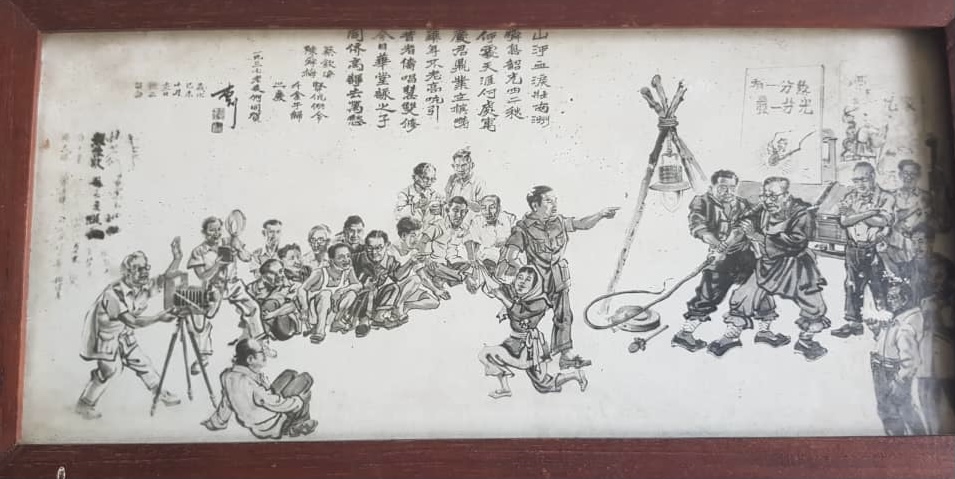
The next hero, Ang-not-Wang, in The Urghhling Marsh story is a fourth generation Malaysian. His great grandparents on his paternal side fled Tang Aun village in Fujian during the decade-old Xinhai Revolution which ended over two thousand years of imperial rule in China. By the time Sun Yat Sen became ‘Father of the Nation’, Great Grandfather Wang had already settled in Penang, Malaya as a poultry seller. Due to a clerical error at the Registry of Birth, Death and Marriages and a lackadaisical attitude to incorrect spelling, Wang became Ang. The sixth of fourteen children, Ang Iok Hun (1904-1998), was famous as the first station master of the Penang Hill Railway. Iok, pronounced as ‘Yok’ is the Chinese translation for the biblical name ‘John’. He started his career as a “checker” in 1922, overseeing the construction of the railway after passing his Senior Cambridge at the Anglo-Chinese school. A year later, he was promoted to station master, a position he held till his retirement in 1961. Despite historical records stating that the construction workers were ‘mostly convict labourers’, Iok Hun said they were paid workers of Federated Malay States Railway, their hourly rate being 90-95 cents. The mandor or kepala earned twice as much. Iok Hun’s monthly salary was $75, a princely sum for the then 20-year-old. A dollar could buy him a roast duck, or thirty three eggs or thirty three durians! The workers lived on the bottom of the hill in a kongsi or community longhouse. In those days, malaria outbreaks were frequent, so every man was expected to take a small teacup of quinine daily for a month.

There were five gangs of workers; each gang consisted of thirty to forty fit and strong young men. Their jobs were to fell trees and chop up timber to feed the flames of the boiler. The steam from the boiler powered the winches that pulled a convoy of trucks up the hill supplying the cement, granite and sand for another gang of workers to work on the construction of the railway. The workers were mostly Indians and Hakka men, all noisy and jolly, tough and rough. They loved singing and joking whilst working in the cool and fresh surroundings of the lush tropical jungle. Iok Hun, a member of his church choir, was often heard singing with his men. There were reports of many sightings of tigers and other wild animals in those days. However, there was not a single report of any man who killed a tiger with his bare hands – simply said, the mythical story of Wu Song in Shuihuzhuan was unmatched in Penang. Otherwise, the scenes described are reminiscent of the hills above Liangshan Marsh in the Water Margin story, where the junior recruits had to build jetties, camps, guest quarters and assembly hall from trees they felled in the forest. The mud to make bricks, huts and stoves was in unlimited supply from the river below.

The railway was officially opened on January 1, 1924, by Sir Lawrence Nunns Guillemard, Governor of the Straits Settlements. Prior to this role, he had no previous experience representing the Queen of the British Empire. His governorship left behind many notable buildings which still stand today – the Cenotaph, the Causeway, Singapore Yacht Club, and Singapore General Hospital, to name a few. In the old days, most of the visitors to Penang Hill were Europeans and wealthy towkays. The ordinary folks were either too poor or too preoccupied with survival to holiday there. Life on the hill was slow, the funicular train operated only on the hour. The colonial mansions were a popular retreat for the European expats who frequented the lush green hill to relieve themselves from the stifling and humid conditions below. Once news came that the Japanese would arrive soon, the Europeans fled from their English-style resorts with their beautiful stonework stairs and quaint floor patterns and Italian wall tiles. The size of the mansions complemented the massive well-maintained English gardens. The romantic balconies that looked out to the calm waters of the Indian Ocean were soon to be occupied by foul-breathed and foul-mouthed Japanese officers whose every third word was ‘bakayaro’. “They farted like dogs most of the time,” Iok Hun said. During the early days of the war, the Japanese dropped bombs on Penang. The hill was not spared, a bomb from the sky destroyed the bus that ferried railway passengers to and from their bungalows. A section on the lower end of the railway was badly damaged. The Butterworth power station was also bombed, rendering the railway out of action without electricity. It was not until 1942 that it was repaired when the Japanese required a look-out post on the hill.

At first, the Japanese soldiers were rough and rude, and ignored the signs limiting the maximum number of passengers in the chocolate-brown wooden railway coach. An active member of the Air Itam Methodist Church in his younger days, Iok Hun prayed hard before risking his neck the following day by complaining to the Japanese Governor about the unruly behaviour of the soldiers. The Governor ordered a senior officer to accompany Iok Hun back to the railway station. There was no misbehaviour by the soldiers after that visit. Iok Hun was later summonsed back to the Governor’s estate but the sweat beads on his forehead and his nervous eyes were ephemeral. He thought he would lose his head from a disgruntled officer’s complaint but he only lost his way home after having got tipsy at the Governor’s dinner party at the E&O Hotel for selected staff and guests.
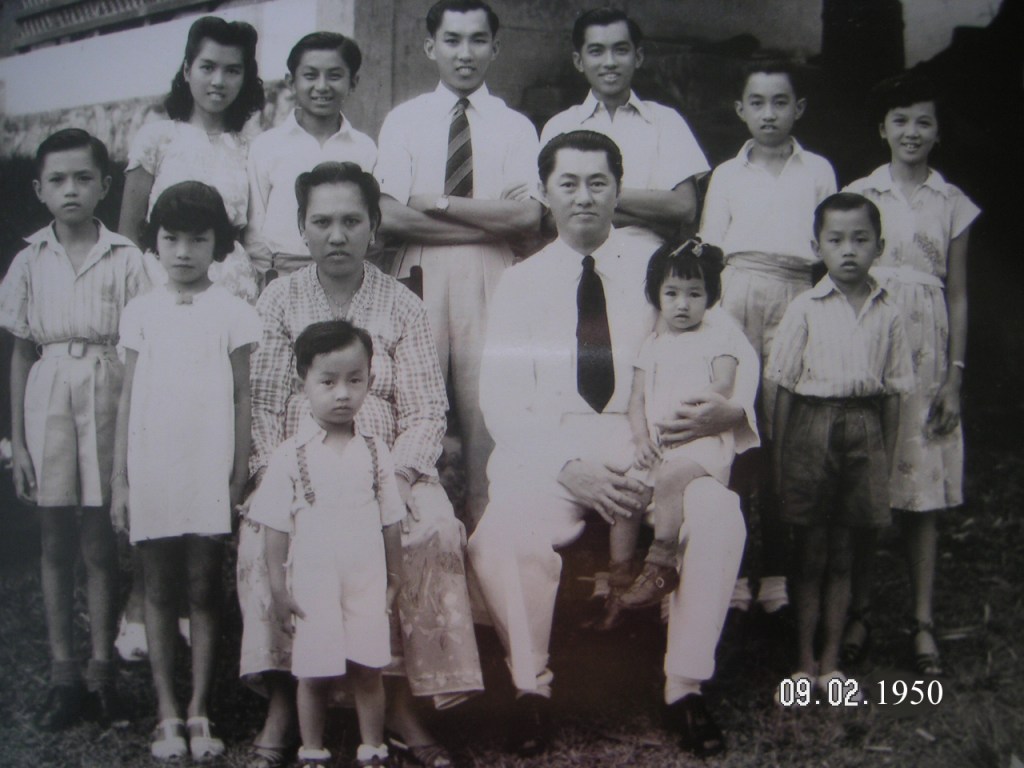
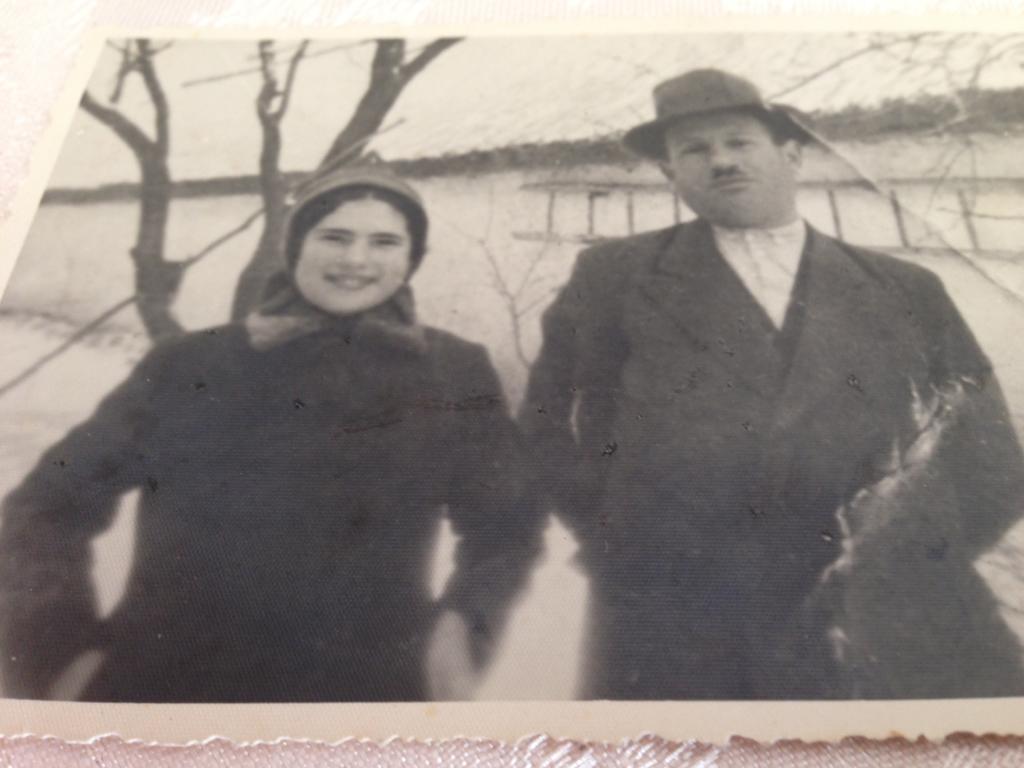
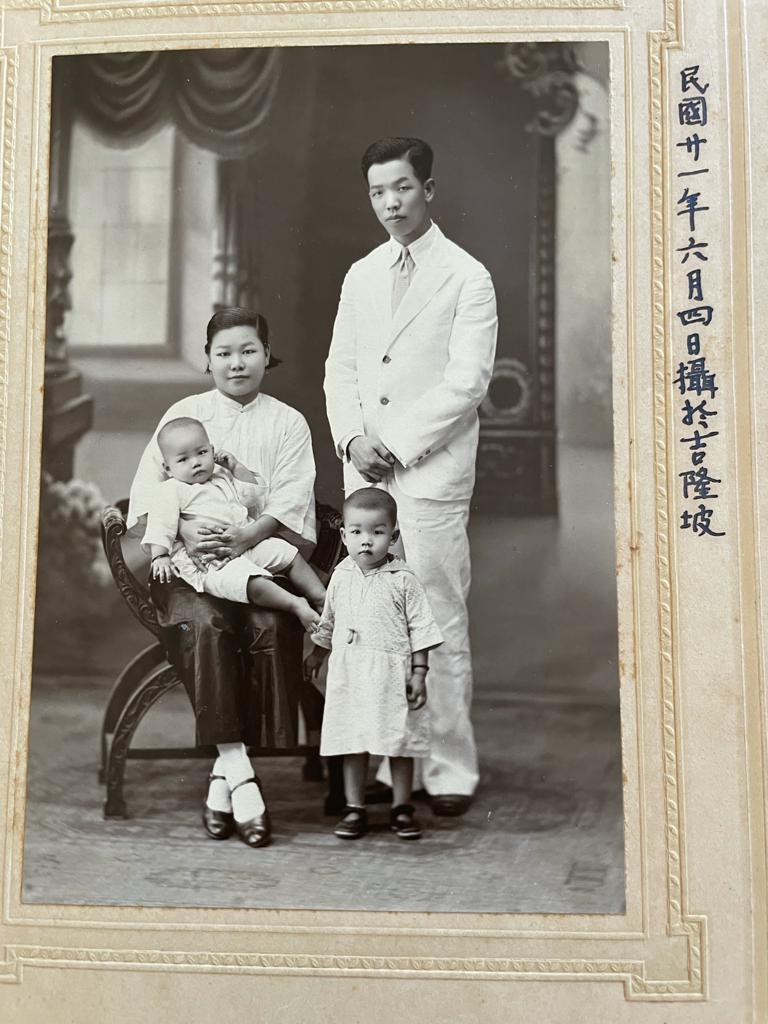
John Ang Iok Hun’s family

Ang-not-Wang’s dad, Ang Sim Boo, born in 1933, was the sixth child and third son of fourteen siblings. His family photo taken after the war in 1945 shows only seven kids playing at the back of their house in Air Itam which was a jungle at that time. Two siblings died during the Japanese Occupation. A Police Volunteer Reservist in the mid-1950’s, he became the station master of Penang Hill after his father, Iok Hun, retired. Sim Boo and his eleven siblings grew up at the railway quarters provided for their father. A notable flautist and a table tennis champion, he was unlike many of the young men of his generation, lucky to be given a solid education. Sim Boo served as the station master for thirty three years. The Penang Governor awarded him the Pingat Bakti Setia medal for his loyalty and dedication to his work in 1987. He spent most of his life up in the hill of Penang. Before the cocks crowed and the evanescent dew clinging to the big palm leaves still whole and clear, the wispy captivating sounds of a sweet angelic flute was often heard wafting in the cool morning air. Occasionally, the melancholy notes of a harmonica would replace the classical contemplative tunes of the flute. Sim Boo was adept at both instruments. Under a stubborn and heavy cloud of mist that wouldn’t lift, Sim Boo called out to his men, “Be careful today, visibility is poor. Don’t use the signal flags when you move the trucks. Whistle once for stop, twice for forward, and three times for reverse”. His loyal men appreciated his care and concern for their welfare and safety.

Unlike Wang Lun of Liangshan Marsh, Sim Boo was an effective leader of the railway station on the hill. His men did not revolt against him. They did not strike. No one raised their hands against him. He was highly respected by everyone around him and his reputation as a tough but fair master attracted many to want to work for him. The mendacious Wang Lun, on the other hand, showed his ‘small heart’ and his ‘two hearts’ by presenting Chao Gai with a tray of silver and gems whilst refusing to accept him and his men into the brotherhood. Wang Lun understood that it was as good as sentencing them to their deaths by the pursuing imperial soldiers who numbered in the thousands. Lin Chong whom Wang Lun had just promoted as his second-in-charge to quell the unrest within his group, displayed his disdain for his chief with a strong body language. He despised such cowardice and lack of altruism and swiftly killed the hapless leader. Upon seeing their leader motionless in a pool of his own blood, the men all knelt or genuflected and made Chao Gai the new leader of the gang.

Ang-not-Wang’s maternal great grandparents were from Lam Aun Hakka State in Guangdong Province, China. His name was Ooi Thean Kua. Her name was Khoo Bon. In Malaya, he was known as ‘lawyer buruk’, i.e. a lawyer without proper qualifications. Be that as it may, a bloke in China born in the 19th century with knowledge of the many facets of law and the legal system is to be greatly admired. “My own great grandparents could not even write their own names. They were always addressed by their status in the family hierarchy and so, their names are forever lost,” Wu Yong, a less popular hero in the Urghhling Marsh said. Peasants in that era could not be expected to be literate; they were mostly impoverished, angry or dying from starvation. There were already large-scale uprisings against the Qing government. The corrupt Manchu officials were thin in numbers and could not govern properly. Foreign invasions added to the misery of the people who were already suffering from natural disasters, civil unrest and disease. The migration to South East Asia for safety and economic reasons continued and escalated after the heavy defeat in the Second Opium War and the capitulation to the perceived weaker Japanese army eventually led to the fall of the Qing.
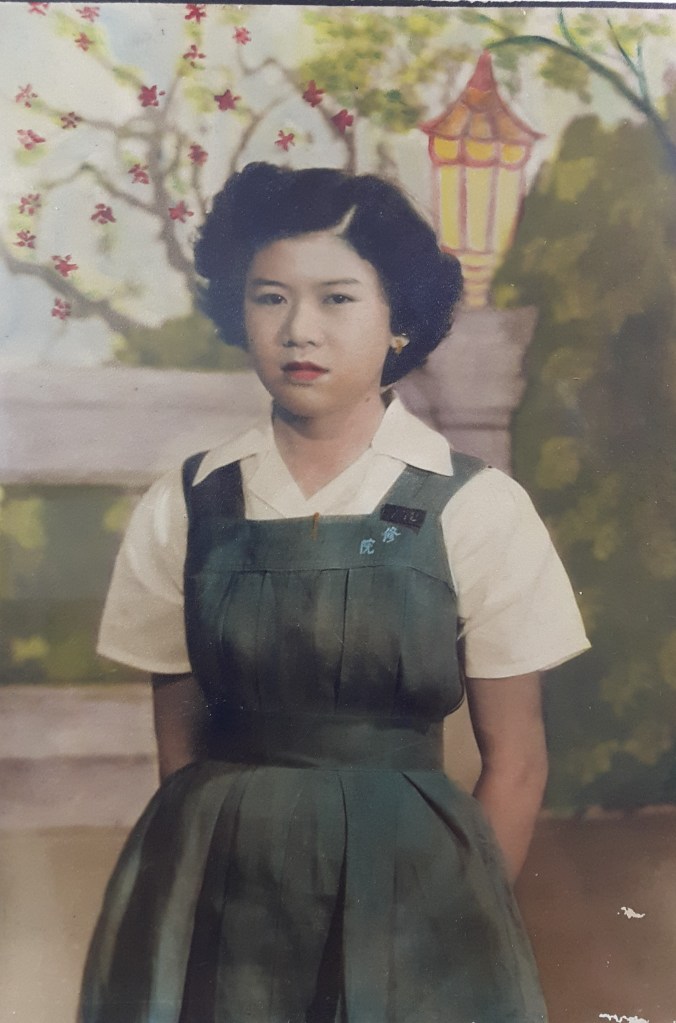
Ooi Phaik Gee before she grew her pigtails

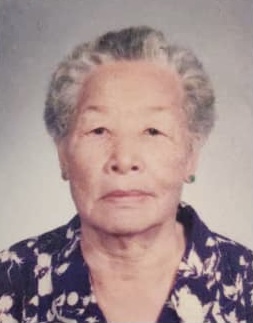
Ang-not-Wang’s mother, six years her husband’s junior, was the second child and the eldest daughter. Although her name was Ooi Phaik Gee, she was better known as “samseng po” or tom-boy in her childhood haunt in Rope Walk. Her father, Ooi Hock Seng (1916-1980), operated a hardware shop called Hock Hoe Trading near Standard Chartered Bank in Beach Street. He remarried after his wife, Loh Chin Neo died in 1953. In the war, a bullet wound permanently scarred her with a bad limp and left a mark of a crescent on her left leg. The family of four was at home in 78, Kimberley Street when a shop selling house coal across the street was hit by a bomb. The front wooden casement window of their house was in flames by the time the family fled outside. Hock Seng carried their son on his back and Chin Neo carried Phaik Gee in her arms as they joined the panic and fear of the crowds surging in the street. Bang, bang! Chin Neo suddenly felt her left thigh go numb before she tripped and fell. As she sat on the road in agony, she saw her wound gushing out blood. Only then did she realise she had been hit by a stray bullet from across the coal shop. A young man who was also running from the mayhem ahead of them turned back to help her. The quick-thinking hero saw an abandoned rickshaw from the corner of his eyes, and rushed to take ownership of it. “In that moment, I would have commandeered it if I had to.” Yap Seng told Chin Neo later, laying further claims of his heroism. He carried Chin Neo into the wooden carriage and pulled it hastily to the Dato Keramat Hospital. Hock Seng and Chin Neo were forever grateful to Yap Seng. They remained friends after the war. The couple had five children.”Her subsequent two stepmothers produced nine more children for Grandpa Ooi,” Ang-not-Wang said as he related his mother’s story to me. “All of them looked up to their sister as ‘Tai Ka Jie’ and their respect for her was unquestionable even though she was only fourteen when her biological mother died. She attended Convent Dato Keramat and was already a devout Catholic in school with Theresa as her Christian name”.
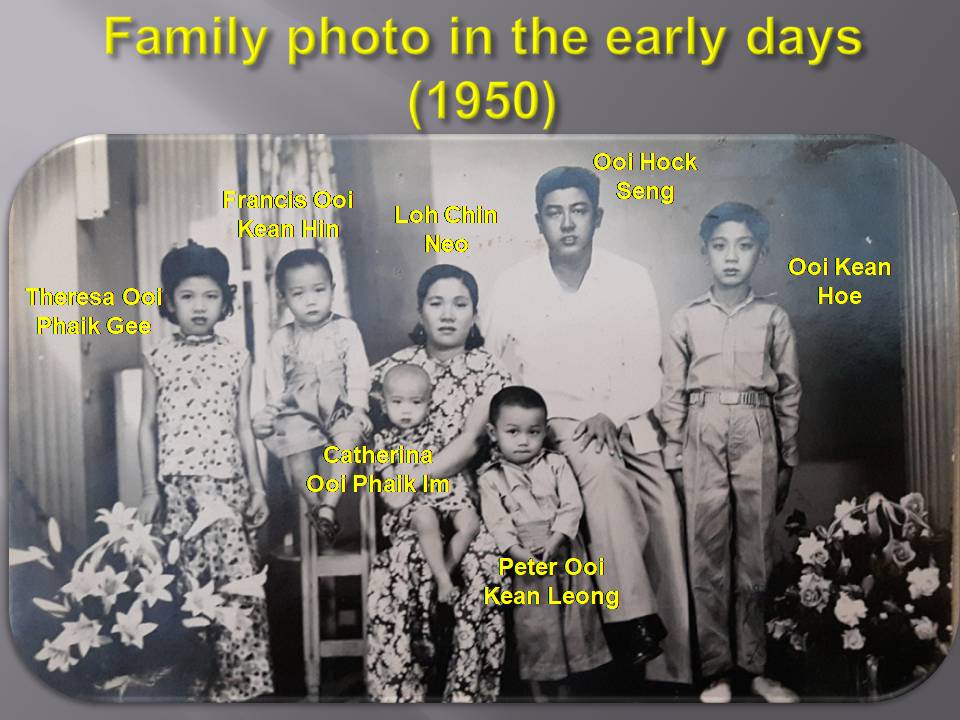
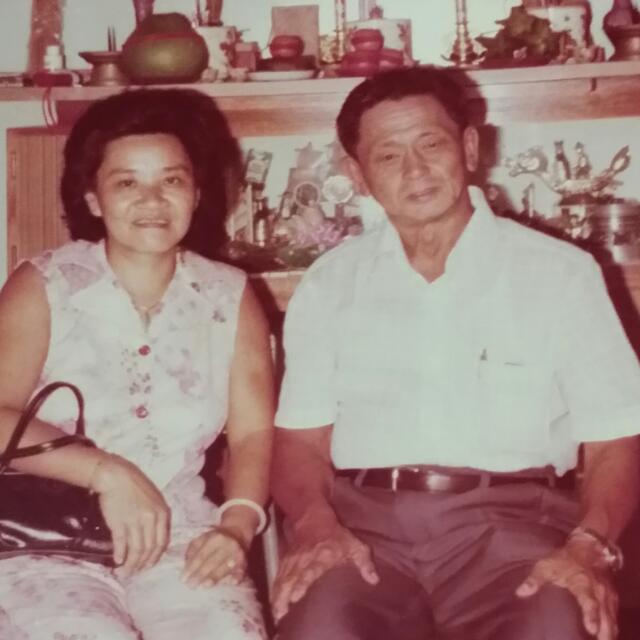
Sim Boo and Phaik Gee were engaged in 1954 “after six months of going to the movies together” and they married a year later. “There’s not much to say,” Ang Sim Boo said about their romance. He couldn’t explain why a Methodist boy would attend a Catholic congregation except to say that was where he first laid his eyes on her. Phaik Gee was a dazzling beauty, with a good sense of style and fashion. Her eyes were mesmerising, and her lips full with a sexy pout. She had a healthy mop of natural curls, and a nose with a prominent bridge that was not aquiline, made cute with a slight bulbous tip. On some occasions, she wore her hair with two pigtails which made her simply adorable in an age of innocence. In some of her photos, she showed a certain coyness and charm reminiscent of a young and innocent Princess Diana. Unlike Phaik Gee who had a knack of dressing well, Ang Sim Boo’s habiliment was predictably the same every day, that of a train station master’s uniform. A practising Methodist all his life, love, faith and hope are the three strengths that remain with him and the greatest of these is love (1 Corinthians 13:13). The couple celebrated their Golden Wedding Anniversary on 18th November 2005. They produced four children and seven grandchildren.

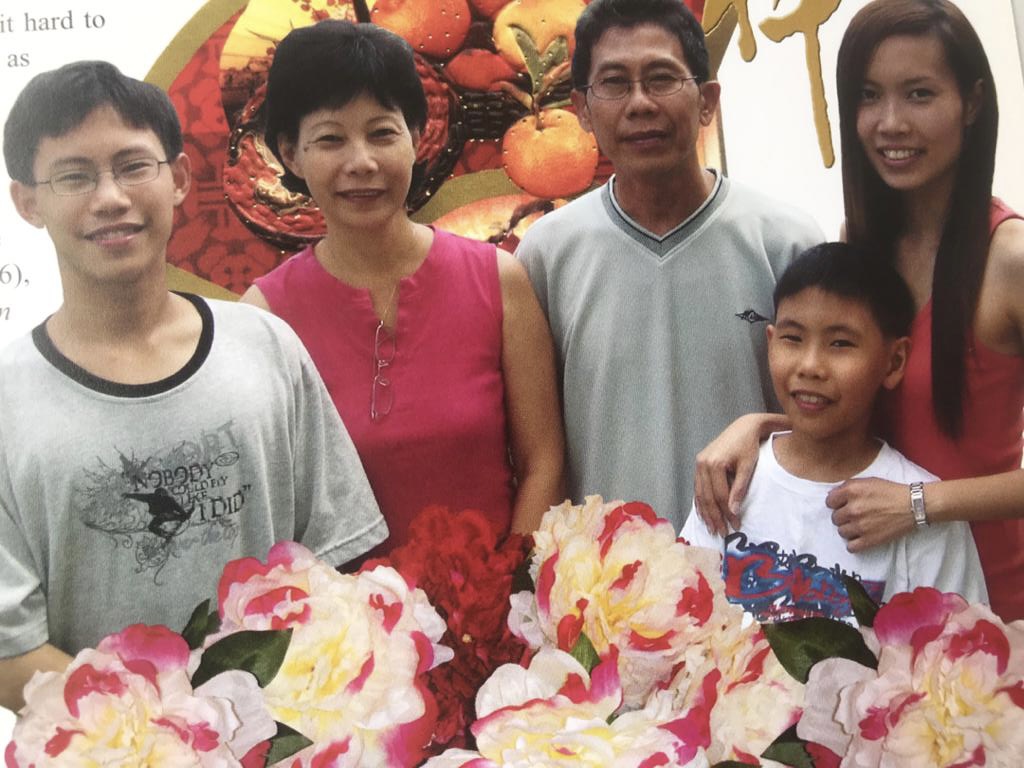
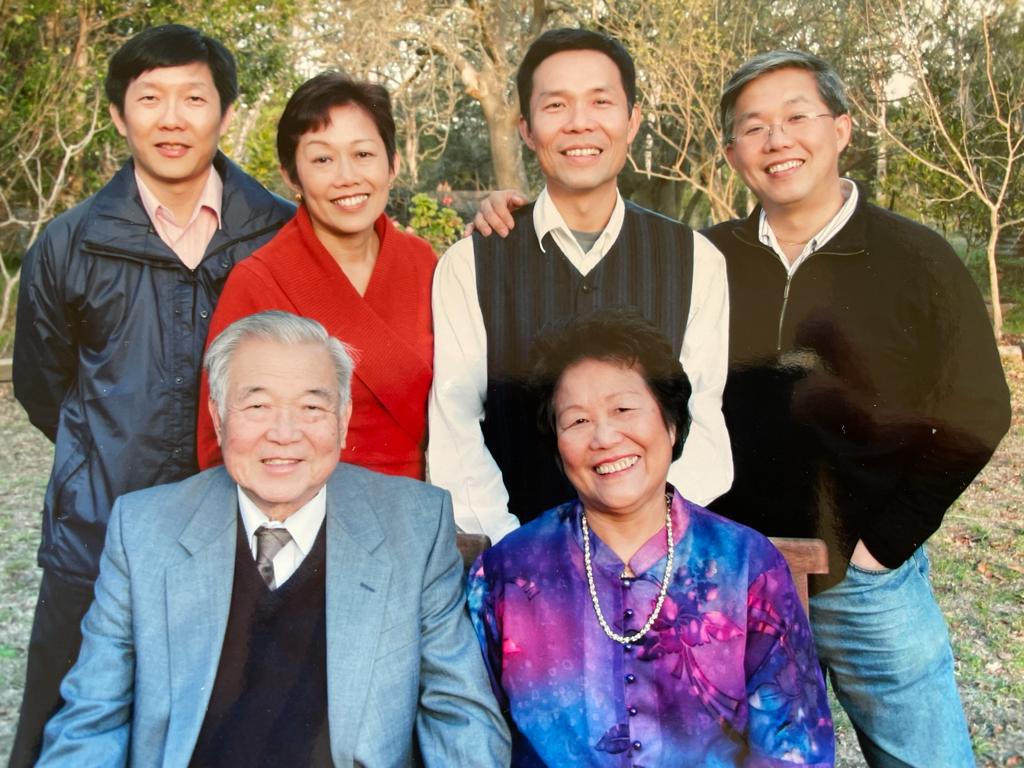
Ang Sim Boo and Phaik Gee with their three daughters, Jenny, Florence and Anna. Ang-not-Wang on the far left.

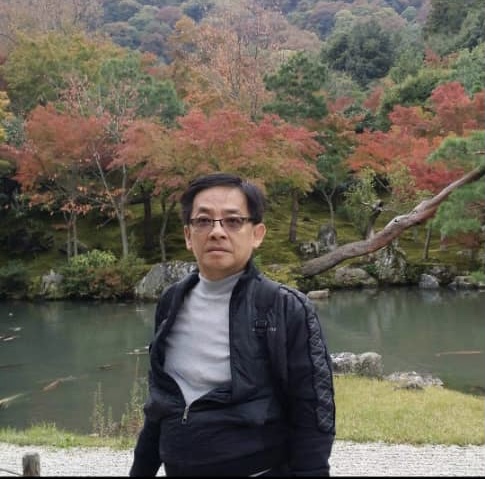
Ang-not-Wang, the second born, is the only son. He is very much like his father. He is well-groomed and wears a perpetual smile, possesses a strong infectious personality, an unwavering Christian faith and is well-liked as a natural leader. Both were in the transport industry; he was a bus checker at one point in his life, and his father a train checker. Both are devout Methodists, great coaches for the younger generation and preach against idle gossip. Ang-not-Wang is not one to readily accept a ‘no’ for an answer when a ‘yes’ can help someone in need. A holder of a double diploma in Bible Study, he is a qualified counsellor in child transactional behaviour. He is a SXI alumni like all the other heroes in his brotherhood. I say that because there is absolutely no doubt that he has been accepted into the Marsh brotherhood even though I have not sought any confirmation. In school, he was like Wang Lun, in white school uniform and a lousy student who was neither good academically nor a sportsman. Whilst Four Eyes (one of the Marsh heroes) caught the school principal’s praise for his swimming prowess, Ang-not-Wang’s bad class report cards attracted the principal’s cane instead. He told me he found God when he turned fourteen. I reckon maybe it is truer to say God found him and converted him from that mischievous trouble-maker that he was in Sunday schools to save the teachers from a hellish time in class. After Form 5, God gave him a taste of his own medicine by making him become a kindergarten teacher. The young man did not enjoy a career as a teacher, so he tried other professions such as a bus checker, a printing operator before finding his element as a salesman in ladies’ and menswear, later switching to biscuits and detergents. He joined Nestle in the eighties, a fast moving consumer goods (FMCG) company that many salespeople aspired to join. Nestle recognised his managerial skills and eagerness to learn and invested in him, sending him to many international seminars and training camps. He moved up the corporate ladder over the next twenty five years and finished as the Senior Manager – Commercial Excellence Manager handling strategies, processes and projects.

Today, Ang-not-Wang occupies his time by looking after the needs of his congregation and sets himself up as a role model for the youths in his community. The pandemic has raged on in Malaysia with no end in sight. Sympathetic to the plight of the local people around him, he helped form the ‘Nuri Cares and Support Group’ in his residential community called Nuri Taman, whereby he organises the distribution of food and small necessities to those out of work and cannot support themselves. Ang-not-Wang is an unsung hero and a quiet achiever. He surely belongs to the Urghhling Marsh brotherhood.

Michael Ang and wife Dorius Ding

The past holds our fond memories, the present is a gift we enjoy and there is always hope for tomorrow.

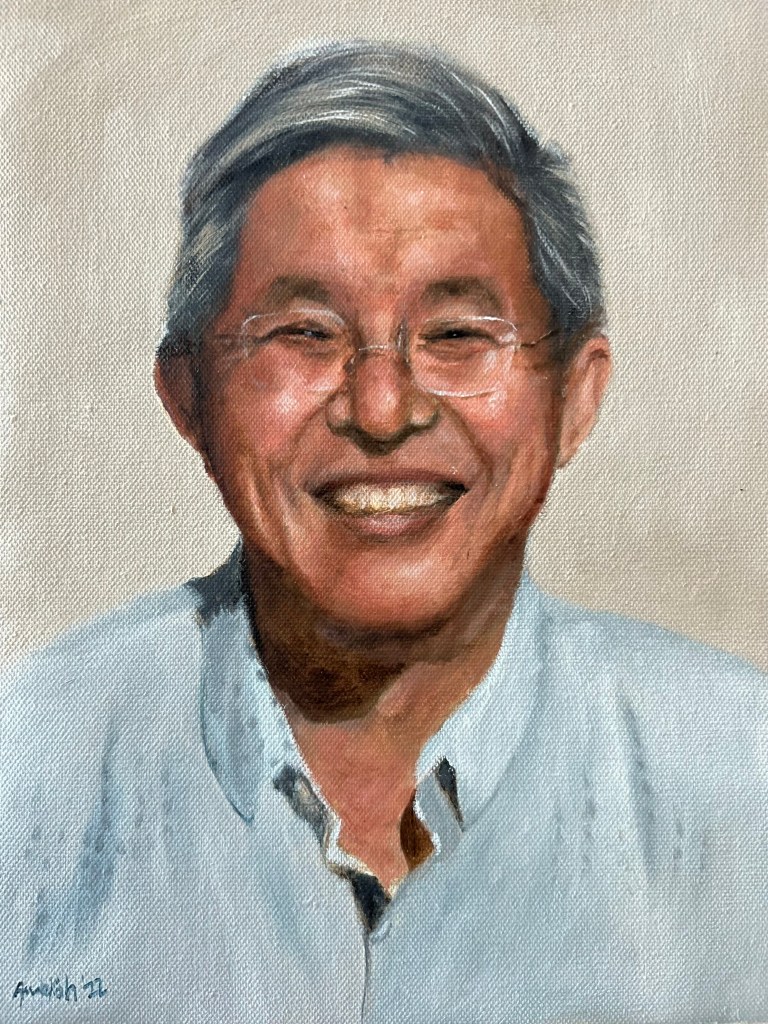
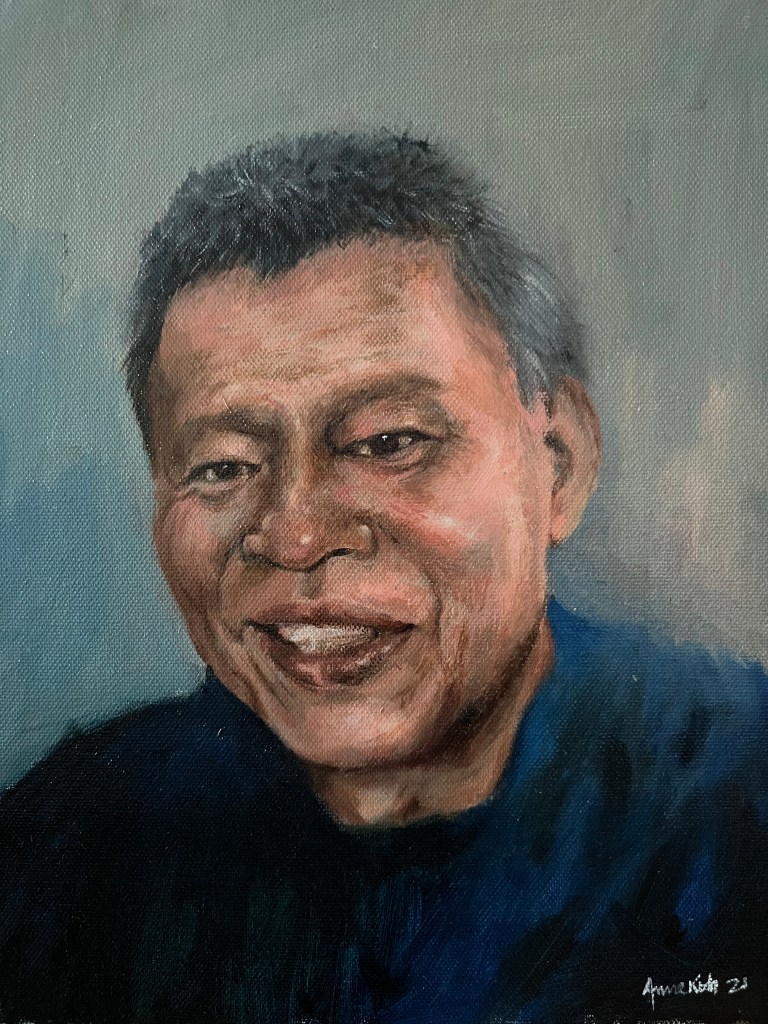
Michael Ang Lay Beng

Portrait of Michael Ang Lay Beng by Anne Koh.
The Venerable Sickly General

The epic novel, Water Margin, is known by a few different names. In Chinese, we call it shuihuzhuan. In the West, it is commonly known as Outlaws of the Marsh. Its translation is ‘All men are brothers’, perhaps the ancient vernacular stems from Confucius’ 四海之內皆兄弟也 or ‘Within the four seas, all men are brothers’. The idea to write a book about a brotherhood of schoolmates and their families’ journeys from the East excited me greatly as the notion that we are all brothers has long been drummed into our psyche from early Lasallian teachings. It is fantastic when brothers reunite after a great distance in time and space. However, the recruitment methods in the novel are often atrocious. I can understand why the author of the book, Shi Naian, found it necessary to resort to ‘unsavoury’ tactics to recruit some of the outlaws. Many of my friends also show strong reluctance to participate and some are strangely aggressive in their refusal to have their stories written. It is not surprising that occasionally, a devious idea foments in my head to persuade less inclined brothers to participate. The hero in this chapter, however, needed no twisting of his arm – he has come forward voluntarily and for that, I thank him from the bottom of my heart.

The only doctor I remember in The Water Margin made a rather late appearance. By then, their leader Chao Gai had already died. It was his spirit that warned Song Jiang of a propitious star ‘Di Ling Xing’ shooting across the sky above him, indicating that a calamity would befall him. Song Jiang was in all likelihood already delirious with a high fever from an ulcer on his back. One of his chieftains, Zhang Shun knew of a doctor who treated his mother with a similar illness and thus knowing it could be fatal, it was imperative that he recruited the doctor urgently to save Song Jiang. The doctor was, of course, reluctant to sacrifice his city lifestyle and jeopardise his livelihood for a rebel. How An Daoquan was recruited to become the Liangshan physician was a strategy often used in the novel. Zhang Shun murdered a prostitute by the name of Clever Pet, and then smeared a ‘confession’ by An Daoquan with her blood on the wall of her boudoir. When the poor doctor woke up the next morning, he realised he had no choice but to flee to Liangshan Marsh. At Liangshan, An Daoquan cured Song Jiang of his life-threatening illness. His reputation as a miracle doctor working with the barest equipment and drugs earned him the title of Divine Physician. Following an amnesty granted to the brotherhood by Emperor Huizong, he later saved the emperor from an illness which enabled him to stay in the palace as the imperial physician. 

The Sickly General with wife (middle) and brother (RHS) at Everest Base Camp, 5,300 m above sea level.

The vivid scenes described in the novel transported my mind to the stories a friend shared with me. He too described an important time of his life spent in the deepest jungles and riverine systems. But, he wasn’t fighting other outlaws or army forces; his endeavours were to snuff out illegal fishing and poaching of endangered species of wildlife such as the Johor rhinos and Bigfoot. Duobing Jiāngjūn, or Peng Kuan (in Cantonese), aka The Sickly General, hailed from the same school in Penang, but we were never classmates. He was a lot smarter. For me, apart from saving lives as a doctor, his major contribution to his country has been as a member of the Malaysian Nature Society. They helped protect the riverine systems and documented many varieties of freshwater fish. They also discovered many birds and butterflies in the virgin jungles that are now part of the Endau-Rompin National Park.

As Sima Yi in The Three Kingdoms said, “Misfortune generates blessings and blessings breeds misfortune”. The opportunity came after one of the heaviest monsoon seasons with floodwaters over 40 metres destroyed much habitat and also all the illegal fishing nets. The Sickly General and his cohorts suggested to the authorities to grab the opportunity to ban fishing in one tributary and that gave birth to Kelah Sanctuary, a crystal-clear river now thriving with Mahseers. His entry into The Urghhling Brotherhood is well deserved and requires no invitation.

The Sickly General’s paternal grandfather Ah Yeh left Chung San, Canton District, China for Selama, Perak in the 1920’s. He married a Hakka girl, a first generation Kedahan. She bore him many children. The Sickly General’s father was the third of four sons. When the war with the Japanese broke out, Ah Yeh burned down his own general store to prevent the invaders from getting hold of the provisions. Ah Yeh and his family went to Penang to live with his eldest daughter who was married to a dentist whose Wu Dental Clinic was in Chulia Street. Wu had a younger brother, a martial arts exponent who trained with sand bags tied to his legs. He purportedly was able to leap over walls just like Lin Chong did in The Water Margin, after he learned Marshall Gao Qui’s adopted son was harassing his beautiful wife in the Yue Temple. Younger Wu made sporadic guerrilla attacks on the Japanese but suddenly died of a heart attack when the enemy troops came to check the shophouse where he lived. Luckily for the whole household, the soldiers did not find his cache of spears and swords. All heads would have rolled and that would have been the end of The Sickly General’s story before he was even born.

The Sickly General’s maternal grandfather, Ah Kung was a first generation Penangite; Ah Kung’s mother was a second wife. In those days, bigamy was a privilege for men with wealth or status.

“Ah Kung’s father passed away when he was still in conception,” The Sickly General told me.

I did not want to pry and ask how he could be so precise – after all, conception occurs within hours to a matter of just a few days after sexual intercourse. After Ah Kung’s birth, mother and child were chased out from the family. He was taken care of by a well-to-do auntie and studied till Secondary School – it was quite a privilege in those days to be given an education. Ah Kung began work as a clerk in the American Automobile company as soon as he graduated from High School. When his wife died of asthma, he was devastated but didn’t remarry;  the eldest daughter and The Sickly General’s mum, the second oldest, had to stop school to take care of the household. His mum worked for a Baba family, and from the Nonya matriarch, she learned great recipes and followed the strict meticulous disciplines of Nonya cooking. A great cook to this day, his mum, now eighty seven years old, insists on generous portions of quality ingredients to make each dish superb. She supplemented her income twice a year by making Chinese New Year cookies and Nonya Bak Chang for the Dumpling Festival.

“Mum was very generous to her seven siblings, and to my father’s fourteen siblings including two sisters who were given away,” The Sickly General said with a voice filled with love and pride. 

The Sickly General was born and raised in Chulia Street, next to Love Lane just behind our school, St Xavier’s Institution (SXI). His father’s eldest sister who married Dentist Wu was the chief tenant of one of the shop lots. Numerous rooms were sub-let to others. The Sickly General’s mother, a pretty single girl then, and her own family were amongst the other tenants. Naturally his parents fell in love in that house, and they married soon after. The Sickly General was the firstborn of four children. Chulia Street still brings him haunting memories of the stench of night soil as they were being collected from each household.

“You don’t want to study hard? Then you’ll become a night-soil carrier,” his mum used to threaten him.

He swears he can still smell them on his clothes sometimes. Another haunting memory of the Chulia Street house is its room upstairs next to the kids’ bedroom. It was locked most of the time, and whenever The Sickly General walked past it, he would get the chills and goosebumps, the eeriness accentuated by the dark wooden floor creaking and cracking in the dark. Stories of Japanese beheadings, ghost sightings, demonic possessions and exorcisms were related by the tenants in that room. When the boy was five years old, his family shifted to Glugor, after Ah Kung convinced his son-in-law to get the lot of land next to the half-wooden bungalow he managed to lease. The hauntings stopped as did the nightmares.

The Sickly General’s father wanted his son to continue as a next generation Saint. All alumni of SXI are called Saints. But because they had moved far away from the school, he was sent to La Salle into the last available class, Std 1E. His father was an English teacher in a Chinese Primary School. His mother, who dropped out of Std 2 after the sudden death of her mum, was a homemaker. The Sickly General’s maternal grandmother died of bronchial asthma at the young age of thirty two. The hereditary disease affected almost every male of the next generation. The Sickly General took the full brunt of the defective gene, earning him the title of Duobing Jiāngjūn. His episodes were as regular as the monthly curse that afflicts women. During the asthmatic attacks which frequently occurred at night, he would sound like a wheezing cat as he was being ferried on his father’s motorcycle to the local hospital. In those days, there were no puffers to depend on. Instead, he would be given an adrenaline jab which opened up his airways giving an instantaneous relief from gasping.

“No outdoor games or ‘cooling’ foods,” his mother would theorise that if he could pass the age of eighteen without any attacks, he would overcome this curse. For the next decade or so, The Sickly General would become a depository for every remedy and concoction that his mother could get her hands on. Some of the more unforgettable treatments include swallowing live day-old hairless mice, drinking mantis dung boiled in herbal soup, consuming raw egg yolk dipped in honey, followed by munching on home-bred beetles fed on herbs and a host of other concoctions and talismans. He grew up not knowing any games or extracurricular activities and enjoying cold drinks and ice-creams were as forbidden as teenage sex. While waiting for the bus, the primary school kids would patronise several hawker stalls. For five cents, many could aim at a dartboard for a prize, or get a bangkuang slice with rojak sauce or simply suck on a cold ice ball smeared with evaporated milk and rose syrup. To challenge his mother’s theory, he tried an ice ball which tasted like heaven but when the night came, hell arrived in the form of a blocked airway that felt like a strangulation.

His parents’ Silver Wedding Anniversary

The Sickly General had his father’s fair complexion but not his height, his mother’s genetic curse but not her Teresa Teng beauty. With a sallow face and a wan smile, a slim body and puny arms, he was laidback and not a ‘silverback’.

“Somehow, I got all their bad genes,” he said with a tinge of self-pity.

His friends called him ‘Pale Face’ which he rather liked, it being the era of John Wayne’s cowboys and ‘injuns’ on TV. His childhood playground was the surroundings of Bukit Glugor. In the valley, there was a large Hindu community where the cow is a sacred animal. The sanctity of the cow meant there was a glut of dried cow dung which the kids could freely collect for their family’s vegetable garden. Boiled fresh milk was sent daily to Ah Kung next door, but their mother made sure to leave them the milk skin which the kids enjoyed like a delicacy. The brothers collected labels in Milkmaid cans to complete the four booklets of Fish, Birds, Butterflies and Mammals. That led to their love for nature. They would collect, set and frame butterflies, rear caterpillars, hatch golden pupae until butterflies emerged. They salvaged glass and invested in a glass cutter to make their own frames and aquariums. They caught fish from rivers and streams near the hills, worms from drains and bred the fish to sell to the pet shops. The Sickly General would go to the book store each month and spend his earnings on Marvel comics. The Fantastic Four was his favourite “as they had the almost accurate and believable scientific theories” but his idol remains Peter Parker, the struggling hero.

The Sickly General finally got into SXI in Form 4. He was quick to sign up with the PKBM cadet corps. The free uniforms and the chance to hold and fire guns were too tempting. He loved everything about the cadet corps, the grind of marching in the sun or in the rain, shouting orders and being shouted at, and giving a mirror-shine to his boots and buckles. He remembers fondly the times when they were packed like sardines into army trucks to the rifle range at Sungei Dua. There they enjoyed the chance to use live bullets for target practice. Those two years quickly passed, and suddenly the MCE was over. It was a disaster unheard of in the school’s history when a good number of students, even those with a string of A’s failed, in the first year of compulsory passing of Bahasa Malaysia. You fail the Malay language, you fail everything. It was a tragedy to see so many smart students being undeservingly left behind.

True to his mother’s prophecy, the asthma attacks disappeared when he turned eighteen and in Form 6, another new great thing happened in his life – girls in his school class! His new motto was ‘I can do all things’. It took many years later for him to add the word ‘almost’ to that. The transformation in him was astonishing. He shed his bilious yellow hue and the young man even put on a slight tan. The two years in the corps helped strengthen his core muscles.

With reticence and hesitance finally expunged in his late adolescence, the pretty girls in his class were no longer admired secretly. His father’s starting salary was $125 which meant he was just outside the minimum income to be eligible for book loans. Instead of buying the required textbooks, he borrowed them from the library and after learning typing from a secondhand book, he typed out the books during school holidays. Ms Tan Poh Gaik was, according to The Sickly General, the best Form 6 Biology teacher on the island. Wu Yong The Cur was quick to disagree. He had an altercation with the same teacher in Sixth Form.

“There is simply no need for us to dissect a frog each,” he protested.

He reckoned one frog was sufficient sacrifice for a class of thirty odd students. Ms Tan disagreed and banished Wu Yong from her class for that day. Her lecture notes were very sought after, and being a representative in the Inter-Sixth Form Science Society, The Sickly General’s knowledge of who were the good teachers in other subjects enabled him to exchange quality notes with other well-informed students. With three other friends, he came up with the idea of producing a whole series of past-years’ model answers in Bahasa Malaysia to sell to the bookstores. After a week of scrutiny by relevant Examiners, they were given the go-ahead to produce the reference books. The publisher offered them a choice between annual royalty or a lump sum cash payment. These Biology- Maths students, without any Accounting knowledge, already knew that numbers could be manipulated. A bird in hand is worth more than two in the bush, so is cash in hand. The Sickly General went home with a number of crisp thousand dollar notes and gave them all to his father. 

The HSC results were the best ever for SXI, with five students eligible to enrol in a local Medical degree course. The Sickly General was offered places in India, Singapore and University of Malaya (MU). Singapore was the most enticing with a full scholarship but it came with a twelve-year bond. In his third year, he went up the roof of a rented room to fix the water tank but on his way down, he couldn’t reach the ladder that he went up from. Believing that previous PKBM training of overcoming twelve-foot walls was true, he jumped down from the roof but it landed him in the University Hospital with a fractured spine. It took a cute hospital houseman to make him realise how serious his injury was. Fortunately, the houseman possessed small hands and was a female. She inserted her finger up his anus to check that the nerve to his future line of descendants was intact. But after two days of entertaining concerned course mates about the awkwardness of his discomfort, he signed the ‘Discharge At Own Risk’ form to attend an important test for his third year exams. There was never any possibility that he would fail any subjects. A crooked back was not going to be a good enough reason to fail. It was obvious that the young man had a great destiny to fulfil.

If you have a great destiny, even if the sky is falling down on you, treat it as a down quilt.

Lady Wu in The Three Kingdoms

Armed with his MBBS, a recognition to work anywhere in the Commonwealth, The Sickly General spent his early professional career in Singapore. After following the advice of many fellow Malaysians, he decided to return to his homeland to work “where you can do anything and still own a house and car, without slogging too hard”. Perlis was his next stop, the smallest State yet so flat “you can practically see everything from a coconut tree”. A year later, he was promoted as the ENT (ear, nose and throat) Registrar in General Hospital KL. The status and money meant nothing to him and his wife after their Filipino maid absconded, leaving their rented house with gates wide open and their two precious kids crawling and bawling away.

They decided to leave the Big Smoke and moved to Pontian, a little fishing town on the southernmost part of the peninsula. Pontian in Mandarin sounds like “really stupid”. To the good doctor, it wasn’t really stupid to set up a general practice there. The Sickly General invested in Ultrasonography and Radiology, the first and only practice in the district to offer that service. Townsfolk had to go to the village for treatment. Isn’t that just so heroic? The Water Margin has heroes rebelling against tyranny and corruption, upholding the values of Confucian virtue, filial piety and benevolence. Similarly in The Sickly General, we have a hero rebelling against societal norms where the rich are catered for at the expense of the poor. A modern-day Robin Hood, he does not rob the rich, but he surely helps the poor. His green credentials from so early in his life – fighting for the environment, protecting natural habitat and promoting a sustainable economy and ecology – shows that this man is way ahead of our time. The Brotherhood of the Marsh is proud to call The Sickly General one of their own.

I can do (almost) all things.

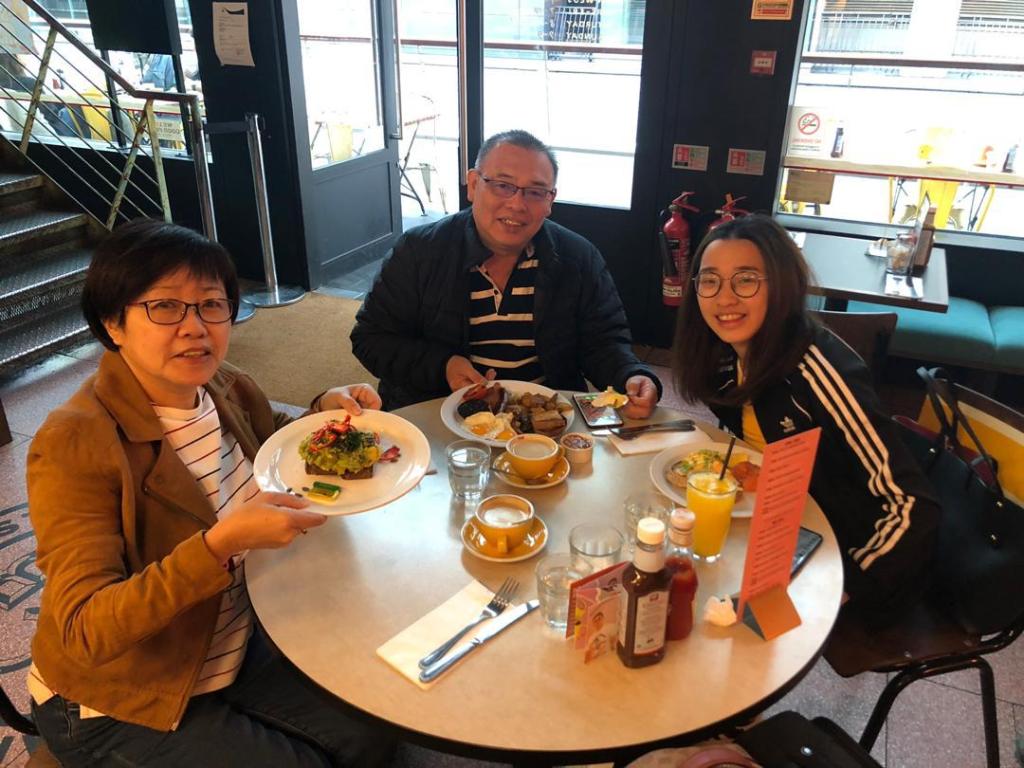
Lum Wei Wah
Portrait of Lum Wei Wah and Honglee by Anne koh.

Know Les, No Less!

Until yesterday, I had not stepped into a bank for over two years, such is the growing irrelevance of a physical bank. It was a most pleasant experience though. The bank teller at my local branch mistakenly assumed I was some other rich client and waived the $30 charge which she had earlier advised me was the fee for that transaction. “Oh, how lovely it must be to be a rich man,” I thought to myself. After that, I couldn’t get the catchy tune from Fiddler On The Roof off my head.

If I were a rich man,
Yubby dibby dibby dibby dibby dibby dibby dum.
All day long I’d biddy biddy bum.
If I were a wealthy man.
I wouldn’t have to work hard.
Ya ha deedle deedle, bubba bubba deedle deedle dum.
If I were a biddy biddy rich,
Idle-diddle-daidle-daidle man.

Would it spoil some vast eternal plan?
If I were a wealthy man.

The last two lines of that earworm made me think of Tevye, the poor Jewish milkman in the story who despite all his attempts to clutch onto his religious and cultural traditions, he ended a lonely brokenhearted father, as one by one, his beautiful daughters fled to America following the eviction of Jews from the Pale of Settlement of imperial Russia. Indeed, a fiddler on the roof portrays the precarious nature of living life on a slippery slope or on the edges. Keeping one’s faith or traditions under threat of persecution can be downright dangerous to one’s well-being.

Les Elias at 21 years old

During my adult life, I have read news articles about the Holocaust and watched gut-wrenching movies about the atrocities committed against the Jewish communities in Europe – movies such as Schindler’s List and The Pianist, but it never dawned on me that one day I would write about anti-Semitic violence, the struggles, suffering and mass displacements of millions of people let alone the horrors of the Holocaust. Unless it was a yes from Les, I would not have this opportunity and privilege to write about his family’s story. His father, George Elias, was born in Sarbogard, Hungary on 20th March 1922. George’s parents owned a grocery store which provided them with a comfortable life. They weren’t ultra religious and did not force George to attend the cheder. His dad’s steely eyes revealed a strong, confident and determined spirit. He would have been very proud of his elaborately manicured handlebar moustache, a symbol of high fashion and stature that described him as a confident and self-made man. The stylish businessman was often seen with a bow tie and an immaculately tailored three-piece suit. George’s mother had the look of a contented wife and mother. She was a tall handsome woman, and when she smiled, she portrayed a kindness and love that was soothing. Les’ smile and dancing eyes are an exact replica of hers.

George’s mother, father and his 17-year-old brother Leslie. All victims of the Holocaust.

Les’ mother, Mary, was born in Guttamasi, Hungary on 4th October 1926. George and Mary did not meet till after the war. Mary’s parents, unlike George’s, were Orthodox Jews who brought her up to strictly follow the Torah. They owned a pub and the well-to-do family enjoyed a very stylish lifestyle. Her father wore a Homburg hat, a tailored overcoat and kept a well-trimmed beard. He practised the daven daily, reciting old Jewish prayers in a singing style whilst swaying back and forth like a rocking horse. He would intone their ancient prayers as he lovingly touched the mezuzah which was affixed to the right hand side of the front door post. Apart from Mary, her entire family would later perish in the Holocaust. Mary was a sweet young teenage girl, a sheine maidl, whom no one’s eyes had yet devoured. She wore a shawl over her beautiful black hair and always went outside in a thick coat that covered her young body. But, her deep-set playful eyes which were accentuated with long curly eyelashes and her sweet innocent smiles already hinted of a striking beauty hidden inside the garments. In the beginning of the war, Hungary was fighting Russia, as part of the Axis Alliance. Mary’s family felt safe even though there were already atrocious stories of pogroms being forced out of Russia, and the German Wehrmacht’s brutal assaults on Polish Jews and Czech Jews were no longer a secret. But, in 1944, all the false notions of security and protection under the Nazi umbrella disintegrated when Hitler learned about the secret peace deals Hungary had signed with the US and the UK. Mass deportations of Hungarian Jews to Poland began soon after. George’s and Mary’s families were not spared. Originally, they wrongly believed that the Germans were their only enemies, but later on, they realised many fellow countrymen were openly and violently anti-Semitic.

There were many rumours of Jewish refugees who met with foul play on their rushed flight to safe destinations. Along the lonely stretches of country roads, it was difficult enough to avoid the Germans during the day but when night arrived, a different problem arose. Where would a safe place be to rest their aching and blistered feet? It was often bad luck rather than good luck to be invited by a farmer to use his barn for the night. Lured into his property, defenceless refugees were killed in their sleep for their few possessions. George’s and Mary’s families did not leave town. Their businesses were at first forced to display the Star of David on their premises. Not long after, the frightening sounds of big trucks arrived at their front doors before the sunbeams had even warmed them. Evil-eyed helmeted soldiers with their menacing Sturmgewehr assault rifles wore badges of black zigzagged designs on crimson red background sewn onto their smart uniforms. Their new well-polished steel-studded boots stomped heavily and loudly on the cobblestones, the harshness of the sounds so threatening a great composer would find challenging to produce. They rounded up anyone in the streets wearing a white armband emblazoned with a blue Star of David and forced them into the waiting trucks. They let their rifles do the talking. Those who resisted were shot where they stood. Screaming women held at gunpoint had their vaginas probed for gold and precious stones before being yanked away from their homes, leaving a trail of billowing black smoke and shattered glass. They were bewildered to be forced out not only of their own homes but also from their own country. By mid-afternoon, the town appeared more a ghost town – the few who remained had haunted looks, broken limbs and bloodied faces. The painful groans and soft yelps for help had replaced the twitter of happy birds. A lone girl was skipping on a side lane, seemingly oblivious to what had happened. Could it be that one can become desensitised to so much violence in a day? Les’ grandparents were amongst the hundreds of thousands deported in cattle carriages to the Auschwitz gas chambers. George was sent to a working camp where able-bodied men could do the work required of them and avoided harsh punishment. His last Yom Kippur night with his family felt like an eternity ago. He wept loudly when told his fiancé had perished in Auschwitz. Since that fateful day, he steadfastly refused to utter a single word about that part of his life.

George with his fiancé. She was gassed in the Holocaust

Mary who was around eighteen years old mentioned long spells of sickness from hunger and extreme living conditions in the Auschwitz concentration camp. Many women were subjected to sexual assaults by the Germans and those who disobeyed or were uncooperative were set upon by fierce Doberman Pinschers. Those lucky to survive were released from the camps after the war ended. Les’ father learned of their families’ demise only after years of futile prayers and false hopes. Their heartbreak was beyond consoling as one by one, they learned of the truth from eyewitnesses or hearsay which gained credence over time. George was told his father and mother both perished in the camp around 1944. His father’s seventeen-year-old brother Leslie was helped home by some passers-by after having collapsed on a nearby street. His gaunt hollow face was almost unrecognisable with sunken lifeless eyes and the once fit and fast runner instead owned a stooped skeletal body held intact only by his skin. Leslie unfortunately passed away after a small meal that evening, his wrecked stomach could not accept the little food he took. Les’ voice trembled before breaking into a mangled string of indecipherable words. At that point, silence took over our conversation. It was better that I let compassion over-rule the scrutiny of knowledge. The only other survivors from George’s side were his twin sisters who had befriended the teenage Mary in their camp. Mary was as lifeless as a coffin when she got out. She refused to tell anyone what happened to her parents in there, apart from saying they were separated in the camp in 1944. As most of the Jewish people in the concentration camps had lost their family members, as soon as they found an opportunity to find a new partner, they got married and started their new families. The first mitzvah in the Torah, ‘to be fruitful and multiply’ had taken a whole new meaning.

Mary with her dad, before the war

Les was born in Szekesfehervar on 6th May 1951. His mother’s full hips had promised fertility and she did not disappoint George. Les’ sister was born two years earlier and his brother two years after him. When the mischievous Les was three years old, he somehow got into his mother’s make-up box, and painted lipstick all over himself. When he was four, his father’s bicycle fell on him as he was examining the gears. Les was more than a handful but his loving parents never spanked him. Not even when he got his sister’s long curly hair tangled up on the wheels of his toy car. His favourite hiding place was in the small stuffy shtiebel where his mother often prayed. When he was five, the sky fell on their whole world. Post-war Hungary had been swallowed up by the Russians and belonged to the Soviet Eastern bloc. In October 1956, the Hungarians revolted against the Soviets but it was clear to George that the Hungarian Revolution would not last long or end well for them. On the day they fled their home and country, George was morose and quiet. He had already decided they would flee their home that night but he could not share his decision with anyone. No one else in the family had time to digest what was happening when they were all asked to pack their belongings into three small well-worn suitcases early in the night. There was no room for their menorah, a gold candlestick, a family heirloom.They were all in tears and panicking. They travelled for about eight hours on a rickety truck from Budapest to near the Hungarian border. From the drop-off point, they walked quietly in pitch darkness, the freezing cold biting into the bones. Although it was only late Autumn, the conditions out there in the fields and forest were freezing. Before dawn, it started to snow quite heavily and made the journey even tougher. In the silent night, trudging in the snow, Les could hear the occasional uncontrolled whimper from his siblings. The tension in the air could cut a piece of paper as they got nearer the border. Les’ parents did not know what to expect. They prayed for a favourable blessing from heaven that would determine their fate. Will they be arrested? Shot? Or can they buy their way to freedom? At the border, George was held up for many nerve-wrecking minutes, as the Hungarian soldiers demanded more gold from him, on account that there were five in his family. Mary had cut her hair short and dressed as manly as she could to avoid the hungry eyes of the soldiers. But, once they crossed the border into Austria, the journey to Vienna by car was an uneventful two days. Finally, unfurled before their eyes, they enjoyed the colourful scenery of the countryside only Autumn could deliver.

Vienna was the capital of the world before the Austro-Hungarian empire collapsed in 1918. It should have been an exhilarating city to visit in the mid 1950’s, where life was lived with style, elegance and charm. Johann Strauss Jr left a huge footprint on the city with his waltzes, polkas and operettas just over half a century earlier. But, the city was swamped with over 170,000 refugees, among them more than 18,000 Jews. Very quickly, lodgings had to be found for them – hotels, private residences and camps sprung up, supported by food shelters and medical centres. The Elias family was admitted into a shelter for Jewish refugees where they were fed and clothed and provided with some space to sleep. But, as the centre got more and more crowded, the family had to split up. Les and his father moved to stay with another Jewish family whilst the others were put up at a different house for the next six months. George was by then penniless, having paid the border guards every cash and gold he had. The refugees were offered only temporary respite there – they were all expected to be relocated to other countries. The Jewish Centre helped them migrate to Santiago, Chile where George had a sister there. The boat trip took around two weeks. It should have felt like a holiday cruise but none of them was in a celebratory mood, not when their breadwinner was penniless and jobless and did not know what to expect in a new country.

George and Mary in Budapest

“My father was an electrician in Hungary but in Santiago, he found a better paying job as a salesman. We all had to learn to speak Spanish to get by. My mother ran a small take-away business in our residential apartment, serving Hungarian meals to help supplement the family income,” Les said. They still struggled, so George sublet a room in their apartment to bring extra cash in. After school and on weekends, George made Les door-knock around the city blocks, selling eggs to help pay their bills but more importantly, for his son to learn about life. Secretly, Les wanted to save up enough money to buy himself a harmonica. Many years later, he did manage to own one and played it like a maestro. Their stay in Chile didn’t last seven years. It was as if George had a crystal ball that foretold him Chile’s economy would worsen drastically in years to come. He made a snap decision to leave Chile in 1963. A relative in Melbourne helped secure visas for them. Exactly ten years later, with inflation rising over 600% under Salvador Allende’s presidency, the Chilean government was toppled by a military coup led by General Augusto Pinochet. Allende committed suicide, his death being the first of countless thousands tortured, murdered or simply vanished under junta rule.

“When we arrived in Melbourne, all five of us settled in my uncle’s unit at Brighton Rd, Elwood where we resided for 6 months. After that, my father was able to rent a unit in Nelson Street, Balaclava. We lived there for the next seven years. At the age of twelve, I enrolled into Grade Six at Elwood Central School where I also attended special English classes. I went to Brighton Tech the following year and after Year 11, I enrolled in an apprenticeship in the printing industry in Brighton for four years,” Les summarised his school life in Australia.

He soon got bored doing newspaper advertisements in Jewish News. Chasing a better income, he tried his luck by working on the weekends in the markets as well as holding down a full-time job. He soon realised he was earning much more money at the weekend trash and treasure markets selling jeans. A year later, he quit his job at the advertising office, and invested his whole energy in the markets tripling his income, selling menswear and womenswear at the Victoria Market. The voluble young Les discovered he had all the prerequisites to be a very fine businessman – he was charming, witty, trustworthy, knowledgeable and quick-thinking. One Sunday afternoon in 1986, he was approached by a man to sell car seat covers. Les discovered that there was only one store in the markets that sold seat covers, so he went back to Mr. Davidovitz who owned the factory that made the seat covers. Les negotiated a capital-free deal on a sale or return basis.

The dollars started to roll in, boosted by an ever-increasing range of sizes, fabrics and sheepskins. Les invested in a ‘massive’ truck and converted it into a mobile store room for his stock. His sales got to a stage where the factory needed to top up his stock levels midweek as he was frequently sold out before the weekend. Word soon got out that Les was the biggest car seat covers seller in Melbourne. Other manufacturers started to knock on his door. Mr. Davidovitz invited Les for coffee and offered him a share of his business to entice him to stay loyal to his brand. By then, Les was already a proud owner of a double-storey forty-square house in Caulfield with a massive swimming pool and was able to squeeze the offeror for a better deal. In 1991, Ilana Accessories changed hands and became a partnership of three owners. Les and the third partner bought out the original owner many years later and today, Ilana Accessories has grown exponentially into the indisputable industry leader of car seat covers internationally. Casting my mind back to the lyrics of the Fiddler On The Roof, I now realise the vast eternal plan all along was for George’s progeny to be wealthy and safe. Their journey although treacherous, heartbreaking and tortuous has also brought them joy, love and wealth. George passed away in Melbourne on 21st August 2008. Mary followed him four and a bit years later. In their final years, they looked at their family which had grown to thirty members and were thankful of the blessings they received from heaven. The days of distrust and suspicions were another lifetime ago, where neighbours and acquaintances could become informers and betrayers. It was a time when a friend could extort another for every cent they had before turning them over to those who hunted for the Jews as a sport. “I am so glad they got to enjoy a long and happy life here in Melbourne,” Les said with a voice filled with love and gratitude.

Would it spoil some vast eternal plan?
If I were a wealthy man.

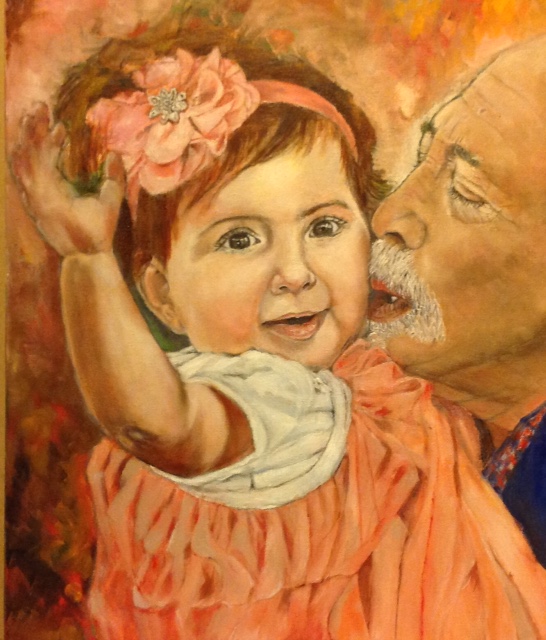
Les with his grand-daughter Jasmine. A painting by his good friend, Joon
Les and his grandchildren in Melbourne

The Orphan, Often The One

The next hero of The Urghhling Marsh surely has to be The Orphan. The brotherhood of schoolmates and old friends does not lack tales of heroic battles and unforgettable scars, but in his quest to find a life of comfort and meaning, The Orphan adds extra intensity, dimension and depth. He is neither fat nor thin, tall nor short; the fellow is not sallow and not swarthy, not an extrovert yet he is not an introvert either. His head is not hoary and not black. He is often the one who sits back and observes everyone at a gathering, and speaks only when spoken to. When he does, he gets their attention as what he often says is illuminating. He is remarkable and big-hearted and his humility will embarrass any egregious loudmouth and purveyor of falsehoods. For these reasons alone, I do not hesitate to include him in our marsh brotherhood.

The Orphan is unlike many of the heroes of Liangshan Marsh. Unlike Lin Chong of Shuihuzhuan fame, The Orphan is not skilled in martial arts and has no military training. He is unlike Li Kui who had the privilege of carrying his mother on his back to the summit of a mountain in Yiling, only to find her devoured by tigers as he went looking for water to quench her thirst. Li Kui, also known as the ‘Iron Ox’ is a fearsome rebel, often drunk and when drunk is often vulgar and dangerous. He is hot-tempered and his many brushes with the law and the lawless is due to his brashness and uncontrollable anger at the smallest slight at him or his friends. The Orphan, on the other hand, is a stranger to anger and violence. He is also nothing like Gao Qiu who became Marshal of the Imperial Guard through his football skills impressing Prince Duan. The Orphan did not have the free time to play football like many of us did in school. It was Gao Qiu’s vengeful intent to court-martial drill master Wang Jin who failed to congratulate him on his promotion to high office that began the story of The Water Margin. The Orphan, on the other hand, is often the one to extend an apology even when he is not at fault.

The Orphan is unlike many of the heroes of Urghhling Marsh too. Unlike Lucky Law, The Orphan did not have parents at all, let alone such highly credentialed parents as Lucky Law’s to coax him to do his school work or coach him to be a better person. The Orphan had none of the opportunities that some of the other heroes enjoyed – no tertiary education meant no chance to be a doctor like Lucky Law. He is unlike The Mayor also. A much less mischievous type in school, The Orphan was not involved with the truant Mayor in climbing school walls behind the bicycle park, smoking or picking up Convent Light Street girls at the bus stop. He is unlike Wu Yong The Cur who claims to have amazing powers of making winners become losers simply by supporting them. Wu Yong after the euphoria from the Aussie swimmers at the Tokyo 2020 Olympics, rediscovered his zest for the Games and decided to watch the other Aussie girls in action this week. The Opals, The Hockeyroos and The Matildas all lost despite being hot favourites. Disbelieving his own awesome powers, Wu Yong gave himself another chance to prove he does not possess such a gift. Last night, he watched The Stingers lose their match.

“Sigh, I still have the power to jinx those I support,” Wu Yong said forlornly.

Someone should suggest to him to write to the various coaches and inform them not to over-analyse their defeats – it was not their strategies they got wrong or that the players didn’t execute the plans well. It was simply the case of the unusual powers of their fan, Wu Yong, who consigned them to defeat.

Unlike the others, The Orphan is often the one who is different from the crowd, disinterested in sports and other hobbies we share. Unlike Four Eyes, he is not a strong swimmer and unlike Chip the Blue Chip, he is not into gardening. Unlike Prez, he does not enjoy drinking beer and unlike Blue Eyes, he is not into tattoos and bike-riding. He is unlike Typhoon, without an alluring sobriquet such as The Amorous One and neither is he debonair like Pierce Brosnan. Unlike The Cook, he does not cook up a storm. But, what The Orphan has is a kind and forgiving heart which makes him forget about past injustices and maltreatments that would make even the RSPCA squirm. Unlike the great author Ernest Hemingway who can only care for a few people at a time, he is big-hearted to care for people no matter what. The Orphan is often the one to lend a helping hand to those less fortunate.

“His actions speak louder than words,” Prez said of him.

This week, he was seen out on the streets of Penang with fellow heroes, Prez and The Cook, handing out one hundred packages of the most sumptuous Japanese food donated by Nagomi Restaurant whose owner is a fellow Xaverian, Ong Ban Seng, to the needy and desperate, many of whom are suicidal due to the constricting pressure from one of the world’s longest Covid lockdowns.The band of heroes risks personal health and safety, and hefty fines for breaking the curfew.

I can only care about people, a few at a time

Ernest Hemingway
The Orphan (left), with Prez (centre) and The Cook (right)

Be honest. Don’t be a nuisance to society

Ooi Choon Eng

Today, a medical condition deprives The Orphan from reading for pleasure. He suffered a left eye retinal detachment in December 2007, but thanks to a skilful eye specialist, he retains about 75% of his sight. He is thankful he was able to see his children grow up into successful professionals. His daughter and elder son are IT engineers, both having settled in Australia. The youngest is also an IT specialist, an applications developer in KL. All three of them did very well in school and secured international scholarships for their university courses. The Orphan and his wife are empty-nesters blessed with two gorgeous grand-children who often video-chat with them from Perth. The couple lives in their Penang home, a landed property they bought just before their third child was born. At the time, they were criticised for taking undue risks that were well beyond their means. Prior to the pandemic, The Orphan worked as a tour guide in the touristy island of Penang. In the good times, he supplemented his income as a part-time real estate agent during the property market boom. When he saw unemployed graduates join in the fray, he ‘retired’ to give them the opportunities they needed. The island has seen many hotels and many businesses shut down this year. Since there is no demand for a tour guide, he has occupied himself by helping to distribute bare necessities to struggling Malaysians in the ‘white flag campaign’.

“That’s my way of not being a nuisance to society,” he said.

He behaved as if he had already learned from the great statesman and scholar, Zhuge Liang of The Three Kingdoms fame who echoed Laozi’s famous words. ‘Misfortune leans on blessing and blessing is where misfortune lurks’. Both exist together and we must be alert to avoid pitfalls. If we fall into a deep hole, remind ourselves bad luck does not last forever. Get up and don’t lose hope.

Huo Si Fu Suo Yi

Hu Si Huo Suo Fu

Laozi

In 1971, The Orphan’s carers, a kindly old couple who had looked after him for almost two years, moved to KL to be with their adult children after they had all received job postings to the big city. They referred him to The Salvation Army (TSA) Boys Home (SABH) at 15 Hilir Sungei Pinang, but he was rejected due to his age – the thirteen-year-old was considered too old to be admitted. After endless persuasions by TSA, the old couple agreed to pay the minimum maintenance fee before the young teenager was finally admitted into the home. In his new secondary school at SXI, he was placed into the Industrial Arts class (Form One to Three) and Social Science (Form Four and Five).

In school, he received stares and whispered remarks of ‘a naughty boy from an institution’ from students and teachers. TSA was not able to pay the $7.50 school fee and their appeals for exemption were ignored by the school office. As a non-fee paying student, The Orphan was not allowed into class to attend the first few morning lessons.The desperate boy would attempt to sneak into a class when there was a change in the teacher. Sometimes, he was hauled out by an unkind teacher, at huge distress and embarrassment to the boy. Recess time was similar to primary school days; he would be seen at the tap near the compound drinking to fill up his tummy as he eyed the other kids queuing at the outside gate to buy their snacks and toys. He was finally given exemption from paying the school fee after the school director came to know of his situation in Form Three.

Having missed so many lessons, he was amazed to pass the Lower Certificate of Examination that year. If he had failed, he would have had to leave the SABH. Although life in the SABH was not a bed of roses, there was still a bed there for him to sleep at night. He knew enough of the hopelessness of being homeless in the street. As in any institution for people who were forgotten or abandoned, discipline was strict in a daily regimented routine for the inmates. He declined to describe the Dickensian conditions of the home, except to say that the seniors would bully the juniors, especially the ‘newbies’, to take on more duties but less food. Saying grace was a prerequisite before a meal could be consumed. After grace, The Orphan would often find half of the rations on his plate ‘missing’. His tummy was forever growling amidst the gurgling water inside.

Donations to TSA declined in the mid to late 70’s. The orphans had to grow tapioca on an empty plot of land belonging to the JKR (Department of Roads) to supplement their food supply. They were expected to scavenge for cockles and shell meats on the Sungei Pinang mudflats near the home. They reared poultry but such feathered delicacies were luxurious items beyond their reach even though they looked after them daily. The chooks were products to be sold in the market to pay for more urgent needs for SABH. Upon ‘graduating’ to Form Four and Form Five, The Orphan had to work after school hours to help pay for the maintenance fees to TSA. There was never enough time and energy to think about school work. After-school activities and sports were never in his schedule. Still, he managed to attain a GCE certificate after Form Five but that meant he had to be discharged from TSA at seventeen years of age. From then on, he was on his own.

“Where did you go?” I asked.

The Orphan pursed his lips before saying he found ‘a place to sleep’, without elaborating further. “I scavenged for items to sell to the recyclers,” he said. He later toiled away in a shipyard in Singapore before making his way back to Penang after finding an apprenticeship at a components factory in Bayan Lepas. To meet the weekly rent payments, he survived on one meal a day with lots of water to fill his stomach. The Orphan was often the one to skip lunch whilst his colleagues tucked into their meals under the shady trees.

Being immune to unkind treatments, bleak surroundings and harsh realities, my focus was simply to see another new day

Ooi Choon Eng

From early childhood, he is immune to unkind treatments, bleak surroundings and harsh realities. Built into his inner being is the focus to “see another new day”. Once he left the orphanage, he realised he had to leave behind past traumas and psychological scars. It would have been impossible for him to face the challenges ahead had he carried with him that baggage. In 1978, a kind superintendent of TSA employed The Orphan to work in the orphanage. He was elated to be given the ‘hands on’ job as a social worker with no prior training. In many ways, he was the perfect choice for the role, having seen society’s harsh treatment of destitute and hardcore battlers – victims often through no fault of their own. He met his future wife at TSA – she was a volunteer at the various church activities and community work; their affinity and love for each other told them their marriage was clearly arranged in heaven. They led a nomadic life for the next five years, moving from place to place when cheaper lodgings were available. With their combined incomes, they managed to save enough deposit to buy a two-bedroom flat after a few more years. Finally, The Orphan at age 29, had a place he could call his own. On the first night in his flat, he hid inside the toilet and cried his heart out.

“Why in the toilet, bro?” I asked him.

He said he did not want his wife to witness his sobbing. It was the last time he let out all the raw emotions of misery, grief, loss, insecurity, loneliness, anguish and abuse collected since his early childhood.

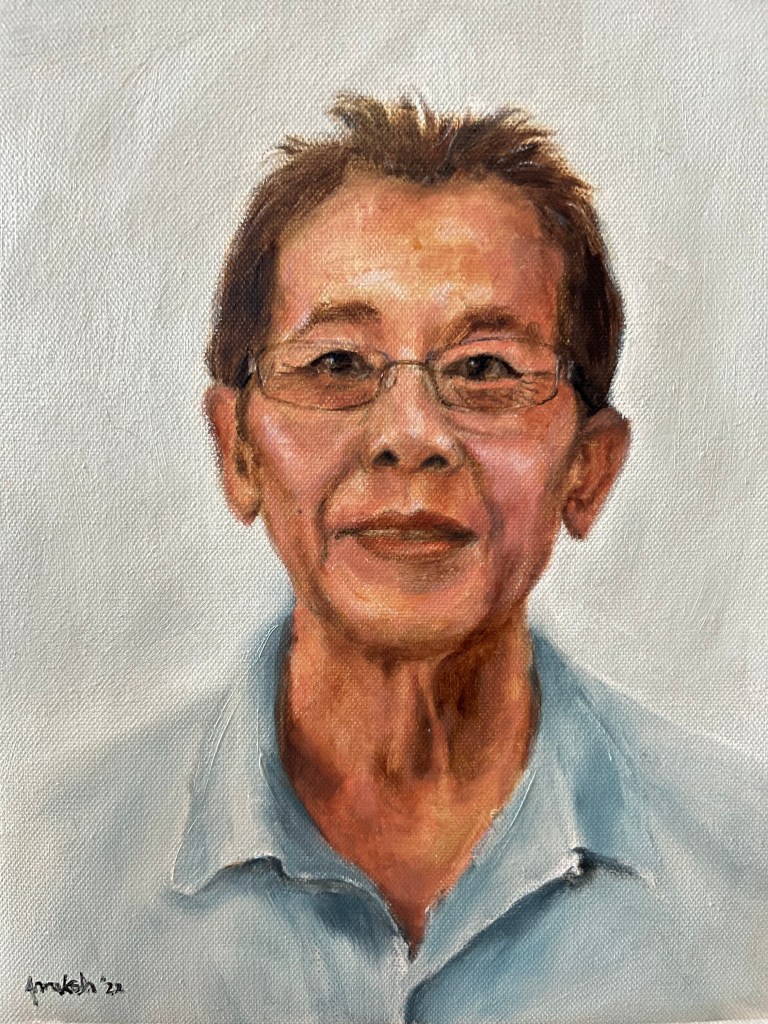
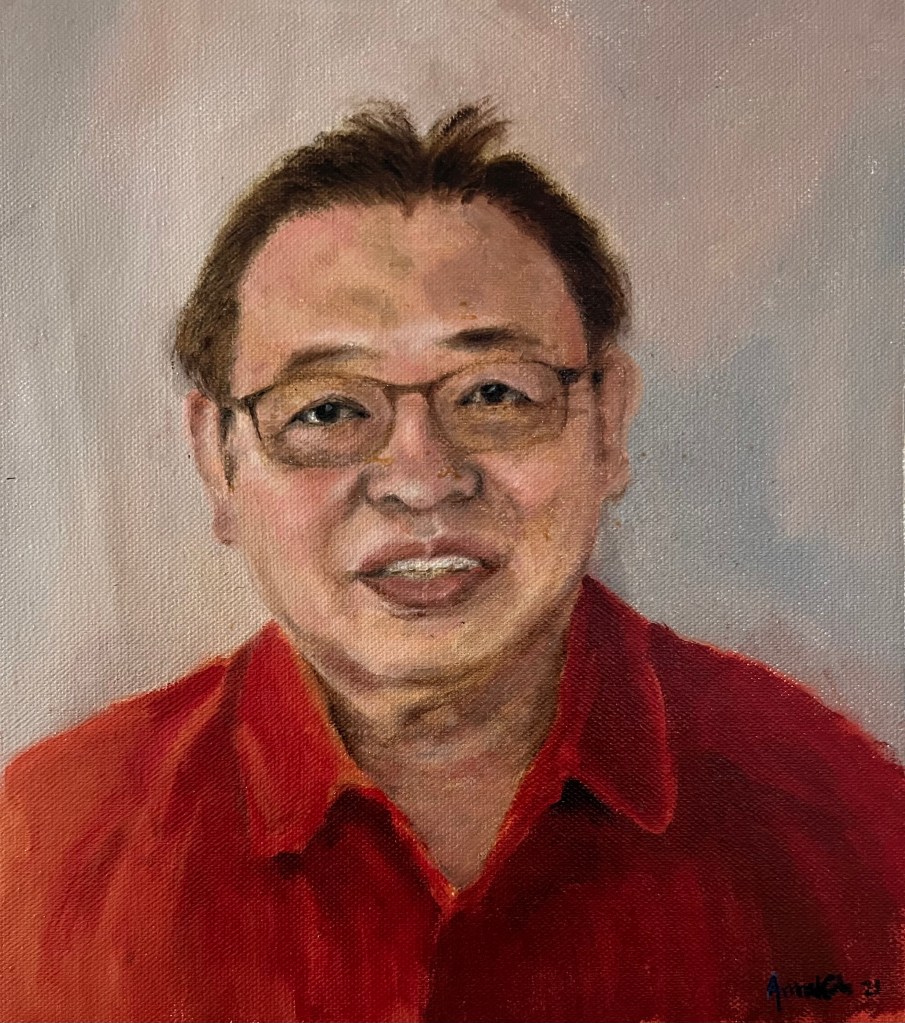
Portrait of Ooi Choon Eng by Anne Koh.

The Orphan remembers his father was a Hokkien, named Ooi Cheng Yong aka Police Detective Sergeant 642. “When I was two or three, my father abandoned us,” The Orphan started his story.

“Why did he?” I prodded.

“Someone told me he had to, due to safety concerns for my mother and me,” The Orphan said. His earliest memory was seeing himself bawl his eyes out as he was being handed to a scarily old Malay woman in Tanjung Bungah, and a scene of him stark naked, running away from some village bullies and then bathing by a roadside water pump. Another ingrained memory was of him being sent to a distant relation somewhere on the mainland. A sawmill reminds him of the place. Standing by the roadside, he would sob loudly and scream for his mother to take him home. He longed for her, but she did not reappear for many months. Due to the little lad’s constant howling or perhaps due to his mum’s outstanding arrears, the relative packed up the boy’s belongings in a plastic bag and shooed both mother and son away when the mother finally came to visit.

“Mum was always in arrears with the babysitters’ fees and so we were like nomads, being forced to move from place to place,” The Orphan said without a hint of self-pity.

His illiterate mother struggled to find odd jobs and found it even harder to keep them. She rarely visited him to avoid the babysitters’ demands for payment. He never saw his father again – it was rumoured that he was gunned down by a communist sympathiser for being a fierce law enforcer.

“I will assume mum enrolled me at the Saint Xavier’s Branch School in Pulau Tikus,” The Orphan said he has no memory of how he got there.

I suspect he wiped out major segments of his memory bank. School life for The Orphan was a nightmare with painful memories.

“I was frightened of school, my results were always poor.” The Orphan was often the one to beg for help from a classmate to copy homework answers.

After the 1969 race riots, he missed one whole year of schooling. Yet, it was special for him as it was the last time he lived with his mother; both were holed up somewhere in Love Lane throughout the dark period of Malaysian history.

A vivid memory during primary school days was the vicious treatment he received from the class teacher. It did not matter to the teacher that the innocent child was late for class because of the trishaw man. The many canings the poor lad received did not make the trishaw man arrive any earlier. The child, traumatised by such unfair and unreasonable behaviour of unsympathetic adult teachers, became more timid and insecure. On another occasion, he was made to stand in front of the class with outstretched hands lifting his heavy school bag for a prolonged spell. The teacher then poured cold water into his shirt uniform. The loud guffaws from some supercilious classmates were hurtful to him. Walking home in a soaking wet shirt made him a laughing stock. Recess time was awkward for The Orphan who had to put up with the loud sniggers and cruel taunts from bigger kids whilst envying from a distant the students with their delicious food and lollies. The Orphan would simply gravitate to the solace of the tap as he filled up his stomach with water.

Standard Six was another painful year for The Orphan. He was turned into a child labourer to catch up on arrears. Every day immediately after school, he languished in silence and obscurity till late into the night with house chores and menial work that were more suited to adults. He ran away a couple of times after copping severe beatings for slow or unsatisfactory work. His mother had not shown her face for over a year by then. The Orphan did not hold any grudges against her, fully understanding her predicament in her own inability to even care for her own needs.

The twelve-year-old already had the wisdom to forgive and not harbour toxic emotions. He is often the one to simply accept whatever life dishes out, without complaint and without fuss.

“Do our best with what we got,” he said.

“Focus on seeing another day,” he added after a long pause. 

“For me, that’s the best quote I got from The Orphan,” Wu Yong said.

“It has been too long since the last time I woke up to appreciate the numinous beauty of an early dawn,” The Orphan said before choking on his own saliva.

There is a sense of spiritual quality or maybe even a presence of a divinity in seeing the birth of a new day. Witnessing the awe of sunrise gives us hope and rekindles the primal instinct of self-preservation in this age of shallow distractions.

The wise man attends to reality

The fool scrambles after empty glory

Sima Yi, military strategist to Cao Pi in the Three Kingdoms

The Very Best of Lak

The one hundred and eight outlaws in The Water Margin are a disparate group from every level of society, ranging from the downright trodden, poor peasants, innkeepers, and fishermen to highly ranked military officers and influential officials of the court. The brotherhood of school friends and people close to me are no different. We come from hugely diverse backgrounds, yet we are able to intermingle and bond as a close unit despite our many different views regarding politics, religion and any matter under the sun. The one thread that keeps us together, I think, is our common decency and high regard for virtue and kindness. Some of us are like spring water, others are like the harshest desert, yet together, we become an oasis. The outlaws of the Liangshan Marsh are no different – virtuous and benevolent yet rebellious against the State, robbing from the rich and the corrupt and redistributing to the needy or unfairly treated. Their belief was that they would be shielded from punishment by the government since their actions were always out of loyalty to the Song emperor.

The next hero I salute will be enthusiastically welcomed to the Urghhling Marsh. I am quite certain. He is highly deserving and I hope the next two thousand words will prove it. His parents arrived in Malaya from Canton, China as a young couple. They were from quite well-to-do families. But during the communist era in China, most of their properties and assets were seized and redistributed to the people, so there was no inheritance to pass on to their descendants. The hero’s name is Lak, pronounced as luck, but despite such an auspicious name, luck did not visit him during his childhood.


When Lak was three years old, his father was killed in an accident due to a faulty car door that would not shut properly. He was thrown out of the taxi he was in when the speeding driver veered off-course round a bend on a coastal road in the island of Penang. There were no seat belts to buckle up in those days. He was in his forties when he left his seven children fatherless. Lak was the youngest of five boys and two girls. The three oldest kids, although still very young, had to stop schooling. A casual observer would have wrongly deduced that their mother remarried many times. They had different surnames. Amongst them, there was a Chee, Choo, Chu, and a rather unique Chhoo. Very few today would understand that babies’ names were often mis-spelt at the registrar in mid-20th century Malaya. Their mother could only speak her own Teochew dialect and was likely not even aware her children’s surnames were different, such unimportance was given to their anglicised names. Although she was not quite forty, she managed to keep the whole family together, “through thick and thin,” Lak emphasised. “To her, nothing was impossible,” he added. “You just have to put in the effort, and everything can be solved,” she often repeated to her kids. Despite the sudden loss of her husband and her limited resources, she continued to send gifts and money back to China for her folks there. Her parents were not informed of her husband’s passing – she did not want them to worry in vain. She worked long days and nights until her body felt like a dead branch on a tree, ready to fall to the ground. She wasn’t just independent, she had many dependants and friends to support. “She still helped others when she should be the one to receive help?” I asked. Lak remembers a villager from Nibong Tebal who frequently travelled to the island to sell medicated oil. A friend of Lak’s mother, she would ‘camp’ at their house for weeks each time. In return, she would give her generous host some of her unsold stock. “Mom believed that we should help if it is within our ability,” Lak said.

Work hard and make an honest living. Do not steal or harm others in your pursuit of wealth.

Mdm Low Hooi Kean


They learned to make do with what they had. A single kembong fish would be a main dish and had to be equally shared over a meal. On the odd occasion, they would treat themselves to a bowl of Assam Laksa. They would consume the noodles and keep the soup for later. They would add plain Hup Hoe marie pia (biscuits sold loose from big rusty-looking tins) to the leftover soup and enjoy it as a second meal. They were too busy with life’s constant challenges; their focus was to subsist and persist – no one had time to self-pity and no one had time for those who were inclined to self-pity. Being the youngest in the family had its advantages. Lak was very fortunate as all his siblings had started working by the time he was enrolled in Primary School.

As a preschool kid, he did not feel he was deprived or underprivileged. In his neighbourhood, everyone was just the same as everyone else; they were all as poor as one another. The kids along that stretch in Weld Quay enjoyed the same seasonal activities, marbles, spinning tops, kite-flying, or fishing in the drain. But, once he attended school, he knew the other boys were different. Unlike a private college where all the students are from above average income families or rich, our school was a mixing pot without any exclusions. Lak discovered he belonged to the poor category, insignificant like a blade of grass in a football field. In class, he was given a card which entitled him to a daily slice of bread with a tiny dollop of jam on top and a glass of icy syrup water. Realising that very few kids were handed that card made Lak sad.

As the years went by in school, he dreaded donation days for the Sisters of the Poor, and Teachers’ Day when other kids brought nice gifts for their teachers. “Except me,” he said. After the school holidays, everyone had stories to tell about what they did during the holidays. “Except me,” he said. During recess or before school assembly, there would be a long serried rank of eager beavers in white school uniform queuing up at the Indian hawker’s cart parked outside the school gate to buy lollies, plastic toys and other knick-knacks, “except me,” Lak said.

“Did you grow up with an inferiority complex?” I asked.

“Maybe a little. But we had our pride and self-respect; we weren’t allowed to walk like losers,” Lak confided.

Lak’s mother

From the age of six, Lak followed his mother and a sister to work in a factory that repackaged junk food into small packets. Lak worked the morning shifts before attending school classes in the afternoon. He continued with this rigorous routine right through Primary School. The factory imported items such as sweet cured preserved plums and preserved olives in bulk from China and Thailand. They were paid on a piecemeal basis. The family worked as a team, and on a good day, they could earn about three dollars. After a while, Lak’s mother showed her entrepreneurial mettle. Every two or so years, she made a trip to Canton couriering goods for people who wanted to send items to their families back ‘home’. With the fees she earned, she would purchase items that she knew would sell in China. Bicycles and sewing machines were among items that were in high demand. She was also a pioneer in the banking business, collecting monies from her clients before remitting them in person to their families in Canton for a fee. Success from these early ventures was replicated in Thailand every few months. It would not be an exaggeration to say she pioneered the import/export business between Thailand and Malaya. She brought from Penang what the Thais wanted and imported pots and pans, etc from Thailand. She did all that without any formal education and without any language and literacy skills. 

We will struggle but not bow down in defeat

Mdm Low Hooi Kean


In Form One when it was compulsory to join a uniform unit, the choice was simple for Lak.

“Join the army cadet corp. No need to purchase a uniform!” Lak chuckled.

Life slowly improved. The family bought a black and white TV in the early seventies. Lak missed all the TV shows in the 1960’s as his mother forbade her children to watch from outside their neighbours’ front windows.

“Toys? Comic books? Unheard of,” he said.

The siblings shared a lantern for the moon cake festival. It was the one and only lantern throughout the many festivals they enjoyed as kids. The lantern was only used for a couple of nights before being neatly packed away for the following year.

Sometimes we are right, but don’t ever be dead right

Chhoo Lak Thiang

Early in his career, Lak learned that it is not always important that we are seen to be right.

“Why not?!” asked Wu Yong, another ‘outlaw’ in the Urghhlings Marsh, who believes we are wrong not to correct our wrongs.

Lak then proceeded to ask Wu Yong a question that was only met with silence. “If you are driving on the right side of the road and a truck is roaring towards you on the wrong side of the road, is it important that you are right?” asked Lak.

My cost is one month of my life. My reward is the value my boss sees in me

Chhoo Lak Thiang

After obtaining Grade 4 results in the Form Five exams, the MCE, Lak decided to enrol in City & Guilds Electrical Courses. He discovered he had colour vision deficiency, and quickly changed to a book-keeping course instead.

“Working life wasn’t easy when all you had was just a GCE O level,” Lak said.

“What’s the GCE?” Wu Yong asked.

“You didn’t sit for Upper Form Five,” The Cook, another ‘outlaw’ of the brotherhood replied.

But Lak soon realised he excelled in accounting and was recruited by a licensed finance company as an Internal Audit clerk in 1977 earning a measly RM150 a month. In his wisdom, Lak saw it as an opportunity and a stepping stone. Without the paper qualifications, Lak knew that he had to prove his worth through his performance. He welcomed responsibilities above and beyond his position as a challenge to show he was ready for bigger and better things.

“This was the most valuable lesson I learned from my mom,” he said.

In 1991, due to the government’s policy on Bumiputra quotas, he was bypassed from a promised junior manager’s post. Fortunately, his boss recognised the injustice and rewarded him with the promised monetary promotion but without the position. Through the years, Lak gained his vast experience from working in various departments and subsequently he was elevated to head of a department. Eventually, he was promoted to the position of Branch Manager. I feel elated for Lak as I write this, even though this success happened decades ago. His achievement was not just a monthly fat pay cheque and a nice-sounding job title. It represents much much more. An accomplishment against huge odds. It brings relief and joy. A lightness of being, after a lifetime of struggle. Peace of mind. Certainty. Satisfaction. Opportunities. Dignity. Gratefulness. Success prompts us to be grateful, to appreciate what we have achieved and who we have around us – our loved ones who have supported us when we are at our lowest and encouraged us to carry on.

Lak met the love of his life in that branch; their romance soon turned into a wedding, but because the attendees were mostly bosses and colleagues, “it felt like a company annual dinner,” Lak said in a smiling voice. A fond memory Lak has was that after their nasi lemak breakfast, the groomsmen were readying to accompany the groom to fetch the bride from Malacca to KL, but none of them knew how to drive a Mercedes which Lak had managed to borrow from a colleague. The groom had to drive the beautifully decorated wedding car himself.

Through various mergers, Lak ended up working in a bank. There by chance, he discovered Fraud Investigations and applied to be transferred there. Lak’s career found its second wind, as he found fraud investigations stimulating and challenging. There was a high-profile case of a highly respected Navy Admiral with some political muscle, an existing borrower with no known risks who applied for a bigger loan. Lak blacklisted him for attempted fraud despite a strong appeal from department heads and accusations by other bank managers of not knowing his job. In another case, a loan had been approved and was just pending disbursement. Fraudulent documents were detected and reported to the CEO who directed Lak to make his decision. Lak revoked the loan and directed the conveyance lawyer to recover all costs from the applicant. Such a bold step was unheard of in those days. The applicant attempted to litigate but his case fizzled out, proving Lak was correct to make that call. His judgement, integrity and tenacity was never again questioned by his peers. Equally, he trusted his staff, as if he had learned the wisdom from Liu Bei of The Three Kingdoms fame.

An astute lord does not employ those whom he suspects, nor suspects those he employs

Liu Bei, Prince of Shu

Lak, in recent years, has attracted my attention with his pearls of wisdom. It would not surprise me at all if he had gained his wisdom from the three blood brothers who made their oath in the peach garden to live and die together in The Three Kingdoms. Lak would know to seize his opportunities as they arise unlike Liu Bei who on numerous occasions missed to take control of new territories due to his pretences to uphold propriety and virtue. From Guan Yu, Lak would remind himself not to allow arrogance and overconfidence to lull him into complacency – as this was how Guan Yu lost Jingzhou, a fort vital for the Shu Kingdom’s grip on the Riverlands and central plains. From the third brother Zhang Fei, Lak would remember not to be hot-tempered and abuse his people as that was how two aggrieved generals decapitated Zhang Fei as he slept.

I have no hesitation to add Lak to the Urghhlings Brotherhood alongside Blue Eyes, Wu Yong The Cur, Four Eyes, The Cook, Lord Guan, Typhoon, Chip the Blue Chip, Prez, The Mayor and Lucky Law.

Portrait of Chhoo Lak Thiang by Anne Koh.

Lucky Law, Not The OutLaw

As I was thinking about the setting for the beginning of this story, I could not help but think of Wu Song the Tiger Slayer, in The Water Margin. He was returning to his village, Qinghe County, to visit his elder brother and had presented four farewell salutations to Song Jiang and Chai Jin a few days earlier. At the time, none of them had any inkling they would become outlaws of the Liangshan Marsh. He decided to rest overnight at a small inn before heading for Jingyang Ridge. The innkeeper warned him about a large man-eating tiger with a white forehead and protruding evil eyes which had killed about thirty locals and wounded many more. The remoteness of the forest, the tension in the air, the treacherous narrow paths, unpopular treks covered by thick vegetation, the scenic meadow and beyond it a green hill on the horizon, the pleasant whispers of cool mountain air, the warning signs about a menacing tiger on the prowl, the imminent threat to his life. These were similar images in the scene that I visualised in my mind as I pondered on how to start this story about the next ‘outlaw’ in the Urghhling Marsh. I shall call this ‘outlaw’ Lucky Law.

It was along a rarely used track in a mosquito-infested, energy-sapping humid jungle that the small group of travellers were dragging their tired feet on. One of them was a handsome man in what was once impeccable clothing and he moved and spoke with a respectable demeanour. He was bringing his six-year-old son with him from Johore Baru after a four-year stint as a teacher, to Rawang where his mother and siblings lived. The little skinny boy was Lucky Law’s father, Law Nai Choong; the tall handsome man with piercing eyes and a large forehead, his fraternal grandfather, Law Chin Tang. Little is known of Chin Tang’s birth family or history. Intelligent and impressive, Chin Tang, born in 1910, was adopted from a family in Ipoh, by Law Chun Hoi and Lau Ah Say. They were a childless couple who adopted four children. Chun Hoi had a government job as an approved opium seller as he could speak both English and Chinese. Such a lucrative job was difficult to obtain in those days unless one had literacy skills and useful connections. They lived at 13 Welman Street, Rawang. Chin Tang was the third of the four kids adopted. When he turned nineteen, he was forced by his parents to marry their last adopted child, his sister by the name of Loong Chui Fung. The story goes that they were locked in a room by their mother for three days and the rest is history, as the saying goes.

Law Chin Tang with Chui Fung and two children in 1932

Chin Tang was indubitably a very intelligent man. He was dux of Victoria Institution Selangor in 1929 and was awarded the Loke Yew scholarship to attend the Arts faculty of Hong Kong University from 1932 to 1934. His poems are held in Hong Kong University to this day. He was one of very few with an education in those days; one with a university degree was virtually unheard of. Chin Tang’s father died in 1935 and although he was the third oldest in his family, he became the head of his family. Chin Tang and Chui Fung divorced in 1940 due to their irreconcilable differences as he was a learned gentleman whereas she barely finished high school. Chui Fung remarried but her new husband did not want to care for another man’s children so Lucky Law’s great-grandmother had to look after Chin Tang’s four children.

Law Chin Tang, Best Scholar 1929

On the journey to Rawang, Chin Tang and his fellow travellers camped where they could. They were not the healthiest or fittest people to be travelling with. One rotund woman was especially slow and to describe her as a whinier would be quite kind. Chin Tang knew the group had to stay united. He tried to ‘make fire and water compatible’ for everyone. One night, whilst preparing to sleep in a long unattended animal shed – maybe abandoned, Chin Tang asked a friendly Indian man whom he had just met to look after his son should he meet with some bad tidings. The next morning, Chin Tang volunteered to reconnoitre the immediate vicinity before the group’s departure. Sadly, he never returned. No one saw him or heard from him again. Luckily, the Indian man was good to his word and brought Nai Choong, Lucky Law’s father, back home to Rawang. Lucky Law’s great-grandmother was left to look after her grandchildren alone with no money and no one left at home to earn money for the family.

Not before long, another tragedy struck when their home was bombed in 1942. This left only the middle and back of the shophouse in a somewhat liveable condition. The next two years were a desperate time for them; most days they had only one meal of rice congee to survive on. Nai Choong, at a tender age of seven then, sold cut-pineapple at the Rawang railway station to help support his family.

“Dad almost never discussed this time in his life with us as it was a very sad and difficult time for him,” Lucky Law explained without being asked.

The following year, Lucky Law’s great-grandmother died leaving the children as orphans and a $500 debt for her casket. A boy, the youngest of four, was sold for $90 and the second sister at fourteen, was married off to an admirer. Nai Choong and his eldest sister were taken in as servants by a very good friend and distant relative of their father, Mah Kam Tong, who had studied at the same university in Hong Kong with Chin Tang. Mah was quite a rich man in his day and lived at Bukit Bintang Road in Kuala Lumpur. Although Mah had ten children of his own, he allowed the two young orphans to attend school with them. Nai Choong and his sister did not have a room for themselves; he slept in the hallway next to the adult servants’ room. A piece of string was tied to his toe so that he could be woken up at 5 am without disturbing the master’s family. Nai Choong’s chores began immediately – he would be off to the baker to get fresh bread, then helped prepare breakfast and cleaned the kitchen before going to school. After school, he would be required to do general house-chores and kitchen work, helped with the laundry and ironing, and later when he was older, he became their cook as well. It would be quite late in the evening, after clearing the dining table and washing all the pots and pans and dinnerware, before he had some time to study. Whilst everyone had already retired to their rooms, he would urge his elder sister at the kitchen table to keep up with their school work with the aid of a 10-watt lamp. She found those tasks too demanding. It was no surprise that she was often caught asleep during classes at Bukit Nanas Convent. The nuns took pity on her and took her in as a boarder after her first year with the Mah’s. She remained there until she finished school and went to the local teachers’ training college in Kuala Lumpur.


Nai Choong lived with the Mah’s from 1944 to 1954 as their servant. A child servant from age eight. The harsh reality for this poor boy pierced my heart and I simply could not continue writing. I must have stared at my computer screen for a long while whilst my synapses flashed about in absolute disarray. No sensible words could pour out. How did he cope with so much sadness? Orphaned at such a tender age, what force did he discover to carry on? His days were long and tortuous, his duties and chores never ending. The obscurity of his entire person, more or less a child slave, putting up with ragged days and ragged nights with no end in sight should have smothered his self-confidence. Any self-loathing would have been justified, the insecurity, vulnerability, self-doubt too heart-breaking to imagine. The deep well of despair, humiliation, and his stunted world of aloneness would have driven any mortal to give up, let alone a kid. It would be totally understandable if there were any feelings of self-revulsion and stinging anger. He was not unloved like a stray cat, or kicked around like an empty can though; remarkably, he felt grateful – to have been fed, clothed and had a roof over his head. More importantly, he was not deprived of an education. He was sent to school at St John’s Institution Kuala Lumpur with the Mah boys. Nai Choong despite all the setbacks and challenges, managed to obtain Grade One in the University of Cambridge Local Examination Syndicate Overseas School Certificate Exams. He obtained a scholarship to go to Kirby in England for a teacher training course. There he met his future wife, Teoh Saw Choo of Bukit Mertajam who had also obtained a similar scholarship. Lucky Law’s parents were at Kirby together from 1954 till 1956. Upon their return to Malaya, they quickly married and were stationed in Bukit Mertajam (BM). She taught at BM Convent as an English teacher whereas he was a Science & Mathematics teacher at BM High School.


Lucky Law, their first-born, was named after a nun, Sister St John who was very kind and inspirational to his mother. His parents had three other children after him, a sister born two years later, in 1960 and two younger brothers. He attended Stowell Primary School in BM from Standard One till Standard Four after which the whole family moved to Penang. The parents felt that there were better schools on Penang Island. Lucky Law attended Standard Five to Form Two in St Xavier’s Institution (SXI).


He left SXI in early September 1972, at age thirteen. He remembers not getting the English Prize in Standard One because he could not spell ‘vegetable’. I did not have the heart to inform him I won the English prize that year in my class. He was the dux in our class in Form Two. He informed me that he, and fellow outlaws Wu Yong, and Typhoon were amongst only six students who got promoted from Form 1A2 to Form 2Comm1 after sitting for the ‘progress test’. “I was a walking zombie; those sort of things were not on my radar, but I was pleased Lord Guan and The Cook were the other Urghhling Marsh ‘outlaws’ there,” Wu Yong said. He admitted he did not have that competitive streak that Lucky Law had from young.

Form 2 Commerce 1, 1972

On 11 September 1972, Lucky Law’s family sailed from Singapore to Fremantle arriving nine days later.

“My parents decided that it was more economical to sail than fly and we could bring more furniture and other belongings for our home in Sydney,” he explained.

The trip on the Indian Pacific train was not a bonus like how it was promised to be. “It was quite boring actually, we were cooped up for three days in a train with only red desert sand to look at …. We realised how big Australia was when we arrived to Sydney; it was like arriving in an oasis,” Lucky Law said, forgetting a similar outback scenic offer from The Ghan to Alice Springs can cost over $5,000 per one-way ticket.

“Did you have any regrets, leaving our Motherland?” I asked.

“I lack a true childhood friend although now with our Xaverian brotherhood, I have reconnected with some childhood friends. This also amplifies the strength and importance of the unity and love of the family unit,” he said.

The family that plays together stays together

John Law Choong Chet

On arrival in Sydney, he attended Form Two in the third term at Patrician Brothers High School in Liverpool.

“I suppose it was a challenge to catch up, being two terms behind the class?” I suggested.

“No, I managed to win the Maths and Science prizes,” he said proudly.

Lucky Law was dux and school captain in 1974. In 1975 he moved to Patrician Brothers College in Fairfield for his Form Five and Form Six years. He was made school vice-captain and scored the highest points for HSC for his school. He was equal first in Biology for the whole of New South Wales in 1976.

Try your best with every exam; even if you do fail, at least you have tried your best

John Law Choong Chet

Those academic accolades are mentioned to demonstrate that studying came easily to him and that he had been given every opportunity to succeed by his thoughtful parents.

“You’re an aberration, Lucky Law, you succeeded without failure,” I said.

Cao Cao, Prince of Wei in The Three Kingdoms once said, “a military commander is like a physician.”

When a physician treats more and more, his medical knowledge and skills improve, but after more and more have died. Lucky Law, however, has been lucky throughout his life. Those along the way has also been blessed by him – countless lives have been soothed or saved by him.

Without failure there is no success

Cao Cao

Their parents’ sacrifices were not lost on the children. Even before sitting for his HSC exams, Lucky Law had already been given a place at ANU to study Commerce Law. He remembers praying to God, placing his life and his future career in His hands.

“God gave me the marks to do medicine at Sydney Uni,” he said.

He started in 1977 and graduated in 1982 and so he feels very lucky. “I have enjoyed this vocation of medicine where the poor should have access to medicine like the rich,” he added. In his career as a GP, he has never charged for a consultation for children under 18 years of age and he won’t ever send a reminder bill to delinquent patients. “If they can’t pay my low charges then they need the money more than I do,” he said. His charges for working adult patients are half of what other doctors charge and those unemployed pay half of that again. 

“I am so proud of both my parents – of the sacrifices they endured for their children, especially my father. He was literally a penniless orphan who fended for himself yet was able to win a scholarship to England. When he died in 2013, my mum retired comfortably due to their life-long hard work, frugality and astuteness with their investments. Not only that, my other siblings have also done well. Both my sister and brother are doctors too and my youngest brother is a qualified accountant.”

“How were they frugal?” I asked.

“Oh! When we attended church, the priest in his sermon told the congregation he was impressed with an Asian family working together in the garden of the house he had walked past….. he was unaware they were us. My parents made their own curtain, bed sheets and pillowcases to save money….. we helped sand and polish the timber floors, paint the whole house and landscape the garden….mum knew how to sew, she even made us some shirts, not the most fashionable but a shirt was a shirt!” he spoke proudly.

I got the feeling his loving recollection of his parents were for him as soothing as moonlight streaming down on a koi pond.

50th Wedding Anniversary celebration, Lucky Outlaw on the far right.

Man is not a mere stalk of grass, how can he be without emotions?

Lu Su, adviser to Sun Quan, Wu emperor of The Three Kingdoms

“Were you sad when you left home?” I prodded.

“It was an exciting time for me! I was already 27, one of the oldest bachelors still living in his parents’ home. I met an Air New Zealand hostess and quickly followed her to Christchurch!” Lucky Law promised to dig up some old photos of the beautiful girl to show me. But, I don’t think I will be so lucky.

For the Law family, Australia has certainly been a Lucky Country. To cap it all off, Lucky Law is married to a Kiwi, his sister to a Spanish Jew, his brother to a German, and the youngest to a Japanese. It did not escape his father who lost his own father on that remote stretch of jungle track near Rawang and endured untold sadness after, that his children in multicultural Australia have married the very peoples who were at war – the ANZACS, the Japanese, the Germans, the Jews and the Chinese.

Lucky Law inspires many with his righteousness and benevolence. Au fait with just about any topic, the successful and kind doctor enjoys a myriad of interests in life, be it music, food, travel and performing in his choir. I have no hesitation to add Lucky Law to the Brotherhood of the Marsh alongside Blue Eyes, Wu Yong The Cur, Four Eyes, The Cook, Lord Guan, Typhoon, Blue-Chip, Prez and The Mayor.

Portrait of John Law by Anne Koh.

Early Mayhem For The Mayor

The mayor in our brotherhood needs no introduction. Everyone knows him by that nickname. “Why The Mayor?” I asked a few friends. No one seems to remember how his name stuck. He used to work as a barman in many famous drinking holes in Penang. Later, he joined The Holiday Inn at their Barons Table grill room and was put in charge of the bar. His career as a young man for many years after he left school was around food and beverages, as a barman, a restauranteur, and an inn-keeper. When I was reading about Du Xing in The Water Margin, I knew The Mayor was our Du Xing, the appointed inn-keeper near the Liangshan marsh who acted as the eyes and ears or early warning system for the gang of outlaws. Du Xing had a fierce face, with big eyes and ears. A quarrelsome character, he was often involved in fist fights and became an outlaw when he killed a business partner. The Mayor during school days was also frequently involved in back-alley fights with rascals and other gang members. He shares many similarities with Du Xing, except he is not ugly like ‘Demon face’. Mayor possesses a wide beaming smile that does not seem to leave his attractive fortune-giving thick lips. One old-wives’ tale taught me that men with thick lips, flat noses and long earlobes are blessed with unimaginable riches and longevity. Decades of pulling my earlobes and biting my lips have been unrewarding for me thus far. To make a woman swoon, a man usually uses charming words, struts like a peacock or croons with a sexy voice. The Mayor simply needs to smile. Oh, such wonderful lips!


The Mayor’s paternal grandparents were both born in Penang. His great grandparents were Malays. Malay as a race was first coined by JF Blumenbach, a German who lived in the 19th century. He clumped all Australo-Melanesians together and called them Malays. His paternal grandfather worked as a clerk in Chartered Bank. His grandmother was a Thai from Pattaya and thus, her descendants are Peranakan. “What can you remember about her?” I asked. “She was a cheroot-smoking matchmaker who loved to munch on sireh (betel leaf),” was all The Mayor said. As an afterthought, he added that he enjoyed going to the Rex cinema with her for Chinese movies.


Life during his childhood years was tough. The Mayor remembers they were often moving “house”. His family lived in a rented room during his school days and shared the rest of the common areas with the landlord. There was always a reason to relocate -a rent increase (never justifiable in his dad’s mind), or the rent became unaffordable, or the landlord simply changed his mind (they were too noisy?), or the room was too crammed for all of them. Perhaps, it was due to the constant pressures of life that he was whacked a lot by his mother. The Mayor’s dad worked at Universal Cars on Anson Road. He was a clerk in the lubrication / service centre for Ford cars. “There was never enough money to put food on the table, I think my dad’s salary was less than RM350 a month. How to support a wife and three children?” he asked with both palms facing heaven. “When I was small, I envied those schoolmates whose families had cars. The bus was my only mode of transport to school from Std 3,” he recalled. “Sometimes, we were so desperate my dad had to borrow money to pay for food,” The Mayor’s voice quivered. He often was sent to a relative’s house to borrow supplies like rice, soy sauce and eggs. He harboured bitter memories from childhood about the serious deprivation they suffered and opportunities lost if their father was not poor. One night, they all went to bed hungry and in tears. He decided right there and then that he will not be poor like his parents. He promised himself that he will not fail when it is his turn to provide a basic level of security and comfort for his family and to give his children a good education – essentials that he was deprived of during his teenage years. He has lived by that promise ever since. The great Sima Yi comes to mind when I write this. He was Cao Cao’s military general and regent during the Three Kingdoms period of China.

I am not one to beg for a bowl of soup at a banquet. I would rather be the one who delivers a cup of rice to a man in need.

Sima Yi


“I remember when I was about ten years-old; we had just moved into a Rifle Range flat. I got a severe beating from my mother. I felt very depressed and decided to walk all the way through the Batu Gantong cemetery, then along Western Road to my paternal grandparents’ house in Kuching Lane, Pulau Tikus”. That journey took almost an hour for the little boy. Another childhood memory was at St Xavier’s Branch School when he tried to be a hero and dared to complain about the physical abuse by his teacher, Mr Norbert Martin. At that time, the 12-year-old leader gathered a few classmates to discuss what steps to take. A young classmate, The Cook, suggested that The Mayor ought to bring his parents to school to confront the teacher. The Mayor’s mother turned up the next day and slapped her son in front of the whole class instead. That was a scar upon a scar. His parents were too busy making ends meet and had no time to guide the children in their school work. Another scary moment during that period of his life was the sectarian violence of May 13, 1969. “We were living in Tanjong Tokong Lama. As a kid, I was scared witless to see the words ‘Bunoh Cina’ in red paint on the roads,” he said. Those two Malay words were chilling for a young boy. ‘Kill Chinese’ was the message that appeared everywhere overnight. His parents were strict on all of their kids – the adults’ behaviour made them even more fearful. They were not to leave the house for whatever reason. His dad was angry at the politicians. Overnight, the Malays had become the enemy in what was a racially harmonious society. But, once the troubles were over, his dad taught him never to hate.

Do not be angry.

Anger will only lower your intelligence.

Do not hate your enemy.

Hate will make you lose your good judgment.

Rather than hate your enemy, make use of them instead.

Cao Cao

The Mayor and I were classmates in Form One. I had forgotten it until someone thrusted our class photo under my nose. Somehow, we didn’t mingle then. He was one of the boys who stuck a little mirror on his shoe. I shan’t disclose the reason why he did it except to say our teacher Mrs N Ah had a habit of wearing only white undies, her short dress barely covered. The way she sat on the raised platform with her legs apart became the focal point for the class. Many still consider that was the best year of school. The Mayor started working night shifts after his Lower Certificate of Education (LCE) exams at Intel Bayan Lepas canteen. “My plan was like a bright star in a dark sky,” he said. “If I passed the LCE, the money I earned would be handy for my Upper Secondary school years but if I failed, I would have a promised job in Intel as a production operator,” he beamed. The Mayor passed and enrolled as a Social Science student. In school, he was active as a valued member of the tug-of-war team, the dragon boat team, and was also a prominent member of the 7th Georgetown North Scout Group.

“I spent my school holidays mostly in Kuching Lane with my maternal grandparents”. There was a kampong (village) next to the lane, where at the end of it was a stream. “We had so much fun there playing in the water, catching tadpoles, stealing rambutans and mangosteens from private orchards. I’d go there the very next day after school,” he said. “The depressing thing for me whenever I visited them was that they would always see cane marks on my legs,” he sighed. “How come?” I asked. The Mayor looked at me incredulously. He did not need words but his facial expression told me I was dumb to even ask. “Report card days are always on the last day of school,” he said with wasted breath.

In Upper Secondary, The Mayor started forming more bad habits. During recess time, he and a few regulars like Michael John Thong, Alphonsus Scully and occasionally Lye Kim Leong would climb over the school wall near the basketball courts and disappear for the rest of the day.

“What did you guys do when you wagged school?” I asked.

“Oh, nothing exciting,” The Mayor replied.

“You know, the usual stuff,” he said. “Sneaking into the cinemas, smoking in coffee shops, playing billiards in the community hall, group dating, shoplifting favourite snacks or drinks from the Indian stall-owner if we saw he was preoccupied or getting into fist fights with older school boys at the Boston Bar, it was not such a thrill,” he added casually. “It was more exciting to loiter at the open-air carpark between F & G blocks of Rifle Range flats and wolf-whistle at girls passing by, or hang out at the Convent Light Street bus-stop after school to tease the girls waiting there. Best times!” he added.

Immediately after his Form 5 exams (MCE), The Mayor disappeared from the school scene and worked for two years at Chuan Lee Hin, a wholesaler in Siah Boey as their van assistant peddling Camel cigarettes for RJ Reynolds Tobacco Co. The next ten years, he was in and out of employment working as a barman for the likes of Cozy Corner at Oriental, Princess Coffee House and VIP restaurant at Townhouse Hotel.

“At that last job, I became ‘kwai lan’ (Hokkien for idiotic) and tried to form a workers’ union at the workplace”.

He soon discovered the terrible truth about powerless workers without a union. He was immediately sacked. He tried his hand as a plumber in construction sites in Butterworth for about six months but found the job tough. The following eight years, he was back as a barman at D Bierkrug, a German pub at Sri Bahari Road, then at Villa Roma coffeehouse at Sunrise Gurney Drive. Then on a fateful afternoon, an ex-general manager of one of the venues approached him to join him in a new venture at a Johore Baru hotel. Before too long, he left the hotel job after marrying the woman who made his legs ‘feel like jelly’ the first time he saw her in a coffee shop. She ran an agency dealing in life and general insurance. He joined her in her business but found the purely commission-based job unrewarding. He hated the constant rejections and did not enjoy the cold-calling style of work. But, luckily he remembered the promise he made to himself all those years ago about not wanting to be poor ever again. His wife was instrumental in tapping into his obvious talents and vast network from decades working as a barman. He firstly approached his drinking buddies, and with their patronage and their recommendations, The Mayor was quick to achieve the Million Dollar Club in just his second year. Indeed, he has been a bright star in a dark sky ever since.

Breakfast at Canary Wharf

Dying to succeed. Die I must also succeed.

Choong Kok On

Here is a man right in front of me, who has tasted the depths of bitter despair to now shining brightly as only a newly-born star can. I was eager to know how he achieved such success, given his background.

“Will you tell us your secrets to success?” I asked.

“Perseverance. Desire to be successful. Be systematic and organised,” he said with a firm voice.

The Mayor was unaware the first two were also Sima Yi’s secret of success – persistence and enthusiasm. His wife told him he would never be rich working for someone else.

“Luckily, I listened to her!” he enthused.

One. I am afraid of pain.

Two. I am afraid of suffering.

Three. I am afraid of dying.

So, I have no choice but to obey Cao Cao and work for him.

Sima Yi

Very soon after joining the Million Dollar Club, The Mayor realised his dream of owning his own prestige cars. He did it for his dad.

“Dad worked for a car dealer, but he never owned a car in his life,” The Mayor said.

The Mayor has owned impressive cars like the Citroen Xantia, Mercedes E200, Citroen C8, and BMW X5. He is a worldly man, attending annual business conventions around the world prior to the pandemic. Not bad for someone who was a rascal as a young lad whose only guiding light was never to be poor again. He is happy all his siblings have also climbed out of the poverty trap.

“We don’t have to be poor again,” he said with a great sense of gratitude.

Yet, I sense a lot was left unsaid. The ineffable miseries of his childhood, I suppose, will remain loud in the silence.

Mayor at the Keukenhof.

“Please, can you share some more?” I asked The Mayor.

Clearly, he is a man who can inspire many to get out of their dark hole, to give themselves a fighting chance, to not give up, to perhaps even dream of greatness.

After some coaxing, The Mayor added, “One must be humble, caring, and always put the other party’s interests first. Be a willing listener, be a problem solver not a whinger, show a deep well of patience, offer realistic solutions and never force your products down someone’s throat. Learn to win friends, enjoy their company and be genuine.”

Like Du Xing who was conferred the title ‘Martial Gentleman of Grace’, The Mayor is also a gentleman full of grace and kindness. Du Xing was one of the few Liangshan heroes who survived all the campaigns. The Mayor inspires many also for being a survivor despite impossible odds. He enjoys a healthy reputation as a successful and honest insurance broker. I have no hesitation to add The Mayor to the Brotherhood of the Marsh alongside Blue Eyes, Wu Yong The Cur, Four Eyes, The Cook, Lord Guan, Typhoon, Chip the Blue Chip and Prez.

Portrait of Choong Kok On by Anne koh.

Our President’s Precedents

The character in The Water Margin that most resembles the next hero in my story has to be Chao Gai, the chief of Dongxi Village who became the leader of the marsh brotherhood. Chao Gai’s inspirational leadership of great heroes and unrivalled kindness that instilled many to follow his saintly crusade made me put down the book and contemplate on where I have gone awry in my own life. We all fondly refer to the President of our class reunion committee as Prez. That Prez also exhibits such heroic qualities and magnanimous heart forced me to stop and consider why I have been a lesser man with a smaller heart and a narrower mind. He has a heart that clearly does not discriminate or incriminate but is well balanced, hospitable, virtuous, kind, and above all, caring and generous. Why, why, why then, have I remained in the shadow of moral mediocrity and continue to occupy myself with the self-imposed staleness of increasingly meaningless goals of the financial and material kind? What causes a person to choose the path of selflessness? To own an instinctive inclination to reach out and help those less able or less fortunate? It seems counterintuitive to common sense; surely the Theory of Evolution requires us to look after ourselves first and foremost? I felt a deep sense of shame as I read about Chao Gai’s kind deeds and related them to Prez’s ever-present big-hearted compassion that puts his benevolence and courage often in the limelight. These heroes share a common thread – they are brave, selfless, kind and often reach out to help the needy or less fortunate. I can’t tick any of those boxes with real conviction for myself, and this has been as annoying as a blowfly to my conscience. I should not mislead the reader – I do of course, also contribute to society, with the efforts from work and small donations to charities and medical research. But, they are not really worth mentioning and pale in comparison to the innumerable fundraising campaigns, charity work and support for orphans, the needy and the elderly that Prez has led.

Prez’s paternal grandparents travelled from Fujian in Tong’an via Singapore and settled down in a rented room in Kimberley Street, Penang. They had two sons and two daughters. Prez’s father was the youngest of the four. Prez never met his maternal grandfather – apparently, he converted to Christianity but attended only one service before he succumbed to an illness. His entitlement from that single gesture was a right to be buried in the Western Road cemetery. Prez’s maternal grandmother was a kind and generous woman. She outlived her husband by many years but she was buried in Batu Gantung, far away from his final resting place on account that she did not convert.

Prez’s dad was known as Ah Tong. Educated in a Chinese-medium school, his lack of English language skills was of no consequence during pre-colonial rule. As a young man, he worked as a lorry driver distributing ice blocks, and later transported pigs for Khow Lee, the famous Kuala Kangsar Road pork shop. In 1956, he and his wife Hong Choo had enough saved to start their hobby farm – rearing pigs and poultry in Air Itam. It was his mother who imparted the first rule for Prez to abide by throughout his life. Prez’s benevolence and compassion directly stem from her instruction – the emphasis to give rather than take. He has a collection of rules which he steadfastly lives by, a set of precedents if you like, that are established by long practice.


Give before you take.

Hong Choo
Hong Choo and Ah Tong at a tea ceremony.


A fond memory for Prez was the motorcycle rides with his parents from their home in Beach Street in town to their farm, although he was scarred by one trip when he dropped one of his slippers whilst sitting sandwiched between both parents. His mum who was a pillion rider behind him saw that he had lost a slipper, but she too made not a single sound and thus saved the four-year-old boy from his father’s rotan (Malay for rattan cane). He had a tough childhood but that did not deprive him from having some happy memories too – shooting birds with catapults, catching and nurturing fighting spiders and staging fights, swimming in the river with the neighbourhood kids, and avoiding police raids during Chinese New Year gambling sessions were especially exciting moments. His favourite prank was “pounding itchy berries upstream, downstream kids ‘kena’ (suffered) itchiness”. Prez was still only a kid, but he was not spared the daily chores that a farm demanded even from a boy – collecting dried wood for the furnace, chopping banana tree trunks, collecting weeds and food scraps for the pigs, bathing the pigs and clearing the pigsties of their wastes, collecting eggs and cleaning chook poo from the nests. They kept some goats too, but those proved to be a handful, as they were prone to damaging neighbouring crops and fences.

A 1937 painting of Ah Tong‘s clan professing their love for their motherland during a wedding celebration.


In 1963, his family moved to Air Itam to live, thus avoiding the unproductive daily commuting time. His parents retired in 1969. Air Itam lies on the foothills of Penang Hill, a verdant valley with a few pristine streams. The cool clear water and clean fresh air from the hills they enjoyed was a well-kept secret. The family house still stands, now over a hundred years old. Prez is the sixth child in his family, the third son.
He attended La Salle School in Air Itam before joining my school, St Xavier’s Institution for Fourth and Fifth Form. “You were in our school’s Army Cadets, right?” I asked. “Yes, the cadet uniforms were the cheapest,” Prez said, indicating that monetary concerns outweighed passions and interests. In the first few weeks in his new school, the teacher pestered Prez incessantly to buy the compulsory accessories – a school tie, a cap and a coloured tee shirt for the Sports ‘House’ he was selected to. His dad finally agreed after muttering to himself for weeks whenever asked for the money. Prez described how bad their living conditions were. I was reminded of the Chinese word for poor, qiong 窮. It is formed from three words. The first word at the top is a small cave. The second word below it on the left is body, and the last word on the right is an archer’s bow, bent and stretched. So, 窮 describes how a person is hunched over, cramped and stretched to the limits in a tiny harsh dwelling. A picture of abject poverty.

Prez had to attend Upper Form Five, after which he accepted that tertiary education was beyond his family’s budget. He contributed to the family’s coffers during those High School days but the amounts earned from an uncle’s car-wash operation and tuition fees as a part-time teacher were not enough. Two older sisters fared worse, sacrificing their education, and did not complete high school. All the children had to work from an early age; his two brothers ran a stall selling their family farm’s chook eggs at the Chowrasta market for many years.

From 1977 to 1979, Prez worked as a construction labourer in Kuala Lumpur after abandoning his ambition to further his education at a tertiary level. His big break came when he joined Jabatan Telekom in March 1979. There he stayed and built his career in warehousing and logistics and later branched to technical and service restoration until his retirement in 2018. Today, Prez is still blissfully married to his wife of 39 years. She was the irresistible girl from three doors away and together, they produced two daughters and a son. They enjoyed their childhood together, “swimming in the river, playing ‘tar li tui’ (chasey), and spent a lot of time together in their teens – hiking, picnicking, camping, etc, etc, etc”. Prez refused to elaborate what ‘etc, etc, etc’ was or where they were enjoyed. Instead, he offered this additional detail, “She had lots of admirers but I beat them all because of my honesty and good reputation in the neighbourhood”.


“What you do not wish for yourself, do not do to others.” 己所不欲,勿施於人。

Confucius

The above saying takes different forms throughout history. The Bible’s version is well-known by all, ‘Do unto others as you would have them do unto you’. This is a favourite rule that Prez keeps in his heart – one could say this is another unshakeable precedent he adheres to. “No one wishes ill-will on themselves, similarly, we ought not wish ill on others”.

“If we were all to practise this, then the world will be rid of evil a long time ago. There would be no urghhlings for me to write about,” I said.

Prez sighed and observed this fact,”Time and time again, humans are less loyal and trustworthy than dogs”.

A friend, John Scalzi, taught me this prayer recently, ‘Dear God, please help me be the person my dog thinks I am’.

Education is the only fortune.

Lim Theng Lye

Prez was the kampong (Malay for village) tuition teacher when he was still in High School. His passion for education was infectious and for that, he would have unknowingly helped many children to a more promising future. The universal convention about the value of education adopted by the kampong kids would have stemmed from this precedent that Prez holds dear. He did not forget the importance of physical education either. Prez built a concrete badminton court on land adjacent to their house, and espoused the discipline that regular exercise from their twice weekly badminton sessions was good for health and happiness. His appreciative daughter told me they didn’t have money worries in school. “As much as honesty is the bedrock of our loving family, papa is our drumbeat of learning”.

Fortunes are dictated by fate, life and death are prescribed by heaven.

Unknown

Prez is an ardent follower of this precedent. “If you can’t change your fate, change your attitude,” he said. “We may not be born equal, but with the right attitude, nothing is beyond any of us,” he instils in his children. I see him as a straight arrow, outright without artifice and wears no mask of pretence.

Man may calculate, but it is heaven that ordains. 人算不如天算

Old Chinese saying

“God’s plans supersede our own. Man proposes but it is God who disposes,” Prez said this is also one of his favourite precedents. In other words, let us put our best foot forward, and give it our best shot in any endeavour. We commit to any undertaking with as much effort and determination as possible, but let us not be disappointed with our ‘personal best’. We cannot grumble if we have tried our hardest.

A droplet of grace will be repaid with a fountain of gratitude. 滴水之恩,当涌泉相报

Han Xin, a military general to Liu Bang, eventual founder of the Han dynasty. 

Prez’s loyalty and benevolence can shame people. There is never any favour that is too inconvenient or any kind deed that can be ignored by him. But, it is also his immense sense of gratitude that can overwhelm even a man with a heart of stone. Prez teaches his children they must follow this precedent and be as indebted to kindness and patronage, and never to abandon anyone who has put their trust in them.

Like his dad, Prez had great intentions for lasting friendship. So one day in 1980, he pulled out from storage an old list of names and addresses of his classmates from his last year of school, and started an annual reunion. After a request from Jason Lee in 1982, Prez organised the first reunion of all Lasallians from the same year. In 2009 following a suggestion from Joe Tan, he formed our brotherhood and named it LaSaints58 – Brothers Forever. This group comprises schoolmates born in 1958 from the three schools, La Salle, St Xavier’s Branch and St Xavier’s Institution (SXI). There have been recent murmurings from some quarters that we should be politically correct and call ours a fellowship instead, to be all-encompassing since some girls did join SXI in Form Six. The founding committee members were: Stephen Loo Vitong, Michael Ang, Lawrence Cardosa, Steven Tan Jit Huat, Gilbert Chin, Roy Liu and Patrick Leong. Sub-committee members were: Wilson Gan, Mak Kem Seng, Tan Chueen Seng, Oh Teik Soon, David Sivampatham, Admiral Ch’ng, Lye Tuck Lum, and Loh Thiam Fook.

Loyalty, Courage and Discipline are my only three conditions.

Guan Yu, courtesy name Yunchang

Guan Yu, the God of War, a military general who served Liu Bei during the late Eastern Han Dynasty in the Three Kingdoms, adopted a son by the name of Guan Ping. He had only three conditions for the young man before he accepted him. Loyalty. Courage. Discipline. Prez considers these three attributes as important as honour, compassion and righteousness. These are the six pillars of a great precedent for his children and those who follow him. “We will remember these precedents until our teeth fall out,” his daughter promised.

Prez and I never attended the same class in school. He still has that demeanour of a young larrikin whose infectious laughter can make an elegy sound happy. It would be fair to say we never met in school, although I did recognise him from some school photos he shared. Angelina Jolie may have her amorous hot lips and Brigitte Bardot her famous pouting lips, but Prez’s trademark thick lips complement his flashy white teeth also. Meeting him two years ago was like ‘seeing sweet rain in a time of drought’. The respect he commands is unrivalled and his popularity is universal. I still hold dear in my heart his wonderful kindness when during the first wave of the pandemic in March last year, he attended my aunt’s wake despite a lockdown order in place. After observing the Buddhist obsequies, he paid his respects and handed a ‘white handkerchief’ to my cousins, as a condolence gift from our brotherhood. When we were feeling devastated and emotionally vulnerable, he was there to support us in our grief. I have no hesitation in including Prez, a most worthy man, to the brotherhood alongside Blue Eyes, Wu Yong, Four Eyes, The Cook, Lord Guan, Typhoon and Blue Chip.

Portrait of Lim Theng Lye by Anne Koh.

Chip, The Blue-Chip

When I think of excellence, absolute reliability, top shelf quality or highly prized assets, the word that comes to my mind is blue-chip. Throughout my life, I have come across very few examples of that. In real estate, I was lucky to purchase one such awesome property on the final morning of a rushed three days in Brisbane, where The Mrs and I left our mid-teenage sons to pursue their tertiary education. The waterfront villa along the Brisbane River in Kangaroo Point went for a song in a very depressed market, such was my astute negotiation skills against a rather desperate Singapore-based seller. In the sharemarket many moons ago, I was also lucky to acquire some BHP and Oxiana shares, both true-blue Aussie blue-chip mining companies, with all that mineral wealth in the ground for them to dig in perpetuity. Before the reader gets too excited, I have long divested all of my blue-chip investments, such were the topsy-turvy economic cycles we lived in. There is, of course, one other who belongs in the blue-chip category. The perspicacious fellow is my good friend Chip. His general knowledge is astounding and often mesmerising. He has the strange ability to discern what most others don’t and to understand what escapes most. I am proud to say that he is perhaps even more blue-chip than we first met in 1965.

When I was reading The Water Margin, a hero by the name of Hua Rong pricked my interest. He was ranked fifth leader in the brotherhood and put in charge of supplies such as food, ammunition and other important provisions without which, the whole gang would have disintegrated. He was their quartermaster, in other words. Chip’s reputation in school was that he was the quartermaster of our troop of Boy Scouts. The success of a Coronation Camp was measured by the quality of the activities, the attendance of beautiful Girl Guides and the quality and adequacy of the food and drinks. The latter criterion was under Chip’s domain. I still hold fond memories of Chip and a few other close friends chopping down 30-foot high bamboo trees alongside the turgid and fast-flowing river behind my parents’ old house at Scotland Close. This was in preparation for building tents for the camp. We transferred them to the campsite about an hour’s ride away, one at a time, tied to two bikes one behind the other about 15 feet apart. Hua Rong was known as “The general with the uncanny arm,” such was his remarkable accuracy with the bow and arrow. He convinced the leader of the outlaws his archery skills were no fluke when he brought down the third bird from a column of flying geese with an arrow through its head as he announced he would. Chip may not have an uncanny arm – I know that because he did not destroy me in the tennis court last Boxing Day – but he does have an uncanny ability to read the ‘mood’ of the brothers and to smooth any ruffled feathers before they became rumbustious. You will never witness Chip annoying anyone or becoming a target for ridicule or scorn. He is much too aware of his surroundings and perceptive of potential discord. Chip does not have Hua Rong’s thin waist and overly broad shoulders but he is handsome-looking with healthy red lips and somewhat stained teeth from his love for the daily ‘short black’. There is an old saying that a person who is guarded about his privacy ‘holds his teeth very closely to his lips’. So, I was a little surprised that Chip agreed for me to write his story. It is a compelling one to share and I hope young readers will find it inspirational.

Chip grew up in a tough neighbourhood where gangsters and triads roamed the streets after dark. His house was in Third Street, a stone’s throw from the infamous street ‘Chit Teow Lor’ or Seventh Street. “Were you ever beaten up?” I asked. “No, we felt safe as they left us alone.They saw us as their neighbours,” he said. “Did they try to recruit you?” I asked. Chip did not answer my question but he said, “I knew where they hid their guns and parangs (Malay word for machetes) – under drain covers, in stacks of firewood piled in the back lanes. I would peer through my bedroom window’s wooden plantation blinds and witness gang fights”. It stuck in my mind that despite his growing up in rough and violent surroundings, being saturated with daily vulgar words from neighbourhood kids, Chip has maintained a gentlemanly charm throughout. I have not once witnessed any vituperation from him. Chip’s childhood days were happy and carefree – running in the back lanes, playing open-air badminton with neighbours and catching guppies in monsoon drains. His inquisitive mind was not bound by school rules and it meant school homework was not a priority for the young Chip. It was not surprising that he was never in the same classes that the elite boys and semi-elites attended. Although we were in the same school from Standard One right through to Fifth Form, I knew Chip only because we were cubs and scouts. I did not have to see his report cards to know his academic results were poor. “Did your dad spank you when asked to sign them?” I annoyingly asked. “Papa’s favourite remark was ‘you can do better’,” Chip replied.

Childhood days were mostly difficult days. “But papa unfailingly ensured that there was food on the table…….though he was seldom at the table with us when we had our meals,” Chip informed me his dad was always busy at work. “Papa brought home bundles and bundles of vegetables every day….. alas, most were rotten and after the usual big effort, mama would manage to salvage enough to barely fill a plate”. Even though his father was a vegetable seller in the market, Chip’s family never enjoyed the best and the freshest vegetables at home. Chip’s dad arrived in Malaya from Houxi, in Jimei District, Xiamen municipality, at age three. The year was 1927. “Papa was brought over by his grandfather,” that was how Chip started his story. Papa’s grandfather was helped by clansmen upon his arrival in the new country and found work in Sia Boey Market. When he was ten years old, papa’s school life at Sum Min School ended. He had to work in Prangin Market to help his grandfather make ends meet. Three years later, he would be all alone in the world – his grandfather perished as a statistic of the Japanese bombing whilst working in the market. At the age of 16, the boy became his own boss when he opened his own stall at the market. After two years of steady income, the young business owner married a gorgeous girl he had eyed for awhile. It was during the Japanese occupation, an era when single ladies were married off no matter how young to avoid the hungry eyes of the Japanese soldiers.

“My father also had a skirmish with the Japanese soldiers,” Chip continued. 

“He was 18 or 19 then……he had just married my mother”.

“He was on his way home from the market when the Japanese soldiers rounded him up and herded him up a truck”.

“A Taiwanese lady who knew my father witnessed his arrest and without a thought for her own safety, boldly walked over to the soldiers pleading for his release”.

“This lady spoke Japanese and calmly lied to them that my father was her son”.

“If not for her, I wouldn’t exist,” Chip said with hands placed together in prayer.

Papa was forever grateful to the Taiwanese woman, and called her ‘mother’ from then on. His own parents finally reunited with him in Penang in 1937. It was an awfully long ten years for the boy, growing up without his parents. But, a short four years later, his father returned to China leaving his mother with him. It makes sense now that Chip says he had two paternal grandmothers. “My (real) grandma was very likely from a wealthy family – she was a ‘bind feet lady’….. can you imagine how a lady with bind feet lived in Penang during the war?” Chip asked. “My ma had to serve her day and night, such were the demands from an incapacitated mother-in-law”. I detected a newfound pride in his voice for his mother. Chip’s family tried to track down their grandfather in China a few years ago. But they drew a blank. An old-timer said to them, “He left, came back and disappeared again soon after”.

Family photo, 1969

13 May 1969. “We had a curfew in place, if you remember. I witnessed the clashes between the police and the triads. I experienced the acrid smell of tear gas which was used as a crowd control measure. Post 13 May, there was an obvious change in the neighbourhood landscape …… a sudden disappearance of certain neighbours….”.

“I was told that they were triad members and had been arrested and ‘buang’ (Malay word for expelled) to another town”.

“So, was life quieter? More peaceful?” I asked naively.

“No, a new wave of crime descended …… drugs! I witnessed sachets of heroin exchanging hands in broad daylight. As we walked along the five-foot-way to the local provision shop (chai tiam mah), we could see sachets hidden in cracks of walls, under pot plants, etc”. It was beginning to be obvious to me that kids who grow up in rough neighbourhoods do not become feckless later in life. If you were weak, you were dead. Schools and colleges are places that hopefully make us smart. But it is the streets that teach us to be street smart. Chip has been the one who knows to read his surroundings quickly. He is a true master at reading people too. He enjoys the benefit of knowing he can trust his personal judgements of characters and situations.

“We could smell the alluring scent of opium they were smoking, as we walked through the zinc sheds at Chulia Street towards Penang Road on the way to school,” a friend chimed in.

“No wonder you found excuses to walk the back lanes of Presgrave and Tye Sin streets, the sweet smells from the opium dens along there were no secret,” I added.

Visits to the chai tiam mah were happy moments for Chip. “Mama would say “go get rice or sugar or salt” and I would run up the five-foot-way without detours to the shop and buy the provisions obediently”.

“Why happy moments?” I asked, expecting him to share secrets of a crush on the lanky shop-owner’s daughter whose beautiful deep-set eyes were perfectly matched with a long pig-tail and mysteriously soft fair-toned mounds on her chest.

“The uncle will reward me with a lolly!” shouted Chip, who was innocently unaware of how boring his answer was to me.


 Friends are important – they make you or break you.

Yeoh Chip Beng
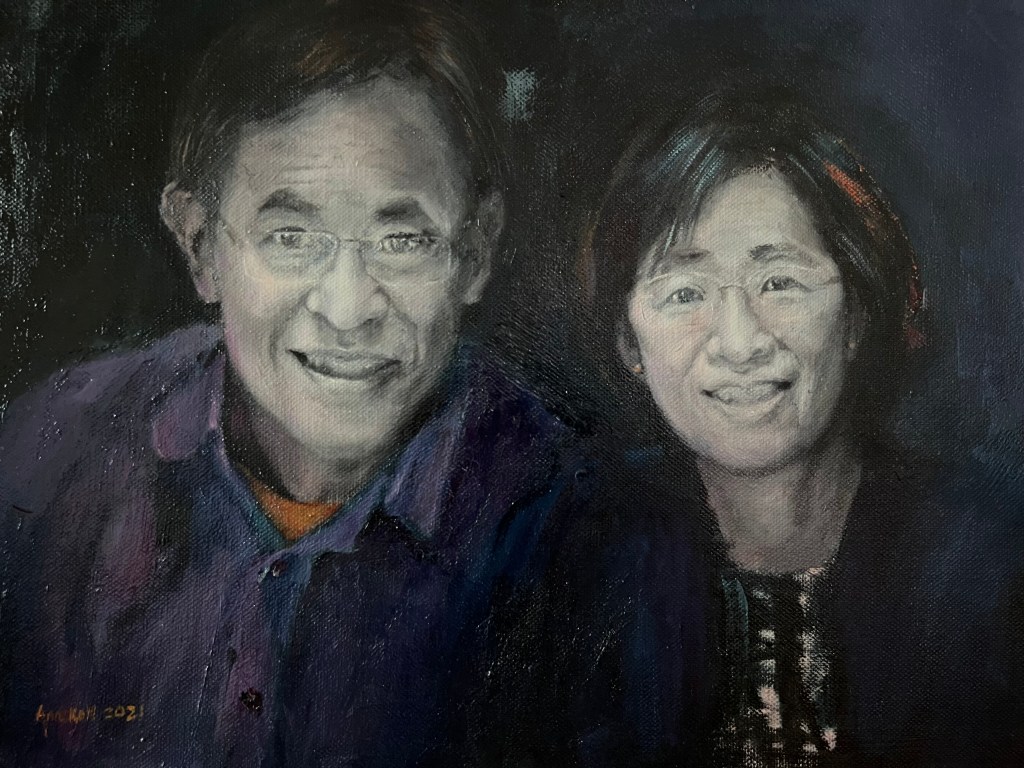
To this day, Chip does not remember how he was sent to Sydney to further his education. Like many others, he had to stay back a year after his dismal results in the M.C.E. I was not aware many of my friends had to suffer the ignominy of attending Upper Fifth Form. In truth, it was not really an embarrassment to repeat Form 5, many failed because of the Malay language test. Chip finally grew up, in his first year in Sydney. He surrounded himself with the right people whose focus was to leave home, get to Australia, have that free education, gain some life experiences and go home as a successful graduate, and live happily ever after. For most students from Malaysia, money was tight. Chip was no different. “We do not have to be poor forever,” we reminded each other.

It was a no-brainer that he would join me and another childhood school friend as flatmates. We found a flat in a brown building sitting high on a hillock in Kensington, a mere half-hour’s walk to the university. Chip was our Hua Rong in the small brotherhood – imaginative, resourceful and a great cook! Reaching home at 3pm was a daily thrill for me. I would rush up the long flight of stone steps and head straight to the rear of the building past the rusty Hills hoist from which would hang uncollected for days, racy undies and lacy bras. I used to wonder what the owner looked like. Chip would be visible through the kitchen window. “Chip!” I would yell out happily as I got into the kitchen from the laundry room door. Chip would turn around, with his signature grin complete with perspiration on his forehead. “Fried rice?!” I asked enthusiastically one afternoon. It surely was. Chip’s fried rice was special before the Chinese restaurants called theirs Special Fried Rice. Three eggs, Birds Eye frozen peas and sweet corn, and a hint of tomato sauce. Our weekly allowance was meagre, the rent represented 80% of my earnings as a waiter. Our food bill was limited by whatever savings I had left. Chip was in the same boat. The other flatmate came from a rich family, so he was able to supplement his meals in the uni cafeteria and in his favourite American burger outlet. My lunch was standard and never varied. One peanut butter and strawberry jam sandwich and a 125ml carton of wholesome milk. Some uni friends called me and the other flatmate ‘The Fat and The Thin’- there is no need to guess who ‘The Thin’ was.

We celebrated Chip’s 21st birthday in our Silver Street flat in Randwick. We moved there from Kensington after we had our 24-inch Panasonic TV and my pride and joy, a 10-speed bicycle, stolen. It was a small party without booze (unaffordable) and girls (also unaffordable). We did not dress up for the occasion and we cut one another’s hair in the vain hope that we would look presentable in the photos. No photos will be presented here, unfortunately. Chip understood we would turn up without presents – we were poor students on our own, without any financial backing from home. But, Chip cooked up a storm. It was one of the best meals I had in years. The finale was a big wok of birthday noodles impressively garnished with yellow egg strips and red egg strips. He did it all himself, is that not simply incredible? Every birthday ought to be celebrated with noodles with red egg strips, a Chinese tradition that has virtually died here.

Chip’s birthday noodles
Boyhood pals, from Penang to George Street, Sydney in 1979.

Chip surprised himself that he did amazingly well academically – the first year results were beyond his expectations. Distinctions and High Distinctions became the norm even in his second year. His excellent results got him invited to the Honours programme in UNSW. He was tempted and wanted to stay the extra year in Sydney. Money was tight at home but he could struggle through another year, he reasoned. But the decision was made for him. A prestigious Big 7 audit firm offered him a job in Singapore and that was that. No further discussions were entertained. It was fatuous to argue otherwise. This street kid from yonder was heading to Singapore and entering the world of international banking and high finance.

Chip with his lovely wife, a symbol of international success.

During a recent visit to Chip’s home which nestles in the lush green hillside above Penfolds vineyards, I looked at him admiringly from a distance whilst he was busily serving his signature Ribeye fillet. It was as usual, the epitome of a perfect steak only Chip amongst us, can master. It crossed my mind that he had every reason to be house-proud. A man’s home is his castle. Chip’s castle is beautifully designed and tastefully decorated. The sprawling garden is well maintained and showcases Adelaide’s skyline and the distant shoreline in the west. No matter how he dismisses the quality of his castle in the blue-ribbon suburb, a casual visitor cannot miss the banner that spells success. There he was, carving the steak in his kitchen, yet the vision I had of him was that of a grand old master of the corporate world, a retired Finance Director of a famous public company based in Sydney, and a retired acting chairman of another publicly listed company in Melbourne. How did he get to the top of the echelon of the predominantly white club? Today’s modern women push for more gender equality in the corporate world, demanding more leadership positions for women. Yet, it is the bamboo ceiling that is a lot harder to break for Asians in Australia. Where 9.6% of the community has an Asian background, a paltry 1.9% of executive managers has Asian origins. Chip from Third Street, Penang achieved what most say is only for the dreamer. He did it without fanfare and none of the pomposity that often is packaged with glittering success. He did it against all odds, arising from a background that was fragile, frugal, dismal and bleak. I have no hesitation in including Chip, a most worthy man, to the Brotherhood of the Marsh alongside Blue Eyes, Wu Yong, Four Eyes, The Cook, Lord Guan and Typhoon.

The best Ribeye that would tantalise any steak lover.

Portrait of Yeoh Chip Beng & Ai Poh by Anne Koh.
A Boon For Typhoon

Whilst reading The Water Margin, a dilemma developed in my mind about the loyal and noble heroes in the epic tale. On the one hand, we cannot deny that they held honour, virtue, loyalty and trust to the highest degree yet the judicious killings of anyone who crossed them were unpalatable for me, especially the wanton massacres of maids and servants to rid their murderous acts of witnesses. Their vicious and ruthless treatment of those they found contemptible was for me as repulsive. “Leave hair not leave heads” 留 发 不 留 头 often their modus operandi. We can easily overlook the rebels’ excessive drinking but the cannibalism of victims was too often portrayed as a normal practice. Yet, there was also the idea of the virtue of Zhixing which was often repeated in the stories, the Confucian virtues of benevolence, righteousness, propriety, wisdom and trustworthiness. Similarly, when I was a kid, Robin Hood of Sherwood Forest appealed to my moral instincts in clear black and white terms. Their good over evil, helping the poor and down-trodden by robbing the rich and unjust was simple but effective story-telling that left me starry-eyed about the value of heroic virtues, outlaws they might had been. The one hundred and eight heroes in Liangshan Marsh showed a high standard of sincerity, respect, filial piety and loyalty – all virtuous qualities. These noble qualities and perhaps the style of writing that lent acceptance of these men as heroes made it less disturbing for me even though the outlaws were at times frighteningly violent. It was the noble hero, Chai Jin (or Nobleman Chai), also known as ‘Little Whirlwind’ who most impressed me with these virtues. Without Chai Jin, there would be no great stories about Lin Chong, Wu Song and Song Jiang, who all sought refuge in his residence from corrupt officials. Chai Jin’s generosity and virtuous qualities remind me of a childhood friend since school days. Instead of Little Whirlwind, I shall call him Typhoon.

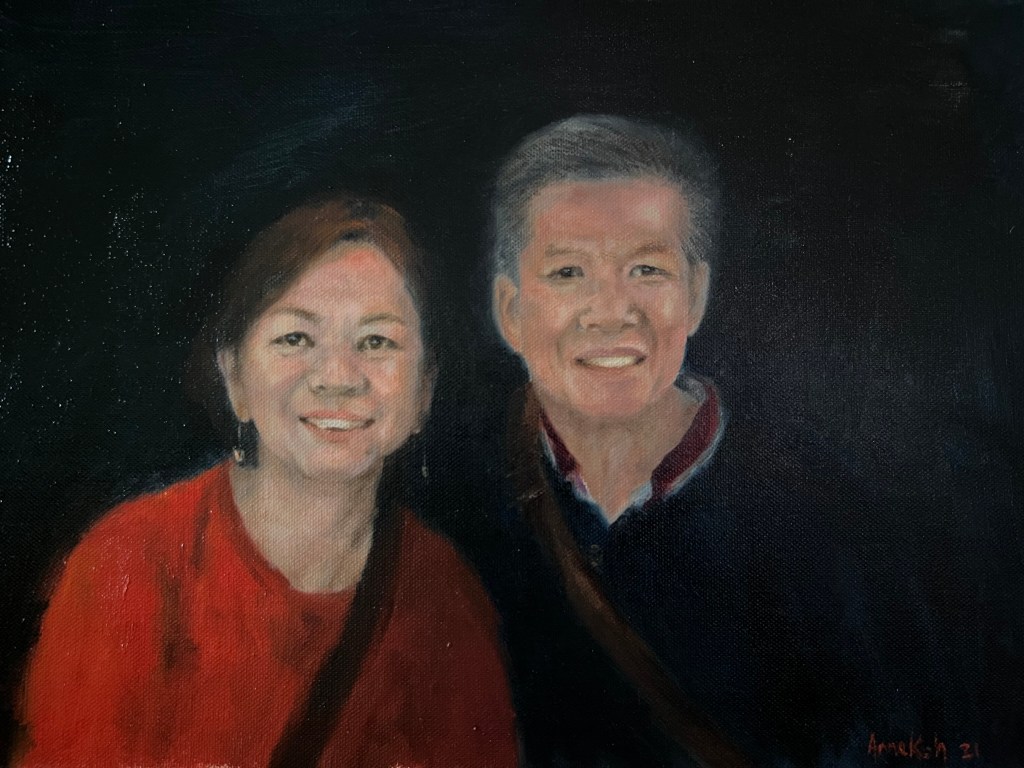
Another incredible man of virtue was Liu Bei of Three Kingdoms fame. His legitimacy to the title of Son of Heaven was the most certain, his righteousness and his lineage was unquestionably that of Emperor Xian’s, the last emperor of the Han Dynasty. Also known as Liu Xuande, his compassion and honour for his people made him the most virtuous of the three kings who vied for succession to the Han throne. He was often seen weeping after hearing some bad news. Despite the counsel from his magnificent adviser, Zhuge Liang, the virtuous Liu Xuande was often conflicted between the obligations of his patriarchal (imperial) ambition and the loyalty and honour to his fraternal brothers which Zhuge Liang viewed no more than as a military pact. Liu Xuande’s eventual demise from a defeat at the battle of Xiaoting was avoidable, had he not sought to avenge the deaths of his blood brothers. Despite Zhuge Liang’s countenances, Liu Xuande ranked honour among equals higher than loyalty to authority. Liu Xuande, king of Shu-Han, also motivated me to write about Typhoon.

Typhoon was born and brought up in an idyllic fishing village at the northwest tip of Penang Island. Telok Bahang was predominantly a coastal bay enclave and flourished as the second largest fishing base for trawler boats and inshore fishermen. Away from the shoreline, agricultural farms and plantations dotted the landscape. He was the seventh child in a family of eight children of which three were daughters. Had he been a girl, he would have been given away. “Not sold?” I raised the question in my mind. “No, girls were ‘worthless’ then,” was my conclusion. Typhoon’s Papa was a hard-working rubber tapper in maternal father’s 30-acre estate. For extra income, he did odd jobs like gardening at neighbouring farms and sorting fish on the fishing boat jetties. His impoverished childhood meant his physical attributes were under-developed. Mama helped wherever possible; her children were already more than a handful. Income was meagre and putting food on the table was tough. On May 13 1969, the country exploded with racial riots after the politicians played the race card to divide the people. But in their village, there was no racial tension. Malay families lived as squatters in their maternal grandfather’s estate. Mama and her Malay soul sister, Mak Nan continued as if the world had not changed. A few months later, after an agonising three years of debilitating decline in health, Papa succumbed to cancer. Typhoon was a wee lad of eleven years of age, but even he knew the tough times were about to get tougher. Village life offered a little respite from the financial upheaval and vast emptiness for a quiet and shy boy without a father. The beaches were his popular stopover – walks on the sand, collecting seashells, digging for clams, netting shrimps, catching sea worms, and watching the sun disappear behind the hills over Muka Head were all cherished memories. By the plantation, the siblings bathed on the river, did the laundry, fished for catfish and fetched water for the vegetable plots.

Telok Bahang in the 70s.

Papa was a native of China who hailed from the Province of Guangdong. He was of the cantonese speaking Pan 潘 clan. Like many other provincial folks of his time, he journeyed to Malaya to seek a better life. Mama was a Loo 呂, her father was from Guangdong too. Papa arrived in Penang with a brother and a nephew, each with a small rattan basket of belongings. Unlike other arrivals who stayed in the town in search of prospects, they took a bus and headed for the furthest part of the island. Noticed in a coffee shop at the fishing village where they arrived, all three men were offered work and free accommodation by a local landowner who would become Papa’s father-in-law. Typhoon’s parents married in Telok Bahang when Mama was only 15. Papa’s actual age was unknown, “My guess is as good as anybody’s,” he said to Mama.

Old photos of Papa were destroyed by termites.

None of Typhoon’s siblings progressed beyond secondary school. The girls were the first to dropout. Education wasn’t important anymore once Papa died. Mama needed their help in managing the household. The older boys got to complete senior school after which they had to find work to supplement the family’s income. Mama’s income from tapping rubber was never enough. Growing up in the rural countryside had its downsides. For one, it narrowed Typhoon’s perspective of life. There was little development and few opportunities around, nothing much beyond the green landscape of the kampong. It was foreign to harbour any ambition. Typhoon was the only one in his family to acquire a tertiary qualification but it wasn’t immediately after secondary school. There was a short stint selling batik and a shorter one manning a bookstore. He was lucky to gain a diploma under the sponsorship of the local authority he was working for and completed a degree course in Health Sciences years later through distance learning. He learned the lessons of resilience and self-reliance during those long years. “If you could turn back time, would you wish you were born in more vibrant and ambition-driven surroundings?” I asked. Without any hesitation, he gave me a resounding “No!” “Growing up in a village was blissful and unforgettable.” “Once a kampong boy, always a kampong boy,” he said.

The village boy together with three siblings rented a room on the upper floor of a communal home of ahmas or majie (妈姐), a sisterhood of retired maid-servants. The house at 83 Muntri Street was conveniently located right opposite our school’s side gate. “It was not home to me; there I was plagued with anxiety until the weekends when I would rush back to my village and feel instantly rejuvenated,” he confided. I was surprised to learn of his anxiety and home-sickness, both good enough reasons to consign a sufferer to mediocrity. Yet, Typhoon was one of the smartest in school. During our time in school, the system had no qualms about grading and ranking us. Sometimes, the teachers even caned us or twisted our nipples. The system of reward and punishment was practised by all; I was more aware of the punishment side – detention for any minor offence, a swift lash of a bamboo cane was the standard price should one’s hair touched the collar. We knew exactly where we sat in the hierarchy of intelligence. Typhoon resided in ‘A’ class throughout lower secondary school. In High School, he belonged to the elite ‘Science 1’ group. Typhoon was more versed in the rewards side of the system. He was highly respected both by peers and teachers, and enjoyed real status; he was rewarded with enviable positions such as the Secretary of the Board Of Librarians, the Vice-chairman of the Chess Club and  the Vice-chairman of Buddhist Students Society.

His sobriquet was The Amorous One, the villagers called him “Goh Paik Si.” He reckoned it was on account of his bike’s rego number 584, the number to the locals meant Chu Pak Kwai, the Amorous Pig. He sounded surprised when I told him it was more likely due to his irresistible good looks and his attractive kind-heartedness that made him the village Romeo. Whilst thinking about stunning good looks and amazing attractiveness, I must mention Diaochan’s incredible feat in the Three Kingdoms where she used her beauty and charm to bring down the treasonous warlord Dong Zhuo and his foster son, commander Lü Bu, two warriors whom all the rebel leaders failed to defeat. That Diaochan could bring about the demise of powerful men without a dagger or sword spoke volumes to me. Equally, Typhoon has that same ingenuity and confidence to succeed where most others fail.

Diaochan sets her trap

We can’t stop the wheel of life from turning. But there’s a pause button we can use to reflect and review.

Phoon Choon Chee

It is mighty difficult to find another person as resolutely honest and noble as Typhoon. I had not seen him for over forty years prior to our last meeting at a school reunion two years ago. He had lost his chubbiness and soft pink lips. His once-sparkling innocent eyes looked tired but wiser and offered a window into his soul. Therein I sensed unselfish love, purity and moral quality. His steady and usual sangfroid nature is still very much appreciated by his friends; we know to count on him to break any awkward impasse by posting a funny photo to calm the group during frequent furious exchanges amongst some of us. The well-combed shiny black hair has been replaced by short swept-back silver-grey locks that closely resemble those of Pierce Brosnan’s. In fact, his whole demeanour, the wide smiles, the deep wrinkles on his forehead all reminded me of the actor. Quite charming, well-mannered, sophisticated, stylish and suave. Debonair, in one word. But, the essence of the man is of course, his virtue and general moral goodness. There is no doubt in my mind Typhoon is a worthy man to join Blue Eyes, Wu Yong, Four Eyes, The Cook and Lord Guan in the Brotherhood of the Marsh.

A boon for Typhoon meeting Junie, a true love story