It’s Offal, isn’t it Awful?

She was off to Darwin for a six-month stint in a Darwin hospital. In another life, she would have been a professional violinist but it was medicine she chose or perhaps it was her mother who chose it for her. And so, they held a farewell party for her, to celebrate another milestone, another small step to a big career as an anaesthetist, a word that many at the party had trouble saying and one that The Mrs could never spell.

“Wah! Congrats, Corinne! You’ll rake in the money soon! My analsthetitcian friend just bought a condo worth millions!” one of her aunties said.

“Well done, Corinne. An anaesthesist soon, we are so proud of you!” The Mrs said.

“Here’s an ang pow for you, luv. Congrats for getting into anahhssthetihhss,” Corinne’s eldest aunty said, without her new dentures.

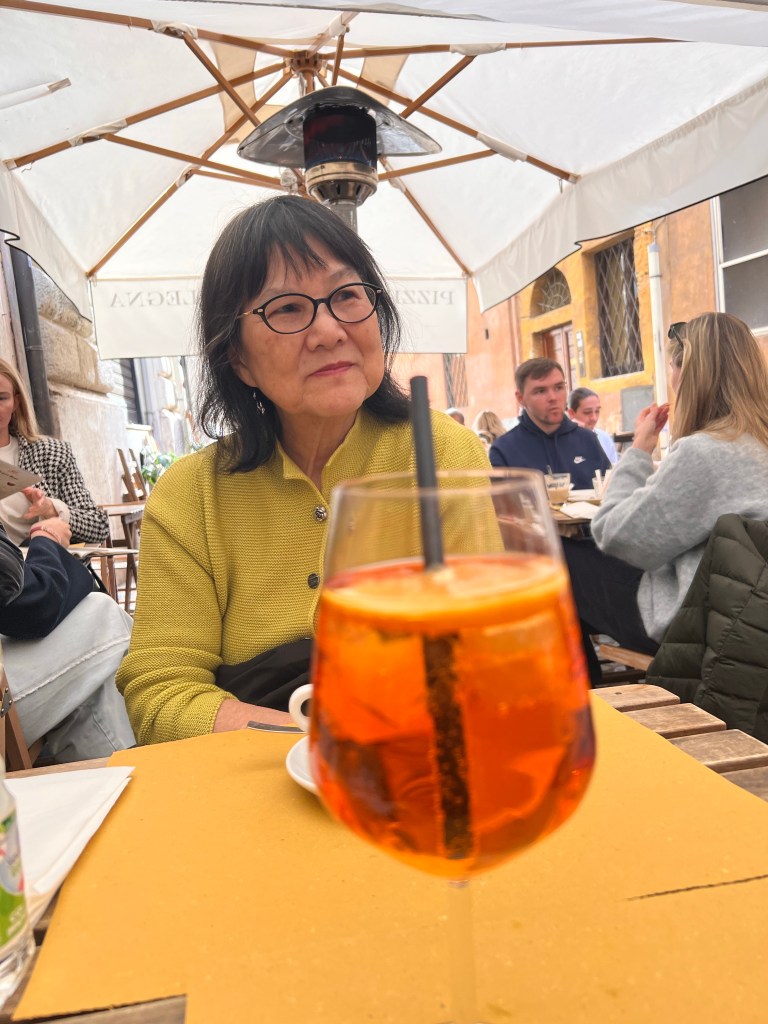
Corinne did not correct anyone; she was going to be an anaesthesiologist, not an anaesthetist. She didn’t think it was necessary to explain the difference to her elders. She smiled sweetly and snuggled up closer to her boyfriend next to her. Tall and gangly, he had never been seen in a smart shirt but the smile that he wore on his face more than made up for his slovenly appearance. His ruffled brown hair, somewhat knotted, was proof he did not own a comb. They make a contented couple, with mutual admiration for each other. Both soft-spoken, they whispered to each other when they talked, maybe as a tactic to be physically close. Her uncle, the old man, wondered out loud to me if they could even hear themselves when they quarrel.  

The party was held at the Urumqi Restaurant in Gouger Street, the main street in Adelaide’s Chinatown. The old man had not even heard of the restaurant that was remarkably popular for their Uyghur food. Not wanting to miss the AO’s men’s final, they booked a table for 5.30 pm which was just as well, as the usual dinner time slots were all booked out.

“Wow, they must be good,” the old man said when told that, cynically discarding his normal distaste for lamb and mutton. He was pulling at the obstreperous string algae in the pond when he looked up to listen to The Mrs speak. The glare of the sun caught his clouded eyes and as he frowned, she mistakenly assumed he did not welcome her sudden presence.

“I know you find me annoying, but must you frown every time I talk to you?” she asked in her most icy tone.

“No, it’s the sun,” he said defensively.

“Don’t bring our son into this,” she began to argue before changing her mind and instead told him to hurry home to change for the party.

They arrived at Gouger Street early. The sun was still violent on their skin, imparting oxidative properties with its UV rays. The old man had implored his wife to apply some cream on herself the night before after being horrified at seeing his own wrinkles in the shower cubicle. Adelaide, being near the desert, had been harsh to them over the years. The difficulties of their youth had piled deep wrinkles on their faces. The scaly condition of their limbs and the gnarled fingers of gardeners only exacerbated their ageing. The excess skin and fat hanging off his arms and the sunken biceps, once bulging and hard, spoke volumes about his poor exercise regime.

Unusually, there were many vacant parking bays along the main street. The old man did not have to circle a few rounds along the back streets to fight for a space to park. He eased his white Golf GTi into a bay but failed to park it straight even after a few tries. Once upon a time, he used to enjoy praises from The Mrs for his driving and parking skills. Not any more. He blamed it on the pandemic and then blamed it on his deteriorating eyesight. They hardly got out of their house once the lockdown was imposed in early 2020.

He got out of his car and checked the parking sign again and again as he pretended not to see that the front tyre of his car was straddling the painted line on the road. It’s a Sunday, he reminded himself, assured that the traffic inspectors would have better things to do.

“Yes, we can park here,” The Mrs said it twice, the second time a little bit more forcefully, and the old man quickly agreed before her impatience got the better of her. He had stopped committing himself to negative emotions from statements of opinion and cynicisms dished out by people around him. As Epictetus said all those years ago, anxiety is caused by people wanting things that are outside their control. The old man finally saw the light and learned not to sacrifice his peace of mind by listening to errant comments or hoping for wishes to come true. None of them were within his control – it was as foolish as staying up in the wee hours of the night, wanting his football team to win the game.

Their idea to have an early dinner failed miserably in its implementation. Their one-hundred-year-old mother was nowhere to be seen. Of course, they should have expected that. It had not yet dawn on them to expect a different outcome. There was a saying about people persisting on the same action but expecting a different result. Even President Biden of the US was guilty of that – bombing the Houthis and when asked if that would be successful, he replied ‘No”, but he would keep bombing them anyway.

Insanity is doing the same thing over and over again and expecting different results.

attributed to Albert Einstein

“A stint at relieving her bladder had led to other distractions,” Corinne’s mother apologetically said on the phone.

“Don’t wait for us, you guys start without us,” she added.

But, of course, everyone waited for their matriarch to arrive.

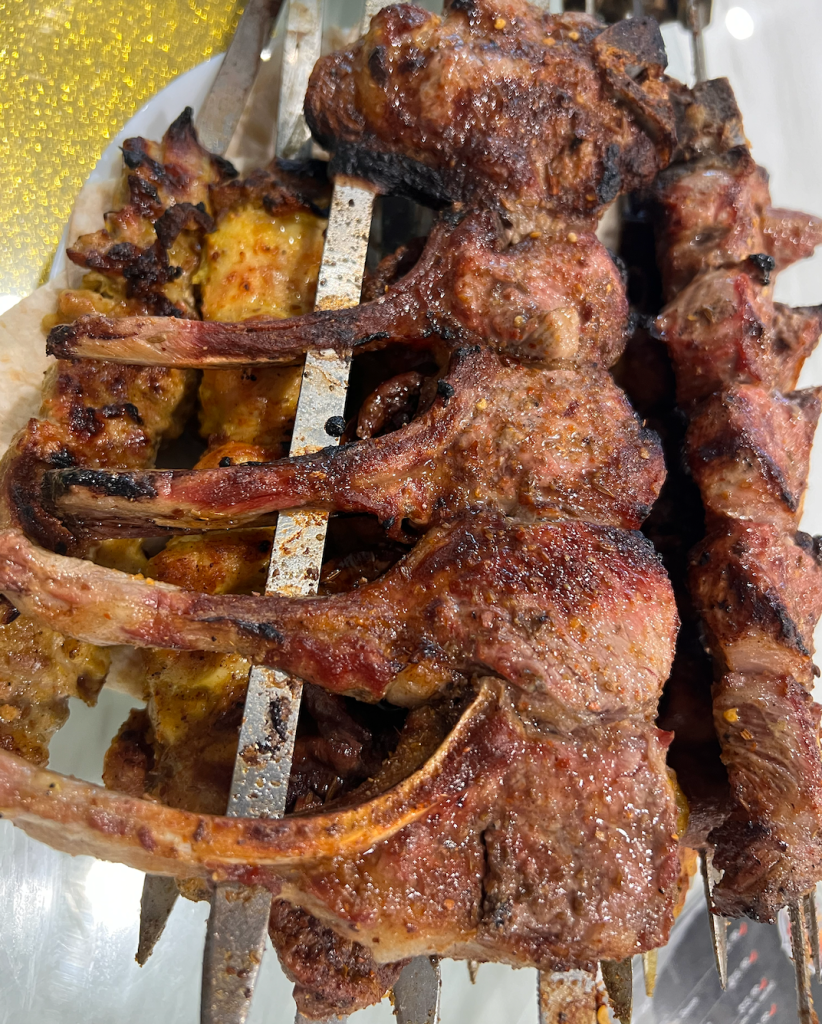
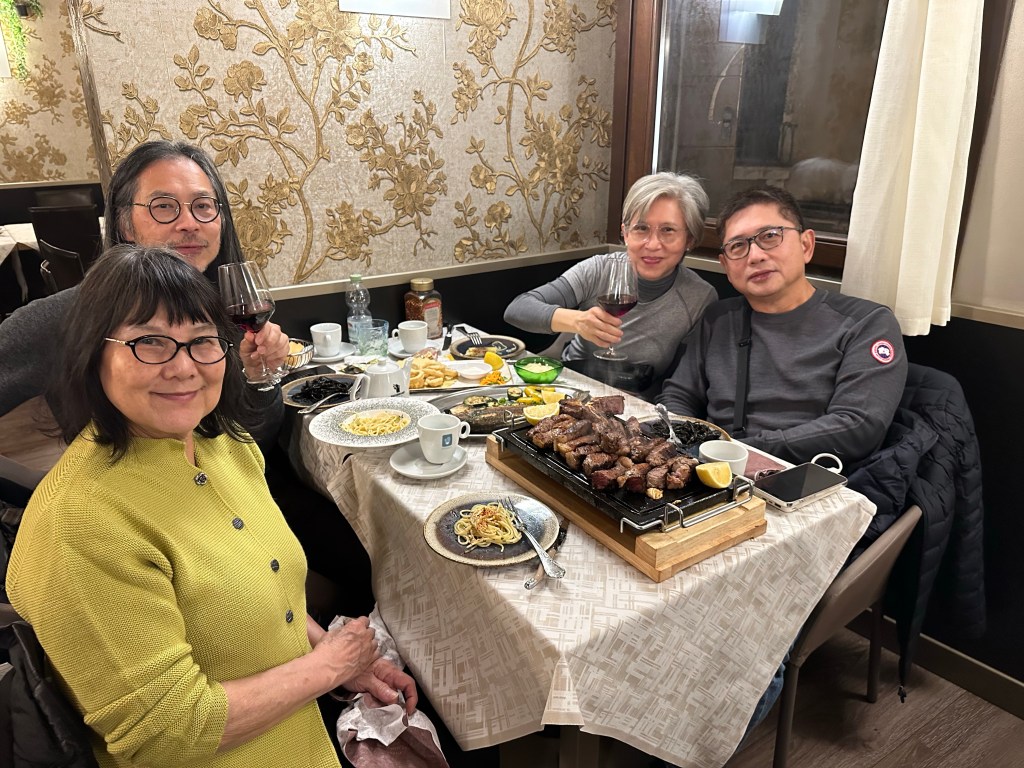
The restaurant timed it perfectly. As soon as their matriarch was seated at the table, the food started to arrive. Lamb, mutton, dapanji (a big plate of chicken and noodles) and even lamb kidney. Sheep yoghurt milk was the only drink on offer unless highly chlorinated tap water was preferred.

“It’s offal, isn’t it awful?” the old man asked, as he pointed to the sticks of lamb kidney. It took him over four decades to learn how to eat lamb. The last time he had roast lamb was in New Zealand where his good friend, John Law and his wife, Karen, served it for dinner in their sprawling Christchurch home.

“Just try it, ba,” the old man’s son said. “It’s nice,” he said but his opinion was met by his disbelieving father.

“I bet it is as ‘nice’ as Heggis,” the old man said with sarcasm, before retelling his story about tasting his first Heggis in Edinburgh two months ago. Heggis, made of sheep’s heart, liver, suet and lungs, did not leave a nice memory for him.

Maybe, the Scottish and Uyghurs lacked the right recipe for offal. The old man remembered fondly the chicken entrails rice broth he had in Hong Kong and the small and large intestines that were unmissable ingredients in olden day sar hor fun that his dad occasionally brought home after a late night movie in the 60s.

The old man and The Mrs were amongst the last to leave. The younger members had said their goodbyes to Corinne some fifteen minutes earlier, hugged her and wished her luck in her new life in Darwin. They did not linger and make small talk as the older folks waited for their matriarch to finish her cold piece of lamb kidney, the fat of which had started to coagulate and turn whitish. By the time she was gently eased into the front passenger seat of the Tesla, Medvedev had already won his first game at the tennis final. The old man detected the whiff of lamb fat on his hair as he hurried to his own car. Skeins of offal scent unwound themselves and blended with the heavy staleness of long trapped pungent smells in his car, forcing him to open the windows. Cool evening air rushed in and injected the smell of deep fried fish from a nearby restaurant. A group of young revellers shouted and shrieked at one another as the old man pressed down on the foot pedal to accelerate away from the city.

“Make sure you wash your hair tonight,” The Mrs said.

Why Reason With One Who Can’t Reason?

All week, the old man was in a liminal state between quitting his violin and practising for his orchestra’s first rehearsal for the year. He had sprained his wrist from lugging their travel bags on the streets of Venice and Rome. There, he discovered that cobbled stones were romantic to walk on but presented real risks for someone of advanced age to trip or slip and fall. The castor wheels of his bags groaned loudly on the uneven surface and transmitted the bumps onto his wrist, he reckoned as he clenched his fist and winced. His Mrs said he played badly and that was the reason why he felt like quitting. True, his attempt to express the pain he felt for the misery and death in Gaza through John William’s music in Schindler’s List was dour and sour, a pale version of the depths of despair he felt and heard inside his mind.

“Don’t play in front of baby Bach,” she said and warned that his scratching sounds would turn her seven-month-old nephew off classical music.

“Don’t play when Murray is around,” she said and pitied the family’s dog who would hide his ears under a pile of blankets.

His feeling of liminality had spread to his love for writing also. New ideas of topics to write were still seeding in his mind but the inclination to sit down and type the first word had simply vanished. There was the urge to write about Truman and Eisenhower, how both men warned against the CIA and the military industrial complex in America. The former created the CIA whose aim was for it to be the eyes and ears of the state but later warned against its second function as the private army for the President. The old man had the idea to write about the revelation that the Ukraine war could have ended in April 2022 with peace talks so advanced that both warring party delegations were pleased with the outcome in Turkey. The US, displeased with the concession by Ukraine to end NATO expansion, sent their British stooge, Boris the Bozo Johnson to cull the peace talks. Joe Biden had turned out to be the worst President of the US ever, presiding over conflicts in so many countries in a mere three years. Why reason with someone who can’t reason? What was the reason behind that?

Meanwhile, in Davos, the WEF had gathered together in January 2024 with the theme ‘Rebuilding Trust’. They had a shaman on stage who rubbed her hands as if with glee to make certain invocations before blowing bad breath, presumably, onto the heads of the dignitaries who were seated in a line like school students; was that a way to appease all the different religions and their factions and to instil trust in these billionaires and power-hungry elites by looking at the past and what our ancestors wished for in order to look to the future? Trust once lost will take a long time to be regained.

The world had been under sustained attack since the pandemic, with trust of our governments being the main casualty. The world had become a place where misinformation was really disinformation, conspiracy theories were proven correct, gender had become a major issue when for the past millennia it was just a simple matter of man or woman, Emmy awards and Oscars were not won based on quality of performance but on meeting DEI criteria of diversity, equity and inclusion. Can there be trust when mRNA vaccines don’t stop the spread of a virus and don’t offer immunity? In a world where excess fatality rates exceed 30% and the authorities do not address the reasons why? Where young and healthy individuals are dropping dead suddenly and highly respected oncologists are reporting the high incidence of turbo cancers? Turbo cancers sounded like a disease equipped with a super fast gas turbine engine. Where people cannot reason with their government leaders who cannot reason? Where Canadian protesters end up with their money being seized by their government? How do they rebuild trust when they steal our money in broad daylight through taxation, debasing our money through reckless printing and inflation?

It was precisely the realisation that our governments are stealing our money that the old man started reading up about Bitcoin. Over the many millennia, humans had valued rocks, glass beads and seashells as money. Fiat money, comparatively, is a young form of money. Introduced by President Nixon in 1971, money was no longer backed by gold but by government decree or fiat. In the last quarter of 2023, the US Federal Reserve printed two trillion dollars out of thin air. Yet, it would be the same people who claimed Bitcoin has zero intrinsic value. The most vocal in recent times was Jaime Dimond of JPMorgan Chase, a bank that benefited greatly from government handouts during the 2008 global financial crisis. Dimond said Bitcoin was “a pet rock that does nothing”, that lacks economic intrinsic value. Dimond could say the same about diamond, I suppose. The old man was angry. He said a successful banker such as Dimond would lead many people astray with his bad advice. Why reason with someone who can’t reason? What was undeniable however was many central banks that distrust the USD had reverted to investing in gold in their treasuries. Gold, like many other rocks, have regained favour amongst shrewd investors who prefer to store their wealth in commodities found in rocks such as lithium, oil and copper.

For the first time in history, we ordinary people have the opportunity to front-run the institutions and wealthy individuals and invest in a rare commodity whilst the price is still low. The old man, demonstrating a heightened level of caring for his friends, had been orange-pilling them, sharing his knowledge of Bitcoin’s special properties and benefits and the idea that it would one day be the global reserve asset. His Mrs had warned him not to behave like a fool. The wise woman advised him no good would come from it – if they lost money, they would blame him, and if they made money, they would only credit themselves with their investment decision. Besides, the woman had long argued against Bitcoin, believing all the FUD reported in the news ever so often. The fake news, uncertainty and doubt dished out by his siblings had also convinced her it would be a disaster to put any of their savings in it. The recent weakness in its price had further galvanised her opposition to Bitcoin as a safe form of investment.

“You said the institutions are coming!”

“You said it’s basic maths, supply and demand. Price will surely go up,” the maddening woman said, putting on her most cynical voice.

“You have rocks in your head!” she shrieked, in a shouting match with the old man. The old man had yet to win one of their shouting matches. His raspy sandy voice, a perpetual liability many decibels lower than hers, and his slowness in forming ideas, always detrimental, often unconvincing, ensured he lost the debate that afternoon.

The Bitcoin price went down two days after the ETFs were approved. The old man lost his argument. It was as simple as that.

“Here, go read the Bitcoin Standard,” was all he said to her as she strutted out of his study after yet another victory.

She had not read any books about Bitcoin, nor had she come across the white paper by Satoshi Nakamoto. She plugged her ears with her pointy fingers when he talked about Bitcoin ETFs and Gary Gensler’s SEC admission he only approved the ETFs because the federal appeals court forced him to.

“What ETF and SEC? Don’t tell me, I don’t want to know!” she said loudly, pretending those letters meant nothing to her and believing that the one with the louder voice always wins the argument.

“Why reason with someone who can’t reason?” I asked, but the old man simply shrugged his shoulders.

Why do people try to reason with someone who can’t reason? People are high in EQ but low in IQ, that’s why.

“People are stupid?” I asked, without expecting an answer. The old man stopped to wonder out loud why people without any knowledge of the topic they were arguing about would argue strongly based on nothing but on their own uninformed opinions.

The difference between the rich and poor is that the rich have a lot more moneyErnest Hemingway

Bitcoin is the best money that humans have created. It is money that is durable, portable – digital and not physical, divisible – 100 million satoshis to a Bitcoin , unseizable and totally sovereign, does not require trust in a third party and perhaps most importantly, extremely rare and impossible to forge. It is powered by thousands of computers all over the world, having recently hit an all time high hash rate of 500 exahashes per second in January 2024 or 500 times more powerful than the world’s most powerful supercomputer, according to Yassine Elmandjra of ARK Funds.

Discussions about money always bring out the worst in us. As Seneca said in his On Consolation to Helvia, the rich are restricted by the baggage they can carry when travelling abroad and in a hasty situation, they will abandon their entourage. That is the truth about money. No matter how much we value money, it does not solve most of the problems people without it seem to think it will.

“Money isn’t everything but everything needs money,” the old man countered.

The old man’s mother came for lunch that Saturday afternoon. It was their routine for many decades, to bring her home for the day. Not surprising that it had been decades – their mother was, after all, a hundred years old. They filled their weekends with their mum’s presence. She had been a powerhouse in their family. The matriarch dictated most things, even what they cooked and in the manner they cooked. I suppose it’s alright, since they cooked her favourite dishes for her to enjoy and when she finally lacked the strength or stamina to chew properly, they cooked soft foods such as tofu, rice broth and fish. Every weekend, if not Tuesdays which was the norm when their father was still alive, she came. Their father died in 2007. He was a beautiful man, a handsome man with a heart of gold or Bitcoin in today’s parlance, who never made them feel guilty for being his imperfect children. She, on the other hand, was always a challenge to please, often challenging them about the stuff they buy, interrogating them about where the jewellery she gave them had gone to, checking their grocery receipts for any overpayment, rummaging through their fridge like a tax auditor, checking the kitchen bin for food scraps that could be salvaged.

She looked great for her age. Hoary but not deathly white, with a nice pinkish hue on her face that was absent of a cobweb of deep wrinkles, a common trademark of old age. Refusing all offers to upgrade her wardrobe for many years, she still wore her rather worn clothes smartly and with style. Her kids were slow to understand she was losing her mind to dementia. She had become forgetful and then confusing, but all they saw was that she was wrong and unreasonable. They relished that she was wrong – she no longer was the authority who shall be obeyed. They argued against her and challenged her recollections and some of them resented her accusations. Without any understanding of dementia and how it makes a sufferer confused, delusional and angry, they allowed themselves to be injured emotionally and scarred psychologically by their own mother. And so, they argued and argued with their mother and in doing so, they hurt her and belittled her, diminished her authority and rendered her powerless.

“Why do we try to reason with someone who can no longer reason?” the old man asked.

Ahma, pleased with winning again. December 2023.

Concentrate, It’s a Concentrate

Summer arrived late. Everyone had already left – the house was once again quiet and the mood dismal, its elderly occupants dull and sullen. The garden, although still green, was becoming tatty and untidy, providing clear evidence of a recent storm. A dead branch still hung from the old oak tree, too high up and too awkward to reach and so, the old man of the house simply pretended that the cataracts that dulled his eyes had accelerated his blindness. I envisaged his impaired vision would be used again and again, as a wonderful defence against claims, if any, of laziness in the garden and poor house-keeping. He had told their visitors it was a recent storm but his definition of recent was measured in months rather than minutes or hours and so, the visitors had gone along with the idea that he had not the time yet to clean the mess up. The sun had become unforgiving again. A lapse in concentration the other day meant the near-death of a banana plant. Banana plants, fast-growing and spectacular in the tropics, needed special care in Adelaide. Earlier attempts at growing them had failed but the elderly couple was gifted a couple of plants from their Sri Lankan neighbours behind their land in early spring.

“It’s easy, just water them,” the kind wrinkled woman from Colombo said.

The old man’s Mrs simply echoed her.

“It’s easy, just water them,” she said to the old man who was unstacking dishes from the dishwasher, as she segued her way out of the new responsibility. It wasn’t many weeks later before they began arguing about who planted the banana plant near the wall.

“Of course, I did,” the old man said. He justified that with his knowledge that to survive Adelaide’s cold winters, growing next to a stone wall would give the plant a fighting chance. But, his Mrs merely bit her lips and bided her time until they were both outside in the yard the following day. She merely pointed to where the banana plant was to smugly show her victory.

“Silly woman,” the old man mumbled to himself.

Only she would be so silly to plant it away from the wall.

The days had turned hot but it was atypically humid, so much so that the old man began to wash his hair more frequently but still not daily as instructed by his wife. He began changing his clothes daily though, an instruction that was not given, since it was her role to wash their clothes.

“Why don’t you just cut your hair?” she barged into his study and demanded for the umpteenth time. She was almost in tears, tearing and pulling stubborn long hair caught up in the rollers of their Xiaomi robot vacuum cleaner.

“They are stuck!” she cried, filling her whimpering voice with desperation and hopelessness.

“Leave it to me. I’ll fix it,” he said, reluctantly peeling his eyes from his laptop.

“I don’t want you to fix it! I want you to cut your hair!” she cried again but this time, her voice threatening and deadly serious.

The old man relieved the roller from her hand as he marched out of his room.

“I’ll vacuum the house from now on,” he muttered, as he brushed past her.

“I don’t want you to vacuum the house! I want you to cut your hair!” she shouted, as she chased his footsteps to the garden, oblivious of the mid-afternoon heat.

The days leading up to Christmas were such a happy time. It felt so long ago and belied the fact that it wasn’t quite three weeks since they were opening their presents. They had gathered at their neighbour’s on Christmas Day. Lunch would be greatly delayed that day as everyone took their sweet time to unbox their gifts, one at a time and one person at a time. The elderly couple was without their middle son who chose to remain in Glasgow to work and not risk ruffling his new employer’s mood. A bonus for him was not measurable in monetary terms but the joy of spending a really white Christmas in his new home enthralled him. Without him, their family tradition to enjoy a panettone and sip port whilst they exchanged presents stopped. Popular Christmas songs still blared from the sound system that was minus the B&O Beolab 3 speakers which had begun to play up. Mariah Carey did not fail to make her mark with ‘All I want for Christmas is You’. They had a new addition to the family though. Their Number One son formalised his relationship with his girlfriend that year having publicly acknowledged that she had moved in with him. She would be the one to masterly cook up a seafood barbeque in Thai style, with his help, of course.

The neighbours had their house full of in-laws in addition to their greatest joy, a brand-new grandson who at seven months had already collected a few names – Seb, Sebastian, Bach, Boy-boy, and Ah-boy. It would not surprise anyone if he were to inherit another nickname, Baz. Bach was already showing advanced intellectual development for his age. His bright twinkling almond eyes smiled, a gift from his mum who got it from her mum, Eva. Packed neatly below a pair of lightish brown eyebrows, the shine from his eyes suggested a level of intelligence far exceeding the average. His pink smiling lips complemented the pinkish hues of his face to advertise that he was a bundle of joy, health, contentment and happiness, a result of the uncomplaining and unconditional loving care and constant attention his mother gave. Much loved and adored by all, it did not surprise that Bach got the most presents, one of which his dad could not resist and began to play with, in front of everyone. It was, however, Eva who received the most expensive gift that morning.

Sebastian at 7 months, advertising he’s a bundle of joy, health, contentment and happiness.

Eva, whose shiny black hair in a very short span of time had turned mostly white with streaks of gold, looked more Italian than Chinese in Roma, causing the minor inconvenience for the taxi driver who was told to look out for his Asian passenger. The taxi driver would fail to pick up his passengers that day. The old man had frowned on numerous occasions in Italy during their ‘recent’ three-week family holiday together whenever people commented positively about her hair. White hair made him look much older than he felt, so he was quite displeased that the opposite was true for Eva. Their numerous holiday photos proved it time and time again that he had aged too fast and made him doubt the effectiveness of the anti-ageing nicotinamide mononucleotide (NMN) tablets he had been taking for many years.

Eva’s nephew from Singapore beamed a wide smile that showed off a deep dimple as he gave her a long hug and handed her a nicely wrapped gift. Intricately gift-wrapped, one would have ordinarily dismissed it as a gift with an expensive exterior but an ordinary interior, which may be the reason why he quickly explained what it was. The small bottle of La Mer’s The Concentrate is a potent barrier serum for skin coupled with extra antioxidant power.

“Wow! It’s too expensive!” Eva exclaimed, visibly pleased with the elixir of youth that will enhance the health of her skin. She had switched off her ears as her nephew rattled on its benefits like a professional skin-care specialist. He called her Yiyi or aunty from the maternal side.

“Yiyi, concentrate, it’s a concentrate,” he said.

“Yiyi already looks too young for her age,” the old man said softly, and gritted his teeth, ruing his ill-discipline in front of everyone.

“Yeah, what’s your secret, sis?” Eva’s older sibling asked.

“Concentrate, it’s the concentrate of chicken essence I have been giving her,” Eva’s husband said.

James, Eva’s hubby, was as convincing as their nephew in rattling off the benefits of chicken essence.

“It’s not just the collagen she gets; she doesn’t suffer from fatigue anymore! Look, look at the skin on her arm. Look at how it has repaired itself – the scar from the ‘scolding’ has virtually disappeared,” James said enthusiastically, unaware his Malaysian accent of the word ‘scalding’ had briefly befuddled the old man. He then proceeded to demonstrate the method of extracting the chicken concentrate from a video he took in KL of the ‘Khind’ electric double boiler in action. He was so impressed with the wonderful pot he emptied the shop of that product and ordered some more for his relatives and friends.

The old man looked bewildered at the party. The enthusiasm in the room about youthfulness juxtaposed awkwardly with his disregard for his own wellbeing. Grey and hunched, he had shocked himself the morning before when he could not even do a plank push-up properly.

“Squeeze your buttocks, ba! Tuck in your pelvic muscles,” his youngest son said.

“I can’t find them, son!” the old man yelled back.

“See, just gyrate them,” the younger man demonstrated slowly.

The old man tried to mimic the action, but badly, showing his incompetence in gyrating his lower groin area, the inability quite likely due to a prolonged lack of sexual activity.

A few days after the embarrassing episode, the old man’s eldest son suggested to his dad he should consider taking creatine monohydrate.

“Ba, concentrate, it’s a concentrate,” Number One son said.

Creatine is a natural supplement used to improve physical performance. Our muscle cells will produce more energy. During exercise, adenosine triphosphate (ATP) is used up to produce energy. Creatine supplements help boost ATP levels and encourage muscle growth.

“It should also boost brain power, help blood sugar control and fight certain neurological diseases,” he added.

https://www.healthline.com/nutrition/creatine-exercise-performance#how-to-supplement

But, the old man’s head had turned away towards the French doors that showcased a small pond with a trickling waterfall surrounded by an array of green foliage. There was a distant look in his eyes that often were scanning to recognise every individual koi. Deep in his own thoughts, he was a world away from his son. He was not listening to, much less concentrating on what was being said about creatine. Troubled by the troubles in Gaza, he simply wished for peace. Later that day, he wrote a message to his ex-schoolmates after being told by one of them that many did not agree with his views about the ongoing conflict between the Zionist regime and the Palestinians who once represented 90% of the population in Palestine, a time before the Balfour Declaration and The Contradictory Promises. The following night, he showed me this version of his message to his friends.

“I am intrigued to witness this alternative world. A world in which my friends support an occupying force with genocidal intent on a people that the state drove away from their homes, segregated them in an open-air prison for decades and deprived most of them of a chance to leave or enjoy the simple pleasures we often take for granted, like taking a short holiday overseas or enjoying a long shower or having enough to eat.

A world in which the aggressors are deemed right to exact inhumane conditions on the populace and when the long-suffering people rise up and resist or rebel, they are accused of seeking vengeance or revenge on their oppressors. A world in which the occupying force can simply bomb the people they call ‘human animals’ and their homes, universities and hospitals to smithereens and proclaim they have the right to do so and my friends do not only agree with this heinous crime against humanity but also support the oppressors’ claim that the shocking death toll was due to the evil freedom fighters’ ploy to use their people as human shields, people that can’t or won’t, (it doesn’t matter which) leave their sanctuaries within a barbed-wire fence guarded and controlled by one of the most well-armed force in the world.

My dear friends, how can we support a regime that has proclaimed their intention to erase the people and erase all memories of them, to demolish everything and exterminate everyone? How can we agree that there is no ‘uninvolved civilian’, that every citizen of Gaza is an enemy of Israel?

There is no sympathy for the traumatised and the hungry experiencing catastrophic famine, and the diseased, deprived of medical help because most health infrastructure is destroyed and the desperate who have lost their loved ones and their homes. There is no thought of the wretched souls who willingly followed the oppressors’ command to vacate to a designated ‘safe zone’ only to be murdered by a rain of missiles. There is little or no sympathy for the wretchedness that these people have endured all their lives under this very long occupation.

What Hamas did was, of course, vile and wrong. In attacking their occupiers, they knew there would be a swift and ruthless retaliation. Their people would die by the tens of thousands. Yet, that is what they did. Out of desperation? Recklessness? Evil intent? Revenge? I do not know why but they showed stupidity and foolishness.

This world is indeed a sad world. We, urghhlings, can do better. We can at least cry for the dead and the wounded and cry out for an immediate ceasefire instead of judging and pointing fingers. We can at least speak up for the oppressed rather than support the oppressors. I feel compelled to share my thoughts here, to speak for the dead who are forever silenced.”

Peace to all mankind is as unreachable as walking to the moon.

Wu Yonggang

Loch Fyne, so Fine

They left Italy with a heavy heart. An old world with the grandeur of once being the centre of an empire, Rome promised so much but delivered even more. Every step they took, every corner they stood, every path they chose, there were unmistakable signs of ancient history – of a she-wolf suckling the infant twins, Romulus and Remus, of Etruscans and Greeks who fought for colonies, of old relics and long buried buildings stopping the construction of a new railway line or a road, of gladiators who fought for honour or freedom, of slaves who were inconsequential to those who cheered from the seats of the colosseum, of emperors and senators who wielded power and influence and who could take a life by the mere turning of a thumb.

The voices spoke and the spirits of the dead who didn’t want to die screamed and shouted but in their group, only the old man heard them. As in the movie The Haunting in Venice, Rome was as haunting as romantic Venice if you let the dead get to you. The travellers left Venice for Rome after a romantic two days of gondola rides and private boat trips and glittering nights of Venetian food and wine. They left the ancient city of desperate ghosts and the unwilling dead trapped in perpetuity. The skeletons came alive but no one else noticed them. The old man was useless, merely walking away despite their pleas to be freed. He was just a black cloud that attracted unhappy spirits. We cannot hide from our ghosts but whether they are real or not does not matter, we need to make our peace with them. There were few stories that had a good ending there. Even Shakespeare’s old story about the merchant of Venice wasn’t enchanting. Venice didn’t need a fort to protect it. The palace actually faced out to the sea, absent of cannons and towers. The treacherous water channels were enough to deter would-be conquerors and sink merchant ships; ultimately, the water will even sink Venice itself.

Perhaps it was appropriate that they attended Tan Dun’s Buddha Passion on the first night in Rome. In Italy for over two weeks, they had heard about and felt the tragedies of wars and witnessed enough ruins from the last two millennia. The old man needed his soul to reset. Omitaba. But, Tan Dun wrote about the Deer of Nine Colours. Saving a man from drowning only brought the deer its own demise after the man dobbed on its whereabouts to collect a rich reward from the King. Karma can be unforgiving. The old man did not find peace and enlightenment from Tan Dun’s work. In the final act, Nirvana, Buddha revealed he wasn’t God and he wasn’t the son of God and neither was he sent by God.

“What are you then?” his weeping disciples asked as the Buddha laid dying.

“I am awake….” he replied.

Omitaba.

Perhaps that’s the best message from Tan Dun. Be awake to the present but do not forget the past.

After the concert, the old man introduced himself and shook Tan Dun’s hand as he was leaving the stage of the concert hall at the Academia Nazionale di Santa Cecilia. It was a nice feeling; the maestro was very warm and kind to the old man.

Great music, maestro!

Alora, look after your bags please,” Maddalena, their tour guide said. Every sentence had to start with that. Every minute needed special attention to thwart would-be pickpockets and bag snatchers. Every distraction, every nudge, every bump a possible ploy to dispossess them of their wallet or passport.

Alora,” let me say it again,” Maddalena said to the old man when he asked a question that she had volunteered the answer to a second earlier.

Alora. Yes, after Monti, I’ll take you to the Colosseum,” she repeated, unnecessarily louder.

The old man auditioned for the role of Gladiator, so he said.

They had been warned about Rome many weeks before they left home. Apart from the worry of losing their wallets and passports to pickpockets, the old man was busy warning them about other potential pitfalls.

“Steps!” he shouted and pointed at them almost everywhere and every day in Rome.

“Watch out, cobbledstones!” Uneven and slippery, they had caused some people who were unaware of the danger to cut short their holidays from sprained ankles.

“That old woman is a gypsy. She just scammed your money by looking toothless and old!”

The Mrs taking a breather at Monti, Rome.

But, on day two, he was charmed by what he saw. The Romans may have gone but they had left a mountain of treasure for humanity. Maybe the Italians no longer considered themselves as Romans but Roma will forever be their benefactor, bringing millions of tourists to visit and witness their greatness all those years ago. Their empire lasted five hundred years till AD 476 but the eastern side continued as the Byzantine Empire, extending their greatness and influence well after the Renaissance and Mannerism periods. The Roman emperor was the people’s god until they found the Christian God. It intrigued the old man that the fall of the empire, largely due to overspending on the military and new laws that banned the use of cheap labour (slavery) was the impetus for the rise of a new religion – a new faith in a new God – which eventually heralded the Dark Ages.

In Rome, the old man met two dead heroes. Marco Aurelio, also known as Marcus Aurelius, was on a horse whereas Stephen Hawking was in a photo, celebrated as a cherished diner in a local restaurant in 2017, according to its proud owner.

In the shadow of his hero, Marcus Aurelius of Rome

“I thought he couldn’t swallow any kind of food,” the old man said but the owner of the restaurant with the best cuisine in the heart of Rome, La Taverna dei Fori Imperial, didn’t reply. He merely cupped both hands and gave a slight shrug as if to say his food wasn’t just any kind of food but the best and of course Stephen Hawking wouldn’t have dined there if he couldn’t enjoy his food!

The fashion in Rome was a worthy rival to that of Milan. The evergreen Eva Green, often shivering from the cold nights in Italy, finally succumbed to her sister’s incessant pestering from Milan to Florence and bought a fawn coloured Max Mara overcoat in Rome to prepare for the much colder nights in Scotland, their final holiday destination after Italy. When outside, she wore it like a high fashion item but in the hotel room, its dual purpose was soon apparent as a dressing gown.

Her husband, James, a double-o seven-agent kind of man, suave and confident with a swagger in his movements, had said his goodbyes and waved nonchalantly with a half salute as he stepped into a private boat in Venice two days earlier. James, although a retired merchant of some eight years, had a mission to accomplish somewhere else. Without him, Eva was even more reluctant to spend on herself. A remarkably kind woman, she never thought twice about buying any item if ever a family member needed it, but if she needed something, she would talk herself out of it.

At the Vatican, the splendour and richness of the architecture, sculptures and art were awesome and spell-bounding and while the God they follow was omnipresent, their treasures were ubiquitous. The viewing of Michelangelo’s ceiling of the Sistine Chapel left the sexagenarians with stiff necks and a groggy Eva Green stumbled out of it quite unlike a Bond girl on the big screen due to her past episodes of vertigo. Michelangelo was just thirty three years of age when commissioned to paint the ceiling.

“It took him four years and a stiff neck to complete his masterpiece,” the old man said.

The Creation of Adam, in which God and Adam outstretched their hands to one another was the painting that moved the old man the most. He took no notice of the guard who yelled at him to move along. When in the presence of greatness, ignore pettiness.

“You were moved by God?” Eva asked.

“By Michelangelo!” the old man replied.

It surprised the old man that the Vatican chimney used to signal the white or black smoke for the election of the next Pope was not a permanent fixture of the building. It also surprised him that the devout followers of the faith were provided with a vast array of white plastic chairs at the foreground of the independent state to use when they congregate there to listen to the Pope. The plastic chairs were not only an eyesore but also offered a stark contrast between the haves and the have-nots, and contradicted the religion that taught their followers they were all born equal in the eyes of their Lord. For the faithful ordinary folk to endure the cold on flimsy furniture whilst the opulence and abundance was being enjoyed inside the building by the elites and the powerful felt wrong.

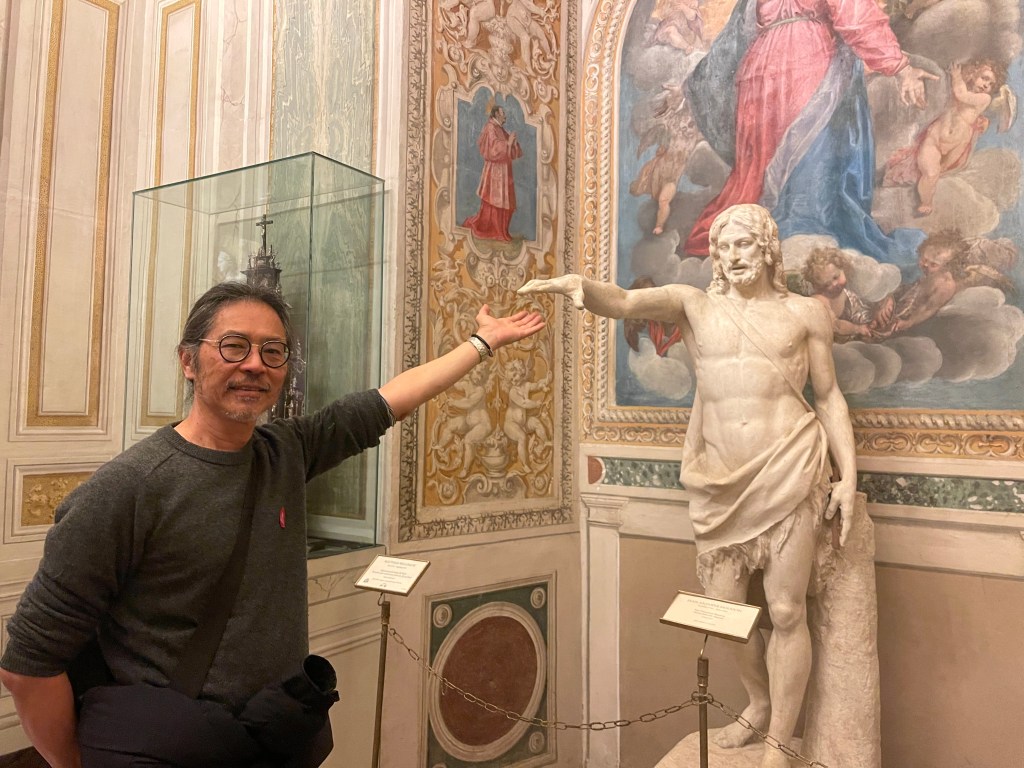
Inspired by Michelangelo, the old man posed like Adam at the Borghese Gallery.

Heathrow treated the travellers badly. Their flight to London was delayed but not late for the connecting flight to Edinburgh. They weren’t told their seats had been bumped and their flight rescheduled to the next day. It wasn’t a pretty sight to see the old folks rudely delayed by the airport staff and it was a much uglier sight to see them scrambling and running to their departure gate only to be told their boarding passes had already been cancelled. The following day, the alarm buzzed at 3:30am. The loss of their expensive hotel room at The Scotsman in Edinburgh hurt the old man as he grunted and struggled to get up from the lousy bed at the airport hotel.

“Be stoic,” Eva said later at the airport when told of his grumblings. Her sister agreed. It was easy for them to be accepting of their circumstances, since they didn’t pay for the hotel room. The old man clearly wasn’t graced with wisdom and contentment that Tan Dun had tried to impart to him in Rome. He seemed to have aged a lot faster; the deeper and darker wrinkles may have given him more character but the aggressive growth of his hideous pot-belly was a huge price being paid for the indulgences of the past three weeks.

Edinburgh was grey and wet and very young. Compared to Rome, many places on earth will feel very young. Even Edinburgh Castle looked young and uninteresting to the old man despite it being built in the 11th century. The old man’s Mrs needed a whole day to recover from their ordeal in Heathrow so it was left to Eva to decide the itinerary for their first day in Scotland. Eva wanted to walk the steps of queens and kings of Scotland, so they stopped by the castle after a breakfast of haggis and eggs.

Tracing the steps of kings and queens in Edinburgh

By late afternoon, the Mrs had fully recharged and shaken off the flu (or was it Covid?) that the taxi driver in Rome had shared with them on their way to the airport. She wasn’t going to miss the Royal Scottish National Orchestra (RSNO) concert that night at Usher Hall. It was a stupendous performance by the soloist, cellist Pei Jee Ng. He gave a tremendous interpretation of Shostakovich’s cello concerto No.1. The poignant 2nd mvt was a real treat followed by a cadenza that was wonderfully executed, filled with anguish and despair that painted a dark picture of Stalin’s iron grip on Soviet Russia. Pei Jee Ng made them cry. The old man was rubbing his chest in obvious physical discomfort during the cadenza. Music indeed is the most powerful art form; musical notes on pages of paper, performed well, could affect a listener physically, spiritually and emotionally.

The RSNO concert was followed by a post-concert drink for VIPs and orchestra donors. Somehow, Eva lost her way and walked into the Intermezzo Room. She was welcomed by the CEO of the orchestra who asked her travelling companions to join them for champagne. The old man was feted like a celebrity; people had assumed he was related to the soloist.

“Never mind, just smile and enjoy being in the limelight,” he told his Mrs.

When the pleasant chit-chats and champagne had dried up, the group was invited to the following night’s concert in Glasgow.

“Sure! We will see you there!”

Glasgow was a beautiful city. Bigger and more metropolitan than Adelaide and as vibrant if not more charming than Melbourne, it was the perfect city to end their holiday. A sumptuous Thai lunch at the Chao Phraya and a light pho dinner that turned into a big meal at Little Vietnam due to their generosity was a satisfying first taste of a fine day in Glasgow. Yes, there was the highlight to come! Another tremendous performance by the soloist and the orchestra followed by more free-flowing wine and champagne at the Intermezzo Room.

Bravo! Pei Jee Ng. What a scintillating performance!

https://bachtrack.com/review-pei-jee-ng-sondergard-royal-scottish-national-edinburgh-december-2023

https://www.edinburghmusicreview.com/reviews/scheherazade-rsno-23

They had a selfie with the soloist Pei Jee Ng and Betsy Taylor, principal cellist of the RSNO for that concert.

With a day to kill, Eva led the group into an antique shop the next morning. The store was packed like a bric-a-brac store, with hardly any space to walk straight and no room to walk tall and upright. A stack of old books fell off their shelves right in front of the old man as his eyes were scanning for their titles.

“It wasn’t me!” he shouted defensively.

“Aye, tae right, it wasn’t yoo, naw worries,” said the old antique-looking store owner, in heavy Lowlands accent.

“She just walked through the wall agine, she’s just showin’ awff,” he said casually, and clicked his tongue.

By ‘she’, he meant the old postmaster’s wife who died a long time ago.

“Strewth, there used to be a doorway where the wall is noe,” he explained, as if that was an adequate explanation.

Glasgow was losing its youth by the day. Ghosts have a tendency to make a place feel old and ancient. So, they had a sudden impulse to leave the street with the old shops.

“I ain’t goin’ tae the shoaps o’er aire,” the old man said, practising his Scottish accent.

Eva enjoyed their walk in the park. The white carpet of snow was a bonus.

On the penultimate day of their four-week European holiday, the group chanced upon some fantastic local oysters and smoked salmon in Loch Fyne.

“Oh, they are so fine,” the old man said.

“The finest!” Eva chimed in.

It had to be said. Barra Island scallops and Loch Fyne salmon were discoveries that were as pleasing as all the history they learned in Italy. They had visited the beautiful places they wanted to see, such as Lake Como, Bologna and the Tuscan towns of Siena and Montepulciano. They had tasted real Italian food and real gelato from Milan to Napoli and from Bologna to Roma. They had viewed from up close famous artworks such as The Last Supper and marvel at marble sculptures such as Michelangelo’s David and Canova’s Pauline Bonaparte but perhaps the finest discovery of all was the awesome landscapes that only nature can create, in Loch Fyne and its surroundings.

“It’s more beautiful than Lake Como and New Zealand’s Queenstown,” the Mrs decided verbally.

Loch Fyne, so fine indeed.

A Merchant in Venice

The boatman declined to sing a love song despite being offered more money for the gondola ride. So, the old man hummed the first tune that came into his mind. He hummed in a sonorous tone and with much emotions the romantic melody of Oh Sole Mio, because he didn’t know the Italian lyrics and didn’t know what the song was about.

But there’s no other sun
More beautiful
My sun
Is upon your face
The sun, my sun,
Is upon your face.

The sun was indeed caressing her face. Eva looked sweetly into James’ eyes and tenderly touched his face as if to check that he wasn’t just in her dream but real and strong, the masculine and heroic head of their family. The gondola ride was less romantic than she had imagined; the old man and his Mrs should not have boarded with them. A gondola shouldn’t be crammed with four people, least of all two old people who looked odd and unbalanced and liable to capsize the boat at any moment.

“Say baciami to him,” the old man said to Eva, as he snapped a few photos of her and her hero.

Tell him he’s your hero, your idol, your everything. “Kiss me. Oh, kiss me,” she implored.

The late afternoon sun bathed on them now. The old man looked at James who was tilting his head oddly, quite clearly unlike a real James Bond. Bond would never look clownish but James seemed shy and awkward to be kissed by Eva.

James Bond and Eva Green, evergreen in Venice

A retired merchant holidaying in Venice, James had allowed for no expenses to be spared. Their suites at Belleview@Canoletta Suites overlooked St Mark’s Square. The suite on the highest level, the fifth floor, had a sauna and the other, one level below, had a jacuzzi and a huge balcony that Eva and her sister practised their royal wave to the ordinary people down below.

James generously made himself responsible for all expenses during their three-week Italian holiday, including that for the old man and his Mrs. The exact opposite character of Shylock in the Merchant of Venice, there was no demand for a “pound of flesh” nor was there any requirement exacted on the old man to pay for taxi fares or gratuities for the tour guides. Flights were on business class and train rides were either in club or executive coaches and boat rides were private.

A private boat ride to Venice
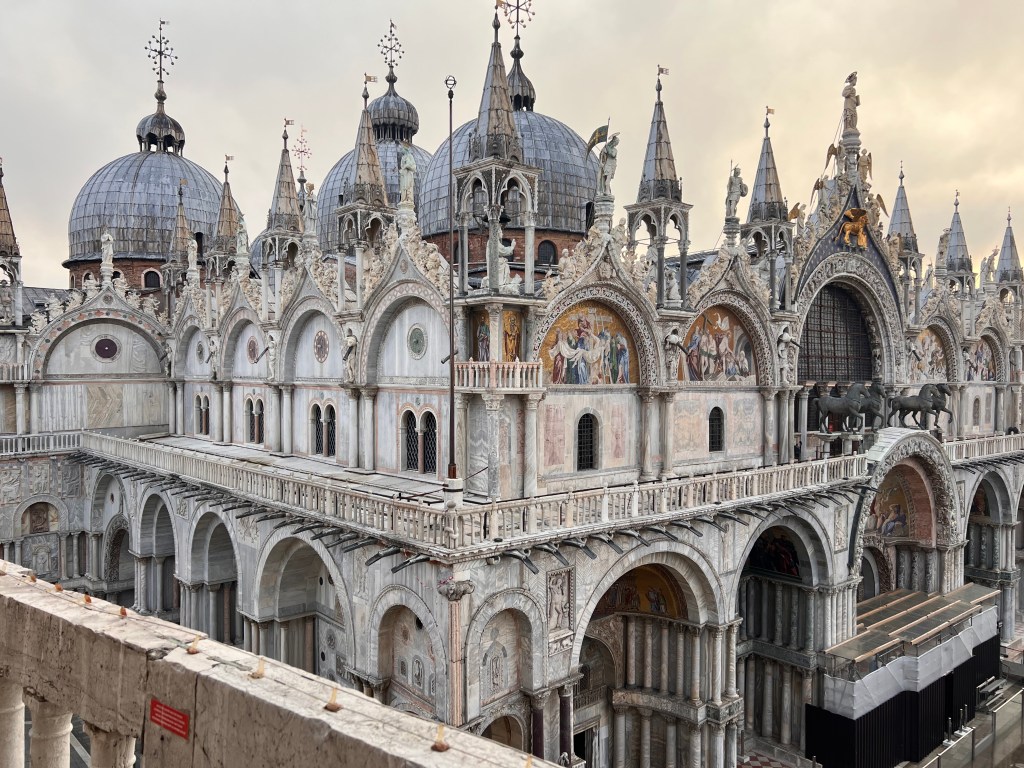
St Mark’s Cathedral, literally just a stone’s throw from the old man’s balcony.

Exacto! Please let me pay for everything-ah,” he insisted, adopting the accent of their Italian tour guide.

Perfecto! Let me look after the bill,” he told the barman.

“Free Prosecco for you and your friends today,” the barman replied.

The old man wondered if Shakespeare was describing the antisemitism sentiments of Antonio, the Venetian merchant, against Shylock the Jew in the late 16th century in The Merchant of Venice. Sadly today, the Zionist state of Israel is invoking the claim of antisemitism on anyone who is voicing their opposition to the genocide happening in Gaza. Islamophobia, Russophobia or Sinophobia does not have much impact on the public’s abhorrence of unfair treatment to the people concerned but somehow a claim of antisemitism is politically powerful to the claimant and damaging to the accused.

“Senile is the root word for senators,” the tour guide said. Venice was a maritime powerhouse for about four hundred years up to the 14th century. The seat of power laid in Venice before the Renaissance. The senators were not elected by the people but appointed by those in power. They were old men who didn’t have much time left on earth and therefore did not need to be elected for multiple terms. Perhaps the American system of electing a senile Joe Biden would not be so strange to a Venetian today.

James almost disembarked at the wrong train station on the mainland instead of Venice Santa Lucia. It would have been another debacle just like the one in Como where the old man’s Mrs had her nightmarish incident of being the only one stranded on the wrong train station. Eva didn’t ever raise her voice at James who seemed foggy with Covid. She merely placed her hand on his lap to tell him to remain seated. But, he wasn’t as fogged up as the old man who hailed a car marked ‘carabinieri’ to stop in Napoli.

“It’s not a cab,” James shouted.

A carabinieri isn’t a cab!

James left Venice a day earlier than the others. He had a mission to attend to, somewhere in Asia. The old man sighed with relief upon the news. Now he could go back to his regime of intermittent fasting and restricted calorie control. When James was around, he made sure they ate well, too well. His taste buds went haywire from Covid in Naples and Florence. Suddenly, he had an affinity for McDonald’s and Chinese food. But the Chinese were mainly from Wenzhou. Their dishes weren’t to his liking either. Everything was either too salty or too bland. The virus transformed him into a Goldilocks.

The old man particularly liked to try the local favourites wherever they went. In Bologna, they tried Bolognese lasagne. In Venice, they went for spaghetti in squid ink and pasta vongole. But it wasn’t yet time for the dolce! Si, no desserts until the secondi is polished off with bread. One lobster? No, make it two. T-bone steak must be ordered by the kilogram. After that, it’s dolce time. Eva did not deviate from panna cotta everywhere she dined. The panna cotta was simply perfecto for her. Eva turned out to be a Goldilocks too, but the virus was not responsible for that. She loved her sweets but not too sweet and not too rich, not too cold and not too hot.

“The limoncello is on the house, sir.” the waiter said to James, who was so pleased with the service. It was to cost him a great deal more, so impressed was he with the ristorante. He tipped them more than the limoncello would have cost him. Much more! But, James had the style and class of a Bond.

They needed a bigger table everywhere they dined!

But, the old man wasn’t at all surprised. He half expected a freebie everywhere he went, such lofty expectations he had. In Rome, they were offered free Prosecco, by the man outside the restaurant whose job was to encourage passers-by to go in. Rome. Ancient, noisy, crowded, chaotic. The travellers had their first traffic accident in Italy as they approached Rome from the airport. One man decided to walk straight into the side door of the Mercedes van they were in as the taxi crossed a major intersection. The man remarkably dusted himself as he picked himself up from the road, grabbed his smashed glasses, and limped to the window of the car to apologise to the old man. Hand signals conveyed clearly what words couldn’t.

They say all roads lead to Rome but no one told the old man all roads to Rome were jammed with tourists and traffic and peppered with eardrum-breaking screeching a from wailing ambulances and loud unending sirens from the polizia escorts that flanked fleets of black limousines rushing everywhere and going nowhere it seemed.

Alora!” Magdalena greeted them in Roma with her favourite sentence opener. She was the one who taught the old man how to tell if a marble statue was drunk. From Roman times to the Renaissance and from Mannerism to Gothic, smiling statues depicted people imbued with wine.

“Was Mona Lisa drunk too?” The old man asked Magdalena.

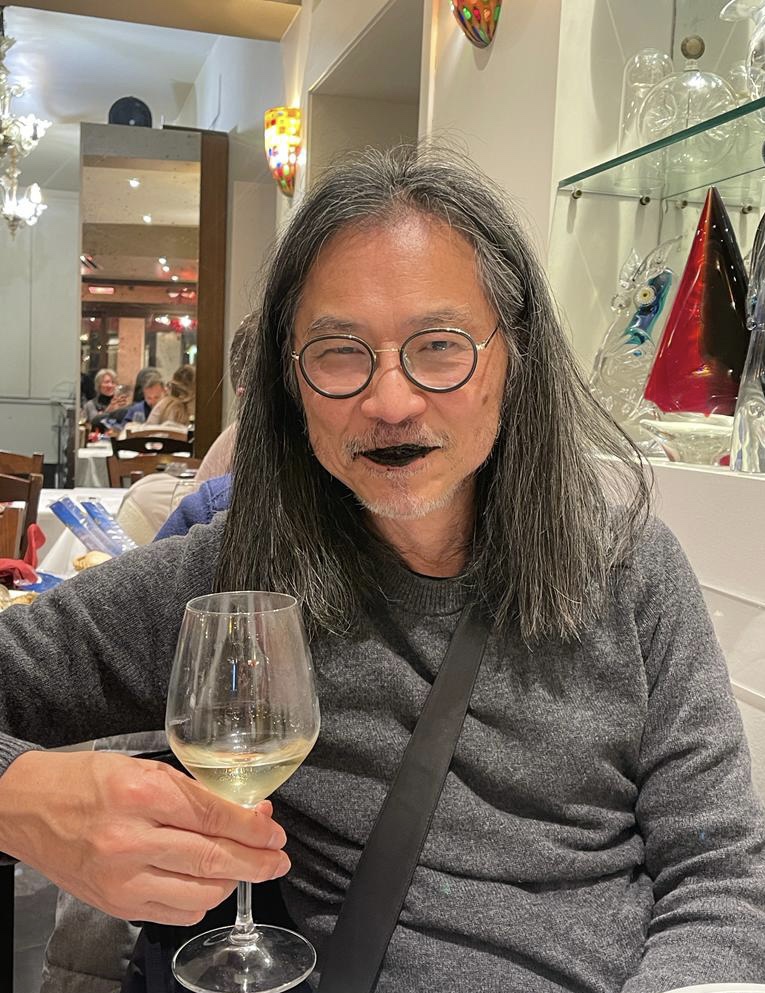
The old man posed with a smile after a hearty serve of squid-ink spaghetti. He would be considered drunk a few centuries ago.
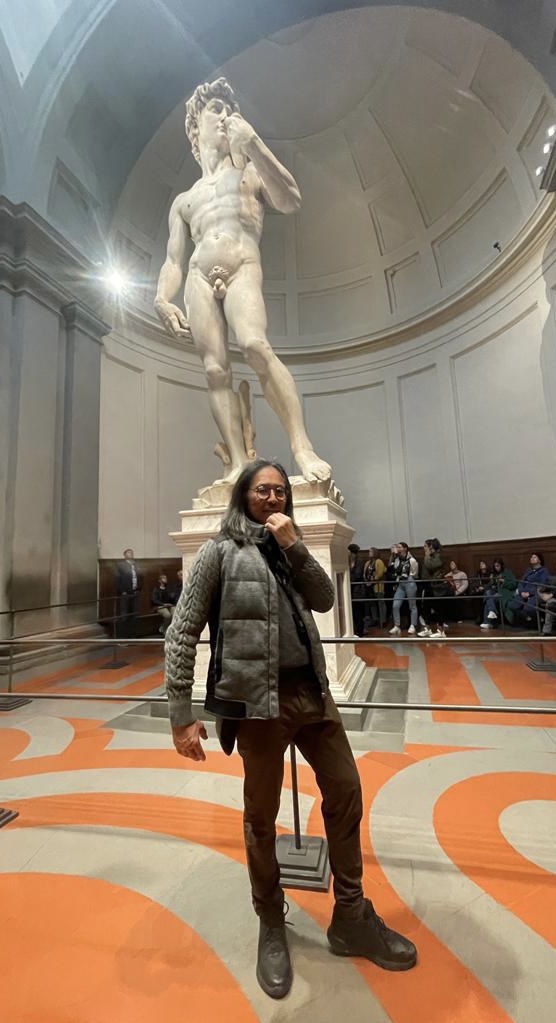
He said he lost his jacket on the flight from Venice to Rome. Could he have left it with David instead?

Take a Look-ah at Lucca

Their tour guide, Francesco Conforti, looked imperial like a Roman emperor as he sat behind the wheel of his gleaming black Mercedes V-class van. The warm golden rays of the setting Tuscan sun caressed his golden curly locks as he said to the old man and his travelling companions, “Consider that you like-ah Siena so much-ah, you must take a look-ah at Lucca tomorrow, after you visit-ah Pisa.”

Francesco, suave and tall, much taller than any of the four passengers in his van, showed a muscular and towering frame, reminiscent of Michelangelo’s David in Academia Gallery, an impressive physique his thick fleecy jacket failed to hide. Francesco towered over ‘James Bond’ who was looking more worse for wear than when he was in Naples. No matter that he appeared less suave in Firenze, he and ‘Eva Green’ still remained the classy couple in the group.

Michelangelo’s David, in all his glory

The demure ‘Eva’ with her sweet smiles and dazzling big eyes that out-dazzled even her big diamond ring, somehow oozed spades of class and sophistication despite appearing in all their holiday photos in the same black outfit. A very light traveller, she didn’t have to ponder on what to wear each day. They seemed to have fallen in love again, expectedly so, one may add, since under the Tuscan sun, not only do the Sangiovese vines, wheat and spelt spring out from the undulating terrain giving the land its stunning colours that change with every changing season, love springs eternal too for the couple.

“What’s the weather forecast for today?” the old man asked Francesco.

“You will see!” Francesco replied.

The Italian, who the old man’s Mrs said should be an actor, had the wisdom of Marcus Aurelius and the looks of Adonis. Never flustered by erratic drivers, he would wonder out loudly what was inside the mind of an errant driver.

“Don’t they know? Step by step-ah, everyone gets to where they need-ah to be,” he said wisely.

“In Italy, you drive by looking-ah at the other driver’s eyes-ah,” he added.

“To be hon-nest, traffic lights-ah aren’t common-ah because red-ah, green-ah, amber-ah is up to the driver’s imagination-ah,” he explained.

“Some drivers-ah don’t look at you,” he explained.

“They just go. You don’t exist-ah!”

At Siena, it became clear ‘James’ had lost the spring in his steps and the air of debonair in his normally charismatic mannerisms. The sore throat he was complaining about travelled with him all the way from Naples. He struggled with his luggage quite unlike a double-oh agent, oh, so clumsy he had become, tripping himself with a lazy right foot as he checked out of Naples’ Hotel Excelsior. Since even Sorrento didn’t appeal to him, it was understandable that he said all the places from Posillipo to Vomero were just eyesores.

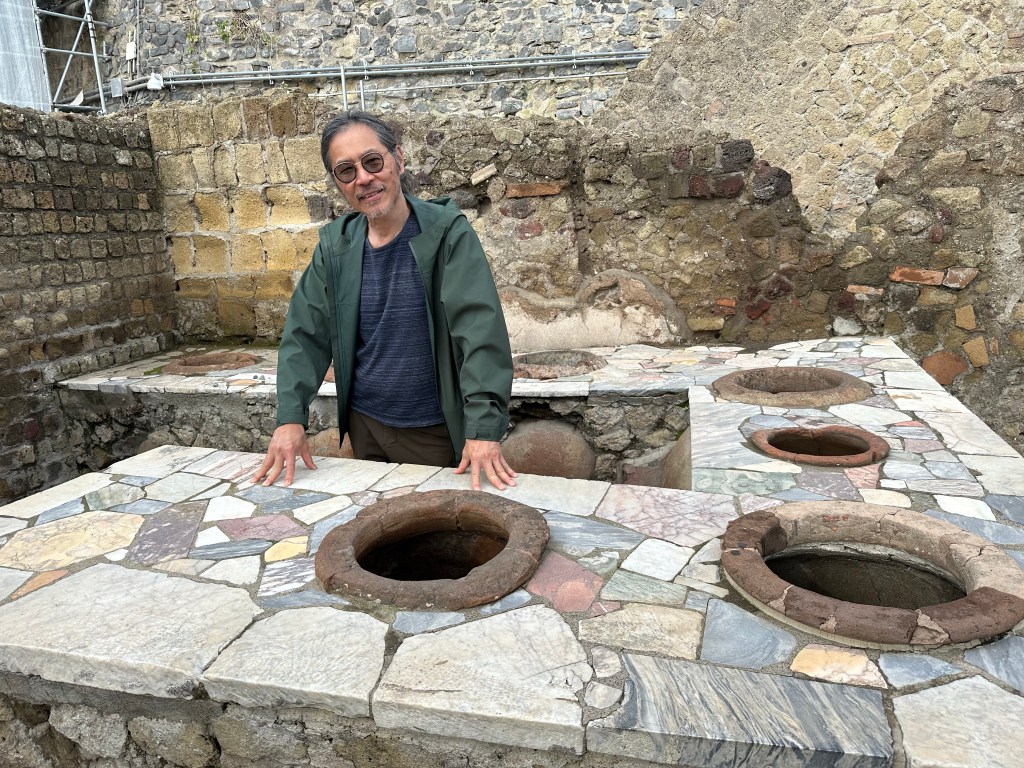
His enthusiasm for the high life sparked briefly as they checked into Hotel Marina Riviera in Amalfi Coast as was his keen interest at how the rich people lived in Herculaneum. There, the ancient Romans showed how splendid life was even before Christ arrived on earth. Unlike Pompeii not so far away, Herculaneum was an ancient resort town, an idyllic wellness centre where the wealthy could simply adopt the ‘otium romanum’ way of life, a contemplative lifestyle of leisure and idleness to recharge oneself and pursue one’s interests such as philosophy or seek wisdom or simply lead an aristocratic culture in the countryside. Before the eruption of Mount Vesuvius in 79 A.D., the ancient people of Rome already knew how to enjoy the therapeutic benefits of thermal baths and spas in the seaside resort. There were separate spa centres for men and women and the earliest fast-food stores in the world were also discovered buried deep in volcanic mud.

A fast-food joint in Herculaneum pre-79 A.D. The man behind the counter looked ancient too.

‘James’ did not enjoy the Catacombs of San Gennaro. Burial sites for the religious followers of St John did not impress him. Let the dead rest in peace was what he said to the old man, a travelling companion in his party. He swore he could still smell death in the dark limestone caves deep underground.

Catacombs of San Gennaro

Massa, their black guide from the Ivory Coast who blended too well in the dark tombs, said, “Please do not dilly-dally here. You wouldn’t like to spend the night here by yourself.” Before he had finished his sentence, ‘James’ belied his physical condition and was the first to get back out into the light.

In the Amalfi Coast, The Madonna was seen holding a bouquet of flowers looking out for travellers in the sea.

At the Grand Hotel Continental in Siena, ‘James’ was no longer just complaining about his sore throat. His coughing was gaining frequency and volume, proving Einstein’s E=mc2, the more he coughed, the more energy he expended. He felt so unwell, he had the urge to call for a doctor to visit him at the hotel on the following morning. Luckily, he didn’t or the doctor would have shown him two pink stripes on the testing kit, proving that Covid was not a myth and he would have had to isolate himself in the hotel.

But, what if the authorities had designed a new antigen test kit to test positive for any type of phlegm in one’s throat in order to sell more mRNA vaccines?

He failed to restrain his urge though in Firenze – a trait all James Bonds possess; but his urge wasn’t for some hot looking chick. The white stuff in his throat got the better of him, so he insisted that a doctor called on him at the plush Golden Tower and Spa Hotel. The hotel staff in Firenze discreetly suggested to ‘James’ that he masked up like Zorro, once the doctor confirmed he had Covid. It suited ‘James’ fine, since the hotel offered him free room service for the rest of his stay there including a complimentary bottle of Spumante which enhanced his role as double-oh seven. Oh, it even sparkled his mood. The white mask did cramp his style as no James Bond, living or dead was ever seen wearing one. Everywhere he went, ‘James’ stood out, not because of his handsome looks or his sophisticated sense of dressing but because the white accessory covering his face made him highly visible.

“The duomo is so close you can touch it,” said the hotel receptionist

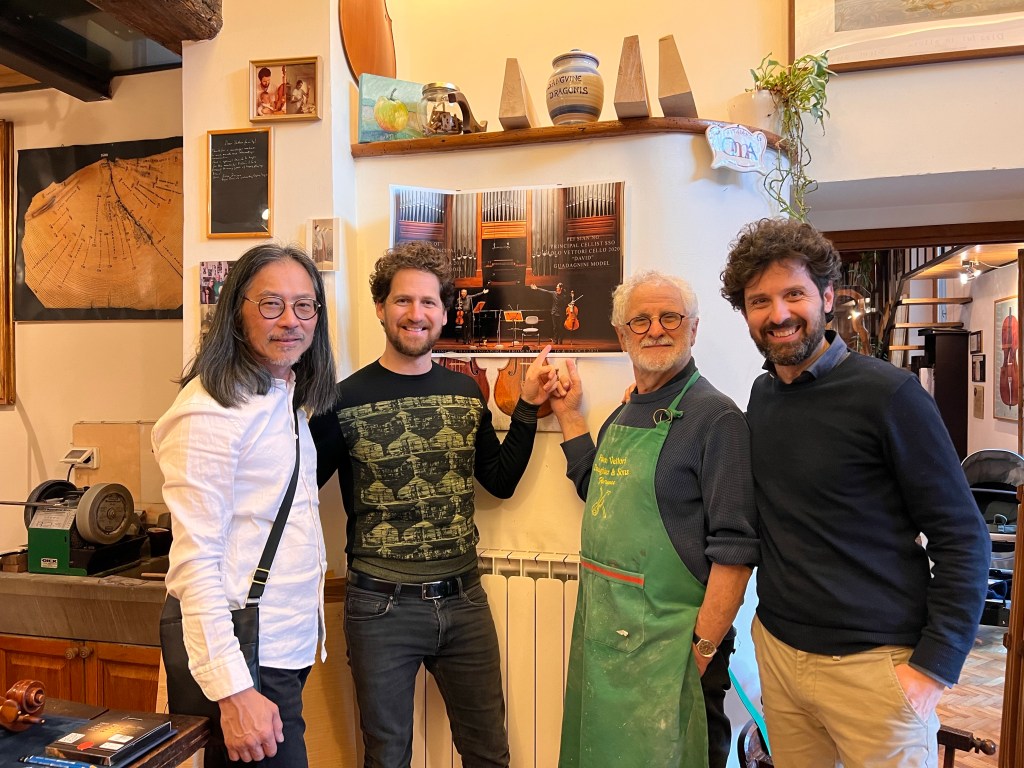
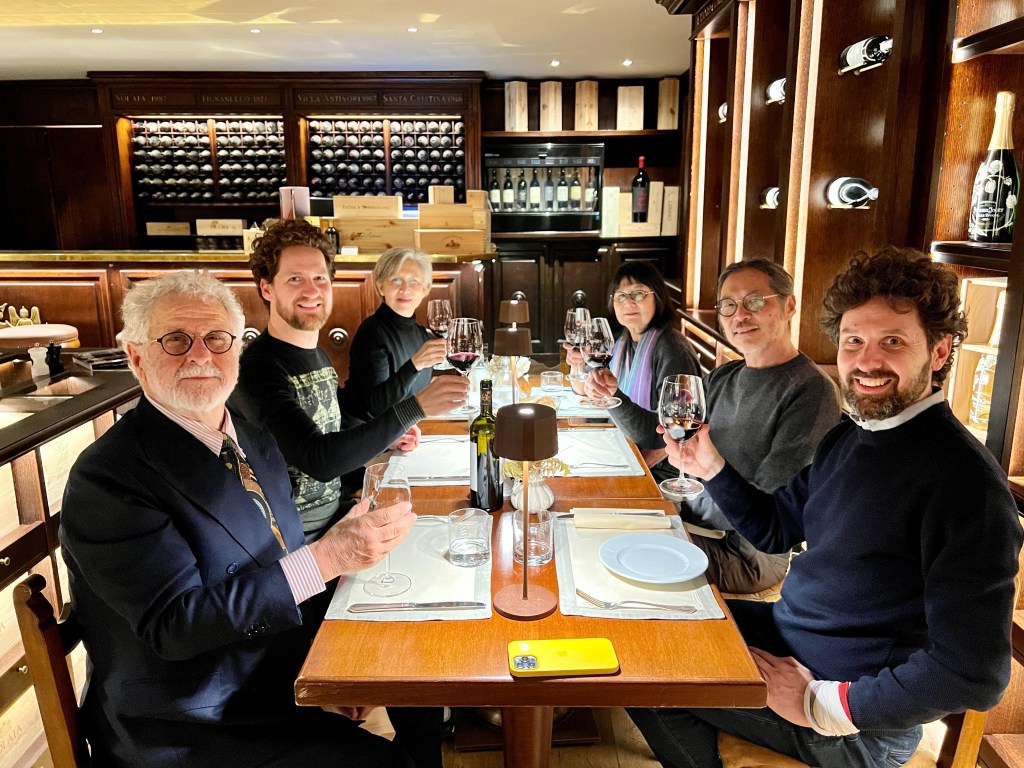
He missed out on their visit to the Florentine luthiers, the three generations that make up the Vettori family. The old man was very keen to meet the patriarch, Paolo Vettori, whom he incredulously succeeded in getting him to commission a copy of Guaneri del Gesu’s Ole Bull violin of 1744. The sons, Dario and Lapo, generously gave a masterclass of violin-making that took up more than two hours of their time. Later, the Vettori family threw a dinner party to welcome the visitors as family members rather than as friends, such was the amazing warmth of the Vettori clan. Grazie millie!

With Dario, Paolo and Lapo Vettori
Dinner with the Vettori family. What a privilege!

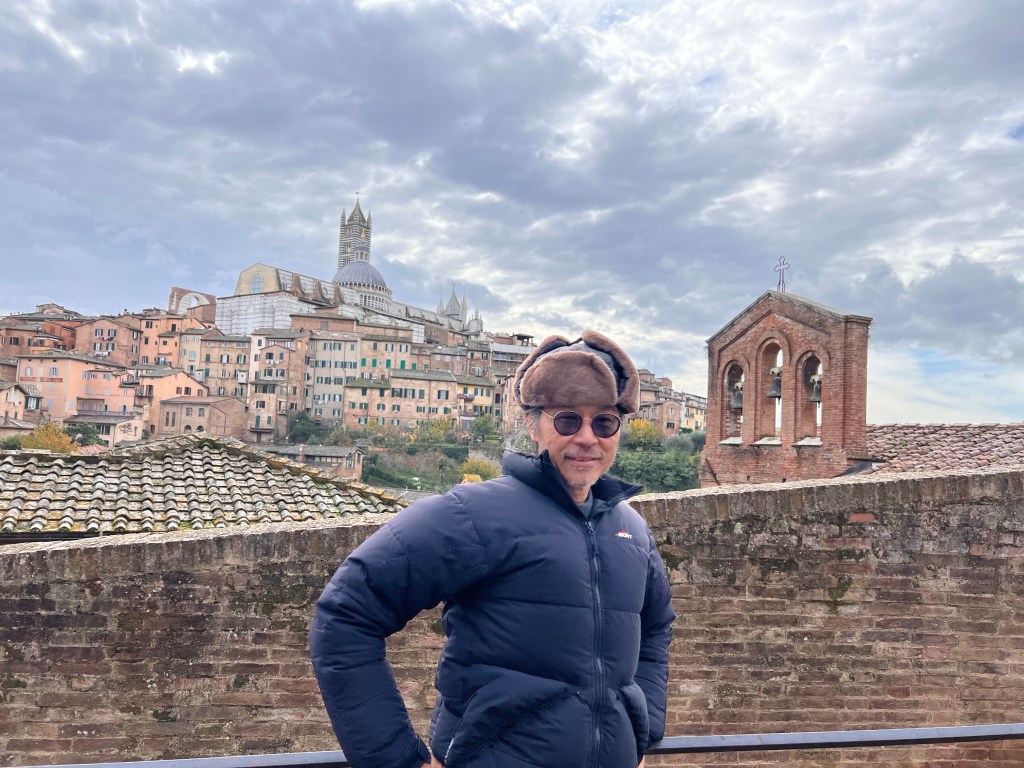
The following morning, the travellers arrived in Siena. “It’s my most favourite town in Tuscany,” the old man announced to no one in particular.

He forgot no one asked and no one cared what his favourite things in life were. ‘Eva’ said she would name her next child Siena, briefly forgetting how brief a woman’s fertility was. The old man’s Mrs was the most practical. Beauty does not rank much, if at all.

“It’s a beautiful place, but the paths are too up and down, too steep for old people,” she said.

If I had a daughter, I’d name her Siena just like beautiful Siena!

In Siena their walking tour included Piazza del Campo, Tower of Mangia, Gaia Fountain and the Duomo. Every town and every city had a duomo. Duomo here, duomo there and more duomos everywhere soon confused them about where they were. Monteriggioni was a small town so small they were glad it only had a chiesa (church) but no duomo (cathedral). The old man even discovered the reason why they built baptisteries.

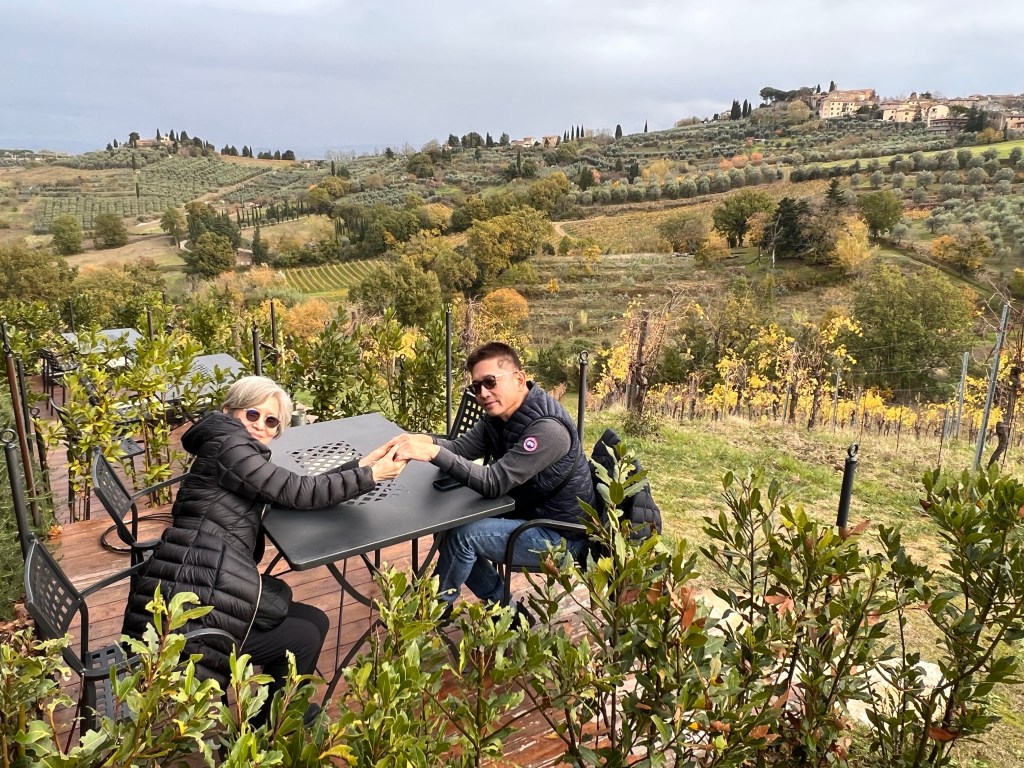
From Montepulciano to Montalcino, the travelling party lacked the energy and enthusiasm that they brought with them to Italy. The missing piece that spoilt their mood affected them as much as discovering a missing piece in a jigsaw puzzle. Their energy was sapped by the lack of energy from ‘James’. He was quiet during lunch and he was absent during the wine tasting where ‘Eva’ enjoyed the Brunello di Montalcino. Lunch was a sumptuous affair at San Gimignano, at a farm close to the village with wine tastings but ‘James’ hardly had a bite of anything. The Covid patient had lost all sense of taste and was grumpy at everything that was served at the table.

A renewed vow at Pienza

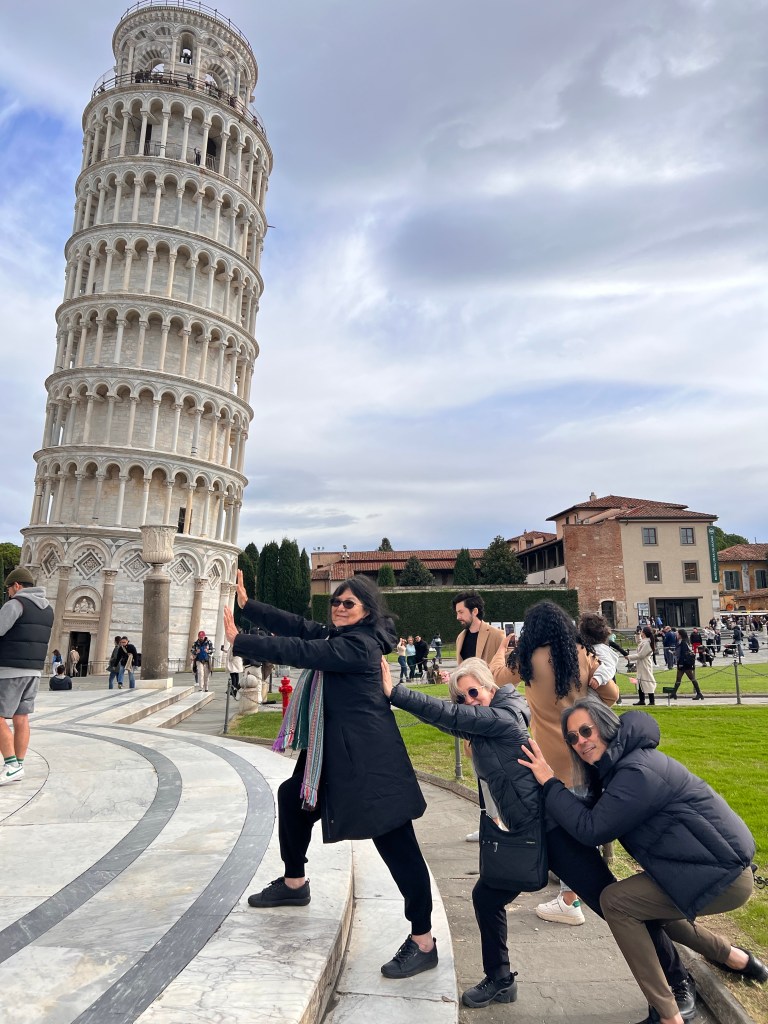
The following day, the group took up Francesco’s suggestion and toured Lucca after their morning visit to Pisa. In 1506, the port city of Pisa fell to Florence but it remains famous today because of its leaning tower. The old man was reacquainted with Galileo Galilei, who was born in Pisa. It was in the cathedral there that a young Galileo observed the effects of the pendulum from a chandelier that swung from the leaning Duomo. Later, he was to earn the wrath of the church when he supported the Copernican assertion that it was the earth that evolves around the sun and not the other way, wrongly and stubbornly championed by the Catholic Church for a further 359 years before the Pope finally apologised to Galileo! To claim that the earth was not the centre of the universe was a heresy punishable by death and Galileo was ex-communicated for having that view. Under house arrest for the rest of his life, it was said that Venice came to his rescue and his head remained intact.

The chandelier in the Duomo gave a eureka moment to Galileo Galilei.

At Lucca, the birthplace of Giacomo Puccini, when Francesco was asked if he could sing any of the arias made famous by Pavarotti, he replied,” I sing like a cat crushed by a door!

“Puccini, a genius at writing operas but so arrogant,” Anna, the tour guide said.

“Take a last look-ah at Lucca,” Francesco said to his passengers as he sped towards Florence. Of all the places they had visited in Italy, nothing can beat the birthplace of the Renaissance. Finally, after over 900 years of the Dark Ages, the rebirth of great classical antiquity, arts, architecture and science took place right there in Firenze. The Medici way of banking and accounting were introduced during this period also. That was, of course, a misinformed historical report about the Renaissance. The old man was ill-informed to believe the Dark Ages lasted nine hundred years after the fall of the western Roman Empire in the fifth century.

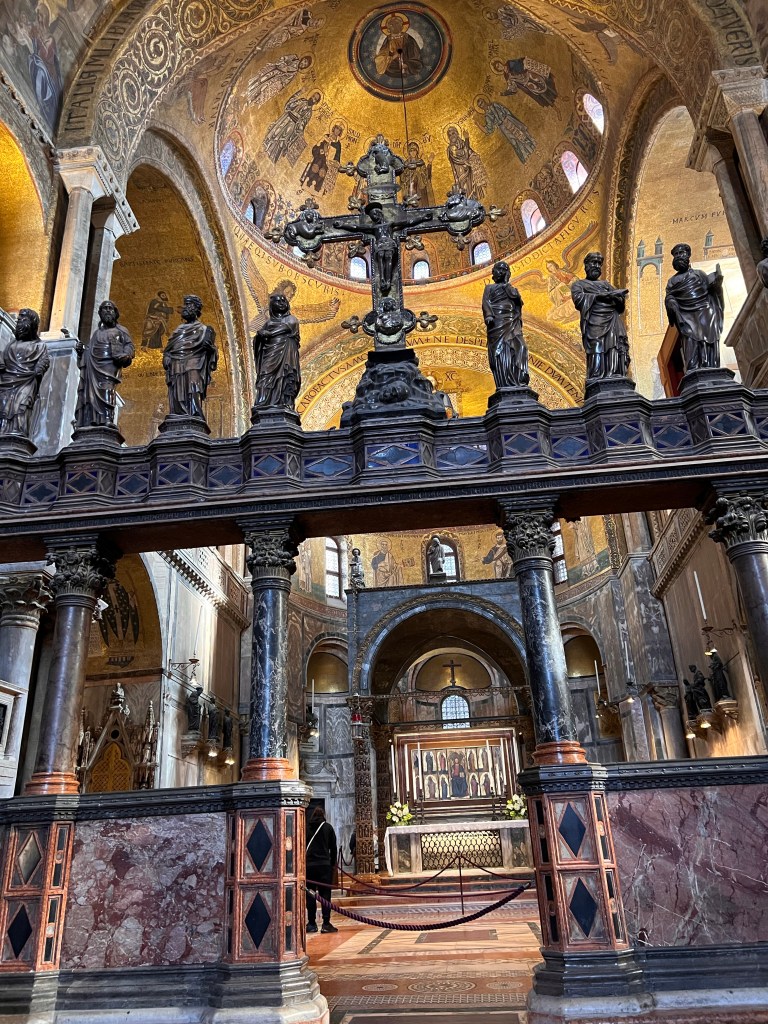
He only realised that upon his arrival at Venice. There, he was amazed at the architecture, science and art being practised in the so-called Middle Ages in the great Venetian city. A treasure trove of mosaic art can be readily found in the St Mark’s Cathedral and in the Doges Palace. The splendour of art incorporating gold, precious stones and mosaic tiles used to show their wealth and power was simple mind-blowing! Dark Ages may be best to describe Europe at the time but Venice was a flourishing city where the bankers and merchants were not shy to flaunt their wealth.

St Mark’s Cathedral, built in the “Dark Ages”.

Beautiful Nipples. Naples, Actually

The old man was still fuming about the missed opportunity. The photo with the pretty Italian lass was ruined by her boyfriend who sneakily positioned himself between her and the old man. She was a most unlikely beauty to have a photo taken with, he later told me. He said his heart missed ten beats and he was almost pronounced dead by the time she stood close to him.

“Can-ah I-ah have-ah a photo-ah with you-ah?” she asked, screwing her button nose, making herself even more adorable.

She asked the old man where he’s headed next after leaving Bellagio, as she posed sensually for the camera, looking right into his eyes.

“Naples. I hear it’s beautiful there also,” he replied, her beauty imposing on him to use the word ‘beautiful’ even though he had heard the place was simply chaotic, messy and littered with rubbish almost everywhere. The bumpy roads of Naples were so neglected that anyone with loose dentures was liable to lose them if they left their mouth open during a journey from Posillipo to Vomero.

“Beautiful nipples-ah?” she asked, changing her alluring look to a quizzical one. Italian women know how to pose for the camera. Well, at least in Milan anyway, and at Bellagio. She had a classic look but standing next to her boyfriend made her less classy.

“We have a saying about nipples,” she said.

“See nipples and die!”

The old man left them without asking for a photo. He thought she was just distasteful and vulgar. He did not understand that ‘see Naples and die’ meant that once you have visited Naples and saw its charm and beauty, you have seen enough beauty to die satisfied.

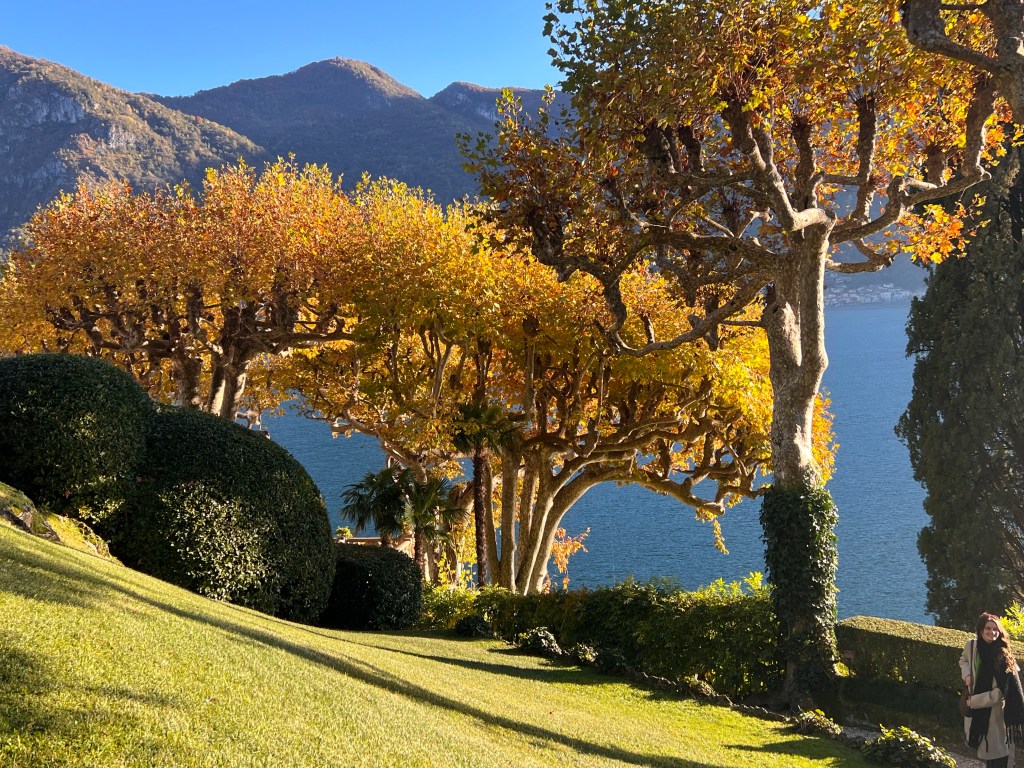
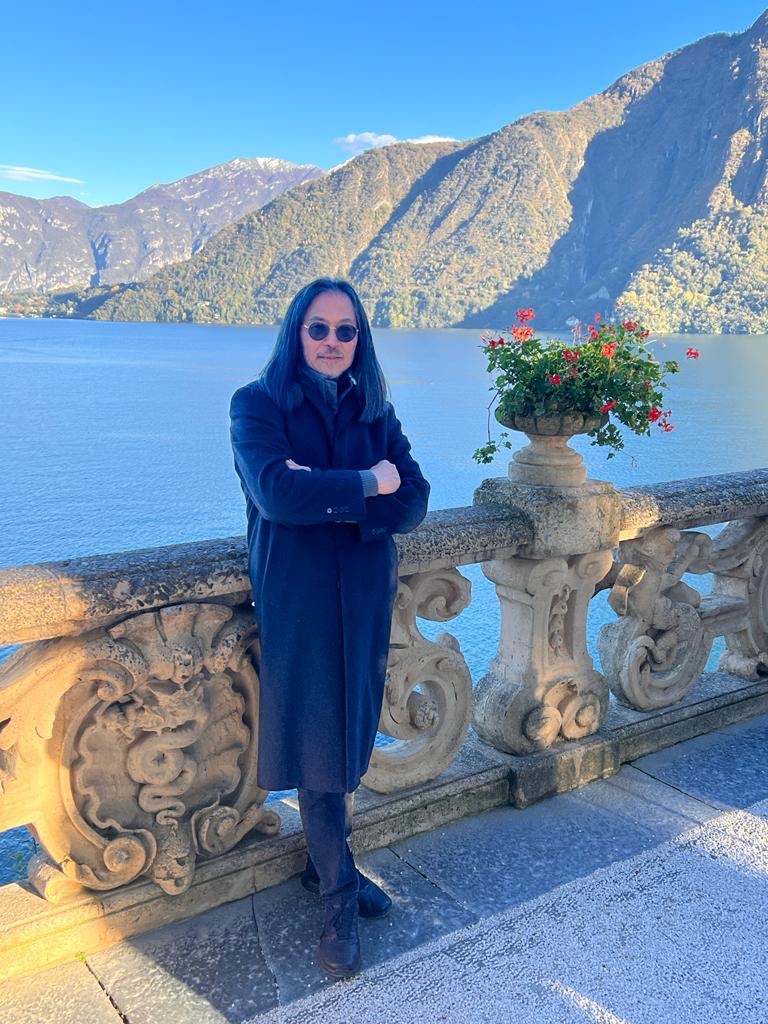
The air was still warm with the afternoon sun shining brightly despite it being mid-November already. He and his travelling companions hurried to the jetty to catch the next ferry; they did not fancy missing it as they had to leave for Bologna early the next morning. The old man, accustomed to walking his dog regularly, was unchallenged by the gentle terrain of Villa Balbianello’s garden and arrived at the jetty on his own. His companions behaved more like dogs in a park, sniffing here and there, smelling the flora and stopping to soak in the ambience of the romantic garden. By the time they joined him at the jetty, he had already scouted the place and could see a ferry speeding towards their direction.

“The ferry will depart at 1.30pm,” ‘James Bond’ said, as the ferry slowed down. With fifteen minutes to go, the group decided to sit away from the gate to avoid the throng of passengers expected to alight from the ferry. ‘Eva Green”s sister was observing a young couple from Singapore, hoping to engage them in a conversation but the couple, both of them quite fat, remained aloof and walked away. So, she started to chat with a group of Filipino girls instead, and soon both sisters were deep in conversation with their new friends. All four of them looked to be no more than in their late teens, all dark in complexion, all unattractive and therefore did not attract the old man’s attention. There would be no photo session with any of them. ‘James Bond’ reconnoitred the immediate surrounds of Bellagio jetty and collected a collage of photos for his album. The old man sat alone, waiting for the first passengers to appear from the boat. None did. To his horror, the boat didn’t stop and veered away from the jetty. The ferryman must have seen no one was waiting at the jetty and hurried to the next stop.

“Oi! Ferryman, come back!” he yelled.

The busy chatter around him stopped, all in shock at the rudeness of the voice. The filipino girls, ‘Eva Green’, her sister, ‘James Bond’ and a Hungarian couple with a baby girl all looked his way. They behaved like they were inhabitants of Herculaneum, all looked horrified and stunned, with no time even to breathe, as if Mount Vesuvius just had a cataclysmic eruption and spewed tonnes of volcanic mud twenty five metres deep onto them.

The next ferry, the last for the day, wasn’t due till 5.10 pm by which time it would be already dark. The newfound friends decided to walk across the dead road to a local hotel which welcomed them like a Venus flytrap. Once you walked in, you were destined to part with your money. The old man reckoned the hotel worked in tandem with the ferryman; there was nowhere else for them to kill time.

Hot tea, thank you.

Four cappuccino please, thank you.

Some nuts and chips, thanks.

“Vorrei una birra, grazie,” the old man ordered a beer.

The problem with Bellagio was the lack of public transport in a town that was peppered by winding and undulating tracks, some of which are quite steep and slippery when wet. ‘James Bond’ had not only booked and also prepaid for an expensive dinner at a ristorante a few miles from their AirBnB villa. When they finally landed on Bellagio again, it was already dark. The blue and emerald water of the lake had turned black.

“Watch out for dog poo,” ‘Eva Green’ said, in a dialogue unimaginable even in a very bad movie script.

“What poo? There’s no dog around,” her sister replied.

Eva’s eyes, glued to the grass as they crossed a garden in a moonless night, suddenly lit up with laughter.

“Hah, see what I stepped on!” she shouted loudly but with delight in her voice.

The two men were some five or six metres ahead of her. They were tired and hungry and did not care to turn their heads back to look. Her sister, thinking Eva was just tricking her to double back for her, also kept walking.

“Look, look, it’s a U.S. twenty dollar note!” Eva shouted for attention, pleased that looking out for dog shit could give her such a good reward.

Eva rewarded herself with white truffle pasta in Bellagio

The following day, they said goodbye to Bellagio and an uneventful hour-long taxi ride to Milano Centrale followed by another uneventful hour-long train ride got them to Bologna. Both Eva and her sister were by then reminding each other to be less adventurous or else the screenplay for their holiday might mirror that of Book Club: The Next Chapter and see them spend a night in a local jail in Italy!

Church of Santa Maria Della Vita, Bologna.

Their holiday started to unravel in Bologna. ‘James Bond’ got sick of Italian pasta and then he got sick. His throat started to hurt and a mild fever haunted him all the way to Naples. His companions continued with their walking tour in Bologna, leaving him alone in their apartment to rest. ‘James Bond’ couldn’t rest despite being unwell but he pretended to be asleep when his companions got back, fully drugged with happy hormones. In their apartment, Eva cooked lunch which consisted of incredibly fresh prawns and two live crabs from a seafood store adjacent to Via Clavature, a side street of Piazza Maggiore, where they were staying. Prawns and crabs weren’t suitable food for the unwell ‘James Bond’; besides, he reckoned it would cramp his style to be dirtying his hands whilst sucking on some skinny and hairy crab legs.

It didn’t make sense for ‘James Bond’ to openly admit that he was frightened by some loud strange noises when he was trying to rest alone in the apartment. After much prodding by ‘Eva Green’, the sickly ‘James Bond’ reluctantly shared his encounter with an unknown nemesis.

“No need to look away,” Eva said to the old man and his Mrs, before adding, “There was nothing to see. All that happened was that he heard a lot of loud sounds; of trolley wheels being dragged on a timber floor and animated male voices emanating from your room.”

The old man gave her a quizzical frown but said nothing. People were beginning to disbelieve his frequent ghost stories, so why bother to explain that his room was carpeted and he was out all day?

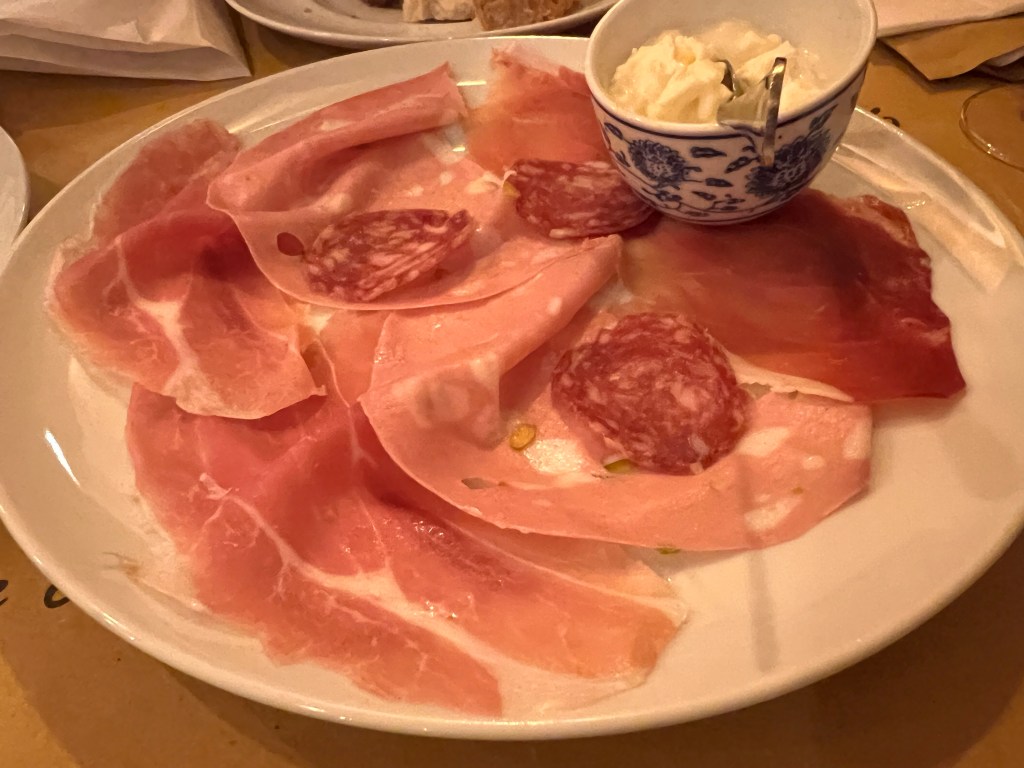
But, ‘James Bond’ heaved himself out of the black sofa he had laid on all day to join the party for their food walking tour around the Quadrilatero, an ancient commercial district in Bologna. There, they sampled the best produce from the Emilia Romagna region – pancetta from Piacenza, prosciutto ham from Parma, the wonderful parmigiana reggiano cheese from Reggio Emilia, the incredibly expensive 28-year-old Aceto balsamic vinegar from Modena, tortellini and mortadella in Bologna itself and so much more.

Tagliatelle Bolognese is what’s traditional in Bologna, not Spaghetti Bolognese
Antipasti from the Emilia Romagna region
Bologna, birthplace of tortellini

Bologna, a truly foodie’s paradise, did not disappoint. But, ‘James Bond’ did. He woke up the next morning with a throat that’s got a lot of white stuff in it.

“See, it’s bacteria or virus,” he said to Eva, as he opened his mouth wider for her to peer into it.

“Si, si,” Eva replied in full agreement with her action-hero before turning off the flashlight of her phone.

When they got to Naples the following afternoon, the normally suave “James Bond’ was looking worse for wear but he still strode the red carpet at the Teatro di San Carlo to attend Rudolf Nureyev’s Don Quixote that evening.

‘Eva Green’ and ‘James Bond’ attending a ballet in Naples.

The next morning, ‘James Bond’ developed a slight fever and had trouble swallowing.

“Please take him to the closest farmicia,” the old man said to Fulvio, their limousine driver in Naples.

“No, take me to the hospital,” ‘James Bond’ said with authority.

“Are you not well, Sir?” Fulvio asked sympathetically.

“Many people sick. Nipples very wet and cold last week,” he added.

“My doctor friend in Nipples very busy this time of the day,” he said helpfully.

“Tell me what’s wrong and I’ll explain to her.”

“Tell her I have a sore throat,” ‘James Bond’ answered.

“A sore throat? No fever?” Fulvio asked, as he raised an eyebrow and gave a shrug.

That evening, ‘James Bond’ went to bed really early, before 7 pm in fact, skipped dinner and missed the sunrise the next morning.

No jumping-off-balconies scene for ‘James Bond’ in Naples.

Train to Get Off a Train

“Vorrei una Vino!” the old man said, after telling me his story.

Italians have a similar quirk to Malaysians in the way they speak. They somehow need to add an ‘ah’ to a word whereas a Malaysian won’t finish a sentence without a ‘lah’.

“Ok lah, can lah, come lah,” was how I was persuaded by him to write this story.

The old man had turned his grey mop on his head to almost white in a matter of two days since leaving Milan. The night before, he ordered a tagliatelle in Bellagio which he considered to be the best pasta he had ever had.

“It’s-ah best-ah,” the short waitress with very short blonde hair said.

“There’s-ah white-ah truffle-ah with-ah lots of-ah cheese-ah,” she struggled in a language foreign to her.

“Mi dispiace,” she said in her sweet voice.

“My-ah English-ah is bad-ah,” she apologised.

The old man and his travelling companions were in Bellagio only because they had decided Egypt was too risky to be visiting whilst the war raged between Israel and the Palestinian civilians in Gaza. He had not considered that travelling to a town of three thousand would pose any risk to them. One’s imagination seldom matches reality. Had they gone to visit the Grand Pyramids, they would be sailing on the Nile telling one another Agatha Christie stories.

In Milano, Zegna, Prada and Versace weren’t suitable stores to step into. He couldn’t imagine himself wearing a haute couture coat, such garments only look great and make you feel great, but only if parading oneself pretending to belong to high society mattered. He would rather boogie in Boggi or goose around in Canada Goose or in a Liu-Jo. He knew the difference between being rich and being wealthy.

“You’re rich when you can buy almost anything but you’re wealthy when you can buy anything without having to sell your time,” he said.

At 65, he still had to work even while officially on holiday and working is of course, selling one’s time. When his travelling companions were in bed in the wee hours of the night, he would be hunched at the dining table selling time, always consciously avoiding making bodily noises in case those sleeping weren’t asleep. He found it extremely uncomfortable that he couldn’t just cough to clear his throat or release the pent-up air in his bloating stomach casually or put the kettle on or simply hum a stubborn tune that kept playing in his head.

The Trenord Express from Milan to Como San Giovanni was to take 40 minutes and from there an idyllic hour’s ferry ride to Bellagio. That was the plan. When plans aren’t followed, goals aren’t met.

“It sounded so easy but we forgot we were in Italy,” the old man said.

The truth is they weren’t trained to travel by train. They were well advised to travel light, heavy and bulky luggage bags aren’t friendly in Italy where the height differential between the station platform and a train could be enough to twist one’s ankle or wrist especially when one had to heave a heavy bag up or down. The advice should have also included instructions on how early one should get their luggages off the overhead racks.

“You’re too eager to get them down,” Eva Green told the old man as he was about to take his backpack down.

“It’s safer to wait till the train comes to a complete halt,” she added.

It seemed like good advice. The old man tacitly agreed with her, oldies should slow down and take things nice and easy. They were on a happy holiday.

“Relax, unwind and live life, free and easy,” she had reminded him.

They had been engrossed in a long conversation with a young couple from Saudi Arabia since the train left Milan. Having checked that their station was the fourth stop and they still had plenty of time, the old man said, “I know I’m not supposed to talk about politics, religion or race, but can you tell me why the Shias and Sunnis don’t get along?”

The husband sounded like a professor as he explained to the old man the main differences between Sunni and Shia beliefs. The old man soon forgot to check the route board adjacent to the overhead luggage racks and believed they had already left Como Camerlata, the third stop. As the train slowed down, he glanced at the board and was pleased to see Como San Giovanni lit up.

“Ok, guys, let’s go!” he said excitedly, as he got to his feet like a young panther and started to haul down the bags.

“Move along, move along,” he told them to hurry, as newly arrived passengers rushed to claim the vacant seats. Impeded by a big bloke, he struggled to bring the last bag down.

As he approached the sliding doors, he noticed they were starting to close.

“Hey Eva, don’t let them close,” he called out.

Eva stood still, right in front of the closing doors as her sister waited outside on the platform. Her husband, James Bond, didn’t flinch either. Both seemed to understand each other perfectly well. Eva wasn’t about to risk scratching her new luggage bag. She had heard that some doors can damage bags that are placed to stop them from closing. She was so wrong to think the big round button on the door would open them. Horrified that her finger that was madly poking at the button had failed to open the doors, James tried to prise them open but for once, his muscular arms were useless.

And then, their train started to move. The old man looked out and saw his Mrs was about to burst into tears. She had the look of a tortured Gazan, her face contorting and twisting into a mixture of agony, fear and hopelessness.

“Stay there! Don’t leave the station! Wait for us!” James shouted, his muscular voice as useless as his muscular arms. The Mrs soon disappeared into a black dot.

When they arrived at the next station, they discovered that they had arrived at the right station! The old man was too eager and therefore too early to unload the bags at Como Camerlata!

James and the old man strode up the flight of stairs with the flair of James Bond and the nimbleness of a gazelle. Poor Eva was stuck behind a group of old people all wearing black garments. She shouted in vain for the two men to wait for her. The old man’s bright blue backpack became the beacon for her in a vastness of black in front of her.

Follow the blue bag! Follow the blue bag! But she couldn’t keep up until all she could see was a blue dot, with the two men running towards the taxi rank in the distant. In their haste to rescue the damsel in distress at the other station, they had left behind another damsel in distress at this station.

“None of them turned back to even check on me!” Eva exclaimed as she dragged her bags up three flights of stairs.

Not a black dot then

“That was how we missed our connecting ferry to Bellagio,” the old man explained to me. The last ferry was at 5.10 pm, by which time the beautiful and idyllic blue water of Lake Como had turned black and the supposedly gorgeous scenery of autumn colours was just a vast body of black with a shimmering of distant light on a moonless night.

The following day, Eva and James were to try their roles in the re-enactment of the Casino Royale at the Villa Balbianello in Lenno but James felt a kissing scene at the villa would be more interesting, so he would be Anakin Skywalker since Eva said Padme’s role wasn’t so difficult to play in the now not-so-secret wedding in Star Wars Episode II: Attack of the Clones.

They didn’t kiss!

Eva didn’t miss the boat from Bellagio to Lenno but she almost missed Lenno. James spotted her as she was leaving their boat at the stop before Lenno.

“Hey you! Come back!” he shouted at her.

Lesson learned. Before travelling with a group of oldies, train them how to get off a train first and then make sure they don’t rock the boat when they leave a boat.

A garden at Villa Balbianello
Waiting for his Mrs to play the role as Padme Amidala

Whist waiting for his Mrs to turn up, a pretty lass asked the old man to take a group photo of her and friends. They were young, chirpy and attractive. She reminded him of a younger Marion Cottilard, oozing a sensuality that was foreign to him now. Tilting her head, she asked in stuttering English, “Come-ah, take-ah photo with me-ah.”

As Evergreen as Eva Green

The old man’s mistake on his flight to Milan was to watch The Book Club – The Next Chapter. It was about four glamorous women who decided to take a holiday to Italy after the pandemic lockdown was finally lifted. Jane Fonda was simply stunning, despite her age, outdoing the stunning Italian sceneries even! Having watched their glam-holiday, the old man felt his Italian getaway would be flat as a week-old spumante. Not so! Life does not have to be a box of chocolates for the ordinary man and neither does it have to be a bed of roses. One just has to make one’s own bed no matter the circumstances and lie in it the best one can. The key to unlock the secret to happiness is simple, he had often said to his centenarian mother. Just think of the good in everyone and forget the bad.

After a grinding thirty-six hour journey from Adelaide, the arse-end of the world to Italy, he and the Mrs finally arrived in Milan, his burning eyes weighed down heavy from jet-lag, his head spinning from the loud banging of conga drums inside his skull but spirits soaring so high the lazy and rude airport security people at Heathrow failed to wipe the grin off his face. The couple met their travelling companions, the Mrs’ sister and hubby from Kuala Lumpur, at Melpensa Airport, the old man exchanged long hearty hugs despite knowing how bad his breath would be after the tuna pasta he just had at the airport lounge and how his armpits would be reeking of garlic and onions. The Mrs’ sis and hubby looked as if they had just stepped out of a wellness resort, he, charming and disarming as if he just auditioned to be the next James Bond and she, regal with sophistication and brilliant like a pink diamond, as evergreen as Eva Green.

James Bond and Eva Green at Milan Duomo

The four of them were not outdone at all by the movie’s fab four on their first day in Italy. Milan was superb! Their breakfast was as romantic as Breakfast at Tiffany’s. The best pizza the old man ever had was right there in Milano. Although the viewing time was restricted to only fifteen minutes, the chance to be in the same room as The Last Supper at Santa Maria delle Grazie and admire the brilliance of Leonardo Da Vinci up close felt like a private moment with God, the old man confided to me. James Bond had no intention of joining the rest of them at La Scala that night, but after the events of the previous night at their Airbnb apartment in downtown Milan, he felt compelled not to spend the night alone in the bedroom.


“What events on the previous night?” I asked.

James Bond yawned but said nothing.

Eva Green, her eyes glittering like a pair of pink diamonds, suggested that I made her a cup of tea before telling me the story.

“It was our first night in the apartment,” she began.

The building survived both world wars. The lift with its ornate timber doors and black iron scissor gates groaned and shuddered violently at each stop. Eva Green woke up thirsty at about 3 am and went into the kitchen for a cup of water. She was pleased there was a full cup of pre-boiled water left on the kitchen bench. How thoughtful, she thought her sister must have left it there for her. She picked up the cup and returned to her room to share the water with James. She did not notice the old man, who was sleeping on the spare bed in the sitting room. He was quite well awake, feeling chuffed at the Bitcoin price chart that showed a long green candle and although she was carefully quiet in her movements, he could hear the soft steps her high arched slippers made. He assumed she had just come out to check on her sister who had been quite noisy unzipping her bags and unpacking items from plastic bags. She must be jet-lagged to be up and about at that ungodly hour, he assumed. Plastic bags, notoriously noisy to handle, emit loud crinkling and rustling sounds no matter how careful one is in the middle of the night. As for zippers, no matter how you unzip, you can never do so without making a sound. She was zipping and unzipping as if she had a hundred bags to unpack that night. The old man was about to get up to ask the Mrs to stop the racket in case she woke up the other couple but Eva beat him to it. As soon as she got to the kitchen, adjacent to her sister’s bedroom, the noise stopped. Ah, not a single word needs to be exchanged between sisters. The old man marvelled at that thought. Had it been him, the Mrs would have ignored him lecturing her or worse, she would have given him a piece of her mind for trying to tell her what to do or not do.

“Did you simply stare at your sister to make her stop unpacking?” the old man asked Eva the next morning.

“Huh? What do you mean?” Eva asked.

It dawned on him she was not aware of the noises her sister was making and that it must have been just perfect timing that as Eva came out of her room, the Mrs had finished unpacking. Hours later, he went to check on the Mrs and was shocked to see none of their bags had been emptied out. If she didn’t make all that noise, who did?!

“I just went to the kitchen to get a drink,” Eva said. The next sentence she said made the old man freeze like a snowstorm had blown right at him.

“I was so pleased there was a full cup of water on the bench,” she continued.

“A full cup? One cup?” he asked.

“Yes, why?” she asked.

“I filled up three cups and lined them up in a straight line to indicate they are drinkable,” the old man replied, with the loud emphasis on the number of cups, before explaining to Eva that he thought she got up to see what her sister was doing, making such a racket at three in the morning.

“What noise? I didn’t hear anything!” Eva said, explaining again she got up because she was thirsty.

James Bond, upon hearing the story during breakfast, said with an unusual urgency in his voice, “Please buy me a ticket to La Scala tonight, I’m not staying alone in my room tonight!”

The following day, the party left Milan for Bellagio where James Bond and Eva Green planned to retrace the footsteps of their namesakes at the Villa del Balbianello.

On their way to breakfast in Milan. Their Airbnb unit is on the 4th level of the building behind them.
A selfie with Jesus at The Last Supper.
James and Eva at the Galleria Vittorio Emanuele II
Early arrivals at La Scala

Have Pizzas, no Pizzazz

As the old man sat by the window of his study, his mind cast back to his childhood. His fading eyebrows that were more grey than black knotted up his forehead, exacerbated the deep creases, the result of tortuous nights of money worries and unanswered desperate prayers during the tumultuous years when his retail shops closed one after another, after the franchise owners said lawsuits from landlords and suppliers were untenable to face and legally undefendable. As his dream of a franchise ‘empire’ collapsed, so did his own stores.

His childhood was nightmarish, the spartan meals and frequent rowdy quarrels between his parents haunted him for much of his youth. Their verbal fights were legendary in the neighbourhood that consisted of a row of shophouses along upper Penang Road. His father, debonair and well-dressed, attracted the ladies, according to his mother. She lacked education and therefore lacked the confidence and ability to ask for a divorce. He lacked education yet taught himself how to read and write and keep the books. Was he unfaithful or was she delusional and wrecked by insecurity and jealousy? Her cries of anguish and his cries of the tormented were to recur in all his boyhood nightmares.

They weren’t plebs by any means, but like most people in Penang, life for them was backward and harsh during and immediately after the war. By the time the old man was born, the Japanese had left and so had the British occupiers. He was born free but the frugal life they led did curtail much of his freedom. The beginning was humble but poverty was easily avoided if people were prepared to work hard.

Consumerism did not exist; electricity was affordable, thankfully due to the sparse availability of gadgets that required electrical power. His family got by simply with dim light globes absent of any lamp shades and a redifusion set that blared news and music all day. They kept some chooks but chicken essence for him was a once-in-a-lifetime luxury item to power his tired brain during the major exams in Form 5. The tropics had not warmed up yet, so ceilings were not fitted with fans then. Warm sticky nights weren’t a problem when there was the sea breeze to depend on to cool down their rooms.

His dad did what a dutiful son did, saving enough to send money back home twice a year. Home was always China to him, even after he had left Penang and spent his final nineteen years in Adelaide. In the 50s and 60s, each remittance to China was about $50, enough for his siblings to support their mother and squirrel away some savings. He continued to send money ‘home’ even after their mother passed away. Over the decades, his siblings bought a house and some gold from the funds he had repatriated. The unending stream of money to them ended when he discovered they had flaunted the seed capital he gave for them to open an optical store in Shaoxing. He had wanted them to start a franchise chain but whoever usurped the money had shorter term plans.

“Life is good today,” Heng Poe said to the old man, reminding him to stop complaining about his problems but to be grateful for all the problems he didn’t have. Heng Poe, a friend in Johor Bahru, often shared little gems of wisdom in their chats.

“I know, I know,” the old man replied with a prickly voice.

He disliked his friend for being wiser and smarter. Heng Poe retired some six months earlier, joining many of their friends in early retirement. The old man once boasted to his mother he would retire by 45; early retirement represented financial success and profligacy of resources and time because people could afford that. He just turned 65. With no imminent news of his retirement, by his own measure of success, he was already twenty years late.

He was supposed to leave for Giza this week for a once-in-a-lifetime cruise on the Nile. The troubles in Gaza put a stop to that. The troubles. That sounded so wrong and grossly inadequate. The poor wretched souls are being mercilessly massacred in Gaza in what is a collective retribution to the Palestinians for the Hamas atrocities against Israelis. The cycle of murder and vengeance will not end if one side will not allow the same freedom and legal rights to the other side. The troubles meant thousands of dead Palestinians, many of whom are children and many more wounded or dying without water, food and basic necessities. It isn’t a war between Israel and Hamas. The Hamas militants aren’t dying in big numbers.

“Yes, it’s a war between Israel and children,” the old man said to himself, creasing his forehead with yet deeper lines.

When peace was brokered between Iran and Saudi Arabia in March, the old man sighed loudly and said “Oh oh.” Without reason, he feared that something would trigger the Middle East to become embroiled in another major conflict. The dark states have always divided the Arab world to keep them fighting each other, ever since they found oil.

“I still wanted to go,” the old man said and paused before adding, “but they cancelled before I got a chance to voice my opinion.”

He was out-voted 3 to 1, so they didn’t need his decision when they cancelled their Egypt holiday. Like a kid, he just had to tag along whatever the (other) adults said. He left it unsaid about what a holiday meant. If you want comfort and safety, stay at home. A holiday should take you out of your comfort zone, introduce new experiences, excitement even, and foreign smells, tastes and feelings. A hint of danger thrilled him about Egypt. Giza and the Sinai desert beckoned, a mere three and a half hours away to the massacres in Gaza. It wasn’t to be, instead, his travelling companions had switched their destination to Milan – Lake Como the ultimate attraction – and a chance to savour how the A-list celebrities in haute couture enjoy their days. Milan is home to high street fashion brands like Gucci, Prada, and Dolce & Gabbana.

“Milan is so chic and classy I’m afraid I will be so under-dressed even at my best,” the old man said as he checked the dress code for places like La Scala and Ristorante Giacomo Milano, where Salvatore Ferragamo and Mick Jagger have been known to dine there.

They may have escaped the fire and the rockets in Gaza but news of heavy rains in Northern Italy meant that they may still yet have a memorable but uncomfortable holiday. Central Milan was flooded and Lake Como had broken its banks. It looked pretty obvious to the old man his chance to be a dashing James Bond was dashed at Villa Balbianello. There would be no kissing scene in the garden either, if they cancelled the boat ride to Bellagio.

“I’ve just booked to attend a ballet at the Teatro di San Carlo in Naples, the world’s oldest working opera house,” the old man said to Heng Poe.

“Home of the pizzas,” Heng Poe replied.

“No lah, they don’t make pizzas in theatres, it’s more dance and pizzazz,” the old man said to his wiser and smarter friend.

It dawned on him that he had come a long way from his childhood days of dim lights, the little need for electricity and the frequent hunger pangs, his bedtime companion. He looked up from his book and noticed how much life had transformed. The house was never silent anymore – the usage of electricity was quite ridiculous with noisy gadgets that caused the constant sounds of waterfall from the pond, the humming of the internet modem, the running water of the aquarium, the sudden knocking sounds from their fridge, the guttural voices of Taiwanese talk show hosts from his wife’s iPad, the music from the TV and recently, the bubbling sounds of the double boiler from which four bowls of pure essence would be produced from one whole free range chicken.

Where have all the flowers gone? Thinking of the Gazans.