A Minion’s Opinions

Opinion. Everyone’s got one. It’s the currency of human interaction, flowing freely from every mouth, shaping and misshaping our perceptions of the world. From the high and mighty to the lowly minion, from the well-informed to the woefully ignorant, opinions are churned out with reckless abandon, a ceaseless tide of perspectives crashing against the shores of reality.


In the span of a single morning, the old man had already unleashed a torrent of opinions in his backyard, his pronouncements echoing through the quiet suburban landscape. Even the weather wasn’t safe from his pronouncements to his Mrs as she looked up from the uneven stakes that she had tried for days to train her tomato plants to cling on to with their tendrils like desperate arthritic fingers.

“It is not going to rain today,” he enunciated deliberately and slowly through his crooked teeth, as if words spoken with proper diction somehow bestowed infallibility upon his opinions.

His wife, however, was unconvinced. “You’re just wasting water,” she retorted, her voice laced with the exasperation of a woman who had heard it all before. “You’re just wasting your time. It’s gonna rain soon!” she opined in vain.

The old man didn’t care to scan the sky again for dark clouds as he kept aiming his hose at their banana plant, his gaze fixed on the banana plant he was watering. “It needs all the water it can get,” he muttered, his voice barely audible above the loud pissing from the hose. He had always believed that even trees possessed a certain discernment, a silent judgment of their surroundings. Trees discriminate. The two banana plants were discards (he nastily presumed) from their back neighbour, an old, shrivelled and bony Sri Lankan woman with eyes so milky he was surprised she could see them from her garden.

A year ago, she gave them the two plants, one almost withered and yellow, the other straight and green but thin. He planted the weak one in his neighbour’s garden – the good neighbour on the eastern side. The neighbour on the western side, they didn’t care much for – grouches, he called them, a long-standing opinion cemented by his wife’s endless litany of complaints. He had heard her grievances a thousand times, his usual response a silent nod or a noncommittal grunt.

The banana plant he was watering just before the rains swept through their hillside suburb was not much taller and not much thicker. It remained stunted and unimpressive, one of its leaves, once a promising burst of green, now wilted and drooping like the hunched back of its original owner, the brown-skinned woman with the wispy white hair. Meanwhile, the sickly yellow plant in the eastern neighbour’s yard had flourished, its leaves unfurling in a majestic display of verdant grandeur.

Trees discriminate!

“Even trees have eyes for rich people,” the old man declared to his Mrs, his voice carrying a note of disdain. The neighbours were out shopping, their ears spared from his haughty pronouncement.

“Ssssstrewth! They aren’t treeeesss,” she said. “They are plantssss!” she said with glee packed with subtle sharpness in her voice to show she had another win over him. Her sibilant reply did not escape him, warning him to simply agree with her.

“It’s just our bad luck that you planted it in the wrong spot,” she offered her opinion unsolicited but nonetheless delivered with the air of undeniable truth, the softness in her voice measured, not to annoy him too much.

“Sure, it’s the wrong spot. We can see that now, but no one said anything when I was planting it,” he countered, his flawed logic digging him deeper into a hole of his own making.

“I wasn’t here, remember?!” she shouted from the chicken run.

Noticing that the chooks were scattering away from her, their feathers ruffled in alarm, he said to her to calm down.

“You’re scaring them away!” he yelled back. Not the least concern for them, he merely used them for scoring points.

“They are just fighting for the worms I just threw to them!” she retorted louder.

He shook his head, muttering to himself, “She’s forever correcting me, the know-it-all.” But then, a flicker of self-consolation: “Never mind, even a broken clock is right twice a day.” And so, the tide of opinions continued to ebb and flow, shaping and reshaping their little corner of the world.

Smelling the distinct scent of petrichor in the air, a harbinger of impending rain, he hastily turned off the garden tap and began winding up the inexpensive Gardena hose he’d purchased from Bunnings. “Damn,” he muttered to himself, “She’s going to be right again.”

Observing his neighbours returning home, their arms laden with shopping bags, he stood on his tiptoes to get a better look. “Need any help?” he called out in his most amiable tone. Without waiting for a response, he swiftly nipped across their backyard. His motive was clear – to help his neighbours and, perhaps more importantly, to deny his wife the satisfaction of gloating about winning their ongoing debate about the weather.

“Here, let me help,” he offered, taking some of the bags from James, his next-door neighbour. James, two years his junior, had retired early. The more astute of the two, James had also achieved greater success, not just financially, but also in terms of respect and admiration from others. Despite this, the older man never displayed any inclination to genuflect to his prosperous neighbour or seek his guidance. His Mrs, much to her dismay, held a different view and often reproached her husband for not heeding James’s advice on financial matters.

“He’s been retired for over ten years!” the old man would retort, defending his stance. James had cautioned him against putting all his eggs in one basket – a simple yet universally true piece of advice. Yet, the old man, revealing his stubborn and foolish nature, chose to disagree with his neighbour. He was dismissive of those around him, never considering the possibility that they might be right and he might be wrong.

“It’s like in poker,” he’d often declare, “You go all in when you hold the best cards,” his voice brimming with unwavering confidence.

A confidence that may be misplaced, based on wrong opinions rather than true knowledge,” his Mrs would plead in vain.

“A fool and his money are soon parted,” she’d caution him, exasperated by the stubborn old man she shared her life with.

Throw out your conceited opinions, for it is impossible for a person to begin to learn what he thinks he already knows.

Epictectus, Discourses, 2.17.1
他妈的, 她是他的妈 Ta Ma De, That’s His Ma.

She was muttering to herself when he arrived. Alone at the dining table, picking at a piece of toast, long turned cold, she was estimating, no, almost, measuring six small squares of bite-size proportions to cut her remaining breakfast into. Meticulously, precisely and carefully, she sawed at the cold but still crispy bread with a butter knife. Made of pure silver, the knife was a find that thrilled her, a bargain buy from the local odd shop not long after she settled in Adelaide in 1988. It came all the way from England, its journey quite typical for the early settlers who arrived in South Australia as graziers, farmers and colonial masters of the land they named after their Queen. So, Tandanya was renamed Adelaide.

The old man called out to his mother, “Ma, how are you today?”

He had deliberately switched his demeanour to chirpy and upbeat just before he opened the front door and entered his sister’s home. The sister, the official carer of their mother, was nowhere to be seen, either she was scrubbing clothes in the laundry room or tip-toeing precariously up on a ladder, over-extending herself to reach a wayward branch with her secateurs. Their very old mother looked up with a faint smile and returned her gaze to the bread. She had one more cut to make to complete a square that would become a manageable size for her to bite. But, the crumbs on her plate annoyed her considerably such that she succumbed to the compulsion to sweep them to one side of the plate with her fork.

Finally, she was chewing at her reward. The remaining five more squares would take her a good half hour and then there was the cup of coffee that she would ask to be warmed up every so often for her. When he entered the house, he knew he was entering the Goldilocks zone. Everything must be just right, not too hot and not too cold, not too hard and not too soft, except for the coffee which must be overly sweetened. Three teaspoonfuls of sugar won’t do, add condensed milk to sweeten it some more. She had stopped drinking in recent months, no, not just wine, brandy and her favourite Tia Maria. Drinking would cause her to choke and convulse, so she could only sip and carefully swallow the tiny bit of liquid down her throat. Swallowing was no longer a reflex action for her, it needed careful focus and mental control to push the coffee down with her weakened pharyngeal muscles.

But, it was already one pm and his youngest sister and her hubby were sure to be arriving at his house soon. For many years, they had unfailingly carried out their filial duty of looking after their mother. Since he and his sister still worked, they could only dedicate their weekends to their centenarian mother. Saturdays were the sister’s shift. He and his Mrs would spend the afternoon with their mother at his sister’s place for lunch and reciprocate the following day; Sundays being his turn to look after their matriarch. It was already one pm, so he had to persuade his mother to abandon her coffee and forget about her cold toast. As he sat next to her, watching the dry and wrinkled skin of her throat wobble and bobble in synchronised motion with her pharyngeal muscles, he reminded himself not to rush her. The old and the frail cannot be hurried. You risk breaking a limb or breaking their tranquillity. The contradiction struck him personally, having observed that the old, although quickly running out of time, cannot be rushed to make up for lost time.

“Ok, ma, let’s go. Slowly and carefully,” he said to his mother who was rearranging the crumbs on her plate.

“I can only be slow,” she replied.

Sundays were his shift for the week but in reality, it was left to his Mrs to do all the planning, preparation and cooking. She would start days before, checking Youtube food channels for a suitable menu for her Goldilocks mother-in-law. The leafy part of veggies can’t be chewed, the stems, her favourites, must be soft, but not too soft. The rice porridge must not be too watery yet not too thick. Pork mince was best made into balls, not loose and grainy in the porridge. His task was easy, all he had to do was put on a jovial face, change to an upbeat demeanour much like putting a fresh shirt on and coax her into his car. Other siblings weren’t so lucky or perhaps they weren’t as perceptible to read her mood swings. She would not be hurried and the biggest mistake one could make was to interrupt her midway through an action or a story. A sin would be met with an immediate sour change in her mood or worse, with fury. She was placid, malleable, even pleasant one could say in her prime, but dementia had reduced her into a confused, delusional and depressed woman, susceptible to the occasional slamming of her hands on the table to show her frustration at the world. It was becoming more frequent for her to refuse to cooperate and not leave the house. Reasons were varied, a sudden mood change, a sudden thought about the Japanese, or simply just frail and feeling exhausted. Sometimes, she wished loudly that she would not wake up the next morning.

You’d be silly to reason with her dementia. So what if you’ve cooked a sumptuous meal for her? So what if you’ve booked a table at her favourite restaurant? So what if the rest were already seated at the table? Anything could trigger her and rouse her defiance. It could be a word or a thought that popped into her mind. But, more often than not, they were the usual culprits. Some of the bad episodes in her life, imagined or otherwise, all coalesced into one character, usually an unknown Japanese. The Japanese man visited their house, she said, he simply barged into the toilet one night without knocking to check when she was inside doing a pee. The Japanese man stole the rice noodles she cooked – he placed the ni kor ki she had cooked for everyone in a basket and cycled away. He did not even return the basket! The Japanese man was a son-in-law but sometimes he was also a grandson or a visitor. She was 17 when she married their father and one night at age 19, she sat frozen with her back turned to the Japanese Kempeitai, hiding her marmoreal face which was carved with fear and panic as the vicious soldiers from the Land of the Rising Sun stormed into the house and dragged her husband away from their bedroom. It was reasonable to expect a young woman still in her teens to carry a lifelong psychological scar from that horrible experience but she showed no hatred and did not outwardly despise the Japanese until her dementia in recent months exposed her fear and hatred towards them.

His mother was fine in the car. Quite chirpy in fact. The journey from the dining table to the car took twenty minutes longer than expected as she needed to segue to the toilet. On the garden path, she pointed to a bush of daisies and declared for the umpteenth time her grandma used to cook them for her in a soup when she was about seven years old but it was only after she said her husband loved those veggies in a steamboat that he realised she had mistaken them for Tung Ho. The journey to his house was only a short twelve minute ride. The same old stories were recounted as they passed certain landmarks that afternoon.

“This house belongs to Lim Chong Eu,” she said as they passed a nondescript house. The late Mr Lim was Penang’s longest serving Chief Minister. He signed the pact in 1973 with Don Dunstan to make Penang a sister city of Adelaide’s. Perhaps he was here, perhaps he did buy a house but surely not in Trinity Gardens. Fifty years ago, it was a blue-collar suburb, not blue ribbon.

As they passed Philps Reserve, she pointed to the small park and said it was there that she turned back home after having walked all that distance after a row with the daughter who was now her carer. Perhaps they had a row, perhaps she managed to walk away from their house but surely she could not have walked that far. She no longer had the physical strength let alone the mental awareness of the direction to get there.

Further up Glynburn Road, the small post office soon came into view and as surely as night followed day, she started her story about her grand-daughter whose name she no longer could recall. How Yuh, when she was still in Primary School had to stop at the post office for a breather having lugged a heavy sack of books on her back on her way home from school. The old lady still had the logic to criticise the silliness of the school system to insist on students carrying all their books to school, irrespective of whether the subjects were being taught that day.

“Wa eh keen bo teok,” the little girl said to her granny in Hokkien, explaining why she was having a bad day, that “her veins were not right.”

Glynburn Road was a quiet street, almost quaint. The old mechanic’s workshop had closed decades earlier and what stood in its place was a splendid cafe adjoining the old hotel in the Adelaide foothills. The Feathers Hotel was a dingy little pub in the late 80s and 90s but it now boasts a sparkling pavilion with outdoor seating in a beautiful garden setting of Mediterranean vibes but annoying Asian fusion menu. The old man had taken his mother there once or twice but she didn’t like the food. It wasn’t eastern and it wasn’t western.

The old man’s car struggled up Greenhill Road and left a trail of petrol fumes and dark smoke from the dirty exhaust pipe. As he turned into the side street, a secret reserve appeared, presenting the arrivals with a wilderness not expected so close to the city, a Shangri-La of green surrounds filled with soft golden rays of sunshine and freshly scented air of gum leaves and sweet pheromones of recently mowed grass.

What will mother be like when she arrives, he asked himself.

The answer did not take long to reveal itself. She saw her son-in-law get out of his Tesla and immediately knotted her fading eyebrows and grunted under her breath.

“Take me home. I don’t wish to see the Japanese,” she hissed in a quivering voice.

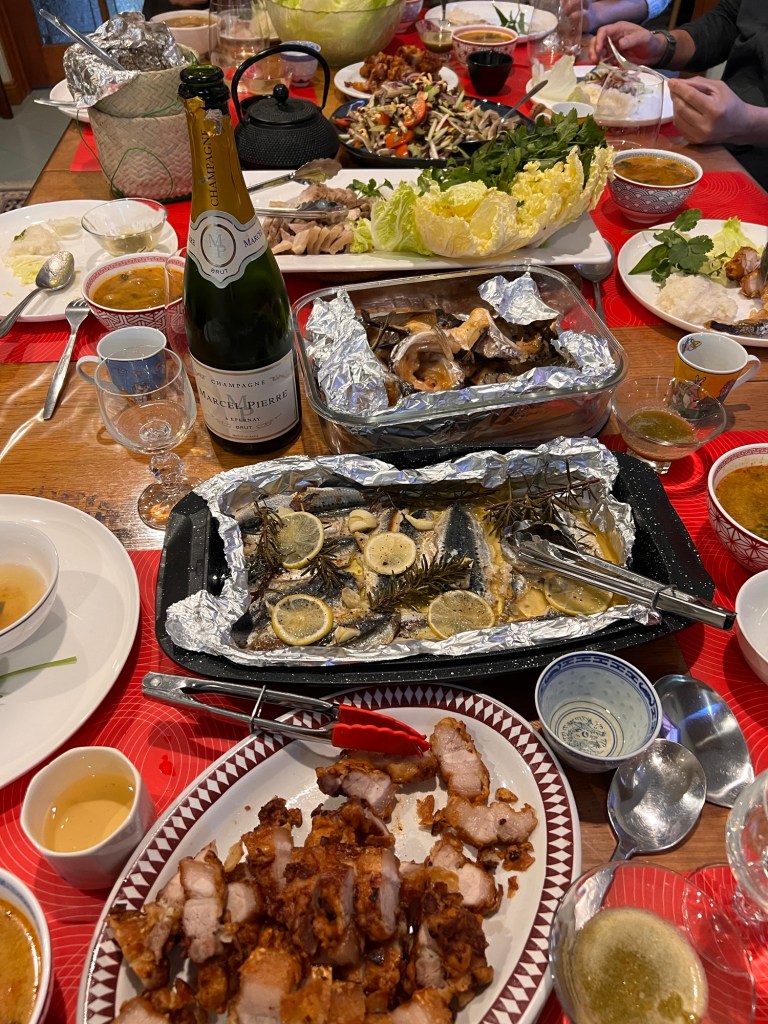
A typical Sunday lunch party for Ma
A pre-dinner pampering, a foot bath and a bowl of steaming hot chicken essence.

Pronounce the Pronouns

The old man was busy in the kitchen when I dropped by his house. It was already lunchtime and my stomach was growling. So, my face lit up when he said he was about to make himself a small bite to eat. But, like the grumpy host that he was, he did not offer me anything except tea or coffee.

“Coffee ,thanks,” I replied, but did not bother to tell him whether it was black or white, long or short. He ought to know, I informed myself.

It turned out he was preparing just a meagre bowl of rolled oats and Greek yoghurt laced with fruits, seeds and nuts. That was breakfast for him at lunchtime. People who practise intermittent fasting have a boring existence, I decided.

As he was waiting for his oats to cook in the milk, he showed me the Twitter message by Elon Musk that he was reading on his phone. He appeared dull and sleepy, as if he had another sleepless night. His bad breath was over-powering, forcing me to take two steps back. It was his Mrs who taught him brushing his teeth first thing in the morning was a waste of time and effort, since he hadn’t eaten anything since cleaning them the night before. He seemed foolish or maybe it was weakness to just do whatever she said. I remember thinking of him as uxorious in his younger years.

Leave him be, there’s no need to judge him, I reminded myself. Instead, I told him his late night discussions with his friends about the merits and properties of Bitcoin ought to stop. Anyone with a busy mind during bedtime only lend themselves a bad sleep.

“And we all know the lack of restorative sleep will only lead to memory loss and bad health,” I said, judging the old man poorly for his foolishness.

He ignored me and continued to look at the milk boil. He groaned at the tub of Farmers Union Greek yohurt as he took it out of the fridge. The lightness of the tub meant it was near empty, so he was soon scraping away at its sides and bottom for the last blobs of the white stuff. I did not dare tell him he had forgotten to make my coffee.

So, I returned to Elon Musk’s message.

“Whether or not you agree with using someone’s preferred pronouns, not doing so is at most rude and certainly breaks no laws. I should note that I do personally use someone’s preferred pronouns, just as I use someone’s preferred name, simply from the standpoint of good manners. However, for the same reason, I object to rude behavior, ostracism or threats of violence if the wrong pronoun or name is used.”

“I feel like having a cup of coffee, so I’ll make myself one, ok?” I asked the old man as I watched him shovel a spoonful of oats into his mouth. His body was there in the room but his mind wasn’t, or maybe he didn’t hear me. His mouth reminded me of my old grandma’s. Seemingly edentulous, sunken and wrinkled and therefore deformed, his mouth moved slowly like a brown mollusc missing its shell as he laboured to chew and swallow the food.

When I returned to the table with my coffee, his bowl was still almost full. A slow eater like his hundred-year-old mother, he appeared wasteful of the morning that had just turned into an afternoon.

He looked up at me with a frown and said he had mulled over the issue of misgendering a person for quite a long while and when he was reading Elon Musk’s pronouncement about pronouns the day before, his attention had perked up enough to awaken him from the state of stupor the extreme summer heat had reduced him to. Adelaide’s notorious hot spell had lingered for too many days and the smaller than normal crowds at the WOMADelaide festival 2024 was probably the outcome of it. The old man bristled at the suggestion that final numbers would prove the festival to be another big success.

“Expecting hordes of people enjoying music, arts and dance outdoors would be expecting people to enjoy being roasted in a hot oven,” he said.

“The other reason for the smaller crowds was due to a boycott for cancelling the concert of a Palestinian dance group,” he told me. Event organisers had become too political, and much too often, sided with the woke narratives spun by the west. Anti-genocide or anti-zionist protests and anti-war movements were too conveniently labeled as antisemitism or Pro-Russian stooges. Traditional understanding of biology had been thrown out the window. A girl born with a uterus could become a man if she said so. “Sorry, I meant if he said so,” he continued, but his apology was not genuine. A boy born with a penis could demand that it be cut off, no, not just the foreskin, the whole long thing. A boy with balls in his scrotum could become a woman if he said so.

“Sorry, I meant in her scrotum and if she said so,” he said sarcastically, the venom in his voice deterred me from arguing.

WOMADelaide, wo, so mad.

“So, be careful and pronounce your pronouns carefully,” he said. I knew he was deeply serious about this issue and was disturbed by this new movement that had government support to carry it to all levels of education including primary schools.

“The world has gone topsy-turvy,” I surmised. “Why should we care what people say anyway, right?” I asked.

If the person has a womb but wants to call herself a man and demands that we use ‘he’, ‘him’ and ‘himself’ when talking about her, then why argue with the woman? Just go with the flow. But, the old man would not have that. “It’s English and it’s biology!” he protested. Many are now so afraid of being accused of misgendering a person that they are using ‘them’, ‘they’ ‘it’ to address a single person.

“Being gender neutral isn’t being neutral,” he said.

I kept silent hoping the dark cloud above him would blow away. But, he kept ranting but I refused to become my truculent self that moment.

“You’ve already taken the side of the ridiculous when you use ‘he’ on a person born with a vagina and uterus.”

I fidgeted and switched my weight to my left bum instead. Sipping the last drop of coffee from my cup, I suggested it was all a waste of energy to discuss something of no importance.

“Who cares?” I asked. If they want to be called whatever, leave them to it.

“So, if the dickhead has a dick, why should we call him ‘she’ just because he says so?” the old man persisted, behaving like a mad dog biting on a bone and would not let go. His arms akimbo, he appeared ready for a long debate.

“And then, there are those who claim to be ‘non-binary’. What’s non-binary? I had to ask Google,” he raged.

I gnashed a reluctant smile but had to agree with him on this one. How can a person be neither male or female? So mixed-up that they feel they have mixed genders or no gender at all, and then there are those so obese that they lack a neck to speak of, yet if described as fat, they would be quick to be offended.

“Never mind, a rotting piece of wood cannot be carved,” I said, hoping he would be pacified.

“Would you like tea or coffee?” he absent-mindedly asked.

Nothing is more hostile to a firm grasp of knowledge than self-deception.

Diogenes Laertius, Lives of the Eminent Philosophers, 7.23