Concentrate, It’s a Concentrate

Summer arrived late. Everyone had already left – the house was once again quiet and the mood dismal, its elderly occupants dull and sullen. The garden, although still green, was becoming tatty and untidy, providing clear evidence of a recent storm. A dead branch still hung from the old oak tree, too high up and too awkward to reach and so, the old man of the house simply pretended that the cataracts that dulled his eyes had accelerated his blindness. I envisaged his impaired vision would be used again and again, as a wonderful defence against claims, if any, of laziness in the garden and poor house-keeping. He had told their visitors it was a recent storm but his definition of recent was measured in months rather than minutes or hours and so, the visitors had gone along with the idea that he had not the time yet to clean the mess up. The sun had become unforgiving again. A lapse in concentration the other day meant the near-death of a banana plant. Banana plants, fast-growing and spectacular in the tropics, needed special care in Adelaide. Earlier attempts at growing them had failed but the elderly couple was gifted a couple of plants from their Sri Lankan neighbours behind their land in early spring.

“It’s easy, just water them,” the kind wrinkled woman from Colombo said.

The old man’s Mrs simply echoed her.

“It’s easy, just water them,” she said to the old man who was unstacking dishes from the dishwasher, as she segued her way out of the new responsibility. It wasn’t many weeks later before they began arguing about who planted the banana plant near the wall.

“Of course, I did,” the old man said. He justified that with his knowledge that to survive Adelaide’s cold winters, growing next to a stone wall would give the plant a fighting chance. But, his Mrs merely bit her lips and bided her time until they were both outside in the yard the following day. She merely pointed to where the banana plant was to smugly show her victory.

“Silly woman,” the old man mumbled to himself.

Only she would be so silly to plant it away from the wall.

The days had turned hot but it was atypically humid, so much so that the old man began to wash his hair more frequently but still not daily as instructed by his wife. He began changing his clothes daily though, an instruction that was not given, since it was her role to wash their clothes.

“Why don’t you just cut your hair?” she barged into his study and demanded for the umpteenth time. She was almost in tears, tearing and pulling stubborn long hair caught up in the rollers of their Xiaomi robot vacuum cleaner.

“They are stuck!” she cried, filling her whimpering voice with desperation and hopelessness.

“Leave it to me. I’ll fix it,” he said, reluctantly peeling his eyes from his laptop.

“I don’t want you to fix it! I want you to cut your hair!” she cried again but this time, her voice threatening and deadly serious.

The old man relieved the roller from her hand as he marched out of his room.

“I’ll vacuum the house from now on,” he muttered, as he brushed past her.

“I don’t want you to vacuum the house! I want you to cut your hair!” she shouted, as she chased his footsteps to the garden, oblivious of the mid-afternoon heat.

The days leading up to Christmas were such a happy time. It felt so long ago and belied the fact that it wasn’t quite three weeks since they were opening their presents. They had gathered at their neighbour’s on Christmas Day. Lunch would be greatly delayed that day as everyone took their sweet time to unbox their gifts, one at a time and one person at a time. The elderly couple was without their middle son who chose to remain in Glasgow to work and not risk ruffling his new employer’s mood. A bonus for him was not measurable in monetary terms but the joy of spending a really white Christmas in his new home enthralled him. Without him, their family tradition to enjoy a panettone and sip port whilst they exchanged presents stopped. Popular Christmas songs still blared from the sound system that was minus the B&O Beolab 3 speakers which had begun to play up. Mariah Carey did not fail to make her mark with ‘All I want for Christmas is You’. They had a new addition to the family though. Their Number One son formalised his relationship with his girlfriend that year having publicly acknowledged that she had moved in with him. She would be the one to masterly cook up a seafood barbeque in Thai style, with his help, of course.

The neighbours had their house full of in-laws in addition to their greatest joy, a brand-new grandson who at seven months had already collected a few names – Seb, Sebastian, Bach, Boy-boy, and Ah-boy. It would not surprise anyone if he were to inherit another nickname, Baz. Bach was already showing advanced intellectual development for his age. His bright twinkling almond eyes smiled, a gift from his mum who got it from her mum, Eva. Packed neatly below a pair of lightish brown eyebrows, the shine from his eyes suggested a level of intelligence far exceeding the average. His pink smiling lips complemented the pinkish hues of his face to advertise that he was a bundle of joy, health, contentment and happiness, a result of the uncomplaining and unconditional loving care and constant attention his mother gave. Much loved and adored by all, it did not surprise that Bach got the most presents, one of which his dad could not resist and began to play with, in front of everyone. It was, however, Eva who received the most expensive gift that morning.

Sebastian at 7 months, advertising he’s a bundle of joy, health, contentment and happiness.

Eva, whose shiny black hair in a very short span of time had turned mostly white with streaks of gold, looked more Italian than Chinese in Roma, causing the minor inconvenience for the taxi driver who was told to look out for his Asian passenger. The taxi driver would fail to pick up his passengers that day. The old man had frowned on numerous occasions in Italy during their ‘recent’ three-week family holiday together whenever people commented positively about her hair. White hair made him look much older than he felt, so he was quite displeased that the opposite was true for Eva. Their numerous holiday photos proved it time and time again that he had aged too fast and made him doubt the effectiveness of the anti-ageing nicotinamide mononucleotide (NMN) tablets he had been taking for many years.

Eva’s nephew from Singapore beamed a wide smile that showed off a deep dimple as he gave her a long hug and handed her a nicely wrapped gift. Intricately gift-wrapped, one would have ordinarily dismissed it as a gift with an expensive exterior but an ordinary interior, which may be the reason why he quickly explained what it was. The small bottle of La Mer’s The Concentrate is a potent barrier serum for skin coupled with extra antioxidant power.

“Wow! It’s too expensive!” Eva exclaimed, visibly pleased with the elixir of youth that will enhance the health of her skin. She had switched off her ears as her nephew rattled on its benefits like a professional skin-care specialist. He called her Yiyi or aunty from the maternal side.

“Yiyi, concentrate, it’s a concentrate,” he said.

“Yiyi already looks too young for her age,” the old man said softly, and gritted his teeth, ruing his ill-discipline in front of everyone.

“Yeah, what’s your secret, sis?” Eva’s older sibling asked.

“Concentrate, it’s the concentrate of chicken essence I have been giving her,” Eva’s husband said.

James, Eva’s hubby, was as convincing as their nephew in rattling off the benefits of chicken essence.

“It’s not just the collagen she gets; she doesn’t suffer from fatigue anymore! Look, look at the skin on her arm. Look at how it has repaired itself – the scar from the ‘scolding’ has virtually disappeared,” James said enthusiastically, unaware his Malaysian accent of the word ‘scalding’ had briefly befuddled the old man. He then proceeded to demonstrate the method of extracting the chicken concentrate from a video he took in KL of the ‘Khind’ electric double boiler in action. He was so impressed with the wonderful pot he emptied the shop of that product and ordered some more for his relatives and friends.

The old man looked bewildered at the party. The enthusiasm in the room about youthfulness juxtaposed awkwardly with his disregard for his own wellbeing. Grey and hunched, he had shocked himself the morning before when he could not even do a plank push-up properly.

“Squeeze your buttocks, ba! Tuck in your pelvic muscles,” his youngest son said.

“I can’t find them, son!” the old man yelled back.

“See, just gyrate them,” the younger man demonstrated slowly.

The old man tried to mimic the action, but badly, showing his incompetence in gyrating his lower groin area, the inability quite likely due to a prolonged lack of sexual activity.

A few days after the embarrassing episode, the old man’s eldest son suggested to his dad he should consider taking creatine monohydrate.

“Ba, concentrate, it’s a concentrate,” Number One son said.

Creatine is a natural supplement used to improve physical performance. Our muscle cells will produce more energy. During exercise, adenosine triphosphate (ATP) is used up to produce energy. Creatine supplements help boost ATP levels and encourage muscle growth.

“It should also boost brain power, help blood sugar control and fight certain neurological diseases,” he added.

https://www.healthline.com/nutrition/creatine-exercise-performance#how-to-supplement

But, the old man’s head had turned away towards the French doors that showcased a small pond with a trickling waterfall surrounded by an array of green foliage. There was a distant look in his eyes that often were scanning to recognise every individual koi. Deep in his own thoughts, he was a world away from his son. He was not listening to, much less concentrating on what was being said about creatine. Troubled by the troubles in Gaza, he simply wished for peace. Later that day, he wrote a message to his ex-schoolmates after being told by one of them that many did not agree with his views about the ongoing conflict between the Zionist regime and the Palestinians who once represented 90% of the population in Palestine, a time before the Balfour Declaration and The Contradictory Promises. The following night, he showed me this version of his message to his friends.

“I am intrigued to witness this alternative world. A world in which my friends support an occupying force with genocidal intent on a people that the state drove away from their homes, segregated them in an open-air prison for decades and deprived most of them of a chance to leave or enjoy the simple pleasures we often take for granted, like taking a short holiday overseas or enjoying a long shower or having enough to eat.

A world in which the aggressors are deemed right to exact inhumane conditions on the populace and when the long-suffering people rise up and resist or rebel, they are accused of seeking vengeance or revenge on their oppressors. A world in which the occupying force can simply bomb the people they call ‘human animals’ and their homes, universities and hospitals to smithereens and proclaim they have the right to do so and my friends do not only agree with this heinous crime against humanity but also support the oppressors’ claim that the shocking death toll was due to the evil freedom fighters’ ploy to use their people as human shields, people that can’t or won’t, (it doesn’t matter which) leave their sanctuaries within a barbed-wire fence guarded and controlled by one of the most well-armed force in the world.

My dear friends, how can we support a regime that has proclaimed their intention to erase the people and erase all memories of them, to demolish everything and exterminate everyone? How can we agree that there is no ‘uninvolved civilian’, that every citizen of Gaza is an enemy of Israel?

There is no sympathy for the traumatised and the hungry experiencing catastrophic famine, and the diseased, deprived of medical help because most health infrastructure is destroyed and the desperate who have lost their loved ones and their homes. There is no thought of the wretched souls who willingly followed the oppressors’ command to vacate to a designated ‘safe zone’ only to be murdered by a rain of missiles. There is little or no sympathy for the wretchedness that these people have endured all their lives under this very long occupation.

What Hamas did was, of course, vile and wrong. In attacking their occupiers, they knew there would be a swift and ruthless retaliation. Their people would die by the tens of thousands. Yet, that is what they did. Out of desperation? Recklessness? Evil intent? Revenge? I do not know why but they showed stupidity and foolishness.

This world is indeed a sad world. We, urghhlings, can do better. We can at least cry for the dead and the wounded and cry out for an immediate ceasefire instead of judging and pointing fingers. We can at least speak up for the oppressed rather than support the oppressors. I feel compelled to share my thoughts here, to speak for the dead who are forever silenced.”

Peace to all mankind is as unreachable as walking to the moon.

Wu Yonggang

Phew, So Few.

The old man’s eyes looked sad. Oftentimes, he wore an expressionless face with shifty and slanty eyes that made him unattractive. It could be said his voice was monotonous and stodgy. The content of his conversation was usually out of topic or delivered late, after others had switched to other matters of interest. It hinted of a rather slow thinker, perhaps. I have observed him for a long time and my conclusion, made recently, was that he was a gangly awkward fellow who was prone to trip himself with his own foot. At the optometrist a few days ago, he found his hooded eyes hugely embarrassing when the young and gorgeous-looking woman had to lift and spread apart the excess skin from above and below his eyes in order to examine them. The angry tips of his eyebrows were turning white and faint, as if they were being slowly erased by time. His hair, once thick and wiry, had turned hoary and dry. They hung well past his shoulders, somewhat accentuated with faint wavy curls. The receding hairline used to worry him but with each passing year, there was growing acceptance that his ageing process could no longer be slowed, despite cutting-edge science that promises ageing can be reversed. Looking at the creases on his forehead triggered in my mind a word association with an iron. There had to be a way of smoothing them, surely.

入门休问荣枯事,观着容颜便得知。

One look at a man’s face tells you whether he’s prospering or suffering

Shi Naian, Shuihu Zhuan, Chapter 24

He told me about an incident he experienced many weeks ago. The winter had been long and severe and the sunbeams had failed to break through the clouds for days. But, that day the sun decided to work a bit harder and chased away the freezing winds from the south. The azure sky was still and constant, as the rain clouds floated away like butterflies in the sky. He was walking his dog in a field adjacent to a reserve when he came across a family of noisy parakeets. On that beautiful moment, he closed his eyes and listened to the wind blow. It was just a gentle whisper which did not have the energy to free any hair from the loosely tied bun on his head. Many minutes passed before his dog returned to nudge at his legs after a game of chasey with some bigger dogs. He saw a strange halation of light at the edge of the field furthest from him when he opened his eyes. In his left eye, a short burst of floaters that behaved like bubbles released from a straw clouded his vision briefly. He quickly dismissed it from his mind after the sharp reminder seared his head warning him that such an occurrence warranted an urgent call to his eye specialist. The Greek doctor whose rather long name was impossible to remember let alone spell had warned the old man that sudden floaters in his left eye could indicate that the retinal tear had worsened. He hugged his dog for instant comfort and decided to inspect what had caused the halation he saw earlier.

At the edge of the reserve, the old man came across a patch of ground that was in dire need of attention by the park ranger. Unkempt and thick, the long grass there seemed to summon him to draw closer. He did not let his guard down even though he knew there would be no brown snakes loitering in the middle of winter. He pretended to scare his dog with his sibilant whispers.

 “Murray, it’sssss not s-s-s-ssssafe here. Watch out for s-s-s-ssssnakessss….S-s-s-sshhhh, can you hear the hisssss? Ssh-shh-ss-s-shall you check that grass-s-s-s-sy patch there?” he said softly. 

The good thing about his dog was he’s not afraid of pretend-snakes. The other good thing about his dog was he would never treat the old man like used tissue paper. “The more you know humans, the more you love dogs,” he said to me, as if he had just invented the phrase.

Rain or shine, night or day, hungry or full, his dog loved him. A love that was as unconditional as the story of the Corinthians in the good book. 

The  dog barked enthusiastically like he had found treasure. The centre of his attention was a round dark hole in the ground. Just like his dog, the old man was on all fours as he edged his body nearer the hole. It was as big as a manhole except it was missing its round cover. Its verge had been baked hard over the years, a mixture of mud, cement and stones. A millipede sprung shut and pretended to be dead in one of the cracks as four paws rushed past it. The old man pushed his glasses firmly onto the bridge of his nose as he peered into the dark cavity.

“Hello-o-o-o, hello-o-o, hello-o-o” he said loudly, enjoying the reply of a distant echo. 

He blinked a few times to adjust his eyes to the darkness down there but he could not find the bottom. The smell of faint putrescence reminded the old man of his aquarium when it was overdue of a water change. Maybe there’s rotten vegetation down there; he hoped it wasn’t the smell of an unfortunate animal that had fallen in and made it its own burial ground. He covered his nose with a handkerchief that was scented with cheap perfume and quickly distanced himself from the odoriferous place.

The old man had many fears – of heights and of the sea. Why the sea? Simply because, being a poor swimmer, his biggest phobia was to die like Jack, in The Titanic. For years and years, he refused to entertain the idea of going on a cruise until the year when he won a free holiday to Alaska. He never liked it but his excuse was that he missed out on watching the FIFA Wold Cup that year. The Americans did not care to screen any live matches on the boat.

It caused him great anxiety even to drive up Greenhill Road to the charming hill towns nestled in places like Summertown, Piccadilly and Hahndorf. Strangely, he loved to use the enduring nature of the sea and the hills and their predictability when he was a young teenage boy writing love letters to his girlfriend(s).

My darling, I miss you so much.

The autumn leaves may be dying outside but in my heart, my love for you is an eternal spring. The hills are alive with the sound of your sweet voice. I shall hold you close, and never ever let you go. You do know, don’t you, that you will forever melt my heart, my darling and I will be forever yours. My love for you is like the sea, always returning to the shore. It is impossible, my darling, to stop thinking of you. You’re the pearl of my life and I am your oyster, my darling, I will keep you safe in my arms, like the oyster’s shell does for its pearl. Darling, you’re the whole world to me.

Wu Yonggang

What he did not realise was it was already sung many years earlier by Perry Como.

Can the ocean keep from rushin’ to the shore?

It’s just impossible

If I had you, could I ever want for more?

It’s just impossible

And tomorrow

Should ya ask me for the world

Somehow I’d get it

I would sell my very soul and not regret it

For to live without your love

It’s just impossible

Perry Como

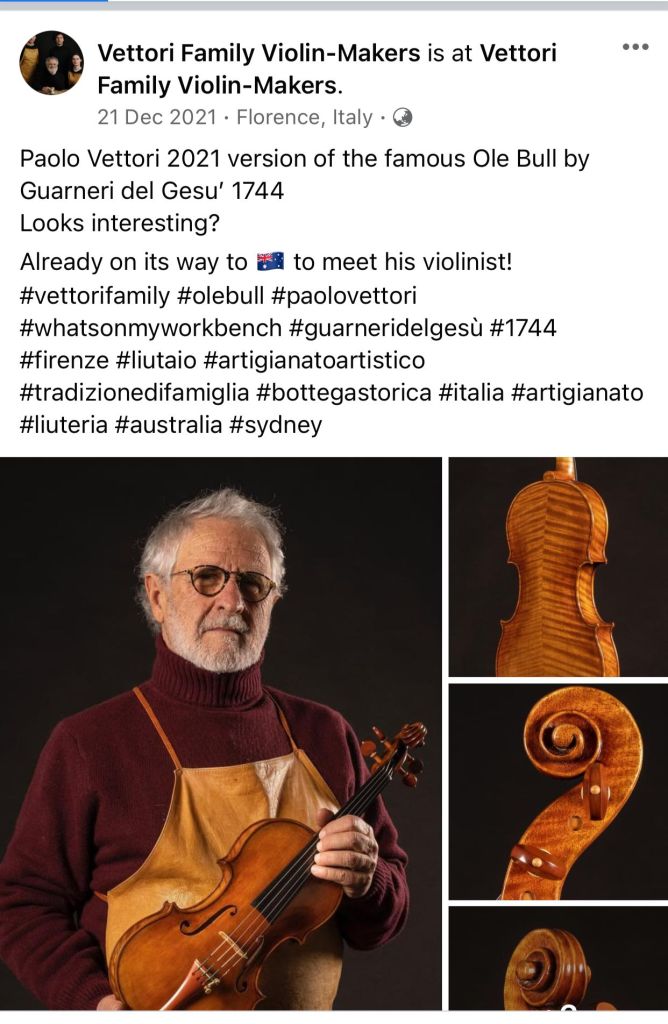
The old man had not had his eyes checked during the two and a half years of the pandemic. He could tell he needed new glasses once the black notes on his music sheets started moving like active tadpoles. Not long ago, he bought a beautiful violin, one that was made specially for him in Florence. As if he deserved better, he also bought a fine well-balanced violin bow that weighed 60 grams from Pierre Guillaume, a famous modern maker. To complete him as a serious player, his youngest son gave him a highly desirable case, which he nicknamed ‘Storm Trooper’, the reason would be quite obvious once you see it. I did not have the heart to tell the old man that to be a serious player, it needed much more than those things he showed me. He seemed to have drifted somewhere far away in his mind, so I dragged him back with a loud voice.

“Come, play me something nice,” I said.

He walked closer to where I was sitting. I could smell him; he had not changed his clothes for two weeks, I could tell. They were the same tan-coloured trousers, the same black turtle-necked long-sleeved skivvy, the same black thick jacket from Target that was rain-soaked days earlier. He picked up his violin, showing pure love for it with his careful tender touch, and took an eternity to tune it.

“Practice. Practice makes perfect,” I said, scratching my left ear with my forefinger, after I heard his Ave Maria, Meditation by Bach. He was tuning his violin again, not because any of the pegs had slipped, but the sounds were a good filler for the awkward silence.

After he had re-tuned his violin back to its previous pitch, he confessed he had been practising the piece for many months. I refrained from uttering a single word to hide my disappointment in his slow progress.

After a long pause, I said, “Perfect practice makes perfect.”

He winced, betraying his expressionless face.

Paolo Vettori, maker of the old man’s violin.
Take a bow, Pierre Guillaume!
The old man’s violin case, an Accord.

The young and gorgeous-looking optometrist in Norwood had a huge dazzling diamond ring on her wedding ring finger. Not many professions these days allow such close proximity between two consenting adults in a small and dark room, the old man thought to himself. She had a very attractive face and a rather alluring voice. Her long black hair had an extra shine and it smelled good, of Argan oil, the old man decided. But, she kept the old man busy, and diverted his eyes to the machine instead. Unkindly, she kept asking him to read letters and numbers so distant they seemed to be on another planet. “Which is clearer, this or this?” she kept asking him different combinations. The more she showed him, the more confused he became and the more muddled his answers were. After scanning his eyes for cataracts and glaucoma, she gave out a nervous sigh.

“Oooh, hmmmm.”

“Is there a problem?” the old man asked.

“How long ago did you say you had the retinal tear?”

“Oh, maybe eight to ten years ago.”

“I will make an appointment for you to see the eye specialist in North Adelaide. You must call him on Monday,” she said.

Monday arrived but the old man promptly forgot to call his eye doctor. No matter, he got a call from the eye clinic instead.

“Please remember to arrive early; your appointment is at 11.30 today,” a woman said over the phone.

“What, why? Mondays are very busy days for me,” the old man said, as he tried to wriggle out of the appointment.

“The doctor has very kindly squeezed you in today despite the seventy consults he already has,” the voice on the phone sounded firm and final.

“Ok, ok. How long will it take? Can I drive back within the hour?”

“No sir. You will need someone to drive you home. He has allowed time to carry out the operation today.”

“Operation?! What operation?” “I am not going to agree to an operation! I can see!” the old man protested anxiously.

His Mrs rushed in from some corner, hitherto unnoticed. “You scaredy-cat! I will be very very angry at you if you cancel the operation!”

“Angry at me? These are my eyes!” the old man said with disdain.

North Adelaide was just a twenty minute car ride away on a late Monday morning. The eye specialist was dressed quite sloppily. “Successful people need not dress up for anyone, it seems these days,” the old man said to his wife later on their way home. The eye doctor only made his appearance towards the last minutes of the consultation of which he would have claimed full professional fees for all the work carried out by his nurses. In his notes, much of it griffonage, he wrote that the old man had a ‘very impressive” ERM in his left eye and despite that, was maintaining excellent vision with no symptoms. In layman terms, ‘impressive’ meant significant. ERM was shorthand for epiretinal membrane. The wrinkling of his retina was so severe it would normally have meant a seriously blurred and distorted vision.

“His HST is fully operculated,” the doctor’s notes read, meaning the horseshoe tear is advanced to the state where the separated flap of the retinal surface is suspended but the body appeared to have healed itself such that it seemed unlikely that it would allow fluid to seep behind the retina. The doctor was amazed by the incredible image on his screen. He wore a bemused look and with an air of incredibility in his voice said, “I have never seen such an astonishing recovery! You should be blind!” Very very few cases escape without any issues given such significant distortions and unevenness of the ERM.

“Phew, so few?” the old man said whilst thanking the gods for his good luck.

“I could have told him it was due to the NAD+ I have been taking for the past three years,” the old man said.

Mad About NAD

Pa was bed-bound for the last two years of his life. That was something he dreaded when he became wheel-chair bound. He did not want to contemplate life without the freedom to move independently. The idea revulsed him so much that he uncharacteristically shared his feelings with me. Patriarchs of his generation only barked orders and assumed total control of their families. Patriarchs would never share their worries openly and they certainly would not reveal any hint of anxiousness to their children. When they said “one, it is one” (yi jiu se yi) and “two means two” (er jiu se er), they meant there weren’t other ideas to be entertained. They were decisive men whose tolerance for nonsense and tardiness was zilch. Pa was a gentle patriarch – he got his way with kindness and persuasion, never once was I belted or roared at. Roar he could – I heard him. The neighbours along the 12 terrace shop-houses from 3 to 3K Penang Road would have heard him too. Perhaps too often, Pa and Ma engaged in shouting matches. He had an unfair advantage. He was a lot louder than Ma – after all, his lungs were designed for him to perform the lead role as Zhuge Liang in amateur productions of Three Kingdoms in Peking opera. So, I knew he could sing and dance but I never saw him do any martial arts. So, maybe he was not the consummate performer. There was an old Er Hu in the house but Ma many years later told me he was a lousy student.

But, I know not to take the assessment of a wife seriously. My own, The Mrs once blocked her ears with her index fingers when I played my violin to her. She asked to be serenaded. I thought my version of Monti’s Czardas was pretty good, considering I had not touched my violin for some three years when I first met her in Sydney. That was the first and last time I bothered to serenade her. It was also the first and last time she asked for a performance below her balcony window. I used to bring Pa and Ma home on Tuesday afternoons. He would spend the few hours watching or listening to old recordings of my sons’ concerts. His favourite VHS tape was the one by ABC Classic FM. That was a recording of four soloists in different instruments, competing to be the winner of a national competition in Australia. His grandson’s performance with the Sydney Symphony Orchestra was so good he won. A huge win, really. One of the prizes included concerto concert opportunities in Shanghai and Beijing. They never eventuated and it made us forever cynical about prizes from Chinese corporations.

Never mind, Pa said the boy and his brother were going to be world famous. A grand-dad has every right to be super proud of his grandsons. I chose not to debate him on how remote the possibility was of that happening. I wouldn’t have won the argument anyway. Once the patriarch’s mind was made up, only the matriarch’s could change it. Besides, his George Peppard good looks were passed on to the grandsons and that X-factor would surely take their fame further than anyone could envisage. I imagine he might have harboured that thought. I do not remember what Ma did when she was here on those many Tuesdays. Perhaps auditing the fridge and freezer, and examining the stock in our pantry for prices and use-by dates. The Mrs would cook extra sumptuous meals on Tuesdays. We could see how much Pa enjoyed his meals with us. He would sit himself at the dining table and drum his fingers softly on it and before too long, dish after dish would magically appear in a train-like manner in front of him. Their visits continued even after Pa was moved into a nursing home. Nursing home food would be one good reason for anyone to want to shorten their life. Everything was mashed and presented like Neapolitan ice cream in three big round scoops but that was where the similarity ended. They only looked delicious but they tasted bland and fake – green was supposedly blended broccoli, vanilla was actually made from powdered potatoes, and the insipid orange was purportedly pumpkin. Ma the slow-eater would take far too long to start her dinner for Pa to wait. Ma was always busy in the background – I never figured out what kept her so occupied.

After all, as a dinner guest, there was nothing expected of her except to relax and enjoy the meal. It was a customary practice of hers to have the sudden need to use the washroom when everyone was seated at the dining table. By the time she re-appeared, Pa would have finished his meal. Often, Pa would ask to be driven back to the nursing home before Ma had even taken her seat at the dining table. They were the first odd couple I knew. Pa was “fast hand fast leg” (khwai shou khwai jiao) quick to attend to matters whereas Ma would treat everything like an embroidery that required extreme attention and finesse. You could tell Pa was from equatorial Asia the way he used water from the tap like the rain would never stop whereas you would think Ma dry-cleaned her vegetables and pots at the kitchen sink. You would never hear the sound of falling water from her faucet. I cherished the Tuesday night rides with Pa back to his nursing home – it was just him and me. It reminded me of our day trips to Sg Petani to inspect his rubber plantations when I was a wee boy. I did not just drop him off at the door and return home to resume my dinner. That wouldn’t be right. Instead, I would make sure he was safely tucked in his bed, after a good wipe-down with a warm towel. Helping him with his dental hygiene required me to brush his dentures thoroughly. Difficult as it was in transferring his bulky frame from his wheelchair to my CR-V and vice versa, I never hurt my back once. I figured out the safest way was to help him lift himself off the wheelchair and sit him on my right thigh and then use it as a springboard for him to transfer his weight onto the front passenger seat.

On Goldilocks mornings when the weather was perfectly fine – not too sunny and not too humid, and the breeze was just right – not too strong and not too cool, it was not uncommon to see an Asian man in his early forties pushing his heavy-set dad in a wheelchair to a Chinese restaurant a few hundred meters away from St Basil’s nursing home in St Peters for lunch. We knew every inch of the side streets and avoided the ones that needed repairs and those with speed humps. One Tuesday night, on the way back to his nursing home, Pa told me to help him end his life should he be bed-ridden eventually. Euthanasia was illegal in those days but Pa was always ahead of the curve. He said he wouldn’t tell if I didn’t tell. No one needed to know but I did not know the tricks to hide such a crime. I was not ignorant of Dr Death, Philip Nitschke who founded Exit International. He has legally assisted terminally ill people to end their lives but even today, it is still illegal to assist someone to die with dignity in South Australia. We can only rely on Common Law to grant a competent adult under an enduring power of attorney to authorise a specified adult to refuse life-sustaining medical treatment should the principal become incompetent. I should have said much more to Pa but all I said was he would be looked after.

It was about two years before it was eventually too difficult for him to use his wheelchair. I cried inside when I first saw them dispatching him from his bed to a wheel bed using a mechanical lifter. He was hoisted in a sling like how a sedated rhinoceros was dropped onto a lorry in a David Attenborough documentary. But, the ignominy of being hoisted like a sack of rice was a small price to pay. He told me it did not hurt him to be strapped tight although it would have hurt his pride. It did not stop us from our usual Tuesday outings. Instead, he travelled in a Des’ minibus taxi on his special wheel bed. Unfortunately, Des’ punctuality was often lacking and the extent of their lateness was always measurable by the decibels of Pa’s banging on the table with his hands. I miss those times terribly. They were not menial tasks I had to do for Pa or awkward back-breaking manoeuvres to move or sit him comfortably. They were opportunities to spend precious time with him and privileges for me to show my love for him. I still miss him. Today is the 13th anniversary of his departure from this world. It happens to be Good Friday – the Christian world remembers the death of their saviour. I will remember the sacrifices Pa made for us.

Ever since I read about David Sinclair and Stephen Wu’s research into NAD, I have been mad about NAD. I must admit I have yet to read Dr Sinclair’s book, Lifespan. It was on Joe Rogan’s programme that I first heard about his idea that ageing is a disease. More importantly, that the disease is treatable! That is right, it made me sit up and take notice. What he meant was one day we will not have to age. He wasn’t talking about extending our lifespan per se, but actually extending our health lifespan. Now, that makes sense, right? Who wants to live longer, unless we live healthily for longer. As I was listening intently to Dr Sinclair, I could not help but allow Pa to come into my thoughts. It was too late for me to share with Pa about IF, intermittent fasting and how that could have reversed the early onset of Type 2 diabetes when he turned 60. It was also too late for me to share with Pa about NAD and how one day that could actually be the elixir of life that grants us eternal life or eternal youth.

NAD, short for Nicotinamide adenine dinucleotide, has many roles in metabolism. It has two forms – in a chemical reaction, NAD+ accepts electrons from other molecules and becomes NADH. It is the discovery of sirtuins in 2000 that got the scientific world excited. They are a family of proteins that regulate cellular health and the implication is that sirtuins affect ageing and apoptosis. It is hoped that clinical evidence will support the theory that sirtuins can provide longevity benefits (The sirtuin SIRT6 regulates lifespan in male mice. Kanfi Y, Naiman S, Amir G, Peshti V, Zinman G, Nahum L, Bar-Joseph Z, Cohen HYNature. 2012 Feb 22; 483(7388):218-21.) Sirtuin functions have been described in the central/peripheral nerve system, cardiovascular system, immune system, liver, bone, skeletal muscles, stem cells, and tissue regeneration. They have also been associated with most major diseases, such as cardiovascular diseases, cancer, metabolic disorders, neurodegenerative diseases, arthritis, and osteoporosis, all of which are age-related. (https://www.ncbi.nlm.nih.gov/pubmed/21497775/)

Why NAD then, you may ask? Well, sirtuins can only function in the presence of NAD+. In February 2019, I wrote to David Sinclair asking him to include Ma in his clinical trials. I was surprised he wrote back, but although he and his colleague Lindsay Wu are both attached to UNSW, their clinical trials are being conducted in Boston. “Sadly, Australians can’t yet be part of it. If that changes, Lindsay or I will make an announcement publicly.” Lindsay Wu also surprisingly wrote back to say their work is still under development and would not be able to have Ma involved in their trials. “For the moment I can recommend exercise and a varied diet as the best ways to maintain healthy ageing – in particular, I believe that resistance training is useful in the elderly.” I hope these guys will make their breakthrough discovery a huge success for mankind. But, Ma does not have the luxury of time. Last year I found a product called Tru Niagen that was only sold in the US. I ordered them online but my excitement for Ma to be supplemented with NAD turned sour. Australia did not allow unapproved “drugs” to be imported. A few weeks ago, I received an email from Tru Niagen that they are now available in Australia! You should see the way I jumped with joy, yeah like in the Toyota advertisement. Two days ago, my first shipment of Tru Niagen arrived! I look forward to sharing photos of a rejuvenated Ma in the next few months. For benefits of Tru Niagen visit https://www.mypillapp.com/tru-niagen-review/