
Sydney greeted the Old Man and his Mrs with a gentle warmth, a stark contrast to the grey skies that had threatened their arrival. The air, thick with the promise of a pleasant day, hung still and inviting. The harbour turned a vibrant blue and seemed to deepen under the balmy expanse above, mirroring the optimistic shift in the weather. The heavy pregnant clouds that shadowed their descent had vanished with surprising speed, a fleeting memory that would not mar their brief sojourn in the city.
“It feels good to be back again,” he said to his Mrs who had promptly unbuckled her seat belt as the plane taxied to a halt. It was a need to break free whenever she felt restrained or suffocating in a confined space like in a car. It was therefore habitual for her to unclick her seatbelt before they even reached the driveway of their home.
Their purpose in Sydney was to celebrate the artistic achievements of her sister, who was a featured artist in a prominent exhibition. The rest of their party had arrived the previous day, and their first order of business was a leisurely lunch at Circular Quay, conveniently located a short train ride from the airport. Travelling light was their preferred mode, each of them managing with just a single piece of cabin luggage, which they cheerfully wheeled along the eastern promenade. The small rollers of their bags created a sporadic, rhythmic clicking against the paved boardwalk, a lighthearted soundtrack to their reunion.
It wasn’t long before the midday sun compelled them to seek refuge behind the oversized plastic menus offered by the harbourside restaurant. These large placards served a dual purpose, providing both shade from the intense glare and a temporary shield, allowing them a moment to defer the inevitable decision of what to order. His Mrs, perusing the offerings, voiced a distinct disapproval for a particular dish that had been suggested for another member of their party.
“It’s not about you!” he retorted, his tone sharper than perhaps intended.
She visibly recoiled, a flicker of hurt in her eyes, but chose to let the comment pass without immediate confrontation. Although she let it slide, a mental note was made, the incident carefully filed away in the vast archives of their shared history, to be retrieved and deployed at a more opportune moment. Their marriage, spanning what felt like an immeasurable length of time, had equipped them both with a well-honed arsenal of grievances, both real and imagined, ready to be deployed in future skirmishes. It was a certainty that before long, she would gently, yet firmly, steer the conversation towards the uncomfortable truths of his sometimes overbearing nature and perceived coldness, using the lunchtime remark at Circular Quay as a prime example of his shortcomings as a husband.
The other day at The Other Art Fair, the air was electric and everyone’s mood was charged with positive ions. The mood of the attendees and the artists alike was buoyant, filled with a sense of possibility. Every displayed piece of artwork held the potential for a life beyond the gallery walls, the promise of a sale hanging in the air. It was a space where optimism thrived, where life felt particularly vibrant.
The preceding evening had been marked by a fun-filled celebration, no specific occasion needed beyond the simple joy of togetherness and the appreciation of the present moment. The few among them who enjoyed wine had shared three bottles of Penfolds Bin 28, generously provided by their host, a teetotaler. While considered an entry-level offering from the world-renowned Barossa wine producer, the number 28 held a special significance in Cantonese, signifying “easy prosperity,” thus imbuing the label with an auspicious aura.
All the while though, the Old Man buried his troubled mind from spewing out into the open and kept concealed the deep undercurrent of worry and sadness. He was determined not to cast a shadow over the celebratory mood or diminish the enjoyment of his companions. News of his mother’s declining health had reached him even before his departure, but her condition had taken a significant turn for the worse. By the time his plane touched down in Sydney, one of his sisters had made the difficult decision to admit their 101-year-old mother to the Royal Adelaide Hospital, RAH to the locals. Her frail body had listed precariously to one side, her left hand frozen in an unnatural position.
The stark reality that she could no longer stand unaided had made it undeniably clear that she required professional medical attention. While a CT scan was deemed too risky for someone of her advanced age, the doctors had swiftly diagnosed a mini-stroke. The implications were clear: she could no longer be cared for in the familiar comfort of her own home. In ordinary circumstances, securing a place in a nursing home could take months, and even when one became available, a multitude of factors would need careful consideration. Would the quality of care be adequate? Would the facility be clean and well-maintained, or would it carry the unpleasant odor of neglect or worse, would the ghosts of residents long deceased still roam about the corridors? Would she be relegated to a shared room, and if so, could she comfortably coexist with a stranger around the clock? What about the essential facilities and medical equipment? Would the food be nutritious and palatable? Would they include Chinese dishes? And perhaps most importantly for her family, would the location be convenient enough for frequent visits? The one blessing was money would not be an issue. Their mother had ample saved up.
In what felt like a miraculous convergence, it seemed as though all the divine entities she had invoked in her long life had responded in unison, granting their affirmative blessings. Yet, for the Old Man’s mother, this was not the outcome she desired. The prospect of ending her days in a nursing home was deeply unsettling. After enduring the hardships of poverty, surviving the tumultuous years of the Japanese occupation, and diligently working to build a secure future for her children, she recoiled at the thought of relinquishing all that she had striven for in exchange for a small, unfamiliar room and a meager collection of personal belongings, all in one crumpled plastic bag.
They had managed to secure a spacious private room for her in a bright and welcoming facility, offering a pleasant view of a garden adjacent to an open-air parking area. The Old Man was scheduled to bring her there after his trip to Sydney, to introduce her to the concept of respite care should the need arise. Instead, her doctor at the RAH had resolved the matter for them. There would be no opportunity for her to voice her objections, no room for negotiation. The course had been set, not by her own will, but by necessity. No amount of pleading, tears, or defiant gestures, even the threatened brandishing of her walking stick (should she possess the strength), would alter the predetermined path. In the end, their formidable matriarch, who had always commanded through sheer willpower or the unwavering force of maternal love, could only accept her fate. She was now destined to tread a path that many would find profoundly disheartening – entering an unfamiliar room in an alien environment, to be cared for by strangers for the remainder of her days.
The Old Man’s return from Sydney was driven by a deep-seated need that went beyond the logistical updates provided by his siblings. He carried with him the weight of familial responsibility and a profound longing to witness firsthand his mother’s condition. The spectre of her advancing dementia loomed large in his mind, painting a grim picture of confusion, emotional turmoil, and the irrationality that often accompanies the fading of cognitive function. He braced himself for an encounter with a woman lost in the labyrinth of her own mind, a stark contrast to the vibrant matriarch he once knew. The relentless march of her dementia had accelerated with cruel speed, leaving her adrift in a sea of forgotten memories and distorted perceptions. The son who had once held a cherished place in her heart was now a stranger, a figure upon whom she inexplicably unleashed scorn and even hatred. The unfamiliarity of his aging appearance, marked by long, unkempt hair, coupled with the intimate act of bathing her during a period when his siblings were unable – only because she vigorously and viciously fought them off, triggered a profound sense of violation and resentment. In her clouded mind, he was no longer her beloved son but an intruding “Zong Sa,” a term signifying “wild born,” a label laden with unfamiliarity and perhaps a primal sense of otherness. He was a ghost of her past, a son erased by the relentless tide of the disease.
Yet, amidst this heartbreaking alienation, a flicker of recognition sparked, a momentary parting of the heavy curtains of dementia during his visit. The old man had found his long-lost mother again. Later that evening, a wave of relief and a fragile sense of hope compelled him to write to his family. The words flowed with a mixture of pain, love and profound gratitude.
‘Ahma hasn’t been this clear headed and calm for a very long time,’ he typed, his hand perhaps shaking slightly. ‘She woke up and called me by my name. That in itself is quite rare these days.’ This simple act, the utterance of his name, was a beacon in the encroaching darkness, a fleeting return to the familiar shores of their shared past.
Her subsequent question, posed in her native Ningbo dialect, “yu so beh fa?” – is there any other option? – revealed a poignant awareness, a flicker of understanding regarding her circumstances. It was a question that hinted at acceptance, or at least a resignation to her fate. He seized this brief and rare moment of lucidity, offering her words of comfort and reassurance. He painted a picture of her new reality, emphasising the positive aspects: the attentive care, the spacious and clean environment, the dedicated carers. He acknowledged the inherent suffering of life and gently lied to her that her current situation was not so bleak.
‘Life is suffering, I said but this isn’t so bad. Surrounded by her children who will visit daily. Her room was pleasantly warm. She held my hand for a long time and I pointed out she’s only in a thin garment and she isn’t even cold whereas my house was already freezing cold. Two carers came in and she said “Omitofu” to the sweet young one, who spoke a few words of Mandarin to her, probably the full extent of her vocabulary. She asked who the other one was, an Indian girl whose silhouette against the light behind her made her unrecognisable. Soon after, ahma dozed off and I could hear a soft comforting snore from her.’
The Old Man leaned closer, his voice a gentle murmur against the quiet of the room. “Ahma,” he breathed, his gaze soft as he searched her aged wan face. Her eyes, once bright and full of life, were now clouded with the passage of time and suffering, yet he looked into them with unwavering affection, hoping the simple truth he was about to impart would find its way through the jumbled walls of her memory. “Your children,” he continued, each word weighted with love, “all love you very much.” He repeated it softly, a comforting affirmation in the stillness.
A wave of tenderness washed over him as he reached out, his weathered hand carefully taking hers. He held it gently, feeling the fragility beneath his touch, remembering all the years this hand had cared for them, fed them, clothed them, guided them, comforted them. Leaning down, he pressed a soft kiss to her wrinkled forehead, a silent expression of gratitude and enduring love. As he straightened, a lump formed in his throat, a bittersweet ache of love and the inevitable. With a final, tender look, he whispered, “Goodnight, Ahma,” a promise of rest, a gentle closing of the day. He deliberately omitted the word “goodbye,” his heart unwilling to utter such a finality, clinging instead to the hope of another dawn, another lucid moment.
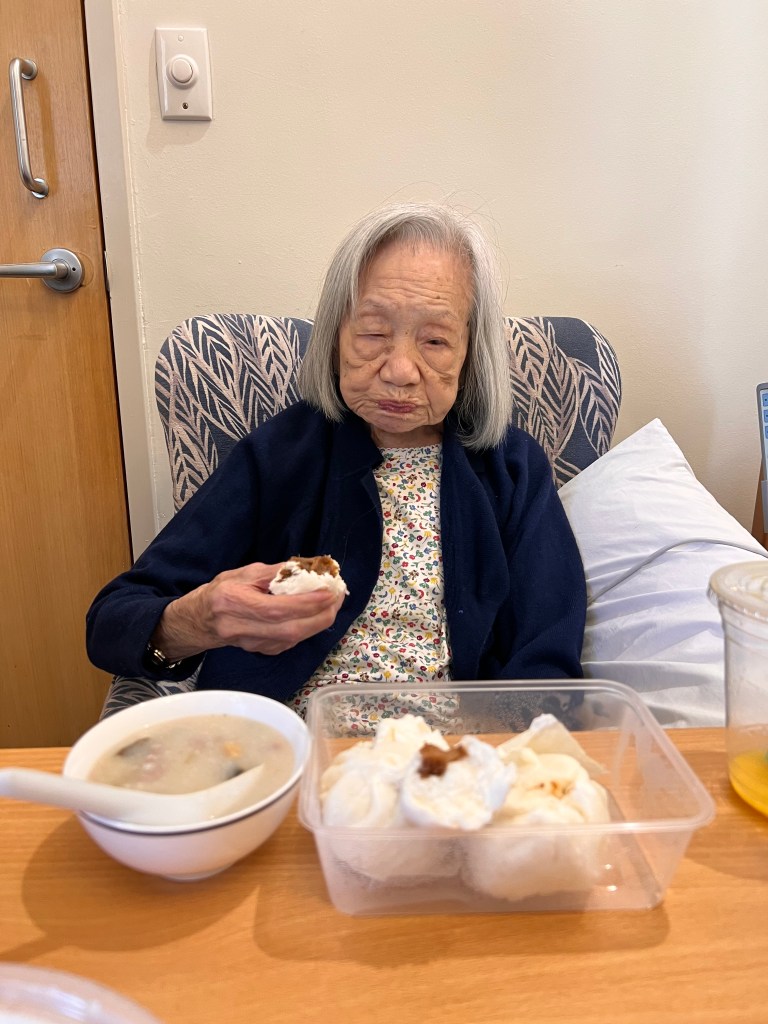
The truth was he himself would rather not live for so long, till life became meaningless and loved ones became strangers. He had arrived at a disquieting personal truth: the prospect of extreme longevity held little allure. He found himself increasingly resistant to the notion of enduring beyond a natural span, envisioning a future where the vibrant tapestry of existence faded into a dull, repetitive and meaningless pattern. The thought of time stretching endlessly before him was not a comforting vista but a desolate expanse where purpose might erode and the sharp edges of memory could blur. More poignant still was the fear of outliving those he held dear, the agonising possibility of watching familiar faces become distant, their shared histories fading into the mists of time, ultimately leaving him adrift in a world populated by strangers who once were intimates. The very essence of a meaningful life, interwoven with connection and shared experience, threatened, as it has to his mother, to unravel in such a protracted and lonely, isolating existence.
 Urghhlings