Where do I begin?
From the ending, I suppose.
My Mrs does the same whenever we sit down for a show. She rarely will watch a mini-series sequentially from the start to the end. More often than not, she will impatiently skip the early chapters and rush ahead to find out how the story ultimately ends. Will her hero survive? Will the damsel in distress be saved in the nick of time?
So, indulging that same instinct, let me get to the end first.
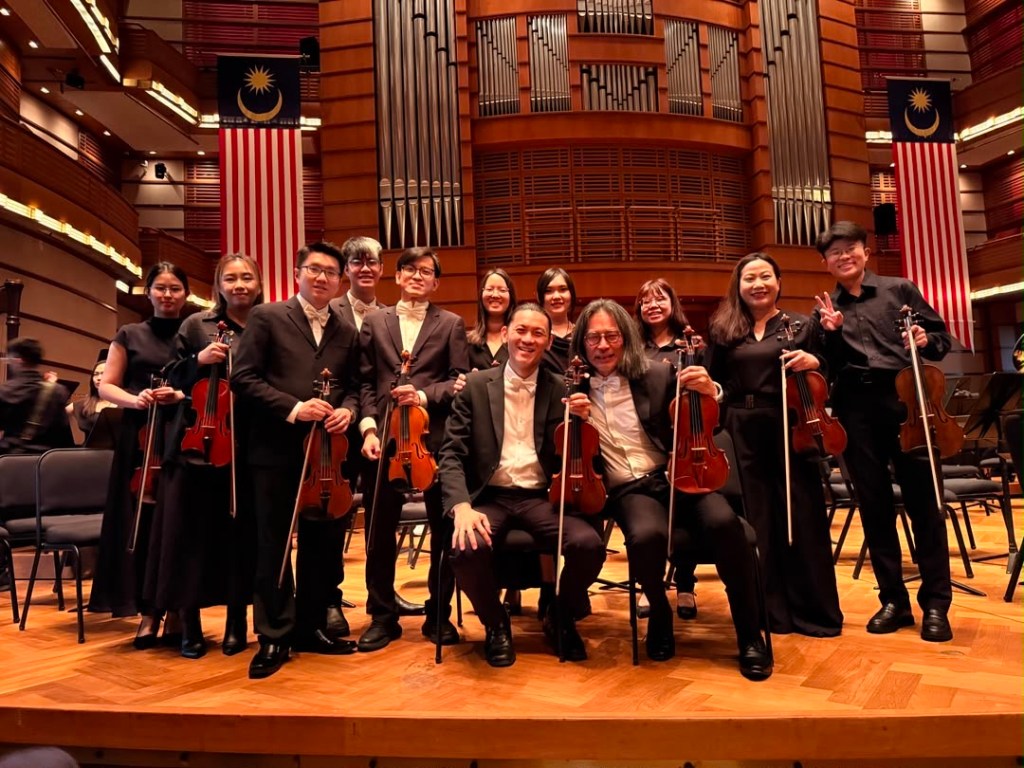
It was on a memorable Sunday afternoon. In Kuala Lumpur, Malaysia. Right at the majestic KLCC complex, to be precise. Inside the world-class Dewan Filharmonik Petronas (DFP), in fact—the prestigious home to the acclaimed Malaysian Philharmonic Orchestra.
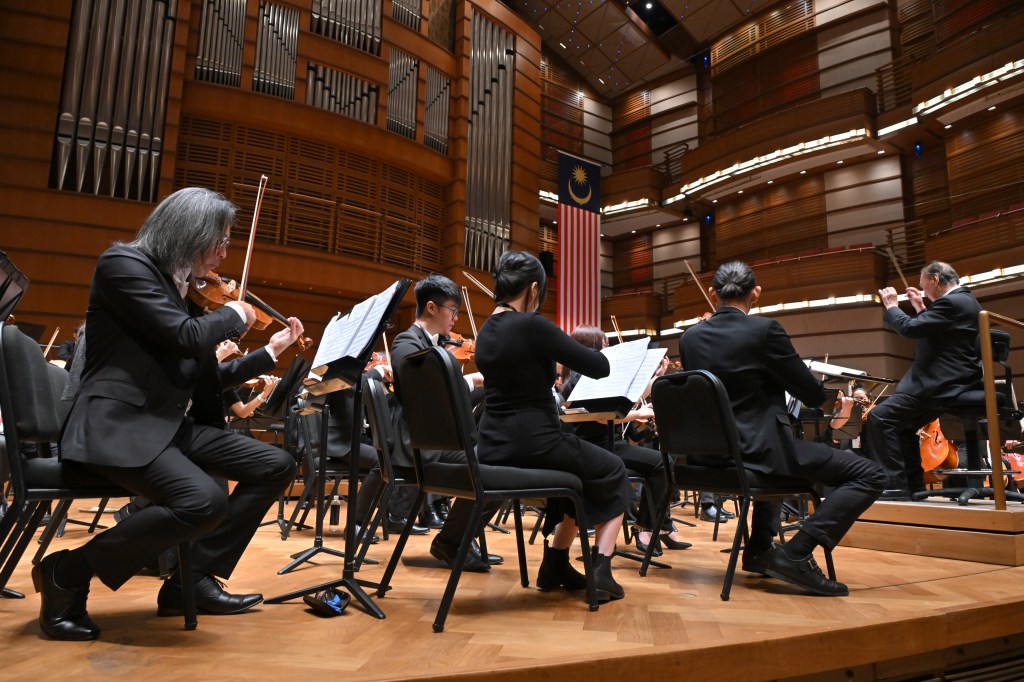
I was there, not merely taking in the performance as an anonymous audience member, but as an active performer standing on stage, no less! Standing on that magnificent stage and soaking in the overwhelming warmth of the applause in such a hallowed hall was an unforgettable experience like no other. Yet beneath the excitement and sparkle, I recall feeling somewhat disappointed in myself. I felt I had not played to the absolute best of my ability. My intonation in the Windsor Overture—the opening piece of our ambitious program—was unusually suspect, and my bowings felt frustratingly timid at times. As the applause reverberated across the tiers, I berated myself for the shaky start. Later, in the quiet, wee hours of that night, I had to gently remind myself to be kind to myself. It ought not be about my individual flaws or ego at all. The Penang Symphony Orchestra (PSO) as a whole thoroughly deserved every bit of the accolades and the thunderous applause that filled the hall that afternoon. The entire orchestra had performed amazingly well together.
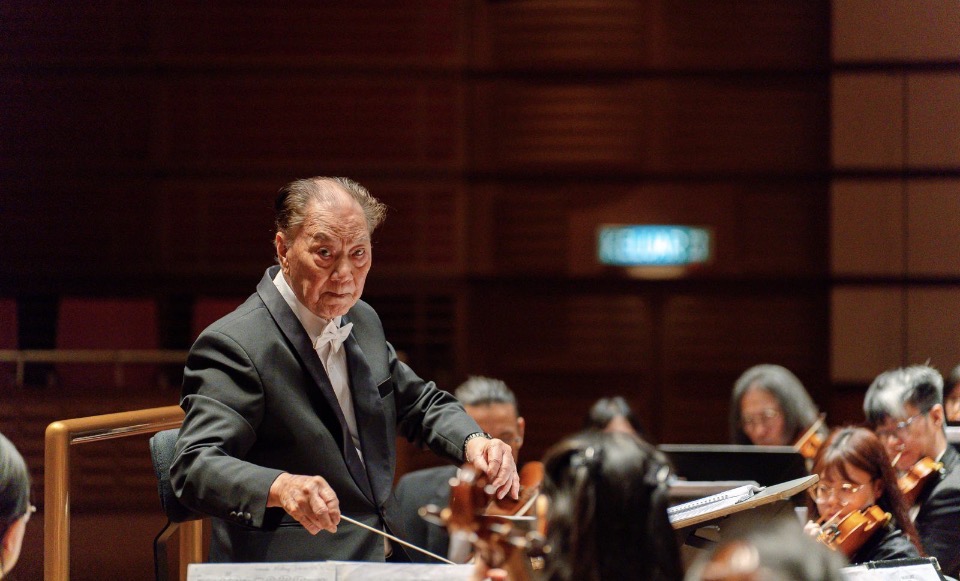
The maestro, Dato’ Woon Wen Kin, a giant in the Malaysian classical music industry, continually impressed me with his musicianship, strong leadership, and a seemingly inexhaustible supply of artistic energy and drive. Over almost six decades of dedication and drive, he had led the transformation of what was once a classical music desert into a vibrant oasis for Penang and beyond, paving the way for future generations to appreciate and cherish the timeless beauty and greatness of classical music.
“Straighten your bow,” Lee Chye Guan, our concertmaster, leaned over and urged me amidst the applause. The audience’s applause was thundering throughout the hall and showed no signs of stopping anytime soon. Unable to catch his exact words over the din, I looked back at him in complete confusion and simply shrugged my shoulders.
“Straighten your bow!” Kar Ying, standing directly in front of me as the no. 3 player, echoed over her shoulder.
I checked the bow and violin I was holding in my left hand as the audience continued with their exuberant clapping and hollering. My bow is straight, the tip pointing almost vertically at the beautiful timber floor.
“Why? My bow is straight!” said I.
“Your bow tie!” Chye Guan replied loudly.
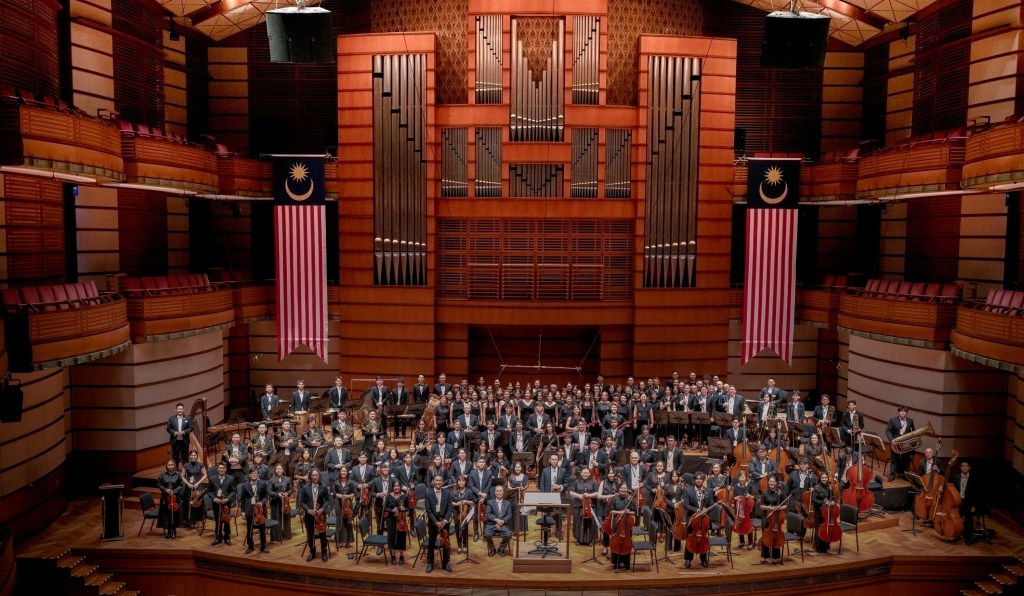
The concert started at 3pm, on 16 August 2026. I was already very tired by then. We were told to have our breakfast at 7 that morning. Two words on the time slot of our itinerary for the day caught my attention. MUST EAT. So, I ate, even though I am accustomed to fasting till noon or thereabouts. In Malaysia, do what the Malaysians do. Just go with the flow. There’s no need to stand on one’s ground, fight the good fight out of principle. Just relax, no hard and fast rules and everything will be alright.
It was kinda weird initially. Cars double parking, sometimes, even triple parking, drivers oblivious to blocking the traffic just because they have to wait for the street hawker to prepare their orders. But, no one gets flustered. Give and take, compromise, being rigid, being a stickler for rules doesn’t work in a densely populated city. Relax. All will be well. So, I ate my breakfast. Instant coffee, kaya toast and fresh fruits. A breakfast I would have declined at home, especially the instant coffee. I, a coffee snob, calmly sipped inferior coffee. It was so unlike me. But a me whom I was beginning to like. I was relaxed, easy-going and unfettered by things that would normally have made me curse. Malaysia can. Malaysia Boleh. Just smile and everything will be alright. Just a smile, I reminded myself. I was beginning to not recognise the new me. I was beginning to like the new me.
A rather likeable me. I could tell, because normally I was not. People in the orchestra treated me with genuine respect. I was a founding player, 55 years ago. A pioneer. I never thought of myself as being a pioneer of anything. But, the penny suddenly dropped. When I told my story to some of the members, someone observed that. “You’re a pioneer!” he said. So, they see me as someone who contributed, albeit a very insignificant one, to the birth of classical music life in Penang and in doing so, also helped to spread the gospel of Beethoven, Bach and Brahms et al in Malaysia.
The young members of the orchestra helped me with everything – with changes to the bowings, separate bows instead of long slurs, spiccato instead of saltando, and so on. They made sure I got my lunch and even lugged my luggage in and out of the concert hall. It was a cultural surprise. I left Penang, my birthplace, in ’77. Almost 50 years ago. I was unaware the old Asian culture was still being adopted in which the elderly are respected simply because of their age. A purity in the practice of respect I imagined that had been long abandoned by a new generation chasing a modern way of life, a materialistic society in which monetary success overshadows everything else. Strangely, although I do not see myself as elderly, I am already viewed and treated as an old man.
I was invited to go back to Penang and help celebrate the 45th anniversary of the PSO. The maestro was my violin teacher. Dato’ is a title conferred to him for his lifelong dedication to promoting classical music in Malaysia. Dato’ Woon’s voluminous achievements in the classical music genre are indeed something to be celebrated. To achieve what he has, in the era when he began, required more than mere ambition and ability. He possessed incredible passion, energy, persistence, tenacity and the art of making things happen – a charm and disarming persuasiveness to raise support and funding from philanthropy. People are creatures of habit, and so, out of habit, I shall refer to him as Mr Woon instead.
Mr Woon, his sister Nen Kin, and her best friend – my eldest sister – were flatmates in London from ’63 to ’67. The two friends attended Trinity College together. Both returned to Penang and became the premier piano teachers of their generation. They both picked the cello as their second instrument. I was instantly enthralled by the cello when I saw her return home with one on her back and declared that I wanted to learn to play the cello. My sister diverted my interest to the violin instead. She told me the cello was simply too big for me to learn. I was already nine but I believed her, not knowing then that Jacqueline du Pré began cello studies at age four! She could have told me it was quite impossible to buy a 1/4 size cello in the ’60s in Penang. Perhaps, she wanted to support Mr Woon. He too had returned to Penang, in 1968, to teach the violin and needed to quickly establish himself. The best way to do that was to find students to teach. So, I was one of his first students. I was ten when I began my lessons and about thirteen by the time I joined Penang’s first orchestra. He began as the concertmaster under the conductor, Master Chye Pak Loong.
I learned from Mr Woon till 1975. He advised me to learn German and dangled the rosy picture of me furthering my violin studies in Vienna. But, I did not enrol to study German. I guess I had made up my mind that I wasn’t good enough to be a violinist. Taking 8 years to obtain Grade 8 meant I had no prodigious talent. In 1975, I was more interested in playing football than playing the violin. I was still playing football most afternoons in my school field despite Mr Woon having arranged for me to play a violin solo in a students’ concert. I was the closing act but I did not know the importance of that. Neither was I concerned where the concert venue was. I had assumed it was just a room in some nondescript school hall. So, I continued to play football and thought nothing about the concert. When my big day came, on August 5 1975, I was horrified to be driven to the Dewan Sri Pinang, at the time, the most prestigious concert hall in Penang. “What? I’m playing in this monster of a building?!” I asked my sister, as I hesitated to leave her car.
I had attended just a single violin lesson with Brother Michael in school before quietly switching over to Mr Woon. Crucially, I had done so without ever informing the imposing white man in the flowing white robe that I was quitting his class. Right at that overwhelming moment on stage, looking out into the audience, I suddenly regretted my silence and lack of courtesy. His fierce, glaring eyes and heavily knotted, bushy white eyebrows seemed focused directly on me, churning my young conscience with guilt. Prior to my departure for Australia in 1977, a remarkably pretty Eurasian girl reached out and asked me to meet her at a mutual acquaintance’s house, where she presented me with a cassette tape containing a live recording she had personally taken of that memorable concert. She was so stunningly beautiful that I found myself completely tongue-tied, failing to even ask for her name before we parted ways. Decades later, a thoughtful sister-in-law arranged to have that fragile old recording digitised for me. Listening back to it now, for the record, my performance of Monti’s Czardas would undoubtedly have benefited from far fewer afternoon football games and a good deal more dedicated practice time.
Exactly a week prior to our high-profile DFP performance in Kuala Lumpur, the PSO performed a celebration concert in Penang, hosted inside the school hall of Aik Hua Primary School in Relau. I had extended a warm invitation to my good pal Greg to attend the show, but he instantly declined. Unlike the majority of my old cousins and schoolmates from over 50 years ago, Greg didn’t decline out of fear that he would doze off during a classical music rendition. Instead, he politely demurred because he surmised that a primary school hall equipped with badminton courts was far better suited for shuttlecocks and rackets than high-brow orchestral music.
As it turned out, Greg was completely wrong. The badminton courts unexpectedly proved to be an exceptionally fine venue for hosting the PSO’s landmark 45th anniversary celebration. The hall, despite its distinctly cheerful pink decorative motifs and utilitarian pink plastic chairs, transformed into a truly grand setting for a grand occasion. The lighting and sound production systems were modern, sophisticated, and of true professional-grade quality. From my vantage point on stage, I found the natural hall acoustics to be refreshingly clear, balanced, and honest. My only lingering wish from that night was that the stage technicians hadn’t shoved a prominent microphone directly in front of my face—a daunting sight that made me tense up with sudden nerves just seconds before we struck our first notes!
By this point, any particularly attentive reader should have picked up on an obvious chronological inconsistency regarding the timeline of this year’s anniversary celebrations. Earlier, I mentioned that I was approximately thirteen years old when I first joined the orchestra, and that I was ten years old in 1968 when I commenced formal violin lessons from Mr Woon. Following that timeline, Mr Woon’s very first ensemble would have been established around 1972—which was roughly 54 to 55 years ago. The current ensemble, the PSO, officially formed 45 years ago, is therefore not technically the exact same organisation in which I served as a founding pioneer! That earlier inaugural ensemble established by Mr Woon was known as The Penang Philharmonic Orchestra & Choir, I think. The most senior surviving original members from that historic precursor to today’s PSO are Mr Woon himself, his sister Ms Woon, and Judy Oh, who served as my very first concertmaster. Among that pioneering cohort, I believe I rank as the fourth oldest surviving member, now standing at 67 years of age.
In truth, I felt hopelessly underprepared for the demanding and expansive repertoire that Mr Woon had ambitiously programmed for these milestone concerts. Under standard, ideal circumstances, my personal practice routine demands a solid 9 to 10 weeks of focused, daily practice to properly digest, understand, and comfortably execute the intricate violin parts required for a full-length symphonic program—a lineup that typically features a brisk opening overture, a major instrumental concerto, and a grand, multi-movement romantic symphony following the intermission. For these PSO anniversary concerts, however, my preparation timeline was drastically compressed and severely delayed. I was unable to even open the sheet music or begin studying the pieces until returning home from an extensive four-week vacation across Asia—visiting Kaohsiung, Taipei, Chengdu, Chongqing, Guangzhou, and Penang—which only wrapped up in late June. That left me with an uncomfortably tight three-week window to tackle and practise the formidable orchestral parts entirely on my own at home, before boarding my flight from Adelaide on 22 July.
My goal was to give myself at least 3 formal rehearsals with the full orchestra to find my footing. Rehearsals were scheduled every Friday night, meaning those three sessions required a full 3-week stay in Penang. To my relief, my very first rehearsal with the PSO went far better than I had dared hope. I had anticipated a much harder ordeal—navigating a foreign environment, unfamiliar faces, noticeably faster tempos across several passages, and adjusting to a new conductor. During the session, Mr Woon formally re-introduced me to the ensemble, teasingly telling everyone that I was a “very old player”. I immediately interjected to correct him on the spot, jokingly assuring the orchestra that he obviously meant I was a “very good player”! My initial impressions of the orchestra were immensely positive. The violin section was good – I could hear almost every player. I could even hear my own playing most of the time.
However, they had modified the bowings in numerous sections—swapping long slurs for separate bows, or employing down-up-up patterns instead of standard down-up-down—which meant I had to painstakingly review all my sheet music to annotate the adjustments. Naturally, this threatened to throw off my fragile muscle memory, whatever little I had. The rapid, intricate passages were also taken at a much brisker pace than I had hoped for, forcing me to fudge and fake some notes, ok, many notes. Fake it till I make it. Yet, despite these challenges, I didn’t feel like an outsider for a single moment. The orchestra members were exceedingly warm, polite, and welcoming—perhaps showing a gentle deference to an elderly veteran. In fact, several musicians warmly stayed behind well past 10:30 pm just to chat with me.
The concertmaster for our KL concert, Lee Chye Guan, very kindly and generously held an impromptu strings sectional on my first Sunday there. He guided us through the more challenging passages, ensuring our intonation, bowing directions, and phrasing were fully unified across the section. So, by the time we performed at Aik Hua Primary School, I had three formal rehearsals, one strings sectional, and one dress rehearsal under my belt. For the KL concert at Dewan Filharmonik Petronas, we were fortunate to have an extra rehearsal in Penang and a dress rehearsal at the DFP to fine-tune our balance and adapt to the hall’s magnificent acoustics.
The harsh problem with ageing, however, is that everything we used to take for granted can no longer be relied upon – my eyesight has become unreliable when reading dense orchestral scores, my fingers are no longer as flexible or nimble on the fingerboard, and my memory is defective so that whatever technical progress I achieve today seems lost tomorrow. In Penang, to compensate for these physical limitations, I had to resort to practising rigorously for 3-4 hours every single day. Rigorous practice for the elderly, however, does not give us a linear return in positive outcomes; physical fatigue sets in much faster, and pushing through the strain often brings diminishing returns rather than perfection. Practice does not make perfect. It is only perfect practice that makes perfect.
On the day of our Penang concert, I proudly bragged to my fellow musicians about the thick, hardened calluses that had built up on the fingertips of my left hand after weeks of intense, continuous practice. But, by the time I had changed into my formal concert attire, I realised my fingers were so severely overworked and fatigued that they began to cramp the more I struggled to loop and tie my bow tie. Unable to maneuver the fabric, I finally gave up when my left fingers completely seized up although without pain. It was an enormous sense of relief that my hands slowly recovered from the intense stiffness and spasms by the time my Grab car arrived at Aik Hua Primary School about an hour later.
Unusually, we were required to wear our full performance clothes during the dress rehearsal itself. Perhaps that strict requirement was precisely why the term “dress rehearsal” was originally coined in the first place. Following the rehearsal, we had about two hours to rest, unwind, and enjoy a lovely dinner that was generously provided by the orchestra before the evening concert officially began. There were quite a number of cute, pretty young girls performing in the PSO—all enthusiastic musicians, yet delightfully harsh with their unbridled, unfiltered honesty. During our group dinner, they curiously asked me how they should properly address me. I jokingly suggested “Gung-gung” (granddad). Without missing a beat, they immediately started calling me Gung-gung for the rest of the tour. Ah, sigh. Lesson learned: never joke around with young girls, as they will hold you to it with complete sincerity!
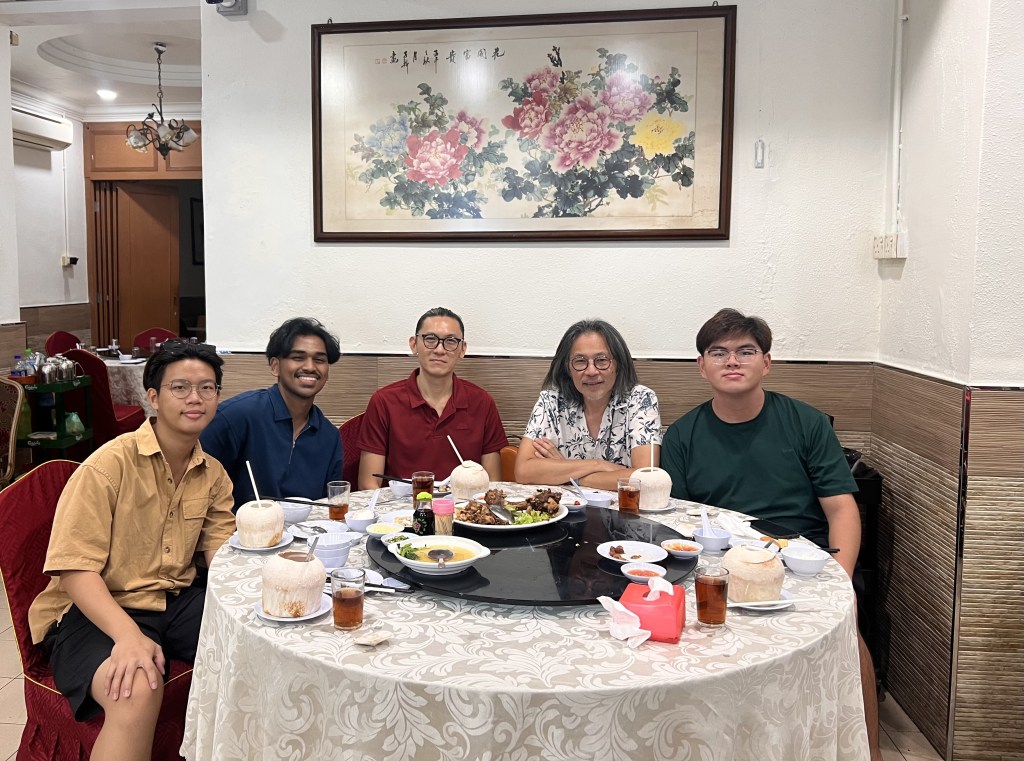
I had a tremendous time in Penang during those three weeks. Childhood schoolmates happened to be in Penang – Swee Fuan for his medical appointments and Johnny Yong, a recently retired GP from Houston was visiting his brother. Both began their school life in SXI with me in 1965. So, we became the three food musketeers, gallivanting to all corners of Penang Island in search of the best street foods that the island paradise is famous for. Other days, the three food musketeers became the Magnificent Seven in food heaven, with the addition of Theng Lye, Aloysius, Ban Leong and Gilbert Chin. Ban Leong fell sick, presumably from the food, and was replaced by Hock Cheng from Bukit Mertajam. Gilbert’s wife even cooked me her favourite Beehoon Kerabu. Food, glorious food, glorious indeed when someone’s wife would bring me food. Penangites are such warm people.
To work off the extra carbohydrates we were consuming during our culinary adventures, Johnny and I established a regular routine for our morning walks, spanning 4 to 5 hours each time, twice a week at the Botanical Gardens. Intrigued by the rich local history surrounding the Moon Gate, we were particularly curious to locate the hidden ruins of Yu Yi Yuan, a grand mansion constructed before 1891 by a wealthy businessman from China. Over the course of three determined attempts, we asked numerous hikers along the trails, most of whom had no idea these historic remnants even existed; nevertheless, I dare say we successfully managed to discover the overgrown ruins ourselves.
We made it a cherished post-walk ritual to end our trek at the small fruit and vegetable stall near the Indian temples, where we would refresh ourselves with cold young coconuts. On one memorable occasion, we even treated ourselves to a delicious, highly prized Penang Hill durian. Sadly, our subsequent visits yielded no further sign of the King of Fruits, as the local durian season had come to an unexpected and abrupt end. Each time we visited the stall, I made it a personal point to purchase fresh eggs or farm veggies to deliver to my Ahyi (my youngest maternal aunty), who resides nearby.
The three weeks flew by, far too quickly. One of the greatest delights of indulging in street food in Penang is that I never had to inquire about the prices before I order the food; if a local kopitiam or hawker stall is bustling with patrons, you can guarantee the price is right and the quality is exceptional. My friend Fuan knows no moderation when it comes to eating—he only knows fun and full bellies! On one particularly ambitious food tour, we set out to eat the famous Ayer Itam laksa, but not before stopping at Cecil Street to feast on Duck Koay Teow Th’ng (keh liao, with all the extra toppings), Toktok Mee, crispy roast pork, tender Charsiew, and smoky Bak Kwa (traditional Hokkien salty-sweet dried pork slices). For dessert, we cleansed our palates with herbal Guilinggao jelly, Woong Kee’s silky Taufu Fa, and a sweet longan soup. And before I forget, we also made a late-night pilgrimage to the Old Green House stall for Char Horfun, deeply flavourful Hokkien mee (again, keh liao), and piping hot Bakut Teh. Crikey! I almost left out what was arguably the absolute best Char Koay Teow cooked with a rich duck egg, accompanied by a bigger-than-my-palm curry puff stuffed with red onions and a bowl of aromatic Siam Laksa at Under the Tree!
Unsurprisingly, this relentless quest for Penang’s finest street foods soon caused a rather troubling silhouette to appear in the bathroom mirror. I had originally arrived in Penang with a flat stomach—it was genuinely as flat as the jaded wooden washboard my mum used to clean our clothes when I was a child. I was well aware that I had put on a few pounds, but when your belly visibly wobbles while drying your hair with a towel, it comes as quite a rude shock to the system. To be honest, it wasn’t a problem a cummerbund can’t fix except our performance clothes did not include one. I strictly chided myself never again to towel-dry my hair so vigorously. After all, as any proper hair care routine dictates, the secret is simply to squeeze out excess water and gently dab with a soft towel!
Beyond the incredible food and the deeply nostalgic reunions with old friends and family, two distinct cultural moments stood out as true highlights of my trip: an enchanting oboe recital at the Penang Harmony Centre during which I witnessed the quality of local star players and their impressive biographies. The other highlight was an emotional screening of the tear-jerking film, Dear You. Dear You presents a profoundly moving story that left me feeling completely fragile by the time the credits rolled. My own father was one of those early pioneers who sacrificed so much, sending monthly letters and modest portions of his meager earnings back home to support his mother and siblings. Watching the film made me reflect on my own writing, and I felt a pang of regret for not delving deeper into this poignant narrative in my book, Urghhlings, The Brotherhood of the Marsh—specifically the profound emotional pain, sacrifice, and heartache that drove characters to leave their homelands for Nanyang in search of a better life.
All too suddenly, the trip was drawing to a close, and I found myself saying reluctant goodbyes to my dear friends. However, I simply didn’t have the heart to say a proper goodbye to my Ahyi; when I visited her in my final week, she was in immense distress from severe pain in her right hip. I suspected it might be a minor fracture rather than an exaggerated cry for attention or sympathy. Fortunately, my cousins acted quickly and took her straight to the hospital for proper medical evaluation, despite her having just visited the clinic for a routine checkup three days prior. It was indeed a fracture.
The following day marked my penultimate day in Penang. As if on cue, the skies opened up and poured persistent rain across Penang Island all day and through the night.
Contemplating the downpour, I asked, “Could it be that the heavens are reflecting the bittersweet sorrow I feel about leaving my beloved hometown once again?”
My Mrs, bless her soul, brought me back to reality with a quick and abrupt thud.
“You are overthinking, as usual. The weather has nothing to do with your coming and going. Rain is a natural phenomenon.”
The rain was wonderful. It cleansed the island, renewed life and gave the surroundings a fresh scent for the people to enjoy from the petrichor. I was soon on my way to KL. I had to be up by 6 in the morning to pack the final few things into my bag – toothbrush, toothpaste, a comb and power cords. By the time I had thrown out the rubbish and cleared the floor of any signs an old man with long hoary hair had stayed there, the Grab car was already waiting downstairs for me. The pick up point for the two coaches to take the orchestra to KL was at Han Chiang High School. To be among so many school students and young people was a buzz for me. I had not experienced such a scene for a very long time. The last time was in 1999 when I waited for my three sons to come out from school to fetch them home. This was my first orchestra tour! Soon, we were off by coach to KL, where we would be staying at a hotel together and travelling together. Mingling with young people gave me a long lost perspective, they were energetic, positive, full of fun and above all, happy. Being with young people keeps us young – I do believe this to be true.
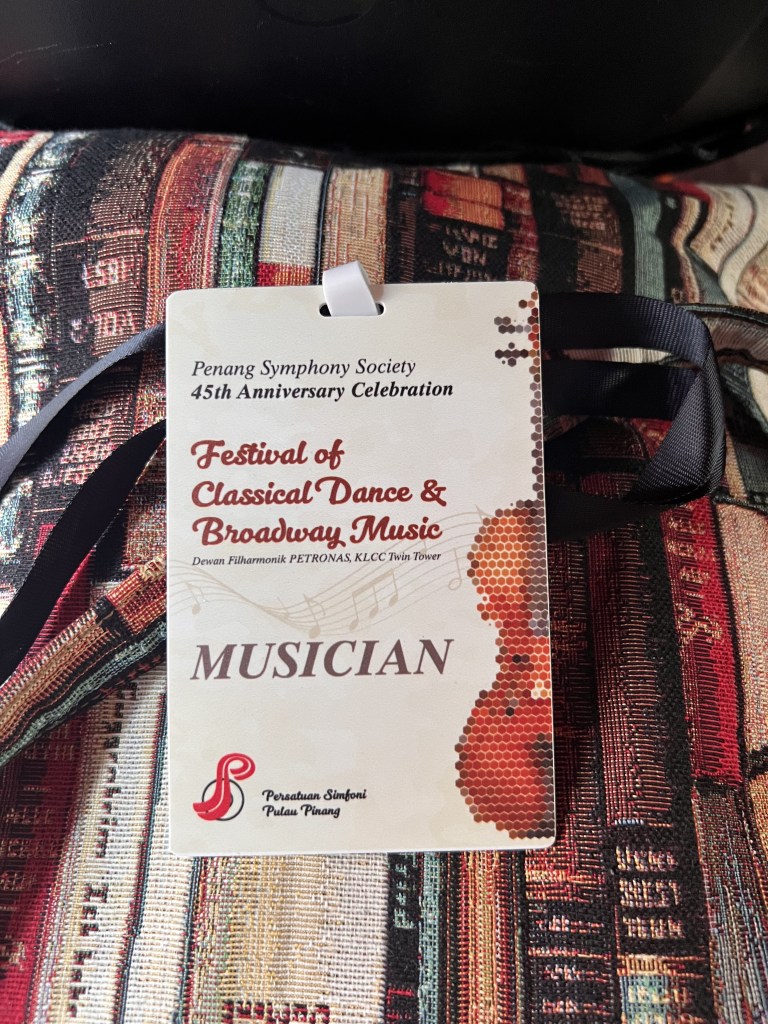
On the coach, we were handed a tag that we had to wear to access the DFP. In caps, was the word MUSICIAN.
Wow. I am a musician! I stared at that word that was applicable to me and a nice warmth washed over me. Why did I not ask myself this very question carefully all those years ago – to be or not to be a musician? I like being a musician. I should have taken up Mr Woon’s advice and gone to Vienna!
A musician’s life is rather different, I find. They celebrate life much more wholesomely, infusing every shared moment with a spirit of camaraderie and creative vitality. I found I was being transformed into a happier, fun-loving, light-hearted bloke, almost a larrikin, I think. Nothing fazes me anymore in the company of other musicians. They are a genuinely happy bunch, possessing a deep emotional sensitivity that allows them to connect profoundly with their craft and one another, making them exceptionally responsive to subtle aesthetic features and artistic beauty. Musicians tend to celebrate life far more readily, turning even ordinary gatherings into memorable occasions. In Penang, surrounded by such warm and passionate colleagues, I was beginning to behave like one of them too. I was always ready to “let my hair down” and celebrate any moment that merited a hearty meal together, enjoying good conversation or partaking in fine wine late into the night (except I find very few Malaysians drink wine).
There was a palpable buzz in the bus as conversations hummed and anticipation grew. The DFP website had closed ticket sales for our concert! Could tickets be sold out?!! The thought was both exhilarating and scary! Suddenly, I felt a slight trepidation creeping in. I wasn’t prepared to be playing in such a grand, world-class venue – not after having stopped playing the violin for 49 long years and only picking it up again just 4 years ago. When Mr Woon invited me to return to the orchestra to help celebrate its 45th anniversary, I immediately said yes without hesitation. But, knowing my limitations, I asked to play in the Second Violins. He said the orchestra already had enough seconds and firmly insisted he wanted me to play in the First Violins instead. I agreed, but requested to be seated in the back row so that I would not injure a current player’s ego should I take over someone’s regular chair. The reason for that request was half true. The real, unvarnished truth was that I desperately wanted to remain unseen in the back, sheltered from the spotlight. Hidden yet heard. Instead, I later discovered to my quiet dismay that he had assigned me as the no. 5 player, seated on the right side of the third desk, fully exposed to the gaze of the entire audience.
My son in Singapore gave me a sweet surprise. He had previously mentioned that he would try to attend my concert, but he gave me no assurance that it was a certainty, as it would be very rushed for him to make it after having his own gig the night before. As I was walking into the KLCC for the very first time, his message suddenly arrived on my phone.
It read, “I have landed in KL!” Instantly, the slight trepidation I had felt earlier began to grow rapidly. Deep down, I want my sons to be proud of me for accepting this assignment. Showing them photos of me during and after the performance would have been enough to impress them. The world-class venue as a prop would have lent me a lot of credence, and playing on such a stage is a kudos very few of my friends, if any, could ever hope to receive. But having an astute, sharp, experienced, and celebrated musician such as my own son sitting in the hall meant he would instantly see and hear every single one of my flaws.
GULP. The slight trepidation was no longer slight.
His aunty wrote, “After all the hard work and perseverance, you’re finally going to be on stage playing with the orchestra. Enjoy every moment—you’ve earned it. We are so happy for you!
Jia yu!”
His brother’s girlfriend also sent me good wishes, “Good luck! We hope you have an amazing time and enjoy every moment. We’re so proud of you and really wish we could be there with you today. Hopefully next time!”
Thanks, guys. What a rare moment for me to play on such a rarefied stage! This was well beyond my expectations and surely well beyond what I deserve! But I shall take it! I should remind myself I’m just an amateur and should not push myself beyond my abilities.
My Mrs reassured me with a gentle, grounding smile, I imagined across the seas. “Yes, just tell yourself you are just an amateur. Very amateur!” Her words were a necessary antidote to my spiraling nerves, a reminder to embrace the joy of the moment rather than the weight of expectation.
Over the years, my travels have taken me to the hallowed stages of the world’s most iconic music halls—from the intimate, wood-paneled warmth of Wigmore Hall and the historic grandeur of Carnegie Hall to the operatic splendour of La Scala and the acoustically brilliant auditoriums of the Adelaide Town Hall and the Esplanade and Victoria Concert Hall in Singapore. I’ve sat in the hushed, expectant silence of the Mariinsky Theatre and the storied halls of Prague’s Rudolfinum, absorbing the echoes of masters past. It’s a long list including Royal Albert Hall, Auditorium Parco della Musica Ennio Morricone, Teatro San Carlo, The Concertgebouw, Sydney Opera Hall and all other major concert halls in Australia. Yet, despite the prestige of these global temples of music, none could replicate the electric, singular thrill of performing on the stage at the Dewan Filharmonik Petronas in Kuala Lumpur. That stage wasn’t just wood and lights; it was a bridge back to a very old, albeit brief love for music-making, a homecoming of the soul. For that unforgettable privilege, I owe a debt of profound gratitude to Mr. Woon for extending the invitation to return. More deeply, I am humbled by the warmth of the Penang Symphony Orchestra, whose members—young, talented, and fiercely passionate—welcomed me not as an ageing visitor, but as one of their own, an integral part of their harmonic tapestry.
Music keeps us young.
– Woon Wen Kin