Dour About The Tour

Tan Ban Leong told me it was raining the whole morning in Penang yesterday. The angry skies across the island spat at the people and blackened their moods. The defeated sun, ably aided by the heavy grey clouds, darkened their day and made life difficult for those who needed to be outside, making a living or just living, homeless or aimless. A simple enough unsolicited news on the weather but it triggered me to write this blog. I’m bewildered that I used to blog every Saturday morning without a break for months and months, years, actually. Sitting down at my desk on a Saturday morning now feels foreign; the realisation that I abandoned the discipline I had inculcated in myself the importance of forming good habits over the last four years or so saddened me. For a long time, I was pleased with my own stoic discipline to push the boundary of my newfound hobby to write every week, sometimes feverishly. Why did I stop? Maybe, the low readership of my blogs had finally got to me. I felt my copious writings were as useful as an ashtray on a motorbike. It was a massive undertaking which mostly bore ephemeral dopamine effects. It was easy to rid myself of my hedonistic tendencies. I convinced myself the idea to write was to have a useful hobby and maybe to improve the way I communicate and express myself – it was nothing about happiness.

Ban Leong went on to say that last night was the first night in days that it did not rain. That was what triggered me. It is hard to imagine that my mood turned as stormy and tumultuous as the weather in Penang. Dark, brooding and sullen I became. Dour, in a word. Dour about the tour, in fact. I was supposed to be in Penang last night, you see. My plan was to attend the final two rehearsals with the Penang Symphony Orchestra before we embarked on our China Tour. Since I got back from my holidays in early August with a dog-eared vanilla folder of music sheets, I have been practising like a professional violinist, putting in two to three hours of serious work daily. So, I channelled the majority of my “me time” to my violin practice instead. Am I ready to perform? You bet! Well…. I am always lenient on myself, which is why mediocrity is self-inflicted.

Mediocrity is self-inflicted, genius is self-bestowed.

Walter Russell

The Mrs walked towards me the other night as I was playing Grieg’s Wedding Day, Op. 65 no. 6 and kindly suggested I should use a lot more bow and although never trained in music herself, she proceeded to inform me to press my bow on the strings more firmly. I simply nodded, she is right, of course but it is a lot more than that.

To get a nice, strong tone from my violin, I focus on several key aspects of technique which I learned some 55 years ago and which ChatGPT confirms.

  1. Bow Pressure: Apply consistent, firm pressure on the strings without pressing too hard. Too much pressure will cause a scratchy sound, while too little will produce a weak tone. The balance between weight and speed is crucial.
  2. Bow Speed: Maintain a smooth and controlled bow speed. Faster bow strokes can increase volume, while slower strokes provide more resonance. Experiment with varying speeds to find what works best for different dynamics.
  3. Contact Point: The point where the bow meets the strings (closer to the bridge or the fingerboard) affects the sound. For a stronger tone, play closer to the bridge, but not too close as it may result in a harsh sound.
  4. Bow Angle and Straightness: Ensure the bow moves straight across the strings, parallel to the bridge. Any diagonal movement can lead to inconsistent sound quality. Also, keep the hair flat on the strings for an even tone.
  5. Left Hand Technique: Good finger pressure on the fingerboard is essential. Ensure my fingers press the strings firmly to produce a clear tone, but avoid excessive tension that can inhibit flexibility and vibrato.
  6. Relaxation: Tension in my shoulders, hands, or arms can hinder sound quality. Keep my body relaxed and use the natural weight of your arm to apply pressure on the bow.
  7. Rosin Application: Make sure my bow is properly rosined. Too little rosin can make the sound weak, while too much can cause excessive friction and a gritty tone.
  8. Practise Long Tones: Slow, long bow strokes on open strings or simple scales help develop control over tone production.

I nodded and thanked her for her input. Wow, she actually listens to my practice, I thought and felt enthused. I should have left it at that but after I had finished playing the piece, I went to her with the music and showed her the many bars that were marked “p” and “pp”.

“Do you know what “p” means?” I asked, and then stupidly answered my own question with an annoying tone.

“‘P’ means piano, soft, and ‘pp’ is pianissimo, very soft,” I needlessly said and began hating my own voice.

That, of course, has been the story of my life. I have always been tactless, careless and thoughtless. Spinning these faults as honest, direct and open, it is no wonder that my friends anointed me ‘The Annoying One’. The Mrs was being supportive and helpful, never mind that she has never touched a violin, but she does understand and feel music, having been an avid classical music listener since we met. I am sorry she married someone with the EQ the size of his shoe. In old Aussie parlance, I would be called Casablanca, a wanker. The old cobbers would have also described me as slow as the Second Coming. At almost sixty six now, I have to admit I am like a piece of rotten wood that cannot be carved. Despite the almost half a century of living together, she is unable to sculpt me into the knight in shining armour who sweeps her off her feet in her dream. Side by side, we are incompatible like water and fire, yet our lives are balanced enough that there is little likelihood of us drowning our spirits or burning our bridges.

Chip Beng chipped in quickly. He is an Adelaide resident but we go all the way back to 1958 in Penang. Being like fire and water is complicated but can be complimentary – when the water is too cold, the fire can heat it up……and if the fire is too fierce, water can douse it and regulate its ferocity.

So, last night, I was in a pissy and hissy mood in my study. In protest, I had decided not to touch my violin. Instead, I sat there peeling off dead skin from my feet; they were as dry as a dead dingo’s donger. Clearly, the almost-robotic routine of applying Nivea cream every day has proven to be futile. Einstein was right. Why do we persist in doing something that doesn’t work again and again and expect a different result? I was supposed to be in Penang last night, sitting as a tutti player in the First Violins of the orchestra, showing off my beautiful Paolo Vettori violin which I commissioned some years ago and brandishing my French-sounding Belgian bow, a ‘sakura’ by Pierre Guillaume that my youngest son gave me as a surprise present inside a shiny white Accord violin shaped case, also a surprise present. A surprise within a surprise, unforgettable and oh, so cherished.
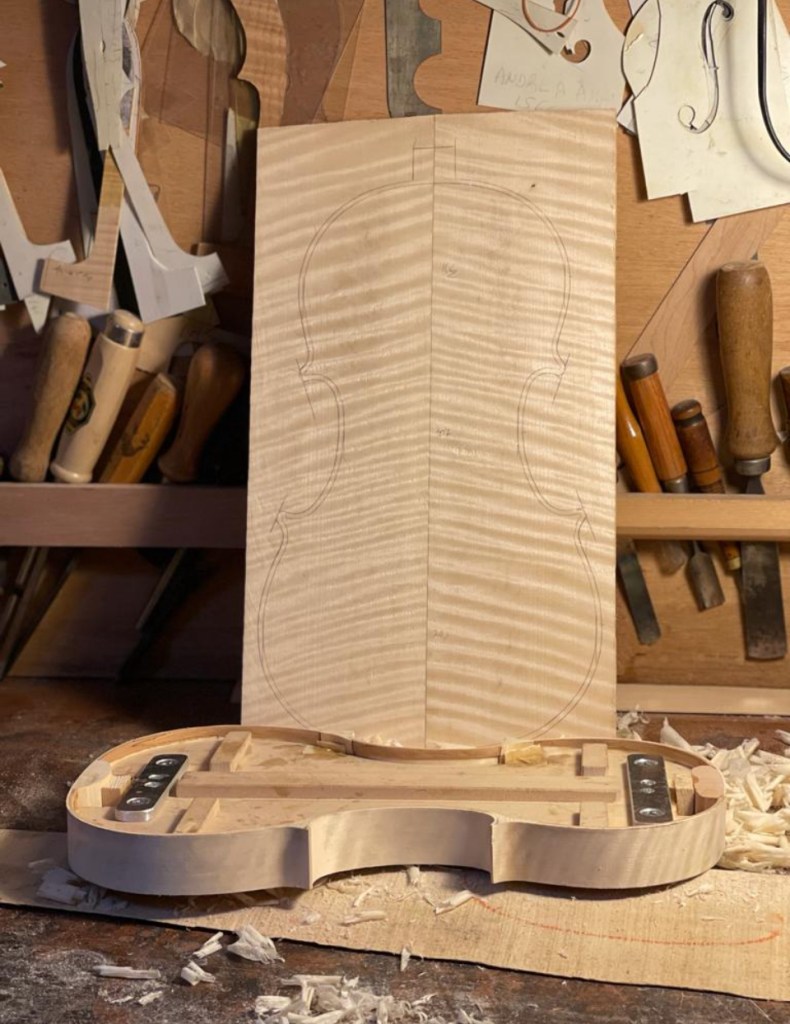
My Paolo Vettori violin, then a work-in-progress, with the Guarneri ‘del Gesù’, Cremona, 1744, the ‘Ole Bull’ template

But, I didn’t even have to cancel my air tickets to Penang because they were not bought in the first place. I half-suspected the tour was not happening when the conductor, Mr Woon, kept saying they were having issues with the venue in Xiamen. But, in my heart I knew that if Xiamen was the only issue, he would have still proceeded with the tour if he had Guangzhou and Shenzhen firmly in the bag already. To save him from embarrassment, I kept quiet even though I was bursting to ask him the obvious.

If those other two venues were ‘set like jelly’, then why cancel the whole tour?

I suppose it is forgivable that I feel dour about the tour. I had to forego the concert on 18 September with my local orchestra, the Burnside Symph in order to prepare for the China gig. It was to be my first international tour with an orchestra, so hyped up I had made it sound. Mr Woon said it is not cancelled, merely delayed till November. I took the news like a Pompeiian, frozen in time, caked in layers of utter disappointment and shock. But, do I continue to sacrifice my “me time” and the next BSO concert, Beethoven’s towering 9th Symphony in November for this very much vaunted international event that I never imagined was possible in my life? Maybe, this is just another piped dream of mine. Dour about the tour, that I am. Remind me not to be fervid about anything, please.
To The Fore When I’m Sixty-Four

In a few more days, the old man will turn 64. Crikey. Has it been so long since he first sang the Beatles song? He was a teenager then, with so much promise and seemingly limitless potential. He had a thick mop of hair, so stiff and thick they felt more wiry than hairy. No designer style yet it looked decidedly designed in the shape of a coconut. His flatmates took turns to cut it for him. Free labour did not mean labour freely given. His lack of concern about hygiene and looks showed in his face. It was messed up with active pimples that were prone to explode more randomly after greasy or spicy meals. Still, he didn’t care, since he didn’t notice them. Scrawny and bespectacled, he moved like a shadow, following his friend’s moves. They attended uni classes together. They rushed to the library together to secure the books mentioned by their lecturer. They went to the shops together to do their weekly shopping. Did I say ‘together’? Not quite, he was often a step or two behind, just like a shadow. His friend came from a well-to-do family, the father a doctor and the mum a headmistress. Those with a better background tended to start off in life more confident, more comfortable and definitely with more freedom. He was however, a son of a dhobi, not from the lower caste like the Indian laundryman but nevertheless he considered his father was a working-class man. He was wrong about his circumstances – it wasn’t that he was out of touch with reality, his reality was quite spartan and dire. He never had enough to eat – his mother made sure that they lived a rather thrifty lifestyle so that they would not grow up ‘wasting’ money. Every morsel of food was small and inadequate, everything had to be sliced to thin slivers to be shared by many siblings. In uni, he worked three shifts a week in a Chinese restaurant and if he did not go back home to visit his family during the summer vacations, he would find full-time work in a factory or warehouse. In fact, as soon as he arrived in Australia, he found work as a drinks waiter. That first moment of financial independence thrilled him as the pay was enough to cover his food and lodgings. It took him just a few more weeks to save enough to send home some money to his best friend whom he asked to arrange a meal for the gang of about ten school friends he left behind in Penang. It was enough to buy them a good lunch at the Eden, an outlet that served western food. Strangely, only one of the friends wrote to thank him for lunch, but he did not think much of the oddity back then. Such matters did not dwell in his mind, he was simply happy to see a photo of them enjoying a meal together. He was accustomed to being in the background or backstage. Giving speeches and barking instructions in the class was as foreign to him as eating gorgonzola or as impossible as swimming in the desert.

The two friends were so often seen together that the richer one became known as Fat Shadow and the other, Thin Shadow. No one ever asked who’s who, the answer was as clear as night and day. Both of them loved to sing love songs. The old man’s favourite was ‘My Way’ deciding that the words meant something to him, and that he would grow up to live life his way. They sang ‘When I am sixty-four’ often too, not appreciating that life would hurtle so fast that their sixty-fourth birthdays would arrive in the blink of an eye. Fat Shadow was the more outgoing of the two, therefore the more visible and louder. Thin Shadow packed his own lunch and was never seen in the uni cafeteria. His lunch was predictable. IXL’s strawberry jam and peanut butter sandwich. It mattered not if it was spring or autumn.

Three years passed by and uni days ended. The two friends grew apart and without a goodbye, they went their separate way. Thin Shadow stayed on in Australia. Later, he heard Fat Shadow had made his way to Singapore and established a career there. Life’s cycle was pretty much the same for the friends. “You fall in love and marry the girl in your dream,” he said. “Then, you wake up and realise the dream was better and you were a better person there.” Their kids came soon after and life as they knew it ceased forever. “It was about me initially, then ‘us’ for a short while and then ‘them’ very quickly and for a long time after that.” “It became always about them,” he said, finally understanding the gravity of parenthood once he worked out the monthly pay cheque he earned was just enough to cover their living expenses. “We lived and breathed raising our children, and gave them the best opportunities we could muster,” he said.

Happy union with wife and children is like the music of lutes and harps.

Confucius, Book of Poetry

“But, aren’t Confucian teachings about children showing respect and being filial to their parents?” I asked, sensing that he gave much more than he expected to receive.

“It is also true that they didn’t ask to be born and weren’t given a choice,” he said, justifying their belief that they therefore were obligated to take care of them the best way possible.

The old man’s kids left home early. It didn’t seem so long ago that his eldest son was a sweet little boy, no more than three and a half years old. With a chubby face packed full like a big round pork bun, his aunty (伯母 – bó mǔ ) called him Bak-pao-bin or ‘pork bun face’. The toddler was well brought up and was the epitome of a Confucian son. In a restaurant, he would keep to his seat and not run around like a headless chook. With a meticulous habit of not leaving any crumbs at the table, he was distressed when the French waiter kept saying “merci, merci’ to them at the end of the evening.

“Mummy, I am not messy,” said the child who was about to break into tears.

An empty nester at the age of 45, the old man was struck by the brevity of their happy times together as a family. Hedonistic as a teenager and as a young man, he was suddenly wrecked emotionally by the sudden emptiness that engulfed him. The music and laughter that permeated the walls of their home evaporated into the air, as if a storm had lashed down on the world and frightened away all the birds and butterflies in the park. Their bluestone Federation-style house, emptied of children, looked abandoned and sinister in the distance. He was traipsing aimlessly on the park across the road when his resolute composure gave way. Feeling weak, he lowered himself to sit on the ground but ended up squatting when he discovered it was soggy and cold. His thoughts turned epicurean, preferring the avoidance of pain in the body and of troubles in the soul rather than seeking pleasure. He raised himself up and felt like a new dawn had arrived. He was ready for the next chapter in his life.

For the next fifteen years, he worked hard in his business and tried to build a retail ’empire’, a goal that he failed to fulfil. At the end of this period of high risks and torturous toil, his plan collapsed in ruins amid the global financial contagion that spread from America. He was not awoken by Elton John’s song about the candle in the wind at Princess Diana’s funeral. He failed to recognise that life is fragile and tomorrow is not promised. Today is the present, literally a gift that should not be taken for granted. But, in recent years, it was the pandemic that stopped him in his tracks and made him reconsider the meaning of life. He was attracted to Friedrich Nietzsche’s leanings to nihilism, a theory that life has no intrinsic meaning and humans have no real purpose. Growing up in a ‘Buddhist’ environment, he had already been exposed to the idea that we ought to tame our desires to reduce suffering, a concept not dis-similar to passive nihilism, or a will to nothingness. However, Nietzsche’s Existential nihilism gave us the way to create our own personal subjective meaning through a combination of free will and awareness of becoming what he called a ‘Higher Man’, a better version of ourselves.

In recent years, his answer to rapid hair-loss was to wash his hair infrequently. This was after discovering a clump of hair trapped on the drain hole cover of their shower cubicle. His normally stolid face winced, aghast at the loss, now held gingerly in his fingers. Despite his Mrs’ incessant nagging about his foul-smelling pillows and the ever-increasing need to free-up the robot’s vacuum main brush from the entanglement of long hair, the ownership of said hair was without dispute since hers was cut, like a bob, he persisted in keeping them unwashed for days. Soon after, he was washing his hair once weekly, believing that his receding hairline would be stemmed. His doctor was on a long vacation leave and he had no one to discuss the merits of taking Finasteride to further combat the loss of hair. “It’s important not to be impotent,” he said to me, after learning that a side effect might be a loss in his libido. I felt like telling him about the many benefits of being celibate and many in fact, celebrate the freedom of having no interest in sex. But, he looked like he was in no mood to listen to me, so I simply walked away.

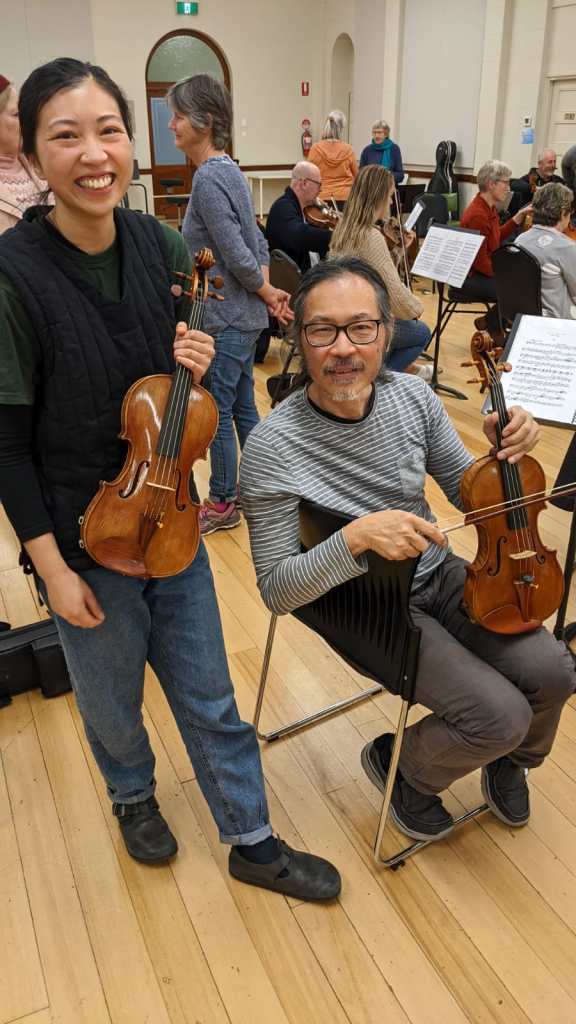
After much coaxing from his nieces, the old man finally summoned enough courage and stood up from the shadows at the back of the hall where the Burnside Symphony Orchestra held their practice sessions every Tuesday night. He stepped into the fore a few days short of his sixty-fourth birthday and introduced himself to the concertmaster. She welcomed him to join them in the First Violin section but he said he was happy to start at the very back of the Second Violins. Two hours later, he emerged a rejuvenated man who seemingly had multiple shots of happy hormones racing through his body that night, thrilled with the music-making and friendships made, savouring a blissful happiness reminiscent of the fun nights he enjoyed as a 15-year-old student in the Penang Orchestra. “Now I have a lot to look forward to when I am sixty-four,” he said.

When I’m Sixty-Four

When I get older losing my hair

Many fears from now

Will I still be standing on my pedestal

Heyday, meetings, own a gold mine?

If I’d been a flop, work till sixty three

Would you lock the door

Will you still need me, will you still love me

When I’m sixty-four

Our kids will be older too

And if they say they were hurt

That I betrayed you

Could they be happy, ending abuse

When our fights forgone

You can sit with a dreamer by the fireside

Chilly mornings on the way to Ryde

Nothing’s forbidden, smokin’ the weed

Amore or amour

Will you still need me, will you still love me

When I’m sixty-four

Every summer visit the Hermitage in St Petersburg

There’s nothing to fear

There is talk of war

Putin going nuclear

A lunatic’s rave

Dead men on a cart, NATO aligned

Putin’s point of view

Predicate precisely what the US say

Sanctioned dearly, wasting away

Not an inch eastward, yet there they are

Hermits evermore

Will you still need me, will you still love me

When I’m sixty-four

Lyrics by Wu Yonggang, tune by Lennon-McCarthy
With members of Burnside Symphony Orchestra in Oct 2022