
She was muttering to herself when he arrived. Alone at the dining table, picking at a piece of toast, long turned cold, she was estimating, no, almost, measuring six small squares of bite-size proportions to cut her remaining breakfast into. Meticulously, precisely and carefully, she sawed at the cold but still crispy bread with a butter knife. Made of pure silver, the knife was a find that thrilled her, a bargain buy from the local odd shop not long after she settled in Adelaide in 1988. It came all the way from England, its journey quite typical for the early settlers who arrived in South Australia as graziers, farmers and colonial masters of the land they named after their Queen. So, Tandanya was renamed Adelaide.
The old man called out to his mother, “Ma, how are you today?”
He had deliberately switched his demeanour to chirpy and upbeat just before he opened the front door and entered his sister’s home. The sister, the official carer of their mother, was nowhere to be seen, either she was scrubbing clothes in the laundry room or tip-toeing precariously up on a ladder, over-extending herself to reach a wayward branch with her secateurs. Their very old mother looked up with a faint smile and returned her gaze to the bread. She had one more cut to make to complete a square that would become a manageable size for her to bite. But, the crumbs on her plate annoyed her considerably such that she succumbed to the compulsion to sweep them to one side of the plate with her fork.
Finally, she was chewing at her reward. The remaining five more squares would take her a good half hour and then there was the cup of coffee that she would ask to be warmed up every so often for her. When he entered the house, he knew he was entering the Goldilocks zone. Everything must be just right, not too hot and not too cold, not too hard and not too soft, except for the coffee which must be overly sweetened. Three teaspoonfuls of sugar won’t do, add condensed milk to sweeten it some more. She had stopped drinking in recent months, no, not just wine, brandy and her favourite Tia Maria. Drinking would cause her to choke and convulse, so she could only sip and carefully swallow the tiny bit of liquid down her throat. Swallowing was no longer a reflex action for her, it needed careful focus and mental control to push the coffee down with her weakened pharyngeal muscles.
But, it was already one pm and his youngest sister and her hubby were sure to be arriving at his house soon. For many years, they had unfailingly carried out their filial duty of looking after their mother. Since he and his sister still worked, they could only dedicate their weekends to their centenarian mother. Saturdays were the sister’s shift. He and his Mrs would spend the afternoon with their mother at his sister’s place for lunch and reciprocate the following day; Sundays being his turn to look after their matriarch. It was already one pm, so he had to persuade his mother to abandon her coffee and forget about her cold toast. As he sat next to her, watching the dry and wrinkled skin of her throat wobble and bobble in synchronised motion with her pharyngeal muscles, he reminded himself not to rush her. The old and the frail cannot be hurried. You risk breaking a limb or breaking their tranquillity. The contradiction struck him personally, having observed that the old, although quickly running out of time, cannot be rushed to make up for lost time.
“Ok, ma, let’s go. Slowly and carefully,” he said to his mother who was rearranging the crumbs on her plate.
“I can only be slow,” she replied.
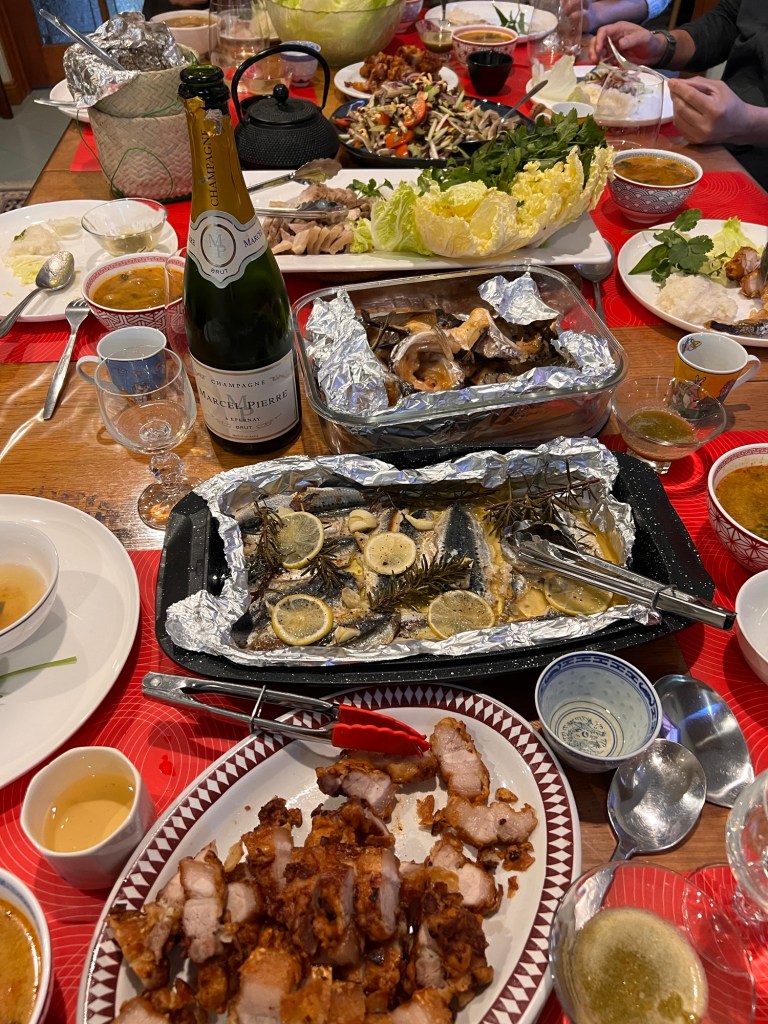
Sundays were his shift for the week but in reality, it was left to his Mrs to do all the planning, preparation and cooking. She would start days before, checking Youtube food channels for a suitable menu for her Goldilocks mother-in-law. The leafy part of veggies can’t be chewed, the stems, her favourites, must be soft, but not too soft. The rice porridge must not be too watery yet not too thick. Pork mince was best made into balls, not loose and grainy in the porridge. His task was easy, all he had to do was put on a jovial face, change to an upbeat demeanour much like putting a fresh shirt on and coax her into his car. Other siblings weren’t so lucky or perhaps they weren’t as perceptible to read her mood swings. She would not be hurried and the biggest mistake one could make was to interrupt her midway through an action or a story. A sin would be met with an immediate sour change in her mood or worse, with fury. She was placid, malleable, even pleasant one could say in her prime, but dementia had reduced her into a confused, delusional and depressed woman, susceptible to the occasional slamming of her hands on the table to show her frustration at the world. It was becoming more frequent for her to refuse to cooperate and not leave the house. Reasons were varied, a sudden mood change, a sudden thought about the Japanese, or simply just frail and feeling exhausted. Sometimes, she wished loudly that she would not wake up the next morning.
You’d be silly to reason with her dementia. So what if you’ve cooked a sumptuous meal for her? So what if you’ve booked a table at her favourite restaurant? So what if the rest were already seated at the table? Anything could trigger her and rouse her defiance. It could be a word or a thought that popped into her mind. But, more often than not, they were the usual culprits. Some of the bad episodes in her life, imagined or otherwise, all coalesced into one character, usually an unknown Japanese. The Japanese man visited their house, she said, he simply barged into the toilet one night without knocking to check when she was inside doing a pee. The Japanese man stole the rice noodles she cooked – he placed the ni kor ki she had cooked for everyone in a basket and cycled away. He did not even return the basket! The Japanese man was a son-in-law but sometimes he was also a grandson or a visitor. She was 17 when she married their father and one night at age 19, she sat frozen with her back turned to the Japanese Kempeitai, hiding her marmoreal face which was carved with fear and panic as the vicious soldiers from the Land of the Rising Sun stormed into the house and dragged her husband away from their bedroom. It was reasonable to expect a young woman still in her teens to carry a lifelong psychological scar from that horrible experience but she showed no hatred and did not outwardly despise the Japanese until her dementia in recent months exposed her fear and hatred towards them.
His mother was fine in the car. Quite chirpy in fact. The journey from the dining table to the car took twenty minutes longer than expected as she needed to segue to the toilet. On the garden path, she pointed to a bush of daisies and declared for the umpteenth time her grandma used to cook them for her in a soup when she was about seven years old but it was only after she said her husband loved those veggies in a steamboat that he realised she had mistaken them for Tung Ho. The journey to his house was only a short twelve minute ride. The same old stories were recounted as they passed certain landmarks that afternoon.
“This house belongs to Lim Chong Eu,” she said as they passed a nondescript house. The late Mr Lim was Penang’s longest serving Chief Minister. He signed the pact in 1973 with Don Dunstan to make Penang a sister city of Adelaide’s. Perhaps he was here, perhaps he did buy a house but surely not in Trinity Gardens. Fifty years ago, it was a blue-collar suburb, not blue ribbon.
As they passed Philps Reserve, she pointed to the small park and said it was there that she turned back home after having walked all that distance after a row with the daughter who was now her carer. Perhaps they had a row, perhaps she managed to walk away from their house but surely she could not have walked that far. She no longer had the physical strength let alone the mental awareness of the direction to get there.
Further up Glynburn Road, the small post office soon came into view and as surely as night followed day, she started her story about her grand-daughter whose name she no longer could recall. How Yuh, when she was still in Primary School had to stop at the post office for a breather having lugged a heavy sack of books on her back on her way home from school. The old lady still had the logic to criticise the silliness of the school system to insist on students carrying all their books to school, irrespective of whether the subjects were being taught that day.
“Wa eh keen bo teok,” the little girl said to her granny in Hokkien, explaining why she was having a bad day, that “her veins were not right.”
Glynburn Road was a quiet street, almost quaint. The old mechanic’s workshop had closed decades earlier and what stood in its place was a splendid cafe adjoining the old hotel in the Adelaide foothills. The Feathers Hotel was a dingy little pub in the late 80s and 90s but it now boasts a sparkling pavilion with outdoor seating in a beautiful garden setting of Mediterranean vibes but annoying Asian fusion menu. The old man had taken his mother there once or twice but she didn’t like the food. It wasn’t eastern and it wasn’t western.
The old man’s car struggled up Greenhill Road and left a trail of petrol fumes and dark smoke from the dirty exhaust pipe. As he turned into the side street, a secret reserve appeared, presenting the arrivals with a wilderness not expected so close to the city, a Shangri-La of green surrounds filled with soft golden rays of sunshine and freshly scented air of gum leaves and sweet pheromones of recently mowed grass.
What will mother be like when she arrives, he asked himself.
The answer did not take long to reveal itself. She saw her son-in-law get out of his Tesla and immediately knotted her fading eyebrows and grunted under her breath.
“Take me home. I don’t wish to see the Japanese,” she hissed in a quivering voice.

 Urghhlings