The silence of my home was a deafening counterpoint to the turmoil in my whole being when I finally returned, a long ten days after Ahma, my beloved mother, had passed. The guilt was a physical weight, pressing down with every step I took across the threshold of my house. How could I have chosen a four-week holiday, knowing with absolute, sickening certainty that the odds of seeing her alive again were heavily stacked against me? The logic I had employed before leaving, while seemingly sound and unequivocal, now felt like a desperate, flimsy shield. She was 102, a veteran of life but now a prisoner of severe dementia. Another stroke was a constant, looming threat, poised to further reduce her mental and physical faculties, or worse, another episode of end-of-life considerations was inevitable. Any of her aged organs could decide to simply shut down, or perhaps, the most heartbreaking thought, she might simply surrender her will to fight on and live. She had gone for ten days already, yet I had not seen her since that chilling day. How did she die? Did she have a peaceful death?
A frightening question haunted me: did my absence contribute to her giving up? Did she know I was missing from her routine? The answer, when it came through my brother’s retelling, was a thunderous confirmation that rocked my fragile sanity. Yes, she knew, I told myself.
I had departed on a Wednesday. That Saturday night, the very first shift I missed—my regular, sacred time to visit and feed her—she had rejected my brother, who had taken my place. “No same,” she had mumbled, refusing his care. Then, with a clarity that belied her condition, she had uttered the phrase, “mak deh wo” – no egg yolk. It was such a small, seemingly minor detail, yet the egg yolks were a simple pleasure she enjoyed tremendously, a treat I had never once failed to serve her during the last five months she lived, no, existed, in the nursing home after a stroke took away her ability to eat solid foods. Her comment was a direct acknowledgment of my absence, as if a sorrowful message that pierced the barrier of her dementia.
My house, a monument to my recent dereliction of duty, looked precisely as I had left it. It felt the same, too, imbued with the familiar chaos of my life. Untidy, messy, and the air hung stale and heavy, an expected consequence of having every window and door sealed for a long stretch. The stately Tasmanian oak dining table, a piece of furniture I cherished, was barely visible beneath a chaotic mess of newspapers and magazines, some unread, others half-finished, strewn haphazardly across its surface.
As I moved past the antique half-moon table, my eyes fell upon the framed black-and-white photograph of my father, resting just behind a simple copper incense holder. The image had faded somewhat—an unsurprising consequence, considering I had printed it eighteen years ago after his death so I could establish a place to pray to him. A cold, certain knot formed in my stomach: I knew, with the kind of knowledge that requires no thought, that I would soon have to print a similar photo for Ahma.
My immediate, non-emotional concern was for my chooks. Had they been fed adequately? Was their water supply fresh? Was their coop still the impregnable fortress it needed to be against the wily fox? Was the auto-door still functioning with reliable precision? The chore list was clear: roll up the blinds, unlock the rear sliding door, and go straight to the backyard to check on my feathered charges.
As I closed the sliding door behind me, my attention was snared by a strange, almost unsettling sight—an army of ants, unlike any I had encountered before, marching relentlessly upward. They followed the exact edge of the door frame, heading for a small, barely perceptible hole in the wall above. It wasn’t the mere presence of ants that was odd, but these ants. They were pale brown, almost translucent, and possessed a strangely clear hue. They moved with unsettling speed, yet their appearance suggested a morbid fragility, almost as if they were already dead. The sight conjured a brief, terrible memory of the ants that had hastened the death of one of my chooks some months prior, but these newcomers bore no resemblance to those aggressive, dark black attackers.
I finally reached the chicken run and was greeted by a joyful cacophony of rushing chooks. A genuine, small wave of relief washed over me. Phew, all good. All alive (a small victory that immediately triggered a fresh wave of grief for my mother, and I shed a few silent tears). After tossing them a handful of fresh veggies from the garden, I paused to confirm the auto-feeder was still stocked with plenty of seeds and grain. The garden looked wild and untended but at least it hadn’t died from the summer heat. My neighbourly duty then called me to the adjoining yard to check on their pond. The fish, looking noticeably leaner, rushed toward me, associating my presence with food. It was a comforting detail that they still recognized me—they had lost weight, but I, ironically, had put on an extra layer of fat around my waist. Ah, the sheer vicissitude of circumstances; gaining weight in the wrong parts of my body, I thought with a grimace, was the price one paid for a relaxing cruise to the Mediterranean.
The time was well past 8:30 that night. Yet, there would still be light for another good half-hour, a delightful feature of a summer evening in Adelaide. I walked back toward the house and was brought up short by the locked sliding door. Why? I asked myself in mounting frustration. I knocked loudly on the glass and called out to my wife, the “Mrs,” demanding an explanation.
“Why lock the door? You know I’m outside!” I scratched my greying hair, long but now so sparse the length made me look stupid.
She was preoccupied, busy unpacking the remnants of our trip from her travel bags piled in the middle of the dining room. Her response was a simple shrug of the shoulders—she couldn’t hear my words through the glass, but the frustrated, impatient expression plastered on my face clearly conveyed that I was locked out. With a sigh of her own, she removed the metal bar that had been securely wedged between the door and the wall—a simple, effective mechanism to prevent the door from being slid open. She then rolled up the blinds, unlocked the door, and, with an air of innocence, asked me why the door had been locked. I should have been asking her that question, but all I managed to say was that the door should not have been locked. I chose not to point out the blinds should have already been rolled up or that the metal bar should never have been wedged there in the first place, not after I had just opened the door.
Later, the Mrs headed upstairs to take her shower. In the blessed solitude of her absence, I lit a joss stick to pray to Ahma. I craved this time for solitary reflection, a moment to articulate my apology to my mother for not being present in her final days. As I was deep in prayer, a distinct sound reached me—the clear, unmistakable clink of a cup being placed onto the cold, granite countertop of the kitchen behind me.
I knew, with profound certainty, that it was my mother. The concept of 77 (七七, qi qi), the seven by seven, or 49 days, was true, I was sure of it. The Chinese believe in it deeply, and Buddhists especially follow this ritual of mourning for the deceased for 49 days. They hold the belief that the spirits of the deceased will linger in this realm we call our world for 49 days before finally departing. The sound of a cup was not scary; it was, rather, deeply reassuring. It was my mother, letting me know, in the simplest of ways, that she was still around.
“Ahma, I love you,” I prayed, pouring my heart into the words, hoping desperately that she would hear me.
That night, I sought refuge in sleep earlier than usual. As my head sank into the pillow, I couldn’t help but observe the unusual, intense darkness of the night. It wasn’t merely dark; it was a deep, pervasive, deathly kind of darkness. The timber wooden door, a piece of craftsmanship whose patterns and grain I often admired, was now a featureless black expanse, swallowed by the total absence of light. The Mrs, also noticed the strange, unusual darkness. She got up and checked to see if the street lights outside had failed. No, she could clearly see they were on, their white light twinkling faintly through the leaves of the plum tree in our front yard. The stars in the sky were also brightly twinkling around a silvery gibbous moon. Yet, despite these external light sources, not a single ray managed to penetrate the window pane. The bedroom was enveloped in complete, suffocating darkness, and the accompanying silence was truly weird. No insects singing their nocturnal chorus, no frogs mating in the nearby pond, no sign of the gully winds rustling through the trees, and no sounds of dry leaves sweeping the road.
“Ahma, I love you,” I prayed again into the void, a desperate whisper, hoping she would hear me. The nights since have been dark. A weird darkness.
The following morning, I got downstairs as soon as I woke up. I did not forget the deathly-looking ants and so, armed with a full can of Raid Max Ant Killer, I went outside to kill them. To my shock, there was no trace of them! They either knew I was going to destroy them and fled or they never really existed. Unless… Ahma got rid of them for me.
I’m glad Ahma died in her sleep, a peaceful end to her suffering. Her face had a radiant glow, according to a sibling who was first to arrive at the nursing home.
The journey from Toulon to Aix-en-Provence was immediately defined by an atmosphere of inescapable confinement and auditory discomfort, a stark contrast to the promised idyllic escape. On the crowded bus, the old man, a keen participant in the excursion, found himself a captive audience to a cacophony of bodily noises. It is not considered impolite in many social settings to excuse oneself from a room or a dinner table when plagued by proximity to aggressive sneezing or coughing. Yet, on this moving coach, escape was an impossibility.
The initial discomfort came from the back of the bus—the loud, rhythmic snoring of an old bloke that began almost as soon as the journey commenced. This noise was, perhaps, less surprising than the absence of the advertised scenery. The brochure had painted a compelling picture of a “verdant patchwork of meadows filled with countryside flowers and bucolic valleys of noble heritage.” From the perspective of a bus hurtling along a freeway, however, the landscape remained stubbornly mundane.
This general hum of annoyance was soon intensified by the sounds of illness and poor manners. Coughing, initially a distant, manageable sound from the front and rear, became acutely personal when a man in a dirty red jacket took a seat just two seats to the old man’s right and joined the chorus. As if this respiratory distress were not worrying enough, the lady directly in front of him began to emit startlingly loud burping noises. These were not discreet, sharp sounds, but “ginormous and long noises,” emanating from a woman who, with her elegant appearance, seemed beautiful and sophisticated. Her dignity, however, was rapidly eroded as her involuntary expulsions were exacerbated by the gentle sway and gyrations of the moving bus. She was prone to seasickness on the boat but this was such a gentle bus ride by comparison! The sounds were as uncouth and jarring as the “uncontrolled farts” that two elderly passengers had released earlier during the effort of heaving themselves up the steps to board the vehicle.
The general unpleasantness of the journey was, in a sense, a microcosm of the entire trip’s frustration. Such annoyances, the old man reasoned, were often to be expected when travelling with a large group of elderly folks on a Mediterranean cruise ship’s shore excursion. But the trip itself, advertised as a five-hour opportunity to explore Aix-en-Provence, felt like a calculated deception—a “real con.”
The old man’s participation was entirely an impulse decision, ignited by the practicality of economics. He had initially intended to hire a private taxi, but when his fellow travellers decided not to join him and only informed him of their decision during breakfast, the cost became prohibitive. The cruise excursion was his only alternative and he had only twenty minutes to find the booking office and pay for the ticket, if indeed there were any tickets left for sale. The leaflet that lured him focused heavily on one major attraction: the promise of ample personal time for tourists to “retrace the steps of Cezanne by visiting his studio, where he painted some of his largest and most ambitious works including The Woman with the Coffee Pot.” Feeling abandoned, the rest of his companions bar one followed suit, everyone of them cursing under their breath for the abrupt way he left their breakfast table without as much as an explanation or convincing them to join him on the excursion.
The five-hour excursion was, inexplicably, immediately cut by 30 minutes, likely under the pretense of ensuring all passengers returned in time for the boat’s evening departure. With 90 minutes dedicated to the outward journey to Aix-en-Provence and another 90 minutes for the return, this left the tourists with a meagre 90 minutes of free time to wander the historical town, founded by the Romans in 122 BC.
As the group was being guided through the “labyrinth, stone-paved streets” of Aix-en-Provence’s beguiling Old Quarter, the old man finally voiced his specific reason for being there, asking the guide where Cezanne’s studio was located.
“Ah, that’s easeely an howeur’s walk away, hoh!” she replied, her words heavy with a thick French accent, confirming his rising suspicion.
The old man silently swallowed his profound disappointment. There was no point in drawing attention to being swindled. It was better, he thought, not to let the world know he had been scammed.
In truth, his mind had already travelled far beyond the fraudulent Cezanne tour. Less than half an hour after leaving Toulon, he and his sister, who was travelling with him, had received an urgent text message from a sibling back home, informing them of a sudden and severe decline in their mother’s condition.
The news was a profound shock, knocking the breath from him and causing him to curse his decision not to cancel the entire cruise holiday a fortnight earlier. The trip up to this point had been almost preternaturally perfect. It was the final leg of their cruise holiday before their ultimate destination, Barcelona, and they had experienced the best of everything they could have hoped for: perfect weather, no squalls, no miserable fights among themselves, intense mahjong games, wonderful food, and genuine laughter. In fact, the old man had experienced an unusual level of attention, which now, in retrospect, seemed ominous. Strangers compared him to John Wick; a couple from Hong Kong, Bernard and Joanna called him “Yao Yeng Si”—a Cantonese term they translated for him as “cool dude.” Bernard later called him “Keanu,” a nickname he had heard before in Istanbul. An old lady admired his glasses, another loved his old tee shirt, and many complimented his jacket. Many smiled or waved to him as they passed him on the boat or on land. Some even acknowledged his presence with a nod. The perfection, he realized, had been “too good to be true.” He morbidly concluded that these seemingly random, positive interactions had been a kind of gentle preparation for the terrible news he was about to fully absorb in Aix-en-Provence.
The details of the message were agonisingly clinical and raw:
“Her breathing is very laboured and she’s heaving very hard during the few seconds that she’s conscious and when she’s unconscious she doesn’t appear to be breathing at all. When she’s awake, her face is very contorted, she’s digging her nails into my hand or she will pull at the bedcovers or she will scratch at her head. And then her face becomes relaxed again briefly before she loses consciousness again. It’s quite distressing to watch, so I won’t send you any videos. I think it’s time to give her the morphine. She really is not getting anything out of this existence, whether or not she’s in pain. I don’t want her to suffer anymore.”
The family had already made the heartbreaking, collective decision to consent to initiate her “end of life” pathway.
The old man wrote back, each word a physical burden on his mind: “Thank you for your observations. I agree with you. It’s now suffering without any hope. It may be just a matter of hours before she won’t regain consciousness. Play soothing music for her please. Barriere’s Adagio for two cellos, was what I played for Ahpa [our father].
Not long after, a nurse from the nursing home attempted to call him. Due to the bus’s poor internet connection, he missed the call, and in a state of growing panic, he frantically asked his older brother to ascertain if it was an emergency. All the while, the bus was passing the long, dramatic stretch of limestone hills in the distance. Cezanne was entirely forgotten; his mother’s comfort and well-being were the only matters occupying his mind.
He and his younger sister were still on the bus as it meandered toward the town centre when their phones rang simultaneously. His sister managed to ask their siblings to call back in a few minutes when they could step away from the other passengers and have a private conversation.
When he finally had a chance to speak to his mother, he found himself incapable of speech. She had briefly regained consciousness, but all he could manage to utter was his name and “Ahma, it’s me,” before the sudden, crushing weight of grief constricted his throat, reducing him to an emotional mess. He felt a big heavy stone in his throat.
He used the time his younger sister spent speaking to their mother to collect himself. He was now certain his mother could only hold on for a few hours more. He had to speak or risk the eternal regret of having been unable to find his voice to say his final goodbye.
“Ma, we are all ok and will look after ourselves well; It’s time to be calm and peaceful and know that Pa will be waiting for you. Go in peace, know that we all love you and that we are all safe and well,” he said, forcing the words out, gulping down his tears, and holding his voice steady and clear.
Immediately after, he walked quickly away, seeking solitude to allow the tears to fall. In Aix-en-Provence, the place of the artistic scam, he searched for a deeper providence for his mother, deeply certain she would not wait for them to return home to Adelaide. Later, on the bus ride back to Toulon, a realization settled over him: his mother had already found providence for a very long time. The loving and tender, benevolent care that he and his siblings had given her for most of her life had to be a profound gift from a great power.
Less than 24 hours later, the old man was wandering along the side streets off La Rambla in Barcelona. After a light lunch of tapas and Sangria, he paused, reading the words that appeared on his phone. A deep, raw shock came over him before he finally shouted, his voice cracking with finality, to his sister, who was some seven meters ahead with the rest of their companions, “Hey sis, Ahma just passed away!”
They had, just moments earlier during lunch, raised their glasses and made a toast to the grand old dame, entirely unaware that she had passed away approximately half an hour earlier.
First printed and bound in Penang in 2023 by Percitakan Practical Sdn Bhd All rights reserved. No part of this book may be reproduced in any form or by an electronic or mechanical means, including information storage and retrieval systems, without permission in writing from the author, nor be otherwise circulated in any form of binding or cover other than that authorised by the author. The right of Wu Yonggang to be identified as the Author of the Work has been asserted in accordance with the Copyright, Designs and Patents Act 1988.
Nothing Iffy About Iggy (Part II)……………………………………………
Oh Gosh, It’s Josh!……………………………………………
Soon, Won’t be Revealed Anytime Soon………………………………
Add a Word About Edward………………………………………
Shell, it Shall Be……………………………………………
Wu Yong – To The Fore When He’s Sixty-Four………………………
Wu Yong – So Much More At Sixty-Four………………………………
Don’t Be Harsh, It’s A Marsh……………………………………………
The Sum of Sum………………………………………………….
Be Regal, Find The Marsh Girl…………………………………………
Be Regal, Found The Marsh Girl………………………………………
Death Near The Nile.……………………………………………
The Final Chapter For The Chaps……………………………………………
———————————————————————-
“We don’t get to choose our parents, that they were given by chance – yet we can truly choose whose children we’d like to be”
Seneca, On The Brevity of Life, 15.3a
———————————————————————-
To my wife and three sons, thank you for making me whole. With love.
Wu Yonggang
———————————————————————-
Special thanks to Wilson Gan and Anne Koh for their incredible generosity and unwavering support. This book would not have happened and the stories here would not have found a voice if my friends did not agree to let me write them. To all of them, a big thank you. Many thanks also to my grand niece, Lee Hui Chee, for her design of this book’s front cover.
——————————————————————–
PREFACE
We don’t get to choose our first school just like we don’t get to choose our parents. Similarly, we don’t get to choose our Std 1 teachers. Yet, we can truly choose to be whose children and whose students we‘d like to be. Jesus told us in the gospels that we are children of God. Many in our school learned to be that, thanks to Christian teachings of our Lasallian teachers, during our time, ably and strictly led by Brother Directors, Br. Lawrence Spitzig, followed by Br. Charles Levin in 1967 with Br. Michael Paulin Blais as his strict disciplinarian. Also known as Lau How or Old Tiger, Br. Michael’s reputation has not at all diminished as the crouching tiger who roamed the corridors and playground carrying his hidden long cane in his long white sleeves, looking for truants and students with hair that grew past their collars. Br. Charles was thirty eight years old when he became our principal, a post he held for twelve years and largely was responsible for moulding us into who we are today. We were different races from different socio-economic backgrounds with different cultures and different superstitions and went there to learn not only the usual school curriculum of the day but also embrace different religions or no religion and other philosophies, such was the great melting pot of the school that taught us to respect that education is key to progress and a better life and that differences were not divisive but enriching. SXI was also famous for its annual musicals, an event staged initially by Br. Charles. He worked closely with Br. Michael whose name is forever associated with forming the school’s symphony orchestra. The school’s marching band, SXI’s Corps of Pipes and Drums, was also an excellent cultural representative for our school. The Water Margin is about one hundred and eight outlaws in the Liangshan Marsh who turned heroes – their brutal acts towards the unjust and immoral sat comfortably side by side with their filial piety, virtues, heroism, righteousness and loyalty to their brothers. They were similar to Robin Hood’s merry men in Sherwood Forest who robbed the rich to help the poor. Although the brotherhood story in this book has none of the gory killings, rapes and hideous masacres in The Water Margin, the analogy is there if we look at the teachings of Br Charles and his support of Br. Michael’s harsh almost Victorian-era disciplinary actions and attitudes in imparting their rigid discipline, charity and strict moral code to their students.
We come from hugely diverse backgrounds, yet we are able to intermingle and bond as a close unit despite our many different views about everything.
Some of us are like spring water, others are like the harshest desert, yet together, we become an oasis. As I deliberate on whether to complete this book, I am torn by the uncertainty in my mind about whether it will reek of gross exaggeration should I use the theme of The Water Margin to find similarities from it. Will it be susceptible to attack by serious scholars and proper historians? The idea to link my friends’ stories to an epic Chinese classic was greatly exciting for me, but the more I dwell on it, the more doubts I have about its relevance and appropriateness. In trying to be sophisticated, will I be accused of sophistry instead? I needed guidance and so I reached out to some of my best buddies. Should I can this project? The stories I have collected are based on truth or perceptions of truth. No one told me or hinted that their stories are fictional. Yet, I had to ask. Am I too foolish, too ridiculous to compare their stories to the epic stories of The Water Margin? No, after a lengthy discussion with some friends and further self-reflection on this matter, I concluded that I wasn’t comparing them to the legendary stories but merely drawing inspiration from them. Comparing real people with real stories to fictional stories in the novel is fine, I hope, even if those fictional stories were based in part on historical characters and historical events with historical narratives or passed down by great story-tellers from ancient times. What I have done is to use the traits of the Liangshan heroes as the backdrop to write about the real people in my stories. There is no attempt to liken them or to compare them with these heroic brigands or to promote rebellion to right the wrongs in society or romanticise the notion of taking the law into our own hands if the legal system was broken or skewed to the rich and powerful. That we have the President of our class reunion committee, aka Prez who exhibits heroic qualities and magnanimous heart, a compassionate heart that clearly does not discriminate or incriminate but is well balanced, hospitable, virtuous, kind, and above all, caring and benevolent. He is not alone, of course. There are many in the Urghhling Marsh who have the same courage and selflessness and quietly demonstrate their propensity to contribute to society with mighty efforts of work and donations to charities and medical research. It is not wrong to single them out here. Four Eyes continues to raise funds for charities to help the poor and donates generously from his own pocket. Lucky Law inspires many with his honesty and generosity, providing free medical care to children under eighteen years old and to those that cannot afford to pay. The Orphan is a kind and forgiving heart which makes him forget about past injustices and maltreatments that would make even the RSPCA squirm. He is often amongst the first ones to lend a helping hand to those less fortunate. Similarly, we have Ang-Not-Wang, an unsung hero and a quiet achiever, who is a role model for the youths in his community.
There is also the wonderful legacy left by a fallen brother, The Venerable General who not only saved thousands of lives as a doctor, but was also a valuable member of the Malaysian Nature Society who helped to protect the riverine systems in Malaysia and contributed in the discoveries of many birds and butterflies in the virgin jungles that are now part of the Endau-Rompin National Park. Finally, I must thank my brutally honest friends such as Aloysius Cheang Keng Kong, Ung Tek Fuh and Phoon Choon Chee for their support and critical advice. I must also thank Richard Koo, See Kok Yeong, Yeoh Chip Beng, and Tan Ban Leong for their encouragement and unwavering interest to read my stories, and John Law Choong Chet for voicing his balanced perspectives and timely advice.
——————————————————————–
INTRODUCTION
Our school, St Xavier’s Institution (SXI), started as a Malay school at Church Street in 1787 at the behest of Francis Light to Bishop Arnaud-Antoine Garnault, a French Catholic priest. In all likelihood, it is the oldest state school in Malaysia. In 1852, three De La Salle brothers took over the running of the school and renamed it St. Francis Xavier’s Free School. It was moved to the present grounds six years later upon the completion of a school building and has been known as SXI since. Had our school building not been used as a marine barracks by the Japanese occupiers in WW2, the Americans would have no reason to destroy it. SXI would have probably retained the grand baroque-style double-storey building that was built in 1895.
The intention of the Catholic mission schools was to provide education to everyone regardless of race, social status, religion or creed. In that regard, these schools were non-discriminatory. Our education was based on the principles and values of Christianity without imposing the need for conversion to Christianity.
The strict discipline and the school’s motto Labor Omnia Vincit moulded us into what we are today. We were taught how to embrace diversity without adversity and unity in diversity as we mingled freely with one another regardless of race, social status, religion and creed.
Once a year, there will be a charity drive to raise cash and food donations that will go towards helping the poor and needy. The teachers also taught with passion and fervour and imparted their knowledge to us without abatement.
The well rounded balanced education, values and discipline has produced many outstanding people and unsung heroes who have contributed immensely to society and their professions. Sons of St Xavier’s valiant and true!!
These ‘valiant and true’ qualities also shine in The Water Margin, and the moral teachings – Confucianism in The Water Margin and Christian values taught in SXI – are brought to life in some of the stories told in this book. In one of the chapters, Wu Yonggang wrote, “I stand accused of being grossly ridiculous to even try to compare the sharp vicissitudes of fortune many of these heroes of the Song dynasty suffered to the ordinary struggles we experienced in the 20th century, yet I felt sure our forefathers may have had their own heroic stories to tell, uprooting themselves early in their mostly wretched lives to seek greener pastures in faraway lands. Their quest, although without any of the virtuous deeds of the Liangshan bandits such as rebelling against corrupt officials, or staging civil unrest against the emperor’s rule, was still admirable for the sheer bravery and pioneering spirit to seek fortune in unknown lands”.
Aloysius Cheang Alumnus of SXI (‘77)
———————————————————————
Foreword
It is indeed an honour to have been invited to pen a few words in the Foreword. These simple words are but mere words and pale in comparison to the rich recollections found in this book. The Greeks first came up with the term “anamnesis” which has taken on various definitions in various fields such as medicine and religion; but basically it was a power-word that means “calling to mind”. And a “calling to mind” of the memories of many of our brother (and sister) Xaverians is in itself a celebration of the school we all love. I would like to offer my heartiest congratulations to Wu Yonggang and the Xaverians of The Brotherhood of the Marsh.
The future is bright, when Lasallians unite!
Labor Omnia Vincit!
Brother Jason Blaikie, FSC Brother Director St Xavier’s Institution (C5718) Penang
——————————————————————–
CHAPTER 1
Irreverent To The Irrelevant
The epic novel, The Water Margin, is known by a few different names. In Chinese, we call it Shuihu zhuan. In the West, it is commonly known as Outlaws of the Marsh. Its translation is ‘All men are brothers’, perhaps the ancient vernacular stems from Confucius’s 四海之內皆兄弟也 or ‘Within the four seas, all men are brothers’. The idea to write a book about a brotherhood of schoolmates and their families’ journeys from the East excited me greatly as the notion that we are all brothers has long been drummed into our psyche from early Lasallian teachings. It is fantastic when brothers reunite after a great distance in time and space. However, the recruitment methods in the novel are often atrocious. I can understand why the author of the book found it necessary to resort to ‘unsavoury’ tactics to recruit some of the outlaws. Many of my friends also show strong reluctance to participate and a few are strangely curt or outwardly derisive in their refusal to have their stories written. It is not surprising that occasionally, a devious idea foments in my head to persuade less inclined brothers to participate. The hero in this chapter, however, needed no twisting of his arm – he has come forward voluntarily and for that, I thank him from the bottom of my heart.
For relevance, I shall write about Blue Eyes. As our hair becomes grey and sparse, and our backs can only be upright and straight briefly with effort, my many childhood friends increasingly remind one another we are being treated with irreverence more and more as we become irrelevant in our own space. “Don’t work so hard – we will end up bitter and forgotten anyway.” “We are old, there’s no need to teach anyone anything, even if you are sure you are right,” said another. “Don’t try to protect your loved ones from any misfortune in this world. You can’t. Just love them.” “Forget about hair-care treatments and anti-ageing creams, they are useless,” said one who is balding and wrinkled.
Blue Eyes has been the only one to teach me how to remain relevant, but only to myself, as we accelerate to the final phases of life – the planned obsolescence of our own self which we call retirement and the inevitable ending that not so long ago seemed so distant but now, it makes its presence felt more and more.
My eyes were glued to Blue Eyes when I first spotted him in primary school. The mixed-bloods usually have stunning looks and Blue Eyes only reinforced that idea in my head, despite his denials that he’s Eurasian. Tall and swarthy are traits that beautiful or handsome people possess.
Although he was just average in height and fair-skinned, that lovely boy still caught my attention. It wasn’t anything sexual of course, since we were only about seven years old. One could say a baboon or silverback can also be the star attraction in a zoo. Being attractive isn’t just about looking handsome; it’s also about charisma and having a special presence. There is an old saying that being tall does not mean you can see tomorrow. Yet, I suspect Blue Eyes saw what his future would be and planned to live it that way from very early on. His pinkish white skin was well complemented by the shiny mop of bouncy and soft curls. I was disappointed with him on days when he came to class well-groomed with Brylcreem. I am sure he loved his soft curls as much as I did. Faint freckles and a cherubic button nose vied for cuteness against a pair of deep dimples whenever he smiled. What attracted me of course, were his doll-like flirty eyes. They were decorated with the most luscious curly eyelashes that Shirley Temple would have been proud of. For some strange reason, his eyes appeared blue to me. His moniker has stuck with me ever since.
This black and white photo can’t show his blue eyes.
Blue Eyes has a tendency to misspell the four-letter-word that means fornicate. “Pharque,” “Pharquer,” “Pharqueing,” amongst a plethora of variations on the theme. This is mystifying especially in this day and age when the norm is to go for abbreviations and band-aid fixes. Why lengthen a four-letter-word? We were often in the same class at school, although I was too shy to mix with him on account of his superior background – being Eurasian, I mistakenly believed. In early post-Colonial days, the ‘Ang-moh’ (red-haired) still held sway over the plebs. One day in 1971, he simply vanished. That was the day after we stood side by side shooting a jet of pee into the urinal to see who lasted longer. He didn’t show up in school and after a week had passed, no one I asked knew why. In those days, students didn’t say goodbye when we left school. No hugs, no announcements, no handshakes, no goodbyes.That was the last time I saw Blue Eyes.
It would be forty eight years later before we met again, in a WhatsApp chat group for our year’s alumni. “Blue Eyes!” I called out to him enthusiastically, possibly as excited as the Eureka moment was for Archimedes. But of course, no one knew who Blue Eyes was, least of all Blue Eyes himself. “None of us had blue eyes,” they chortled in harmony but I was adamant they did not look carefully. I had learned about The Third Eye from the fake Lobsang Rampa just before Blue Eyes vanished from school. It told me he was a free spirit, carefree and with boundless energy and absolute freedom. He did four years of aircraft engineering in the Singapore Air Force. Maybe it was the Skyhawks he serviced that gave him his wings to quit the mundane routine of a “grease monkey tinkering with turbine blades” as he put it. He paid a hefty price to break the twelve-year bond with the Air Force, so he could get as far away as possible from everyone and everything.
Free. Where the buffalo roam
I was reading the book Zen & The Art Of Motorcycle Maintenance a few weeks ago. It conjured up the image of Blue Eyes and his Mrs travelling the vast outback of Canada from the Prairies of Alberta in the Northern Rockies southwards to Montana, being wowed by the vastness of the plains and the rolling hills. He, on his Suzuki Hayabusa, for decades the fastest production motorcycle on the road, and she on her BMW 650. She understood that riding two up was not as fun as riding solo. So, she decided on riding lessons and hopping on her own ride. That was when the philosophical questions came up in my mind about the life choices they made. At an early age, they chose to be childless rather than bring up another human being to contribute to the damage to Earth with consumables and what-not. Maybe he also meant that at the time they could ill-afford to feed another mouth, after paying off the bond indenture to the Singapore government. Robert Persig in Zen & The Art Of Motorcycle Maintenance sought to explain the metaphysical concept of Quality whilst criss-crossing the back roads of country America heading northwest from Minneapolis to the Dakotas with his son on their motorcycle. Persig’s alter ego Phaedrus, a brilliant and tenacious scholar of Philosophy, as the story unfolded, illuminated the difference between rhetoric (the art of persuasion) and dialectic (logic) and his ultimate conclusion that we ought to care about quality. Phaedrus was another reason why the story, for me, connected to Blue Eyes and his childhood obsession with Morbius, an antihero, a living vampire in the Marvel world.
Tattoos on his body are positioned in order of his favourites, Morbius, Namor and Dr. Strange.
“Why Morbius? I asked.
“Oh, that’s an easy one. I love his beautiful ugly mug, and he tries to kill the baddies for food….”
Ah, kill the Urghhlings. I can relate to that.
I finally found out why Blue Eyes looked so sweet and adorable in school. He is more mixed-blood than a biracial! His mum, a half-Japanese, half-Peranakan was rather free spirited also. His dad, a streetwise Peranakan, “altered course” after surviving the Japanese firing squad during their reign of terror in Penang. They split up when Blue Eyes was nine, consigning him to a young life growing up without “family-ness”.
When the angst and arguments simmered, he was allowed to visit his mum who had moved to Singapore. He loved the old Penang Airport, still holding fond memories of his jaunts to Singapore to visit his mum during school holidays. At an age when I was still playing marbles and flying kites, Blue Eyes was already eyeing “the gorgeous ground hostesses in their figure-hugging outfits with firm butts and curves and the smoothest hands….”
He apologised for digressing.
What truly caught his eyes were all the beautiful tall posters of holiday destinations, such as those of the Eiffel Tower, London’s Tower Bridge, Taj Mahal, and of beautiful women in conical straw hats and long dresses posing in lush-green Vietnamese paddy fields. He wanted to see all those places, like right then and there! Years later, his Mrs was also another influencer in his life who encouraged him to soar like an eagle and free his spirit. She too desired to see the world, be it organised or off the seat-of-the-pants, spartan or otherwise, aimlessly without a destination or with a luxury cruise. She loved it and lived it as much as he did.
His aircraft engineering credentials could not get him a job when they arrived in Vancouver on tourist visas. The sum of money they had left from selling their car was fast running out. He thanked his good friend, an ex-Air Force buddy for putting up with them for the two months, and headed as far east as they could with the pittance they had left. When they got to Edmonton, they decided it was serene and far enough to be their new home.
A short stint as a pizza delivery guy was followed by two years as a cook for a pool hall. Every day, he did the lunch shift from eleven am to three pm, and after a short break in the arvo for “errands and shit”, he would get back to the joint for the seven pm to two am shift. That lasted two years before his manager, “a good bloke,” got arrested for drugs.
“The pharquer,” he said after a long contemplative pause.
Morbius, an anti-hero, his hero.
There is an ancient Chinese saying: ‘Don’t pull the tiger’s whiskers’ but Blue Eyes wasn’t aware of it then. The next manager wasn’t so kind and didn’t appreciate his easy-going style, so Blue Eyes ripped off his apron and left. His timing was perfect. His HDB flat in Singapore had finally sold leaving them with some chump change (North American slang for loose change). The clear option for them to stay on permanently in Canada was to start a small business and hire some locals. His mother-in-law stepped in with a loan and with his chump change, it was enough for him to become a bona fide owner of a video rental store. Those VHS days were big money churners but there is an old saying that ‘money does not grow on trees’. He worked twelve to fifteen hour days, seven days a week for about six years. His bank manager saw fit to offer them generous loans so they could buy themselves a new house, a couple of rental properties near the university and two other video rental outlets in outer suburbs.
They also opened a printing store called Campus Copy next to the university to cater to the students’ stationery and printing needs. It felt like they were printing money during those good times.
Alas, I must also share another old Chinese saying:
Fu wu chong zhi, huo bu dan xing
‘Blessings come along alone; troubles often come together.’
Their video rental business got hit by disruption innovations in the late 1990’s, the DVD and a few years later, online streaming.
Did any of us expect a thin round disc could destroy a major global industry? His stores were finally brought to their knees in 2008 when the Global Financial Crisis hit.
Blue Eyes and his Mrs got out their motorcycles and wiped off the thick layer of dust that had caked onto the leather seats. He meticulously serviced those beasts of the road before bringing them to life again. Now, I could take the time to describe how he carefully serviced every moving part of his motorcycles and how he replaced the engine oil with the best quality golden colour oil, or describe the amazing sceneries of the Canadian outback or fill you with details about the bone-shattering cold that comes with a white winter or how silence enfolded them once the stars studded the black sky above the plains, but I am not writing a classic novel. So, I will skip the thrill of a rare sighting of bald-headed eagles in the Yukon or the suspected sighting of the Eastern Elk – extant or extinct, out Woop Woop somewhere, or the bodacious ride even when the windsock warned them of 180kph headwinds that would knock their boots off. Indeed, the couple were both airborne, blown off the road by a vicious tempest and landed on the other side of the road where an oncoming 4WD narrowly missed making meat patties out of them. After many days of riding somewhat aimlessly without a schedule, they felt released from life’s unyielding treadmill.
Blue Eyes woke up one morning and said to his Mrs, “We have cars and motorcycles, yet we still walk to our bed.”
They hugged each other tightly, and then both broke out in laughter. That moment of enlightenment has become the bedrock of their lives. Freed by the knowledge of the futility of possessing and accumulating many things we think are necessary when our needs are actually simple and few.
I haven’t yet retired from my business in which I have been at the helm for over thirty years.
“It is time to pass the baton to your son,” Wilson Gan, a good friend, said this week.
It’s time to smell the roses, watch the durians drop, catch a free bus, varnish the timber doors, rest or do nothing. Read a book. Write a book. Trim the roses. A myriad of things to do that await me as the sun in my life starts to set.
That got me thinking about leaving my own ‘hamster wheel’. How does a hamster feel without its wheel? Does it die prematurely? I am still in my business not because I am a necessary cog. I am here because I am like a hamster who is afraid to be without its wheel.There can be no doubt that anyone is replaceable.
A long weekend white knuckle ride to Lethbridge
What will become of me when I am not required anymore? If I peer into the mirror long enough, I would admit that I have been ‘surplus to requirements’ many years ago. Will those around me treat me with irreverence as my relevance becomes questionable? Will I be made to feel like a waste of a bowl of rice?
“Of course not!” I hear The Mrs shout. “Ba, don’t be silly!” my adult sons will chide me.
Last Sunday, I lit a joss for Pa. He has been gone for fourteen years already. I cried almost daily, mourning his passing for the first two years. After that, I cried for him during times when I was emotionally fragile. But, I have not shed a tear for Pa after his tenth anniversary. When I was a little boy, he was the air that I breathed, the water that nourished me, the meaning of my life. When I grew up and became a father myself, Pa was the rock that my foundation was founded on, the sage who I would go to for advice. He was the one who laid the stepping stones to secure a safe nest for my family, He was always relevant and I remain reverent. The next generation won’t be the same, I can’t expect. They tell me to be stoic. Be practical. Don’t be emotional. Don’t be foolish. Soon I will be irrelevant. Will they be reverent?
“Does it matter?” Blue Eyes asked. We ought to live for ourselves, not vicariously through others. “Be brave to live the life of your dreams. Don’t worry, you overthink.” “What’s your advice, Blue Eyes?” I asked. He came up with a beauty.
“Live! Be carefree!”
I am much soothed by a great line I read from The Water Margin (Suihu zhuan), 四海 一家 , “Within the four seas, all men are brothers.” I will find some relevance there.
Portrait of Richard Lim Guan Hong by Anne Koh.
CHAPTER 2
Curse The Curs
Wu Song, one of the one hundred and eight heroes in The Water Margin, was my inspiration to write this story. I watched the episode maybe a hundred times with Pa, and briefly even harboured a wish to be like him. He was incredibly strong, totally fearless, righteous, tall and handsome. Wu Song enthralled both Pa and me by killing a man-eating tiger with his bare hands. With his bare hands! He cut open the breasts of his adulterous sister-in-law, Pan Jinlian, and pulled out her heart, lungs and entrails after finding out she poisoned her husband (his older brother) who to her was ‘three parts dwarf and seven parts imp’. But, to be as brave as he, I would need to get drunk. Very very drunk. I have been tipsy but never drunk in my life. So, it won’t be possible for me to be like him. Just as well, as I discovered later in the book, he indiscriminately slaughtered some nineteen maids and servants in Colonel Zhang’s house. That is the trouble with this 14th century Chinese classic, despite the common thread of Confucian morals fighting the debauched, nefarious and corrupt. The heroism, righteousness and benevolence of these heroes cannot right the wrongs of their callous brutality and violent disregard for the law, corrupt or otherwise.Their path to rebellion and correcting injustices through the people’s support was a concept brilliantly adopted by Mao Zedong in his uprising against the government of the day some 500 years later. The acceptance of The Water Margin turned full circle when the Maoist teachings were discarded following the collapse of the Cultural Revolution; the ageing leaders knew too well that a rebellion against them would undo all they had achieved.
All week, I tried to encourage some of my childhood friends to permit me to write short stories about them. We hail from a Lasallian / Xaverian brotherhood formed from years growing up in the same school. We have been calling one another “brothers” ever since. The idea that I could mimic the style of The Water Margin and write about my friends from school pricked my interest. ‘Within the four seas, all men are brothers.’ invigorated me. I was excited by the prospect of writing tales that encompass tragedies or traumatic experiences of our elders during the Japanese Occupation in Malaya, and about their successes or failures following the great promise and hope for a new nation that post-Colonialism offered; and subsequently, the decades-old Malaysia’s ‘Malays First’ malaise, right through to the tumultuous changes at breakneck speed the internet has brought us. I hoped to uncover stories of black swan events and heroic fights against many injustices and discriminations that a brotherhood like mine has lived through. I wanted to share their stories and at the same time, reveal each person’s unyielding belief or ethos and life’s heroic crusades. Disappointingly, no one has come forward. I was hoping my chapter about Blue Eyes would be good enough to placate any privacy concerns they may have.
Unwilling to give up on this idea, I thought if I enticed them with a substantial gift each, I would gain acquiescence from a few brothers at least, but this has also been met with silence. Incredibly at our age, everyone still prizes their privacy above all else and prefers to remain anonymous. A friend said I should be generous, and tell my own story first. “Be eponymous,” he suggested.
Wu Yong at 17 years old
I decided to write about Wu Yong instead since there is no one I know who can be as interesting as Wu Song. Wu Yong is nothing like Wu Yong ‘The Inquisitive Scholar’ in The Water Margin, of course. No, he isn’t so clever like the strategist who was second-in-command of the outlaws of the marsh.
The Wu Yong I know is known locally as Wu Yong the Cur. Cur means a mean, cowardly person. It also means a mongrel dog. Wu Yong is a scrawny chap with a sallow complexion – especially during the winter months – and puny limbs that attract ridicule from his sister. “Keep fasting and you will shrivel up fast!” she said. He looked up at her with his narrow cloudy eyes, and swallowed back the words that were at the tip of his tongue. Wu Yong loves his dog.] He once told me, “Dogs have many friends because they wag their tails, not their tongues.” Dogs keep secrets very well, of course. I have asked my son’s pup, Murray, many times to confirm if my son has a girlfriend but Murray merely wags his tail and licks my hand with his wet tongue. Murray does not gossip. Wu Yong cannot understand the olden day’s contempt for dogs in China. Every dog is a mongrel, a cur. They won’t say “you fart” but they will include the poor dog and announce, “you blow dog farts.” If something is smelly or bad, the word “dog” must be included. The Chinese character 臭, “chou” meaning smelly, repulsive or bad, is formed from two words: self and dog. Since ancient times, dogs have had a pejorative connotation in Chinese culture. A slur will often consist of the word ‘dog’ in it. Zou gou 走狗, “go dog,” or a traitor. Hanjian or traitors who aided the Japanese during their occupation of China were also called zou gou. 狗男女, add a dog to men and women and we get awful men and women. Another example of the unworthiness of curs is the saying 狗 眼看人低, “dogs’ eyes look people down,” or useless people looking down on others.
Curse the curs. Why do the Chinese have such a low opinion of dogs?
“Out of a dog’s mouth will never come ivory tusks.” – one who can’t be successful.
“If the dog leads the man, the man is blind.”
“From the lowly perspective of a dog’s eyes, everyone looks short.” – You’re nothing!
“Dog head dog brain” – you’re a drifter.
“Hang a goat head, sell dog meat” – cheat with false advertising.
“Before you beat a dog, find out who its master is.” – you’re not important but your relative is.
“Dog without a master” – you’re miserable and unfortunate.
“When money is stolen you can only beat the dog.” – you’re to be blamed for everything.
“Wolf heart dog lungs” – you’re ungrateful.
“He painted a tiger, but it turned out, a dog.” – a disappointment.
Display a “Beware of the dog” sign – Conceal our weakness through pretence.
Wu Yong and his dog
Wu Yong leads a comfortable middle-income lifestyle in the suburbs but throughout much of his life, he finds the respect that is extended to many others around him is often withheld from him. His mother often calls him reckless or rash. 冒失. He is not refined and not smart, like a bull in an antique shop.
His choice of words are often provocative and he does not give her confidence when important decision-making is required. His tendency to speak his mind – to set things straight – often annoys his friends. They misunderstand and say he is captious. His siblings have learned to simply ignore him, “Oh, he is just blowing dog farts.” Yesterday, Wu Yong got his name struck off the small dinner club that he was invited to join only a few weeks earlier. An intellectual discussion about blockchain and cryptocurrency attracted personal attacks about him as a blockhead for daring to debate such “techie” matters with his dinner hosts. He was criticised for attempting to correct their statements that there is no income from holding cryptocurrency or that whoever holds it is merely for tax evasion reasons. He told them about staking, Defi lending, yield farming and interest-bearing accounts but they didn’t listen. They said he was “blowing dog farts.” In such serious disagreements, typically people resort to attacking his foolishness instead of solely focusing on the subject matter. By exaggerating his hand gestures and mimicking the way he speaks at three octaves higher in pitch, they successfully depict him as a fool.
As his mother often reminds us, he is 冒失, rash. They know it, and so, by reminding him of his poor investment record and being grossly underweight in his retirement nest egg, they made sure he doesn’t forget he is a flop, financially. He is also “笨 笨, bèn, bèn” foolish, his old mother confided to me.
“His brother is much cleverer,” she whispered into my ear.
I know one of his sons had recently said that about him – his foolishness, so I am beginning to think it is true of Wu Yong. Poor bloke – he honestly tries hard to please his mother, wanting desperately for her to be proud of him.
“No, I don’t find her termagant at all, but she has been a firm matriarchal figure all her life, even to her own sisters,” he said defensively of his mother.
His love and adoration for her knows no bounds. Wearing his heart on his sleeve, Wu Yong told me he feels like an outcast – unpopular, misunderstood and therefore usually picked on.
A friend said to him, “You’re a fool to gamble with your retirement funds.” “Bitcoin isn’t real like gold! You can’t treat it like it has value – it is not a precious metal.”
Wu Yong explained to me he understands why gamers are prepared to pay thousands of dollars for a game skin. Yes, the need to feel successful and respected is as important to people who spend the bulk of their time in the virtual world and owning a rare accessory in a game gives them a status that they may not have in the physical world.
So, who is to say they are wrong to perceive value in things we do not quite understand? Seldom understood and incapable of presenting himself as an intellectual, Wu Yong is often the subject of criticisms and ridicule – an easy target in any group that is looking for some light entertainment.
He is sometimes overheard singing the lyrics of his favourite song, My Way, I will state my case of which I’m certain….
I did what I had to do I saw it through without exemption I planned each charted course Each careful step along the byway…..
But through it all, when there was doubt I ate it up and spit it out I faced it all and I stood tall and did it my way!
I told him that may be the reason why he is unpopular; he has the habit of just spitting out things that aren’t agreeable like they are early morning phlegm. “Why don’t you swallow your pride and bite your tongue instead when the situation isn’t to your advantage?” I asked.
He simply shrugged his shoulders, put his hands in his trouser pockets, and trudged away slightly hunched, without saying a word. I pity him. Many, including his Mrs, find his odd mannerisms and harmless coquetry annoying. His neighbours say he is indecorous, they may have heard him pee in the garden and not forgiven him.
Wu Yong’s many years of long days and ultimately, business flops mirrored that of Blue Eyes’s. But that’s where their similarities end. Blue Eyes found the freedom to be himself and travelled the world with his Mrs after they found the key to unchain themselves from the prison that their small business had become. Wu Yong’s mental anguish resembled more like the artist LS Lowry’s, not that he can be compared to the great artist. Punishing long hours and limiting in leisure time, Wu Yong’s life-long sacrifice is only now belatedly beginning to bear fruit. He informed me he is more than halfway to building the requisite nest egg for his retirement. He seems unaware at sixty two, many of his peers have already retired. LS Lowry had to deal with a very self-absorbed and demanding mother who took every opportunity to denigrate his work. She made him feel diminished as a rent collector during the day and a wannabe painter at night. Others labelled him a ‘Sunday painter’, so he agreed and said “I’m a Sunday painter who paints every day of the week!” After her husband died, she resented their industrial surroundings in Pendlebury whilst reminiscing about her wonderful young life as a promising concert pianist in an affluent suburb in Manchester. LS Lowry is famous for his stickmen paintings of lonely people going about with their lives in bleak industrial landscapes.
Echoing his own sad and miserable life, he once said of his crowds of stick figures: “All my people are lonely, and crowds are the most lonely thing of all.” His paintings reminded his mother of everything she hated about her life, to the point of her encouraging him to burn them all. Luckily for the world, he didn’t. Despite her hurtful opinions of him which she dished out liberally, he lovingly cared for his suffocating and mean mother without a complaint. It was sorrowful for him that he could never please her. Many years after she died, he was awarded a knighthood for his contribution to art. He turned it down. Apparently he said, “What’s the point? It’s too late for Mother.”
Painting helped him forget he was alone; he couldn’t have lived otherwise. Wu Yong said he can relate to that. His voice, soft, rueful. He too feels alone, unappreciated and often misunderstood. But, like Lowry, he too has a steely resolve to get on with it and find comfort in doing the things he enjoys. Wu Yong does not rely on hope to get by. He said hope is just a trick for us to stick around a little longer, waiting for something to change or someone to reach out to us. I think Wu Yong is worthy to join Blue Eyes in The Brotherhood of the Marsh.
Inspired by LS Lowry
CHAPTER 3
Wu Yong: My Pa My Pal
This is Wu Yong’s story about his father.
I was very much glued to Pa when I was a young lad. Pa was not just my father to me, he was also my hero who could do no wrong. I would have followed him everywhere, ardently like his shadow, but I was only a kid. You know the ones, keep silent and know your place, be invisible. But, Pa didn’t treat me like a kid all the time. Sometimes, he would invite me to follow him. Even day trips to faraway places. I would wake up no matter how early – it would always be dark before the sun rose – and follow him excitedly to catch the early morning ferry to Prai and from there the long drive to inspect rubber plantations in Selama and Sungei Petani. Most times, the “tao-yu-tiam towkay” (Soy sauce King) would meet us at the ferry terminal but when he didn’t show, I would be doubly happier. It meant I could sit in the front of the car. Every trip was a cherished memory. I would watch Pa do what he did best, and that was to manage the operations and audit the results of the business by casually chatting with the supervisors and workers. He would take me to Penang San Kiang Association not for ping-pong games and tai chi lessons but for mahjong sessions. You would see us there, every weekend and even on the occasional week night. San Kiang Association was a club for migrants from the three Jiang’s in China, Jiangsu, Jiangxi and Chejiang. Pa usually won at mahjong. More often than not, I would see him pocket the winnings into his baggy trousers. It did not annoy me that I was sucking in all that stale air and tar-filled nicotine in the enclosed room which the players at the five tables rejoiced when it was finally fitted with an air-conditioner. Pa was there smoking as well, and therefore, there was nothing wrong with smoking. Pa was always smartly dressed and suitably attired for any occasion. He was my pa, my pal. Whilst he was alive, I could never dream of calling him a friend. My young eyes saw Pa as way above that – superior, a higher authority that demanded respect. The patriarch. I did not question or doubt our patriarch, ever. Of course, I was wrong. I was just a kid. Pa was not the enlightened one. He did not belong to the noble class, he was not knighted.
If anything, he was benighted during his youthful years. Ignorant, uneducated, and by today’s standard, rather deprived. He never pretended to be anything but true to himself – he never forgot his roots and regularly sent money home to his mother. He just carried himself so well – in my young eyes, he was simply faultless. It was only after Pa passed away that Ma told me he sent back enough money to buy a shop- house for his siblings in China.
11 June 1959, Pa visits his mother on his 2nd homecoming
Pa left home when he was just nine years old. Home was in Shaoxing. In those days, it was more than four hours away from Shanghai, the place of his apprentice indenture. During his apprenticeship, he quickly learned one rule – gobble down his food quickly or go hungry. There was never enough to share. He never learned the luxury of enjoying his food slowly and chewing deliberately. The skinny lad that was Pa went home penniless after two unforgettable years of hard slog, sweat and tears. He never admitted to crying, but I imagine he did. His masters reneged on paying him his paltry wages for the two years. They explained to him that he broke the contract when he returned home for Chinese New Year. It was a bad time to be living in China during the 1920s and 30s. I suppose that would be true right up to the Cultural Revolution also.
Survival was the only game in town. If you wanted more, if you had a bigger dream but you were penniless, then the only option was to leave. Not long after he returned home, the reality of desperate poverty forced him to accept the offer from his boss and move to Malaya where greener pastures were promised to him. He arrived in Malaya in the early 1930s, with just a few dongpan (copper coins) and a shirt on his back. His travel bag was made of cloth and contained only a few personal items. Unlike me, throughout his life, he never saw the need to carry a leather bag. Pa did not see the need for unnecessary flouting of material goods. In Malaya, opportunities were aplenty. Pa was an avid reader – a quite remarkable achievement, considering he hardly had two years of schooling – and even taught himself basic book-keeping and English. But, life wasn’t meant to be easy for a new immigrant. During the Japanese Occupation, he was arrested for spying against the invaders. Unknowingly, all he shared was a chess game by the roadside with an alleged communist sympathiser. That was enough reason to capture and torture both men.
My father shared a chess game with a man he hardly knew. His battle strategies were on the chess board, nothing as serious as a resistance fighter plotting against the Japanese Empire. In jail, his own survival was being challenged and his life was a day-by-day proposition. At any moment, he could have been summoned by the Kenpetai for a beach-side execution.
He reckoned he only survived because a fellow cell-mate, a teacher, had given up the fight to live. The dying man refused his share of plain rice porridge and pushed his rations to my father instead. By the time I was born, Pa had built a profitable laundry business which catered to the needs of European expats, wealthy tourists who flocked to the Pearl of the Orient and RAAF personnel based in Butterworth. By then he had a small share in a coconut plantation and he managed the consortium’s first rubber plantation in Sungei Petani. He invited many relatives and clansmen from the San Kiang community to join him in these ventures. Many made comfortable livelihoods from the laundry operations that serviced the hotel industry in Penang.
Those who joined him in the plantations business made a tidy fortune from the land sold off after the rubber plantations and oil palm estates were no longer productive. But, we do not have perfect stories to tell. Pa sold his shares too early when he moved to Australia – he missed out on the real estate bonanza. Others had bad stories to share too. There will be those who regretted moving to Penang, a big city in those days. Some of their children became addicted to drugs, some got involved with crime, some died young. There were illicit sexual escapades, broken marriages and failed investments. There were success stories but there were many flops too.
Pa and Ma at Penang Botanical Gardens in 1966
I respect my father. A lot. It would not have been easy to live with a woman like Ma. She has always lived frugally. A Ningbonese, a Penangite. Both infamous for their extreme thrift. They carry the reputation as the “Chinese Jew or Chinese Scot”. By that, I do not mean their religion or origin but their natural inclination to be extremely tight with their money. Ma would haggle about one cent with anyone in the wet market. Some of the seafood vendors and grocers would visibly shudder to see Ma approach their stalls. With eight children at home, how did she share one apple? Ma would slice that apple into eight pieces, equally. If one piece was slightly thicker, a slither would be cut from it to compensate the child who was ‘short-changed’.
She taught us to be fair and equitable at all times but I had to unlearn that to stop myself from being annoyingly exact in later life. Ma has a lifelong propensity to lose things despite being a very careful and fastidious person. She kept her precious jewellery and collectible coins hidden in nooks and crannies that people would not find and/or under layers of linen and clothing. It’s possible she hid them so well she herself had trouble finding some of them but I do believe some of her things were stolen and perhaps that was the reason for her paranoia. Her detailed account of what she lost in the shop-house convinced me there would be some truth in the matter. Too many workers and tenants lived in that house with us. Her fridge and food larder were daily audited and inspected also. Today, we know to eat our food freshly cooked and prepared from fresh ingredients for maximum nutrition but Ma insisted on choosing the oldest food in the fridge to eat first, their use-by date was irrelevant. She cannot bear to throw away food, even if they show early signs of decay.
Can you imagine how long it would take Ma to prepare a meal? Selection of the veggies alone would take a good half an hour, unwrapping and re-wrapping them with newspapers to check on them. How did Pa put up with her fussing around at her fridge? Her fussing and rummaging at the nooks and crannies? How did he cope with her remonstrations when her mind told her some precious item was missing? How did he keep his sanity from her insane suspicions? They were married in 1940 and it was upon Pa’s death in 2007 that they finally parted.
It was Ma’s prerogative to also inspect my larder and fridge. Maybe it was just her curious mind at work, checking price tags to see if I am still a shrewd shopper. Relax, Ma. I am a Ningbonese. A Penangite too.
Pa settled in Australia in 1988. He was seventy one then. At the time, I thought he was a very old man with a bad limp, compliments of a stroke which struck him on his 60th birthday party. Pa fought the disease with every ounce of will he had. He was a fighter, the type who would just not stay down.
It was inspiring to see him beat the disease with his tenacity and remarkable discipline. Pa spent a good chunk of his mornings going through his very thorough exercise routine which included long walks followed by the gentle yet strenuous Tai chi moves.
1988, Pa after his daily morning exercises, at our Highbury home.
Ma and my eldest sister, Big Sis arrived a couple of months later. They had to make sure all Ma’s precious belongings were packed properly in the container and more importantly, accounted for. Many of Ma’s boxes and bags of belongings remain unused or more accurately, are useless. Unused but not unpacked. She regularly unpacked them for audit purposes and repacked them carefully. Precious to her – once upon a time, paid for with hard-earned money, prised from proud savings, with big plans to use them for so-and-so and for whatever occasion – they are still there in her bedroom gathering dust in their yellowed wrappers. They remain valuable to her, brand new but destined for the rubbish tip if Vinnies or The Salvos reject them one day.
Pa suffered two more strokes during his years in Adelaide. They were mini ones. The problem with mini strokes was that they were not alarming. One day, he fell whilst putting on his coat and broke his leg. After that, his health started to deteriorate.
Although Pa exercised every morning, he was diagnosed with Type-2 diabetes. Back then there was no science to inform us that Type-2 diabetes was reversible simply by fasting. Our ignorance ultimately led to Pa losing his left leg. In the nursing home, his foot was always freshly bandaged, professionally and properly. The clean, bleached-white bandage impressed upon us that the nursing home was doing everything right to treat his wound. They never told us it was so bad that there was a risk for gangrene. Pa, I am so sorry I did not do all I could to take better care of you. I trusted the professionals unreservedly. We all did. How foolish and ignorant of us. Despite my daily visits, despite the time spent with you, I did nothing to prevent the loss of your limb. I remember the subsequent years you suffered from the phantom pain. I remember your reluctance to lose your leg due to the old Chinese belief that we must enter the next world with our whole body intact to ensure a good next-life. I admire your consent to the amputation without a whimper. No complaints, no protests, no finger-pointing. I sensed your huge reluctance but thankfully, you kept it brief.
Pa stayed in a nursing home for four years. He would have hated it there, at St Basil’s nursing home in St Peters. But, being the wise and considerate man that he was, he understood the circumstances and never complained. Earlier on, he asked to go back home but Ma explained it very well to him – she and Big Sis were not able to take care of him anymore. Pa was susceptible to falling and they didn’t have the physical strength to move him let alone lift him off the ground. That was that. Pa just accepted it and never insisted on having it his way. He never made it ugly for us. He didn’t try to make us feel guilty. There were no tantrums, no whingeing, no ploys to manipulate any of us. He always greeted me with a smile whenever I visited him at St Basil’s and that was daily. Occasionally, my visits were twice daily if he wasn’t his usual chirpy self. It was habitual for me to stop in front of his room and wash my hands at the wash basin directly opposite his bed, before entering his room. If he was awake, he’d be sure to call out my name to welcome me.
He would ask in his Shaoxing dialect, “Wu Yong, how is it that you have time to visit?” Yung-gor, nung yu khung lei ah?
Pa was always pleasant to be with, right to the end. His end didn’t come quick enough for him though. He told me to “help him go” if ever he was bed-ridden. That was about eighteen months before he lost the ability to move by himself. I told him if it happened, hopefully by then euthanasia would be legal. Pa didn’t see why it should be illegal to help a loved one die with dignity, as long as there were proper protocols in place. Pa lingered on and the last year of his life was pretty ordinary. He had trouble swallowing his food, and once he could no longer enjoy his meals, he lost interest in life. One day, he told me he missed a good plate of Char Koay Teow, a famous Penang street food. I served it to him, blended and therefore gooey. He finished it without a sigh. And later on, he did not even want to go out anymore. It became too hard to move him from his bed, even with a mechanical lifter. The straps hurt him, maybe the nurses were too heavy-handed and bruised his bed sores but his dignity was likely bruised too. If you can picture cattle being lifted high for slaughter, then you can understand his feelings at the time. His last six months would have been tortuous for him.
His eyesight was failing, he had become incontinent and he had even lost the enjoyment of an outing. Visits to his favourite restaurants ceased. I used to push him to the nearby Jade View Chinese Restaurant for the occasional lunch. He would be on his wheelchair, bright and attentive of the surroundings as I deftly manoeuvred his two-wheeler along the footpaths to the restaurant. I knew every root-damaged pavement and every bump on the footpaths in that section of the neighbourhood.
Pa loved life. I think he was thankful for the life that had been dished out to him. No matter that he had it tough at the beginning. The bitter days away from home at such a tender age. The nights he went to sleep hungry and cold. The loneliness and fear the young boy would have felt in a foreign place far from his mother’s bosom.
And then to arrive as a teenager, on a foreign land with foreign smells and foreign- looking people, alone without family and friends, with just a few copper coins to get by? Scary. The sense of adventure may have been a thrill, the limitless potential for a new life exhilarating, even. But, the uncertainty and the unknown would have been equally daunting. I think Pa counted his blessings and appreciated what he had. He knew life could have been a whole lot worse than what he had carved out for himself. He was never one to complain about bad luck or to dwell on negatives. Two months after he turned ninety one, Pa left this world on 10 April 2007 but he hasn’t left me. I keep him in my heart, always. He calls out to me to be strong when times are challenging. He tells me to look at the positives when troubles direct my attention to the negatives. He reminds me of his wisdom when my impulses want me to be rash. He insists I walk on the right side to avoid trouble on the wrong side. Pa, you’re my pal and my beloved father. I thank you for everything you did for me. You were the stepping stone for me to build our next generation. The luxury of vocation, the opportunity to follow our dreams, is the legacy of your toil and sacrifice.
Wu Yong on his father’s lap in 1960
CHAPTER 4
From The Angle Of An Angel
When I read about Song Jiang in The Water Margin, I could not help but admire his filial piety and his big heart of gold. He is the hero who I must write about, I told myself. Song Jiang, as described in the book, was a most charitable man. He never refused to help anyone who asked him for money. He assisted those in distress and raised anyone who had been crushed by their circumstances. He was also known as Welcome Rain or Timely Rain, for his positive influence on people was akin to falling rain on parched lands. He was instrumental in saving Chao Gai, the eventual leader of the brotherhood, and three other leaders including Wu Yong, from certain arrest by Imperial soldiers. Later, he also saved Wu Song, the barehanded tiger killer in Jinyang Ridge, from a gang who caught him when he fell into a stream so drunk that he couldn’t get out of it. Song Jiang had great leadership skills and it was no wonder that they appointed him Second Leader to replace Wu Yong after he refused the top post in deference to Chao Gai. One day, Song Jiang got into trouble when he reached out to help a medicine seller. A tenacious brigand who thought only with his fists and axe was offended by Song Jiang’s audacity to help the medicine vendor despite his warnings not to. After fleeing from his attacker, Song Jiang was rescued by a pirate, the elder brother of Zhang Shun. Zhang Shun was a muscular fellow who could swim as well as a fish and stay in the water for seven days at a time. Zhang Shun was fearless and unbeatable in the marsh. It was both Song Jiang and Zhang Shun who caught my imagination to write about my friend Four Eyes, a living angel, in this chapter.
Four Eyes is as dark-skinned and athletic as Song Jiang. He has all the virtuous qualities of the hero too – compassionate, charitable, accommodating and generous.
A powerful swimmer just like Zhang Shun, the girls were attracted to him like octopus to coral. Why octopus, you may ask. With an inspiring physique like his, I imagine the girls would have used their arms and legs like tentacles to feel his powerful and perfectly-chiselled muscular body. On the weekend as I was watching My Octopus Teacher, it amazed me to see the female octopus clamouring all over the bloke’s body with her sensitive suckers. I could see that the snazzy hunk’s well- defined body would have had a similar effect on the English girls when he went over to the UK in 1979 for his ‘A’ Levels and then for a Polytechnic degree.
“Ah, English girls,” he sighed.
He did not have to remind me of the story of a housemate who, upon seeing other housemates had gone out shopping and left them alone in the house, asked him if he wanted to go to bed. Four Eyes innocently told the beautiful blonde honey with the alluring pony-tail he was content to read his book as it wasn’t quite bedtime yet. Four Eyes was our school Sportsman of the Year in 1975. He represented his country in the Schools’ International Swimming Meet in Jakarta that same year, and waterpolo in the 1977 SEA Games in Kuala Lumpur. In the UK, he became known as the Amorous One when his name tag at a fancy dress party had the first two letters, G and L, blotted by some spilt red wine.
“How on earth did you splash red wine on yourself?” I asked inquisitively.
He said he would tell me on the condition that I do not disclose it to anyone. All I will reveal is it has something to do with an amorous female octopus. No word of a lie!
Br. Charles Levin awarded the gold medal to Four Eyes at the podium, at the 1973 Penang Interschool Swimming Competitions.
“It is too late to say sorry to someone you have hurt unintentionally with your words,” Four Eyes’ dad drummed into him.
“Words,” as Antoine de Saint-Exupéry said in Le Petit Prince, “are the source of misunderstandings.”
Four Eyes learned that long before I read it in that charming little book. His dad, Marcel Gan, bought two sets of Encyclopaedia for him and his five sisters and a brother to use. He would make sure they looked up the words for themselves rather than be spoon-fed.
“If you take the trouble yourself, you won’t ever forget,” he taught them.
Marcel Gan was a Thai national, born in 1921; his father was the District Officer of Kantang in Southern Thailand. Well-to-do, their meals were served on gold-rimmed porcelain plates and they drank from pure silver cups. Their mansion was a shining example of opulence and their private verdant garden was quite exotic, with Chinese weeping willow and Japanese maple adorning the path to a rotunda that was furnished with intricately-carved teak outdoor furniture. Marcel Gan was smuggled out to Penang at his mother’s insistence to avoid him being conscripted to the Thai National Service. His mother, originally from Penang, had a sister there. It was arranged that the sister would adopt Four Eyes’s dad as her own. That was how his name changed from a Thai name, Pratip, (surname unknown) to a Chinese name. Marcel Gan was a smart man, blessed with an abundance of wisdom and common sense. He was a qualified accountant at age fifteen, a time when many of his peers were equipped with low literacy skills.
“He must have read Shakespeare’s Romeo & Juliet,” a friend gathered from the way he serenaded the girl living on Kedah Road and climbed up the rainwater pipe to whisper love-words in her ears.
“His jaunts were as romantic as Romeo’s,” the friend exclaimed.
The girl next door, who was adopted by her parents, was irresistibly beautiful and equally intelligent. It became quite obvious soon after that she would become Marcel Gan’s wife. A few months after they were married, they heard of the plight of a young girl who was about to be sold as a future Ahmah Jie (maid servant). The married couple was quick to adopt her as their first child, such was their compassion and kindness for the girl. Their union, made in heaven, brought them much happiness and love.
“This bountiful God has thought of everything,” thought Four Eyes’ Mama, as she looked lovingly at her litter of seven children.
Marcel Gan, an altruist who would give you the shirt off his back, was respected in his community as a selfless man. He had no qualms about wearing ink-stained shirts to work, skin-deep matters mattered not. Whenever frowned upon by busybodies, all he said was “old shirts are more comfortable.” Theirs was a big family to support, but the struggling couple still generously donated to battlers and beggars who frequently knocked at their door for alms and food. That is compassion from the angle of angels.
Painting by Anne Koh.
Four Eyes’s Mama, Elaine Loo Ah Lan, worked as a seamstress at home to help make ends meet. In a family of seven children, life was not meant to be easy. Every weeknight, after checking their school bags for homework, she would then scan their exercise books and report cards for any red marks. Four Eyes, despite my best efforts, would not reveal if he was ever whipped with a cane by his mum. After their school work had passed her scrutiny, she would then start on her own work. Work meant burning the midnight oil till two to three in the morning. The kids helped by sewing buttons and hemming dresses. It is no wonder Four Eyes still has that lift in his little finger and deft wrist movement whenever he shakes hands with friends. When they got too tired, the two brothers would sleep in the lounge near their mother’s sewing machine. The rhythmic chugging and whirring of the machine was like a lullaby for the boys. Some nights, Elaine slept at her old Singer machine to avoid disturbing her husband’s sleep. She would be up at 5.30 a.m. to prepare breakfast for everyone.
Marcel Gan bought weekly social welfare lottery tickets but never checked them for the winning ticket – his way of contributing to the welfare of the needy. That is thoughtfulness from the angle of an angel.
Four Eyes, on the far left. Family photo taken in 1970.
When Four Eyes was four years old, Second Sis had a bad bike accident that required their mum’s full attention. Distraught and struggling to cope, Elaine moved Four Eyes to a care-giver’s home so he could be properly attended to. A month passed and he got home a very sick boy due to terrible neglect at the care-giver’s. Second Sis felt immense guilt about this and she vowed to forever look after her siblings. She worked as a nurse at the Charing Cross Hospital and channelled her earnings to help support them. Their school fees and petty expenses were covered by her, right through to their tertiary education. She took up a loan and bought a house in Kenton, Middlesex for Four Eyes and his brother to stay during their time in the UK. Every Christmas the two brothers were given two suits each.
“You are what you wear,” Second Sis said to them as she insisted they picked better quality garments.
She and her husband have not stopped caring and looking after everyone in both their families. It is quite natural for a devoted daughter to look after her family, but it is equally important for her to also care for his family – they are a beacon of love and understanding. The monthly remittances home were always prompt and generous. That is undying love from the angle of an angel.
Ian Henderson was Four Eyes’ best friend at the Polytechnic. He brought Four Eyes to visit his parents and they tried to convert the home-sick boy to Christianity.
“They proselytise; it is the right thing to do if you truly believe it is right,” Four Eyes said.
But, he politely declined, “I am a free thinker, and here away from home, I am finally free to do whatever I like.”
In February 1984, their last year at the Polytechnic, Ian Henderson suddenly passed away. At the funeral when all the mourners had left, Four Eyes, whose thick glasses failed to hide his red swollen eyes, strode up to the open coffin and asked his best friend, “Why have you left me, brother?”
At that moment, a white figure rose up from the coffin and said to him, “Now I appear before you, do you believe in me?” His legs gave way and he crumbled clumsily onto the nearest pew.
A voice called out from the direction of the coffin, “Grief not, for he is with me now.”
A few weeks later, the grieving mother invited Four Eyes to pray at her son’s burial spot. The newly engraved words on the marble tombstone read I am the way, the truth and the life. Four Eyes gasped softly. Those words struck a strange chord with him. Four Eyes worked as a duty manager in charge of Housekeeping after his graduation. His claim to fame was introducing a room checklist for staff to work with.
A few years passed and Four Eyes had run out of options to renew his UK visa. His boss at The Cumberland Hotel in Harrow was an old Jewish woman in her 70s. She adored him and fussed on him incessantly. She suggested to him a local girl whom he could ‘marry’ for convenience so that he could stay permanently in the country. But, Four Eyes could not bring himself to complicate the simple life that he lived, a problem-free and stress-free life that he valued. The old Jewish woman cried at his farewell party, her discomfort was clear for all to see.
“Why didn’t you marry her instead?” I asked. “You would have inherited all her wealth!”
Four Eyes was like a ray of sun to her, bringing her lunch or dinner to her penthouse every day. Her kids only went to her for money whereas he was her friend who stayed to chat and livened up her life with humour and zest. That was genuine companionship from the angle of an angel.
As his visa had expired, Four Eyes returned to Penang, his hometown. Life was quite lonely for him during those days. One day, whilst working at Lone Pine Hotel, he met Pastor Koe, a fellow schoolmate from his year whom he briefly failed to recognise. He related to the pastor his experience at Ian Henderson’s funeral. Pastor Koe asked Four Eyes to open his heart to God and ask for His guidance.
“What am I to do?” he pleaded during his prayers.
According to Four Eyes, God sent him to the local swimming club one afternoon. Whilst he was treading water in the middle of the pool, he saw a beautiful girl swimming towards him. The girl bumped into him and her arms splayed around his taut and suntanned body. He told me that was how their love story began on the spot where their hands and bodies entangled. He vowed to sweep her off her feet, make her swoon, ‘sing with rapture and dance like a dervish’.
“I promised her we will be deliriously happy and live a full life together,” he confided.
A Catholic girl, she invited Four Eyes to her church that very weekend, and it would be safe to assume Four Eyes has never missed a sermon since. He was ‘slain’ in front of the congregation on that very first visit. His eyes were closed yet he saw a bright blue light flood in through his skull and soothed his mind. Soon after, he realised he was crying, his eyes were filled with tears of joy. He saw the light again when he witnessed an apparition at the Church of Our Lady of Sorrows on Macalister Road. The same bright blue light was shining on top of the statue of Our Lady. Four Eyes became calmer, more caring and considerate. His parents saw the transformation in their son, and they too converted to the new faith without wavering ever after. That is unshakeable faith from the angle of an angel.
The above quote is least applicable to Four Eyes. He continues to help many charities and orphanages. But, he is acutely aware there are many more that fall through the cracks and are missed by the institutions. He makes it his mission to also help the needy who do not have a safety net to rely on.
“They are equally deserving to be succoured in time of hardship and distress,” he said.
Once upon a time, Four Eyes was in a coffee shop with a few mates. A stationery pedlar came to their table and asked to sell them a box of pens. Four Eyes, without hesitation paid twenty dollars instead of the asking price of ten dollars. The pedlar tried to give the change to Four Eyes, but Four Eyes told the pedlar to keep it, the extra money was his bonus. The pedlar’s face lit up with a broad smile and his eyes sparkled. After he left their table, Four Eyes’ mates said he was crazy to give so much. “No one pays double the price for pens!”
One of them became quite querulous and added, “You will spoil the market!”
Four Eyes didn’t care to reply. In his heart, he understood the sum of ten dollars was not quite enough to buy a packet of cigarettes, but it was plenty to feed the bloke for a whole day. That is generosity from the angle of an angel.
A sketch of Four Eyes by Anne Koh.
I think Four Eyes is worthy to join Blue Eyes and Wu Yong in The Brotherhood of the Marsh – a brotherhood of old friends through thick and thin, to the bitter end or to a brighter future.
Portrait of Wilson Gan Wee Soon by Anne Koh.
CHAPTER 5
The Cook In My Book
Li Kui featured a lot in The Water Margin; not surprisingly, as this colourful character is full of vigour and straightforward honesty. If the band of heroes wanted anything done, the go-to fellow was Li Kui. He got things done. “Things” usually meant killings. When I came to the part where Li Kui split open Taoist Luo the Immortal with his axe, and upon seeing his blood was white, he exclaimed that the celibate must be filled with sperm. I knew I had to write about my friend who is equally sharp-witted and hilariously funny. I shall, for obvious reasons, call this friend The Cook. He is as brutal as Li Kui, but not with killings but with his honesty. Li Kui, also known as The Black Whirlwind, was dark-skinned, rash and obstinate. He wielded his axe effortlessly, “chop, chop, chop,” and “crack, crack, crack,” as he hacked his victims into many pieces. Wherever he went, people were scared of him – he had that nasty killer’s demeanour about him and it would not surprise me one bit that if looks could kill, it would be his.
The Cook, on the other hand, is a fine specimen for any lady. He has the killer looks and it still irks me that the pretty girls in school fell for him as they over-looked me – and I am the taller and darker one. Maybe they found me mawkish when I should have been hawkish. He has a fair complexion, with faint freckles and big attractive eyes with double eyelids (something I only get if I rub my eyes hard). He wears his hair well-combed, never tousled. He frequents a local Malay barber whose services many cannot afford or justify. Like Four Eyes, he is a strong swimmer, gliding playfully in the water like a dolphin. Needless to say, a strong swimmer possesses a finely tuned body that is toned to perfection with a long torso, a flat abdomen, a thin waist and powerful legs. Unlike Four Eyes, The Cook did not win at any swimming meet, but as a swimming instructor, he too attracts a bevy of star-struck teenage girls. Why didn’t I learn to swim, guys?
The Cook, photo taken in 1990.
Li Kui was brash, uncouth, strange-looking and his antics amused many. The Cook protested that he is nothing like Li Kui, “He’s the hatchet man – everyone avoided him!” He pretended to sneer before adding “I’m the exact opposite,” he emphasised that his good looks often got him out of trouble whereas everyone feared Li Kui and his fierce looks and wild temper often got him into serious fights. But, The Cook did admit his reputation as a ‘pain in the ass’ was difficult to object to. Today, he is under lockdown due to the pandemic and so, his focus is on cooking up sumptuous meals for him and his pretty wife. Just like Li Kui, he often goes chop, chop, chop, and crack, crack, crack, but instead of chopping up people, he is busy hacking salted fish bone, pork ribs and oxtails with his cleaver. His kiam hoo koot curry and beef curries are legendary. Be sure to note he accompanies each food tasting with his poppysmic trademark as he deconstructs the dish he is cooking.
The Cook’s family name was wrongly spelt, it should have been Weng. His forebears liked to think that they were good merchants but they were really just obedient and savvy – they knew how to bow to the right people, and bend over for the ones with power and influence. For all their efforts the highest title they were bestowed was that of a Salt Official, an honour awarded by the Imperial Palace that rewarded them a monopoly on salt. The Cook’s grandfather had a wooden plaque with Salt Official incised in gold characters. Grandpa lived in a courtyard house with its own lily pond in Longyan China, near Jiangxi and Guangdong.
That they managed to pluck themselves up and leave the Chinese equivalent of the Appalachians was, of course, a stroke of luck. But, they also managed to string together a network of collecting stations in Indonesia trading in native products such as tobacco, gambier, nuts, coffee, and rattan, with export depots in Singapore and Penang – “that was a bigger stroke of luck”, The Cook surmised. I think The Cook was quite unfair to attribute a genius’ foresight and pioneering spirit to mere luck. His father was supposedly the love child of Grandpa’s and his Eurasian lover who was of Indonesian and Dutch blood. So it has been whispered, but there is no one left to confirm this rumour.The Cook contended that it fits with his hazel eyes, high bridged nose, light-coloured curly hair and handsome looks.
The Cook’s parents married when they were barely out of their teens – an arranged marriage that the young kids did not know how to object to. “The Dialect Association made the introduction,” he said after a long pause. “Mom and Dad were from the same Hokkien sub-dialect group, their accent was very unlike Penang Hokkien,” he said.
The Cook reckoned his dad was a big catch for a sundry shopkeeper’s daughter from Kerian, Perak. In those days, a daughter of a sundry shop owner would have been a lucky strike for any self-respecting bachelor, so my unlocking of The Cook’s hidden meaning that his dad must have been a really really wealthy merchant would be spot on.
“Chinese family fortunes are supposed to last for three generations; arse luck I’m the 4th,” he complained.
His dad had a shop in the Chinese section of Beach Street in Penang when The Cook was still a little boy. It is of course quite forgivable for a little kid to think his family was poor. A cocktail of peer group pressure and parental ruse meant most kids in school grew up not knowing they were richer than the others. Most of the bosses and their wives (towkays and towkay-sohs) knew to act poor, so their children would study hard in school to climb up the ladder of success. Crying poor also allowed them to negotiate better deals and secure looser payment terms from their suppliers.
The Cook’s parents’ wedding day.
“Later on, dad began to import wheat flour and safety matches,” The Cook said. “Safety matches?” I asked. The Cook looked at me with disdain and said, “Yes, they are matches that don’t ignite by accident.” His mum was busy with seven kids and did not involve herself in the family business. Her full lips were never weighed down by gravity, the sweet smiles they produced melted anyone’s bad mood and they often turned harsh words into kind ones. She was no termagant. Her children were all very attractive and smartly attired. The beautiful daughters wore pretty dresses; the boys were incredibly captivating with their handsome looks and strong muscular bodies. Everyone looked intelligent and happy. A casual glance would tell a passer-by theirs was a well-loved, well-fed and wealthy family. No one wore unmatched socks that needed rubber bands to keep them tight around the ankles and no one was embarrassed in school with uniforms that were three sizes bigger – their possessions were mostly made to fit or made in England.
The Cook’s family photo taken in 1961 (?)
When The Cook was little, he did not know the shop in Beach Street belonged to them. He assumed his uncle owned it and that his dad was the worker, because whenever he visited, his cousins were always there playing in the shop.
They told him they often stayed behind till late, whereas he was often told to leave before it got dark. When the war came, all business contacts were severed with the Indonesian suppliers. Konfrontasi in the mid-1960s was a violent conflict that erupted when the Indonesians opposed the formation of Malaysia. The Cook’s dad lost his shop and ended up as a commission agent at a first floor office along Penang Street. It was rumoured that some old company money was parked in Singapore but no one bothered to find out. The Cook didn’t pursue it either – if the horse had bolted, there was no point to close the gate – seemed like an appropriate reminder.
“It could be worth a fortune,” I prodded. He looked at me and screwed up his face with a pout before adding, “The rice is already fried, and you want it uncooked?” He seemed annoyed at my inane questioning, so I did not delve into it further.
Unlike Blue Eyes, Wu Yong and Four Eyes, The Cook did not pack his bags and leave town when opportunities seemed thin after their school years were over. “The other side is not necessarily greener,” he contends. So, he made his side greener. For that, I salute him! That is exactly the one special trait of Li Kui’s that I admire. He is doggedly loyal and unequivocally forthright. If you want to pick someone to stand by you through thick and thin, pick The Cook. He found opportunities where others didn’t. A small octopus may camouflage itself and hide in crevices or under rocks but bet on The Cook to catch it. He has a knack to find success when most others fail to even hear the opportunity knocking. A successful loss adjuster in his heyday, he was as feared as Li Kui but by scammers and fraudsters who panicked at the sight of him.
The Cook calls himself the AA Cook. “AA?” I did not dare ask him if that meant he was an anonymous alcoholic. His encyclopaedic knowledge of cooking stupefies me somewhat. It is not just the names of pork cuts and beef cuts or the myriad of fish and shellfish he knows or the exact proportions of spices and herbs for a dish, it is his ability to serve up a Peranakan, Mediterranean, Indian, Malay or the many Chinese provincial styles of the most delectable food at a moment’s whim. I bet his Mrs is very satisfied with him.
His mom was a superb cook. “She taught me the basics,” he replied when I asked how he knew the tiniest intricacies of cooking. By that he meant he watched and learned as she busied herself in the kitchen, and magically produced superb dishes that only stoked the children’s appetite. It was said that he was the only one in his family who could read recipe books. He has this gift of visualising everything he reads that becomes real. He can taste the food from reading its recipe, and he can tell you the recipe from tasting the food. The immense fecundity of his imagination left me speechless.
The Cook’s guiding principle was possibly adopted from Alfred E. Neuman – What, me worry? The man simply does not own a single wrinkle on his face. “Worrying never got me anything,” he said as he pointed to his thick mop of hair that is devoid of a single strand of grey.
His mantra has always been “Be brave! Where are your balls?! Try new things. Don’t stop learning.” He left one big motto unsaid, but I knew from his body language that it was about telling himself he is better looking than the next guy and that gives him his exaggerated swagger. He names his proudest achievement by singing “Staying Alive, Staying Alive.” I think The Cook is a worthy man to join Blue Eyes, Wu Yong and Four Eyes in The Brotherhood of the Marsh.
Stayin’ alive, live long and prosper! Portrait of Ung Tek Fuh by Anne Koh.
CHAPTER 6
Lord Guan, Go On
Reading an epic novel is a big challenge for me now. What is required is time, lots of it, attention to detail, good healthy eyes and most of all, an unfailing memory. Early in my life, I think I was too eager to acquaint myself with the few ‘epics’ that my brother left lying around. I was too young and naive to understand the concepts and politics, yet I soldiered on thinking I had the high brow to absorb everything I read. Dostoevsky’s Crime and Punishment and Gogol’s Dead Souls and Diary of a Madman were read by the time I was seventeen or eighteen. Tolstoy’s War and Peace, crammed full of human suffering, lost, unfinished, I think. There were hundreds of characters in those stories, that a brain such as mine simply could not store all their names and idiosyncrasies. The most vivid picture I got from them was the bitter cold Russian winters but even that, I am no longer sure. Maybe I got that in my head from watching Dr Zhivago. But, one thing is for sure; the rouble is the name of one currency I do not have trouble remembering.
Recently, I finished reading The Water Margin. It is a story of one hundred and eight heroes of Liangshan Marsh, and many more who did not join the brotherhood. Which means a lot of names and characters. During the past week, I have been weakened by the winter flu and so, it was easy to tell myself to neglect the garden. Neglect the rowing exercises. Neglect the early morning Qigong routine. Maybe I have been telling my body to delay its recovery, so that I have every excuse to shorten my working hours, and retire to my bedroom early. There, I have been squirrelling away my energy and waking hours to race through the novel. On the weekend, I started on Three Kingdoms, a not-to-be-missed classic wonderfully translated by Moss Roberts. Again, hundreds of heroes and villains, usurpers and wannabes. Russian names may be long, but Chinese names sound too similar! And each character will have a minimum of three names! A real name, style name, and sobriquet. My hero in the book is no other than Zhuge Liang. I have mentioned him a few times in the past.
Having lived in Australia for over forty years, I forgot the name that appears first is not the first name. Zhuge (pronounced Chu-ger) a double surname, Liang his given name, and his style name Kongming. As if these were not enough to tell us who he was, he gave himself the nickname, Master Sleeping Dragon or Crouching Dragon, from a stretch of hills near where he lived, Sleeping Dragon Ridge in Xiangyang. A hero with four names! Whilst reading these two books, I urged myself to write about a childhood friend, whose life has been as turbulent as red sprites during thunderstorms. Yet, it is equally true to say his has been a life that is fully lived, colourful and filled with a full spectrum of human experiences. Please allow me to laud Lord Guan. Go on, I hope he will invigorate you as much as he has inspired me.
Red Sprite, lightning above turbulent thunderstorm clouds
When I read about Lu Da in The Water Margin, I thought amongst my friends, Lord Guan is the perfect hero that most resembles him. He was also known as The Fat Monk. A popular character, he first appeared in Chapter Two of the novel. Killing the butcher who forced a pretty girl to be his concubine and then tricking her of all her money, Lu Da went on to be a great hero of the marsh. Lord Guan bears many of Lu Da’s physical attributes. Both big with big strides and monstrous jumps. Lord Guan also possesses a towering frame, massive thighs, and a big face with a generous nose, bushy eyebrows and fat ears. A gentle giant, he has big smiles whereas Lu Da wore a fearsome military look. Lord Guan has the presence of a happy and contented monk, often helpful and caring but never mendicant. I chose the name Lord Guan for this friend because his namesake was also a hero in the Three Kingdoms, a historical novel attributed to Luo Guanzhong. There, he was also a giant of a man, with crimson-coloured phoenix eyes, and brows like nestling silkworms. With a rather imposing stature and breath-taking presence, he and Zhang Fei declared their absolute faith in Liu Bei and all three prostrated on the ground in a peach garden and became blood brothers. They annihilated the Yellow Scarves, a dominant rebel group which although defeated hastened the collapse of the Han dynasty some thirty odd years later. But having been reminded of my friend’s life story, I am convinced he is a man of much more depth and substance than Lu Da and therefore more suited as the leader of the band of brothers I am writing about. My Lord Guan has tasted the full gambit of what life has to offer, from the bitter fruits that he spits out instinctively to the sweetest and juiciest rewards that he enjoys in the privacy of his abode. Lord Guan should be compared more with Chao Gai, the leader of the brotherhood. Lord Guan, go on!
Guan Yu aka Guan Gong, is today revered as The God of War by Taoists and Buddhists.Portrait of Beh Chooi Guan by Anne Koh.
Chao Gai was the obvious leader of the marsh, the votes for his leadership were unanimous without any abstention. What makes a good leader? I suppose, first and foremost, one ought to be born with leadership qualities. A leader is born but of course can be made too. Chao Gai was the village chief, generous and hospitable to everyone, including visitors to the village. He was particularly fond of making friends with heroes, people with like-minded virtue and ethics. He had great influence over his people. He was very fit and strong, disciplined and never neglected practising with his halberd.
Lord Guan possesses such qualities too and he is also a long-time Qigong practitioner. His honesty is beyond reproach; his generosity always present, and his virtue unshakable. He believes in reincarnation and it would be the least startling if indeed Lord Guan turns out to be a reincarnated Chao Gai. “But there is no evidence of reincarnation,” I said. “Of course there is!” He swiftly replied. “Why does a newborn know how to suckle a breast?” “And why are some born blind or deformed? Karma! It’s their punishment for having lived a bad life in the previous one!”
He answered his own question before I could even raise my hand to respond. Very rarely do I find a truer friend, and a more just man than him. He doesn’t resile from an agreement; neither does he renege on a promise. He will be the first to step up and apologise for any wrongdoing. Lord Guan, go on, show us your mettle. Born from a Penang mother and an Ipoh father, Lord Guan possesses a towering personality. His name, Beh, sounds like ‘horse’ in Hokkien. It wasn’t surprising therefore that in school, he symbolised the horse – magnificent, handsome and fast. His sobriquet, however, is The Bear, some see him as the huggable and adorable one, but for me, I sense The Bear is also powerful and indefatigable. Decisive, intelligent and fair, his reasoning is never that of a pedant. Lord Guan, go on, show us you’re irresistible and irrepressible.
Lord Guan finds durians irresistible!
Lord Guan’s parents were match-made during the Japanese Occupation of Malaya. The maternal side, worried about the Japanese taking their daughter away for nefarious reasons, quickly pushed her to the arms of Lord Guan’s father. Lord Guan’s grandfather was from China who left his wife and family in Guangzhou to seek his fortune in Ipoh. He married a local woman and had seven sons and one daughter with her. During the Second World War, Grandpa Guan’s sundry shop business suffered from the frequent extortions and unpaid rations by the Kempeitei. The business collapsed and he died soon after the war was over. Lord Guan’s father was suddenly entrusted to maintain the whole family household, despite being ranked No.4 son. He started out as a daily rated census taker and subsequently joined the civil service a few years later because he could speak and write in English – a rare ability amongst his peers during those early years in Malaya.
A family household does not mean one family – in today’s terminology, it is a household of many families. With his salary he sustained not only his own growing family but also had to support his younger siblings and their immediate close relatives. Lord Guan’s grandmother insisted that her fourth son should help all of them as they were her own sisters’ and brothers’ children. Lord Guan’s mother was the one responsible to make ends meet even when it seemed impossible. She had to keep a tight rein on the younger ones besides her own growing number of children. Money was tight but Lord Guan’s mother kept a tighter fist on household expenses. Those were difficult days in Ipoh, when even a grain of rice mattered. “Stop looking at the salted fish, your meal will be too salty,” I imagined she said. There was never enough on the dining table. Lord Guan’s grandma was a part time mahjong player and helped chipped in the household expenses when there were winnings. But, the odds of her losing were always higher.
When Lord Guan’s grandma passed on and her siblings and extended family left after completing school, Lord Guan’s father transferred in 1961 to Penang for career prospects – the other reason, never mentioned, was the couple ached to leave the sad affair of their eldest daughter’s passing a few years earlier. Making a livelihood in a new place was like making a new life. Lord Guan enrolled in the same school as me. Basketball, football, camping, Cubs and then Scouting were his main focus when in school. We got on famously right through the first eleven years in school as I too enjoyed the same activities. He did not join me in Form six but stayed back to repeat his fifth Form. ‘Upper five’ meant a year of watching his peers move ahead of him. He could only look forlornly from afar as some of his mates started courting the pretty girls in Lower six using puerile tactics. Envious of some of them leaving for overseas studies, he had the option of being a trainee SIA pilot or repeating the same subjects.
“Mom decided for me against my father’s wishes,” he said.
The following year, he left for the U.K. The rolling hippy scene there was such an amazing attraction for the teenager but the gloss was quickly dispelled by the cold reality that “the majority of the Brits was a poor lot.” He completed his degree from Polytechnic Manchester in 1982 and joined a Singapore semi-government company to work. There, he lasted two years before “better prospects” lured him to Kuantan.
In 1986, a near-death encounter at Karak Highway taught him some important things about life. His car was a total write-off in the rotational collision.
“I was going round the bend when my car decided to spin around a few times. I could clearly see what was happening and whilst trying to counter the centrifugal forces, I was screaming profanity in slow motion.”
His car was spinning in the wrong direction and he could see his car catapulting towards the guard rails that hugged the cliff edge. When he regained consciousness, he thanked all his gods and lucky stars that he had crashed into the cliff face instead. Surprisingly, he had only sprained his wrists. That and a big bump on his head were bragging rights to prove his death-defying escapade.
“Everything goes very painfully slow if you aren’t due to die,” he concluded. “So, what was the message you took away from that?” I asked.
He smirked and said, ” As in the movie Wall Street, it told me one must enjoy life to the hilt, live life full of possibilities – you never know when it will be all over.”
A second death was predicted by fortune tellers in 1995. It was another crash, but this time it came in the form of the 1997 Asian financial crash that took the wind out of his sails and wiped out his whole world. He sank into a financial abyss, so deep there was only darkness. “Bankrupt, you mean,” he corrected me. His honesty stunned me. If I were a bird, I would stop knowing how to fly, and if I were a fish, I would stop knowing how to swim. “Thankfully there were kind people like Ah Chuan and others who helped me in so many little ways,” Lord Guan said with a deep sense of gratitude. “The road to recovery is always tough and from all the spiritual teachings I encountered, I learned that the natural self shall be our beacon,” he said. Lord Guan had his glittering career swept away from under his feet. Through no fault of his, he lost everything when the financial crisis gripped much of Asia. Economic bubbles and crony capitalism from lax American money supply meant the whole thing was set for a major calamity. Countries with currencies pegged to the increasing US dollar saw their GDP plummet as their exports became uncompetitive. The crisis brought down the thirty-year-rule of President Suharto.
Asian share markets crashed and unfortunately, Lord Guan was then a high-flying remisier with big-time clients. Some jumped from tall towers and others reneged on their contracts. Saying it in a way that would displease their ears, “they avoided him like he was a carrier of a deadly virus.” Lord Guan was left with massive unpaid contracts. During the few years before the crisis, his broking firm was setting profit records. Taxes on the previous years’ profit were outstanding and becoming payable by the time the financial tsunami swept away everything he owned. Lord Guan was so virtuous and honest he did not syphon out monies or squirrel away hard-earned savings for his young family prior to the crash.
“My common trenching business in Penang was being owed monies which could never be recovered. Margin calls and rotating deals ensured I was buried totally in losses in the tens of millions,” he continued.
There is an old saying, ‘No point killing a battered horse when the horse can still be useful’. His stockbroking firm continued to use him to trade with his corporate clients until the Tax Office sued him for outstanding taxes. The tax officers did not care that he had massive losses to claim deductions against the prior years’ profits. Lord Guan considered running away. Penniless and unemployable, he was useless to his family anyway. The couple could not support their family anymore. This is the worst nightmare scenario for any parent of little kids. His super loving wife who never considered abandoning him, decided to try her hands on direct marketing, and he on selling credit cards and later, insurance. Lord Guan’s name was black-listed everywhere, all he could really do was be her driver and gofer. His name was not only unusable, it was a barrier to a job.
“To go out and seek job opportunities, I had to live on RM10 a day, an allowance from my mother – bless her soul – she still saw something in me,” he said.
A great friend saw his predicament and offered him a job selling pottery. His sales were shitty and he couldn’t keep the job. Then one day, an ex-client offered him a sales job for commercial electronic door access and CCTV systems. From sales, he became a technical support staff and eventually he came out and worked for his wife in her own CCTV business.
During his ‘second death’, his friends brought him to see not one but a few monks, and Indian and Chinese fortune tellers who all separately concluded that he was supposed to be dead.
“It was total darkness, there were no stars in my life chart and the total absence of light, according to their calculations and readings, meant death. Strangely, they all had the same conclusion. They were dumbstruck to be reading the fortune of a dead man. Somebody up there must have done some horse-trading using whatever little merits Lord Guan had to help him live on during the total darkness.
With a feeling of absolute worthlessness, hope also abandoned him. Nothing to his name and nothing positive to look forward to. Almost daily, there was mud and shit hitting the fan for him to face and the innuendos and whispers continued for years. Ostracised by some of the so-called friends. Blacklisted by financial institutions and labelled a bankrupt with no bank account to his name and no credit card to depend on. Being bankrupt means you cannot own anything and you still have to make contributions, however small, to help settle some of the debts. For government debts, there can be no deals done. What is owed has to be fully paid. They won’t look at the following year’s losses to cancel what was owed.
“They will extract blood even from stone,” he said matter-of-factly. “I’m so sorry you went through all that darkness and stress,” I said. Life can be so unfair and unyielding. “You’re amazing to climb out of such a dark deep hole,” I revealed a new-found admiration.
Lord Guan’s heart-wrenching story is the real story of great success at the echelon of corporate life being struck down by events too big to predict. A truly black swan day that would have brought anyone to their knees. That he climbed out of it after decades scraping in the bottom searching for scraps, without bitterness and recriminations, deserves utmost respect. That is the mark of a truly virtuous man. After the darkness which lasted what felt like an eternity, he began to look after his body like a temple and cultivate his mind and heart like a productive garden. “Live life to the fullest. Don’t assume you’ll get a second chance,” he advised.
“Everything will run its course, and remind yourself of the old adage when you’re at your lowest, things will only get better,” he spoke with profundity. “Life should be kind to you by now,” I suggested. “When you see me fly to distant places, you will know I am free like a soaring eagle again. But for now, I am the old horse running free on the grasslands,” Lord Guan said as he crossed his fingers.
I liked the picture he painted for me. Either way, he is content and uncomplaining. “What is the real story here?” I asked. With the briefest pause, he said, “There is always someone else who is worse off than you if you decide to turn your head behind to help.”
Lord Guan, go on, we salute you. I think Lord Guan is a worthy man to join Blue Eyes, Wu Yong, Four Eyes and The Cook in The Brotherhood of the Marsh. Lord Guan, go on, you are their natural leader.
CHAPTER 7
A Boon For Typhoon
Whilst reading The Water Margin, a dilemma developed in my mind about the loyal and noble heroes in the epic tale. On the one hand, we cannot deny that they held honour, virtue, loyalty and trust to the highest degree yet the judicious killings of anyone who crossed them were unpalatable for me, especially the wanton massacres of maids and servants to rid their murderous acts of witnesses. Their vicious and ruthless treatment of those they found contemptible was, for me, repulsive. “Leave hair not leave heads” 留 发 不 留 头 often their modus operandi. We can easily overlook the rebels’ excessive drinking but the cannibalism of victims was too often portrayed as a normal practice.
Yet, there was also the idea of the virtue of Zhixing which was often repeated in the stories, the Confucian virtues of benevolence, righteousness, propriety, wisdom and trustworthiness. Similarly, when I was a kid, Robin Hood of Sherwood Forest appealed to my moral instincts in clear black and white terms. Their good over evil, helping the poor and down-trodden by robbing the rich and unjust was simple but effective story-telling that left me starry- eyed about the value of heroic virtues, outlaws they were. The one hundred and eight heroes in Liangshan Marsh showed a high standard of sincerity, respect, filial piety and loyalty – all virtuous qualities. These noble qualities and perhaps the style of writing that lent acceptance of these men as heroes made it less disturbing for me even though the outlaws were at times frighteningly violent. It was the noble hero, Chai Jin or Nobleman Chai, also known as ‘Little Whirlwind’ who most impressed me with these virtues. Without Chai Jin, there would be no great stories about Lin Chong, Wu Song and Song Jiang, who all sought refuge in his residence from corrupt officials. Chai Jin’s generosity and virtuous qualities remind me of a childhood friend from my school days. Instead of Little Whirlwind, I shall call him Typhoon.
Another incredible man of virtue was Liu Bei of Three Kingdoms fame. His legitimacy to the title of Son of Heaven was the most certain, his righteousness and his lineage was unquestionably that of Emperor Xian’s, the last emperor of the Han Dynasty. Also known as Liu Xuande, his compassion and honour for his people made him the most virtuous of the three kings who vied for succession to the Han throne. He was often seen weeping after hearing some bad news. Despite the counsel from his magnificent adviser, Zhuge Liang, the virtuous Liu Xuande was often conflicted between the obligations of his patriarchal (imperial) ambition and the loyalty and honour to his fraternal brothers which Zhuge Liang viewed no more than as a military pact. Liu Xuande’s eventual demise from a defeat at the battle of Xiaoting was
avoidable, had he not sought to avenge the deaths of his blood brothers. Despite Zhuge Liang’s countenances, Liu Xuande ranked honour among equals higher than loyalty to authority. Liu Xuande, king of Shu-Han, also motivated me to write about Typhoon.
Typhoon was born and brought up in an idyllic fishing village at the northwest tip of Penang Island. Telok Bahang was predominantly a coastal bay enclave and flourished as the second largest fishing base for trawler boats and inshore fishermen. It was usual to see a hundred boats or more anchored by the bay and hear the distant din of activities along the shoreline. Away from the shoreline, agricultural farms and plantations dotted the landscape. It was in one of these plantations, a mile from the village centre, that Typhoon was born. He was the seventh child in a family of eight children of which three were daughters. Had he been a girl, he would have been given away.
“Not sold?” I raised the question in my mind. “No, girls were ‘worthless’ then,” was my conclusion.
Typhoon’s Papa was a native of China who hailed from the Province of Guangdong. He was of the cantonese speaking Pan 潘 clan. Like many other provincial folks of his time, he journeyed to Malaya to seek a better life. Mama was a Loo 呂, her father was from Guangdong too. Papa arrived in Penang with a brother and a nephew, each with a small rattan basket of belongings. Unlike other arrivals who stayed in the town in search of prospects, they took a bus and headed for the furthest part of the island. Noticed in a coffee shop at the fishing village where they arrived, all three men were offered work and free accommodation by a local landowner who would become Papa’s father-in-law. Typhoon’s parents married in Telok Bahang when Mama was only fifteen. Papa’s actual age was unknown, “My guess is as good as anybody’s,” he said to Mama.
Typhoon’s Papa was a hard-working rubber tapper in maternal father’s thirty-acre estate. For extra income, he did odd jobs like gardening at neighbouring farms and sorting fish on the fishing boat jetties. His impoverished childhood meant his physical attributes were under-developed. A skilled farmhand, he kept to himself as he worked long hours to fend for his family. Mama helped wherever possible; her children were already more than a handful. Income was meagre and putting food on the table was tough. He made himself a six-foot pole out of chengal hardwood and regularly practised a form of martial arts with it.
“His favourite pastime was enjoying a cup of coffee on a hammock under the chiku tree. Mama would without fail brew a pot for him everyday. He occupied himself by doing chores like cleaning hand tools, sharpening rubber tapping knives, saws and axes, weaving bamboo baskets and making bamboo brooms,” Typhoon reminisces fondly.
On May 13 1969, the country exploded with racial riots after the politicians played the race card to divide the people. But in their village, there was no racial tension. Malay families lived as squatters in their maternal grandfather’s estate. Mama and her Malay soul sister, Mak Nan continued as if the world had not changed. A few months later, after an agonising three years of debilitating decline in health, Papa succumbed to cancer, despite the ‘cures’ prescribed by the village bomohs (mediums) and budget-breaking nutritious food such as meat, eggs and traditional medicine to boost his health. Typhoon was a wee lad of eleven years of age in a debt-ridden family but even he knew the tough times were about to get tougher. Village life offered a little respite from the financial upheaval and vast emptiness for a quiet and shy boy without a father. The beaches were his popular stopover – walks on the sand, collecting seashells, digging for clams, netting shrimps, catching sea worms, and watching the sun disappear behind the hills over Muka Head were all cherished memories. By the plantation, the siblings bathed on the river, did the laundry, fished for catfish and fetched water for the vegetable plots. They made their own catapults, kites and lanterns. They sang along to the music blaring from the radio, never mind that they were all in Mandarin. Typhoon taught himself the harmonica.
Telok Bahang in the 70s.Old photos of Papa were destroyed by termites.
None of Typhoon’s siblings progressed beyond secondary school. The girls were the first to dropout. Education wasn’t important anymore once Papa died. Mama needed their help in managing the household. The older boys got to complete senior school after which they had to find work to supplement the family’s income. Mama’s income from tapping rubber was never enough. Typhoon grew up overnight. He learned to be self-reliant and resilient. He contributed to the demanding village life and tended to their vegetable plots, tapped rubber with Mama, gathered firewood, collected wild fruits and edible plants, fished in the river, and bred rabbits and chooks. Growing up in the rural countryside had its downsides. For one, it narrowed Typhoon’s perspective of life. There was little development and few opportunities around, nothing much beyond the green landscape of the kampong.
It was foreign to harbour any ambition. Typhoon was the only one in his family to acquire a tertiary qualification but it wasn’t immediately after secondary school. There was a short stint selling batik and a shorter one manning a bookstore. He was lucky to gain a diploma under the sponsorship of the local authority he was working for and completed a degree course in Health Sciences years later through distance learning. He learned the lessons of resilience and self-reliance during those long years.
“If you could turn back time, would you wish you were born in more vibrant and ambition-driven surroundings?” I asked. Without any hesitation, he gave me a resounding “No!” “Growing up in a village was blissful and unforgettable.” “Once a kampong boy, always a kampong boy,” he said.
The village boy together with three siblings rented a room on the upper floor of a communal home of ahmas or majie (妈姐), a sisterhood of retired maid-servants. The house at 83 Muntri Street was conveniently located right opposite our school’s side gate.
“It was not home to me; there I was plagued with anxiety until the weekends when I would rush back to my village and feel instantly rejuvenated,” he confided. I was surprised to learn of his anxiety and home-sickness, both good enough reasons to consign a sufferer to mediocrity. Yet, Typhoon was one of the smartest in school. During our time in school, the system had no qualms about grading and ranking us. Sometimes, the teachers even caned us or twisted our nipples. The system of reward and punishment was practised by all; I was more aware of the punishment side – detention for any minor offence, a swift lash of a bamboo cane was the standard price should one’s hair touched the collar. We knew exactly where we sat in the hierarchy of intelligence. Typhoon resided in A class throughout lower secondary school. In High School, he belonged to the elite ‘Science 1’ group. Typhoon was more versed in the rewards side of the system. He was highly respected both by peers and teachers, and enjoyed real status; he was rewarded with enviable positions such as the Secretary of the Board Of Librarians, the Vice- chairman of the Chess Club and the Vice-chairman of Buddhist Students Society.
His sobriquet was The Amorous One, the villagers called him “Goh Paik Si.” He reckoned it was on account of his bike’s rego number 584, the number to the locals meant Chu Pak Kwai, the Amorous Pig. He sounded surprised when I told him it was more likely due to his irresistible good looks and his attractive kind-heartedness that made him the village Romeo. Whilst thinking about stunning good looks and amazing attractiveness, I must mention Diaochan’s incredible feat in the Three Kingdoms where she used her beauty and charm to bring down the treasonous warlord Dong Zhuo and his foster son, commander Lü Bu, two warriors whom all the rebel leaders failed to defeat. That Diaochan could bring about the demise of powerful men without a dagger or sword spoke volumes to me. Equally, Typhoon has that same ingenuity and confidence to succeed where most others fail.
Diaochan sets her trap.
It is mighty difficult to find another person as resolutely honest and noble as Typhoon. I had not seen him for over forty years prior to our last meeting at a school reunion two years ago. He had lost his chubbiness and soft pink lips. His once- sparkling innocent eyes looked tired but wiser and offered a window into his soul. Therein I sensed unselfish love, purity and moral quality. His steady and usual sangfroid nature is still very much appreciated by his friends; we know to count on him to break any awkward impasse by posting a funny photo to calm the group during frequent furious exchanges amongst some of us. The well-combed shiny black hair has been replaced by short swept-back silver-grey locks that closely resemble those of Pierce Brosnan’s. In fact, his whole demeanour, the wide smiles, the deep wrinkles on his forehead all reminded me of the actor. Quite charming, well- mannered, sophisticated, stylish and suave. Debonair, in one word.
But, the essence of the man is of course, his virtue and general moral goodness. There is no doubt in my mind Typhoon is a worthy man to join Blue Eyes, Wu Yong, Four Eyes, The Cook and Lord Guan in the Brotherhood of the Marsh.
A boon for Typhoon meeting Junie, a true love story.
CHAPTER 8
Chip, The Blue Chip
When I think of excellence, absolute reliability, top shelf quality or highly prized assets, the word that comes to my mind is blue-chip. Throughout my life, I have come across very few examples of that. In real estate, I was lucky to purchase one such awesome property on the final morning of a rushed three days in Brisbane, where The Mrs and I left our mid-teenage sons to pursue their tertiary education. The waterfront villa along the Brisbane River in Kangaroo Point went for a song in a very depressed market, such was my astute negotiation skills against a rather desperate Singapore-based seller. In the sharemarket many moons ago, I was also lucky to acquire some BHP and Oxiana shares, both true-blue Aussie blue-chip mining companies, with all that mineral wealth in the ground for them to dig in perpetuity. Before the reader gets too excited, I have long divested all of my blue- chip investments, such were the topsy-turvy economic cycles we lived in. There is, of course, one other who belongs in the blue-chip category. The perspicacious fellow is my good friend Chip. His general knowledge is astounding and often mesmerising. He has the strange ability to discern what most others don’t and to understand what escapes most. I am proud to say that he is perhaps even more blue-chip than we first met in 1965.
A hero by the name of Hua Rong in the The Water Margin pricked my interest. He was ranked fifth leader in the brotherhood and put in charge of supplies such as food, ammunition and other important provisions without which, the whole gang would have disintegrated. He was their quartermaster, in other words. Chip’s reputation in school was that he was the quartermaster of our troop of Boy Scouts. The success of a Coronation Camp was measured by the quality of the activities, the attendance of beautiful Girl Guides and the quality and adequacy of the food and drinks. The latter criterion was under Chip’s domain. I still hold fond memories of Chip and a few other close friends chopping down 30-foot high bamboo trees alongside the turgid and fast-flowing river behind my parents’ old house at Scotland Close. This was in preparation for building tents for the camp. We transferred them to the campsite about an hour’s ride away, one at a time, tied to two bikes one behind the other about fifteen feet apart. Hua Rong was known as ‘The general with the uncanny arm’ such was his remarkable accuracy with the bow and arrow. He convinced the leader of the outlaws his archery skills were no fluke when he brought down the third bird from a column of flying geese with an arrow through its head as he announced he would. Chip may not have an uncanny arm – I know that because he did not destroy me in the tennis court last Boxing Day – but he does have an uncanny ability to read the ‘mood’ of the brothers and to smooth any ruffled feathers before they became rumbustious.
You will never witness Chip annoying anyone or becoming a target for ridicule or scorn. He is much too aware of his surroundings and perceptive of potential discord. Chip does not have Hua Rong’s thin waist and overly broad shoulders but he is handsome-looking with healthy red lips and somewhat stained teeth from his love for the daily ‘short black’. There is an old saying that a person who is guarded about his privacy ‘holds his teeth very closely to his lips’. So, I was a little surprised that Chip agreed for me to write his story. It is a compelling one to share and I hope young readers will find it inspirational.
Chip grew up in a tough neighbourhood where gangsters and triads roamed the streets after dark. His house was in Third Street, a stone’s throw from the infamous street ‘Chit Teow Lor’ or Seventh Street.
“Were you ever beaten up?” I asked. “No, we felt safe as they left us alone.They saw us as their neighbours,” he said. “Did they try to recruit you?” I asked. Chip did not answer my question but he said, “I knew where they hid their guns and parangs (Malay word for machetes) – under drain covers, in stacks of firewood piled in the back lanes. I would peer through my bedroom window’s wooden plantation blinds and witness gang fights.”
It stuck in my mind that despite his growing up in rough and violent surroundings, being saturated with daily vulgar words from neighbourhood kids, Chip has maintained a gentlemanly charm throughout. I have not once witnessed any vituperation from him. Chip’s childhood days were happy and carefree – running in the back lanes, playing open-air badminton with neighbours and catching guppies in monsoon drains. His inquisitive mind was not bound by school rules and it meant school homework was not a priority for the young Chip. It was not surprising that he was never in the same classes that the elite boys and semi-elites attended. Although we were in the same school from Std 1 right through to Fifth Form, I knew Chip only because we were cubs and later, scouts. I did not have to see his report cards to know his academic results were poor.
“Did your dad spank you when asked to sign them?” I annoyingly asked.
“Papa’s favourite remark was ‘you can do better’,” Chip replied. Childhood days were mostly difficult days. “But papa unfailingly ensured that there was food on the table…….though he was seldom at the table with us when we had our meals,” Chip informed me his dad was always busy at work. “Papa brought home bundles and bundles of vegetables every day….. alas, most were rotten and after the usual big effort, mama would manage to salvage enough to barely fill a plate.”
Even though his father was a vegetable seller in the market, Chip’s family never enjoyed the best and the freshest vegetables at home. Chip’s dad arrived in Malaya from Houxi, in Jimei District, Xiamen municipality, at age three. The year was 1927. “Papa was brought over by his grandfather,” that was how Chip started his story. Papa’s grandfather was helped by clansmen upon his arrival in the new country and found work in Sia Boey Market. When he was ten years old, papa’s school life at Sum Min School ended. He had to work in Prangin Market to help his grandfather make ends meet. Three years later, he would be all alone in the world – his grandfather perished as a statistic of the Japanese bombing whilst working in the market. At the age of sixteen, the boy became his own boss when he opened his own stall at the market. After two years of steady income, the young business owner married a gorgeous girl he had eyed for awhile. It was during the Japanese occupation, an era when single ladies were married off no matter how young to avoid the hungry eyes of the Japanese soldiers.
“My father also had a skirmish with the Japanese soldiers,” Chip continued. “He was eighteen or nineteen then……he had just married my mother.” “He was on his way home from the market when the Japanese soldiers rounded him up and herded him up a truck.” “A Taiwanese lady who knew my father witnessed his arrest and without a thought for her own safety, boldly walked over to the soldiers pleading for his release.”
“This lady spoke Japanese and calmly lied to them that my father was her son.” “If not for her, I wouldn’t exist,” Chip said with hands placed together in prayer.
Papa was forever grateful to the Taiwanese woman, and called her ‘mother’ from then on. His own parents finally reunited with him in Penang in 1937. It was an awfully long ten years for the boy, growing up without his parents. But, a short four years later, his father returned to China leaving his mother with him. It makes sense now that Chip says he had two paternal grandmothers. “My real grandma was very likely from a wealthy family – she was a ‘bind feet lady’….. can you imagine how a lady with bind feet lived in Penang during the war?” Chip asked.
“My ma had to serve her day and night, such were the demands from an incapacitated mother-in-law.” I detected a newfound pride in his voice for his mother. Chip’s family tried to track down their grandfather in China a few years ago. But they drew a blank. An old-timer said to them, “He left, came back and disappeared again soon after.”
Family photo, 1969.
Chip recalled the ‘May Thirteen’ racial riots. “We had a curfew in place, if you remember. I witnessed the clashes between the police and the triads. I experienced the acrid smell of tear gas which was used as a crowd control measure. Post ‘May Thirteen’, there was an obvious change in the neighbourhood landscape …… a sudden disappearance of certain neighbours….”
“I was told that they were triad members and had been arrested and ‘buang’ (Malay word for expelled) to another town.” “So, was life quieter? More peaceful?” I asked naively. “No, a new wave of crime descended …… drugs! I witnessed sachets of heroin exchanging hands in broad daylight. As we walked along the five-foot-way to the local provision shop (chai tiam mah), we could see sachets hidden in cracks of walls, under pot plants, et cetera.”
It was beginning to be obvious to me that kids who grow up in rough neighbourhoods do not become feckless later in life. If you were weak, you were dead. Schools and colleges are places that hopefully make us smart. But it is the streets that teach us to be street smart. Chip has been the one who knows to read his surroundings quickly. He is a true master at reading people too. He enjoys the benefit of knowing he can trust his personal judgements of characters and situations.
“We could smell the alluring scent of opium they were smoking, as we walked through the zinc sheds at Chulia Street towards Penang Road on the way to school,” a friend chimed in. “No wonder you found excuses to walk the back lanes of Presgrave and Tye Sin streets, the sweet smells from the opium dens along there were no secret,” I added. Visits to the chai tiam mah were happy moments for Chip. “Mama would say “go get rice or sugar or salt” and I would run up the five-foot-way without detours to the shop and buy the provisions obediently.” “Why happy moments?” I asked, expecting him to share secrets of a crush on the lanky shop-owner’s daughter whose beautiful deep-set eyes were perfectly matched with a long pig-tail and mysteriously soft fair-toned mounds on her chest.
“The uncle will reward me with a lolly!” shouted Chip, who was innocently unaware of how boring his answer was to me.
To this day, Chip does not remember how he was sent to Sydney to further his education. Like many others, he had to stay back a year after his dismal results in the M.C.E. I was not aware many of my friends had to suffer the ignominy of attending Upper Fifth Form. In truth, it was not really an embarrassment to repeat Form 5, many failed because of the Malay language test. Chip finally grew up, in his first year in Sydney. He surrounded himself with the right people whose focus was to leave home, get to Australia, have that free education, gain some life experiences and go home as a successful graduate, and live happily ever after. For most students from Malaysia, money was tight. Chip was no different.
“We do not have to be poor forever,” we reminded each other. It was a no-brainer that he would join me and another childhood school friend as flatmates. We found a flat in a brown building sitting high on a hillock in Kensington, a mere half-hour’s walk to the university. Chip was our Hua Rong in the small brotherhood – imaginative, resourceful and a great cook! Reaching home at three pm was a daily thrill for me. I would rush up the long flight of stone steps and head straight to the rear of the building past the rusty Hills hoist from which would for many days hang uncollected, racy undies and lacy bras. I used to wonder what the owner looked like. Chip would be visible through the kitchen window.
“Chip!” I would yell out happily as I got into the kitchen from the laundry room door. Chip would turn around, with his signature grin complete with perspiration on his forehead. “Fried rice?!” I asked enthusiastically one afternoon. It surely was. Chip’s fried rice was special before the Chinese restaurants called theirs Special Fried Rice. Three eggs, Birds Eye frozen peas and sweet corn, and a hint of tomato sauce. Our weekly allowance was meagre, the rent represented eighty percent of my earnings as a waiter. Our food bill was limited by whatever savings I had left. Chip was in the same boat. Gerald, our other flatmate, came from a rich family, so he was able to supplement his meals in the uni cafeteria and in his favourite American burger outlet. My lunch was standard and never varied. One peanut butter and strawberry jam sandwich and a 125ml carton of wholesome milk. Some uni friends called me and the other flatmate ‘The Fat and The Thin’- there is no need to guess who ‘The Thin’ was.
We celebrated Chip’s twenty-first birthday in our Silver Street flat in Randwick. We moved there from Kensington after we had our twenty-four-inch Panasonic TV and my pride and joy, a ten-speed bicycle, stolen. It was a small party without booze (unaffordable) and girls (also unaffordable). We did not dress up for the occasion and we cut one another’s hair in the vain hope that we would look presentable in the photos. No photos will be presented here, unfortunately. Chip understood we would turn up without presents – we were poor students on our own, without any financial backing from home. But, Chip cooked up a storm. It was one of the best meals I had in years. The finale was a big wok of birthday noodles impressively garnished with yellow egg strips and red egg strips. He did it all himself, is that not simply incredible? Every birthday ought to be celebrated with noodles with red egg strips, a Chinese tradition that has virtually died here.
Chip’s birthday noodles.Chip with Wu Yong. Boyhood pals, from Penang to George Street, Sydney in 1979.
Chip surprised himself that he did amazingly well academically – the first year results were beyond his expectations. Distinctions and High Distinctions became the norm even in his second year. His excellent results got him invited to the Honours programme in UNSW. He was tempted and wanted to stay the extra year in Sydney. Money was tight at home but he could struggle through another year, he reasoned. But the decision was made for him. A prestigious Big Seven audit firm offered him a job in Singapore and that was that. No further discussions were entertained. It was fatuous to argue otherwise. This street kid from yonder was heading to Singapore and entering the world of international banking and high finance.
During a recent visit to Chip’s home which nestles in the lush green hillside above Penfolds vineyards, I looked at him admiringly from a distance whilst he was busily serving his signature Ribeye fillet. It was as usual, the epitome of a perfect steak only Chip amongst us can master. It crossed my mind that he had every reason to be house-proud. A man’s home is his castle. Chip’s castle is beautifully designed and tastefully decorated. The sprawling garden is well maintained and showcases Adelaide’s skyline and the distant shoreline in the west. No matter how he dismisses the quality of his castle in the blue-ribbon suburb, a casual visitor cannot miss the banner that spells success.
There he was, carving the steak in his kitchen, yet the vision I had of him was that of a grand old master of the corporate world, a retired Finance Director of a famous public company based in Sydney, and a retired acting chairman of another publicly listed company in Melbourne. How did he get to the top of the echelon of the predominantly white club? Today’s modern women push for more gender equality in the corporate world, demanding more leadership positions for women. Yet, it is the bamboo ceiling that is a lot harder to break for Asians in Australia. Where 9.6% of the community has an Asian background, a paltry 1.9% of executive managers has Asian origins. Chip from Third Street, Penang achieved what most say is only for the dreamer. He did it without fanfare and none of the pomposity that often is packaged with glittering success. He did it against all odds, arising from a background that was fragile, frugal, dismal and bleak. I have no hesitation in including Chip The Blue Chip, a most worthy man, to The Brotherhood of the Marsh alongside Blue Eyes, Wu Yong, Four Eyes, The Cook, Lord Guan and Typhoon.
Chip with his lovely wife, a symbol of international success. Portrait of Yeoh Chip Beng & Ai Poh by Anne Koh.
CHAPTER 9
Our President’s Precedents
The character in The Water Margin that most resembles the next hero in my story has to be Chao Gai, the chief of Dongxi Village who became the leader of the marsh brotherhood. Chao Gai’s inspirational leadership of great heroes and unrivalled kindness that instilled many to follow his saintly crusade made me put down the book and contemplate on where I have gone awry in my own life. We all fondly refer to the President of our class reunion committee as Prez. That Prez also exhibits such heroic qualities and magnanimous heart forced me to stop and consider why I have been a lesser man with a smaller heart and a narrower mind. He has a heart that clearly does not discriminate or incriminate but is well balanced, hospitable, virtuous, kind, and above all, caring and generous. Why, why, why then, have I remained in the shadow of moral mediocrity and continue to occupy myself with the self-imposed staleness of increasingly meaningless goals of the financial and material kind? What causes a person to choose the path of selflessness? To own an instinctive inclination to reach out and help those less able or less fortunate? It seems counterintuitive to common sense; surely the Theory of Evolution requires us to look after ourselves first and foremost? I felt a deep sense of shame as I read about Chao Gai’s kind deeds and related them to Prez’s ever-present big-hearted compassion that puts his benevolence and courage often in the limelight. These heroes share a common thread – they are brave, selfless, kind and often reach out to help the needy or less fortunate. I can’t tick any of those boxes with real conviction for myself, and this has been as annoying as a blowfly to my conscience. I should not mislead the reader – I do of course, also contribute to society, with the efforts from work and small donations to charities and medical research. But, they are not really worth mentioning and pale in comparison to the innumerable fundraising campaigns, charity work and support for orphans, the needy and the elderly that Prez has led.
Prez’s paternal grandparents travelled from Fujian in Tong’an via Singapore and settled down in a rented room in Kimberley Street, Penang. They had two sons and two daughters. Prez’s father was the youngest of the four. Prez never met his maternal grandfather – apparently, he converted to Christianity but attended only one service before he succumbed to an illness. His entitlement from that single gesture was a right to be buried in the Western Road cemetery. Prez’s maternal grandmother was a kind and generous woman. She outlived her husband by many years but she was buried in Batu Gantung, far away from his final resting place on account that she did not convert. Prez’s dad was known as Ah Tong. Educated in a Chinese-medium school, his lack of English language skills was of no consequence during pre-colonial rule. As a young man, he worked as a lorry driver distributing ice blocks, and later transported pigs for Khow Lee, the famous Kuala Kangsar Road pork shop. In 1956, he and his wife Hong Choo had enough saved to start their hobby farm – rearing pigs and poultry in Air Itam. It was his mother who imparted the first rule for Prez to abide by throughout his life. Prez’s benevolence and compassion directly stem from her instruction – the emphasis to give rather than take. He has a collection of rules which he steadfastly lives by, a set of precedents if you like, that are established by long practice.
Hong Choo and Ah Tong at a tea ceremony.
A fond memory for Prez was the motorcycle rides with his parents from their home in Beach Street in town to their farm, although he was scarred by one trip when he dropped one of his slippers whilst sitting sandwiched between both parents. His mum who was a pillion rider behind him saw that he had lost a slipper, but she too made not a single sound and thus saved the four-year-old boy from his father’s rotan (Malay for rattan cane). He had a tough childhood but that did not deprive him from having some happy memories too – shooting birds with catapults, catching and nurturing fighting spiders and staging fights, swimming in the river with the neighbourhood kids, and avoiding police raids during Chinese New Year gambling sessions were especially exciting moments. His favourite prank was “pounding itchy berries upstream, downstream kids ‘kena’ (suffered) itchiness.” Prez was still only a kid, but he was not spared the daily chores that a farm demanded even from a boy – collecting dried wood for the furnace, chopping banana tree trunks, collecting weeds and food scraps for the pigs, bathing the pigs and clearing the pigsties of their wastes, collecting eggs and cleaning chook poo from the nests. They kept some goats too, but those proved to be a handful, as they were prone to damaging neighbouring crops and fences.
A 1937 painting of Ah Tong‘s clan professing their love for their motherland during a wedding celebration.
In 1963, his family moved to Air Itam to live, thus avoiding the unproductive daily commuting time. His parents retired in 1969. Air Itam lies on the foothills of Penang Hill, a verdant valley with a few pristine streams. The cool clear water and clean fresh air from the hills they enjoyed was a well-kept secret. The family house still stands, now over a hundred years old. Prez is the sixth child in his family, the third son. He attended La Salle School in Air Itam before joining St Xavier’s Institution for Fourth and Fifth Form.
“You were in our school’s Army Cadets, right?” I asked. “Yes, the cadet uniforms were the cheapest,” Prez said, indicating that monetary concerns outweighed passions and interests.
In the first few weeks in his new school, the teacher pestered Prez incessantly to buy the compulsory accessories – a school tie, a cap and a coloured tee shirt for the Sports ‘House’ he was selected to. His dad finally agreed after muttering to himself for weeks whenever asked for the money. Prez described how bad their living conditions were. I was reminded of the Chinese word for poor, qiong 窮. It is formed from three words. The first word at the top is a small cave. The second word below it on the left is body, and the last word on the right is an archer’s bow, bent and stretched. So, 窮 describes how a person is hunched over, cramped and stretched to the limits in a tiny harsh dwelling. A picture of abject poverty.
Prez had to attend Upper Form Five, after which he accepted that tertiary education was beyond his family’s budget. He contributed to the family’s coffers during those High School days but the amounts earned from an uncle’s car-wash operation and tuition fees as a part-time teacher were not enough. Two older sisters fared worse, sacrificing their education, and did not complete high school. All the children had to work from an early age; his two brothers ran a stall selling their family farm’s chook eggs at the Chowrasta market for many years.
From 1977 to 1979, Prez worked as a construction labourer in Kuala Lumpur after abandoning his ambition to further his education at a tertiary level. His big break came when he joined Jabatan Telekom in March 1979. There he stayed and built his career in warehousing and logistics and later branched to technical and service restoration until his retirement in 2018. Today, Prez is still blissfully married to his wife of thirty nine years. She was the irresistible girl from three doors away and together, they produced two daughters and a son. They enjoyed their childhood together, “swimming in the river, playing ‘tar li tui’ (chasey), and spent a lot of time together in their teens – hiking, picnicking, camping, “et cetera, et cetera, et cetera.” Prez refused to elaborate what ‘et cetera, et cetera, et cetera’ was or where they were enjoyed. Instead, he offered this additional detail, “She had lots of admirers but I beat them all because of my honesty and good reputation in the neighbourhood.”
The above saying takes different forms throughout history. The Bible’s version is well-known by all, ‘Do unto others as you would have them do unto you’. This is a favourite rule that Prez keeps in his heart – one could say this is another unshakeable precedent he adheres to. “No one wishes ill-will on themselves, similarly, we ought not wish ill on others.” “If we were all to practise this, then the world will be rid of evil a long time ago. There would be no ugly earthlings for me to write about,” I said. Prez sighed and observed this fact.”Time and time again, humans are less loyal and trustworthy than dogs,” he said. A dear friend, John Scalzi, taught me this prayer recently. Dear God, please help me be the person my dog thinks I am.
Prez was the kampong (Malay for village) tuition teacher when he was still in High School. His passion for education was infectious and for that, he would have unknowingly helped many children to a more promising future. The universal convention about the value of education adopted by the kampong kids would have stemmed from this precedent that Prez holds dear. He did not forget the importance of physical education either. Prez built a concrete badminton court on land adjacent to their house, and espoused the discipline that regular exercise from their twice weekly badminton sessions was good for health and happiness.
His appreciative daughter told me they didn’t have money worries in school. “As much as honesty is the bedrock of our loving family, papa is our drumbeat of learning.”
Prez is an ardent follower of this precedent. “If you can’t change your fate, change your attitude,” he said. “We may not be born equal, but with the right attitude, nothing is beyond any of us,” he instils in his children. I see him as a straight arrow, outright without artifice and wears no mask of pretence.
“God’s plans supersede our own. Man proposes but it is God who disposes,” Prez said this is also one of his favourite precedents. In other words, let us put our best foot forward, and give it our best shot in any endeavour. We commit to any undertaking with as much effort and determination as possible, but let us not be disappointed with our ‘personal best’. We cannot grumble if we have tried our hardest.
Prez’s loyalty and benevolence can shame people. There is never any favour that is too inconvenient or any kind deed that can be ignored by him. But, it is also his immense sense of gratitude that can overwhelm even a man with a heart of stone.
Prez teaches his children they must follow this precedent and be as indebted to kindness and patronage, and never to abandon anyone who has put their trust in them. Like his dad, Prez had great intentions for lasting friendship. So one day in 1980, he pulled out from storage an old list of names and addresses of his classmates from his last year of school, and started an annual reunion. After a request from Jason Lee, an alumnus, in 1982, Prez organised the first reunion of all Lasallians from the same year. In 2009 following a suggestion from Joe Tan, he formed our brotherhood and named it ‘LaSaints58 – Brothers Forever’. This group comprises schoolmates born in 1958 from the three schools, La Salle, St Xavier’s Branch and St Xavier’s Institution (SXI). There have been recent murmurings from some quarters that we should be politically correct and call ours a fellowship instead, to be all- encompassing since some girls did join SXI in Form Six. The founding committee members were: Stephen Loo Vitong, Michael Ang, Lawrence Cardosa, Steven Tan Jit Huat, Gilbert Chin, Roy Liu and Patrick Leong. Sub-committee members were: Wilson Gan, Mak Kem Seng, Tan Chueen Seng, Oh Teik Soon, David Sivampatham, Admiral Ch’ng, Lye Tuck Lum, and Loh Thiam Fook.
Guan Yu, the God of War, a military general who served Liu Bei during the late Eastern Han Dynasty in the Three Kingdoms, adopted a son by the name of Guan Ping. He had only three conditions for the young man before he accepted him. Loyalty. Courage. Discipline. Prez considers these three attributes as important as honour, compassion and righteousness. These are the six pillars of a great precedent for his children and those who follow him.
“We will remember these precedents until our teeth fall out,” his daughter promised. Prez and I never attended the same class in school. He still has that demeanour of a young larrikin whose infectious laughter can make an elegy sound happy. It would be fair to say we never met in school, although I did recognise him from some school photos he shared. Angelina Jolie may have her amorous hot lips and Brigitte Bardot her famous pouting lips, but Prez’s trademark thick lips complement his flashy white teeth also. Meeting him two years ago was like ‘seeing sweet rain in a time of drought’. The respect he commands is unrivalled and his popularity is universal.
I still hold dear in my heart his wonderful kindness when during the first wave of the pandemic in March last year, he attended my aunt’s wake despite a lockdown order in place. After observing the Buddhist obsequies, he paid his respects and handed a ‘white handkerchief’ to my cousins, as a condolence gift from our brotherhood. When we were feeling devastated and emotionally vulnerable, he was there to support us in our grief. I have no hesitation in including Prez, a most worthy man, to The Brotherhood of the Marsh alongside Blue Eyes, Wu Yong, Four Eyes, The Cook, Lord Guan, Typhoon and Chip the Blue Chip.
Portrait of Lim Theng Lye by Anne Koh.
CHAPTER 10
Early Mayhem For The Mayor
The mayor in our brotherhood needs no introduction. Everyone knows him by that nickname. “Why The Mayor?” I asked a few friends. No one seems to remember how his name stuck. He used to work as a barman in many famous drinking holes in Penang. Later, he joined The Holiday Inn at their Barons Table grill room and was put in charge of the bar. His career as a young man for many years after he left school was around food and beverages, as a barman, a restauranteur, and an inn- keeper. Du Xing in The Water Margin, the appointed inn-keeper near the Liangshan Marsh who acted as the eyes and ears or early warning system for the gang of outlaws, was clearly The Mayor in my story. Du Xing had a fierce face, with big eyes and ears. A quarrelsome character, he was often involved in fist fights and became an outlaw when he killed a business partner. The Mayor during school days was also frequently involved in back-alley fights with rascals and other gang members. He shares many similarities with Du Xing, except he is not ugly like ‘Demon face’. The Mayor possesses a wide beaming smile that does not seem to leave his attractive fortune-giving thick lips. One old-wives’ tale taught me that men with thick lips, flat noses and long earlobes are blessed with unimaginable riches and longevity. Decades of pulling my earlobes and biting my lips have been unrewarding for me thus far. To make a woman swoon, a man usually uses charming words, struts like a peacock or croons with a sexy voice. The Mayor simply needs to smile. Oh, such wonderful lips!
The Mayor’s paternal grandparents were both born in Penang. His great grandparents were Malays. Malay as a race was first coined by JF Blumenbach, a German who lived in the 19th century. He clumped all Australo-Melanesians together and called them Malays. His paternal grandfather worked as a clerk in Chartered Bank. His grandmother was a Thai from Pattaya and thus, her descendants are Peranakan.
“What can you remember about her?” I asked. “She was a cheroot-smoking matchmaker who loved to munch on sireh (betel leaf),” was all The Mayor said.
As an afterthought, he added that he enjoyed going to the Rex cinema with her for Chinese movies. Life during his childhood years was tough. The Mayor remembers they were often ‘moving house’. His family lived in a rented room during his school days and shared the rest of the common areas with the landlord. There was always a reason to relocate -a rent increase (never justifiable in his dad’s mind), or the rent became unaffordable, or the landlord simply changed his mind
(they were too noisy?), or the room was too crammed for all of them. Perhaps, it was due to the constant pressures of life that he was whacked a lot by his mother. The Mayor’s dad worked at Universal Cars on Anson Road. He was a clerk in the lubrication / service centre for Ford cars.
“There was never enough money to put food on the table, I think my dad’s salary was less than RM350 a month. How to support a wife and three children?” he asked with both palms facing heaven. “When I was small, I envied those schoolmates whose families had cars. The bus was my only mode of transport to school from Std 3,” he recalled. “Sometimes, we were so desperate my dad had to borrow money to pay for food,” The Mayor’s voice quivered.
He often was sent to a relative’s house to borrow supplies like rice, soy sauce and eggs. He harboured bitter memories from childhood about the serious deprivation they suffered and opportunities lost if their father was not poor. One night, they all went to bed hungry and in tears. He decided right there and then that he will not be poor like his parents. He promised himself that he will not fail when it is his turn to provide a basic level of security and comfort for his family and to give his children a good education – essentials that he was deprived of during his teenage years. He has lived by that promise ever since. The great Sima Yi comes to mind when I write this. He was Cao Cao’s military general and regent during the Three Kingdoms period of China.
“I remember when I was about ten years-old; we had just moved into a Rifle Range flat. I got a severe beating from my mother. I felt very depressed and decided to walk all the way through the Batu Gantong cemetery, then along Western Road to my paternal grandparents’ house in Kuching Lane, Pulau Tikus.” That journey took almost an hour for the little boy. Another childhood memory was at St Xavier’s Branch School when he tried to be a hero and dared to complain about the physical abuse by his teacher, Mr Norbert Martin.
At that time, the twelve-year-old leader gathered a few classmates to discuss what steps to take. A young classmate, The Cook, suggested that The Mayor ought to bring his parents to school to confront the teacher. The Mayor’s mother turned up the next day and slapped her son in front of the whole class instead. That was a scar upon a scar. His parents were too busy making ends meet and had no time to guide the children in their school work. Another scary moment during that period of his life was the sectarian violence of May 13, 1969. “We were living in Tanjong Tokong Lama. As a kid, I was scared witless to see the words ‘Bunoh Cina’ in red paint on the roads,” he said. Those two Malay words were chilling for a young boy. ‘Kill Chinese’ was the message that appeared everywhere overnight. His parents were strict on all of their kids – the adults’ behaviour made them even more fearful. They were not to leave the house for whatever reason. His dad was angry at the politicians. Overnight, the Malays had become the enemy in what was a racially harmonious society. But, once the troubles were over, his dad taught him never to hate.
The Mayor and I were classmates in Form One. I had forgotten it until someone thrusted our class photo under my nose. Somehow, we didn’t mingle then. He was one of the boys who stuck a little mirror on his shoe. I shan’t disclose the reason why he did it except to say our teacher Mrs N Ah had a habit of wearing only white undies, her short dress barely covered. The way she sat on the raised platform with her legs apart became the focal point for the class. Many still consider that was the best year of school. The Mayor started working night shifts after his Lower Certificate of Education (LCE) exams at Intel Bayan Lepas canteen.
“My plan was like a bright star in a dark sky,” he said. “If I passed the LCE, the money I earned would be handy for my Upper Secondary school years but if I failed, I would have a promised job in Intel as a production operator,” he beamed.
The Mayor passed and enrolled as a Social Science student. In school, he was active as a valued member of the tug-of-war team, the dragon boat team, and was also a prominent member of the 7th Georgetown North Scout Group.
“I spent my school holidays mostly in Kuching Lane with my maternal grandparents.” There was a kampong (village) next to the lane, where at the end of it was a stream. “We had so much fun there playing in the water, catching tadpoles, stealing rambutans and mangosteens from private orchards. I’d go there the very next day after school,” he said. “The depressing thing for me whenever I visited them was that they would always see cane marks on my legs,” he sighed. “How come?” I asked.
The Mayor looked at me incredulously. He did not need words but his facial expression told me I was dumb to even ask. “Report card days are always on the last day of school,” he said with wasted breath. In Upper Secondary, The Mayor started forming more bad habits. During recess time, he and a few regulars like Michael John Thong, Alphonsus Scully and occasionally Lye Kim Leong would climb over the school wall near the basketball courts and disappear for the rest of the day.
“What did you guys do when you wagged school?” I asked. “Oh, nothing exciting,” The Mayor replied. “You know, the usual stuff,” he said. “Sneaking into the cinemas, smoking in coffee shops, playing billiards in the community hall, group dating, shoplifting favourite snacks or drinks from the Indian stall-owner if we saw he was preoccupied or getting into fist fights with older school boys at the Boston Bar, it was not such a thrill,” he added casually. “It was more exciting to loiter at the open-air carpark between F & G blocks of Rifle Range flats and wolf-whistle at girls passing by, or hang out at the Convent Light Street bus-stop after school to tease the girls waiting there. Best times!” he added.
Immediately after his Form 5 exams (MCE), The Mayor disappeared from the school scene and worked for two years at Chuan Lee Hin, a wholesaler in Siah Boey as their van assistant peddling Camel cigarettes for RJ Reynolds Tobacco Co. The next ten years, he was in and out of employment working as a barman for the likes of Cozy Corner at Oriental, Princess Coffee House and VIP restaurant at Townhouse Hotel.
“At that last job, I became ‘kwai lan’ (Hokkien for idiotic) and tried to form a workers’ union at the workplace.” He soon discovered the terrible truth about powerless workers without a union. He was immediately sacked. He tried his hand as a plumber in construction sites in Butterworth for about six months but found the job tough. The following eight years, he was back as a barman at D Bierkrug, a German pub at Sri Bahari Road, then at Villa Roma coffeehouse at Sunrise Gurney Drive. Then on a fateful afternoon, an ex- general manager of one of the venues approached him to join him in a new venture at a Johore Bahru hotel. Before too long, he left the hotel job after marrying the woman who made his legs ‘feel like jelly’ the first time he saw her in a coffee shop. She ran an agency dealing in life and general insurance. He joined her in her business but found the purely commission-based job unrewarding. He hated the constant rejections and did not enjoy the cold-calling style of work. But, luckily he remembered the promise he made to himself all those years ago about not wanting to be poor ever again. His wife was instrumental in tapping into his obvious talents and vast network from decades working as a barman. He firstly approached his drinking buddies, and with their patronage and their recommendations, The Mayor was quick to achieve the Million Dollar Club in just his second year. Indeed, he has been a bright star in a dark sky ever since.
Breakfast at Canary Wharf.
Here is a man right in front of me, who has tasted the depths of bitter despair to now shining brightly as only a newly-born star can. I was eager to know how he achieved such success, given his background. “Will you tell us your secrets to success?” I asked. “Perseverance. Desire to be successful. Be systematic and organised,” he said with a firm voice.
The Mayor was unaware the first two were also Sima Yi’s secret of success – persistence and enthusiasm. His wife told him he would never be rich working for someone else.
Very soon after joining the Million Dollar Club, The Mayor realised his dream of owning his own prestige cars. He did it for his dad. “Dad worked for a car dealer, but he never owned a car in his life,” The Mayor said. The Mayor has owned impressive cars like the Citroen Xantia, Mercedes E200, Citroen C8, and BMW X5. He is a worldly man, attending annual business conventions around the world prior to the pandemic. Not bad for someone who was a rascal as a young lad whose only guiding light was never to be poor again. He is happy all his siblings have also climbed out of the poverty trap. “We don’t have to be poor again,” he said with a great sense of gratitude.
Yet, I sense a lot was left unsaid. The ineffable miseries of his childhood, I suppose, will remain loud in the silence.
Mayor at the Keukenhof.
“Please, can you share some more?” I asked The Mayor. Clearly, he is a man who can inspire many to get out of their dark hole, to give themselves a fighting chance, to not give up, to perhaps even dream of greatness. After some coaxing, The Mayor added, “One must be humble, caring, and always put the other party’s interests first. Be a willing listener, be a problem solver not a whinger, show a deep well of patience, offer realistic solutions and never force your products down someone’s throat. Learn to win friends, enjoy their company and be genuine.” Like Du Xing who was conferred the title ‘Martial Gentleman of Grace’, The Mayor is also a gentleman full of grace and kindness. Du Xing was one of the few Liangshan heroes who survived all the campaigns. The Mayor inspires many also for being a survivor despite impossible odds.
He enjoys a healthy reputation as a successful and honest insurance broker. I have no hesitation to add The Mayor to The Brotherhood of the Marsh alongside Blue Eyes, Wu Yong, Four Eyes, The Cook, Lord Guan, Typhoon, Chip the Blue Chip and Prez.
Portrait of Choong Kok On by Anne koh.
CHAPTER 11
Lucky Law, Not The OutLaw
As I was thinking about the setting for the beginning of this story, I could not help but again think of Wu Song the Tiger Slayer, in The Water Margin. He was returning to his village, Qinghe County, to visit his elder brother and had presented four farewell salutations to Song Jiang and Chai Jin a few days earlier. At the time, none of them had any inkling they would become outlaws of the Liangshan Marsh. He decided to rest overnight at a small inn before heading for Jingyang Ridge. The innkeeper warned him about a large man-eating tiger with a white forehead and protruding evil eyes which had killed about thirty locals and wounded many more. The remoteness of the forest, the tension in the air, the treacherous narrow paths, unpopular treks covered by thick vegetation, the scenic meadow and beyond it a green hill on the horizon, the pleasant whispers of cool mountain air, the warning signs about a menacing tiger on the prowl, the imminent threat to his life. These were similar images in the scene that I visualised in my mind as I pondered on how to start this story about the next ‘outlaw’ in the Urghhling Marsh. I shall call this ‘outlaw’ Lucky Law.
It was along a rarely used track in a mosquito-infested, energy-sapping humid jungle that the small group of travellers were dragging their tired feet on. One of them was a handsome man in what was once impeccable clothing and he moved and spoke with a respectable demeanour. He was bringing his six-year-old son with him from Johore Bahru after a four-year stint as a teacher, to Rawang where his mother and siblings lived. The little skinny boy was Lucky Law’s father, Law Nai Choong; the tall handsome man with piercing eyes and a large forehead, his fraternal grandfather, Law Chin Tang. Little is known of Chin Tang’s birth family or history. Intelligent and impressive, Chin Tang, born in 1910, was adopted from a family in Ipoh, by Law Chun Hoi and Lau Ah Say. They were a childless couple who adopted four children. Chun Hoi had a government job as an approved opium seller as he could speak both English and Chinese. Such a lucrative job was difficult to obtain in those days unless one had literacy skills and useful connections. They lived at 13 Welman Street, Rawang. Chin Tang was the third of the four kids adopted. When he turned nineteen, he was forced by his parents to marry their last adopted child, his sister by the name of Loong Chui Fung. The story goes that they were locked in a room by their mother for three days and the rest is history, as the saying goes.
Law Chin Tang with Chui Fung and two children in 1932.
Chin Tang was indubitably a very intelligent man. He was dux of Victoria Institution Selangor in 1929 and was awarded the Loke Yew scholarship to attend the Arts faculty of Hong Kong University from 1932 to 1934. His poems are held in Hong Kong University to this day. He was one of very few with an education in those days; one with a university degree was virtually unheard of. Chin Tang’s father died in 1935 and although he was the third oldest in his family, he became the head of his family. Chin Tang and Chui Fung divorced in 1940 due to their irreconcilable differences as he was a learned gentleman whereas she barely finished high school. Chui Fung remarried but her new husband did not want to care for another man’s children so Lucky Law’s great-grandmother had to look after Chin Tang’s four children.
On the journey to Rawang, Chin Tang and his fellow travellers camped where they could. They were not the healthiest or fittest people to be travelling with. One rotund woman was especially slow and to describe her as a whinier would be quite kind. Chin Tang knew the group had to stay united. He tried to ‘make fire and water compatible’ for everyone. One night, whilst preparing to sleep in a long unattended animal shed – maybe abandoned, Chin Tang asked a friendly Indian man whom he had just met to look after his son should he meet with some bad tidings. The next morning, Chin Tang volunteered to reconnoitre the immediate vicinity before the group’s departure. Sadly, he never returned. No one saw him or heard from him again. Luckily, the Indian man was good to his word and brought Nai Choong, Lucky Law’s father, back home to Rawang. Lucky Law’s great-grandmother was left to look after her grandchildren alone with no money and no one left at home to earn money for the family.
Not before long, another tragedy struck when their home was bombed in 1942. This left only the middle and back of the shophouse in a somewhat liveable condition. The next two years were a desperate time for them; most days they had only one meal of rice congee to survive on. Nai Choong, at a tender age of seven then, sold cut- pineapple at the Rawang railway station to help support his family. “Dad almost never discussed this time in his life with us as it was a very sad and difficult time for him,” Lucky Law explained without being asked.
The following year, Lucky Law’s great-grandmother died leaving the children as orphans and a five hundred dollar debt for her casket. A boy, the youngest of four, was sold for ninety dollars and the second sister at fourteen, was married off to an admirer. Nai Choong and his eldest sister were taken in as servants by a very good friend and distant relative of their father, Mah Kam Tong, who had studied at the same university in Hong Kong with Chin Tang. Mah was quite a rich man in his day and lived at Bukit Bintang Road in Kuala Lumpur. Although Mah had ten children of his own, he allowed the two young orphans to attend school with them. Nai Choong and his sister did not have a room for themselves; he slept in the hallway next to the adult servants’ room. A piece of string was tied to his toe so that he could be woken up at five in the morning without disturbing the master’s family. Nai Choong’s chores began immediately – he would be off to the baker to get fresh bread, then helped prepare breakfast and cleaned the kitchen before going to school. After school, he would be required to do general house-chores and kitchen work, helped with the laundry and ironing, and later when he was older, he became their cook as well. It would be quite late in the evening, after clearing the dining table and washing all the pots and pans and dinnerware, before he had some time to study.
Whilst everyone had already retired to their rooms, he would urge his elder sister at the kitchen table to keep up with their school work with the aid of a ten-watt lamp. She found those tasks too demanding. It was no surprise that she was often caught asleep during classes at Bukit Nanas Convent. The nuns took pity on her and took her in as a boarder after her first year with the Mah’s. She remained there until she finished school and went to the local teachers’ training college in Kuala Lumpur.
Nai Choong lived with the Mah’s from 1944 to 1954 as their servant. A child servant from age eight. The harsh reality for this poor boy pierced my heart and I simply could not continue writing. I must have stared at my computer screen for a long while whilst my synapses flashed about in absolute disarray. No sensible words could pour out. How did he cope with so much sadness? Orphaned at such a tender age, what force did he discover to carry on? His days were long and tortuous, his duties and chores never ending. The obscurity of his entire person, more or less a child slave, putting up with ragged days and ragged nights with no end in sight should have smothered his self-confidence. Any self-loathing would have been justified, the insecurity, vulnerability, self-doubt too heart-breaking to imagine. The deep well of despair, humiliation, and his stunted world of aloneness would have driven any mortal to give up, let alone a kid. It would be totally understandable if there were any feelings of self-revulsion and stinging anger. He was not unloved like a stray cat, or kicked around like an empty can though; remarkably, he felt grateful – to have been fed, clothed and had a roof over his head. More importantly, he was not deprived of an education. He was sent to school at St John’s Institution Kuala Lumpur with the Mah boys. Nai Choong despite all the setbacks and challenges, managed to obtain Grade One in the University of Cambridge Local Examination Syndicate Overseas School Certificate Exams. He obtained a scholarship to go to Kirby in England for a teacher training course. There he met his future wife, Teoh Saw Choo of Bukit Mertajam who had also obtained a similar scholarship. Lucky Law’s parents were at Kirby together from 1954 till 1956. Upon their return to Malaya, they quickly married and were stationed in Bukit Mertajam (BM). She taught at BM Convent as an English teacher whereas he was a Science & Mathematics teacher at BM High School.
Lucky Law, their first-born, was named after a nun, Sister St John who was very kind and inspirational to his mother. His parents had three other children after him, a sister born two years later, in 1960 and two younger brothers. He attended Stowell Primary School in BM from Standard One till Standard Four after which the whole family moved to Penang. The parents felt that there were better schools on Penang Island. Lucky Law attended Standard Five to Form Two in St Xavier’s Institution.
He left SXI in early September 1972, at age thirteen. He remembers not getting the English Prize in Standard One because he could not spell ‘vegetable’. I did not have the heart to inform him I won the English prize that year in my class. He was the dux in our class in Form Two. He informed me that he, and fellow outlaws Wu Yong, and Typhoon were amongst only six students who got promoted from Form 1A2 to Form 2Comm1 after sitting for the ‘progress test’. “I was a walking zombie; those sorts of things were not on my radar, but I was pleased Lord Guan and The Cook were the other Urghhling Marsh ‘outlaws’ there,” Wu Yong said. He admitted he did not have that competitive streak that Lucky Law had from young.
Form 2 Commerce 1, 1972. Typhoon (front row, 4th from left), The Cook (2nd row, 12th from left), Lucky Law (3rd row, 8th from left), Wu Yong (3rd row, 6th from right)
On 11 September 1972, Lucky Law’s family sailed from Singapore to Fremantle arriving nine days later. “My parents decided that it was more economical to sail than fly and we could bring more furniture and other belongings for our home in Sydney,” he explained. The trip on the Indian Pacific train was not a bonus like how it was promised to be.
“It was quite boring actually, we were cooped up for three days in a train with only red desert sand to look at …. We realised how big Australia was when we arrived in Sydney; it was like arriving in an oasis,” Lucky Law said, forgetting a similar outback scenic offer from The Ghan to Alice Springs can cost over five thousand dollars per one-way ticket.
“Did you have any regrets, leaving our Motherland?” I asked. “I lack a true childhood friend although now with our Xaverian brotherhood, I have reconnected with some childhood friends. This also amplifies the strength and importance of the unity and love of the family unit,” he said.
On arrival in Sydney, he attended Form 2 in the third term at Patrician Brothers High School in Liverpool. “I suppose it was a challenge to catch up, being two terms behind the class?” I suggested. “No, I managed to win the Maths and Science prizes,” he said proudly. Lucky Law was dux and school captain in 1974. In 1975 he moved to Patrician Brothers College in Fairfield for his Form 5 and Form 6 years. He was made school vice-captain and scored the highest points for HSC for his school. He was equal first in Biology for the whole of New South Wales in 1976.
Those academic accolades are mentioned to demonstrate that studying came easily to him and that he had been given every opportunity to succeed by his thoughtful parents.
“You’re an aberration, Lucky Law, you succeeded without failure,” I said. Cao Cao, Prince of Wei in The Three Kingdoms once said, “a military commander is like a physician.”
When a physician treats more and more, his medical knowledge and skills improve, but after more and more have died. Lucky Law, however, has been lucky throughout his life. Those along the way have also been blessed by him – countless lives have been soothed or saved by him.
Their parents’ sacrifices were not lost on the children. Even before sitting for his HSC exams, Lucky Law had already been given a place at ANU to study Commerce Law. He remembers praying to God, placing his life and his future career in His hands. “God gave me the marks to do medicine at Sydney Uni,” he said. He started in 1977 and graduated in 1982 and so he feels very lucky. “I have enjoyed this vocation of medicine where the poor should have access to medicine like the rich,” he added. In his career as a GP, he has never charged for a consultation for children under eighteen years of age and he won’t ever send a reminder bill to delinquent patients. “If they can’t pay my low charges then they need the money more than I do,” he said. His charges for working adult patients are half of what other doctors charge and those unemployed pay half of that again. “I am so proud of both my parents – of the sacrifices they endured for their children, especially my father. He was literally a penniless orphan who fended for himself yet was able to win a scholarship to England. When he died in 2013, my mum retired comfortably due to their life-long hard work, frugality and astuteness with their investments. Not only that, my other siblings have also done well. Both my sister and brother are doctors too and my youngest brother is a qualified accountant.” “How were they frugal?” I asked. “Oh! When we attended church, the priest in his sermon told the congregation he was impressed with an Asian family working together in the garden of the house he had walked past….. he was unaware they were us. My parents made their own curtain, bed sheets and pillowcases to save money….. we helped sand and polish the timber floors, paint the whole house and landscape the garden….mum knew how to sew, she even made us some shirts, not the most fashionable but a shirt was a shirt!” he spoke proudly. I got the feeling his loving recollection of his parents were for him as soothing as moonlight streaming down on a koi pond.
His parents’ 50th wedding anniversary celebration, Lucky Outlaw on the far right.
“Were you sad when you left home?” I prodded. “It was an exciting time for me! I was already twenty seven, one of the oldest bachelors still living in his parents’ home. I met an Air New Zealand hostess and quickly followed her to Christchurch!” Lucky Law promised to dig up some old photos of the beautiful girl to show me. But, I don’t think I will be so lucky. For the Law family, Australia has certainly been a Lucky Country. To cap it all off, Lucky Law is married to a Kiwi, his sister to a Spanish Jew, his brother to a German, and the youngest to a Japanese. It did not escape his father who lost his own father on that remote stretch of jungle track near Rawang and endured untold sadness after, that his children in multicultural Australia have married the very peoples who were at war – the ANZACS, the Japanese, the Germans, the Jews and the Chinese.
Lucky Law inspires many with his righteousness and benevolence. Au fait with just about any topic, the successful and kind doctor enjoys a myriad of interests in life, be it music, food, travel and performing in his choir. I have no hesitation to add Lucky Law to The Brotherhood of the Marsh alongside Blue Eyes, Wu Yong The Cur, Four Eyes, The Cook, Lord Guan, Typhoon, Chip the Blue Chip, Prez and The Mayor.
Portrait of John Law Choong Chet by Anne Koh.
CHAPTER 12
The Very Best of Lak
The one hundred and eight outlaws in The Water Margin are a disparate group from every level of society, ranging from the downright trodden, poor peasants, innkeepers, and fishermen to highly ranked military officers and influential officials of the court. The brotherhood of school friends and people close to me are no different. We come from hugely diverse backgrounds, yet we are able to intermingle and bond as a close unit despite our many different views regarding politics, religion and any matter under the sun. The one thread that keeps us together, I think, is our common decency and high regard for virtue and kindness. Some of us are like spring water, others are like the harshest desert, yet together, we become an oasis. The outlaws of the Liangshan Marsh are no different – virtuous and benevolent yet rebellious against the State, robbing from the rich and the corrupt and redistributing to the needy or unfairly treated. Their belief was that they would be shielded from punishment by the government since their actions were always out of loyalty to the Song emperor.
The next hero I salute will be enthusiastically welcomed to The Brotherhood of the Marsh. I am quite certain. He is highly deserving and I hope the next two thousand words will prove it. His parents arrived in Malaya from Canton, China as a young couple. They were from quite well-to-do families. But during the communist era in China, most of their properties and assets were seized and redistributed to the people, so there was no inheritance to pass on to their descendants. The hero’s name is Lak, pronounced as luck, but despite such an auspicious name, luck did not visit him during his childhood.
When Lak was three years old, his father was killed in an accident due to a faulty car door that would not shut properly. He was thrown out of the taxi he was in when the speeding driver veered off-course round a bend on a coastal road in the island of Penang. There were no seat belts to buckle up in those days. He was in his forties when he left his seven children fatherless. Lak was the youngest of five boys and two girls. The three oldest kids, although still very young, had to stop schooling. A casual observer would have wrongly deduced that their mother remarried many times. They had different surnames. Amongst them, there was a Chee, Choo, Chu, and a rather unique Chhoo. Very few today would understand that babies’ names were often mis-spelt at the registrar in mid-20th century Malaya. Their mother could only speak her own Teochew dialect and was likely not even aware her children’s surnames were different, such unimportance was given to their anglicised names. Although she was not quite forty, she managed to keep the whole family together, “through thick and thin,” Lak emphasised. “To her, nothing was impossible,” he added. “You just have to put in the effort, and everything can be solved,” she often repeated to her kids.
Despite the sudden loss of her husband and her limited resources, she continued to send gifts and money back to China for her folks there. Her parents were not informed of her husband’s passing – she did not want them to worry in vain. She worked long days and nights until her body felt like a dead branch on a tree, ready to fall to the ground. She wasn’t just independent, she had many dependants and friends to support. “She still helped others when she should be the one to receive help?” I asked. Lak remembers a villager from Nibong Tebal who frequently travelled to the island to sell medicated oil. A friend of Lak’s mother, she would ‘camp’ at their house for weeks each time. In return, she would give her generous host some of her unsold stock.
“Mom believed that we should help if it is within our ability,” Lak said.
They learned to make do with what they had. A single kembong fish would be a main dish and had to be equally shared over a meal. On the odd occasion, they would treat themselves to a bowl of Assam Laksa. They would consume the noodles and keep the soup for later. They would add plain Hup Hoe marie pia (biscuits sold loose from big rusty-looking tins) to the leftover soup and enjoy it as a second meal. They were too busy with life’s constant challenges; their focus was to subsist and persist – no one had time to self-pity and no one had time for those who were inclined to self- pity. Being the youngest in the family had its advantages. Lak was very fortunate as all his siblings had started working by the time he was enrolled in Primary School. As a preschool kid, he did not feel he was deprived or underprivileged. In his neighbourhood, everyone was just the same as everyone else; they were all as poor as one another. The kids along that stretch in Weld Quay enjoyed the same seasonal activities, marbles, spinning tops, kite-flying, or fishing in the drain. But, once he attended school, he knew the other boys were different. Unlike a private college where all the students are from above average income families or rich, our school was a mixing pot without any exclusions. Lak discovered he belonged to the poor category, insignificant like a blade of grass in a football field. In class, he was given a card which entitled him to a daily slice of bread with a tiny dollop of jam on top and a glass of icy syrup water. Realising that very few kids were handed that card made Lak sad.
As the years went by in school, he dreaded donation days for the Sisters of the Poor, and Teachers’ Day when other kids brought nice gifts for their teachers. “Except me,” he said. After the school holidays, everyone had stories to tell about what they did during the holidays. “Except me,” he said. During recess or before school assembly, there would be a long serried rank of eager beavers in white school uniform queuing up at the Indian hawker’s cart parked outside the school gate to buy lollies, plastic toys and other knick-knacks. “Except me,” Lak said. “Did you grow up with an inferiority complex?” I asked. “Maybe a little. But we had our pride and self-respect; we weren’t allowed to walk like losers,” Lak confided.
Lak’s mother
From the age of six, Lak followed his mother and a sister to work in a factory that repackaged junk food into small packets. Lak worked the morning shifts before attending school classes in the afternoon.
He continued with this rigorous routine right through Primary School. The factory imported items such as sweet cured preserved plums and preserved olives in bulk from China and Thailand. They were paid on a piecemeal basis. The family worked as a team, and on a good day, they could earn about three dollars. After a while, Lak’s mother showed her entrepreneurial mettle. Every two or so years, she made a trip to Canton couriering goods for people who wanted to send items to their families back ‘home’. With the fees she earned, she would purchase items that she knew would sell in China. Bicycles and sewing machines were among items that were in high demand. She was also a pioneer in the banking business, collecting monies from her clients before remitting them in person to their families in Canton for a fee. Success from these early ventures was replicated in Thailand every few months. It would not be an exaggeration to say she pioneered the import/export business between Thailand and Malaya. She brought from Penang what the Thais wanted and imported pots and pans, etc from Thailand. She did all that without any formal education and without any language and literacy skills.
In Form 1 when it was compulsory to join a uniform unit, the choice was simple for Lak.
“Join the army cadet corp. No need to purchase a uniform!” Lak chuckled.
Life slowly improved. The family bought a black and white TV in the early seventies. Lak missed all the TV shows in the 1960’s as his mother forbade her children to watch from outside their neighbours’ front windows.
“Toys? Comic books? Unheard of,” he said.
The siblings shared a lantern for the moon cake festival. It was the one and only lantern throughout the many festivals they enjoyed as kids. The lantern was only used for a couple of nights before being neatly packed away for the following year.
Early in his career, Lak learned that it is not always important that we are seen to be right. “Why not?!” asked Wu Yong, another ‘outlaw’ in the Urghhlings Marsh, who believes we are wrong not to correct our wrongs. Lak then proceeded to ask Wu Yong a question that was only met with silence. “If you are driving on the right side of the road and a truck is roaring towards you on the wrong side of the road, is it important that you are right?” asked Lak.
After obtaining Grade 4 results in the Form Five exams, the MCE, Lak decided to enrol in City & Guilds Electrical Courses. He discovered he had colour vision deficiency, and quickly changed to a book-keeping course instead.
“Working life wasn’t easy when all you had was just a GCE O level,” Lak said. “What’s the GCE?” Wu Yong asked. “You didn’t sit for Upper Form Five,” The Cook, another ‘outlaw’ of the brotherhood, replied.
But Lak soon realised he excelled in accounting and was recruited by a licensed finance company as an Internal Audit clerk in 1977 earning a measly RM150 a month. In his wisdom, Lak saw it as an opportunity and a stepping stone.
Without the paper qualifications, Lak knew that he had to prove his worth through his performance. He welcomed responsibilities above and beyond his position as a challenge to show he was ready for bigger and better things. “This was the most valuable lesson I learned from my mom,” he said. In 1991, due to the government’s policy on Bumiputra quotas, he was bypassed from a promised junior manager’s post. Fortunately, his boss recognised the injustice and rewarded him with the promised monetary promotion but without the position. Through the years, Lak gained his vast experience from working in various departments and subsequently he was elevated to head of a department. Eventually, he was promoted to the position of Branch Manager. I feel elated for Lak as I write this, even though this success happened decades ago. His achievement was not just a monthly fat pay cheque and a nice-sounding job title. It represents much much more. An accomplishment against huge odds. It brings relief and joy. A lightness of being, after a lifetime of struggle. Peace of mind. Certainty. Satisfaction. Opportunities. Dignity. Gratefulness. Success prompts us to be grateful, to appreciate what we have achieved and who we have around us – our loved ones who have supported us when we are at our lowest and encouraged us to carry on.
Lak met the love of his life in that branch; their romance soon turned into a wedding, but because the attendees were mostly bosses and colleagues, “it felt like a company annual dinner,” Lak said in a smiling voice. A fond memory Lak has was that after their nasi lemak breakfast, the groomsmen were readying to accompany the groom to fetch the bride from Malacca to Kuala Lumpur, but none of them knew how to drive a Mercedes which Lak had managed to borrow from a colleague. The groom had to drive the beautifully decorated wedding car himself.
Through various mergers, Lak ended up working in a bank. There by chance, he discovered Fraud Investigations and applied to be transferred there. Lak’s career found its second wind, as he found fraud investigations stimulating and challenging. There was a high-profile case of a highly respected Navy Admiral with some political muscle, an existing borrower with no known risks who applied for a bigger loan. Lak blacklisted him for attempted fraud despite a strong appeal from department heads and accusations by other bank managers of not knowing his job. In another case, a loan had been approved and was just pending disbursement. Fraudulent documents were detected and reported to the CEO who directed Lak to make his decision. Lak revoked the loan and directed the conveyance lawyer to recover all costs from the applicant. Such a bold step was unheard of in those days. The applicant attempted to litigate but his case fizzled out, proving Lak was correct to make that call.
His judgement, integrity and tenacity was never again questioned by his peers. Equally, he trusted his staff, as if he had learned the wisdom from Liu Bei of The Three Kingdoms fame.
Lak, in recent years, has attracted my attention with his pearls of wisdom. It would not surprise me at all if he had gained his wisdom from the three blood brothers who made their oath in the peach garden to live and die together in The Three Kingdoms. Lak would know to seize his opportunities as they arise unlike Liu Bei who on numerous occasions missed to take control of new territories due to his pretences to uphold propriety and virtue. From Guan Yu, Lak would remind himself not to allow arrogance and overconfidence to lull him into complacency – as this was how Guan Yu lost Jingzhou, a fort vital for the Shu Kingdom’s grip on the Riverlands and central plains. From the third brother Zhang Fei, Lak would remember not to be hot- tempered and abuse his people as that was how two aggrieved generals decapitated Zhang Fei as he slept.
I have no hesitation to add Lak to The Brotherhood of the Marsh alongside Blue Eyes, Wu Yong The Cur, Four Eyes, The Cook, Lord Guan, Typhoon, Chip the Blue Chip, Prez, The Mayor and Lucky Law.
Portrait of Chhoo Lak Thiang by Anne Koh.
CHAPTER 13
The Orphan, Often The One
The next hero of The Brotherhood of the Marsh surely has to be The Orphan. The brotherhood of schoolmates and old friends does not lack tales of heroic battles and unforgettable scars, but in his quest to find a life of comfort and meaning, The Orphan adds extra intensity, dimension and depth. He is neither fat nor thin, tall nor short; the fellow is not sallow and not swarthy, not an extrovert yet he is not an introvert either. His head is not hoary and not black. He is often the one who sits back and observes everyone at a gathering, and speaks only when spoken to. When he does, he gets their attention as what he often says is illuminating. He is remarkable and big-hearted and his humility will embarrass any egregious loudmouth and purveyor of falsehoods. For these reasons alone, I do not hesitate to include him in our marsh brotherhood.
The Orphan is unlike many of the heroes of Liangshan Marsh. Unlike Lin Chong of Shuihu zhuan fame, The Orphan is not skilled in martial arts and has no military training. He is unlike Li Kui who had the privilege of carrying his mother on his back to the summit of a mountain in Yiling, only to find her devoured by tigers as he went looking for water to quench her thirst. Li Kui, also known as the ‘Iron Ox’ is a fearsome rebel, often drunk and when drunk is often vulgar and dangerous. He is hot-tempered and his many brushes with the law and the lawless is due to his brashness and uncontrollable anger at the smallest slight at him or his friends. The Orphan, on the other hand, is a stranger to anger and violence. He is also nothing like Gao Qiu who became Marshal of the Imperial Guard through his football skills impressing Prince Duan. The Orphan did not have the free time to play football like many of us did in school. It was Gao Qiu’s vengeful intent to court-martial drill master Wang Jin who failed to congratulate him on his promotion to high office that began the story of The Water Margin. The Orphan, on the other hand, is often the one to extend an apology even when he is not at fault.
The Orphan is unlike many of the heroes of Urghhling Marsh too. Unlike Lucky Law, The Orphan did not have parents at all, let alone such highly credentialed parents as Lucky Law’s to coax him to do his school work or coach him to be a better person. The Orphan had none of the opportunities that some of the other heroes enjoyed – no tertiary education meant no chance to be a doctor like Lucky Law. He is unlike The Mayor also. A much less mischievous type in school, The Orphan was not involved with the truant Mayor in climbing school walls behind the bicycle park, smoking or picking up Convent Light Street girls at the bus stop. He is unlike Wu Yong The Cur who claims to have amazing powers of making winners become losers simply by supporting them. Wu Yong after the euphoria from the Aussie swimmers at the Tokyo 2020 Olympics, rediscovered his zest for the Games and decided to watch the other Aussie girls in action this week.
The Opals, The Hockeyroos and The Matildas all lost despite being hot favourites. Disbelieving his own awesome powers, Wu Yong gave himself another chance to prove he does not possess such a gift. Last night, he watched The Stingers lose their match.
“Sigh, I still have the power to jinx those I support,” Wu Yong said forlornly.
Someone should suggest to him to write to the various coaches and inform them not to over-analyse their defeats – it was not their strategies they got wrong or that the players didn’t execute the plans well. It was simply the case of the unusual powers of their fan, Wu Yong, who consigned them to defeat.
Unlike the others, The Orphan is often the one who is different from the crowd, disinterested in sports and other hobbies we share. Unlike Four Eyes, he is not a strong swimmer and unlike Chip the Blue Chip, he is not into gardening. Unlike Prez, he does not enjoy drinking beer and unlike Blue Eyes, he is not into tattoos and bike- riding. He is unlike Typhoon, without an alluring sobriquet such as The Amorous One and neither is he debonair like Pierce Brosnan. Unlike The Cook, he does not cook up a storm. But, what The Orphan has is a kind and forgiving heart which makes him forget about past injustices and maltreatments that would make even the RSPCA squirm. Unlike the great author Ernest Hemingway who can only care for a few people at a time, he is big-hearted to care for people no matter what. The Orphan is often the one to lend a helping hand to those less fortunate.
“His actions speak louder than words,” Prez said of him.
This week, he was seen out on the streets of Penang with fellow heroes, Prez and The Cook, handing out one hundred packages of the most sumptuous Japanese food donated by Nagomi Restaurant whose owner is a fellow alumnus, Ong Ban Seng, to the needy and desperate, many of whom are suicidal due to the constricting pressure from one of the world’s longest Covid lockdowns.The band of heroes risks personal health and safety, and hefty fines for breaking the curfew.
The Orphan (left), with Prez (centre) and The Cook (right)
Today, a medical condition deprives The Orphan from reading for pleasure. He suffered a left eye retinal detachment in December 2007, but thanks to a skilful eye specialist, he retains about seventy five percent of his sight. He is thankful he was able to see his children grow up into successful professionals. His daughter and elder son are IT engineers, both having settled in Australia. The youngest is also an IT specialist, an applications developer in Kuala Lumpur. All three of them did very well in school and secured international scholarships for their university courses. The Orphan and his wife are empty-nesters blessed with two gorgeous grand-children who often video-chat with them from Perth. The couple lives in their Penang home, a landed property they bought just before their third child was born.
At the time, they were criticised for taking undue risks that were well beyond their means. Prior to the pandemic, The Orphan worked as a tour guide in the touristy island of Penang. In the good times, he supplemented his income as a part-time real estate agent during the property market boom. When he saw unemployed graduates join in the fray, he ‘retired’ to give them the opportunities they needed. The island has seen many hotels and many businesses shut down this year. Since there is no demand for a tour guide, he has occupied himself by helping to distribute bare necessities to struggling Malaysians in the ‘white flag campaign’.
“That’s my way of not being a nuisance to society,” he said.
He behaved as if he had already learned from the great statesman and scholar, Zhuge Liang of The Three Kingdoms fame who echoed Laozi’s famous words. ‘Misfortune leans on blessing and blessing is where misfortune lurks’. Both exist together and we must be alert to avoid pitfalls. If we fall into a deep hole, remind ourselves bad luck does not last forever. Get up and don’t lose hope.
In 1971, The Orphan’s carers, a kindly old couple who had looked after him for almost two years, moved to Kuala Lumpur to be with their adult children after they had all received job postings to the big city. They referred him to The Salvation Army (TSA) Boys Home (SABH) at 15 Hilir Sungei Pinang, but he was rejected due to his age – the thirteen-year-old was considered too old to be admitted. After endless persuasions by TSA, the old couple agreed to pay the minimum maintenance fee before the young teenager was finally admitted into the home. In his new secondary school at SXI, he was placed into the Industrial Arts class (Form 1 to Form 3) and Social Science (Form 4 & 5).
In school, he received stares and whispered remarks of ‘a naughty boy from an institution’ from students and teachers. TSA was not able to pay the seven dollar fifty school fee and their appeals for exemption were ignored by the school office. As a non-fee paying student, The Orphan was not allowed into class to attend the first few morning lessons.The desperate boy would attempt to sneak into a class when there was a change in the teacher. Sometimes, he was hauled out by an unkind teacher, at huge distress and embarrassment to the boy. Recess time was similar to primary school days; he would be seen at the tap near the compound drinking to fill up his tummy as he eyed the other kids queuing at the outside gate to buy their snacks and toys. He was finally given exemption from paying the school fee after the school director came to know of his situation in Form 3.
Having missed so many lessons, he was amazed to pass the Lower Certificate of Examination that year. If he had failed, he would have had to leave the SABH. Although life in the SABH was not a bed of roses, there was still a bed there for him to sleep at night. He knew enough of the hopelessness of being homeless in the street. As in any institution for people who were forgotten or abandoned, discipline was strict in a daily regimented routine for the inmates. He declined to describe the Dickensian conditions of the home, except to say that the seniors would bully the juniors, especially the ‘newbies’, to take on more duties but less food. Saying grace was a prerequisite before a meal could be consumed. After grace, The Orphan would often find half of the rations on his plate ‘missing’. His tummy was forever growling amidst the gurgling water inside.
Donations to TSA declined in the mid to late 70’s. The orphans had to grow tapioca on an empty plot of land belonging to the JKR (Department of Roads) to supplement their food supply. They were expected to scavenge for cockles and shell meats on the Sungei Pinang mudflats near the home. They reared poultry but such feathered delicacies were luxurious items beyond their reach even though they looked after them daily. The chooks were products to be sold in the market to pay for more urgent needs for SABH. Upon ‘graduating’ to Form Four and Form Five, The Orphan had to work after school hours to help pay for the maintenance fees to TSA.
There was never enough time and energy to think about school work. After-school activities and sports were never in his schedule. Still, he managed to attain a GCE certificate after Form 5 but that meant he had to be discharged from TSA at seventeen years of age. From then on, he was on his own.
“Where did you go?” I asked.
The Orphan pursed his lips before saying he found ‘a place to sleep’, without elaborating further. “I scavenged for items to sell to the recyclers,” he said. He later toiled away in a shipyard in Singapore before making his way back to Penang after finding an apprenticeship at a components factory in Bayan Lepas. To meet the weekly rent payments, he survived on one meal a day with lots of water to fill his stomach. The Orphan was often the one to skip lunch whilst his colleagues tucked into their meals under the shady trees.
From early childhood, he is immune to unkind treatments, bleak surroundings and harsh realities. Built into his inner being is the focus to ‘see another new day’. Once he left the orphanage, he realised he had to leave behind past traumas and psychological scars. It would have been impossible for him to face the challenges ahead had he carried with him that baggage. In 1978, a kind superintendent of TSA employed The Orphan to work in the orphanage. He was elated to be given the ‘hands on’ job as a social worker with no prior training. In many ways, he was the perfect choice for the role, having seen society’s harsh treatment of destitute and hardcore battlers – victims often through no fault of their own.
He met his future wife at TSA – she was a volunteer at the various church activities and community work; their affinity and love for each other told them their marriage was clearly arranged in heaven. They led a nomadic life for the next five years, moving from place to place when cheaper lodgings were available. With their combined incomes, they managed to save enough deposit to buy a two-bedroom flat after a few more years. Finally, The Orphan at age twenty nine, had a place he could call his own. On the first night in his flat, he hid inside the toilet and cried his heart out.
“Why in the toilet, bro?” I asked him.
He said he did not want his wife to witness his sobbing. It was the last time he let out all the raw emotions of misery, grief, loss, insecurity, loneliness, anguish and abuse collected since his early childhood.
Portrait of Ooi Choon Eng by Anne Koh.
The Orphan remembers his father was a Hokkien, named Ooi Cheng Yong aka Police Detective Sergeant 642. “When I was two or three, my father abandoned us,” The Orphan started his story.
“Why did he?” I prodded. “Someone told me he had to, due to safety concerns for my mother and me,” The Orphan said.
His earliest memory was seeing himself bawl his eyes out as he was being handed to a scarily old Malay woman in Tanjung Bungah, and a scene of him stark naked, running away from some village bullies and then bathing by a roadside water pump. Another ingrained memory was of him being sent to a distant relation somewhere on the mainland. A sawmill reminds him of the place. Standing by the roadside, he would sob loudly and scream for his mother to take him home. He longed for her, but she did not reappear for many months. Due to the little lad’s constant howling or perhaps due to his mum’s outstanding arrears, the relative packed up the boy’s belongings in a plastic bag and shooed both mother and son away when the mother finally came to visit.
“Mum was always in arrears with the babysitters’ fees and so we were like nomads, being forced to move from place to place,” he said without a hint of self-pity.
His illiterate mother struggled to find odd jobs and found it even harder to keep them. She rarely visited him to avoid the babysitters’ demands for payment. He never saw his father again – it was rumoured that he was gunned down by a communist sympathiser for being a fierce law enforcer.
“I will assume mum enrolled me at the Saint Xavier’s Branch School in Pulau Tikus,” The Orphan said he has no memory of how he got there. I suspect he wiped out major segments of his memory bank. School life for him was a nightmare with painful memories. “I was frightened of school, my results were always poor.” The Orphan was often the one to beg for help from a classmate to copy homework answers.
After the 1969 race riots, he missed one whole year of schooling. Yet, it was special for him as it was the last time he lived with his mother; both were holed up somewhere in Love Lane throughout the dark period of Malaysian history. A vivid memory during primary school days was the vicious treatment he received from the class teacher. It did not matter to the teacher that the innocent child was late for class because of the trishaw man. The many canings the poor lad received did not make the trishaw man arrive any earlier. The child, traumatised by such unfair and unreasonable behaviour of unsympathetic adult teachers, became more timid and insecure. On another occasion, he was made to stand in front of the class with outstretched hands lifting his heavy school bag for a prolonged spell. The teacher then poured cold water into his shirt uniform. The loud guffaws from some supercilious classmates were hurtful to him. Walking home in a soaking wet shirt made him a laughing stock. Recess time was awkward for The Orphan who had to put up with the loud sniggers and cruel taunts from bigger kids whilst envying from a distant the students with their delicious food and lollies. The Orphan would simply gravitate to the solace of the tap as he filled up his stomach with water.
Standard 6 was another painful year for The Orphan. He was turned into a child labourer to catch up on arrears. Every day immediately after school, he languished in silence and obscurity till late into the night with house chores and menial work that were more suited to adults. He ran away a couple of times after copping severe beatings for slow or unsatisfactory work. His mother had not shown her face for over a year by then. The Orphan did not hold any grudges against her, fully understanding her predicament in her own inability to even care for her own needs. The twelve-year-old already had the wisdom to forgive and not harbour toxic emotions. He is often the one to simply accept whatever life dishes out, without complaint and without fuss.
“Do our best with what we got,” he said. “Focus on seeing another day,” he added after a long pause. “For me, that’s the best quote I got from The Orphan,” Wu Yong said. “It has been too long since the last time I woke up to appreciate the numinous beauty of an early dawn,” The Orphan said before choking on his own saliva.
There is a sense of spiritual quality or maybe even a presence of a divinity in seeing the birth of a new day. Witnessing the awe of sunrise gives us hope and rekindles the primal instinct of self-preservation in this age of shallow distractions.
The Orphan with his family.
CHAPTER 14
Know Les, No Less!
Until yesterday, I had not stepped into a bank for over two years, such is the growing irrelevance of a physical bank. It was a most pleasant experience though. The bank teller at my local branch mistakenly assumed I was some other rich client and waived the thirty dollar charge which she had earlier advised me was the fee for that transaction. Oh, how lovely it must be to be a rich man, I thought to myself. After that, I couldn’t get the catchy tune from Fiddler On The Roof off my head. If I were a rich man, Yubby dibby dibby dibby dibby dibby dibby dum. All day long I’d biddy biddy bum. If I were a wealthy man. I wouldn’t have to work hard. Ya ha deedle deedle, bubba bubba deedle deedle dum. If I were a biddy biddy rich, Idle-diddle-daidle-daidle man.
Would it spoil some vast eternal plan? If I were a wealthy man.
The last two lines of that earworm made me think of Tevye, the poor Jewish milkman in the story who despite all his attempts to clutch onto his religious and cultural traditions, he ended a lonely brokenhearted father, as one by one, his beautiful daughters fled to America following the eviction of Jews from the Pale of Settlement of imperial Russia. Indeed, a fiddler on the roof portrays the precarious nature of living life on a slippery slope or on the edges. Keeping one’s faith or traditions under threat of persecution can be downright dangerous to one’s well-being.
Les Elias at twenty one years old
During my adult life, I have read news articles about the Holocaust and watched gut- wrenching movies about the atrocities committed against the Jewish communities in Europe – movies such as Schindler’s List and The Pianist, but it never dawned on me that one day I would write about anti-Semitic violence, the struggles, suffering and mass displacements of millions of people let alone the horrors of the Holocaust. Unless it was a yes from Les, I would not have this opportunity and privilege to write about his family’s story.
His father, George Elias, was born in Sarbogard, Hungary on 20th March 1922. George’s parents owned a grocery store which provided them with a comfortable life. They weren’t ultra religious and did not force George to attend the cheder. His dad’s steely eyes revealed a strong, confident and determined spirit. He would have been very proud of his elaborately manicured handlebar moustache, a symbol of high fashion and stature that described him as a confident and self-made man. The stylish businessman was often seen with a bow tie and an immaculately tailored three-piece suit. George’s mother had the look of a contented wife and mother. She was a tall handsome woman, and when she smiled, she portrayed a kindness and love that was soothing. Les’s smile and dancing eyes are an exact replica of hers.
George’s mother, father and his seventeen-year-old brother Leslie. All victims of the Holocaust.
Les’s mother, Mary, was born in Guttamasi, Hungary on 4th October 1926. George and Mary did not meet till after the war. Mary’s parents, unlike George’s, were Orthodox Jews who brought her up to strictly follow the Torah. They owned a pub and the well-to-do family enjoyed a very stylish lifestyle. Her father wore a Homburg hat, a tailored overcoat and kept a well-trimmed beard. He practised the davening daily, reciting old Jewish prayers in a singing style whilst swaying back and forth like a rocking horse. He would intone their ancient prayers as he lovingly touched the mezuzah which was affixed to the right hand side of the front door post. Apart from Mary, her entire family would later perish in the Holocaust. Mary was a sweet young teenage girl, a sheine maidl, whom no one’s eyes had yet devoured. She wore a shawl over her beautiful black hair and always went outside in a thick coat that covered her young body. But, her deep-set playful eyes which were accentuated with long curly eyelashes and her sweet innocent smiles already hinted of a striking beauty hidden inside the garments. In the beginning of the war, Hungary was fighting Russia, as part of the Axis Alliance. Mary’s family felt safe even though there were already atrocious stories of pogroms being forced out of Russia, and the German Wehrmacht’s brutal assaults on Polish Jews and Czech Jews were no longer a secret. But, in 1944, all the false notions of security and protection under the Nazi umbrella disintegrated when Hitler learned about the secret peace deals Hungary had signed with the US and the UK. Mass deportations of Hungarian Jews to Poland began soon after. George’s and Mary’s families were not spared. Originally, they wrongly believed that the Germans were their only enemies, but later on, they realised many fellow countrymen were openly and violently anti-Semitic.
There were many rumours of Jewish refugees who met with foul play on their rushed flight to safe destinations. Along the lonely stretches of country roads, it was difficult enough to avoid the Germans during the day but when night arrived, a different problem arose. Where would a safe place be to rest their aching and blistered feet? It was often bad luck rather than good luck to be invited by a farmer to use his barn for the night. Lured into his property, defenceless refugees were killed in their sleep for their few possessions. George’s and Mary’s families did not leave town. Their businesses were at first forced to display the Star of David on their premises. Not long after, the frightening sounds of big trucks arrived at their front doors before the sunbeams had even warmed them. Evil-eyed helmeted soldiers with their menacing Sturmgewehr assault rifles wore badges of black zigzagged designs on crimson red background sewn onto their smart uniforms. Their new well-polished steel-studded boots stomped heavily and loudly on the cobblestones, the harshness of the sounds so threatening a great composer would find challenging to produce. They rounded up anyone in the streets wearing a white armband emblazoned with a blue Star of David and forced them into the waiting trucks. They let their rifles do the talking. Those who resisted were shot where they stood. Screaming women held at gunpoint had their vaginas probed for gold and precious stones before being yanked away from their homes, leaving a trail of billowing black smoke and shattered glass. They were bewildered to be forced out not only of their own homes but also from their own country.
By mid-afternoon, the town appeared more like a ghost town – the few who remained had haunted looks, broken limbs and bloodied faces. The painful groans and soft yelps for help had replaced the twitter of happy birds. A lone girl was skipping on a side lane, seemingly oblivious to what had happened. Could it be that one can become desensitised to so much violence in a day? Les’s grandparents were amongst the hundreds of thousands deported in cattle carriages to the Auschwitz gas chambers. George was sent to a working camp where able-bodied men could do the work required of them and avoided harsh punishment. His last Yom Kippur night with his family felt like an eternity ago. He wept loudly when told his fiancé had perished in Auschwitz. Since that fateful day, he steadfastly refused to utter a single word about that part of his life.
George with his fiancé. She was gassed in the Holocaust.
Mary who was around eighteen years old mentioned long spells of sickness from hunger and extreme living conditions in the Auschwitz concentration camp. Many women were subjected to sexual assaults by the Germans and those who disobeyed or were uncooperative were set upon by fierce Doberman Pinschers. Those lucky to survive were released from the camps after the war ended. Les’s father learned of their families’ demise only after years of futile prayers and false hopes. Their heartbreak was beyond consoling as one by one, they learned of the truth from eyewitnesses or hearsay which gained credence over time. George was told his father and mother both perished in the camp around 1944.
His father’s seventeen-year-old brother Leslie was helped home by some passers-by after having collapsed on a nearby street. His gaunt hollow face was almost unrecognisable with sunken lifeless eyes and the once fit and fast runner instead owned a stooped skeletal body held intact only by his skin. Leslie unfortunately passed away after a small meal that evening, his wrecked stomach could not accept the little food he took.
Les’s voice trembled before breaking into a mangled string of indecipherable words. At that point, silence took over our conversation. It was better that I let compassion over-rule the scrutiny of knowledge. The only other survivors from George’s side were his twin sisters who had befriended the teenage Mary in their camp. Mary was as lifeless as a coffin when she got out. She refused to tell anyone what happened to her parents there, apart from saying they were separated in the camp in 1944. As most of the Jewish people in the concentration camps had lost their family members, as soon as they found an opportunity to find a new partner, they got married and started their new families. The first mitzvah in the Torah, ‘to be fruitful and multiply’ had taken a whole new meaning.
Mary with her dad, before the war.
Les was born in Szekesfehervar on 6th May 1951. His mother’s full hips had promised fertility and she did not disappoint George. Les’s sister was born two years
earlier and his brother two years after him. When the mischievous Les was three years old, he somehow got into his mother’s make-up box, and painted lipstick all over himself. When he was four, his father’s bicycle fell on him as he was examining the gears. Les was more than a handful but his loving parents never spanked him. Not even when he got his sister’s long curly hair tangled up on the wheels of his toy car. His favourite hiding place was in the small stuffy shtiebel where his mother often prayed. When he was five, the sky fell on their whole world. Post-war Hungary had been swallowed up by the Russians and belonged to the Soviet Eastern bloc. In October 1956, the Hungarians revolted against the Soviets but it was clear to George that the Hungarian Revolution would not last long or end well for them. On the day they fled their home and country, George was morose and quiet. He had already decided they would flee their home that night but he could not share his decision with anyone. No one else in the family had time to digest what was happening when they were all asked to pack their belongings into three small well- worn suitcases early in the night. There was no room for their menorah, a gold candlestick, a family heirloom.They were all in tears and panicking. They travelled for about eight hours on a rickety truck from Budapest to near the Hungarian border. From the drop-off point, they walked quietly in pitch darkness, the freezing cold biting into the bones. Although it was only late Autumn, the conditions out there in the fields and forest were freezing. Before dawn, it started to snow quite heavily and made the journey even tougher. In the silent night, trudging in the snow, Les could hear the occasional uncontrolled whimper from his siblings. The tension in the air could cut a piece of paper as they got nearer the border.
Les’s parents did not know what to expect. They prayed for a favourable blessing from heaven that would determine their fate. Will they be arrested? Shot? Or can they buy their way to freedom? At the border, George was held up for many nerve- wrecking minutes, as the Hungarian soldiers demanded more gold from him, on account that there were five in his family. Mary had cut her hair short and dressed as manly as she could to avoid the hungry eyes of the soldiers. But, once they crossed the border into Austria, the journey to Vienna by car was an uneventful two days. Finally, unfurled before their eyes, they enjoyed the colourful scenery of the countryside only Autumn could deliver.
Vienna was the capital of the world before the Austro-Hungarian empire collapsed in 1918. It should have been an exhilarating city to visit in the mid 1950’s, where life was lived with style, elegance and charm. Johann Strauss Jr left a huge footprint on the city with his waltzes, polkas and operettas just over half a century earlier. But, the city was swamped with over 170,000 refugees, among them more than 18,000 Jews. Very quickly, lodgings had to be found for them – hotels, private residences and camps sprung up, supported by food shelters and medical centres. The Elias family was admitted into a shelter for Jewish refugees where they were fed and clothed and provided with some space to sleep. But, as the centre got more and more crowded, the family had to split up. Les and his father moved to stay with another Jewish family whilst the others were put up at a different house for the next six months.
George was by then penniless, having paid the border guards every cash and gold he had. The refugees were offered only temporary respite there – they were all expected to be relocated to other countries. The Jewish Centre helped them migrate to Santiago, Chile where George had a sister there. The boat trip took around two weeks. It should have felt like a holiday cruise but none of them was in a celebratory mood, not when their breadwinner was penniless and jobless and did not know what to expect in a new country.
George and Mary in Budapest.
“My father was an electrician in Hungary but in Santiago, he found a better paying job as a salesman. We all had to learn to speak Spanish to get by. My mother ran a small take-away business in our residential apartment, serving Hungarian meals to help supplement the family income,” Les said.
They still struggled, so George sublet a room in their apartment to bring extra cash in. After school and on weekends, George made Les door-knock around the city blocks, selling eggs to help pay their bills but more importantly, for his son to learn about life. Secretly, Les wanted to save up enough money to buy himself a harmonica. Many years later, he did manage to own one and played it like a maestro. Their stay in Chile didn’t last seven years. It was as if George had a crystal ball that foretold him Chile’s economy would worsen drastically in years to come. He made a snap decision to leave Chile in 1963. A relative in Melbourne helped secure visas for them. Exactly ten years later, with inflation rising over six hundred percent under Salvador Allende’s presidency, the Chilean government was toppled by a military coup led by General Augusto Pinochet. Allende committed suicide, his death being the first of countless thousands tortured, murdered or simply vanished under junta rule.
“When we arrived in Melbourne, all five of us settled in my uncle’s unit at Brighton Rd, Elwood where we resided for 6 months. After that, my father was able to rent a unit in Nelson Street, Balaclava. We lived there for the next seven years. At the age of twelve, I enrolled into Grade Six at Elwood Central School where I also attended special English classes. I went to Brighton Tech the following year and after Year 11, I enrolled in an apprenticeship in the printing industry in Brighton for four years,” Les summarised his school life in Australia.
He soon got bored doing newspaper advertisements in Jewish News. Chasing a better income, he tried his luck by working on the weekends in the markets as well as holding down a full-time job. He soon realised he was earning much more money at the weekend trash and treasure markets selling jeans. A year later, he quit his job at the advertising office, and invested his whole energy in the markets tripling his income, selling menswear and womenswear at the Victoria Market. The voluble young Les discovered he had all the prerequisites to be a very fine businessman – he was charming, witty, trustworthy, knowledgeable and quick-thinking. One Sunday afternoon in 1986, he was approached by a man to sell car seat covers. Les discovered that there was only one store in the markets that sold seat covers, so he went back to Mr. Davidovitz who owned the factory that made the seat covers. Les negotiated a capital-free deal on a sale or return basis.
The dollars started to roll in, boosted by an ever-increasing range of sizes, fabrics and sheepskins. Les invested in a ‘massive’ truck and converted it into a mobile store room for his stock. His sales got to a stage where the factory needed to top up his stock levels midweek as he was frequently sold out before the weekend.
Word soon got out that Les was the biggest car seat covers seller in Melbourne. Other manufacturers started to knock on his door. Mr. Davidovitz invited Les for coffee and offered him a share of his business to entice him to stay loyal to his brand. By then, Les was already a proud owner of a double-storey forty-square house in Caulfield with a massive swimming pool and was able to squeeze the offeror for a better deal. In 1991, Ilana Accessories changed hands and became a partnership of three owners. Les and the third partner bought out the original owner many years later and today, Ilana Accessories has grown exponentially into the indisputable industry leader of car seat covers internationally.
Casting my mind back to the lyrics of the Fiddler On The Roof, I now realise the vast eternal plan all along was for George’s progeny to be wealthy and safe. Their journey although treacherous, heartbreaking and tortuous has also brought them joy, love and wealth. George passed away in Melbourne on 21st August 2008. Mary followed him four and a bit years later. In their final years, they looked at their family which had grown to thirty members and were thankful of the blessings they received from heaven. The days of distrust and suspicions were another lifetime ago, where neighbours and acquaintances could become informers and betrayers. It was a time when a friend could extort another for every cent they had before turning them over to those who hunted for the Jews as a sport.
“I am so glad they got to enjoy a long and happy life here in Melbourne,” Les said in a voice filled with love and gratitude.
Would it spoil some vast eternal plan? If I were a wealthy man.
Although Les is not an alumnus of Penang’s St Xavier’s Institution, he has been a great old friend of Wu Yong’s for many decades. I have no hesitation in adding Les to The Brotherhood of the Marsh as an honorary member alongside Blue Eyes, Wu Yong The Cur, Four Eyes, The Cook, Lord Guan, Typhoon, Chip the Blue Chip, Prez, The Mayor, Lucky Law, and The Orphan.
Les with his grand-daughter Jasmine. A painting by his good friend, Joon Ng.Les and his grandchildren in Melbourne
CHAPTER 15
The Venerable General
The only doctor I remember in The Water Margin made a rather late appearance. By then, their leader Chao Gai had already died. It was his spirit that warned Song Jiang of a propitious star ‘Di Ling Xing’ shooting across the sky above him, indicating that a calamity would befall him. Song Jiang was in all likelihood already delirious with a high fever from an ulcer on his back. One of his chieftains, Zhang Shun knew of a doctor who treated his mother with a similar illness and thus knowing it could be fatal, it was imperative that he recruited the doctor urgently to save Song Jiang. The doctor was, of course, reluctant to sacrifice his city lifestyle and jeopardise his livelihood for a rebel. How An Daoquan was recruited to become the Liangshan physician was a strategy often used in the novel. Zhang Shun murdered a prostitute by the name of Clever Pet, and then smeared a ‘confession’ by An Daoquan with her blood on the wall of her boudoir. When the poor doctor woke up the next morning, he realised he had no choice but to flee to Liangshan Marsh. At Liangshan, An Daoquan cured Song Jiang of his life-threatening illness. His reputation as a miracle doctor working with the barest equipment and drugs earned him the title of Divine Physician. Following an amnesty granted to the brotherhood by Emperor Huizong, he later saved the emperor from an illness which enabled him to stay in the palace as the imperial physician.
The Venerable General with wife (middle) and brother (RHS) at Everest Base Camp, 5,300 m above sea level.
The vivid scenes described in the novel transported my mind to the stories a friend shared with me. He too described an important time of his life spent in the deepest jungles and riverine systems. But, he wasn’t fighting other outlaws or army forces; his endeavours were to snuff out illegal fishing and poaching of endangered species of wildlife such as the Johore rhinos and Bigfoot. Duobing Jiāngjūn, or Peng Kuan (sickly general in Cantonese), aka The Venerable General, hailed from the same school in Penang, but we were never classmates. He was a lot smarter. For me, apart from saving lives as a doctor, his major contribution to his country has been as a member of the Malaysian Nature Society. They helped protect the riverine systems and documented many varieties of freshwater fish. They also discovered many birds and butterflies in the virgin jungles that are now part of the Endau-Rompin National Park.
As Sima Yi in The Three Kingdoms said, “Misfortune generates blessings and blessings breeds misfortune.”
The opportunity came after one of the heaviest monsoon seasons with floodwaters over 40 metres destroyed much habitat and also all the illegal fishing nets. The Venerable General and his cohorts suggested to the authorities to grab the opportunity to ban fishing in one tributary and that gave birth to Kelah Sanctuary, a crystal-clear river now thriving with Mahseers. His entry into The Brotherhood of the Marsh is well deserved and requires no invitation.
The Venerable General’s paternal grandfather Ah Yeh left Chung San, Canton District, China for Selama, Perak in the 1920’s. He married a Hakka girl, a first generation Kedahan. She bore him many children. The General’s father was the third of four sons. When the war with the Japanese broke out, Ah Yeh burned down his own general store to prevent the invaders from getting hold of the provisions. Ah Yeh and his family went to Penang to live with his eldest daughter who was married to a dentist whose Wu Dental Clinic was in Chulia Street. Wu had a younger brother, a martial arts exponent who trained with sand bags tied to his legs. He purportedly was able to leap over walls just like Lin Chong did in The Water Margin, after he learned Marshall Gao Qui’s adopted son was harassing his beautiful wife in the Yue Temple. Younger Wu made sporadic guerrilla attacks on the Japanese but suddenly died of a heart attack when the enemy troops came to check the shophouse where he lived. Luckily for the whole household, the soldiers did not find his cache of spears and swords. All heads would have rolled and that would have been the end of The Venerable General’s story before he was even born.
The Venerable General’s maternal grandfather, Ah Kung was a first generation Penangite; Ah Kung’s mother was a second wife. In those days, bigamy was a privilege for men with wealth or status.
“Ah Kung’s father passed away when he was still in conception,” The Venerable General told me.
I did not want to pry and ask how he could be so precise – after all, conception occurs within hours to a matter of just a few days after sexual intercourse. After Ah Kung’s birth, mother and child were chased out from the family. He was taken care of by a well-to-do auntie and studied till Secondary School – it was quite a privilege in those days to be given an education. Ah Kung began work as a clerk in the American Automobile company as soon as he graduated from High School. When his wife died of asthma, he was devastated but didn’t remarry; the eldest daughter and The Venerable General’s mum, the second oldest, had to stop school to take care of the household. His mum worked for a Baba family, and from the Nonya matriarch, she learned great recipes and followed the strict meticulous disciplines of Nonya cooking. A great cook to this day, his mum, now eighty seven years old, insists on generous portions of quality ingredients to make each dish superb. She supplemented her income twice a year by making Chinese New Year cookies and Nonya Bak Chang for the Dumpling Festival.
“Mum was very generous to her seven siblings, and to my father’s fourteen siblings including two sisters who were given away,” The Venerable General said with a voice filled with love and pride.
The Venerable General was born and raised in Chulia Street, next to Love Lane just behind our school, SXI. His father’s eldest sister who married Dentist Wu was the chief tenant of one of the shop lots. Numerous rooms were sub-let to others. The Venerable General’s mother, a pretty single girl then, and her own family were amongst the other tenants. Naturally his parents fell in love in that house, and they married soon after. The Venerable General was the firstborn of four children. Chulia Street still brings him haunting memories of the stench of night soil as they were being collected from each household.
“You don’t want to study hard? Then you’ll become a night-soil carrier,” his mum used to threaten him.
He swears he can still smell them on his clothes sometimes. Another haunting memory of the Chulia Street house is its room upstairs next to the kids’ bedroom. It was locked most of the time, and whenever The Venerable General walked past it, he would get the chills and goosebumps, the eeriness accentuated by the dark wooden floor creaking and cracking in the dark. Stories of Japanese beheadings, ghost sightings, demonic possessions and exorcisms were related by the tenants in that room.
When the boy was five years old, his family shifted to Glugor, after Ah Kung convinced his son-in-law to get the lot of land next to the half-wooden bungalow he managed to lease. The hauntings stopped as did the nightmares.
The Venerable General’s father wanted his son to continue as a next generation Saint. All alumni of SXI are called Saints. But because they had moved far away from the school, he was sent to La Salle into the last available class, Std 1E. His father was an English teacher in a Chinese Primary School. His mother, who dropped out of Standard 2 after the sudden death of her mum, was a homemaker. The Venerable General’s maternal grandmother died of bronchial asthma at the young age of thirty two. The hereditary disease affected almost every male of the next generation. The Venerable General took the full brunt of the defective gene, earning him the nickname Sickly General, Duobing Jiāngjūn. His episodes were as regular as the monthly curse that afflicts women. During the asthmatic attacks which frequently occurred at night, he would sound like a wheezing cat as he was being ferried on his father’s motorcycle to the local hospital. In those days, there were no puffers to depend on. Instead, he would be given an adrenaline jab which opened up his airways giving an instantaneous relief from gasping.
“No outdoor games or ‘cooling’ foods,” his mother would theorise that if he could pass the age of eighteen without any attacks, he would overcome this curse. For the next decade or so, The Venerable General would become a depository for every remedy and concoction that his mother could get her hands on.
Some of the more unforgettable treatments include swallowing live day-old hairless mice, drinking mantis dung boiled in herbal soup, consuming raw egg yolk dipped in honey, followed by munching on home-bred beetles fed on herbs and a host of other concoctions and talismans. He grew up not knowing any games or extracurricular activities and enjoying cold drinks and ice-creams were as forbidden as teenage sex. While waiting for the bus, the primary school kids would patronise several hawker stalls. For five cents, many could aim at a dartboard for a prize, or get a slice of jicama (bangkuang) with rojak sauce or simply suck on a cold ice ball smeared with evaporated milk and rose syrup. To challenge his mother’s theory, he tried an ice ball which tasted like heaven but when the night came, hell arrived in the form of a blocked airway that felt like a strangulation.
Wei Wah’s parents’ Silver Wedding Anniversary
The Venerable General had his father’s fair complexion but not his height, his mother’s genetic curse but not her Teresa Teng beauty. With a sallow face and a wan smile, a slim body and puny arms, he was laidback and not a ‘silverback’.
“Somehow, I got all their bad genes,” he said with a tinge of self-pity.
His friends called him ‘Pale Face’ which he rather liked, it being the era of John Wayne’s cowboys and ‘injuns’ on TV. His childhood playground was the surroundings of Bukit Gelugor. In the valley, there was a large Hindu community where the cow is a sacred animal. The sanctity of the cow meant there was a glut of dried cow dung which the kids could freely collect for their family’s vegetable garden. Boiled fresh milk was sent daily to Ah Kung next door, but their mother made sure to leave them the milk skin which the kids enjoyed like a delicacy.
The brothers collected labels in Milkmaid cans to complete the four booklets of Fish, Birds, Butterflies and Mammals. That led to their love for nature. They would collect, set and frame butterflies, rear caterpillars, hatch golden pupae until butterflies emerged. They salvaged glass and invested in a glass cutter to make their own frames and aquariums. They caught fish from rivers and streams near the hills, worms from drains and bred the fish to sell to the pet shops. The Venerable General would go to the book store each month and spend his earnings on Marvel comics. The Fantastic Four was his favourite “as they had the almost accurate and believable scientific theories,” but his idol remains Peter Parker, the struggling hero.
The Venerable General finally got into SXI in Form 4. He was quick to sign up with the PKBM cadet corps. The free uniforms and the chance to hold and fire guns were too tempting. He loved everything about the cadet corps, the grind of marching in the sun or in the rain, shouting orders and being shouted at, and giving a mirror-shine to his boots and buckles. He remembers fondly the times when they were packed like sardines into army trucks to the rifle range at Sungai Dua. There they enjoyed the chance to use live bullets for target practice. Those two years quickly passed, and suddenly the MCE was over. It was a disaster unheard of in the school’s history when a good number of students, even those with a string of A’s failed, in the first year of compulsory passing of Bahasa Malaysia. You fail the Malay language, you fail everything. It was a tragedy to see so many smart students being undeservingly left behind.
True to his mother’s prophecy, the asthma attacks disappeared when he turned eighteen and in Form 6, another new great thing happened in his life – girls in his school class! His new motto was ‘I can do all things’. It took many years later for him to add the word ‘almost’ to that. The transformation in him was astonishing. He shed his bilious yellow hue and the young man even put on a slight tan. The two years in the corps helped strengthen his core muscles. With reticence and hesitance finally expunged in his late adolescence, the pretty girls in his class were no longer admired secretly. His father’s starting salary was a hundred and twenty five dollars which meant he was just outside the minimum income to be eligible for book loans. Instead of buying the required textbooks, he borrowed them from the library and after learning typing from a secondhand book, he typed out the books during school holidays. Ms Tan Poh Gaik was, according to The Venerable General, the best Form 6 Biology teacher on the island. Wu Yong The Cur was quick to disagree. He had an altercation with the same teacher in Sixth Form.
“There is simply no need for us to dissect a frog each,” he protested.
He reckoned one frog was sufficient sacrifice for a class of thirty odd students. Ms Tan disagreed and banished Wu Yong from her class for that day. Her lecture notes were very sought after, and being a representative in the Inter-Sixth Form Science Society, The Venerable General’s knowledge of who were the good teachers in other subjects enabled him to exchange quality notes with other well-informed students. With three other friends, he came up with the idea of producing a whole series of past-years’ model answers in Bahasa Malaysia to sell to the bookstores. After a week of scrutiny by relevant Examiners, they were given the go-ahead to produce the reference books. The publisher offered them a choice between annual royalty or a lump sum cash payment. These Biology- Maths students, without any Accounting knowledge, already knew that numbers could be manipulated. A bird in hand is worth more than two in the bush, so is cash in hand. The Venerable General went home with a number of crisp thousand dollar notes and gave them all to his father.
The HSC results were the best ever for SXI, with five students eligible to enrol in a local Medical degree course. The Venerable General was offered places in India, Singapore and University of Malaya (MU). Singapore was the most enticing with a full scholarship but it came with a twelve-year bond. In his third year, he went up the roof of a rented room to fix the water tank but on his way down, he couldn’t reach the ladder that he went up from. Believing that previous PKBM training of overcoming twelve-foot walls was true, he jumped down from the roof but it landed him in the University Hospital with a fractured spine. It took a cute hospital houseman to make him realise how serious his injury was. Fortunately, the houseman possessed small hands and was a female. She inserted her finger up his anus to check that the nerve to his future line of descendants was intact. But after two days of entertaining concerned course mates about the awkwardness of his discomfort, he signed the ‘Discharge At Own Risk’ form to attend an important test for his third year exams. There was never any possibility that he would fail any subjects. A crooked back was not going to be a good enough reason to fail. It was obvious that the young man had a great destiny to fulfil.
Armed with his MBBS, a recognition to work anywhere in the Commonwealth, The Venerable General spent his early professional career in Singapore. After following the advice of many fellow Malaysians, he decided to return to his homeland to work “where you can do anything and still own a house and car, without slogging too hard.”
Perlis was his next stop, the smallest State yet so flat “you can practically see everything from a coconut tree.” A year later, he was promoted as the Ear, Nose and Throat Registrar in Kuala Lumpur General Hospital. The status and money meant nothing to him and his wife after their Filipino maid absconded, leaving their rented house with gates wide open and their two precious kids crawling and bawling away.
They decided to leave the Big Smoke and moved to Pontian, a little fishing town on the southernmost part of the peninsula. Pontian in Mandarin sounds like ‘really stupid’. To the good doctor, it wasn’t really stupid to set up a general practice there. The Venerable General invested in Ultrasonography and Radiology, the first and only practice in the district to offer that service. Townsfolk had to go to the village for treatment. Isn’t that just so heroic? The Water Margin has heroes rebelling against tyranny and corruption, upholding the values of Confucian virtue, filial piety and benevolence. Similarly in The Venerable General, we have a hero rebelling against societal norms where the rich are catered for at the expense of the poor. A modern- day Robin Hood, he does not rob the rich, but he surely helps the poor. His green credentials from so early in his life – fighting for the environment, protecting natural habitat and promoting a sustainable economy and ecology – shows that this man is way ahead of our time. The Brotherhood of the Marsh is proud to call The Venerable General one of their own.
Portrait of Lum Wei Wah and Honglee by Anne koh.
Addendum: Sadly, our brother Lum Wei Wah suddenly passed away on 16 May 2023 during a holiday in Egypt with wife Honglee and daughter Joanna.
CHAPTER 16
Ang-Not-Wang. How Wang Became Ang.
Wang Lun in The Water Margin, was the first chief of Liangshan Marsh. His band of outlaws was small then. When assembled, they formed only two lines. Wang Lun, “The White Clothes Scholar”, was not the academic type. Having failed the government examination at the Eastern capital, he went to stay at Squire Chai Jin’s estate for a few days. He was somewhat beholden to the Squire who also gave him some silver for travelling expenses when he left to continue his journey. Drill Master of the Imperial Guards, Lin Chong by chance also met Squire Chai Jin after he escaped from jail following his troubles with Master Gao Yanei. Gao, the foster son of lecherous Marshall Gao Qiu, implicated Lin Chong of crimes he did not commit so that upon his banishment, he could marry Lin Chong’s beautiful wife. She hanged herself after being pressured to marry the despicable ugly young man. Lin Chong’s admirers, reviled by the injustices, lured Gao Yanei to a hut and cut off his penis but kept his testicles intact. This left the obnoxious character with intense sexual desires that were permanently unsatisfied. But, I shall not deviate from the story about Wang Lun, a chief of the stronghold on the hill with no special abilities. The squire handed his letter of introduction to Lin Chong recommending him to join the gang.
“Present my letter to the chief, and he will welcome you like a brother,” he said.
Although he was obligated to satisfy Squire Chai Jin’s request, Wang Lun still insisted on seeing Lin Chong’s ‘membership application’.
“Ok, do you have paper and ink for me to write one?” Lin Chong asked, unaware that a membership required a man’s freshly severed head to be presented to the chief before he could be welcomed into the brotherhood.
The next hero, Ang-not-Wang, in The Urghhling Marsh story is a fourth generation Malaysian. His great grandparents on his paternal side fled Tang Aun village in Fujian during the decade-old Xinhai Revolution which ended over two thousand years of imperial rule in China. By the time Sun Yat Sen became ‘Father of the Nation’, Great Grandfather Wang had already settled in Penang, Malaya as a poultry seller. Due to a clerical error at the Registry of Birth, Death and Marriages and a lackadaisical attitude to incorrect spelling, Wang became Ang. The sixth of fourteen children, Ang Iok Hun (1904-1998), was famous as the first station master of the Penang Hill Railway. Iok, pronounced as ‘Yok’ is the Chinese translation for the biblical name ‘John’. He started his career as a “checker” in 1922, overseeing the construction of the railway after passing his Senior Cambridge at the Anglo-Chinese school. A year later, he was promoted to station master, a position he held till his retirement in 1961.
Despite historical records stating that the construction workers were ‘mostly convict labourers’, Iok Hun said they were paid workers of Federated Malay States Railway, their hourly rate being ninety to ninety five cents. The mandor or kepala earned twice as much. Iok Hun’s monthly salary was seventy five dollars, a princely sum for the then twenty-year-old. A dollar could buy him a roast duck, or thirty three eggs or thirty three durians! The workers lived on the bottom of the hill in a kongsi or community longhouse. In those days, malaria outbreaks were frequent, so every man was expected to take a small teacup of quinine daily for a month.
There were five gangs of workers; each gang consisted of thirty to forty fit and strong young men. Their jobs were to fell trees and chop up timber to feed the flames of the boiler. The steam from the boiler powered the winches that pulled a convoy of trucks up the hill supplying the cement, granite and sand for another gang of workers to work on the construction of the railway. The workers were mostly Indians and Hakka men, all noisy and jolly, tough and rough. They loved singing and joking whilst working in the cool and fresh surroundings of the lush tropical jungle. Iok Hun, a member of his church choir, was often heard singing with his men. There were reports of many sightings of tigers and other wild animals in those days. However, there was not a single report of any man who killed a tiger with his bare hands – simply said, the mythical story of Wu Song in Shuihu zhuan was unmatched in Penang. Otherwise, the scenes described are reminiscent of the hills above Liangshan Marsh in The Water Margin story, where the junior recruits had to build jetties, camps, guest quarters and assembly hall from trees they felled in the forest. The mud to make bricks, huts and stoves was in unlimited supply from the river below.
The railway was officially opened on 1 January 1924, by Sir Lawrence Nunns Guillemard, Governor of the Straits Settlements. Prior to this role, he had no previous experience representing the Queen of the British Empire. His governorship left behind many notable buildings which still stand today – the Cenotaph, the Causeway, Singapore Yacht Club, and Singapore General Hospital, to name a few. In the old days, most of the visitors to Penang Hill were Europeans and wealthy towkays. The ordinary folks were either too poor or too preoccupied with survival to holiday there. Life on the hill was slow, the funicular train operated only on the hour. The colonial mansions were a popular retreat for the European expats who frequented the lush green hill to relieve themselves from the stifling and humid conditions below. Once news came that the Japanese would arrive soon, the Europeans fled from their English-style resorts with their beautiful stonework stairs and quaint floor patterns and Italian wall tiles. The size of the mansions complemented the massive well-maintained English gardens. The romantic balconies that looked out to the calm waters of the Indian Ocean were soon to be occupied by foul-breathed and foul-mouthed Japanese officers whose every third word was ‘bakayaro’.
“They farted like dogs most of the time,” Iok Hun said.
During the early days of the war, the Japanese dropped bombs on Penang. The hill was not spared, a bomb from the sky destroyed the bus that ferried railway passengers to and from their bungalows. A section on the lower end of the railway was badly damaged. The Butterworth power station was also bombed, rendering the railway out of action without electricity. It was not until 1942 that it was repaired when the Japanese required a look-out post on the hill.
At first, the Japanese soldiers were rough and rude, and ignored the signs limiting the maximum number of passengers in the chocolate-brown wooden railway coach. An active member of the Air Itam Methodist Church in his younger days, Iok Hun prayed hard before risking his neck the following day by complaining to the Japanese Governor about the unruly behaviour of the soldiers. The Governor ordered a senior officer to accompany Iok Hun back to the railway station. There was no misbehaviour by the soldiers after that visit. Iok Hun was later summoned back to the Governor’s estate but the sweat beads on his forehead and his nervous eyes were ephemeral. He thought he would lose his head from a disgruntled officer’s complaint but he only lost his way home after having got tipsy at the Governor’s dinner party at the E&O Hotel for selected staff and guests.
John Ang Iok Hun’s family.
Ang-not-Wang’s dad, Ang Sim Boo, born in 1933, was the sixth child and third son of fourteen siblings. His family photo taken after the war in 1945 shows only seven kids playing at the back of their house in Air Itam which was a jungle at that time. Two siblings died during the Japanese Occupation. A Police Volunteer Reservist in the mid-1950’s, he became the station master of Penang Hill after his father, Iok Hun, retired. Sim Boo and his eleven siblings grew up at the railway quarters provided for their father. A notable flautist and a table tennis champion, he was unlike many of the young men of his generation, lucky to be given a solid education. Sim Boo served as the station master for thirty three years. The Penang Governor awarded him the Pingat Bakti Setia medal for his loyalty and dedication to his work in 1987. He spent most of his life up in the hill of Penang.
Before the cocks crowed and the evanescent dew clinging to the big palm leaves still whole and clear, the wispy captivating sounds of a sweet angelic flute was often heard wafting in the cool morning air. Occasionally, the melancholy notes of a harmonica would replace the classical contemplative tunes of the flute. Sim Boo was adept at both instruments.
Under a stubborn and heavy cloud of mist that wouldn’t lift, Sim Boo called out to his men, “Be careful today, visibility is poor. Don’t use the signal flags when you move the trucks. Whistle once for stop, twice for forward, and three times for reverse.”
His loyal men appreciated his care and concern for their welfare and safety. Unlike Wang Lun of Liangshan Marsh, Sim Boo was an effective leader of the railway station on the hill. His men did not revolt against him. They did not strike. No one raised their hands against him. He was highly respected by everyone around him and his reputation as a tough but fair master attracted many to want to work for him. The mendacious Wang Lun, on the other hand, showed his ‘small heart’ and his ‘two hearts’ by presenting Chao Gai with a tray of silver and gems whilst refusing to accept him and his men into the brotherhood. Wang Lun understood that it was as good as sentencing them to their deaths by the pursuing imperial soldiers who numbered in the thousands. Lin Chong, whom Wang Lun had just promoted as his second-in-charge to quell the unrest within his group, displayed his disdain for his chief with a strong body language. He despised such cowardice and lack of altruism and swiftly killed the hapless leader. Upon seeing their leader motionless in a pool of his own blood, the men all knelt or genuflected and made Chao Gai the new leader of the gang.
Ang-not-Wang’s maternal great grandparents were from Lam Aun Hakka State in Guangdong Province, China. His name was Ooi Thean Kua. Her name was Khoo Bon. In Malaya, he was known as ‘lawyer buruk’, i.e. a lawyer without proper qualifications. Be that as it may, a bloke in China born in the 19th century with knowledge of the many facets of law and the legal system is to be greatly admired.
“My own great grandparents could not even write their own names. They were always addressed by their status in the family hierarchy and so, their names are forever lost,” Wu Yong, a less popular ‘outlaw’ in the Urghhling Marsh said.
Peasants in that era could not be expected to be literate; they were mostly impoverished, angry or dying from starvation. There were already large-scale uprisings against the Qing government. The corrupt Manchu officials were thin in numbers and could not govern properly. Foreign invasions added to the misery of the people who were already suffering from natural disasters, civil unrest and disease. The migration to South East Asia for safety and economic reasons continued and escalated after the heavy defeat in the Second Opium War and the capitulation to the perceived weaker Japanese army eventually led to the fall of the Qing.
Ooi Phaik Gee, before she grew her pigtails.
Ang-not-Wang’s mother, six years her husband’s junior, was the second child and the eldest daughter. Although her name was Ooi Phaik Gee, she was better known as “samseng po” or tom-boy in her childhood haunt in Rope Walk. Her father, Ooi Hock Seng (1916-1980), operated a hardware shop called Hock Hoe Trading near Standard Chartered Bank in Beach Street. He remarried after his wife, Loh Chin Neo died in 1953. In the war, a bullet wound permanently scarred her with a bad limp and left a mark of a crescent on her left leg. The family of four was at home in 78, Kimberley Street when a shop selling house coal across the street was hit by a bomb. The front wooden casement window of their house was in flames by the time the family fled outside. Hock Seng carried their son on his back and Chin Neo carried Phaik Gee in her arms as they joined the panic and fear of the crowds surging in the street.
Bang, bang! Chin Neo suddenly felt her left thigh go numb before she tripped and fell. As she sat on the road in agony, she saw her wound gushing out blood. Only then did she realise she had been hit by a stray bullet from across the coal shop. A young man who was also running from the mayhem ahead of them turned back to help her. The quick-thinking hero saw an abandoned rickshaw from the corner of his eyes, and rushed to take ownership of it.
“In that moment, I would have commandeered it if I had to.” Yap Seng told Chin Neo later, laying further claims of his heroism.
He carried Chin Neo into the wooden carriage and pulled it hastily to the Dato Keramat Hospital. Hock Seng and Chin Neo were forever grateful to Yap Seng. They remained friends after the war. The couple had five children.
”Her subsequent two stepmothers produced nine more children for Grandpa Ooi,” Ang-not-Wang said as he related his mother’s story to me. All of them looked up to their sister as ‘Tai Ka Jie’ and their respect for her was unquestionable even though she was only fourteen when her biological mother died. She attended Convent Dato Keramat and was already a devout Catholic in school with Theresa as her Christian name.
Sim Boo and Phaik Gee were engaged in 1954 “after six months of going to the movies together,” and they married a year later.
“There’s not much to say,” Ang Sim Boo said about their romance.
He couldn’t explain why a Methodist boy would attend a Catholic congregation except to say that was where he first laid his eyes on her. Phaik Gee was a dazzling beauty, with a good sense of style and fashion. Her eyes were mesmerising, and her lips full with a sexy pout. She had a healthy mop of natural curls, and a nose with a prominent bridge that was not aquiline, made cute with a slight bulbous tip. On some occasions, she wore her hair with two pigtails which made her simply adorable in an age of innocence. In some of her photos, she showed a certain coyness and charm reminiscent of a young and innocent Princess Diana. Unlike Phaik Gee who had a knack of dressing well, Ang Sim Boo’s habiliment was predictably the same every day, that of a train station master’s uniform. A practising Methodist all his life, love, faith and hope are the three strengths that remain with him and the greatest of these is love (1 Corinthians 13:13). The couple celebrated their Golden Wedding Anniversary on 18th November 2005. They produced four children and seven grandchildren.
Ang Sim Boo and Phaik Gee with their three daughters, Jenny, Florence and Anna. Ang- not-Wang on the far left.
Ang-not-Wang, the second born, is the only son. He is very much like his father. He is well-groomed and wears a perpetual smile, possesses a strong infectious personality, an unwavering Christian faith and is well-liked as a natural leader. Both were in the transport industry; he was a bus checker at one point in his life, and his father a train checker. Both are devout Methodists, great coaches for the younger generation and preach against idle gossip. Ang-not-Wang is not one to readily accept a ‘no’ for an answer when a ‘yes’ can help someone in need. A holder of a double diploma in Bible Study, he is a qualified counsellor in child transactional behaviour. He is a SXI alumnus like all the other heroes in his brotherhood. I say that because there is absolutely no doubt that he has been accepted into The Brotherhood of the Marsh even though I have not sought any confirmation.
In school, he was like Wang Lun, in white school uniform and a lousy student who was neither good academically nor a sportsman. Whilst Four Eyes, a Marsh hero, caught the school principal’s praise for his swimming prowess, Ang-not-Wang’s bad class report cards attracted the principal’s cane instead. He told me he found God when he turned fourteen. I reckon maybe it is truer to say God found him and converted him from that mischievous trouble-maker that he was in Sunday schools to save the teachers from a hellish time in class. After Form 5, God gave him a taste of his own medicine by making him become a kindergarten teacher. The young man did not enjoy a career as a teacher, so he tried other professions such as a bus checker, a printing operator before finding his element as a salesman in ladies’ and menswear, later switching to biscuits and detergents. He joined Nestle in the eighties, a fast moving consumer goods (FMCG) company that many salespeople aspired to join. Nestle recognised his managerial skills and eagerness to learn and invested in him, sending him to many international seminars and training camps. He moved up the corporate ladder over the next twenty five years and finished as the Senior Manager – Commercial Excellence Manager handling strategies, processes and projects.
Today, Ang-not-Wang occupies his time by looking after the needs of his congregation and sets himself up as a role model for the youths in his community. The pandemic has raged on in Malaysia with no end in sight. Sympathetic to the plight of the local people around him, he helped form the ‘Nuri Cares and Support Group’ in his residential community called Nuri Taman, whereby he organises the distribution of food and small necessities to those out of work and cannot support themselves. Ang-not-Wang is an unsung hero and a quiet achiever. He surely belongs to the Brotherhood of the Marsh.
Portrait of Michael Ang Lay Beng by Anne Koh.
CHAPTER 17
Wu Yong Wu Cuo. 吴永误错!Wu Is Yong, Not Wrong.
In The Water Margin, Wu Yong is also known as ‘The Inquisitive Scholar’, the brigand’s chief strategist. A resourceful man, he is described in the book as fair in complexion, possessing the two typical physical attributes of a scholarly and sophisticated Chinese from the beginning of the Ming Dynasty in 1368 – a handsome face and long beard. Wu Yong first made his appearance when he helped his long-time good friend Chao Gai assemble a team of seven men to commit a daring heist of gold, pearls and other valuables worth one hundred thousand strings of cash coins. A convoy travelling from the Northern Capital to Dongjing, the Eastern Capital protected the birthday presents from Grand Secretary Liang to his father-in- law Prime Minister Cai Jing. In these few chapters, Wu Yong, whom I believed was ‘without mistakes’ (wu cuo) made two serious ones. It took me a second reading to realise that. The first mistake was to accept that what they planned to do was not morally wrong, since “the presents were ‘ill-gotten’ loot obtained by immoral means anyway.” “Even if Heaven knows of the matter, our act will not be regarded as a crime,” was how they cleansed their own conscience of any guilt. Wu Yong’s second mistake was more serious; it could have caused the death of Song Jiang, the eventual leader of the Liangshan Marsh outlaws.
Song Jiang was sent to prison after he confessed to the murder of his mistress, Yan Poxi who blackmailed him following her discovery of his purse hanging on their bed rail. In it was a letter from Chao Gai who explained that he was fleeing to Liangshan Marsh after being incriminated in the heist. Anyone who associates with an outlaw risks losing his head. Yan Poxi wrongly assumed Song Jiang would grant her the gift of one hundred gold bars mentioned in Chao Gai’s letter, disbelieving Song Jiang that he accepted only one of the gold bars. In a moment of desperation, he killed her in their bedroom as she screamed for attention. In prison, Song Jiang, having bribed the head jailer, enjoyed the freedom to frequent a local inn. One day, he got himself so drunk he wrote a seditious poem on an upstairs wall of the inn. If proven as a rebellious plot, this would be a death sentence. Wu Yong devised a plan to fake a letter from Prime Minister Cai Jing which included a forged stamp of his prime ministerial seal. The letter required Prefect Cai, the son of Cai Jing, who was holding Song Jiang in Jiangzhou’s prison to cart the prisoner to the Eastern Capital for the Emperor to personally interrogate the suspected rebel. Wu Yong’s plan was for the outlaws to rescue the prisoner during his transfer to the Capital. Wu Yong Wu Cuo, Yong who is not wrong, realised the grave mistake he made. The Prime Minister does not ever use his official seal in his letters to his family. Prefect Cai ordered Song Jiang’s dispatch to the town square for immediate execution following the discovery of the fake letter. Until the universe is unmade, contumacy will always trump obedience to lawful authority in a band of outlaws. The outlaws stormed the procession, killed all the guards and rescued the prisoner.
The other Wu Yong, the cur from Urghhlings Marsh, is not scholarly and not a master-planner, unlike Wu Yong of Liangshan Marsh fame. He has been known to say he’s Yong, not wrong. Wu Yong calls himself ‘The Cur’. I called him today and asked him why. It seems odd that anyone would call himself a mongrel or an inferior dog. Another meaning of ‘cur’ comes from an old Norse word meaning to grumble or growl. In that context, a cur is a surly bloke. Suspecting that Wu Yong meant he was the latter, a grouch who complains incessantly, I was taken aback that he said he was born in the year of the dog, and there was nothing wrong with a dog.
A dog has magnificent qualities that many humans lack!! After all, a dog is a man’s best friend. “So, what is wrong to call oneself a cur?” he asked.
In Curse The Curs, we learned that Wu Yong was unpopular, misunderstood and therefore often picked on. His mother said she has always known him to be foolish and rash. It did not surprise her to hear that people think he “blows dog farts” whenever he speaks. I was astonished to see how fast he has aged. It was only last year that I had the opportunity to take a long look at him and study his movements. His long mane has turned dry, wiry and hoary, gone are the shiny black strands. The gait is more that of a clumsy old man’s – missing are his sure steps that, once upon a time, reminded me of a mountain goat. The evanescent wrinkles on his forehead are now deep and long, and permanently etched. His wife finds his unrestrained farts indecorous and annoying in bed. So, I gather he fails miserably in that department, even though as a young man he read the 1972 edition of The Joy of Sex. She disagrees that his coquetry with the waitress in their favourite restaurant is simply harmless behaviour. But, she isn’t the least concerned. He is a scrawny chap with a wan complexion and puny arms. It seems more than a coincidence that he is suffering from a frozen shoulder since his Covid flu jab from five weeks ago. His doctor laughed at his suggestion that somehow the vaccine had caused inflammation to flare up in his left arm. His partial physical impairment is becoming obvious as I look at his ever-shrinking biceps and the stiffness in his arm movement. His arms look pencil straight, gone are the toned mounds of muscles.
“Just as well I don’t wear a bra,” he confided to me today, as he demonstrated with the partially paralysed limb. He failed to take off his imaginary bra.
His miserable forlorn voice added to the dolorous story of his misery and pain in the bathroom where he struggles daily to undress himself.
“I am not wrong,” he said adamantly.
He pointed to the Google results of ‘adhesive capsulitis’ from his search for ‘side effects of flu vaccines’. Wu Yong, I think is not wrong!
I became interested in why Wu Yong The Cur needed to assure everyone he is not wrong or ‘without mistakes’. Is he not aware that such self-justifications can become weak excuses that are not only unnecessary and tedious, especially to someone who doesn’t actually care, but worse, they reflect poorly on his own insecurities? Trying to appear right all the time will only show his own fragile ego. Does he not know respect is earned and not demanded? Pretending to be right when he is wrong will only hasten the damage to his diminished status. A ‘know-it-all’ in any gathering will suck the fun out of the party. We lose the friendly banter and the innocence of our silliness whenever we have two guys in a room who must be right.
“Why do you have to be so defensive?” I asked him in an interview for this story.
“So what if they mock you or belittle your comments?” I prodded him for his answer.
Most people do not invest their time and emotions in a silly debate anyway. It takes a wise one to be the spectator or simply walk away. There is no need to prove we are right when there is no point to prove. I teased at his wounded pride like how a surgeon would carefully pull out a cancerous growth from a patient’s organ.
It began as early as when Wu Yong was no more than nine years old. He was dabbing his lips with the soft damp towel his mum had given him to wipe his face. His mum shouted at him from across the main work area of their shophouse on Penang Road. The workers in the room, hunch-backed from years of ironing clothes from a bench too low for the height, looked up from their charcoal irons and cast their dull eyes on the boy who was being yelled at by ‘Towkay-Soh’ (boss’ wife). Their eyes lit up in unison, awoken by the surprise entertainment. The young Wu Yong, embarrassed by the unwanted attention, protested loudly.
“My mother was accusing me of cleaning my teeth with the towel,” Wu Yong said.
The louder he squealed, the angrier his mother got. “FEI KOR PHIWO!” (DO NOT LIE TO ME in Ningbonese)!” she threatened as she chased him around the office desk with a bamboo cane. The boy was too fast and agile for his mother, which made her even more furious.
“I was telling her the truth,” he said.
Wu Yong reckoned from that day on, he had the need to say he is not wrong when he is right. “I am Yong, not wrong” would ring loudly like a temple bell in his mind whenever he felt wronged.
Portrait of Wu Yong by Anne koh.
Wu Yong calls the other event that moulded his character to defend himself strenuously ‘The Missing Note’. I assumed he must have been ‘out-of-sync’ during an orchestral rehearsal after missing a note, or perhaps made his violin teacher, Mr Woon, scream at his carelessness for misreading the music.
“No, it was a missing ten dollar note,” Wu Yong said.
He was in Upper Secondary by then. Every afternoon after school and every Saturday after Boy Scouts meetings, he had to rush home to their shophouse to man the dhoby shop. His parents were beginning to enjoy some respite from the long hours of their laundry and dry-cleaning business.
“That’s why a son is more useful than a daughter,” Wu Yong whispered in my ear.
His job was to serve customers who dropped off their dirty clothes to clean or to retrieve them from the bank of tall glass cupboards that displayed the cleaned and crisply ironed clothes awaiting collection. Wu Yong was adept at folding and packing the clothes into paper bags, beaming with self-satisfaction every time he received praise from the customers who were mostly Europeans. Unfortunately, the till was short of a ten dollar note one day.
“Ma accused me of stealing from the till,” he said.
“Why would I? I had the freedom to buy lunch from the Mamak stall,” he continued.
For a dollar or a dollar fifty, Wu Yong could fill himself up with a plate of rice and curry chicken. The fifty cents would have been for one hard-boiled egg dipped in curry and some veggies.
“Whatever food I spent on, I recorded the expense in the journal, but somehow that day, I was short ten dollars,” Wu Yong said.
He never checked the till’s float before starting his shifts, such was the accuracy of his work. His mother flew into a rage when he dared suggest the float was short ten dollars before he started his shift.
“Yeah, Yong, not wrong,” I quickly sympathised with him.
Wu Yong related this story to his mother last night during her 99th birthday celebration. The grand old dame said she does not remember such an incident occurring.
“Maybe she meant she wouldn’t have flown into a rage; such a lack of control isn’t lady-like at all,” I suggested to Wu Yong.
Another childhood incident that flawed his character has to be the one about ‘The Slaughter of His Pet Hen’. The family kept some hens in the back lane immediately behind the row of twelve shophouses. The private lane was protected from the outside by a twelve-foot-high brick wall which had a crown of razor-sharp jagged glass. The square heavy duty metal grid cage, cleverly situated above a small open drain whereby their poo could be easily hosed straight into, was quite ‘palatial’ for the three or four chooks which were more accustomed to being crammed in small wicker baskets used by the chicken-seller in the wet market. There was a particularly beautiful bird which the young boy fancied. He made it known to his mother and the family maid, Yung Jie, that the bird was his pet and “not to be touched” (by the chopper).
On the eve of Chinese New Year just after he had turned thirteen or fourteen years old, he discovered his hen had gone missing. Yung Jie’s hand was pulling out the entrails of a defeathered chook when he confronted the woman who was in high spirits. Chinese New Year meant not just a few ‘angpows’, red envelopes containing money for everyone and one day of gambling and feasting but also tins of kueh kapek, peanuts and assorted lollies plus crates of F&N Orange and Sarsi drinks to enjoy. Yung Jie would not confirm that the chook she had just killed was Wu Yong’s pet. Her awkward chuckles and nervous denials raised the boy’s suspicions who went rummaging through the metal rubbish bin that was once a tall biscuit tin. Recognising the drab scalded feathers as his pet’s proud colourful plume, he burst into tears and started accusing poor Yung Jie of animal cruelty. He poured so much guilt on the poor woman that she also burst into tears and started wailing about her miserable life. To this day, Wu Yong has not been forgiven by some of his siblings who accuse him of bullying their servant whom they all remember fondly.
“I was not wrong!” he shouted.
He remains defiant that they should not have killed his pet although he deeply regrets wounding Yung Jie’s kind heart.
It does feel like the night talking to the day with Wu Yong, or more appropriately in this case, a chicken talking to a duck. Sometimes, I just have to agree to disagree with him.
Three days earlier, another episode triggered off Wu Yong into another flashback about being wronged when he wasn’t wrong. “Wu Yong, wu cuo!” he protested. He is Yong, not wrong. We get that now. Over the winter he had been pruning his neighbour’s roses, getting them ready for a big show in mid-Spring. It was a rather wet and cold winter, and with a crooked arm, he did not quite complete his task. As luck would have it, a retired horticulturist – a former lecturer in Horticulture and Landscape Design who was also once a curator of Lae Botanic Gardens for over twenty years, stopped by and walked up to the house. He had been admiring the garden for quite some time, he informed Wu Yong. But, he could not restrain himself that afternoon and decided to offer his services to prune the roses “properly”. Wu Yong’s neighbours, having been stuck overseas during the whole of the pandemic, were quick to agree to the offer from the expert. Upon seeing the result of his work, the neighbour’s wife exclaimed, “Oh, you have been pruning them wrongly, Wu Yong!”
Can you hear the Galahs laughing at Wu Yong’s mistakes? Photo taken by Yeoh Chip Beng
This is Wu Yong’s story about his mother.
It surprises me that Ma was not born in China. For years, my reply when asked where I came from, was standard. “My parents were both born in China. Pa, in Shanghai and Ma, in Ningbo. I was born in Penang.” When I became an adult and had children of my own, I discovered my dad was not born in Shanghai but in Shaoxing in the province of Zhejiang and mum was actually born in Malaya. A woman with secrets! If a person lived a life that is smooth-sailing and uneventful, without any hint of a major scandal, made no scientific discovery, had no artistic creation to show, with only daily housekeeping duties and mundane tales of bargains in the wet market, then their life story would be boring and colourless. There would be no story to tell. Ma ticked all those boxes yet I am compelled to write about her. “NO! You should not write about mum’s life. You cannot share her stories with your friends! Respect her privacy! Respect ours!” That was the view of a sibling when I first broached the subject. A very strong view. Keep mum about mum.
Ma is 99. Why should her life story be buried? Why not show where she has left her footprints? There is absolutely nothing about her that I am embarrassed about. Even if there was, so what? Ok, point taken. She may want to remain anonymous, with zero inclination to have her life summarised in words that she has no opportunity to edit or censor. Ma, you can trust me. I will honour you, and what can be more honourable than to be truthful about you?
When Ma was four years old, her whole family travelled to China for a short holiday. I suppose her father, Ngagung, wanted to show off his young family to his mother. He married at twenty eight, his wife, my grandma Ngabo, was eighteen. By then they had Ma, followed by two sons and another daughter. It took twenty eight days for the family of six to arrive in Shanghai in a cargo ship and from there, an overnight boat to Ningbo. Ngagung’s mother – the old lady – lived with her eldest daughter in what was a big house in those days. A widow for much of her adult life, she sold homemade tofu to make ends meet. Some of us were cynical to hear that a widow who sold tofu could afford to live in a big house, especially during such tumultuous times in China. Ma was four then, maybe it was “big” because she was little.” So, I asked her to elaborate. “Ma, how big was big?” It turns out the house was indeed big. It had four bedrooms, a separate dining room and a kitchen, complete with a square compound in the middle of the property, “where they grew some vegetables.” Ngagung’s father, a casualty of the Opium War, died when Ngagung was only eight years old. A minor government official in the late Qing dynasty, his addiction to opium caused his early demise.
Two hundred and seventy five years after the Portuguese settled in Malacca, the British colonised the Malay peninsula with their first settlement in Penang in 1876. The original idea was to have Penang as a refuelling base for the East India Company’s lucrative business with China.
At the same time, the Perak War was being waged by the British against the locals after governor W Birch was killed during a revolt. The locals surrendered within a year. The European settlers who initially arrived to cash in on the spice trade soon diversified and invested in sugar and coffee plantations. It wasn’t until Ridley’s arrival in the early 20th century that the focus shifted to rubber. ‘Mad Ridley’ was mad about rubber, he knew the automobile’s popularity would create a huge demand for rubber. Teluk Mak Intan in Perak was renamed Teluk Anson after the acting governor of the Straits Settlements, Archibald Anson. He had the foresight to expand the town knowing that the confluence of three rivers would make the place a hive of business activity. When Ma was born in 1923, the population of Teluk Anson was growing rapidly, from three thousand three hundred in 1901 to about ten thousand. The three pillars of Perak then were tin, rubber and coconut. Most of the tin and rubber were sent to Penang via Teluk Anson. The coconut produced in Lower Perak was sent to Singapore via Teluk Anson to make coconut oil for export. Ma was born in Bagan Datoh, in a rubber plantation. In 1931, Ngagung’s mother became ill. Her eldest daughter had died leaving the seventy-six-year-old to fend for herself. Food supplies were sparse, her surviving children had all left home for greener pastures. So, Ngagung brought Ngabo and their children back to Ningbo, in September that year. Ma was eight years old. Tasked with lighting the kitchen stove, unlike in Bagan Datoh, she found they didn’t use coconut husks in China. “Tsk tsk tsk. Useless girl.” Ma cannot forget the belting she received from her father. He was apparently embarrassed that his daughter did not impress the old lady. After a six-month stay, Ngagung returned to Malaya by himself. He knew he would miss the birth of his youngest daughter, but he could not risk losing his job at the coconut plantation. Ma only had eight months’ schooling prior to leaving Bagan Datoh.
Luckily for her, the old lady granted her wish to study and arranged for Ma to continue her education in Ningbo. Her schooling lasted just over two years. The old lady decided the school fee was unaffordable. One yang a year. One yang was equal to ten gok che, one gok che fetched 300 copper coins or dongpan. Ma tried cotton picking, in Yuyao, not far from Ningbo. A day’s hard labour paid her only 30 dongpan. She didn’t turn up for work in the cotton farm after that. She was better off making ‘Hell money’, paper money for the deceased; she was paid as badly but at least it wasn’t physically demanding, and she only had to work for two to three hours each night. Ngabo’s own mother lived just one or two streets away. In those days, a daughter who is married off is treated like discarded water from a wash basin. Although Ngabo often visited her own mother, her children were not allowed to accompany her. Maybe there wasn’t enough food to go around, children of “discarded water” were not welcomed?
Ngabo’s own father, a boatman who plied the Yong River for income, died of poisoning together with a son and daughter. The Japanese were suspected of poisoning their water supply.
The old lady lasted five years. She was my great-grandma, on my maternal side. I do not know her name, and I do not know what she looked like; there is no photo or painting of her. We don’t even know where she is buried. She was eighty one when she died in 1935. The next joss stick I light up will be for her. After she passed away, Ngabo, Ma and her four siblings all returned to Malaya. They arrived in Five Miles (a village that was five miles from Teluk Anson) and stayed a few days at Ngabo’s sister’s home before continuing their journey back to Bagan Datoh. They finally arrived home in September that year, but life was to change forever soon after.
Ma’s name is Xu Mei Lan aka Chee Moay Lan徐梅蘭, Mei is plum flower and Lan is grace and elegance. I have long realised the importance of choosing the right names; it is often that we become what our names mean. Ma is indeed a graceful and elegant woman, as beautiful as the plum flower.
Ma’s mother, my Ngabo, was subjected to the unfathomably cruel and oppressive fashion for bound feet. She was also denied the opportunity to gain an education due to poverty and her gender and failed to be independent. The fashion for bound feet in China persisted for a long time, in fact, over a thousand years, mainly due to the mistaken belief that it would give girls a chance to have a “better” life. The fashion waned only after the roaring twenties. Wealthy men were titillated by tiny little feet; sexual objects that their concubines must have. A small foot in China was as popular as a tiny waist in Victorian England. Women with bound feet walked, swayed in fact rather “alluringly”. It was believed that the resulting “sexy” gait would give the woman an unusually tight inner thigh and pelvic muscles – all that to mean that they hoped for tighter vaginal muscles. That trend spread to the villages, men of all persuasions followed the cruel practice and bound their own daughters’ feet also, in the hope they could be married off easily. Foot-binding was a symbol of status and wealth, the poor would not deprive themselves of that. Ngabo had her feet bound but unfortunately, she was not married off to a rich man. Hers was not the calibre of the sought-after ‘Golden Lotus’ – three-inch small, and not quite within the four-inch ‘Silver Lotus’. The inferior ones were five inches or longer, the ‘Iron Lotus’. The two years of excruciating agony in having her toes and arches broken and then crunched flat against the soles were in vain. She did not catch a scholar, not even a shopkeeper. Her husband, my Ngagung, brought her to Malaya, and soon found work as the laundryman for an Englishman, a coconut plantation owner in Bagan Datoh.
The Englishman, a wealthy and generous fellow, provided Ngagung with an atap house, two ironing benches and all necessary materials to look after the laundry and dry cleaning needs of the plantation owner’s family and those of European families nearby. Ma only saw the Englishman a few times and never met the lady of the vast
estate. She never met their children either. It was an oil and water relationship, they never mixed. I risk being accused of deplorable stereotyping but it is true that they employed a Hainanese cook, their security guards were Bengalis and coolies were all Tamil Indians. Ngagung succeeded in getting employment there for two others from his village. Their apprenticeships for three years would reward them a hundred and sixty dollars each. The British apprenticeship system started in the Middle Ages. I cannot see any financial reason to end this clever way of finding cheap labour.
Ma was the eldest child in her family. She had hoped to be a teacher. At the time, anyone with five years of education could become a teacher; she was halfway to reaching her ambition. But, all hopes of that died with Ngagung. In February 1936, Ngagung contracted Typhoid and passed away. In those days, when the sole provider of a family dies, usually hope dies too for those left behind. She was only thirteen years old.
The second eldest was a son, my Jiu-Jiu. He was eleven at the time. An ambitious boy, he fought tooth and nail, and screamed that he wanted to continue with his schooling. He had hardly any lessons before he was forcibly carried away by their eldest uncle, my 2nd Ngagung to Five Miles. Five Miles was a village that was five miles from Teluk Anson. Jiu-Jiu, like Ma, also lost his hope to receive a school education. Instead, he was forced to be an apprentice in the laundry business. An apprenticeship meant long days, hard labour and pittance for wages. For the next four years of her life, Ma kept herself useful in the family. Daughters were viewed as expenses to the family, of little or no value. The sooner they were gotten rid of, the better for the family. Her main task was to look after her siblings – wash their clothes, cook for them, feed them, keep them out of mischief, and put them to bed. Apart from that, she was also responsible for the well-being of the ducks and chooks; collecting the eggs and ensuring they were well-fed and all accounted for at the end of each day. The end of the day was seven pm, and to save on energy, that meant lights out and bedtime. On rare occasions, Ma had to use the toilet, which was located outside the house, after bedtime was announced. A visit to the toilet on such occasions meant baring her bum to a swarm of mosquitoes. The price paid for such poor discipline was an itchy backside, courtesy of the mozzies. Ngabo, as would any widow with four children at home to rear, eventually invited her dead husband’s head worker to her bedroom. The strong younger man would become the new head of her family. Ma hated the man for taking her dad’s place; fortunately for her, she never had to learn first-hand this fact of life that was not uncommon in those days.
Even birds know this law of the jungle. Magpies will often mate for life. However, if a male is killed while there are hatchlings in their nest, the female will take a new partner. Ma’s future husband, my Pa, would be her sole and reliable provider. She is fortunate not to have her own magpie stories to tell.
When Ma turned sixteen, she overheard serious discussions about her future.
“She is not young anymore. Time to let her go.” “Find her a husband soon, the longer you wait, the harder it will be to find her a man.” “You cannot have her at home forever. Have you considered the farmer’s son?” The farmer’s son was recommended by the rice wholesaler in town. “He is a good man, he just turned twenty one.”
Given ten acres of arable land, the young man was ready to start his own family. His parents, from Fujian province, advertised his fine credentials to all the match-makers around the villages. Healthy, hard-working, responsible, young and strong, and most importantly, a land-owner. One morning, Ngabo asked Ma to stand at the front window. “Stay there, and do not move away until I say so.”
It was almost mid-morning when Ma noticed a young boy cycling past their wooden hut. The road was some ten metres away from the boundary of their front garden. He made a U-turn and cycled back to where he came from. Not a word, not a smile, their eyes did not even meet. “He’s very dark skinned,” Ma summarised.
The other candidate for her hand was Pa. He was born Wu Yuan Quan, the fourth son of 文榮, grandson of Liu Shan 六山. His teacher – a man who occasionally turned up to teach the village boys – changed his name to Wu Zeng Zhi, 吳增智,but on his mother’s tombstone, his birth name 元泉 was used. Wu Zeng Zhi is a more intellectual name. When one receives education, one becomes learned. Zeng means to expand, Zhi is wisdom, resourcefulness, or wit. A handsome man, Pa’s first stint away from home was an abject failure, in terms of money; he wasn’t paid a cent because he returned home to celebrate Chinese New Year with his family before the two-year “contract” was up. But, he continued with his apprenticeship in the dry- cleaning trade. Later, he was sent to Kuala Lumpur (KL) by his entrepreneurial boss. The boss had a chain of dry-cleaning shops in Shanghai, and wanted to start another in Malaya. He sent his best apprentices abroad. Pa worked for him for two years in KL before deciding to be his own boss. It made sense that Pa chose to set up his own business near Teluk Anson, it being the hub then for Malaya’s premier industries.
As fate would have it, his shop was located just two doors from 2nd Ngagung’s laundry shop, the one where Jiu-Jiu was forcibly taken to. Ma’s uncle was the husband of Ngabo’s younger sister, 2nd Ngabo. Whenever Ngabo visited her sister,
Ma and her siblings (another brother and two sisters) would tag along. Such visits were infrequent.
“Maybe once or twice a year, they were like an outing or a short holiday,” Ma said. 2nd Ngagung would send Ma to spy on the opposition’s dry-cleaning shop. “How many customers did they have that morning? How many garments? Did you see him? Was he busy?”
Ma never spotted the man who would become her husband. She would have fallen head over heels for him. There would have been no uncertainty and angst when asked who she would marry when she returned to visit 2nd Ngagung during the mooncake festival in 1940.
“The farmer boy with the ten acres or the dry-cleaner who now lives upstairs?”
The dry-cleaner had by then closed his shop, having lost out to his competitor. He cut his losses and became 2nd Ngagung’s dry-cleaning expert instead. Inside information many decades later revealed that it was a strategic alliance that he forged with 2nd Ngagung. He wanted to get close to him and win his approval to marry Ma. 2nd Ngagung’s business grew. With both laundry and dry-cleaning businesses, he monopolised the trade. Impressed with the young man, 2nd Ngagung decided this man would be the best candidate for Ma. His wife, 2nd Ngabo, however disagreed.
“He is a noisy tenant. His heavy footsteps annoy me when he is upstairs.” ” An inconsiderate man!” “He drags his slippers!” “Flip flop, flip flop.” Three months later, they were married. Ma decided against the farmer. “Why?” I asked her. “He is Hokkien, dark-skinned, a farmer. I saw myself slaving away in the field, rain or shine. Hard life.” “The other is tall and handsome. Fair-skinned. Ambitious. Skilled in a good trade.”
Ma’s assessment of the two choices, I have to say, was superb. It did not mean she was happy to be married off though. Far from it, of course. But, at seventen, she knew her time was up. She could not continue to be an expense to her family. She stood at that same window where weeks earlier, she was displayed like a shop window mannequin for viewing by the young farmer. She cried her heart out, bitterly disappointed that she could not have the education and the career that she had aspired to. She had to yield to the plan for her future which others had determined for her. Girls like her were mere chattels, to be disposed of as soon as practicable. Three months after the mooncake festival, Ma left her home at Bagan Datoh in a hired car. The next phase of her life was about to begin. Pa and Ma were married on 24 December 1940.
On the same day, the warring nations, England and Germany began an unofficial two day truce to celebrate Christmas. It was a Tuesday, maybe the restaurant in Teluk Anson charged less on Tuesdays. The wedding party consisted of two tables, i.e. twenty people altogether, including bride and groom. No one from Ma’s side was invited, not even Jiu-Jiu, the brother who worked for 2nd Ngagung; he had to mind the shop. Even her own mother did not attend the wedding. In her white wedding gown, Ma was a classic beauty, before that term was made famous by the Hollywood sirens from the Golden Age. The tailor was from Shanghai, a friend of Pa’s who charged him mate’s rates for the silk dress. He ran out of fabric before the wedding dress was finished; Ma remembers clearly it barely touched the ground, there was no train for her bridesmaid to hold. Her beautiful lacy headwear lacked a veil for the same reason. To help mask the missing veil and train, the Indian florist made her an extra big bouquet. It was so big she struggled with the weight; a hand- tied bouquet would have been classier. Her wedding dress later became stock for hire in 2nd Ngagung’s shop.
Wu Yong’s parents on their wedding day.
The newly-weds rented a room on the floor above the shop. Rent was five dollars a month.They lived there for seven months. Pa’s work station, an ironing bench was upstairs, in the next room. The other workers worked downstairs, the laundry arm of the business was more laborious and less skilled. Ma was confined in the room to keep out of harm’s way. I suspect Pa did not want his beautiful wife to be ogled by his colleagues. One morning, Ma went to the temple to pray for good luck. Pa was not aware where she had gone. By the time she came home a few hours later, he was in tears. He refused to tell her why he cried that day, but he probably thought she had run away. Their marriage was match-made, but that was the early tell-tale sign that he had fallen in love with his wife. Those early months of their marriage were sweet. He worked in the adjacent room whilst she kept herself busy during the day. She only needed to cook for herself, Pa’s remuneration included breakfast, lunch and dinner. 2nd Ngagung said she need not have to cook; it was alright for her to eat the leftovers after the crew had finished their meal. Pa declined his kind offer; his bride would learn to be independent. Ma’s chores were light, apart from cooking for herself, she kept busy with washing, mending, and making a new set of pyjamas and boxer shorts for Pa. The shop’s customers were predominantly Europeans. It was normal to find old English newspapers and magazines left in the shop. Afternoons spent browsing through them was how she learned some basic English grammar. Five o’clock was knock off time for the workers. She was happiest then, with an evening walk with Pa to look forward to or a movie to enjoy!
From left: Jiu-Jiu, Ma, 2nd Ngabo, Ngabo, Ngagung and 2nd Ngagung
They left Teluk Anson with just a small bag of clothes each. Their prized possession, a cheap Japanese bicycle, was chained inside the shop. It had been a while since their last outing at the movies. After they were married in Teluk Anson, Ma’s favourite pastime was her Saturday bicycle rides as a pillion rider to town for movies with her handsome husband. It was said the 1930’s was ‘the age of the bicycle’ for it brought unimagined freedom to the young girls. Their circumstances were unsettled. They had not yet moved into their new rented shop in Bishop Street when the Japanese dropped their bombs from the sky. The front of the shop was destroyed. The glass display window the glazier had sealed the day before was completely shattered; its replacement was a wooden hoarding to deter would-be thieves from helping themselves to their meagre belongings – the only item worth stealing was probably their pendulum clock.
It was just before the pendulum clock struck three times. Outside it was pitch-black, the angry wind was a welcome guest as it forced its way into their stuffy, sweltering room via the wooden slats of the window louvres. Ma changed her position, and now faced away from Pa. All passion spent over an hour ago, he snored especially loudly after having satisfied himself inside her. She was relieved that his fire had been quelled, otherwise his restlessness and sulking would have spoiled another good night’s sleep. Ma was never taught the joy of sex. Brought up to respect proper decorum and propriety, in today’s vernacular, she would be easily classified as a prude. Sex was for procreation, not for recreation. Ma stirred from the timber floor. Her bath towel served as the mattress. Pa’s was crumpled and almost completely hidden under his long legs. He was a messy sleeper, even the face towel to catch his drool was missing from his pillow. They had an endearment for each other. Ma called him by his name one day, but he did not respond. So, she called out again, “Hey! Ngeh-doh. Blockhead!” That time, Pa answered, “What is it? Ngeh-doh?” Ever since then, they never stopped calling each other that. After she had straightened Pa’s face towel back onto his pillow, Ma carefully closed her paper and wood hand fan, a parting gift from her mother when she visited to say her goodbyes. Beautifully hand painted in water-colour, the red and pink roses on a greenish paper seemed to throw a floral fragrance whenever she waved them to cool herself. His was a scented one, made of thin slats of dark-stained bamboo with intricate carvings, riveted together at the pivot point, and tied together at their far ends with cotton thread.
“You didn’t have a mattress?” I asked Ma incredulously. “No, the only furniture we had was a square wooden dining table and four stools.” Ma, ever one to demonstrate frugality one upmanship, laughed, happy to have reminded me of what “tough life” really means. Her facial expression then turned serious, maybe even sad. “And then, our lives were turned upside down.” she continued with her story.
It was Monday, March 23, 1942. The two Kenpeitai men crashed through the venetian louvres, and were immediately on top of Pa. Pa did not even have time to rise to his feet as they pummelled his body like a punching bag. Ma could not describe much else. Before she froze like a stunned mullet, she had turned away from the violence, facing the wall. Too scared to look and maybe even more scared to be seen by the Japanese secret police; their reputation as notorious as the Nazi SS paramilitary. By the time she breathed again, they had hauled her Ngeh-doh away.
Li Tong, the owner of the small oriental arts and souvenir shop next door, was also rounded up. He was sleeping in the second bedroom, a sub-tenant of the entrepreneurial Pa. The whole house became eerily quiet, even the angry wind had retreated, disappearing into the dark night. Every light in the house had been turned on by the Japanese as they hunted for men to catch. Each light was by today’s standard unbearably dim, no more than 15W. A less frequently used room such as the outside toilet was equipped with a 5W globe, so weak it threw a reddish glow. It was Pa’s instruction never to turn on the lights at night.
“A brightly lit house will attract the attention of the Japanese”, he had advised Ma.
He did not need to explain that it was also a good way to save money. Since the Imperial Army’s bicycle infantry replaced the fleeing British regiment in Penang, they had formed the habit of using candle for light.
The next day, Li Tong returned. He was almost unrecognisable with dirt-caked dishevelled hair, his singlet torn and bloodied, his face riddled with cigarette burns – all telltale signs that he was tortured. He was lucky. Released after only one night of interrogation, he was thankful to be alive.
“Quick! Cook some rice porridge for your husband. Bring his pyjamas also. He is being held indefinitely.”
Ma rushed to the back of the house and chundered a load into the drain, but so far, she had not shed a single tear.
After the meek withdrawal of the British on December 17, 1941, the Japanese occupied Penang just three days later. In the early days of occupation, the Japanese used a soft, gloved approach to win over the civilians; the friendly and fair treatment of local businesses was to promote the Greater East Asia Co-Prosperity Sphere. This was an objective to bring South East Asian countries together as a new bloc, sharing peace and prosperity under the umbrella of a benevolent Japan. After the fall of Singapore thirty five days earlier, the Kenpeitai was sent to Penang, by then renamed as Tojo To.
This show of force was a marked change from the earlier strategy of cooperation. The 2nd field Kenpeitai under Lt General Oishi Masayuki was especially brutal, and gained notoriety for their fierce and cruel methods of subjugating the local Chinese populace. They embarked on a number of Sook Ching massacres to instil fear amongst the ethnic Chinese. Before the Kenpeitai’s arrival, life under Japanese occupation was still almost normal for many. The earlier gloved treatment of the town folk saw the return of many who had run away to hide up in Penang Hill and in the countryside.
“We had sixty dollars left when the first bomb fell. Ngeh-doh knew his business was finished before it even started,” Ma continued with her story.
“History books said the citizens suffered great upheaval, repression and massive food shortages. Is it true, Ma?” I asked.
“We were so poor, it made little difference then.” Ma said.
Breakfast was plain rice porridge enhanced with a dab of Shanghainese fermented tofu. Lunch and dinner had the same set menu. Plain rice and a plate of green vegetables. The vegetables cost two cents. “A local farmer delivers them each morning, ringing his bicycle bell as he rides past the street before nine a.m.”
With their brand new shopfront substantially damaged, Ma resorted to selling cigarettes from the ‘Goh-kha-ki’ or five-foot way, in front of their rented house. Two sticks of cigarettes sold before lunch represented a good day. The profit was the equivalent of the day’s supply of vegetables, i.e. two cents. She hardly saw the Imperial soldiers, they did not patrol that side of town. They were housed in Minden Barracks, in Gelugor, quite a distance south of Georgetown. On the rare occasion that she walked past a Japanese soldier on the street, she just had to remember to bow to him. Those who forgot to bow or refused to, would cop a beating, or were killed sometimes. Apart from rice, the other expensive item was firewood used for cooking. A bundle of a hundred sticks cost a dollar and ten cents. To save on that, she would shave the wood into thin pieces to avoid unnecessary burning.
The Wesley Methodist Church on Burma Road was where the Japanese housed those rounded up by the Kenpeitai. The brutal military police used it as their head office initially, but soon converted it to a holding base for interrogation and torture. Ma got there in the late morning, the task of lighting a fire to cook the porridge took a bigger effort than usual. Raining tears and nasal mucus, her grief finally overwhelmed her. She arrived on her bicycle at the front garden of the church and was met by a Sikh guard.
“No, no food allowed!” the guard roared as he commandeered Pa’s lunch. He was kind though, advising Ma to make her way to the rear side of the boundary. A little rise on the land offered her a vantage point from which to catch the occasional glimpse of her man. For twelve days, she would be there on the same spot. Her heart would soar if he appeared in the compound. Hunched, filthy and weak, Pa trudged weakly in small steps. from one end to the other. It must be life-giving, to be out in the warmth of the sun. What she could not see, she heard in loud decibels. The distance could not hide the screams and cries for help from inside the church. A trishaw puller went up to Ma and consoled her.
“Your husband is in there?” he surmised. “Do not worry. He will be alright. Colonel Watanabe is not like the rest of the Kenpeitais. He does not execute the prisoners for fun.”
The Kenpeitais tortured and beheaded whomever they disliked; whomever suspected of being anti-Japanese or a communist and whomever they deemed as lacking subservience through failure to pay obeisance. Pa’s crime was that he was seen playing a game of Chinese chess at the roadside, with a Chinese bloke the day before his arrest. The man was suspected of being a communist sympathiser, and was duly rounded up with about fifty others. A hooded informant pointed him out to the Kenpeitai on the padang at Fort Cornwallis and he was immediately beheaded. That same night, they came for Pa.
On the thirteenth day, April 5, Pa did not make his usual brief appearance. The few scrawny men sunning in the compound had returned to the dark recesses of the church building. After almost like an eternity, Ma’s ashen face broke into a contorted grimace of sorrow. Her shuddering bony frame collapsed into a sobbing heap at the feet of a stranger next to her.
“He is gone. Oh no, he is gone.” she wailed.
She rushed back to the front gates where the same Sikh guard who had enjoyed Pa’s porridge was standing motionless.
“Abang, can you tell me where my husband is?” she pleaded desperately. “I do not know who your husband is, but try the Penang Gaol. A few prisoners were sent there today.”
He failed to disclose there was also another truck that morning which took some men to either Air Itam or Batu Ferringhi, places where many Sook Ching massacres took place. According to Lee Kuan Yew, some fifty to a hundred thousand men were massacred during the Sook Ching. These ‘purge to cleanse’ campaigns were carried out by the Kenpeitai units to indiscriminately torture and kill anyone guilty or suspected of anti-Japanese sentiments. Penang’s wartime records show that some five thousand men, mostly Chinese, were incriminated by hooded informants in various collection spots and transported to Penang Gaol on April 5, 1942. That was the day that Pa was trucked to the same prison from Wesley Church. Very few of these men were released, most died from cholera or malnutrition in the overcrowded cells or from beheadings in the secluded locations. Those rounded up were either anti-Japanese, communists, students, educators (intellectuals) or the unlucky ones like Pa, in the wrong place at the wrong time.
Whilst in prison, Pa befriended three men. Haji was a Malay fellow who was eventually released. The Japanese were a lot kinder to the Malays who they viewed as easier to win over with the promise of being freed from colonial rule. The second man, Mr Yeoh, a sports teacher, was a nephew of a rich car dealer in Prai. He did not survive, for he found the daily portions of half-cooked rice inedible, and gave them to Pa instead. The third was a boy student of Chung Ling High School, from Hat Yai. Pa saved his life.
Pa was released on twentieth April. Actually, he escaped, with just his skin and bones. Very late on the previous night, his name was called out.
“Goh Chan Chee! Goh Chan Chee!” the impatient voice bellowed in the prison corridor.
That was Pa’s name in the Hokkien dialect. Whilst delirious with fever and mentally fatigued from the unending interrogations, he still had the presence of mind to decide his name would be Wu Zeng Zhi, in Mandarin. It was not a friendly roll call. The voice that hollered his name was impatient and stern, and it was very late at night, nothing good could be got from that.
It was more likely a call to join those to be trucked out to an isolated beach somewhere. The next morning, two long queues were being organised by the prison guards. One was much longer than the other. The shorter one had men who looked less stressed, less beaten up. Pa decided he was in the wrong queue. When an important Japanese official arrived and the distracted guards stood to attention, Pa took a few steps to his right and joined the shorter queue. He gestured for the HatYai boy to copy him. The boy did not hesitate. To their delight, they soon found themselves lifted up to a lorry for immediate release.
Pa’s release from Wesley Church could be better argued as a daring escape. April 20 1942 turned out to be his lucky day. The shorter queue was being released as part of an early celebration of Emperor Hirohito’s 41st birthday. The Tien Wang’s 天 王 birthday was nine days later. To Ma’s delight, the Indian tailor who was renting the front of their shop croaked out the happiest shriek.
“He’s in the trishaw! He’s here!”
Pa got home in a trishaw. He was already not lucid, feverish and nauseous from acute diarrhoea. Pa collapsed into the arms of the Indian tailor who was renting part of the front of his shop. Ma felt desperately useless that day. Apart from watching her husband writhe in agony, there was little she could do to help her husband who was by then oblivious to soiling his own pants. Someone sent Ma on an errand to buy opium ash. It wasn’t challenging as there was an opium den not far away. The small sachet cost twenty cents but it brought him immediate relief. A kati of samcham bak or belly pork fetched thirteen cents and a bunch of chaisim was two cents. Why was opium ash so expensive?! Many weren’t as lucky as Pa. Ma rattled off many names of those who perished. Many did not survive after their release from jail. One died in a trishaw on his way home from gaol. His wife shrieked when his dead body arrived home. The nephew of the wealthy boss of Prai’s 三林 Motors did not make it either.
Pa never elaborated on that period of his life. He divulged little and never returned to visit Wesley Church or stepped near Penang Gaol. His story about those days was consigned to the darkness of history. Bread was a luxury then, impossible to find. Even rice was difficult to afford – it was usual to cook it with lots of water. Rice porridge was more filling. The adventurous ones would join long queues for jagong or maize scraps to make bread, those swept from the grounds of Weld Quay, mo dei thung in Shanghai dialect, are more dirt than maize. Ma suspected it was the same people who punctured the sacks of grain at the mo dei thung who later swept them up after hours to sell them as scraps. Ma would be lucky only once to buy a loaf of bread, no butter or kaya coconut jam, just plain with sand.
The partially bombed shop was rebuilt once Pa recovered from his ordeal. In a way, it was God-sent. A building damaged from war was free of rent. Business was almost non-existent, so the rent-free status of the shop proved to be a lifeline for the young couple.
Pa’s shop on Bishop Street was inconveniently close to the Japanese headquarters at Fort Cornwallis. The fort was built with bricks by the British after the Sultan of Kedah fell for Francis Light’s treachery and ceded Penang to the British East India Company. Completed in 1810, two years before the ignominious defeat of Napoleon Bonaparte in the Napoleonic War by the Russians, the fort’s purpose was to protect Penang from pirates and perhaps as a deterrence to Kedah. Who would have imagined that a hundred and thirty years later, it would become a strategic military location for the Japanese?
Some of the Japanese officers were housed in the fort. One of them happened to walk past Pa’s recently bombed dry-cleaning shop just a few streets away and told Pa they needed the services of his shop. The shop banner withstood the devastation of the bomb that fell on the front of the shop house. Named Standard Dry-Cleaning Co, Pa intended it to set a new standard to dethrone the World Dry-Cleaning Co as the premier dry-cleaner in town.
The Japanese officer’s business offer could not be declined, such was the persuasive powers of authority with guns. The next day, Pa was escorted to the fort, briefed on the strict procedures and was handed a pass book which allowed him entry to the Japanese quarters in the fort. The price for cleaning the officers’ coats was worth five cents each and their trousers two cents. But these were paid in Japanese banana notes, locally called that due to the banana motifs on the ten dollar notes. Having been jailed and tortured by the invaders a few months earlier, he dared not refuse the request to look after their laundry needs. One could deduce that his decision was made easier also because his embryonic business was suffocating without the Europeans who fled just before the Japanese occupation. Pa’s business was started on the promise of expected arrivals of European expats who would dress well in the day and dress even better at night in lavish evening gowns that shimmer with glittering sequins and woollen suits and silk shirts for their hopefully frequent formal parties. That dream vanished when the British surrendered, allowing the Japanese soldiers to leisurely cycle into the island.
The war was over! The Japanese surrendered on September 2, 1945. Although the Royal Marine commandos returned to a hero’s welcome the following morning, their landing on Weld Quay did not lend confidence to Pa to stay put in his rented shop on Bishop Street, just a stone’s throw from SXI, the school that their son would attend twenty years later. The unfurling of the Union Jack at the front of The Eastern and Oriental (E&O) Hotel with much fanfare did nothing to soothe Pa’s anxiety either.
The Japanese POWs were marched along Penang Road and shipped out of Penang Island in ferry boats that would take them to the mainland in Prai. Pa and Ma gathered their few precious belongings plus about forty in cash and one leather briefcase heaving with “Japanese paper” and hurried off to a relative’s property at Ser Dio Lu, Fourth Street in the countryside. There, they and their first child, a daughter who had been born in October 1943, would hide quietly with a few other families in a timber house on stilts.
At the Ser Dio Lu house, they used palm leaves to separate their living quarters from one another. The Koo family had fled Singapore two years earlier but they were no better off in Penang with the Japanese embarking on the same Sook Ching that spread from Singapore. The Koo’s would eventually establish Penang’s first piano shop, called World Piano. There were two brothers who owned Penang’s soya sauce factory. Those men did not experience starvation during the war years; they were dog eaters. They also hunted wild rabbits and bats to make curries.
I have always known Ser Dio Lu as Fourth Street in the Shanghainese dialect. Everyone else knows it as Anson Road – today, it is just a short distance from the city centre, part of Georgetown’s Inner Ring road. Pa’s assessment of the security vacuum after the Japanese left was prescient. The returning British presence did not have the muscle to police the town effectively.
They failed to quell the hunger riots which would claim a few lives and destroy a few more properties. Pa was also worried about vendettas, concerned they might be accused of working for the Japanese. Those suspected of being Japanese lap dogs were hauled away never to be seen again.
Wu Yong’s dad delivering dry-cleaned uniforms to a Japanese soldierWu Yong’s mum, many years after the war.Wu Yong’s dad, in better times after the war.
CHAPTER 19
The Cook’s Got The Looks
Li Kui, The Black Whirlwind, walked into Song Jiang’s room uninvited and was upset to find a doctor attending to the removal of Song Jiang’s face tattoo. In a rage, he accused his leader of being more preoccupied with his looks than the healthcare for his men.
“Why do you waste the good doctor’s time when he could be tending to our men’s wounds and illnesses?” the loyal henchman asked.
He wasn’t aware that Song Jiang, under the pretext of visiting the capital to enjoy the annual Lantern Festival celebrations in a few days’ time, was actually planning to arrange a meeting with the Emperor to gain an amnesty for all Liangshan outlaws. In the Song Dynasty, every convicted felon bore a red tattoo on their face with the nature of their crime marked permanently in words. It would not do for a criminal to be flashing his crime on his face as he roamed the streets of the capital let alone meeting the Emperor with one. So, An Daoquan the Divine Physician was asked to conduct what was a very early form of ‘laser tattoo removal’. An Daoquan, you may recall, first appeared in the chapter about The Sickly General. Li Kui has a killer’s looks – fierce, brutish and is most of the time, ungroomed, unwashed and uncontrollable. The Cook in Urghhling Marsh on the other hand, has got killer’s looks. Beautiful damsels, distressed or otherwise, are known to ask for his name and other vital details. Li Kui cares less about impressing anyone by presenting himself well or speaking intelligently. He prefers to let his twin cleavers do the talking, pointing to an old violent tribal past as the way to sort any conflict. The Cook, suave and impeccably attired, will suffocate those he won’t suffer with his quick-witted diatribe instead. We will look at The Cook’s looks in detail a bit later.
In The Water Margin, there are not many female characters that we admire. Pan Jinlian, although truly a beauty, is tainted as a goddess of fornication and prostitution. Unfairly, I might add. After all, it is surely forgivable for a siren whom Pan Jinlian is most definitely one, to fall for a strong and handsome hero such as Wu Song, the ‘Pilgrim’ who boasts of killing a man-eating tiger with his bare hands. Even my father was impressed with him, so much so that he watched that particular episode on VHS tape every day for the rest of his life in the nursing home.
Pan Jinlian’s story is a very sad one. Born in a wealthy family, she was sold to a wealthy landlord as a maid when her family became bankrupt. The landlord could not resist her beauty and tried to rape her.
When she reported the sexual assault to the perpetrator’s wife, instead of being looked after or compensated, she was given to a dwarf as punishment for refusing his sexual advances. The dwarf is no other than Wu Dalang, Wu Song’s ugly and much older-looking brother.
Pan Jinlian and Dalang’s is not a romantic story like Beauty and the Beast, although it is true she is the beauty and he, although not a beast, toils daily like a beast of burden bearing the heavy weight of a long wooden bar from which hang two baskets laden with home-made buns for sale on the streets. He is heard in his usual corner, offering his white steamed buns, be it pelting down with cold rain or shining with the warmth of a mild sun under a blue sky. 賣包 啊! 賣包! “Mai bao ah! Mai bao!” The screams from his dwarf-sized lungs are no match for the boy selling pears next to him. Pan Jinlian is the object of ridicule in her town, described as a flower planted in cow dung, a thing so beautiful and fragrant that is wasted on something that is odoriferous and odious, 一朵鮮花插在牛糞上. So, is it fair that we judge her harshly and condemn her for being awakened sexually by her brother-in-law’s masculinity and charm? Can we not allow a most unfortunate lady the respite of a brief encounter that tantalises her senses and fuels her sexual imagination? A respite that temporarily frees her from a forced loveless marriage which offers only a mundane life of ridicule and boredom. To lose her head from losing her self-control is too high a price.
The other villainous female in The Water Margin is Yan Poxi. Also a beautiful young woman in her prime, she had a sad life prior to being killed by Song Jiang. Her father died from a plague leaving Madam Yan and her eighteen-year-old daughter to fend for themselves. Madam Yan, a pimp, could only sell Poxi to the one man she knows is single and rich enough to afford a mistress, Chief Clerk Song Jiang. Was it so wrong of Yan Poxi to want more than the status of mistress, a much lesser status than concubine? She discovers incriminating evidence of Song Jiang’s close connection to the outlaw Chao Gai in his purse which he had left hanging on the bed rail after a tiff had made him hurriedly leave their house. It is understandable for her to want to cement her status as tenable and respectable as the wife of a well- respected man in their community. When he returns to retrieve his purse, she threatens to use the evidence against him unless he marries her. In his eagerness to avoid the attention of the law, Song Jiang agrees to take her as his wife before she comes up with a second demand – that her husband-to-be hands her the one hundred gold bars she mistakenly believes Chao Gai had given him. He kills her to silence her when his pleas fall on deaf ears. How can a woman who asks for money from her future husband be justifiably killed? If we look at the big picture, we ought to be thankful for Yan Poxi. Without her, we would be without Song Jiang, the leader of the Liangshan outlaws. Would we even have The Water Margin to read and discuss? In this regard, I suggest Yan Poxi’s character is much more important than Hu Sanniang even though Yan is not a member of the marsh brigands.
Nicknamed ‘Ten Feet of Blue’, Third Sister Hu or Hu Sanniang is not only beautiful but her martial arts skills are so good she even defeated her eventual husband Wang Ying, a notoriously lustful man. Song Jiang, who although virtuous and noble, is contemptible and beyond understanding to match-make the pair. Hu Sanniang would have been better off with the hero who defeated and captured her – Lin Chong, a most honourable warrior. In those days, young women were married off early since their status in the family is lower than a stool, mere chattels that they were. Hu Sanniang is treated no differently, a heroine she may be, and a daughter of well-to-do Squire Hu. During the battle at the Zhu Family Village, all Hu Sanniang’s family members were slaughtered by Li Kui who only received a verbal reprimand by Song Jiang for the gruesome and unnecessary killings. The irrepressible Li Kui also hacked off the head of Sanniang’s betrothed husband, the ambulant man was being carted to Liangshan headquarters. Yet at Liangshan, not only does Sanniang not harbour any malice or shun revenge, she dotes on her captor who is Song Jiang’s old father and dutifully becomes his god-daughter. Bless her soul, she has such a remarkable forgiving heart!
The topic of beautiful girls came up during a chat amongst fellow marsh brothers – The Cook, Chip the Blue Chip, Wu Yong, Typhoon, and Four Eyes. They were gathered in the realms of their virtual universe earlier this week. Wu Yong was very quiet that day and his mind seemed another universe away. Lucky Law who normally attends their afternoon siestas was absent as well.
“Our days in Upper Five were mostly fun but some days we were filled with self pity, so despondent were we about being left behind,” The Cook said. “You see, most of our friends had moved on to Form 6 or overseas for further education. Our own school, SXI, didn’t welcome us back and instead, we were sent to a godforsaken Chinese-medium school,” The Cook, seemingly still wounded, whined.
“Why don’t we change the subject?” Chip the Blue Chip suggested something more upbeat.
“Talk about BTC?” Wu Yong asked, suddenly awoken from his slumber. Recently, he has been excited about recent price hikes in some of the crypto coins that have caught his imagination. Wu Yong who does not ‘play’ in the sharemarket that has seen a jaw-dropping longest ever bull run (twelve years and counting) likes to play with words instead.
“Siapa ada Ada ?” he asks in the Malay language. “Who has either Ether or Ada (both crypto coins) or neither?” he continued playfully.
“O’Susanna, who has Solana (Sol, another crypto token)?” But, none of them took any notice of Wu Yong who is accustomed to blab to himself.
“We went on group dates. I remember we went to see a show and we sat upstairs in the movie theatre…I was next to her and….” The Cook said, changing the subject yet again, but his voice trailed away amidst the loud roars of a passing truck.
“Four Eyes will remember we went camping overnight with a bunch of girls at this abandoned building during Upper Five. But, the building was actually a fair distance from Penang Hill proper. So we had to take the train and then hike up the steep slope,” The Cook said.
“Abandoned building…. was that the best backdrop for a night of ghost stories to bring the girls to sit closer to you lot?” Wu Yong asked.
“The girls didn’t sit closer, they were hugging us!” The Cook gleefully replied. “One classmate, a cute girl missing two front teeth, was very interested in Four Eyes, after she learned he represented State and Country in swimming meets,” The Cook continued, but it was clear no one was paying much attention to his stories. The Cook suddenly thought of his daughter Chloe. “Chloe would surely be a great female character in the Urghhling Marsh story,” The Cook unabashedly voiced his bias.
“Surely not a Yan Poxi or a Pan Jinlian?” Typhoon suddenly showed interest. “No! Those two are sluts!” Chip the Blue Chip exclaimed, unknowingly showing his knowledge of the Chinese classic.
“Chloe Ung Shu Yun, if I’ve done nothing right in my life, I hope I’ve done right by my daughter,” The Cook suddenly spoke in a serious tone.
“I chose her name Chloe for the character in Uncle Tom’s Cabin. I wanted her to be good, to be faithful,” he said. A quick search on Google also reveals her to be a Greek goddess of the harvest, an epithet of Demeter.
“When I chose it, Chloe was nowhere near being a popular girl’s name. In occasional use it is not now; I think it has moved up from obscurity then to being in the Top Ten girl names today,” The Cook said. “I suppose this is why you keep telling us you’re clairvoyant,” Typhoon suggested. We could sense The Cook suddenly preening himself, totally in agreement.
“Her Chinese name was chosen by a sister’s Mandarin teacher, who being an educator, chose Shu (meaning book) as her middle name,” the proud father continued. “I wanted her to be well read too, so I agreed it was appropriate to use ‘book, Shu,’” The Cook said without stopping.
“It was not meant to be. ‘Book’ was changed to ‘poetry’ by another well-meaning sister who thought ‘book’ sounded too much like ‘lose’ in Hokkien.”
“And so it turns out that a name does indeed influence a person’s character for she is more into the arts than she is into books,” The Cook continued, turning the group chat into a soliloquy.
“She sings and dances very well, something I can’t do to save my life.” “She started ballet when she was very little, about four years old, and trained under the umbrella of the Royal Academy of Dance. She is a beautiful dancer, her movements and graceful Pirouettes more than reflect her Grade 8 and Advanced Intermediate level.”
“I bet she impressed like a swan in a lake,” Chip the Blue Chip chipped in, hinting at his knowledge of Tchaikovsky’s magical ballet.
Chip the Blue Chip’s version of Odette. Photo by Yeoh Chip Beng.
“Chloe is a good swimmer too. She’s not fast but she’s stylish and technically proficient. She makes it look so easy.” “When she was younger I’d arrange for her to be at the pool as folks arrived at the agreed time to consider the swimming courses I was selling.” “She would dip into the pool and swim up and down without breaking the water and without a wake behind her.”
“‘My daughter’, I would casually add,” The Cook said.
Most were sold the swimming courses on offer.
“Chloe likes to remind me that it was either Chloe or Eloise (I wrote it down somewhere and she found it). She’s glad that it’s Chloe,” The Cook said. Wu Yong didn’t interrupt but he told me later he thought it was strange a father would leave the list of names for the child lying around for her to find it later in life.
“Chloe wasn’t studious but she peaked at the right time, during her college days at the most competitive Chinese University college, TAR College. Her MCE results were a little better than mine. As a reward, we sent her to the UK to top up her degree and she didn’t disappoint, returning with her honours degree!”
“Your beautiful Chloe is as beautiful as Hu Sanniang,” Wu Yong finally interrupted the soliloquy.
“From the way you adore her in your conversations, Chloe is no doubt as dutiful and loving. We have a lot to thank Confucius for his teachings on filial piety,” Wu Yong added.
The Cook’s Odette, truly his Princess.
“You’re wrong, Wu Yong,” quipped Typhoon. Four Eyes agreed, “Chloe is so much prettier and more attractive!”
“I told you she’s beautiful!” The Cook exclaimed with increasing excitement in his voice. Isn’t she a beautiful white swan who turns into a gorgeous Princess?” the proud father asked.
It is a leading question, of course. A reminder for me to write about The Cook’s good looks. The aura he emits comes from within. The years of observing a healthy diet and his strict adherence to Intermittent Fasting is paying huge dividends. There is a shine or glow on his skin that broadcasts his discipline for healthy living, and a glint in his eyes that cannot hide his secrets to good health. The Cook’s Eurasian looks would have been passed down from his grandfather’s trysts with the Eurasian lover of Dutch and Indonesian blood. Here is a man still in his prime, fit as a raging bull despite his sixty three years. With his hazel green eyes, high bridged nose, light- coloured curly hair and iron-man physique, the handsome man has often made a few in the brotherhood feel somewhat reticent and diffident with his selfies. Inadequate, even. In the Ughhling Marsh, The Cook ranks best in looks and is the undisputed master of the marsh kitchen.
The Cook is unaware he makes some of us self-conscious with his selfies.
CHAPTER 20
Le Cares About le Carré
It is said that the young should not read The Water Margin. With the heady tales of heroism, sacrifice and gallantry, it can be to the chagrin of a government to have to suppress the rebellious youths who can become highly vocal and violent in their criticism of corrupt officials and do-nothing high-salaried bureaucrats. Laced with youthful enthusiasm and armed with Confucian ideals such as virtue, loyalty and brotherhood, this sense of inspiration and glory is viewed in certain quarters as a cocktail to upend peace and stability in a society if such rebellious sentiments are left unchecked. The right to rebellion, after all, is the most dangerous of all Confucian values.
The Water Margin is a 12th century epic based on righteous men who turned outlaws in the Song Dynasty. Despite its claim that ‘within the four seas, all men are brothers’, the setting of the stories is wholly located in China and Liangshan Marsh the epicentre of the outlaws’ domain. In the Urghhling Marsh stories however, there is no such geographical boundary. The brotherhood is indeed global. In this chapter, we have a hero whose origin is Hanoi in Vietnam. The Chinese called it, amongst many names, Thang Long or “Soaring Dragon” as far back as 1 A.D. when it was part of Han China. The Chinese didn’t turn Vietnam into a tributary state until the 10th century, some two hundred years before The Water Margin heroes’ final battle against the Fang La rebels. That the Liangshan outlaws, upon receiving their amnesty from the emperor would quell a peasant revolution for the emperor, worried Mao Zedong enough to criticise Song Jiang and the leaders of the brigands. He did not want the Cultural Revolution to be opposed during his rule by what he called “capitulationism”. Whether Song Jiang did capitulate is not clear but our Vietnamese hero evidently waved a white flag to his promises to his parents and banished himself from returning to his homeland.
Le Nguyen was born in a village in Hanoi, in 1917. His family was not destitute for they rented a piece of land big enough to rear pigs and subsist on vegetables from their own farm. Le was the second eldest in a family of seven but the only one to complete primary school education, a remarkable achievement then. His parents were proud of him and hoped he would focus on the land. But Le had his own dreams and ambitions. He wasn’t interested in toiling the land.
Vietnam was a colony of France from the 1800’s till 1954 when they suffered a shattering defeat by the Viet Minh. The French were impressed with the abundant natural resources in the French Indochina territories, enjoying the economic boom at the expense of the local people. Le was not hopeful of ever leaving the brutal rule of the French. “It would be nice to see the world,” he thought as he applied for the post in Paris that required a Vietnamese translator.
As a Buddhist, he firmly believed in destiny and karma, and was not dismayed when he failed to get the overseas posting. In his late teens, he became an apprentice to learn the art of engraving in a reputable French-owned jewellery company in Hanoi. He worked hard and within two years, he earned a once-in-a-lifetime opportunity to travel overseas when the company’s engraver in Penang passed away. His dreams of venturing abroad finally came true. He burst into tears as he accepted his boss’s offer, grabbing it like a lifeline. Le’s parents, on the other hand, were apprehensive and did not share his enthusiasm. But Le was in a state of euphoria. Nothing anybody said or did could change his mind. His parents had good reasons to be worried, they were reliant on his income to help with the family’s budget. But, they eventually acquiesced to him leaving after he steadfastly promised to send money home regularly and assured them he will return home as soon as he made his fortune.
On 15 September 1937, Le, a skinny 20-year-old lad, boarded the steamship in Hai Phong with the same exuberance as a wide-eyed kid in a toy shop. He was oblivious to his father’s discomfort and his mother’s red puffy eyes as he bade them farewell to them. “Will I ever see you again, my son?” his mother asked silently in between sobs.
Upon his arrival in Penang, Le was surprised to feel right at home. A big Teochew community welcomed him with open arms. The Teochew clans originated from the Chaoshan region in Guangdong and the familiarity of their food and customs further comforted him. But over time, the struggles of living alone made him homesick and he began to miss his family and friends in Hanoi much more than he imagined. He kept to his promise and sent money home regularly at first but once he succumbed to drowning his sorrows with alcohol, there wasn’t much cash left for anyone else. He became a regular patron of a bar near his home in Georgetown at the time.He enjoyed the company of a few fellow revellers who were particularly attracted by the skimpily dressed dancers who prowled the scene nightly. Le contemplated going back home to Hanoi, but he decided not to let his parents see him as a failed adventurer.
Le’s life changed dramatically when he fell in love with a local woman named Emma whom he married very soon after. Emma was a petite woman, quite fair and very pretty. She liked to dress in the traditional kebaya, and sometimes in the cheongsam; those outfits showed off her ample hourglass figure. Her father died when she was young leaving her mother to live off his paltry pension.The lack of a bread-winner at home meant she never finished Primary School. She brought her only sister to live with them after her mother died a couple of years after their marriage. Le and Emma had two beautiful girls before the Japanese occupation.
In 1940, Le’s company closed down its operations in Penang due to the looming war. The firm was already bleeding financially as stiff competition from the local Chinese and Indian jewellers affected sales. All of a sudden, Le felt lost, confused and afraid. Losing his job meant losing his self-esteem and the ability to support his own family and a sister-in-law. Le’s employer had no pension plans or retrenchment benefits for its employees. The company hired and fired at will. Workers in those days there were not unionised; sycophancy and obedience did not guarantee an iron rice bowl. Le’s exquisite handicraft also didn’t deliver him guaranteed job security.
Le could not afford to return to his homeland with his young family because he did not have enough savings. He was neither thrifty nor spendthrift, and he was not a habitual saver. A fortune teller had already warned him years before.
“Press them tightly! Together!” she almost shouted. Yet, his fingers won’t close tightly together. “I am sorry to say,” she concluded. “ but with these fingers, you will never keep money in your pockets.”
In despair, he turned to the bottle even more but drinking only exacerbated his problems. The broken man often got home late at night, utterly drunk. It was not abnormal for Emma to find Le sleeping outside on the pavement. He would be so zoned out he could not find his way home, and even if he did, he would not be able to find the key to the house. Le never laid a finger on his wife or daughters when he was sober, but it was a different story when he was drunk. Emma’s ugly long scar on her thigh was a permanent reminder of one especially violent night. A nine-day-old daughter given away to save her from certain harm was another direct result of his fury when totally inebriated. Emma never forgave Le for that. This period was incredibly turbulent and tumultuous for Emma and their daughters. She realised she had to find other means to supplement the family’s income or their family would break up. She teamed up with her sister and started making nasi lemak to sell to passers-by.
Eventually, Le sobered up and rented a small shop not far from the Indian quarter of Georgetown. The market may be small for a skilled engraver, but he had no other skill and therefore no other choice. The morning he opened his own shop was the moment he realised he was not going back to his homeland. Instead of celebrating his entrepreneurial ability to be his own boss at the young age of twenty three, he squatted on the floor of his shop and screeched like an animal being skinned alive. He knew he had broken both promises to his parents.
War came swiftly and took many by surprise despite the many whispers in the media. In December 1941, Japanese troops invaded Malaya. They conquered with a speed that shocked their staunchest critics, much like what the Taliban did recently in Afghanistan. Georgetown came under heavy aerial bombardment, albeit for just a short few days. Le’s whole family crammed together in the bathroom surrounded by buckets of water to douse flames if necessary. Everyone was scared out of their wits. The two girls sobbed and shrieked but the exploding bombshells drowned out their screams.Their mother prayed to every God she knew and even to those she did not. After a sustained silence, they rushed out of their hiding place when they heard people laughing and celebrating down on the streets. All prayers were answered, there was no unbearable pain and no deaths in the family. It was a blessing that the fighting ended quickly. A prolonged bombing would have been a terrible outcome; no one wanted the unnecessary loss of more wealth, property, and innocent lives.
Le’s business surprisingly was brisk during the Occupation. The majority of his customers were Japanese soldiers who wanted mementos of their swords, belt buckles, emblems, and other artefacts engraved.
“How many heads were severed by the sword I am holding in my hands?” he asked himself.
Haunted by the ghosts in his mind, he became fervently religious and frequently visited the temple. Le transformed into a serious person who prided in his workmanship and vowed never to go back to the bottle after finding a neighbour so drunk he drowned face down in a small puddle of rainwater. The dead man was a Hakka man. An intelligent herbalist who wrote the most exquisite calligraphy so beautiful that he was paid to write the shop banners for his local community. He was a drinking buddy who took to the bottle to drown his sorrows also.
The Japanese replaced the Straits Settlements currency with what the locals sarcastically called ‘banana notes’ on account of the Banana tree on the ten dollar note. The new money prompted Le to improve his savings, believing in the permanent sovereignty of legal tender. But as the months rolled by, the Japanese administrators were secretly printing more and more notes as the Allied Forces disrupted the economy in Japan. Counterfeiting was rampant also. Most of the notes did not have serial numbers. Hyperinflation inevitably caused the massive devaluation of the currency, yet his Japanese customers objected to any price increases for his services. A Japanese corporal vented his wrath on him for attempting to increase his price.
“You are disrespecting our currency, you traitor!” the soldier yelled. “I should cut off your head this instant. Baka-yarou!” Le was quite traumatised by the event.
In August 1945, Japan surrendered, but the Japanese did not leave until the arrival of Commonwealth troops. One day, a Japanese soldier who spoke good English brought a bottle of sake to Le’s shop and invited him to drink. The recently traumatised Le was too afraid to turn down the request. The soldier was in a down- trodden mood and shared his sad feelings with Le.
“Oh, how I miss my family! I don’t even know if my parents are still alive,” he moaned. Gulping down more sake, he continued, “Will I ever see them again? I didn’t even write them a single letter!” he cried out.
Le did not utter one word in the entire monologue but felt sorry for the soldier. The soldier was a victim of fate or from his own choices in life, much like Le and the Hakka buddy were. Le felt if the man weren’t an enemy soldier, they would have been close friends.
Le started to regret leaving his parents all those years ago. The ‘banana notes’ Le accumulated were worthless although they were once part of the $120 million that was in circulation as legal tender. Le contemplated his bad luck. What had he done that was so wrong in his past reincarnations to deserve such karma? He was broke a few years earlier when he did not know how to save. Now that he had learned to save, he was still broke. He was firmly stuck in a rut no matter which choices he made. Le also faced a new crisis in his business. Most of his customers had left or were leaving Penang. The soldiers were being marched to E&O Hotel and shipped out of the island. He became a devotee of his religion, blaming his luckless soul on his previous lack of commitment to religious duties.
Emma however believed it was God’s will. “God is constantly testing us,” she taught their daughters. “God loves us and all we need to do is believe in Him,” she added. She wasn’t pious but believed that God would somehow watch over those who do not steal, cheat, harm others, or make false accusations.
Between 1945 and 1957, Le fathered four children with Emma. His business did not grow, but the income was sufficient to feed his growing family. He worked seven days a week and had little time for anything else. Often he spent the night in his workshop and resumed work early the following day. Family picnics, outings or birthday parties for his children were alien to him. His wife maintained discipline in the family and managed the family budget.
Le valued education and knowledge and despite his earlier waywardness with money, he saved enough to buy a set of Encyclopedia Britannica for his kids. His eldest daughter wanted to skip school to work, but Le insisted she complete her secondary education. The family lived a simple life; the only electrical appliances they owned was a rediffusion set and a ceiling fan. The ceiling lights consisted of ten watt incandescent globes and therefore were not considered as appliances. Emma bought fish and vegetables from the wet market daily, circumventing the need for a refrigerator. Meat dishes were a luxury and were only served during religious festivals or on special occasions. On the rare Sunday that he did not have to work, his wife prepared his favourite dish – Vietnamese Pho noodles.
“It’s good pho me,” he used to joke.
Le ceased talking about Hanoi, his parents, his family, or even his old friends there. He had stopped corresponding with his parents since he lost his job seventeen years earlier. It was as though the man wanted to erase that part of his life. Maybe he thought of himself as a failure, for he had broken the two promises he made to his parents. In his thirties, Le wondered how life would have been if he hadn’t gone to Penang. The company he worked for was still in business in Hanoi. If he had stayed home, he would have been in a senior position with an income sufficient enough to lift his entire family out of poverty. Yet, he went to Penang to make his fortune and failed.
“But that’s water under the bridge,” he consoled himself.
His immediate concern was providing his children with a good education and preparing them for the challenges of a rapidly changing world. One day in December 1957, John was busily trying to finish a customer’s order when an ex-colleague appeared at his workshop.
“Hey bro, I met a Vietnamese guy at a bar a couple of weeks back. He is the current tenant of the house you lived in,” he said. “He asked me if I knew of a man called Le Nguyen, and when I said yes, he handed me this letter,” the ex-colleague continued.
The letter was addressed to that house and bore a postage stamp from Vietnam. Le’s hand shook uncontrollably and turned icy cold as he took hold of the envelope. It was from his younger brother. Le’s heart sank into an abyss when he read the contents. His whole family was worried about him, the letter said.
“We have never stopped praying for you and for years, baba and mama wondered why you stopped writing,” his brother’s words cried out.
The news that hurt him most was learning both his parents had passed away. Le’s wife then was pregnant with their seventh and last child. The letter was dated 15 September 1957, exactly twenty years to the day he boarded the steamship at Hai Phong. Overwhelmed with emotions, Le did not know what to do. He felt deep remorse for being absent from his parents’ lives and tremendous guilt for failing to be the filial son that he promised to be. It suddenly dawned on him that his weakness and his quick surrender to his own plight had made his parents feel forsaken on their deathbeds. It may be incomparable in terms of importance and grandeur but his quick resignation from his oaths to his parents were similar to Song Jiang’s capitulation of his ideals by not continuing his brotherhood’s struggle for virtue and honour in a period of grinding poverty, societal disarray and moral collapse. Eventually, Le found the strength to reply, offered lame excuses for his long silence, and then begged for forgiveness.
The correspondences between the two brothers became regular. Le’s older children found jobs and considerably eased his financial burden. His eldest daughter had married a RAAF officer and moved to Sydney. With the regular remittances from Australia, the family’s quality of life improved. They finally enjoyed a television, a radio and a refrigerator for the first time. Le moved his business to a new shop in Bishop Street, just off Pitt Street. He had some savings but refused to buy a house despite the numerous opportunities to buy one at a bargain. No one could understand his aversion to owning his own house. Maybe, Le was afraid his children would fight over it one day. After his brother’s death, the link with Hanoi was broken forever.
The war in Vietnam offered him the excuse for his continued self-exile from his homeland. His various personal problems and relentless commitment to work eventually took a toll on him. He greyed at an earlier age. Le of average height, and of average build carried a beer belly since his forties due to habitual drinking and lack of exercise. His skin was yellowing and part of his face especially around his eyes had dark patches. The numbness in his feet and trembling hands revealed the damage to his body from the years of heavy drinking. Despite the telltale signs of yellow teeth and receding gums, he continued to smoke cheroot, a locally made cigar. Le wore the smell of cheroot like a perfume. People would know he was approaching before they could even see him. Le was a kind person known to everyone, a hero in his community. He had an easy-going personality and his readiness to help when called upon was legendary. Le loved John Le Carré’s novels. He absorbed himself in the espionage stories and would never be caught sitting in a coffee shop with his back to the entrance.
“This is not what a spy would do,” he taught me.
Similarly, he would never open a door by touching the door handle or leave his finger prints on a wine glass. In 1988, he and Emma gave away their business to a Teochew friend. Le, as he did as a twenty-year-old, packed his belongings and left his home once more, this time for Sydney to join his daughter and her growing family. It would be the last time he set his eyes on Penang. Le passed away in 2007. Some ten years later, I watched the Night Manager, Le Carré’s post-Cold War novel which was made into a miniseries. I could not help but hope Le was watching it with me.
Le’s youngest son, Tranh visited me recently. He loved my rose garden and assumed I had nothing to do with it. “No, it is all Mother Nature’s work. All I do is add poo to it,” I said.
Le’s investment in education paid off handsomely as all his children born after the war received tertiary education, either in the UK, New Zealand or Australia. It is through Le’s tribulations that Tranh developed a strong and wise character for himself. As far as Tranh knows, his good life and success can be all attributed to his father’s immense sacrifice and his mother’s complete dedication to the family. Tranh Nguyen, representing his father Le, is a worthy addition to The Brotherhood of the Marsh. Addendum: Although a true story, the names and places in this chapter have been changed as the Xaverian brother had a change of heart and did not want his name published.
CHAPTER 21
Zero Hero, Write About Nero
Typhoon, a hero in The Brotherhood of the Marsh, suggested I write about Nero, since there is no new hero to write about. It has been a disappointing few weeks. My project to write a book based on fellow schoolmates from our childhood is stalling. We call one another ‘brothers’. It started so well. The excitement this project created was palpable. The brotherhood from school of course, pales into insignificance when compared with the heroism of the one hundred and eight heroes of Liangshan Marsh in The Water Margin story. We were after all merely kids who grew up in a very safe town environment – we did not have to survive the carnage of wars or overcome insidious plots by corrupt officials of the court or fight tigers in the forests. I stand accused of being grossly ridiculous to even try to compare the sharp vicissitudes of fortune many of these heroes of the Song dynasty suffered to the ordinary struggles we experienced in the 20th century, yet I felt sure our forefathers may have had their own heroic stories to tell, uprooting themselves early in their mostly wretched lives to seek greener pastures in faraway lands. Their quest, although without any of the virtuous deeds of the Liangshan bandits such as rebelling against corrupt officials, or staging civil unrest against the emperor’s rule, was still admirable for the sheer bravery and pioneering spirit to seek fortune in unknown lands.
In The Water Margin, I could almost feel the likes of Song Jiang’s and Lin Chong’s searing pain as they had their faces branded in Chinese characters that condemned them as criminals. Or, smell the foul breaths of Wu Song and Li Kui who were both often so drunk the former killed a tiger with his bare hands once and the latter’s wrath and maniacal violence made him a fearsome character. Often, it was taking justice into their own hands that turned these heroes into outlaws. Due to corrupt magistrates, justice was seldom properly served. “Taking justice into their own hands” meant only one thing. A bloody killing. There is the story about Inspector Lei Heng aka The Winged Tiger who cracked Bai Xiuying’s skull, spilling her brains on a street, for abusing and assaulting his feeble mother. Bai was a songstress who won favours and protection from a lustful magistrate using her beauty and sexual prowess. Also as gory was the story about Yang Xiong who upon discovering his wife had been adulterous with a monk in their own bedroom, plunged his sword into her breasts and pulled out her heart, spleen, liver, kidneys and lungs, and hung them up on a tree. Wu Song similarly ripped open Pan Jinlian’s blouse and sank his dagger into her breasts. With both hands, he removed his sister-in-law’s heart, spleen, liver, kidneys and lungs, and displayed them at his murdered brother’s altar table. Later, he fought and killed Ximen Qing, her lover, at a nearby inn. He chopped off both their heads and placed them at his brother’s memorial tablet as a gesture of respect and justice served. I swear, these gruesome murders were so palpable I could smell their blood and feel their pain. But then again, it could be just the chronic pain I am suffering that I feel.
For two weeks now, there has been no positive reply from any schoolmate for me to write their story. In a few cases, there was simply no reply. Silence. If only silence is consent. I could write about this friend whom I held in high esteem as a young boy. For me back then, he was as heroic as Superman. Nothing could defeat him or his mind, at least. He travelled fast, in his sister’s Honda N360. At the time, most of us were still negotiating the back alleys on our bicycles. My childhood best friend, I knew his idiosyncrasies well. Born with leadership qualities, he outshone me in just about anything or with anyone. The girls flocked to him like bees to honey. He could do the cha-cha as well as John Travolta. Slick. Smooth. Suave. Stylish, with four- inch high clogs and sixteen-inch bell-bottoms sweeping the dance floor. I can still see him with his unbuttoned pink shirt and sharp winged collars. High fashion then, nostalgia now. He was the performer, the star, the soloist on stage. I was the stagehand, in the background, in the dark. No spotlight on me with him around. I knew his parents well. Both jolly and round. The kindest folks around me in my teens. I enjoyed many meals in their cosy home. His mum would not take no for an answer. Maybe I never said no. Her food was wonderful but not plentiful. Yet, there was always some for me. I have no doubt they treated me like a son. His mum was so concerned about the girl I was dating she went to my mother to warn me.
Apparently, the girl had a ‘reputation’. I did not know this story until just last week. My mother would not elaborate apart from saying I was stupid. Did I use the past tense? Sorry, my mother still thinks I am “ben-ben” i.e. somewhat stupid. I still do not know whether to agree or disagree. I suppose that makes her right.
With zero hero in the midst, I am asked to write about Nero instead. Why Nero, I asked. “Oh, he fiddled whilst Rome burned, of course,” Typhoon said. Apparently, this was just a myth. Ancient Rome was a slum full of poor quality housing. Wooden houses burned easily. Some 70% of the city was destroyed in a great fire during Nero’s reign in the first century. But, we know the violin was not invented until the early 16th century, according to recorded history anyway. The oldest violin is made by Amati of Cremona, around 1565. Ok, maybe Nero fiddled on a viol instead. The viol has two C-shaped sound holes instead of the F-holes of the violin. It has six or seven strings instead of the four strings. But, Nero could not have played on a viol, because it was invented some fifteen hundred years later! It later dawned on me that perhaps Typhoon was being sarcastic. To say that Nero played music whilst his city burned has a second meaning. It describes decadence, detachment from reality or worse, decay and disregard for his people’s suffering. Rome was in moral decline. Nero was reviled for his excessive indulgence in pleasure, debauchery and luxury. Conspiracy theorists believed he ordered the fire started, to grab land for his Golden Palace and pleasure gardens. Maybe he wanted an excuse to persecute the Christians and kill off the then obscure religious sect.
According to Typhoon, Nero was like a hero to the Roman commoners though in fact he was a cruel leader. He was a stepson of Claudius and became Emperor at age seventeen, attaining heroic status at a very young age. He was devoted to poetry, art and music, he fiddled the lyre, obviously he didn’t “lyred” the fiddle whilst Rome burned. He even participated in the Olympics and won every contest he participated in. In the chariot race, he was thrown from his chariot and yet was crowned winner on the basis that he would have won had he completed the race. What a hero! At age thirty one, he fled Rome and committed suicide after he learned that the Roman elites had tried him in absentia and condemned him to death for being public enemy number one. Strange that, he almost got away with uxoricide and matricide for which he was never charged. From hero to zero, that was Nero.
Did Typhoon imply that I was out of touch with reality? Fiddling with my violin whilst friends were wrecked with economic hardship? At a time of huge suffering during a pandemic, how dare I bother them about writing their stories? There are more urgent matters to tackle, warring against a virus and putting food on the table as The Cook needs to do daily. Too many matters to think of than worry about giving me stories to retell. Blue Eyes has been back to Edmonton and then back again to the blue waters of Panama. Four Eyes, suddenly with factional wars to quell in his workplace. The Mayor, running for re-election, busily recruiting pretty young girls to wave his banners. Prez our President, running around like a chook without its head, garnering support for the hawkers and the needy in his township. Lord Guan, that towering hero of the brotherhood, still wishing to escape to Hong Kong where a white pleasure yacht full of flowing champagne and a bevy of young beauties is parked on a once fragrant harbour awaiting his arrival. Besides, there is climate change to worry about. Look at the billions of syringes, vaccine vials, face masks, plastic food packaging being dumped daily.
When I run out of heroes to write about, I can always turn to Wu Yong. He is the least popular of the ‘outlaws’ in my Urghhling Marsh stories. To me, it is his many annoying characteristics that make him unpopular and therefore one of the most interesting to relate to. Wu Yong learned the violin in school, from Brother Michael. He attended just a lesson or two before switching to a private teacher, Mr Woon. Brother Michael was an authoritarian. He ruled the school with a long cane which he hid inside the long sleeves of his dazzling white long dress. He prowled the school grounds like a tiger prowling his territory. Any straggler in school to him was like an intruder to a tiger. To be pounced upon and attacked. Any boy who dared defy his instructions and rules would be swiftly caned. Wu Yong did not feel comfortable learning from “Lau Hor”, nicknamed ‘the white tiger’ on account of his race, his white robes and his fierce demeanour. Wu Yong failed to turn up for the school orchestra’s rehearsals after one session. Such was his disdain (or was it fear?) for the Lasallian educator. A school is only as good as its teachers, that is true. But why did they have to be violent? Why did they exact punishment on little kids with such voracious fierceness and unrestrained fury? Did they not know violence begets violence? Wu Yong wondered how many students went on to become violent adults themselves, although many thousands more turned out to be exemplary members of the school alumni.
Wu Yong played the violin rather badly for eight years, although he was convinced he was good enough to apply for a music degree in Vienna. “I knew I would not be good enough to be a performer, but I could become a music teacher,” he reckoned. But, he was honest with himself. He knew he spent more time on the football field than in his music ‘room’ – the 6 ft x 3 ft tiled landing just in front of the toilet and bathroom. He wasn’t cut out to be a footballer, and even less as a teacher. He wanted to be a dentist instead but he failed in that too.
Wu Yong vowed to join his local district’s symphony orchestra this year. At an age where many of his peers have already retired, he knew he should pick up his German-made violin again before his eyes start failing and his fingers become too stiff to dance along the strings. He gave himself one season to hone his skills before applying to join the orchestra. “Well, it is already a new season,” I said. “Have you enrolled?” I persisted. Wu Yong got visibly upset with me. His eyebrows knitted up, his forehead wrinkles scrunched even more. His scowl menacing, his beady eyes cold like steel. I immediately knew I had struck a chord with him, pardon the pun. A raw nerve, actually. “I am suffering from a frozen shoulder,” Wu Yong said icily. “I have not been able to pick up my violin since my last practice in late July; I showed so much improvement too,” he added. Wu Yong blames his incapacity on the recent vaccine jabs he had. He had a winter flu jab on the 1st Aug and his first COVID-19 jab nine days later. He suspects the two jabs so close together had caused him untold joint pain, general muscle pain and a severe frozen shoulder. Only now does he fully understand why they call it a frozen shoulder. At rest for a short while, his shoulder would feel like a slab of meat in a freezer so cold and dead it is; and when he moves it, the pain is so severe and agonising he sometimes wishes he is dead instead. He has not had a good night’s sleep since the COVID-19 jab eight weeks ago. That was fifty six sleeps ago! The intense and prolonged pain is making him into a gloomy and moody person which in turn is affecting his general health. Wu Yong reported to his doctor that his condition may be a case of “Subacromial- subdeltoid bursitis” following COVID-19 vaccination. But, his doctor casually pointed out that his frozen shoulder was on the opposite side, not immediately above the injection site.
Wu Yong’s mRNA vaccine injury
“Ok, that may mean it is not a case of SIRVA! So?” Wu Yong protested. “Just because it is not a shoulder injury related to vaccine administration does not mean my agony is not due to the vaccine, right?” Wu Yong countered, “I had no history of such prolonged joint pain, and no chronic shoulder injury.” “Is it a mere coincidence that I am in such constant agony?” he asked, still convinced the symptoms of adhesive capsulitis occurred a day or two after his vaccination.
Although without any medical knowledge, he firmly believes his injury is a case of arthritis from a COVID-19 vaccination. As expected, his doctor dismissed Wu Yong’s amateurish diagnosis. Anyone would. Everyone did. Maybe he thinks he has stumbled onto an “eponymous disease” such as Alzheimers, Chrohn’s, Parkinson’s, Hodgkin’s, Guillain-Barré, Tourette’s syndrome. Will he call it Wu Yong’s? What is Tourette syndrome, you ask? It involves a sufferer making uncontrolled repetitive movements such as shrugging one’s shoulders, blinking or making unwanted sounds repeatedly. An example in the brotherhood would be Blue Eyes whose uncontrolled outbursts of the various versions of “pharque” and “pharquer ” make it colourful reading in our chats. If he is not careful, I fear Wu Yong will be expelled from The Urghhling Marsh brotherhood. He just isn’t cut out to be a hero. With his frozen shoulder, he can’t even repeatedly shrug his shoulders.
Wisteria is in full bloom but it is doom and gloom for Wu Yong. How will he sweep up the fallen petals with his frozen shoulder?
CHAPTER 22
Park Moon’s Park On The Moon
The year 2021’s Mooncake Festival was celebrated on 21 September, or the fifteenth day of the eighth month of the Chinese lunar calendar. It is also known as the Mid-Autumn Festival although it is definitely Spring here in Australia. Celebrated by most Chinese, Korean, Japanese and Vietnamese communities world-wide, I was surprised to receive a tin of mooncakes this year from my bank manager. He did not understand the story behind mooncakes, so he asked me. Luckily, I had Googled the night before our meeting and impressed him with my knowledge. There is the legend about beautiful Chang’e flying to the moon after stealing the elixir of immortality from her husband, the archer Hou Yi. He was the hero who saved the world from global warming by shooting down nine suns. The other legend about mooncakes originated during the end of the Yuan Dynasty when Ming guerrillas communicated with one
another through hidden messages in their mooncakes. The messages would then be eaten with the mooncakes to destroy any incriminating evidence. I was hoping to link this custom to The Water Margin, but unfortunately the Ming uprising occurred a hundred years after the civil wars of The Water Margin.
Could the greenish areas be parks on the moon? Photo by SY Rees.
It was Wu Yong’s wife who first told him the story about Wu Gang, on account they both share the same name. “Why are you so “bo uak tang?” (not lively, in Hokkien) she asked Wu Yong many years ago. “Why aren’t you like Wu Gang?” she added, unaware he was seething silently. Wu Yong’s other name is Wu Gang, it is common for a Chinese to have two names and a surname. The Wu Gang who lives on the moon is famous for his tireless attempts to chop down an osmanthus tree. We know that if such a tree can exist in nature, it won’t be just a single tree. It would be a park full of trees that produce white and orange blooms with the alluring scent of ripe peaches. Little did Wu Gang know that the osmanthus tree he is tasked with cutting down is a self-healing tree. Wu Gang was sent to the moon during the Tang Dynasty in the seventh century – apparently to achieve immortality.
It is somewhat annoying to learn that the story about Wu Gang isn’t real. For that, we ought to blame Neil Armstrong and his Apollo 11 crew. That’s one small step for man, one giant blow to Wu Gang. A futile toil in a park on the moon. That was how I thought of Park Moon, the next hero in the Brotherhood of the Marsh.
Park Moon is fairly tall with a somewhat fair complexion. A handsome man with meticulously groomed hair, his face is broad but it is not a moon face. It isn’t round and it isn’t pock-marked with crater-like depressions like those on the moon. For a top-tier executive who had served his employer globally for over three decades, he does not have the coldness of a bank manager or the sneering scowl of an art critic. He is a kind man who cherishes his parents’ love and upbringing and acknowledges the big part his teachers helped shape his destiny. A loyal friend, he remains true to his schoolmates and work colleagues, some of whom he continues to mentor. Park Moon’s surname is Moey. On one of his business class trips to Europe, the air stewardess referred to him as Mr. Money. Park Moon placed his forefinger to his thin lips and told her the “n” is missing in his surname which was why he had to go earn some money. It was this quest to pursue his lofty ambitions to be a successful man with loads of money that reminded me of the futility of Wu Gang’s mission on the moon. All the money in the world may get us all the consumer goods we want but as John Lennon said, all we need is love. Park Moon paid a big price for pursuing his dreams. His marriage to a Singaporean lady ended in divorce and he lost touch with their son, a smart young man who graduated from NUS as a Chemical Engineer.
Today, Park Moon has mellowed and is more content with life. Happily remarried to a Convent Datuk Keramat girl who was once his ex-neighbour, he has two lovely daughters with her – one is a doctor and the other is in the biotech field.
“I am exchanging money and perks for happiness as well as to prolong my life with less stressful work. Stepping down from a high position to a lower post can be painful and discomforting initially, especially in terms of pride,” he said.
He is right. No good being Wu Gang for the osmanthus tree cannot be chopped down; all the rewards and status cannot buy us happiness and health. “This is one of the best decisions that I have made in my life,” he said, in a serious voice.
Park Moon’s grandfather spent a year or two in the US working on the railroad. He was smuggled into the country as the Chinese Exclusion Act was enforced in 1882. To avoid detection and capture, he had to wear socks only, to keep the noise level down. Movements and hikes were done strictly in the dark. With the money saved, he went back to China and built his house. His second attempt to re-enter the US a few years later was foiled and he was forced to return to China. That was when he and his four older brothers had their sights on Malaya. They arrived in Malaya in the early 1900s, and settled in the Kulim-Machang Bubok-Bukit Mertajam area. They were from Toishan, a county in the Pearl Delta area of Guangdong. Park Moon’s grandpa was in the woodworking / carpentry trade.
Park Moon’s father, Moey Hua Cheng, was born in 1921 in Kulim, Kedah. He was the second son, but from the father’s second wife.
“One of my sisters told me that after he had passed away,” Park Moon said, divulging a once tightly-held family secret.
His father’s mother was chased out of the house by the matriarch, the first wife. Hua Cheng was brought up by his stepmother. He studied till Standard 3, which was a big deal in those days in Malaya. When he was in his late teens, he was employed to work in a goldsmith and pawn shop, then partly owned by a distant cousin.
“He married mum in 1940,” Park Moon continued.
They moved to Penang after the war where he worked as a shop assistant for Cheong San Goldsmith at 43 Campbell Street.
“Dad worked there till he retired at 72,” Park Moon said, an acknowledgment that it was the norm in those days for a person to work only for one boss in a lifetime.
Despite his short time in school, he could speak, read and write Mandarin very well. He was talented at Chinese calligraphy and was the go-to person if anyone required proper Chinese writing for a big occasion. He was also fluent in Malay and could write Jawi well, and as he was also trustworthy, he helped retain a sizable repeat business from the Malay community. They were mostly farmers who happily spent all their earnings after their harvest, and then a few months later would return to the shop to pawn their jewellery for needed cash; a cycle they repeated every year.
Moey Hua Cheng: ‘Be nice to people on your way up as you do not know who you will meet on the way down’.
Park Moon’s mother, Kong Kui Yon was a foster child raised by a Hakka family. A year younger than her husband, her marriage to him was match made. She was eighteen, of child-bearing age and therefore much sought-after. By the time she was forty in 1962, she had borne eight children. She used to talk about her real mum but never mentioned her father and her other real siblings. In those days, they treated birth parents and siblings as real, adopted ones weren’t. Probably she never knew them. She was brought up in the Kulim-Lunas-Machang Bubok area but didn’t attend school. Her role then was to do the housework and tap rubber for the foster family. Despite her illiteracy, she learned to read some Mandarin. She was a mentally strong and capable woman, pulling the family together through her skills as a fantastic homemaker -juggling the meagre budget and making sure that there was always food on the dining table and clothes for her children to wear.
“The clothes were hand-me-downs from good neighbours and friends that mum somehow was able to alter and make good again,” Park Moon said.
Besides helping her husband make gold bracelets till late at night, she also supplemented the family income by washing clothes for others. Once or twice a week, she would join a group of women in washing the Penang ferries as well as cutting or removing the overhang threads from jeans produced by a knitwear factory near their neighbourhood. Park Moon fondly remembers his mother’s excellent yong tau foo (Hakka stuffed tofu) and other Hakka delicacies as well as fantastic Cantonese dishes and soups.
Park Moon’s mum with his 4th Sis in 2014.
As a shop assistant, Hua Cheng earned about a hundred and fifty dollars per month. This was never enough to feed his family of eight children. The eldest is a boy, born in 1941, followed by four girls and then three boys. Park Moon is the sixth in the family. Before 1964, they all lived in a rented room in a house occupied by three other families who were also tenants at Lorong Susu, off Macalister Road. The room was so small the older kids had to sleep in the common corridor, which still left many young ones sharing the bed with their parents. How Hua Cheng and Kui Yon continued to satisfy their sexual needs without waking up the children deserved annual accolades. In 1964, Hua Cheng and his younger brother managed to pay a deposit for the purchase of a single-storey terrace house in Green Lane area, with the $2000-$3000 given to them by their stepmother as “a token of goodwill” upon her death.
Hua Cheng drummed into his children that education was the only way out of poverty for poor families like them. Unfortunately, to his big disappointment, the four eldest children were not so good in their studies. They attended Chinese-medium schools due to his patriotism for his father’s motherland. Mao Zedong could do no wrong in his eyes and he did not want his children to lose sight of their culture. But, being from the Chinese stream, they ended up working in local companies run by Chinese families and were therefore lowly paid. Hua Cheng began to believe that children in English-medium schools had better career opportunities, thus sending his next four children to be taught in English. He was very strict with them. Getting eighty marks in weekly tests was never good enough. A score of ninety would only earn the question “why not higher?” Like many kids in those days, Park Moon did not attend kindy and therefore could not read or write at all when he began his school life. Despite the poor start, he came ninth in class overall and that secured him in the top class from Standard 2 to Form 3.
Throughout school he was an average student except he got a duck in his Form 1 English test. A student’s mark would begin at forty out of a hundred, for one mistake. A second grammatical or spelling mistake earned a 20 point deduction. Park Moon’s command of the English language improved in leaps and bounds after that trauma. He did not tell me but I suspect his dad caned him. The good thing about being an average guy was that he could get along with both the more academically inclined classmates as well as the mischievous and street-wise types who were known as the ‘kwai lan kia’. Park Moon’s class nickname was “panjang” (long in Malay) because his scrawniness made him seem taller than most even though he was not the tallest. Park Moon was a reasonably well-behaved boy who kept a low profile, yet he was caned three times by the headmaster, Brother John. One of the canings was rather frivolous – he was called out for walking on the grass even though there was no ‘Do not walk on grass’ sign. The other two occasions were for being at the wrong place at the wrong time. Things got a bit rough among the boys playing marbles during recess and he was punished for their transgressions. But the one incident that Park Moon will never forget was his detention by his Standard 2 Form teacher for not understanding her instructions to complete a workbook exercise despite her numerous explanations. So she lost it, grabbed his hair and banged his head hard against the desk. The poor boy was too shocked to cry and too afraid to tell his father whose unshakeable belief was “Teachers are always right.” In school, Park Moon was known as the History King, being the top student in the subject. He got into SXI’s Form 4 Science 1 after better than expected results in the LCE. Science 1 boys were daunting to mix with. He perceived them to be smarter. He did not require his sense of inferiority to be the excuse to leave SXI for the Technical Institute (TI). His father saw technical education as his path to a better future. So, he pleased his father and enrolled in TI instead. Like most of his friends, he failed Bahasa Malaysia in the MCE and had to repeat it. Upper 5 was his St. Paul’s moment. He started attending church and eventually became a Christian. He passed his MCE this time with flying colours. After a year in Lower 6 Form, he arrived in Sydney, Australia with three thousand dollars in his pocket. It was all the money his father had.
“So, make it last till you find a vacation job,” Hua Cheng said to his son. But to young Park Moon, it sounded like “swim or drown”.
Park Moon appreciated the gravity of his situation and was very careful with his finances during his matriculation and first year in Uni. For lunch, he survived on a 250ml carton of milk and a meat pie. Every day. I did not tell him but Wu Yong, another brother of the Urghhling Marsh lived on a 250ml carton of milk and a strawberry jam sandwich.
Every day. Park Moon’s room was spartan. Book shelves, a study chair and a single bed with faulty springs were bought from The Smith Family which sold donated or used goods to raise money for children’s charity. During a hot and dry summer in his matriculation year, he had a difficult four weeks – knocking on factory doors from Rosebery to Parramatta looking for a job, feeling more and more desperate by the day. Then out of the blue, an Indonesian senior whom he barely knew introduced him to Fritzel & Schnitzel, a restaurant in Hunter Street for a kitchen hand job.
The restaurant had just been taken over by a Lebanese family who fled the civil war. Within two weeks, he became the second chef because the owner and his Lebanese chef got into a very serious argument and the chef stormed out in a huff. In his second summer, he got a job in Rosebery – assembling one-armed bandits. The factory workers were migrants and refugees (Vietnamese, Chileans, Croatians, Serbs, Greeks, Italians, Turks, etc). The Croats didn’t like the Serbs, the Greeks hated the Turks and everyone called the Italians wogs. Working in hot and crammed conditions with them was torture. They were mostly bigger, taller and smellier than Park Moon, whose nostrils were just at the right armpit height of his garlic-loving colleagues who seemed to skip their daily baths. A Vietnamese shared his horrifying experience fleeing the country by boats deemed unseaworthy and the many obstacles and traumatic experiences exacted by pirates before they were able to reach Australia.
In his third summer, he got a job at an ice factory at the Pyrmont fish market. It was a one-man show, but would have been a physically demanding job even for two. In the morning, he had to make three to four runs per hour to the fish auction market, delivering five pallet loads of ice each time, using a manual lifter. The pallets loaded with ice were stacked up to his chin level. When the auction hours were over, typically by 12 noon, he then had to bag party ice and store them in the freezers, and when they were full, he stored them in a 40-ft container parked outside the factory. A typical day started at six in the morning – catch the no. 273 bus from Randwick to Pitt Street, then a ten-minute brisk walk to Pyrmont. His day finished at 10 at night. Sunday was the only rest day. He got paid well, for a uni student, but he also got stomach ulcers for missing his meals. It did not make sense why the boss would employ a weak-looking Asian boy for such a physical job.
“Why me and not one of the stronger white guys who were in the queue?” he asked his boss.
“Because you were the hungriest,” he said simply.
In his fourth summer, he was required to do his industrial training at one of the shires in NSW which was quite close to the Queensland border. It was a good experience staying with an Aussie family. The family would drive him to ‘nearby’ Inverell on Saturday which was a good two hours drive away, and in return, Park Moon would cook a Chinese lunch for them the next day. He also tutored the family’s daughter who was in Year 6 or 7. The father would reciprocate and teach him golf and lawn bowling while the son, who was about seventeen years old, taught him archery.
With best mates from uni days. Albert Tan (left), Torng Maw (middle).
In December 1983, Park Moon completed his double-degree course in Science and Engineering at the University of Sydney. He was promptly recruited by Singapore’s Mass Rapid Transit Corporation to work on their new MRT system. After six years there, he felt he had learned enough field work in civil and tunnel construction stuff and electrification works. He then moved on to the insurance industry, and was trained as a Risk Engineer with FM Global. He loved the opportunities to travel worldwide.
“With full perks, executive suites in 5 or 6-star hotels and always Business Class!” he said candidly.
One day, he could be at a Newmont mining site in remote Indonesia and the next day, in a super dust-free room like in a TSMC semiconductor wafer fab in Taiwan. Essentially the job exposed him to all kinds of industries – power plants, semicon fabs, pulp and paper mills, etc. More importantly through all this, he got a global network of friends. As his father used to say, “Why make enemies when you can make friends?”
His first trip to China was in the winter of 1991. The feeling was unreal the moment the plane touched down in Beijing – somehow it felt like a home-coming for him even though that was the first time he stepped on the land where his grandfather was born.
“I was joyous, I could feel the tears in my heart,” he said.
There were no streetlights in Beijing- only the light bulbs in the shops gave some dim light. The main shopping area was however full of people. The drive from Beijing to Tianjin was uneventful. The roads were very wide, but empty of cars.
Instead, there were miles and miles of people in drab grey clothes on their bicycles being passed by a few tractor driven carts. The country was poor, the countryside dismal. Beggars trudged the streets pitifully, those without limbs sat on the roadsides, busily swatting at flies. He could see people carving blocks of ice from the frozen rivers and ponds. When he arrived at Tangshan which was hit by a huge earthquake in 1976 with the highest number of casualties on record, the factory had put up banners at the main gate to welcome him. Once the main gate was opened, as if prompted by a conductor, the factory employees started clapping and singing Huan ying, huan ying like a 1000-strong choir of sixteen voices. Park Moon found out later that the plant was hardly producing anything.
On his second trip to China, Park Moon got into trouble with the local authorities. It was in January 1993, during one of the harshest winters there. He was smuggled up the train from Changchun to Harbin without a train ticket. The plant manager had either forgotten or could not buy the ticket. Having boarded the train at the depot one stop from the train station, Park Moon thought he was provided with a spacious First Class cabin. But, when the train stopped at the train station, he soon realised he was in a six-person cabin and he was the seventh without a ticket. The temperature outside was minus 20 degree Celsius. The icy cold conditions motivated Park Moon to rustily argue in poor Mandarin with the train conductor whose strong Manchurian accent provided his errant passenger with a good excuse to plead ignorance and feign being insulted. The other six passengers relented after a rowdy few minutes and made room for the non-paying guest.
The compromise was good enough for the conductor to extricate himself from the cabin without injuring anyone’s pride. With a little whimper, Park Moon bowed respectfully and said “Xie, xie, thank you.”
Park Moon, one of the nicest heroes in The Brotherhood of the Marsh.
Park Moon is one of the nicest guys I know from my school. In 1996, as he was waiting for a table at the Red Lobsters Restaurant in Toronto, an elderly man came up to him and asked if he could share his table.
Park Moon turned around and saw a man with a noble face and a bad posture. He looked decent enough and smelt clean, although his jacket looked slightly threadbare and his pants were clearly in need of a hot iron. “Sure, fine,” Park Moon replied and signalled to the waitress to set the table for two instead.
When asked for his order after being given enough time with the glossy menu, the old man told the waitress he was with Park Moon, and to let Park Moon order for him. A free rider! Park Moon thought to himself.
“Would you like a glass of red wine?” he asked his uninvited guest. “I’m ordering a T- bone steak for you,” he said in a soft warm voice. “I will have a lobster,” Park Moon said to the waitress and smiled sweetly as he closed the menu.
When their meals arrived, the elderly man did not hesitate to pounce on his medium- rare steak. He ate the meat like a man who had just disavowed his vegetarianism. Meat, glorious meat, he seemed to be humming to himself as he emptied his plate in a blink of an eye. He placed his steak knife and fork side by side at the four o’clock position, signifying he had finished his meal. But, Park Moon had barely started pulling at his succulent eight hundred gram Maine lobster. Suddenly, the elderly man leaned forwards and yanked a claw from the lobster with his deformed fingers that were riddled with arthritis. The meaty claw flew off the table to Park Moon’s dismay and utter shock. Park Moon stepped off his side of the table to pick up the claw. As he bent down, he noticed the restaurant’s carpet, once freshly laid and springy to the feet, were discoloured and heavily-trodden with many small but visible bare patches. Park Moon returned to his seat with the claw pincered by his right thumb and forefinger. The elderly man asked if he could still have the claw. He broke into a radiant smile when his host offered him the whole lobster instead. Park Moon had lost his appetite.
He left his position as Engineering Manager after ten years with the company when Marsh (a major global insurance broker listed in NYSE) came calling. Park Moon became the Managing Director of the risk consulting business unit covering Asia. The company was flying high, so to speak, and he was doing exceptionally well personally, until Spitzer (a US attorney in NY) came along and started to haul-up brokers for non-compliance on financial and accounting misdeeds. As they say, all good things must come to an end and the company came under a lot of pressure from shareholders and market analysts. He called it quits after ten years with Marsh and joined their competitor, AON, also as the Managing Director of risk consulting. He stayed just three years with them and re-joined Marsh in his old role for another five years.
By then, he had grown stale in the business after almost three decades in the same field. Today, Park Moon works on a retainer with international German insurer, HDI Global.
This group of teachers and friends helped shape Park Moon’s life. From left, Sally Lam, Lesley Samson, Johnny Phun Chye Jin, Wilson Gan Wee Soon, Dylan Choong Yoke Pheng and Oh Teik Soon.Portrait of Park Moon by Anne Koh, 2022.
CHAPTER 23
Nothing Iffy About Iggy (Part I)
Having heard Iggy’s story, the one character in The Water Margin that wandered into my mind was Squire Chai Jin. The squire, the most noble hero in Liangshan, was a descendant of Emperor Chai Rong of Later Zhou during the Five Dynasties and Ten Kingdoms period. Emperor Chai Rong, also known by his temple name as Shizong, abdicated in favour of Emperor Taizu, founder of the Song Dynasty. So, in return, Squire Chai was provided with an iron charter that bestowed on him and his offspring perpetual wealth, protection and respect. He first featured in the Liangshan Marsh story when Lu Da and Lin Chong, important heroes of the marsh, were fleeing from constables sent by Marshall Gao Qiu to kill Lin Chong. Chai Jin’s reputation spread far and wide. He was famous for his generosity and kindness; he enjoyed opening his vast estate to visiting scholars and virtuous travellers in need of food, wine, and shelter so that he could meet interesting and well-travelled people. He was well- known for helping anyone he welcomed into his house with money as well. As such, Chai Jin was described as born with ‘dragon eyebrows and phoenix eyes, white teeth and vermilion lips.’
Iggy’s story starts with his great-grandma Maria Da Souza. The King of Siam persecuted Christians during much of the 18th century. In the 1820s, Maria’s family left their Portuguese-Siamese community with the help of Father Pascual and moved to Port Quedah. They then moved to the island of Penang, following the establishment of Penang as the base for Francis Light’s East India Company. By the time the British took over Malacca in 1824 from the Dutch, the Catholic Church was already well rooted, with the community swelling with labourers from India especially Tamils from Southern India and economic migrants from southern China who were attracted to the Malay archipelago which boasted of tin mines in Larut and Taiping, rubber plantations, vast acreage of pepper and other spices and important trade routes to the ports of Penang and Singapore.
Iggy’s grandfather, Wong Fei Hing came from the province of Kwangtung and through the port of Canton arrived on a junk boat as a singkek, an indentured servant, to the Ghee Hin clan. He landed in Penang and worked as a coolie in the Pulau Tikus market. He worked his butt off to pay off his debt and once freed from his indenture, he started a business dealing in meat at the market.
The Catholic Church, being a close-knit community, established schools for the boys and girls around the church. The church was an attap structure and served both as a community hall and a place of worship. It is now the Kelawai Road cemetery. When the church outgrew its location, the Eurasian community gave its priest a piece of land between College General and Burma Road.
The present Immaculate Conception Church stands where the old brick church was erected. The surrounding areas are what is now called Kampung Serani (Serani Village). The Serani are of mixed Portuguese and Malaccan descent with a strong Dutch and English heritage. They are also known as the Kristang or Christian people.
Great-grandma Maria, a spinster, was a pious woman with dark brown skin. Her short height was typical of an average Siamese woman of Songkla whose clothes and wooden clogs failed to give the illusion that she was taller than five feet. In her sparse wardrobe that was impregnated with the scent of incense hung her favourite clothes – sarong and baju kebaya panjang. She wore a bun or kondek hair style. A no-nonsense woman, she believed people should show mutual respect. She treated others with courtesy and respect and expected nothing less in return. Having fled persecution and sacrificed her previous life of comfort and relative luxury, she adopted an orphan girl from the convent in Light Street to keep her company. The girl, of Indian stock, was named Mary and she grew up in the Serani community. No one asked about her race as long as she was a Catholic. In the 1860s and ’70s, all things, big or small, had to be referred to the priest. As was a custom in those days, every eligible bachelor was sought after, and marriage was inevitable for a man.
Great-grandma Maria arranged for Mary to be married to Wong Fei Hing after he was baptised with the name Peter. Peter kept his pigtail braids as was traditional for all Chinese men in the days of the Qing dynasty. He bore an uncanny resemblance to the legendary Kungfu master, Ip Man. It would not be surprising if he was indeed an adept martial arts exponent, his alert but hard, dour face with a crooked right ear (perhaps broken from a fight?) could not bother to smile for the camera. To have his photo taken, he chose his favourite beige changshan or long gown. It was not resplendent but formal enough for a Manchu custom. Peter was a good Catholic and a hard-working man. Peter and Mary had five children. The eldest was Iggy’s uncle, Uncle Joseph who later became Yusoff. Following him in quick succession were Aunt Catherine, Aunt Maria and Iggy’s dad, Daniel. He was born on 8th May 1888 in Kampung Serani, Pulau Tikus. The fifth was stillborn.
Daniel Louis Wong was brought up in the Serani community and went to St Xavier’s Branch Primary School at the Noah’s Ark beside the church. He did his secondary schooling at St Xavier’s Institution in town. In the 1900s, SXI was the school for all Catholic boys. In that school, the cane ruled the day – the teachers viewed corporal punishment favourably, no one thought it was wrong to inflict physical punishment on kids. If a kid was caned, he had better not complain to his parents, for they will cane him for getting caned.
Iggy’s grand-dad, Peter Wong
All the children in the Wong household suffered in silence and learned the notion that discipline was not something that could be compromised. As money was hard to get, they learned the ways to live a frugal life. Joseph, the eldest boy, mixed with the kids in the Malay kampong in Tanjong Tolong and unsurprisingly, he got hitched up to a Malay girl in the village. He converted to Islam and became a Malay. In those days, one could convert one’s race easily, as all that was required was a name change. So, Joseph became Yusoff. His family lives in Gombak today. Peter, although a tough disciplinarian, did not begrudge his son’s apostasy. When he passed away, he left his business to his eldest son, Yusoff but it went bust soon after, as the kind soul that he was had been swayed by the easy-going and relaxed way of life in the Malay community.
“Smoking rokok daun was what he did well,” according to Iggy’s dad.
Great-grandma Maria had fortunes left by the Royal House of Songkla which she gave to the church where they in return cared for her. This was where I started to connect this story with Squire Chai Jin. To this day, Iggy’s family still has links with the abbacy of the Siamese Temple in Bangkok Lane. After school, Daniel Wong went to work in the General Post Office and started in the mailroom in town when he was twenty years old in 1908. The following year, he married Mary Lim at St. Louis Church in Taiping, whom he met through a matchmaker. The couple bore ten children of whom three died at an early age. Not much was spoken of Mary after she died suddenly from an illness.
Daniel’s second wife also died quite early. He worked in the post office for twenty years and retired from government service at forty years of age. He then ventured into business and started Kuching Mosaic Works in the area bordered by the streets which he named Kuching (cat, in Malay) Lane and Pulau Tikus (Rat Island) Lane just before 1929. His belief in hard work and discipline made him a successful businessman.
He told Iggy horrible facts about the history of Penang, having lived through both world wars. Iggy remembers his dad’s story about the Battle of Penang during which the German cruiser Emden attacked the Russian and French ships on 28 October 1914 and blew them up.
“The bodies and carnage floating on the sea made red by blood was a time you would not want to live through,” he said.
Sad to say, Daniel Wong’s next war experience was even worse. During WW2, the Japanese bombed Georgetown in December 1941.
The people were helpless and defenceless during the invasion, as the British quickly surrendered in just a few days. Many of the town folk fled to Pulau Tikus where they dug bomb shelters and hid under houses. The war in Penang was a one-sided affair. The RAF had Buffalo aircrafts but they could hardly get them off the ground. The fighter planes were decimated as they sat idle like sitting ducks at a funfair, except the carnival was the joint Royal Air Force base and Royal Australian Air Force base in Butterworth. Many dead bodies littered the so-called military stronghold of the British army. Many of the living were not spared either. The Brits left the locals to face the Japanese. Iggy’s mum, Cheah See Hoon, who at the time was a 20-year- old unmarried girl said, “The British took off like cowards and the aura of the white man’s supremacy was forever changed.” She called them “bloody useless buggers.”
“The Japanese soldiers were the most brutal and heartless people ever to conquer Penang,” Iggy’s dad told him.
His parents told him gruesome stories of rape, murder, decapitation and fear as well as torture – the Seranis and Chinese fared the worst. During the Japanese occupation, life was hard, food was hard to come by, and people were constantly harassed by the Kempetai. See Hoon, an attractive girl, had an intense fear of the occupiers after many of her Eurasian and Chinese friends were tortured or disappeared. Iggy remembers his dad’s stories about the French priest who suffered the most, from the ‘water treatment’ dished out by his torturers.
See Hoon’s brothers were rounded up and sent to Thailand to build the Siam-Burma Railway. Iggy’s school friend, Gerard Adrian Loh, also had a similar story about his father, John Loh, who was forced to work on the actual ‘Death Railway’ where he lost his leg in Kanchanaburi, when he was aged eighteen. Nothing could efface the brutal hardship and suffering the teenage boy saw and felt, but his faith was his salvation.
As Gerard Loh said, “It is a pretty long story of a man who came through life with a physical handicap that may have destroyed him but had a faith in God that never faltered to his last breath.”
Years after the war, many survivors of the war still visited Iggy’s mum and dad to share their horror stories. The hatred for the Japanese was total and deep rooted. The one big positive gained from their trauma was that their shared stories and bitter experiences helped form a close kinship amongst those friends. Till the day he died, Iggy’s dad kept a deep dislike for the Japanese – he refused to buy anything that was labelled Made-in-Japan.
But, he did not let the evil and despicable acts of their captors destroy him. He espoused to his children to be kind and helpful even if there were others who would take advantage of their kindness and generosity.
After the Japanese surrendered, he began his coffin-making business and started Morden Casket. He provided aid to many people trying to get back on their feet and to make life liveable again. His magnanimous spirit and charity was another reminder of Squire Chai. He also learned from the swift capitulation of the British during the Japanese invasion that the white man was no better than any other person. Their words of reassurance and guarantees were nothing but empty rhetoric. Similarly, the Kempetai were cruel and crass. The Japanese banana notes became worthless overnight. Every change of power makes one wiser and smarter. In 1950, he married again at the age of sixty three, to See Hoon, who was by then twenty seven years old. He knew her as she was the sister of his daughter’s husband, Hin Jin. So, his son-in-law became his brother-in-law.
There was much objection from his children from his earlier marriages, but as they say, love conquers all. From this union, they had Xavier (who died an infant at 11 months) , Rosalind (b. 1955), Iggy (b. 1958) and Ann (b.1960). Iggy’s dad built a mansion at 427 Burma Road between Kuching lane and Pulau Tikus Lane. It was a beautiful stately house with a big well-maintained garden and several servants quarters; Iggy was especially pleased with the tiles his dad designed.
“They were checkerboard style,” he said.
Iggy was born in the house. The children all loved the house and the garden gave them ample space to play. They had many people looking after them, since ‘them’ was a big number. The kids never considered the workers and nannies as servants but as their aunties and uncles. This pocket of land and mansion with the numerous servants and maids also reminded me of Squire Chai’s vast estate.
Iggy’s dad was a disciplined and pious man, he followed the Ten Commandments to the letter. He was 72 years old when Ann, his 17th and last child, was born. A hard worker, he built his business with time and sweat and expected all in the family to do the same. He was hard and tough but harder still on himself. Discipline was his mantra.
“A good practical education and knowledge will lead you to success,” he often repeated to his children.
Bad behaviour was not tolerated at all and they were not allowed to use the four- letter swear word for copulation. Whoever uttered it would be swiftly caned and soap rammed down the mouth to literally clean it. Iggy’s dad worked from before the sun was up till dusk every day and never missed his daily prayers. The kids all joined him during prayer. He always made time to read their school work each day. When he turned 80, he decided to give up smoking and drinking. His liquor cabinet was donated to the church.
“I think the priest had a jolly good time,” Iggy said.
Occasionally, he would visit the convent and schools to check on Iggy and his sisters. Iggy’s dad was a very strict man who expected a very precise timetable to be adhered to at home, much like Captain von Trapp in The Sound of Music. The kids had to follow a strict protocol when it came to eating, studying and behaving at home and at functions such as birthday parties, they were required to sit quietly while the adults danced, sang, drank and smoked the night away.
CHAPTER 24
Nothing Iffy About Iggy (Part II)
Iggy began formal education at Mrs D’ranjo’s kindergarten, next to the Convent Primary School in College Lane. The little boy was a frightened child who needed a security blanket in the form of his elder sister to visit him during recess time. His most vivid memory in the kindergarten were the cats that were well- cared for by a person or persons unknown to him. Growing up in the dark shadows of his father’s strict discipline and towering personality, Iggy learned never to talk back or ask too many questions. His sisters went through this regime also. Their mother was their saviour if trouble brewed. The servants were all very nice to them and the kids played with their servants’ kids. There was no discrimination at all, status or skin colour did not rate a mention. Everyone was equal in that household. Iggy only learned about race and ethnicity when he went to church, his outside world. In Pulau Tikus, there was a social hierarchy of who was who and where you ranked in society. Iggy learned that the fairer Seranis belonged to the upper echelon and the darker skinned somehow congregated to the lower rungs. But, his dad taught him to ignore the discrimination, “work hard to get what you want in life,” was his advice.
Iggy got his academic education in St Xavier’s Branch School but the school’s motto was actually strictly applied by his parents who taught him to work hard, “doing all the housework and school work promptly because, if you don’t do it, it will not get done,” Iggy said.
“Scrubbing the floor, cleaning pots and pans, washing cars and sweeping the house became our duty,” Iggy elaborated.
Labor Omnia Vincit was the school motto which the boys lived by. Iggy did not deviate from that, even after the pretty girls joined them in Form 6. By then, for many of the boys with raging uncontrollable testosterones, their motto became Amor Omnia Vincit. All were conquered by love except for Iggy. He kept a list of aphorisms up his sleeve to remind himself of duty to his family.
“We mixed with Indians, Malays, Chinese and Seranis and had lots of fun,” Iggy said of his childhood.
To this day, he still cherishes his friendships formed during primary school days, and hold fond memories of Urghhling Marsh brothers such as Four Eyes, The Mayor, and The Cook, plus others such as Tan Ban Leong, Patrick Leong, Hong Meng, Deloke Charas, Howard Tan, Joe Tan, Mohd. Tahir, and Mustapha Kamal. They grew up together chasing peacock fish in the streams and climbing rambutan trees.
“It was a good life,” Iggy reminisced.
For Iggy, time has not effaced their footprints in the sand and their distant laughters, although soft and receding, still replay in his mind. School mates such as Colin Andrews, Benard Packiam, Terrance Tan, Charles Barnabas, Peter Aeria also attended the same church as Iggy. They were best of buddies in school, nothing dandiacal about that.
Iggy’s mother, Cheah See Hoon, was born in 1922, in a rural town called Telok Anson. Her father, Francis Cheah, was the manager of the rubber estate owned by his relatives, members of the Cheah kongsi (Hokkien for clan or company). See Hoon learned to speak Hakka from her Hakka baby-sitter. She also spoke Tamil fluently, having grown up in the rubber estate where the majority of the labourers were Tamils. From them, she also learned to be frugal and independent. Her schooling ended during Standard 2 after her parents passed away due to beriberi and as orphans, she and her siblings went to live with their Aunt Sally who was married to a Serani man named John Boudville. Iggy’s mum had a hard life as a teenager, slaving away in Aunt Sally’s Fettes Road house, cooking, washing clothes and ironing from dawn to dusk. Her stories encouraged Iggy to be as tough later in life, but also kind and helpful.
After primary school, Iggy went to SXI at his father’s behest. Iggy’s dad used his close connections with the Christian brothers to make surprise visits to his son in school.
“I had to do my best,” Iggy said, inventing warm water.
The Spanish have a saying for that, someone who says something that is quite obvious is inventing warm water. It was a tough life getting up at five a.m. preparing his own breakfast and recess-time food. His pocket money was ten cents a day. The routine did not vary much.
“Catch the bus at College Lane after early mass and be at school before seven a.m. for catechism class,” he said.
In the first week in Form 1, he couldn’t read what was on the blackboard due to an undiagnosed short-sightedness and so he got kicked out of Form 1A2 and was sent to class 1B4 as a laggard. For reasons unknown, the teacher, Mrs. Nah Soo Leong, was the most popular teacher in that school. To be enrolled in her class was a cause of celebration usually met with whoops of delight and excitement, yet for Iggy, he felt out of place during those early days.
A typical school recess time was running about with his friends and treating one another as a target with a tennis ball. They sweated like pigs. It didn’t matter since everyone in the classroom smelled the same. Iggy joined the school band and learned to march. He wanted to join the drums section but ended up in the bugle corps. Later on, he joined the bagpipes which the school was famous for.
“I owe a lot to Peter Lee, Aloysius Low and Mr Michael Barbosa for allowing me to learn to play the flute, bugle and bagpipes,” Iggy said, before adding, “and of course, to Mr Koh Chin Seng and Mr Nicholas Ng who were instrumental in my love of music.” Blowing the pipes improved his lungs and “made it strong and powerful”, he said. Some of the students nicknamed him ‘The Gasbag’.
From Form 2 onwards, he was transferred to the Industrial Arts stream where lessons learned in the woodwork classes were most beneficial to him in his adult life. For that, Iggy wishes to thank Mr Too Koo Sin, his woodwork teacher. Iggy met many friends like David Christopher who remains his best friend today and Kuppusamy, Tan Chuan Guan and many Catholic mates in the morning faith enhancement class by Brother Peter Papusamy.
Iggy’s dad had by then relaxed his iron grip on discipline at home, and Iggy was allowed to join them on field trips to Penang Hill and Tanjong Bungah where the Christian Brothers had their bungalows. The LCE exams were a huge hurdle for Iggy as he suffered from Typhoid during the exams, but luckily the injections and medication he took helped to lower his fever.
In Shuihu zhuan, Squire Chai, the hero who reminded me of Iggy’s father, owned a mansion in a large estate. The squire’s uncle similarly owned a beautiful mansion in a nearby prefecture. A distant relative of Grand Marshal Gao Qiu, Yin Tianxi, served in the imperial court in Dongjing. After a prolonged spell of harassment to force Uncle Chai to relinquish his property to Yin failed, the latter ordered a gang of thugs to beat him up so that he would surrender his mansion for free. Squire Chai arrived too late to save his elderly uncle who died of his injuries.
This tragic story in The Water Margin about the dastardly deeds of seizing control of someone else’s property echoes that of the family disputes and attempts to gain coercive control of the family home during the latter part of Iggy’s teenage life.
Iggy’s dad, a good singer and a disciplinarian.
The family moved from their Burma Road house to a smaller house on Kelawai Terrace in 1964. Their new mansion on Gurney Drive was being constructed. That year, Iggy had a severe bout of bronchitis, so his mother kept a hen to provide fresh eggs for him. His health improved quickly. The hen, named Emily, became his pet. Emily lived in the house and being Iggy’s life saver, he cared for her diligently.
All was well until July 17, 1975. Iggy’s dad passed away and the whole world collapsed. One day they had money and the next, absolutely nothing. All the money in the bank was frozen. Iggy became a pauper overnight. The night his dad was sent to the General Hospital was filled with trauma but it was also the most confusing time for the teenager.
“It is during a crisis that you can truly see who your true friends are and who are out for a pound of flesh,” Iggy said.
When news of his dad’s death broke, his step-sisters and step-brothers descended on them like vultures to a carcass whilst their dad’s body was still held in a morgue. The bank said Iggy’s dad was the sole signatory and all monies were in his name. It was at this juncture that Iggy was exposed to the rigidness of the law and the coldness of the courts.
It was a nightmare for the seventeen-year-old who had to deal with lawyers and administrators to resolve the ownership of the house and the family’s finances. The house was divided into three shares. Iggy’s mother held one share. His step-sisters were hounding them to get out of their home so that they could sell the house and get their share of the money. Iggy’s mother refused and a ‘battle royal’ ensued. Their mother, a rotund Nonya woman with a typical oriental face, was a kind soul and welcomed everyone into her kitchen with a meal or at least a cup of coffee despite their desperate situation. Seeing the lawyers’ bill rising fast and copping the constant abuse from the older step-children, Iggy’s mother finally gave up and they moved to Seremban in 1983. After they sold the house and settled the court costs and other legal expenses, they had only about thirty thousand dollars left.
1975 was also the year of the Malaysian Cambridge Exam (MCE). The life-changing exam was just another trial in Iggy’s life that year. It was then that Iggy realised he had better pass the MCE or else there would be no hope of any further education. Uncle Ah Leong gave them forty dollars a month to carry on.
“It was a time when life taught us to appreciate friends,” Iggy said.
He studied and got through the MCE and landed in Sixth Form in SXI, despite the tumultuous events a few months earlier. A Christian charity paid for his exam fees and school fees. Iggy gave tuition lessons to pay for the bus fares and bare necessities such as cheap veggies from the side streets to take home for his mother to cook. The neighbours helped out with their leftovers.
“We were so grateful to them. We all made do with what we had,” Iggy said.
Iggy’s mum had the natural inclination of inviting everyone who came to his house to sit and eat. It is like the Nyonya adage of masuk, duduk dan makan.
“Come in, sit down and eat. “There is always a meal for any visitor,” Iggy said whilst shrugging his shoulders as if to say he did not know why and how she could afford to.
Iggy misses her famed helpings of Jiuhu Char, Asam fish, Bubur cha-cha, and her ‘must-haves’ such as Sugee cake and Nonya Kuehs – Kueh Kaput, Kueh Baulu,and Kueh Bangkit. Dressed in her typically dark coloured sarong and baju which highlighted her fair complexion, she worked in the house from morning to night and the centre of all activities was her kitchen. Food, of course, was the subject of her life. When Iggy was still a kid, her most-repeated sentence was “Wait till your father comes home!”
She had a great way of reminding her kids who was boss by telling them the story of the Ten Commandments and putting the fear of God and their father’s cane in them. The turmoil caused by the stepsisters demanding money made life a living hell for Iggy’s mum. It was uncomfortable too for Iggy whose mind was always about his mother’s dire financial situation and how to survive another day.
Memories of his Form 6 life were devoid of the pretty girls in class, even though he was the only boy there. All he cared about was to work hard and help support his family. He couldn’t afford to attend university after passing his Form 6 exams in SXI, and the only choice he had to consider was which jobs to apply for. Iggy found a job as a factory worker in Mostek Electronics in Bayan Lepas.
“Venturing into the employment sector was what education was all about, right?” he asked.
Opportunities to get into the government sector was slim with his P8 result for Malay. It was his worst subject amongst all the subjects he sat for at the MCE. His first pay cheque of RM90 was given to his mum. He never stopped giving her his wages after that.
“She gave me life and made me what I am,” Iggy told me.
His mum passed away at the age of eighty five, in May 2008. Iggy played Amazing Grace on his bagpipes as a goodbye tune for an amazing person.
In 2012, both Iggy’s stepsisters Ethel (Lily) and Theresa (Molly) passed away. He called them ‘Godma’ because when he was baptised, they stood in as godparents in a church ceremony. As such, it was their father’s rule that they should all care for one another. Lily was born in 1924 and Molly two years later. They attended the Catholic school at the Pulau Tikus Convent. It was very likely they too were taught to do housework and cooking just like their much younger siblings much later on. Sewing and needle work was also compulsory at home. Their father required the girls to be skilled in home duties as well. Lily and Molly were both good cooks and bakers. It was a tradition to be able to make cakes and jam tarts as well as to be able to cook Chinese, Indian and Serani food. The two sisters were spinsters who also lived in the Pulau Tikus Lane house. Lily worked as a seamstress, sewing and making dresses in various boutiques in Georgetown. Molly was a cook in the Uplands School in Penang Hill. It was mainly for the expatriate children and their teachers. Molly worked till her forties. Iggy remembers her as rather hot-tempered, and attributed that to her being often close to a hot stove and oven.
In 2017, Iggy started to experience health problems. He survived a heart attack but hasn’t been able to recover from a bad knee which gives him constant pain. He also suffers from gout, describing the unbearable pain with a trembling voice.
“Even a soft light breeze feels like a deep cut to my toes,” he said whilst signalling that this would end his story.
He forced himself up and the loud creaking of his old knees almost drowned out his voice.
“Got to go and teach now. Catch up with you later, bro,” Iggy said, forcing a sugared smile from his heavy lips which are often turned downwards, burdened by gravity.
Despite his debilitating condition, Ignatius Wong does not display any bilious temperament but rather, he remains sanguine that every day will be a good day. He continues to teach English and Malay to the local Chinese children. There is nothing iffy about Iggy. He becomes the latest member of the Brotherhood of the Marsh.
Portrait of Ignatius Wong by Anne Koh.
CHAPTER 25
Oh Gosh, It’s Josh!
My first impressions of Josh told me that he was not a pretentious man. He looked neither tall nor short, thin nor fat. Neither was he stylishly dressed nor posh in the way he spoke. He came across as genuine and confident. Respectful and respected. Time-tested, battle-hardened, eyes wide-opened. A man who would not offer lame excuses; in fact, a man who would not accept excuses. He was destined to fail, like the rest of his gang members. Yet, today he stands tall, flawed in his youth but in old age, spoken of in voices awed by his tenacity and drive. After knowing his story, I was reminded of Marcus Aurelius’ wise words.
Joshua Paul is a worthy addition to The Brotherhood of the Marsh, a group of old schoolmates with eclectic ideas, opinions and varied mix of political and religious ideologies. A diverse group of people who grew up in the same town and were schooled under the one big umbrella of Lasallian brotherhood. His wonderful story is one of grit, determination and either luck or divine intervention, depending on your belief or lack of. In trying to reflect the struggles and adventures of the heroes in my stories to that of the outlaws’ of Liangshan Marsh in The Water Margin novel, I was hard-pressed to find the one character in that epic Chinese classic that best resonates with Josh’s. I mean, he was nothing like the military man, Major Lu Da who rendered the bully, Butcher Zheng, into a crumpled mess. The bully’s crime? Extortion from a singsong girl and her frail old father. He was nothing like Lin Chong either, another military man whose fighting skills were legendary. Lin Chong, a sworn brother of Lu Da’s got into trouble with the law after he rescued his pretty wife from being raped by the play-boy adopted son of Grand Marshal Gao Qiu. Josh was also nothing like Li Kui, although both were very dark-complexioned and endowed with a solidly-built body that hinted of bovine strength. Their natural look was serious with fiery-looking roguish eyes matched with lips that refused to smile. Possessing none of Li Kui’s bad temper and bad habits such as his fondness of gambling and killing people, Josh unfortunately got into as much trouble with the law though. It is who we mix with in life that can ultimately unravel us or save us.
Perhaps I could make a case for likening Josh’s early days to Shi Qian’s who was also known as ‘The Flea on a Drum’. Shi Qian, a small-time burglar, had a knack for stealing things. In the brigands’ stories, stealing is of course, not always a bad thing.
In an earlier chapter, we learned that Shi Qian was the bloke who, while stealing valuables from graves, witnessed Yang Xiong killing his adulterous wife, Pan Qiaoyun. Shi Qian was also the one who duped Xu Ning, a highly admired imperial guard instructor, into joining the gang so that they could learn from him the skills of using the hooked spear or halberd. Shi Qian firstly had to steal Xu Ning’s precious impenetrable armour which was made of gold rings coated with swan feather.
Josh was born in Nazareth, but not the Nazareth that was made famous in the best- selling book of all time. His birthplace was not the Nazareth just ninety miles from Bethlehem, Jesus’ birthplace. Yet Jesus was to touch Josh’s life and transform him into the wonderful person that he is today. Josh’s Nazareth is at the southern end of India, approximately 630 km from Chennai, an arduous and stuffy eleven-hour bus ride. India’s Nazareth was a Christian-majority town, created by missionaries, primarily through the work of Canon Arthur Margoschis (1852-1908), reputedly the ‘Father of Nazareth’. Josh’s father left Nazareth for economic reasons and when Josh was six, his elder brother brought him to Penang. Life was great for the kid in Nazareth but once he left his hometown, he had to grow up very quickly.
His dad, John Paul Ponniah, could not hold a permanent job. His income came mainly from giving private tuition in English, maths and Tamil to children of business traders and hawkers but occasionally, he was asked to teach rich adults in their homes. Tall, lean and muscular, his dad stood straight and walked with an easy stride. Always seen in a white shirt and white pants, he was a handsome man with a promising future. His monthly tuition fee of five dollars seldom varied unless a student had extenuating circumstances. Josh was the only non-paying student in his father’s class of maybe ten to twelve students. The classroom was where his father cooked during lessons and also served as their bedroom at night. For a short time, they catered lunch from a woman who lived on Church Street. Her tiffin carrier had five tiers, but Josh did not have fond memories of the food that was provided. On rare occasions, his father gave him thirty cents to buy a delicious meal of mee goreng and ice kachang at the esplanade. Living with his dad was not pleasant for Josh. He couldn’t handle the constant pressure from his father’s grand expectations.
“My dad visited my class teacher at least three times a year. Needless to say what happened when he found out how bad my results were,” Josh said, twitching as he hinted at the scars from the early beltings. “I don’t remember enjoying my childhood at all, my father was a very strict man and expected me to pass all the subjects,” Josh said.
School was boring for young Josh. The boy had his priorities all wrong, he was more preoccupied with the paltry sum of ten cents for his pocket money.
Usually, he had to save up the money for a few days before he could afford to order from the canteen. The proud boy would not be seen in the queue for the free food either. During school recess, he would watch the others eat. One day, a foreign- looking boy with blue eyes and long curly eyelashes bought him a coconut candy. A candy bar all for himself! The joy the boy gave Josh was so foreign it made a lasting impression on him.
“Thank you, Richard Lim or Blue Eyes, as we call him,” Josh said with a fondness in his heart.
Josh and Blue Eyes, reunited in 2022 after 54 years.
“My escapades running from home started when I was nine years old,” Josh said, his voice turning serious.
“One evening when I was in Std 4, I decided to leave my father for good,” he continued.
He took a ferry to Butterworth and then walked on the railway tracks towards Kuala Lumpur. Hitching a train ride without a ticket, he pretended to sleep or locked himself in the toilet whenever he saw the ticket inspector approach the carriage. He did this repeatedly till he reached Kampar railway station in Perak. At Kampar, he begged for money unsuccessfully from many people until one kind man stopped to help. Josh still remembers the man’s name as Subramaniam.
Old Kampar Railway Station
Subramaniam brought him to his house and after providing a meal to the hungry boy, he surrendered the well-fed boy to the local police station. When questioned by the police officers, he told them his name was Joseph so that he couldn’t be traced back to his strict father. By that time, the angst-ridden father had placed an advertisement in the local newspaper about his son’s disappearance.
The police did not know what to do with Josh, so they transferred him to Selibin Boys’ Home. There, he made several attempts to run away but after repeated warnings, the wardens finally sent him to Asrama Sentosa, another boys’ home in Kuala Lumpur. During the May 13 riots, Josh spent some nervous days there. He impressed the warden who made him the gatekeeper. The gatekeeper’s duty was to open the gate for visitors and government officers. This arrangement was fine for some time till he got fed up. So, he packed his bags and escaped but was caught a few days later walking alone in the middle of the night on the railway track heading towards Penang.
After severe interrogations, the obstinate boy told the truth and confessed to the authorities that his real name was Joshua. He was brought to the juvenile court in Kuala Lumpur and handed over to his rather angry yet relieved father. After missing STD 4 and 5, Josh was surprisingly allowed back to his school, St Xavier’s Institution. The teacher was Louise Barbossa, an excellent teacher who made Josh feel accepted. Josh’s poor grades did not make his father happy so he was again routinely caned. His father’s resolve finally broke one day and he handed Josh to the welfare home. How does a father give up on a son? What goes through a man’s mind before reaching such a sad decision? Surrendering one’s child, denying him of love and security, admitting failure, giving up on a loved one? What does a son feel upon such abandonment by his own father? Guilt? Remorse? Anger? Cynicism? Hatred?
“Did his act break the bonds of trust and love forever?” I asked.
“Were you permanently damaged?” I asked again.
Josh remained glum. Sullen in his own thoughts. The welfare home sealed his fate that year when they sent him to the Paya Terubong Boys’ Home. This home was different from all the other homes that Josh had been to. The guys there were hardcore gangsters, thieves, and robbers but surprisingly they were mostly Josh’s age, about fourteen or fifteen. Many of them were just ‘doing time’, waiting to be transferred to their final destination, Henry Gurney’s School in Malacca. Josh recognised immediately that his life had changed forever. His dad had forsaken him – found him too hard to handle and beyond saving. He knew he was on his own. He knew that to survive, he had to be brave, tough and decisive. Josh lived in that home whilst attending Form 2 at Scotland Secondary School.
Form 3, like all his other years in school, was boring for Josh. So, he asked his dad to arrange a one-way ticket for him to return to India. Josh packed all his belongings including his precious stamp collection and set off for Nazareth. He boarded the Rajula, a vessel that plied between Singapore and Nagapatinam in South India.
The journey took six nights and seven days. The Rajula was not your luxurious cruise liner. Many passengers, including Josh, had to literally run to secure a place to sleep on the deck as soon as the gate was opened. During those days, the customs guys in India were very strict. Almost every item brought in by the passengers was taxed. Whatever they did not tax, they stole. So, Josh was dispossessed of all the gifts for his mother and other relatives that were entrusted to him by his dad.
Nazareth was a small dusty place of no more than a few thousand people. The town was hard to keep clean since it did not rain for most of the year. For a good five months, Josh enjoyed the simple life with his mother, especially her delicious food. Very soft-spoken, considerate and kind, Kirubai Paul was a housewife, a simple woman from a village not far from Nazareth. There was only one entry and exit point for all vehicles into and out of the town. An artist could paint Nazareth quite accurately with one police station, a very old post office and about a hundred small shops scattered all along the main dusty road. Make it very very dusty. The St John Cathedral tower would probably be the tourist attraction. For reasons unknown to Josh, the schools there were well known all over the south of India. Just before the expiry of his re-entry permit to Malaysia, Josh decided he wanted to return to Penang. His dad promptly sent him a second-class berth ticket which meant he did not have to sleep on the deck again.
Life in Penang was even more miserable for Josh; his mother’s delicious food had become just a memory, with only roti chanai and lousy tiffin carrier food to look forward to each day. By then sixteen years of age, he had become more argumentative, more stubborn, and less amiable. John Paul Ponniah, a domineering man who could not hold his temper well, was unpredictable and filled with anger at life. The two did not get on well at all. After a heated argument with his father, Josh was told to return to school or find a job. Josh decided he would not return to school. He started work as a salesman in a bookstore in Chowrasta Market. His wages was a meagre eighty dollars a month plus ten cents for tea break which was always spent on a cigarette and a Hacks lolly to mask the tobacco smell. After work, his life was his life to live and his father had no say in the matter even though the old man was well aware of the bad company Josh was keeping with gangsters who menaced Lines Road and its neighbourhood.
“I was so naïve and ignorant of the danger by getting involved with the wrong company,” Josh said.
“Dad was right, I could have been easily killed during the gang fights, and there were plenty of fights!” Josh admitted, without any prodding from me.
“It was the mercies of God that saved me,” Josh said, finally revealing to me his faith in God.
Soon, it was time to leave Penang for good. His father’s income as a tuition teacher had dropped drastically due to the change in the school syllabus from English to Malay. Through a friend, John Paul had found a better job for Josh, in a book store in a quiet town called Kuala Lipis. Work meant starting at five every morning, selling newspapers on a train as the book store was in the railway station. Gopal, the store owner, never had a smile on his face. A mean boss, Gopal did not look after his employees or showed any consideration for them. So, most of them, in turn, did not look after Gopal’s interests. Josh copied the others and the teenager started to put his hand in the till for his breakfasts and other expenses. Oftentimes the shop would be left to the young employee to manage. Not a brilliant idea, boss! Within a few months, Josh was sacked.
“Not a brilliant idea indeed,” Josh confessed that stealing did not pay. Not knowing what to do next, he went to the only church he knew to pray, the Pentecostal Church in Kuala Lumpur.
Within a month of staying in the church, he found employment in a carton factory in Petaling Jaya but his joy of finding employment at age eighteen came to a screeching halt as his work permit was not approved. In those days, if you were an Indian citizen with a red identity card, you had to have a work permit to work in Malaysia. Having exhausted all avenues to find employment, he sought help from a rich uncle in Malacca. Uncle Isaac was a good man who owned several rubber estates in the surrounding areas.
“But my aunt was a lunatic,” Josh said. “She had this crazy idea that I had gone to take over my uncle’s estates, and accused me of all sorts of things,” Josh said.
Josh frequently cried himself to sleep because of her wild accusations. His uncle by then had no choice but to send him back to Penang. He drove Josh to the railway station, bought him a train ticket to Butterworth and shoved an ink-smudged letter into his trouser pocket. “Only for your father to read,” he said to the boy. But, Josh sneaked out of the train and went back to the church in Kuala Lumpur.
A parishioner found Josh a good job cleaning swimming pools three hours a day. His monthly pay was a hundred dollars. During this time, Josh found some new Malay friends who were living in Kampong Pandan.
One of them was a popular Malay cyclist, Mokhtar Yousuff. He influenced Josh to become a serious cyclist as a way of getting his Malaysian citizenship. Josh participated in several races but never won any medals. Within two years, he lost his job at the swimming pool. Money was scarce, so he went without food on some days. It was at this juncture that Josh’s life was to change dramatically again. He received a letter from his father who had migrated to Singapore to seek employment there. Josh sold his only property then, a Raleigh bicycle for a hundred dollars and headed to Singapore to join his father.
Josh found freedom in Singapore. He had plenty of money for movies, cigarettes and good food. But, he found the factory jobs there boring. Very boring. One of those casual jobs was working for a shipyard contractor for twenty five dollars per day. Maybe it was from boredom that Josh stole watches, binoculars, calculators, anything that could be stolen from the ships’ crew. One day, a friend stole a video cassette and not owning a VCR player, he gave it to Josh. To Josh’s shock and amazement, it was a blue film. When the friend asked him what movie it was, Josh said it was a Mickey Mouse cartoon. To his surprise, he discovered many Sri Lankans, Bangladeshis and Thai nationals were willing to pay five dollars per ‘screening’. So, Josh finally showed some entrepreneurial flair and borrowed a HDB flat to use as his ‘movie theatre’. Pretty soon he was raking in thousands of dollars. After many such screenings, the police were soon aware of his illegal activities and had hatched a plan to nab him. Realising the danger he was in, he quickly sold the rented television and the VCR player to a gullible third party. That night, Josh left everything behind and caught a bus for Kuala Lumpur. His next plan was bigger again. He was going to Italy.
Josh and Eric, a Singaporean friend, bought two return tickets to Italy on Aeroflot. On the first night in Rome, Josh lost all his money to a conman. Without any money left, he sought help from Eric’s friend in Milan who very kindly gave him a hundred pounds. Eric left for Germany to look for work but within three weeks, he quit and returned to Kuala Lumpur. Josh stayed on and found employment in a transport company. He was paid fifty to sixty lira per day. Within a few months, he had so much money he went holidaying on the island of Lipari. It was on the journey to Lipari that Josh found a cute girl named Loredana. They fell in love. It was also in Lipari that he befriended a psychologist by the name of Wolfgang Link. Till this day, they remain good friends.
Milano became his home for the next twelve months. Influenced by his new boss, Josh began to smoke hashish, marijuana, heroin and cocaine. As he had overstayed his visa, he decided to burn his passport and reported it as lost, but kept a copy of his re-entry permit to Malaysia. Just a week before he was due to leave for Malaysia, his apartment was busted by the police for organising a drug and booze party.
Josh was arrested by the Milan police, but he managed to get bail after spending a few hours in the lock-up.
Finally, the day arrived for Josh to leave Milan for good. The sobbing Loredana held him tightly at the airport, and would not let go.
“Why did you not stay instead?” I asked. “Here was a great chance to make a new life with the beautiful Italian lass,” I pressed further.
Instead, Josh made a terrible mistake that day to go back to the same seven friends in Singapore and because of the heavy usage of marijuana, he had become completely delusional. Less than seven months later, his life was in shambles. A misunderstanding took place among the old friends. Hallucinating and imagining he was going to be set upon by the friends, Josh lashed out and a fight broke out. Majid, an Indian Muslim friend, took out a knife and stabbed Josh. The stab needed several stitches to his abdomen. When Josh woke up from his deep slumber, he felt great remorse and a huge disappointment in himself. He gave up on drugs that same day. He had finally woken up. He realised those people were not his friends but his enemies. He parted company with them and promised himself never to walk their path again. That year was 1983. The year he gave his heart back to Jesus and God gave him a new life. Josh felt he was finally delivered. Except for Majid, Vijaan and Rajan, none of those other friends survived. Raju was hanged in Singapore prison for trafficking heroin. Rama died of a heart attack. Raja died of an overdose, and Ah Lam died in a motorbike accident.
“How are those who remain?” I asked.
“Rajan still treats the Changi prison as his second home and Vijaan is suffering from diabetes,” Josh said.
Having left those fellows for good, Josh was determined to succeed, having found employment as a contract worker with a tower crane company. His daily salary was about thirty dollars but he made the wrong choice again, supplying illegal Indian workers to a palm oil factory in Pandan Gardens. He lost the contract and became jobless once more. In November 1985, he met Raj, a rich commercial art dealer. Raj had kindly stopped his Volvo at the causeway for Josh who was hitching a ride in the middle of the night after renewing his visa at the border. It was a chore he had to do fortnightly for the eight years living in Singapore. Raj introduced Josh to the world of fine art reproductions from China. In just two weeks, Josh sold all the remaining paintings that Raj had. It was a good deal for Josh, as he got to keep half the proceeds. Like most things in life, good things do not last long. Raj had already decided to close his business and migrate to America. Josh was left with no paintings to sell but he had pocketed several thousand dollars. Not knowing where to source those art reproductions, Josh gambled and picked Hong Kong as a likely source. Choosing to stay in Kowloon Mansion in Tsim Sha Tsui also proved a good guess. Josh found commercial paintings were being sold everywhere there. In his first two years, Josh made about fifty thousand dollars as his paintings sold like hot cakes. Looking at life through the lens of Christ suddenly felt rosy – he bought his first property in Kuala Lumpur. It was at this time he was introduced to an art historian and lecturer from the National University of Singapore, the much respected TK Sabapathy.
TK Sabapathy talked Josh into holding a major art exhibition in Singapore, the first of its kind. Josh solely organised and funded the major Indian art exhibition. As the curator, he bore all responsibilities and all expenses including purchasing all the art works that TK Sabapathy selected from the nine Indian artists from Chennai, Mumbai, New Delhi, Kolkata and Manipal. His 1991 event at the Singapore Museum was called ‘Joy and Despair’. It was more despair than joy. ‘Joy and Despair’ was a failure. TK Sabapathy, a committee member of the Singapore Art Gallery, convinced them to buy three of the works for about thirty five thousand dollars but it took them over a year to pay Josh. Dr Earl Loo, a very good man, bought one work for the La Salle School of Art.
“Ninety percent of all the artworks bought for the event are still in my possession,” Josh said. “Hopefully, I will sell them to some serious art collectors in India one day,” the ever hopeful Josh said softly.
Josh couldn’t continue residing in Singapore with a two-week visa forever, so he applied for a business visa as an art gallery owner, but his application failed. In 1997, at the peak of the Asian Financial Crisis, Josh returned to Kuala Lumpur with his savings all tied up in the remaining paintings. Joshua Art Gallery closed after three years due to poor sales. As the money noose tightened around his neck, Josh became more and more desperate. Whilst struggling with his financial disaster, he received news that his mother was in her last days of her life. He went back to India to see her one more time. His mother managed to whisper three words to him.
“Are you alright?” she asked.
Josh could not stay long to comfort his mother, and upon arriving home in Kuala Lumpur, he heard the news that she had passed away.
It was on that last night with his mother that Josh decided to move on, from being an art dealer to a dealer in law books. He opened his law books bookshop in 2001, selling law books, custom made trolley bags, souvenirs & legal caricatures. It was a very difficult job to relocate from a seventeen hundred sq ft gallery to a two hundred sq ft store at Wisma Denmark. There’s no turning back, I have to make this little book shop work! With no experience and no money, Josh said to himself. In 2004, his father died. Josh fell on hard times again. To help make ends meet, he contrived a plan to pass off copies of some legal prints from London as originals. His conscience as a born-again Christian bothered him so much that he quickly stopped the fraudulent activity. He called the printer in Brickfields to stop and had him shred all the prints in front of his eyes.
The commercial courts were shifted to Sultan Abdul Samad Building. So, Josh moved his shop also. He found an empty lot at the Straits Trading Building and continued running his business there till 2007. That’s the year when the floods came and destroyed a lot of his stock including some original works of famous Malaysians and some very old documents dating to the 17th century. Well, the flood was a blessing in disguise, for when the income tax officers came knocking at his door, they saw that all the documents and computers were destroyed. There was no further investigation after that.
The new High Court was relocated to Jalan Duta in 2007. Realising that his business would not sustain without lawyers around, Josh got a lawyer friend, Sanjeev Kumar, to draft a letter to the law minister Dato Nazri. The letter worked. Dato Nazri made sure Josh got a shop at the new building. Joshua Legal Art Gallery has been in operation for twenty two years with a branch in Kota Kinabalu. Josh is glad he no longer suffers the roller coaster rides that were much of his early life. Happily married, he is close to his two sons and a daughter and no longer looks at the rearview mirror with guilt and remorse. His grit and determination to drag himself out of the dungeon of misery and crime should serve as a source of inspiration for those with ‘woe is me’ and defeatist attitudes. Josh’s story is a truly inspirational one of turning darkness to light, agony to charity, failure to success, and above all, crime and punishment to salvation. Joshua Paul is indeed a worthy addition to The Brotherhood of the Marsh.
Joshua Paul at his Kota Kinabalu book store on June 10 2022
Comforted by these words from the hymn ‘He Abides’, Josh asked to share them. Once my heart was full of sin, Once I had no peace within, Till I heard how Jesus died upon the tree; Then I fell down at His feet, And there came a peace so sweet, Now the Comforter abides with me.
Josh, being welcomed by Prez to the brotherhood. Prez’s wife Soo Lan and Blue Eyes’s wife Li in the back.Portrait of Joshua Paul by Anne Koh, 2022.
CHAPTER 26
Soon, Won’t Be Revealed Anytime Soon
There were many scenes of boats and boatmen in Shuihu zuan, The Water Margin. In the book, there were characters such as Zhang Heng and his brother Zhang Shun who patrolled the Xunyang River, preying on travellers duped into thinking they were just ordinary fishermen making a living. Our story’s hero in this chapter is Soon, and I must emphasise that although the scenery depicted in his story rekindles the images I formed when reading the Chinese classic, our hero’s grandfather who owned a junk boat certainly was not a crook who scammed travellers along his river routes. Zhang Heng and his brother had their act down pat whenever they sighted would-be victims who looked ripe for plucking. Their trick worked without fail. The younger brother would pretend to escape a mugging by diving into the river to save his belongings. A great swimmer, Zhang Shun would not resurface until he reached the banks of the river. The travellers, thinking he had drowned, would quickly surrender their valuables to the waiting Zhang Heng who did not hesitate to knife those who still resisted.
Song Jiang, whilst being escorted by two policemen to Jiangzhou to face a lengthy jail sentence, was similarly threatened by those two pirates. When Zhang Heng saw Song Jiang and the two men approaching, he sang this song:
Zhang Heng then gave Song Jiang two choices. “Eat deck knife noodles or dumplings in soup.” Since Song Jiang did not understand what he meant, Zhang the boatman explained. He said he would mince his body and throw them into the river if he wanted deck knife noodles. He also said if he wanted dumplings instead, then strip off his clothes and leave them for him. Song Jiang did not lash out and vent his spleen with vulgar invectives but instead begged for their lives.
“Did your grandpa experience any threats from pirates?” I asked Soon, after I had inducted him into The Brotherhood of the Marsh.
This was how he began his story. In Malaysia, the Chinese community called their borrowings ‘tontin’. Borrowers must bid for their loan. A desperate borrower would offer a higher monthly repayment to the lender. It was a time when borrowers and lenders set their own interest rates. For example, the borrower would offer to make twenty monthly payments of one hundred dollars, for a loan of seventeen hundred dollars. The tontin organiser would also earn a fee for ‘collecting back the loan’ when the final repayment was made. That was a common way for the average coolie to send money back home to their families in China. Most remittances to China were through Eu Yan Sang. Eu Yan Sang was a Chinese herbal wholesale merchant. The shop was at the corner of Chulia and Pitt Street. For the blessed ones, their bigger sums were remitted through the Bank of China at Beach Street. The bank closed after the communists won the civil war in China. Another method of sending money home was through a relative or friend who was going back to China. Filial piety was best measured by the amount of money people sent home. It was also true that the more they sent, the more successful they portrayed themselves to be in the new world.
Soon’s mum was born in Penang. Her adoptive parents were poor. But her birth parents were rich. A bit unusual, since it was the norm for the rich to have as many kids as possible and for the poor to give away their children due to their inability to make ends meet. Her biological father owned a junk boat. Most parents in that generation didn’t value daughters. Sold, given away for free or just marry them off. But, it could have been worse. Daughters can be simply ‘made to disappear’. It is still true today in China which explains the skewed ratio between males and females. Out of the population of 1.4 billion in China, there are 34 million more males – the equivalent of the total population of Malaysia.
There is a song with the lyrics Nobody wants me, I am nobody’s child. It could have been easily written by Soon’s mum.
Soon’s mum didn’t say how old she was when she was sold off. The common guess was she was maybe around eight or nine. Later on, Soon’s maternal grandma (the birth grandmother) regretted her decision to sell her child and asked Soon’s uncle to help his sister whenever he could.
“My grandma had small little feet,” Soon said.
“Was she your maternal or paternal grandma?” I asked. It is often confusing when someone who was adopted talks about their family. The Chinese do make it less complicated even if it is less politically correct. “Wai por” 外婆 is the maternal grandma, “Wai” means outside, the literal meaning is that the female side isn’t part of the family. “Ju mu” 祖母 is the paternal grandma, the word “Ju” means ancestral.
“Was that your mum’s birth mother or adoptive mother?” I pressed Soon.
“When we were small, we kept looking at her pestiferous feet – the putrid smell was overpowering most of the time,” Soon replied without answering my questions. Later, he told me he was referring to his mother’s biological mother. The woman not only gave birth to his mum but also gave her her genes.
Soon’s mum spoke of an incident where a midwife with a long history of opium addiction delivered a child. The baby couldn’t let out her vagitus and looked blue in her face after birth. The midwife quickly puffed some opium onto the newborn’s face. The child miraculously cried out and started to breathe normally. The newborn was an addict even in the mother’s womb. Opium addiction was rife in those days. That was how the Brits forced China to her knees when they could not pay for the tea and porcelain they were addicted to. So, they introduced opium to the Chinese and later won both Opium Wars to fix the trade imbalance. Not only were all debts forgiven or paid with the spoils of war, the British Empire carved out big territories in China for their own benefit, as did other Western powers and Japan. Addicts were so common in Penang there was even a Taoist deity who some believed was the God of Opium. He was in charge of Hell, quite appropriately. In a Taoist temple that a young Soon often visited, he would not fail to pray to a deity who was always on the floor with a fan on his right hand and a tongue sticking out of his mouth in a cheeky manner. Chinese mothers often queued up to pray to the deity to grant them their wishes or to thank him for answering their prayers. If their wish came true, they had to buy some opium and place it on the deity’s mouth. The temple caretaker would place the opium on an ice cream stick. After the thanksgiving chants, the caretaker would immediately scoop back the opium for resale, lest the drug addicts partook in the opium. The prominent opium deity was located at the corner of Jelutong and Bridge Street. The temple was also a favourite haunt for those who prayed for empat ekor numbers (four-digit numbers) to come up in the next round of lotteries.
A junk boat similar to the one owned by Soon’s grandfather.
Soon’s grandfather’s jacket had many pockets. Before I asked him which grandpa, he told me he was the rich grandpa – the one who owned the junk boat that plied the Straits of Malacca freighting precious cargo alongside the peninsula. The pockets were obviously to keep his money safe in different locations. The Chinese were obsessed with money. It was common for the first generation Chinese to habitually sleep at the Paya Terubong Heavenly Temple just to dream of a four-digit number. Some people called the temple twelve hundred steps. In olden days, Captain Francis Light’s bronze statue stood opposite Convent Light Street and inside the Penang High Court compound. Soon wondered whether the dead Englishman who, according to Western narratives, founded Penang would have turned in his grave if he knew joss sticks and candles were forever placed at his statue’s feet for good luck. The young Soon did not see the irony of those Chinese gamblers praying to a dead Englishman for some winning numbers. Colonial masters did what they knew best – extract the wealth from their colony and repatriate it back to their imperial homeland. Many years later, someone in the local government decided to move the statue inside the museum. That decision saved the municipality from paying a cleaner to clean the feet of Francis Light’s statue.
Soon’s dad told him he planted a longan tree before he left his hometown in China and emigrated to Penang.
“I believe most immigrants did that,” Soon said.
“Our relatives told us it was a big tree in their compound by the time his dad made his return journey to visit his folks,” he said.
His dad also told him the story of a friend who nailed a python’s head onto a plank. The friend made a small slit on the snake’s abdomen to harvest its gallbladder. He left the gallbladder on the garden bench and went inside the house to get a bowl. When he returned, the snake was gone. This happened during the Japanese occupation of Penang. Some twenty years later, Soon’s dad and his friend went snake gallbladder hunting again and to their surprise, the snake they caught that day was missing its bladder!
Soon’s grandma knew a lot about traditional Chinese medicine. Snake gall bladders and pangolin scales were exceptionally good to cleanse blood. A dried penis from a black dog was best to ward off evil – especially in the high seas. Soon’s grandpa carried one with him whenever he went out on his junk boat.
“How long was that black dog’s penis?” I asked, my eyes enlarged with wonderment.
It was amazing that there was a more important purpose for a penis. Warding off evil with a dog’s appendage was a revelation for me. I always thought it was a man’s appendage that got him into all sorts of trouble normally.
Soon’s grandma was the fourth girl in her family. Even though her family was quite well off, the general consensus in her day was that two daughters were enough. Four was definitely one too many. So, she was sold. Soon’s maternal grandparents came to Malaya in 1900. In that era, junk boats plied around Southern Thailand and Malaya. Most of the sailors were opium addicts. Not surprisingly, since opium was legal under British occupation. The former headquarters of The Star News opposite the Goddess of Mercy temple on Pitt Street was a thriving opium outlet. It was preferred that rich sons of Chinese towkays turned to opium addiction rather than gambled away the family wealth or mixed with bad company. Opium soothed the sick and prolonged their lives. Early immigrants had no medicine and opium was what they turned to for everything to do with pain and suffering. Were the British the worst people on earth? Possibly, in their eyes but after their lives had been wrecked. Soon had one relative whose two generations before him were hooked on opium. Luckily, his grandparents were free of opium as they were poor. Opium was somewhat of an equaliser to society in their era. Rich people became poor and poor people remained poor.
“Have you heard the old Chinese saying that wealth never crosses three generations?” Soon asked me.
“Maybe it is because of the three generations of addicts,” he said without waiting for my answer.
He said the wealth of a junk boat owner mostly lasted two to three generations. The cargo boats were operational until the late 60s. It was a dying business for Soon’s grandpa by the time he was born. He said most Hokkien people in Penang originated from around Xiamen areas. Soon reckoned Penang food has a similar taste to Xiamen food. Penang’s goh kha khi – five-foot way made of granite commonly found in front of shophouses in town – were later introduced to Xiamen when successful merchants returned home from Nanyang in early 20th century.
Soon’s mum and brother were the only two kids their adoptive parents had. She was already old enough to know who her biological parents were when she was sold. She knew where they lived and so was able to visit the natural parents and siblings quite often. Even today, Soon still has contact with those cousins. Soon’s mum did not harbour any recriminations towards her biological family.
“We still have contact with grandma’s real family siblings. My uncle, her real second brother, married at fourteen years old,” Soon said. “My uncle passed away a long time ago,” he added.
It was common for the Chinese to describe their biological family as real. Is the adoptive side less real, I wondered silently.
“As we moved from house to house many times, we lost all our family photos,” Soon lamented when I asked him to show me what his parents looked like. Soon could not find a single photo of his parents when they were young. His mum was born in Penang and his dad arrived in Penang by steamship.
“He didn’t mention the number of passengers – it could have been at least fifty or more,” Soon said.
His parents lived in the same neighbourhood, and often met on the streets. They fell in love and therefore did not require a matchmaker to arrange their marriage. In the old days, people married within their own dialect. It was rare to marry outside perhaps because people seldom venture out of their villages. Soon’s dad was considered tall in his generation. At five foot six, he was at least a head above most others. He combed his hair all towards the back, no parting line just like Mao Zedong’s but without the receding hairline. He was a handsome man with sharp facial features. His mum was at least five foot four, a rather good height for a woman in those days.
“Was she slim?” I asked. “Nobody was plump in those days,” Soon said curtly.
Soon’s dad had one elder sister and a younger brother.
“On mum’s side – not the adopted ones – she had two brothers and three sisters,” Soon said, emphasising he was talking about the biological side.
“My dad borrowed money to start a small hotel business and paid ‘tea money’ for their house after the Second World War,” he said.
‘Tea money’ was rent paid by sub-lessees to the chief tenant of the house.
Soon’s dad went back to his hometown after having been fifty two years away. It was his final visit. His main task was to repair his parents’ tomb, out of filial piety and perhaps also to wish for prosperity and success.
I am sure he prayed for health too. I said in my mind.
“We all believe the grandparents will bless all the grandchildren with success and wealth,” Soon said.
So, it made sense to let the dearly departed know that they are not forgotten. Soon went to his father’s village three years ago, just before the pandemic.
“Nobody wanted to show me which house my father lived in,” he said. “I guess they were afraid their Malaysian family may be tempted to lodge a claim,” he added. A reasonable assumption, I thought.
“My cousins there are quite well-to-do,” Soon said. In China, it is customary to have leftovers on the dining table. Every dish must have some uneaten portion. No clean plates!
“Clean means not enough to eat,” Soon said, revealing his logical mind.
In the next chapter, I would like you to share your story about your wife,” I said to Soon, hoping there will be more stories to be revealed.
“My wife’s original family came from Samba, Indonesian Borneo. Somebody brought a baby and placed her at the Methodist Church doorstep in Kuching,” Soon started.
The baby was his wife’s grandma. I later learned that Soon’s wife is a third generation Methodist Christian, which is to be expected considering the nuns took care of her. All Soon knows about his wife is that she was a Hakka who lost all her roots. But, will he soon reveal more about Soon?
“Your story is fascinating, will you tell me more?” I asked.
Lim Soon Hin simply shrugged his shoulders. “Maybe, let me try and remember my childhood years,” he said.
CHAPTER 27
Add A Word About Edward
“May I have a word with you about Edward?” Blue Eyes pulled Wu Yong away from his work the other day.
Blue Eyes, ever the cautious one, declined to meet with Wu Yong even from a safe distance of a telephone call. He tested positive for Covid that morning and had already informed everyone he wasn’t attending the weekend’s big party. “Why don’t you write to me then,” Wu Yong texted after Blue Eyes did not pick up his phone all morning.
Blue Eyes, who wore a rather dejected look, was upset to miss RU9 that day, their ninth school reunion of Lasaints58 brothers. The LaSaints58 is a group of La Salle School and St Xavier’s Institution students born in 1958. While it is true that some were able to keep in touch with one another since leaving school and occasionally meet up in small groups, by and large, the majority were dispersed far and wide to all corners of the world after their Form 5 or Form 6. It took many decades before many were able to seek out long-lost childhood buddies. Their first reunion, RU1, was held in 2008, i.e. some thirty three years after they left school. The more recent pre- pandemic RU’s attracted about two hundred ex-students including girls from sixth form.
This year’s reunion was held after an absence of two years due to the disruptions from fighting the Covid virus. RU9 was held on 23 July 2022 in their hometown of Penang. The organisers were pleased with a turnout of some one hundred and thirty members including fourteen ex-teachers, despite the worries about Omicron variants and hassles in arranging flights and visas. A major event for RU9 was an exhibition by Malaysian artist, Anne Koh.
The Kuala Lumpur-based artist whose paintings of orchestras and musicians are highly sought after by collectors presented her series of portraits of some LaSaints58 members whose stories are told in this book. The theme of the stories is borrowed from the classic novel Shuihu zhuan, The Water Margin – Outlaws of the Marsh. Blue Eyes and Wu Yong were the first two LaSaints58 guys to join The Brotherhood of the Marsh. To call it a brotherhood is rather apt since they have all been calling one another ‘brothers’ since their first year of school. The Christian Brothers taught them to be brotherly to one another and instilled in them a sense of platonic love and brotherly care in school.
Anne Koh with a few Urghhling Marsh brothers at the RU9 presentation.
Blue Eyes wanted to introduce a close friend of his to the gang of brothers. “All men are brothers, is that not so?” Blue Eyes asked. Wu Yong recognised that although the proposed inductee was not a member of Lasaints58, he could not dispute the simple statement.
Blue Eyes wanted to share a story about the journey of a mate who tore himself away from the grievances of a troubled early life in a broken family and in his journey to find a clear path for himself, encountered many battles with the Devil himself. Will he be triumphant ultimately or will he perish in unconsolable anguish?
Blue Eyes’s mate was from ACS (Anglo Chinese School). Edward Goh was his name. Edward was a smart chap from a well-to-do family. His dad passed away while he was in Secondary School. His mother met another man and remarried soon after. Edward couldn’t fit in with his stepdad. To further his tertiary education, he would have had to continue living with his family which included a brother and a sister and a half brother. Life was unbearable with his stepdad, so he opted to get the National Service over and done with. That way, he figured he had two years to reassess his situation whilst in camp. A year in, he enrolled into the Air Engineering Training Institute.
May 1977. A bunch of the engineering trainees decided to stay back for a weekend to gamble and that was when Blue Eyes first met Edward, over a poker game. He was a year their junior but somehow the two chaps clicked from that moment on.
Months went by and life was good for the larrikins. A year later Edward changed his last name to Tay by deed poll.
“Why?” Blue Eyes asked.
“I do not want my family to find me,” Edward replied simply.
He was a true friend. He would always have your back no matter right or wrong. A very generous bloke, he gave whatever he had if asked. No questions asked.
“His only fault, one and only, was his love for gambling,” Blue Eyes said.
“Pharque that …. he was passionate about it!” Blue Eyes corrected himself.
“You name it, he’ll play it!……from horses at the tracks to two ants running across the dining table to see which one reaches the edge first,” Blue Eyes sighed as the distant memories played in his mind. Wu Yong let him wander off.
Edward stayed with Blue Eyes in Singapore for a couple years after he graduated as it was tough to come up with the monthly rental payments on his measly wages. Blue Eyes managed to convince his mum and stepdad to take him in.
“He’d give my mum a token sum,” Blue Eyes said.
“She would make sure his clothes were washed, bed made, food on the table at any time (emphasising that her kitchen never shut) .…uhm that applied to me too,” he added.
Although the two young men lived under the same roof, they seldom met up due to different assigned squadrons and shift hours. Edward landed a good job with an oil company as a bunker specialist after his Airforce stint of seven years.
From left to right. Blue Eyes, Edward Tay and Steven Leong in 1997.
“There’s a third friend who is integral to this story, Steven Leong, whom I’ve known since Secondary School right up to being in the Air Force together and we remained close friends since,” Blue Eyes continued his story after a multitude of puffs from a cigarette on his balcony.
Through the years all three of them would meet up occasionally but there were also times when it was either Edward with Steven or Edward and Blue Eyes who met up.
“The only trouble is gee whiz, those ‘duo meetups’ happened only when Edward was in dire need of funds,” Blue Eyes said of the times that felt like yesterday.
“We regretted helping him out but there was no way around it for us at that time. If we didn’t, he would have probably ended up borrowing from a loan shark,” Blue Eyes explained.
Years went by and we got the occasional greeting from Edward. Then one day Blue Eyes got a call from Edward’s tenant.
“We were in Kuala Lumpur at that time,” Blue Eyes said. His tenant mentioned that Edward was in the General Hospital and the only contact number they had was Blue Eyes’s number.
“What happened?” Wu Yong asked eagerly.
“ Now this is where it gets f’kenly unbelievable!” Blue Eyes baited him, and made him wait longer whilst he sucked in more tar from his cigarette.
Edward had an accident at his worksite. He lost his right thumb while helping a junior inspector. They had to cut off his right toe to replace the missing thumb. On medical leave for six months, he received workers compensation that took care of his bills. With the money he wanted to better himself so he decided to look into furthering his educational level. Based on his calculations, he was still miles off from being able to afford a four-year stint in the USA.
“So what did he do?” Wu Yong asked impatiently.
“He studied the horse, He’s Dawan, for weeks,” Blue Eyes said. Baffled, Wu Yong pressed Blue Eyes for an explanation.
“He ain’t gonna get any other help so this was the only way he could confirm his ticket out,’” Blue Eyes said.
“He followed her outings, morning exercises, races, his form, the track conditions …..etc, etc. and if he caught this filly right, she would be a guaranteed winner at the race. He was convinced.”
That day came.
Edward dumped all he had on He’s Dawan. He even over-bet with the bookies.
“He was one hundred and one percent sure!” Blue Eyes exaggerated. Blue Eyes pretended to call the race.
“And they are off ……… He’s Dawan is ready to roll, he’s in the pack looking good,” Blue Eyes said in a voice wrapped with heightened emotions.
“Final turn …….He’s Dawan leads by a few horse lengths. They are coming down to the finish and it’s He’s Dawan leading the pack. He’s Dawan is extending his lead! And it’s He’s Dawan well in front by six lengths…she’s a sure winner. She’s gonna win the race!!” Blue Eyes said excitedly.
“Then the gods decided to throw some nitroglycerin into the mix ….. just to get their kicks,” Blue Eyes continued.
He’s Dawan threw off the jockey and literally dropped dead metres before the finish line.
“I don’t think I can even start to understand or imagine what went through his mind. Whatever plans he had were smoked by C3H5N3O9,” Blue Eyes said, using the explosives’ chemical formula for good measure.
Edward was devastated.
“That’s just putting it mildly. Next thing on his mind .. leave this world and try and get an audience with the gods that played this bad joke on him,” Blue Eyes said.
Yes, suicide was the next thing on Edward’s mind.
“How long ago was this?” Wu Yong asked.
“I don’t know the date,” Blue Eyes said.
“He turned on the aircon in his bedroom, swallowed over two hundred sleeping pills and went to sleep. Woke up a couple hours later and vomited most if not all those pills. Fark! .. His attempt failed!”
He went down to the nearby electrical store and bought two electrical timers and some wires. Strip the ends of two wires. Connected the other ends in the timers that were plugged into the wall. Masking taped both of the open wires ..one in each hand each ….and waited for the jolt of freedom.
It came and with it the agonising heat and pain that seared through his body. The 220V burned through both of his palms. He suddenly fell out of bed and the wires pulled the timers out of the power points.
“Pharque! … Second attempt failed!” Blue Eyes continued, as he flicked the cigarette butt into a red spittoon a few feet away.
Smell of burnt flesh permeated through the air-conditioned bedroom. Edward probably didn’t even realise or he didn’t even care. He found a box-cutter in one of the bedside drawers and slit his wrists. He laid himself down gently on his bed and drifted off to sleep.
“He later told me he saw himself knockin’ on heaven’s door,” Blue Eyes said.
Edward’s tenant came home and was bowled over by the stench.
“Bedroom door was locked – so he called the police and next thing you know, I got a call from him from the hospital,” Blue Eyes said.
Blue Eyes flew down to Singapore on the next available flight. He signed all the necessary paperwork for the hospital and assumed total responsibility for all the hospital bills. Three days later, Blue Eyes took his mate back to Kuala Lumpur, all the time keeping his eyes peeled for loan sharks’ watchers and feeling like a gazelle evading a pack of hyenas.
Edward recuperated well. Four months later, the two of them went back to Singapore. Blue Eyes wanted to make sure his mate would be ok.
He seemed a changed man. No form of gambling was allowed during the months in Kuala Lumpur and he appeared resolute about keeping it that way. He talked terms with the bookies who could have rearranged his face and misaligned his limbs had they wished to. To the friends’ combined relief, a compromise was reached with the bookies without the usual burden of daily compound interest.
Blue Eyes felt good; Edward had finally given up his addiction and was well on the path to a full recovery. Blue Eyes happily returned to Kuala Lumpur and before the year was out, he was on his way to Canada to start a new life there.
“A few years later, I got a call from Edward. He got my number from Steven. He had gotten his shit together – all his debts had been paid. His slate was clean. The company he worked for had transferred him to their Bangkok office. He met a Thai girl there and fell in love. He was gonna get married soon,” Blue Eyes said.
“Congratulations and tears of joy from us. Later that same year, we decided to return back to Penang to visit my in-laws in Penang and my folks in Singapore. Stopped in Bangkok on our return leg and together with Steven, we spent a few days with Edward and our nieces – relatives who married Thai,” he continued.
Thailand worked well for Edward because as a foreigner he could not get into any gambling venues or facilities. He was happy as a lark when he and his wife, Emmy, brought Thanyaporn into the world. About two years later, Cherie was born. Blue Eyes was very happy for them – finally, all the planets were lining up for Edward and he did not even have to gamble on that. Not long after Cherie’s birth, Blue Eyes got a phone call from him. He was in arrears in rent for many months besides other debts. Blue Eyes froze, his hair stood on end. Edward explained that he wasn’t gambling. Expenses had increased but his salary had not. He had hired a maid to help his wife and they were renting in an exclusive neighbourhood. He felt he could not short change his family by giving them less. Blue Eyes sighed but his heavy heart could not deny his friend, so he sent him the money he needed. It smelled like the same rabbit hole but being thousands of miles away, who was he to judge?
2003. Blue Eyes returned to Penang for his mother-in-law’s funeral. He visited Edward and his family in Bangkok after the funeral. They seemed happy, and so was Blue Eyes. They spent quality time together but in a blink of an eye, it was time to say their goodbyes.
2008. Edward transferred back to Singapore. He had his young family in tow. He filed all the necessary paperwork for his family to get permanent residency (PR) status. It meant he was serious about resettling in Singapore for good. It also meant he was back in the country where he was once again allowed to gamble. That demon in him reappeared very quickly. Steven Leong had reconnected with Edward and so was able to keep Blue Eyes updated with news.
2010. Marina Bay Sands opens! This spelled great guns for Singapore’s tourism sector but unfortunately not for Edward. The next few years would see Edward slide down a razor’s edge with only his balls as brakes to stop himself from falling into the abyss. Bookies’ collectors would often appear at his doorstep. The wife and kids were continually scared out of their wits by the rough tactics and vulgar threats from the gangsters. The intensity of the harassment got beyond control. They were forever looking behind their shoulders, every shadow was a menace, every sudden noise a bang from a gun. His kids were afraid to go to school but Edward could not stop his addiction. He loved his family but he knew he was at the end of his tether. Their PR application progress was still that – in progress.
2014. Edward told Emmy that he had bought insurance a while ago for a time just like what they were facing. On that fateful day, he instructed his wife to sleep in the master bedroom with the kids. He told her he would not be sleeping there that night. “Don’t come out even if you hear any loud noise or things breaking,” he told her sternly. The kids sensed something was wrong when they kissed their dad goodnight. He gave each of them a long hug and then gestured with an eyebrow and a nod for Emmy to shepherd them into the bedroom. They hugged their mother tightly in bed but did not ask the questions that were racing in their minds. What is wrong? Is daddy in trouble? Why doesn’t he ask for help? Why don’t we go back to Bangkok? That night, Emmy soaked her pillow with her tears. She could hear noises in the other bedroom but she dared not disobey her husband. When the banging and muffled sounds stopped, she mustered the strength to leave her room to check on the next room. She suddenly realised her hand was cold and clammy as she held the handle of the door, fighting the fear to open the door.
Slowly pushing the door open, with one eye wanting to look and the other reluctant to, she remained at the edge of the doorway, as still as Edward’s stiff body on the floor. Emmy rested her hand on the stile for support but her legs gave way and she convulsed in a heap but all the while, her eyes were glued to Edward. She sobbed until there was not a tear left from her eyes. Her body shaking, and whimpers trembling, she was unaware of the snot and mucus drenching her face as she crawled towards her husband. He laid there dead with a thick plastic bag zip tied around his neck over a damp towel. His legs were also tied together at the ankles. A pair of thick socks prevented any bruises to his ankles. His hands were zip tied together. There wasn’t much of a struggle. Only an old badly scuffed vinyl chair was on its side, a sign that he may have tried to muscle his way out of imminent death.
There is no bloody scene to describe, no blunt instruments to look for, no spent shells, no smoking gun. Next to his cold body was a sheet of instructions for Emmy to act upon.
Emmy did as instructed by Edward. She kept the details to herself. Somehow, Edward pulled it off. Emmy was able to collect the insurance money. It was a tidy sum, a million dollars actually. But, within the next twelve months, more than half of the money had gone to ‘friends’ who sought help from Emmy for a variety of reasons. Stupid excuses can be made to sound like good reasons when one is desperate enough.
When she woke up to the scams, Emmy took the kids back to Bangkok to the chagrin of her kids. She continued to make some bad choices for companions who ripped her off further. The elder girl was very upset with her mum. So with what little balance she had left, Emmy bought a small parcel of land four hundred and fifty kms northeast of Bangkok where her folks hailed from.
Steven had lost touch with Edward sometime in 2012. Steven had told him to quit gambling and that he was no longer able or willing to support Edward’s gambling habits. So, neither Steven nor Blue Eyes got wind of what happened in 2014. Edward’s death was reported only in the Chinese newspapers and in a very nondescript column. Someone who knew someone who knew someone else told Steven about a guy who killed himself in a HDB flat. Steven recognised it was Edward’s Chinese name and rushed to the residential block to ask around. Steven was devastated when the neighbours told him the rest of the occupants had left after a suicide in the flat. It was more than a year after his suicide that Blue Eyes and Steven found out about Edward’s death.
“It was as if he was a nobody. Buried somewhere and nobody knew where. As if he had no friends or family. As if he never existed. It was f’kin sad. I asked Steven to look for Emmy and the kids. They were gone with the wind. Evaporated like a morning dew. No one knew anything. I was angry. Our buddy was gone forever and we didn’t know. I cried and cried but shed no tears. So, I drank instead and drank myself into a stupor,” Blue Eyes said.
2021. Blue Eyes was chatting with his cousin in Bangkok whilst in Panama.
“I had asked her before to check out Emmy and the kids and she had tried but to no avail,” Blue Eyes said. Blue Eyes didn’t know Emmy’s Thai name but he knew the kids were Thanyaporn and Cherie.
“So, I was telling my cousin that if I walked around Bangkok and they bumped into me there’s a high probability that I would not recognise them or for that matter, nor would they remember me,” he said.
A month after their conversation, she found a ‘Thanyaporn’ on Facebook. She contacted Thanyaporn and told her that Blue Eyes was looking for one Edward and Thanyaporn who lived in Singapore many years ago. Three weeks later Thanyaporn replied that she was indeed the Thanyaporn in question. Blue Eyes’s cousin gave her his phone number and hoped she would contact him.
She did!
It was so very uplifting for both Blue Eyes and his wife, Li. Both were raining tears of joy as they spoke for hours on video chat. Blue Eyes answered every single question the two girls wanted to know about their dad. They had lived with the stigma that their dad was a useless and uncaring gambler who never loved them.
“If he did, he would have been around in their lives, bla bla bla, that sorta thing,” he said. “We spent a couple of hours assuring them it was not true,” he continued.
Today, Thanyaporn is in her final year in the university in Khon Kaen, and Cherie, the younger one, just entered uni. Emmy works in Bangkok. She visits them once in a while whenever she can. The pandemic put a damper on Emmy’s income but there’s nothing on the job front in Khon Kaen so she has to remain in Bangkok.
Blue Eyes and Li are planning to make a trip north sometime before they head back to Panama. They just want the two girls to know they have their dad’s friends around.
“May I add a word about Edward?” Wu Yong asked.
Rest in peace, brother. You may be gone but you won’t be forgotten in the Brotherhood of the Marsh.
Richard Lim Guan Hong aka Blue Eyes.
CHAPTER 28
Shell, It Shall Be
The next member to be inducted into The Brotherhood of the Marsh is a rather mysterious fellow. He is neither tall nor short, fair nor swarthy. He shared a photo of him with his dad, in front of his gleaming white car with massive nineteen inch mag wheels. His stance reminded me of Clint Eastwood in a spaghetti Western, left hand poised to draw in a duel, the only items absent were a pistol and a hip holster. He is strong but not big, fit but not muscular. For over a month, he has been telling me his stories, yet he has not revealed all that I want to know. He has given me a sketch of himself but the sketch is merely an outline without a glimpse of any bone or innards. His life story is one that is truly blessed without the usual bitterness and awful struggles. He has thrown some meat and fat my way, but there is none of the tears and blood that will make a reader cry. He told me about his grandparents and parents but there is no hint of their suffering, struggles or toil. I learned nothing about their idiosyncrasies, philosophies and customs. I wanted to learn about their adventures and feel the excitement about their early pioneering days, the challenges they faced, their brushes with the Japanese occupiers during the war or how they started their family business. How did they acquire and amass their seemingly substantial wealth? Where did they come from? Were they imperial officials from a dynasty? How did they end up in Malaya? Answers that will make their characters come alive. I needed some scandals to spice up his story. But, what I encountered was a hard shell that would not open up. Alas, a shell, he shall be.
The new inductee to our brotherhood is Lim Hock Cheng. In relating Hock Cheng to The Water Margin heroes, I could think of no one more suitable than chief jailer, Superintendent Dai Zong. It is not that Hock Cheng was a sheriff or worked as a cop or was in charge of a jail. I thought of Dai Zong because he was also known as the ‘Divine Traveller’. All Dai Zong had to do was wear some cloth puttees bearing the images of a divine horse on his legs and he could run two hundred and seventy 里 li or one hundred and thirty five kilometres in a day. Dai Zong first appeared in the Shuihu zhuan novel after Song Jiang, the eventual leader of Liangshan Marsh had narrowly escaped becoming meat for the buns being prepared in the inn where he was drugged. Upon arriving in Jiangzhou to serve a long sentence for killing Yan Poxi, Song Jiang arranged to meet his jailer, Dai Zong. The two of them got on so well that Song Jiang was allowed total freedom to leave the prison whenever he wished.
Hock Cheng does not have special puttees to enable him to travel fast like the ‘Divine Traveller’, but he has an energy source that is superior. He is a proud owner of a Shell petrol station. Yes, his story shall be about Shell. Hock Cheng’s earliest memory of his childhood was the time he spent in a car with his paternal grandfather. “Many people will think it is impossible for a three-year-old to remember so vividly,” he said. “But, honestly, I still remember it as clear as day.” Grandpa put me on his lap as he drove his black car that day.” “I held the steering wheel of his Morris as he turned it left and right.” Not long after that day, his grandfather fell ill and passed away. It was a brief moment shared with the patriarch of the family but Hock Cheng still cherishes the memory today. He is the youngest of six children in his family. Being a son and the youngest, he was the father’s favourite.
Unlike many in school, Hock Cheng had it easy. His school uniform was always sparkling white, starched and ironed to perfection. He was never late for school. Well-groomed and well-behaved, he never got into trouble with the teachers. Detention classes were alien to him and the cane was only reserved for other students, never him. “He paid for his canteen meals without any hesitation, always choosing whichever food he fancied,” Blue Eyes said. When he was nine years old, a sister drowned. She suffered from epilepsy. It was on a Sunday. She was cleaning the fish pond in their garden when she had one of her ‘attacks’ and fell head first into the water. No one saw her unconscious in the pond till it was too late. For many months, the family mourned her loss and the inconsolable father was too distraught to go to work.
Hock Cheng attended St. Xavier’s Branch School in Pulau Tikus.
“Life was normal,” he said.
But, his normal was, of course, very good for many others who had less normal lives. He was a member of the fencing club. Fencing gear was well beyond the budget of the normal school kids. The Made-in-England sabre and sabre gloves, long trousers, jacket, underarm protector were all compulsory items and therefore the sport was exclusive to the rich. He had a motorcycle when we were still proudly showing off our bicycles. He did bodybuilding with proper equipment whereas Wu Yong also pumped iron, and he literally meant iron, i.e. the discarded rusty charcoal irons used in his father’s dhoby shop. Then, Bruce Lee and his style of fighting was a fad.
Whilst most of us drooled at his martial arts and pretended to be the ‘Big Boss’, Hock Cheng actually enrolled in a Shaolin (kung-fu) school. Today, he still keeps fit with a rigorous regime in a local gym. He still applies the remedial massage techniques acquired from his Shaolin master today, helping to treat friends and family who have injuries.
After Form 5, he joined the Youth Park Leadership course. That was where he met his future wife. When his grandfather passed away in 1962, his father took over as the second generation Shell dealer. Hock Cheng began to take an interest in the family business. He worked as a pump attendant whilst he was still attending school in SXI. He started from the bottom and worked his way up the ranks, from the washing boy, to greaser to foreman before becoming the clerk at the station. His father retired in 2001, enabling Hock Cheng to become the third generation Shell dealer. A few years later, his wife joined him in running the business. One of Hock Cheng’s biggest achievements was to win the Shell V-Power Challenge in the country and was a Gold Retailer twice. These awards also meant free holidays to England, Italy and Switzerland. When the family achieved their 100 Years with Shell, they were rewarded with a much bigger operation in Bukit Mertajam. It was really a big occasion, even the then Penang Chief Minister, Lim Guan Eng, attended the event.
Lim Eng Hooi Shell Station 1913 at the corner of Penang Road and Northam Road.
The original petrol station was situated adjacent to the cemetery where Francis Light was buried. He was the founder of the British settlement in Penang, and not the founder of Penang like how we were taught in school. The Old Protestant Cemetery sits on a small patch of ground on Northam Road. It was just a stone’s throw from the shop house where Wu Yong lived. It was the go-to place for the young boy whenever he needed to find a replacement champion for his fighting spiders. He kept one or two at a time in separate lolly tins.
Like gladiators, his champions invariably suffered injuries and damaged egos or irretrievable confidence. It never dawned on the young boy that, imprisoned in tins, despite a healthy diet of freshly caught flies, any prized fighter would eventually weaken. Nestled in the cool shade provided by a grand canopy of frangipani trees, shiny metallic blue-green and black warrior spiders, Thiania bhamoensis, made their homes amongst the thick long green leaves of agapanthus plants.
“It’s very easy to find them,” Wu Yong said. “I just looked for leaves that are stuck together by tell-tale signs of white silky web,” he added.
Apart from their fighting qualities, Wu Yong selected his spiders based on looks, the more iridescent the green or blue, the more he desired them. Wu Yong was surprised that Hock Cheng’s family owned the petrol station. He used to gaze at the Shell sign from his upstairs bedroom and wondered at why the afternoon heat caused the shimmering effect on the road as he observed the attendants attending to customers at the bowser.
Back in those days, Farquhar Street finished at Leith Street. The existing stretch of Farquhar Street between Leith Street and Northam Road was an unused field for the neighbourhood kids to play their games of marbles, tops, kites, masak-masak cooking or hopscotch depending on the season. During wet weather, the field would disappear leaving a thin haphazard trail of lalang grass, sand and stones amidst a body of muddy water and waving tips of lalang grass that resembled a padi field. The stench of mud filled the air and any open wound, no matter how minor, turned pestiferous. It was uncommon for the kids not to have pus on their limbs. The seventh month, the month of the hungry ghosts, was especially bad. Wu Yong called it his ‘pus season’, bringing a paroxysm of cuts and bruises without fail. To reach his school, Wu Yong the boy had to walk southwards on that tricky path, always minding the treacherous ground that might swallow up his white school shoes.
Hock Cheng remains thankful for what his grandfather had provided them with. It is forgotten how he secured the deal with Shell in 1913 or how he survived the Japanese occupation of Penang during the war in the early to mid 40s.
“All he told me was they moved to Irving Road for refuge and ate tapioca,” Hock Cheng said.
His petrol station closed for a few years to avoid supplying fuel to the invaders. After the Occupation was over, Grandpa Lim almost lost his station. He was deemed to have forfeited his right to continue as a Shell operator. It took his agility as a fluent speaker to wrest his business back from his competitor. From the will that he wrote, Hock Cheng said his grandpa had beautiful writing, another indication that he was a learned man. Very few men at the turn of the 20th century had any education in Malaya, so this was a strong hint that he hailed from a well-to-do background.
“My mother liked him,” Hock Cheng said.
He could tell from the way she talked highly of her father-in-law. He was strict but fair to all his children. Grandpa Lim had a good command of English and was a professional auctioneer besides running his petrol station business. Hock Cheng honours his grandpa’s memory by driving his fifteen-month-old grandson around the block. His greatest joy will be for his grandson to remember him the way he remembers his grandfather, he, holding the steering wheel with his tiny hands whilst on the old man’s lap. His grandma also came from a wealthy family. They owned five rows of houses and a mansion in Argyll Road. She inherited one of the houses when her father passed away.
“There is a photo of her in the Penang Peranakan Mansion,” he said.
Her name is Tan Chooi Chit.
Hock Cheng’s mother was Siamese. She was adopted by the second wife of her adoptive father. The second wife was also Siamese. His mother’s biological parents were poor. She, being the eldest, was given up for adoption. Although illiterate, she was a smart person. She knew how to cook a dish simply by tasting it. Her taste buds were able to discern accurately all the ingredients and from the texture of the food, she could figure out how it was cooked.
“Her chicken pie was to die for, the puffy pastry was simply divine,” said Hock Cheng.
She worked long hours at home, taking care of the family. One day, the couple had a big fight. The husband discovered that his wife had been secretly pawning away her gold jewellery. The pawnshop owner had asked him if he wanted to redeem all the gold she had pawned.
Hock Cheng said his mother did it to support his eldest brother who was studying in America. To supplement their income, she provided food and lodgings for some Thai students and sold jelly and cakes during festivities. Her secret condiments made her curry powder famous in as far away places as Genting Highlands and Pahang, where the late Sultan was especially fond of them.
Hock Cheng’s father was born in 1927. He was the second of three brothers and a sister. His mother died at age 28 whilst giving birth to his younger brother. He didn’t get the chance to know his mother.
“Dad’s stepmother was a terror,” Hock Cheng said. “Dad loved photography,” he added, showing off a thick collection of photo albums passed down by him.
When Grandpa Lim passed away, the three brothers had to take over the running of the petrol station.
“Dad was the most artistic and loved doing the displays and merchandising,” Hock Cheng said.
He enjoyed cutting words out of paper and sticking them to sheets of timber. A big banner that said SERVICE IS OUR BUSINESS hung proudly from a display window. They won many display competitions amongst the Shell operators. Over the years, the brothers had different temperaments and conflicting business ideas, one less entrepreneurial, the other less modern. Eventually, Hock Cheng’s father bought out the other two.
“Dad had a Chinaman mentality, ‘enough is good enough’,” he said.
Hock Cheng still thinks fondly of his young days when his father would drive the whole family to Swatow Lane for ice-kachang every Sunday. His father was ninety six years old when he passed away recently.
Grandpa Lim in 1916.Grandma TanHock Cheng’s parents celebrating their 50th wedding anniversary. They married young and did not have a formal wedding.
Hock Cheng and his wife of forty years have two children, both born in Malaysia. The daughter has a double degree in Computing Science and Accounting and is head of Accounting at a big firm in Kuala Lumpur. The younger one worked in Dell for a few years before joining the Shell programme. There is an old Chinese saying that a business will not pass to the third generation, but Hock Cheng is proud that his son is today running the family business in its fourth generation.
Wu Yong welcomed Hock Cheng to The Brotherhood of the Marsh. Recruiting had been slow-going. His original plan was to have a hundred and eight ‘heroes’ before the year was out. There are many brothers doing great things and there are many more who continue to do good work, helping the disadvantaged in their community quietly and without fuss. To those who do not wish to reveal themselves, we say Thank you!
Artist, Anne Koh. Lim Hock Cheng 2022.
CHAPTER 29
Wu Yong, To The Fore When He’s Sixty-Four
In a few more days, Wu Yong will turn sixty four. Crikey. Has it been so long since he first sang the Beatles song? He was a teenager then, with so much promise and seemingly limitless potential. He had a thick mop of hair, so stiff and thick they felt more wiry than hairy. No designer style yet it looked decidedly designed in the shape of a coconut. His flatmates took turns to cut it for him. Free labour did not mean labour freely given. His lack of concern about hygiene and looks showed in his face. It was messed up with active pimples that were prone to explode more randomly after greasy or spicy meals. Still, he didn’t care, since he didn’t notice them. Scrawny and bespectacled, he moved like a shadow, following his friend’s moves. They attended uni classes together. They rushed to the library together to secure the books mentioned by their lecturer. They went to the shops together to do their weekly shopping. Did I say ‘together’? Not quite, he was often a step or two behind, just like a shadow. His friend, a Xaverian brother, came from a well-to-do family, his dad a doctor and his mum a headmistress. Those with a better background tended to start off in life more confident, more comfortable and definitely with more freedom.
Wu Yong was however, a son of a dhobi, not from the lower caste like the Indian laundryman but nevertheless he considered his father was a working-class man. He was wrong about his circumstances – it wasn’t that he was out of touch with reality, his reality was quite spartan and dire. He never had enough to eat – his mother made sure that they lived a rather thrifty lifestyle so that they would not grow up ‘wasting’ money. Every morsel of food was small and inadequate, everything had to be sliced to thin slivers to be shared by many siblings. In uni, he worked three shifts a week in a Chinese restaurant and if he did not go back home to visit his family during the summer vacations, he would find full-time work in a factory or warehouse. In fact, as soon as he arrived in Australia, he found work as a drinks waiter. That first moment of financial independence thrilled him as the pay was enough to cover his food and lodgings.
It took him just a few more weeks to save enough to send home some money to his best friend whom he asked to arrange a meal for the gang of about ten school friends he left behind in Penang. It was enough to buy them a good lunch at the Eden, an outlet that served western food. Strangely, only one of the friends wrote to thank him for lunch, but he did not think much of the oddity back then. Such matters did not dwell in his mind, he was simply happy to see a photo of them enjoying a meal together. He was accustomed to being in the background or backstage. Giving speeches and barking instructions in the class was as foreign to him as eating gorgonzola or as impossible as swimming in the desert.
The two friends were so often seen together that the richer one became known as Fat Shadow and Wu Yong, Thin Shadow. No one ever asked who’s who, the answer was as clear as night and day. Both of them loved to sing love songs. Wu Yong’s favourite was ‘My Way’ deciding that the words meant something to him, and that he would grow up to live life his way.
They sang ‘When I am sixty-four’ often too, not appreciating that life would hurtle so fast that their sixty-fourth birthdays would arrive in the blink of an eye. Fat Shadow was the more outgoing of the two, therefore the more visible and louder. Thin Shadow packed his own lunch and was never seen in the uni cafeteria. His lunch was predictable. IXL’s strawberry jam and peanut butter sandwich. It mattered not if it was spring or autumn.
Three years passed by and uni days ended. The two friends grew apart and without a goodbye, they went their separate way. Thin Shadow stayed on in Australia. Later, he heard Fat Shadow had made his way to Singapore and established a career there. Life’s cycle was pretty much the same for the friends.
“You fall in love and marry the girl in your dream,” he said. “Then, you wake up and realise the dream was better and you were a better person there.”
Their kids came soon after and life as they knew it ceased forever.
“It was about me initially, then ‘us’ for a short while and then ‘them’ very quickly and for a long time after that.” “It became always about them,” he said, finally understanding the gravity of parenthood once he worked out the monthly pay cheque he earned was just enough to cover their living expenses. “We lived and breathed raising our children, and gave them the best opportunities we could muster,” he said.
“But, aren’t Confucian teachings about children showing respect and being filial to their parents?” I asked, sensing that he gave much more than he expected to receive.
“It is also true that they didn’t ask to be born and weren’t given a choice,” he said, justifying their belief that they therefore were obligated to take care of them the best way possible.
The old man’s kids left home early. It didn’t seem so long ago that his eldest son was a sweet little boy, no more than three and a half years old. With a chubby face packed full like a big round pork bun, his aunty (伯母 – bó mǔ ) called him Bak-pao- bin or ‘pork bun face’.
The toddler was well brought up and was the epitome of a Confucian son. In a restaurant, he would keep to his seat and not run around like a headless chook. With a meticulous habit of not leaving any crumbs at the table, he was distressed when the French waiter kept saying “merci, merci’ to them at the end of the evening.
“Mummy, I am not messy,” said the child who was about to break into tears.
An empty nester at the age of forty five, the old man was struck by the brevity of their happy times together as a family. Hedonistic as a teenager and as a young man, he was suddenly wrecked emotionally by the sudden emptiness that engulfed him. The music and laughter that permeated the walls of their home evaporated into the air, as if a storm had lashed down on the world and frightened away all the birds and butterflies in the park. Their bluestone Federation-style house, emptied of children, looked abandoned and sinister in the distance. He was traipsing aimlessly on the park across the road when his resolute composure gave way. Feeling weak, he lowered himself to sit on the ground but ended up squatting when he discovered it was soggy and cold. His thoughts turned epicurean, preferring the avoidance of pain in the body and of troubles in the soul rather than seeking pleasure. He raised himself up and felt like a new dawn had arrived. He was ready for the next chapter in his life.
For the next fifteen years, he worked hard in his business and tried to build a retail ’empire’, a goal that he failed to fulfil. At the end of this period of high risks and torturous toil, his plan collapsed in ruins amid the global financial contagion that spread from America. He was not awoken by Elton John’s song about the candle in the wind at Princess Diana’s funeral. He failed to recognise that life is fragile and tomorrow is not promised. Today is the present, literally a gift that should not be taken for granted. But, in recent years, it was the pandemic that stopped him in his tracks and made him reconsider the meaning of life. He was attracted to Friedrich Nietzsche’s leanings to nihilism, a theory that life has no intrinsic meaning and humans have no real purpose. Growing up in a Buddhist environment, he had already been exposed to the idea that we ought to tame our desires to reduce suffering, a concept not dis-similar to passive nihilism, or a will to nothingness.
However, Nietzsche’s Existential nihilism gave us the way to create our own personal subjective meaning through a combination of free will and awareness of becoming what he called a ‘Higher Man’, a better version of ourselves.
In recent years, his answer to rapid hair-loss was to wash his hair infrequently. This was after discovering a clump of hair trapped on the drain hole cover of their shower cubicle. His normally stolid face winced, aghast at the loss, now held gingerly in his fingers.
Despite his Mrs’ incessant nagging about his foul-smelling pillows and the ever- increasing need to free-up the robot’s vacuum main brush from the entanglement of long hair, the ownership of said hair was without dispute since hers was cut, like a bob, he persisted in keeping them unwashed for days. Soon after, he was washing his hair once weekly, believing that his receding hairline would be stemmed. His doctor was on a long vacation leave and he had no one to discuss the merits of taking Finasteride to further combat the loss of hair.
“It’s important not to be impotent,” he said to me, after learning that a side effect might be a loss in his libido.
I felt like telling him about the many benefits of being celibate and many in fact, celebrate the freedom of having no interest in sex. But, he looked like he was in no mood to listen to me, so I simply walked away.
After much coaxing from his nieces, the old man finally summoned enough courage and stood up from the shadows at the back of the hall where the Burnside Symphony Orchestra held their practice sessions every Tuesday night. He stepped into the fore a few days short of his sixty-fourth birthday and introduced himself to the concertmaster. She welcomed him to join them in the First Violin section but he said he was happy to start at the very back of the Second Violins. Two hours later, he emerged a rejuvenated man who seemingly had multiple shots of happy hormones racing through his body that night, thrilled with the music-making and friendships made, savouring a blissful happiness reminiscent of the fun nights he enjoyed as a fifteen-year-old student in the Penang Orchestra.
“Now I have a lot to look forward to when I am sixty-four,” he said.
Wu Yong, stepping out at sixty four with his nieces as members of the Burnside Symphony Orchestra.
“When I’m Sixty-Four When I get older losing my hair Many fears from now Will I still be standing on my pedestal Heyday, meetings, own a gold mine? If I’d been a flop, work till sixty three Would you lock the door Will you still need me, will you still love me When I’m sixty-four Our kids will be older too And if they say they were hurt That I betrayed you Could they be happy, ending abuse When our fights forgone You can sit with a dreamer by the fireside Chilly mornings on the way to Ryde Nothing’s forbidden, smokin’ the weed Amore or amour Will you still need me, will you still love me When I’m sixty-four Every summer visit the Hermitage in St Petersburg There’s nothing to fear There is talk of war Putin going nuclear A lunatic’s rave Dead men on a cart, NATO aligned Putin’s point of view Predicate precisely what the US say Sanctioned dearly, wasting away Not an inch eastward, yet there they are Hermits evermore Will you still need me, will you still love me When I’m sixty-four”
Lyrics by Wu Yonggang, tune by Lennon-McCarthy.
CHAPTER 30
Wu Yong, So Much More At Sixty-Four
It was an awesome week for Wu Yong, the old man. But, who wants to read about someone else’s good news, right? Otherwise, there would be at least one newspaper in the whole world that covers only good news.
“No, somehow we gravitate to bad news,” Wu Yong told me. “Maybe, that is the price we pay for human evolution,” he added.
I did not ask him to elaborate. I got the gist of it quickly enough. As a species, we have been around for over two hundred thousand years, having evolved from probably Homo erectus who roamed the earth some two million years ago. It is knowledge and the ability to communicate that knowledge that has kept us ahead of the pack, and the most urgent knowledge that we constantly seek are the bad ones such as wars, accidents, diseases, misfortunes, etc. So, our attention is geared towards being quick to receive bad news that may threaten our well-being and our survival for that matter. Local news that spread fastest in ‘To Kill a Mockingbird’ such as the mad dog that was roaming the streets, or Miss Maudie’s house that burned down after the first snowfall, or Tom Robinson being falsely accused of raping a white girl weren’t about gossips but were pertinent to the folks’ security and safety.
“So, was that what you got from the book?” the old man asked.
“We can’t suppress bad news from spreading, it is ‘like wrapping fire in a paper bag.’” I replied.
“Or carrying water in a fishing net,” I added, enjoying myself with such useful metaphors.
I wasn’t the least interested to ask Wu Yong what good news he had. He had invited me to ask him when he came round my office the other day. “What do you reckon happened to me the other night?” he asked with a lopsided smile, carelessly revealing stained teeth that paid the price of decades of drinking tea and coffee without a straw.
He turned sixty-four a few weeks ago but it seemed his body had since then decided to age at lightning speed.
He wasn’t aware of it until his Mrs exclaimed after complaining about his long hair, “You look smart in your new suit but golly gosh, you are ageing so quickly. You should shave off your beard, it’s nothing but a white patch of hair that makes you look older,” she said without adding any solution to the absence of eyebrows that had mysteriously faded away at some unknown point in time.
Not one to look at himself in the mirror, he took a selfie whilst resting in the park after a vigorous walk with his dog.
“Dammit, she’s right,” he muttered to himself on the wooden bench that he assumed as his own since no one else uses it.
Shocked at the sight of his own face, he breathed deeply, his body subconsciously sucking in the fresh air around him, in the silly hope that the sudden supply of oxygen would somehow reverse his ageing.
He sat there on that park bench for quite some time, his forlorn figure hunched and bent. The NMN he was taking and before them, the NAD+ tablets for some two years, seemed a con to him suddenly. To his mind, he had been enjoying a new spring in his steps, a fresh sense of frolicking in his demeanour, maybe even a childlike inquisitive attitude towards life. He had taken comfort in a passage he read in a quote by Marcus Aurelius in recent days, about digging deep within ourselves and we would find the good news, the good things, all the goodness we seek – in ourselves. The other daily reminder for himself was about the buddhist way of life – acceptance and contentment. In Stoicism, they talk about ‘the art of acquiescence’ – to accept rather than fight over every little thing. He sighed loudly, frustrated suddenly at all the buzz words he had accumulated in search of wisdom. Words that make most things sound easy to do, such as acceptance to find contentment and happiness. Happiness…. he sighed again. Even the Americans who were masters of slaves and therefore enjoyed immense wealth from the free labour they secured for almost two hundred and fifty years still needed to pursue happiness and felt the need to include that pursuit in their Declaration of Independence.
“Ok, what good news did you want to share?” I asked the old man, as he sipped the freshly brewed coffee I had made for him.
He is quite strange, I thought to myself. Black coffee in the morning, white coffee in the afternoon. He read my mind somehow.
“That’s because I fast till quite late, no milk in the morning does not mean no milk today,” he said, almost sternly.
He and I go back a long time, so he is less civil with me. A strange human trait. Somehow, we are less kind to the people closest to us. In our many long conversations, I know for a fact the old man’s injuries to his spirit were mostly self- inflicted but sometimes the knock-out blows came from the inner-circle of family and friends. We do not wrap one another in cocoons but why can’t we give each other the best down jacket to keep warm? What’s the use of the best down in the wet?
“All you’ll get is a smelly jacket,” the old man said, proving that old men are grumpy.
Good news should be shared. Any good news, however big or small, should be celebrated. That has always been Wu Yongs way, especially now that those around him are really old or getting old. The old man was the first person to find out his Mrs was pregnant. That day seemed like an eternity ago. They were in their small sixty five square metre flat in Coogee which they called “an apartment” in those days to make it sound bigger and more expensive. His Mrs had transformed into a ravenous woman, always hungry and on the hunt for all sorts of meats and sausages, suddenly despising her favourite snack such as finger buns topped with hundreds and thousands, and often displaying a lethargy in her office at the OPSM Head Office in Sydney’s banking precinct. One night she insisted on Cantonese roast duck after dinner.
“But, we just had dinner,” the old man said.
The Mrs insisted and that was final. By the time he came home almost an hour later with a succulent freshly roasted duck from Chinatown, she had lost her craving.
“That’s not the duck I saw in my mind, this one uses colouring,” she complained.
“I was twenty-three and I realised it was impossible to understand women,” he said.
When she complained to the old tea lady that she was forever hungry, the rotund woman, who spent much of her time knitting at the kitchen table of the office when her chores were done, secretly gave her an extra piece of Arnott’s Lemon Crisp or Scotch Finger.
“You’re with child, luv,” she said to the Mrs, offering not just the biscuits but also a kind grandmotherly smile.
When Saturday arrived, the Mrs instructed the old man to go to the Randwick chemist for advice. The old man was reluctant. His reluctance was reminiscent of the same reluctance he showed a few months earlier when asked to walk into the chemist to buy his first pack of condoms.
“Nah, we don’t need them,” he said at the time.
His nonchalance at ‘protection measures’ wasn’t to say that sex wasn’t on his mind; his raging hormones insisted on frequent sex, but even in those early days, frequency of sex was not a dictate that he could impose on her.
“You’re such a coward,” she snarled and gave him a cold scowl, her eyebrows knitted together and corners of her mouth drooped with displeasure.
He waited in the car as she rushed into the shop after having pulled down her summer hat to either hide her face or hide it from the sun. She came back to the car with a paper bag containing her ‘protection’.
“Show you’re responsible,” she said to him but he would not budge.
As she was unlocking her seat belt, he said, “You should complain to the chemist that the pills didn’t work!” “That is why you’re buying the test kit.” “Ask for a refund or at least a discount.”
She came back with a paper bag containing their first pregnancy test kit.
“Did you get a discount?” he asked.
She said nothing but fumed all the way back to Coogee. The test was easy to do, simply add urine and wait for the chemicals to react. They were chatting in the kitchen whilst the Mrs was preparing a late lunch.
Never a spendthrift, she would never entertain the idea of ordering coffee outside or agree to eat out at a restaurant. Thirsty? Just wait. We will be home soon, why pay for water? Coffee? Coffee? Silence. Silence never meant agreement, silence equals ‘NO’, that much he learnt from many lessons in bed. Suddenly, he yelped out.
“Oh shit! The test result!”
It was as if someone had clashed cymbals in his head repeatedly and violently. He had rushed into their bedroom to look at the test kit but when he reappeared in the kitchen, he was dragging his feet as if chained to a tonne of iron ball. His Mrs looked at him and did not have to ask. His ashen face said it all. He was still in shock or in a daze, he did not tell me. But, he looked completely wrecked. As if life had not yet really begun, yet life had already changed and the life that he had imagined had already ended. He hugged his wife and they both cried. So, he was the first to know about her pregnancy. (The tea lady didn’t know; she guessed right).
“I was the first to know about my niece’s pregnancy too,”Wu Yong said.
“That can’t be, surely,” I said.
“Of course she and her hubby knew first, but apart from them, I was the first one to know,” he said confidently.
Somehow, he felt special. As special as being the first person to know about his Mrs was ‘with child’. Bringing life into the world, that has to be the most amazing thing in life to do or witness. For most, it is a symbol of their love, a wanted result of their love-making, bringing a baby who equally represents the very essence of who they are, their DNA.
At the restaurant where they were dining to celebrate his sixty fourth birthday, Wu Yong noticed the empty glass across the table from him. In fact, there were two empty wine glasses. He raised himself somewhat awkwardly from his seat – ageing does that to us, I had agreed with him just a few days earlier that we become not just slower but also clumsier in our slowness – and offered to top up the glass that his niece’s hubby had drunk from. Hers was empty, and although Wu Yong was surprised she had declined the red wine, he did not insist on pouring her some, as he would often do with others.
“C’mon, just a little, so we can clink our glasses for good luck,” he would often say.
As he reached to pour the wine for her hubby, she said she didn’t want any.
“I know, you said that before,” he replied and looked at her.
Wu Yong was struck by her radiance. He had known how beautiful she was even in her teens, but the radiance, her aura or glow, was captivating. He smiled at his favourite niece (but he tells all his nieces they are his favourites) before saying the wine was meant for her husband’s glass.
“I have a reason for not wanting wine,” she said, smiling coyly with her big round eyes.
Her lips curled upwards and made a sweet smile.
“I know,” Wu Yong said. “You are pregnant!” he said, without guessing.
“How did you know?!” she said, this time her eyes opened wider in amazement.
“I just know,” he said, unconvincingly.
The rest of the party somehow did not notice their exchange. She looked unsure about whether to repeat her major announcement to everyone at the table. The old man felt that awesome feeling of happiness. At that moment, he knew there was never any need to pursue happiness. Happiness just comes. It just happens. He felt the dizzying heights of elation and joy. Bursting with a foreign exhilarating and heartwarming felicity, he nudged at the chap sitting next to him to get his attention. The chap was busy in conversation with his wife on his right. “What?” he asked in a Malaysian accent that was vanishing quickly after having spent almost two months here.
“Your daughter is pregnant!” Wu Yong almost shouted, trying to talk over the din in the room.
“What?” the chap asked again, proving that his hearing was defective.
“I said your girl is pregnant!”
“Violet’s pregnant? hahahahaha, she is pregnant!” the chap turned to his wife and shouted jubilantly.
“Our daughter is pregnant!” he exclaimed in a booming voice.
The Empress Chinese Restaurant got a lot louder after that. Everyone at the table behaved as if they were the only ones dining there. More rounds of clinking wine glasses followed. The pregnant niece’s still contained water. She would not be able to steal a sip of wine for the next little while, I bet. After another toast, Wu Yong left the dinner party hurriedly for his orchestra rehearsal.
CHAPTER 31
Don’t Be Harsh, It’s A Marsh
The biggest challenge I have in writing The Brotherhood of the Marsh is finding enough participants to compile their stories into a book. The idea that stories of my school friends born in mid-century Malaysia, a country that gained its independence in 1957, would be interesting to a reader in the distant future took hold and it excited me that the inclusion of their ancestors’ journey from other lands told in the theme of The Water Margin could allow a peep into the past for such a reader. Also known as Outlaws of the Marsh, the classic Chinese novel follows the adventures and fortunes or misfortunes of the outlaws of Liangshan Marsh. The outlaws preferred to think of themselves as ‘righteous bandits’ robbing the poor to help the rich, a concept that Robin Hood also practised in Sherwood Forest. Previously called Daye Marsh, the sprawling marshland actually exists today as Dongping Lake in Jining, but its size greatly diminished when the Yellow River changed its course in 1289 and subsequent land reclamation continued to reduce its size.
Having decided to write the stories of those willing to share their past, the other big challenge I had was to find a nexus to the marsh theme. The Water Margin had Mount Liang and its network of seventy two rivers, the vast marshes and wasteland spanned some eight hundred li. They formed an impenetrable fort against the imperial government’s forces who were sent to quell the uprising. The outlaws had honour and virtue on their side and ultimately triumphed against the evil and corrupt officials. The first English translation of The Water Margin was by the American author, Pearl Buck, who titled her work All Men Are Brothers. My friends and I aren’t outlaws – rebels might be a more appropriate word for us – and we have always called ourselves brothers, having grown up in a culture inculcated by the Christian brotherhood that emphasised not only morality, chastity and honesty but also the idea that we are all brothers. Are we rebels though? I think it is fair to say that most of us have that streak in us, to resist stupid man-made rules that do not make sense or conform to our sense of fairness and righteousness. It is therefore easy enough to call ourselves brothers since we Lasaints have always called one another brothers. But, our school and its surroundings do not have a marsh and not only that, a marsh needs a name. What shall I call it? I am the one who coined the word ‘urghhling’ from urghhh, ugly earthling. So it feels right for me to call it the Urghhling Marsh! Some of my friends had started to call our group The Urghhling Marsh Brotherhood, so by hook or by crook, I had to justify that name. Finally today, I am happy to run with it. We, from the Urghhling Marsh, are known as members of The Brotherhood of the Marsh.
So, what right have I got to call it a marsh?
This is Wu Yong’s story.
“I grew up at the quiet end of Penang Road,” he said. By that, he meant the E&O end. Wu Yong’s parents owned a laundry shop in 3-J, called Popular Dry-Cleaning. The end shop was 3-K and after that was a field that the kids met every afternoon to play. All twelve link shophouses along that stretch of road were owned by Yeap Chor Ee. Yeap was a penniless immigrant from Fujian, arriving in Penang in 1884. He worked as a travelling barber but made his money from the news he gathered as he moved around the island talking to his clients and friends. Today, we know that information is the new currency and knowledge makes us money. Yeap was well ahead of his time, making great investment decisions from the gossip and secrets he learned.
Wu Yong was born in 1958, just a year into Malaya’s independence from the Brits although in truth, they were not really dependent on their colonial masters who fled in a panic just before the Japanese slowly rode into the island on their creaky bicycles on 17 December 1941. It was the nature of their retreat – swift, ignominious and disorderly – that spelled the collapse of the British Empire.
“The loss of prestige and sense of the invincibility of ‘white man’ woke up the locals and natives,” he said.
So true. Why let the weak and unjust control us and rob us of our resources? We might as well do that to ourselves – apart from a handful of noble and righteous leaders, Malaysian politicians have been doing that ever since.
“The bunkers were still around when I was growing up, but at the time, I thought they were just strange looking homes for the homeless,” Wu Yong said.
Dome-shaped with rectangular narrow windows, they were made of stone and concrete to accommodate maybe two to three soldiers, and protect them against bombs and enemy attacks, except that they were not bunkers. Those pillboxes were not common, adding further proof that the Brits were ill-prepared. Wu Yong saw just one near his home and a second one abandoned in Bayan Lepas in the middle of a paddy field not far from where his Balapai Ahyi lived.
The one near his home was just a stone’s throw away, in the adjacent field a few yards closer to the Shell petrol station that was owned by Lim Hock Cheng’s dad in the chapter “Shell, It Shall Be”. At the time, both schoolmates did not know each other. Wu Yong had stepped into the pillbox despite the many warnings from his mother not to do so. She did not frighten him with stories about live WW2 munitions and unexploded bombs that might sever a limb but instead she told him such places would be haunted with restless ghosts and he would not want to be disturbing their peace.
The smell of putrid concentrated urine was what greeted Wu Yong as he approached the pillbox. The ground was uneven and unkempt with long lush lalang beckoning him to venture nearer. Littered with rubble around its perimeter, the boy had no idea they were evidence of the damage from the bombs that the Japanese fighter planes rained on the locals all those years ago. To the south just a hundred odd metres away, his school SXI and Old Xaverians’ Association (OXA) building were also bombed, signalling the beginning of the Japanese invasion. Wu Yong held his breath in vain. He didn’t breathe for what felt like an eternity yet the smell inside the pillbox overpowered his senses. He stumbled outside; his clothes and hair reeked of the vile putrescence. There was nothing of worth inside save some yellowed newspapers and a filthy mud-caked gunny sack. He had seen such a dirty gunny sack before but at that moment his mind was too clogged up with the filth and stench to think clearly. A gust of fresh air from the sea revived him and jolted his memory. Suddenly, he could picture in his mind the man with the gunny sack. He was a local beggar who roamed the streets muttering to himself and often was visibly annoyed with something or someone. The kids kept well away from him and would scamper inside their homes if they saw him approaching. Of Indian descent, it was clear he never bathed and never changed. Shirtless and with only a dirty once-white loincloth to cover his genitals, his malodorous hair was dishevelled and stiff, not from gel but from generous coatings of dirt and mud.
One afternoon, the scraggly old man did the unthinkable and stepped inside the laundry shop. Wu Yong was reciting some Mandarin words from a text book for beginners to his mother when he smelled a terrible odour. The mad man’s stench preceded his voice and by the time Wu Yong heard his raspy iteration about something he could not fathom, the boy panicked and fell off his chair. The following day, a white van arrived and two men took the poor Indian man away. He didn’t protest; he didn’t struggle. It was the last time Wu Yong saw him.
“I do regret over-reacting the way I did when he came into the shop, but I was a kid.” Wu Yong confided in me.
Wu Yong on his Pa’s lap. His mum was thirty seven years old.
There was a big leadwood tree on the field next to the kopitiam adjacent to his parents’ shophouse. Its leaves were large, dark green, ovoid and leathery; they were quite shiny and broad. Easily over thirty feet tall with a wide span, the Indian almond tree provided people with ample reprieve from the fierce tropical sun. Under the canopy, it was cool and pleasant even when the sun was directly straight overhead. But it was often late in the afternoons when the place became awash with the neighbourhood kids. There was an unspoken understanding that they needed to have their afternoon siestas first before they come out to play marbles or tops (kandok) and when the season changed, there were always a myriad of games to choose from; No one knew who decided on the changes but once a game was picked, there was always universal acceptance and adoption; games such as smashing bees with rocks to cook them with grass and leaves in discarded condensed milk cans (masak-masak), hopscotch which was more popular with the girls and therefore often meant a short season whereas the kite season suited the boys more with the necessary tasks of grounding broken glass bottles into powder and then lacing kite strings using gum and glass powder – kites were won or lost often as a result of how sharp or blunt the strings were. Those kids had no premonition of death and did not entertain the idea that someone could have easily had his throat slit by such a string. The vigour and speed spent to chase down a kite was also frightening, yet no one broke a limb or a neck although Fatty Su aka Tua-pui Su had a slab of thigh flesh sliced from him as he jumped off a workbench and landed on the edge of a slab of glass in his father’s mirrors and glass shop at the other end of the twelve shops. Wu Yong’s dad, upon hearing the panicked cries of his son, rushed to the scene with a small iodine bottle but returned face ashen, saying that little bit of iodine was useless after seeing the slab of white fat opened up in his thigh.
Lian-Hwa-Ho was often mentioned in Wu Yong’s household. Their father’s laundry business had a branch on Leith Street, called Star Dry-Cleaning. It was right across the road from Shanghai Tailor, a shop owned by a man called Chee Ming who wore a perpetual smile that revealed a healthy set of the whitest teeth in an era when teeth whitening had not been invented. Both men came from the same province in China, so it was no surprise that they would reconnect many decades later in Adelaide. Wu Yong’s dad made a reciprocal visit to his friend in Melbourne sometime in the early 90s; it was their last meeting. Lian-Hwa-Ho means lotus river in Hokkien. Lian-hwa is lotus and Ho is river. The Shanghainese clan called it Li-Huo-Wu. A month ago, Wu Yong’s mother who will turn a hundred in September 2023 enquired about her cousin sisters who lived in the shophouse in Li-Huo-Wu. She wondered about the three sisters, Tze Lan, Yek Lan and Fong Lan; she hoped they were well, forgetting that Tze Lan suffered a stroke whilst languishing in a nursing home and passed away last year. The youngest and most beautiful was Fong Lan. People were attracted to the shop and the business flourished, not only because the prices set by Wu Yong’s dad were lower for the locals but also it could be argued that it was her movie star beauty that did the promotion for the business.
“Why did we call that area Li-Huo-Wu, ma?” Wu Yong asked.
He told his mother he was sure he never saw a river there and there were no lotus plants growing in that field they used to play in. That field was long gone; converted into a tarred road joining Farquhar Street which used to end in front of his school, St Xavier’s Institution, to Northam Road in the 70s. 3-K Penang Road, the kopitiam next door was demolished to widen the road, so 3-J became the corner shop. They chopped down the big tree too. The office building for Sin Ping Jit Poh, the local Chinese press, just behind 3-K also had to make way for progress.
It was the end of an era for the kids in the neighbourhood who used to collect tin typeset letters strewn in their field to melt them down to make their own fishing weight sinkers.
Wu Yong’s mother said there was a lotus pond in front of Cheong Fatt Tze mansion, so she wasn’t at all surprised that the area was called Lotus River. Wu Yong told me it is believable that there was a stream back then. The field between his parents’ house and SXI was so often flooded they could catch tadpoles just about any time they wanted. For Feng Shui reasons, a river is far more auspicious than a stream, so Lotus River, it became known as! That massive house with a massive garden was out of bounds for young Wu Yong. It was just on the other side of the field in a south- westerly direction. From their rooftop balcony, the boy used to look across into the vast compound and wondered how it was possible for someone to be so wealthy. A huge chiku tree at the edge of the property provided some privacy for the residents from the prying eyes of the boy. The tree provided Wu Yong with free chiku fruit too.
On lucky days, he would find some nice big ones on the ground, kindly blown down by the sea breeze. His mother taught him to store them in their rice urn to make them ripen quicker. The field was the best playground for the kids. Flat enough to run around playing chasey in the dry season and interesting enough to explore it after the rains leave. It did not need a good soaking before it turned swampy. A muddy field with fast disappearing paths was an insurmountable challenge for the kids wearing their compulsory white school shoes to school. Puddles and little streams were ideal homes for tadpoles and little fish. The sounds of crickets, frogs and cats on heat made a cacophony of sounds that caused sleepless nights for the boy.
Wu Yong at a temple enjoying a vegetarian lunch (top) and sitting atop the wall of their rooftop balcony, looking into the Blue Mansion compound across the field (bottom)
Not noted in school to be an achiever in any field, he harboured no ambition to be an exemplary student. Actually, he was not noticed at all. Wu Yong’s name is absent on the walls at the Hall of Gratitude in the school which recently celebrated its 170th anniversary. The names of some thirty five thousand students who attended SXI were displayed in the hall but not his. They didn’t notice he was there and therefore didn’t know he had left. There was no chance of him being a class monitor let alone a school prefect. Strangely, he was asked if he was interested in applying to be a school librarian. His interview went badly; he knew he had flopped even before the interview ended. After that, he thought he could be a school traffic warden.
“Easy job, right?” he asked. Late in his school life, he finally hoped to hold a responsible post as an office bearer.
“For P.E. lessons, we had to cross Farquhar Street to get to our school field,” Wu Yong said.
“I would have enjoyed skipping class and being out in the sun shepherding the younger kids to cross the road.”
It was said that SXI’s present football field was a lotus pond a long time ago. Tucked away in the upper corner of the island, before WW1, the beachfront land was still undeveloped and swampy in the rainy season. It offered the perfect landing site for pirates in their perahu from the mainland to launch their late night robberies, the dark a dimension away from the bonds of civilised light. The smell of danger, the smell of the nocturnal, the smell of sweat and adrenaline. Apart from a handful of wealthy magnates living in the area, it was the Europeans that was their honey pot. The westerners had settled on the Weld Quay side, naming streets after themselves or reminding them of home, such as Light, Bishop, Pitt, Leith, Church, King, Queen, and so on. Leith Street was originally Nyior Chabang (coconut branches in Malay) – not surprising, since it was lined with coconut trees back then.
There we have it. Swampy land, ponds filled with lotus, a muddy field of lalang grass and water reeds, rows of coconut trees, beach landings by pirates, hiding in marshy land, robbing the rich to help the poor, bomb shelters and pillboxes, war, retreats and then peace. Not at all dis-similar to the epic stories of the Liangshan Marsh.
CHAPTER 32
The Sum of Sum
In the old days, it was common practice for couples to be match made. A matchmaker was as sought after as a doctor in a village or town. How would society in those days continue if not for the roles played by them? They both concerned themselves with bringing life or maintaining life in their society. Without a matchmaker, how else would a couple marry and bear children? There were few opportunities for the youths to meet and fall in love. Youths, they were, for many girls were married off in their teens to lessen the burden on the family budget. 嫁出去的女兒,潑出去的水 Young girls were therefore looked upon as water in a wash basin that must be discarded after use. Once married, they belonged to their husband’s family. In hard, dour times and without effective contraception, it was no cause for celebration should another baby daughter be born in the family. Even today in China, we hear of the phenomenon of brothers pressuring their sisters to get married and move out of the family home so as to stop their daily expenditures from eroding their inheritance which commonly still go to the male heirs.
In the Water Margin, there were some cases of arranged marriages too. Song Jiang’s was a nightmare; he ended up killing his partner. Wu Dalang’s was worse, she ended up killing him. Yang Xiong’s marriage to the fifteen-year-old widow, Pan Qiaoyun, was also a farce. Yang Xiong was a prison warden and executioner in Jizhou. Nicknamed after Guan Suo who was the third son of Guan Yu, the legendary warrior in the Three Kingdoms, Yang Xiong had a pale complexion and a yellowish face. ‘Sickly Guan Suo’ was highly respected for his fighting skills and bravery in battle. Pan Qiaoyun, the daughter of a butcher, was married off to Wang Yasi, her first husband, for money and status. The disappointed Pei Ruhai who fancied her became a monk instead. How Wang Yasi died within a year of his marriage to Pan Qiaoyun was not important, but instead of marrying Pei Ruhai with whom she had an extramarital affair later, a deal was arranged for her to marry Yang Xiong. Their two-year marriage was probably not consummated and the virile highly hormone charged teenage girl turned to the monk instead for sex. In an earlier chapter, we found out that her guts and internal organs were hung from a tree when her infidelity was discovered by Yang Xiong. In Song dynasty days, there was no compassion for a young woman deprived of marital intimacy.
There was a perfectly arranged marriage though, that of Wang Ying and Hu Sanniang’s. They were both elite martial arts exponents but fighting for opposite sides. Wang Ying was a member of the Liangshan Marsh Brotherhood whereas Hu Sanniang, daughter of Squire Hu, fought for the tripartite clans of Hu, Li and Zhu. She defeated Wang Ying but was ultimately captured by Lin Chong whilst pursuing Song Jiang whose shambolic retreat showed a weakness in his leadership. In captivity, Hu Sanniang tended to Song Jiang’s elderly father and was subsequently converted to their cause. Their matrimonial pairing, arranged by Song Jiang, was a blissful one. Unfortunately, the couple was killed in the battle of Muzhou against Fang La.
It was actually the perfectly arranged marriage of another couple that reminded me of Wang Ying’s marriage to Hu Sanniang. Sum Tuck Hoong had shared with me his parents’ story – how they were betrothed to each other without even a glimpse of what the other looked like. Needless to say, it was a deal made with well-meaning intentions by other adults on their behalf and without a need for them to say anything about the matter. They just had to turn up on their wedding day and meet each other for the first time.
A marriage made in Heaven, in 1948.
“They were match made and made a beautiful couple. Married in 1948, dad was twenty eight, mom was twenty,” Sum said.
“Twenty was quite old in those days,” I said, revealing a curiosity about why she was not married off earlier. The world war had ended three years earlier; that they required the extra time to accumulate enough resources to fund a wedding made sense.
Some say the sum of a man’s life is his output – what he has built or amassed in his lifetime. But, having listened to Sum’s story, it is obvious to me it isn’t the possessions but what a person has built to mould their character and moral compass that sums up their life.
A man is the sum of his actions, of what he has done, of what he can do. Nothing else.John Galsworthy
Born in 1920, Sum’s dad, Sum Theam Chew, was handsome and generous. Usually quiet, he was honest and friendly. He wasn’t tall but neither was he short. At approximately six inches shorter than six feet, he stood tall on his wedding day. Chiselled with a high bridged nose and deep set eyes below a pair of eyebrows that were thick and black, his smile revealed a healthy set of white teeth. He was quite tanned but his rented white suit made him appear fairer. He was born into a wealthy family.
Yehyeh, Sum’s grandpa was a man of substance in the society, successful and benevolent and a major donor to the hospital that was being built in Penang in 1924. His donation of five hundred dollars towards the Penang Adventist Hospital represented a lot of money then. Rental for a shophouse was five dollars a month in 1940. A bunch of veggies was two cents during the Japanese occupation. Yehyeh was in the construction business. The row of three storey houses in Campbell St was built by him. He was so wealthy he owned a couple of houses along Muntri street also. Yehyeh’s name was Sum Chee. He was a migrant from Guangzhou who left China just before the turn of the twentieth century as it declined into chaos following two heavy defeats in the Opium Wars against the Brits and the French. The port city of Guangzhou suffered massive destruction during the wars and also sustained immense hardship during the Taiping Rebellion; it was Guangdong where the Yue Bandits 粵匪 originated from.
“Yehyeh had a son and two daughters from his first wife. The first wife was from a wealthy family, with the surname Szeto, and when she passed away, he married my grandma, Porpor, who was sixteen at the time,” Sum said.
“Porpor gave birth to my father followed by five more sons and two daughters,” Sum added as I worked out in my head that his Yehyeh had eleven children in total.
The start-up capital for his construction business probably came from the Szeto family. Porpor, Kok Poh Kheng, wasn’t just the matriarch of the family. She was the boss. It was intriguing that Porpor was the head of the family, especially in those days when men were masters and women were their chattels. Perhaps it was due to her circumstances that forced her to take charge.
“Human proposes, God disposes,” Sum summarised.
Yehyeh was diagnosed with renal failure and died in 1935. He spent a fortune treating his illness and as his life ebbed away, his business empire also collapsed due to the financial strain.
Sum’s dad was fifteen when Yehyeh died a poor man. Being the eldest, he had dropped out of school at age thirteen to support the family. Porpor had to wash clothes with the help of her daughters to supplement the family income. In pre-war times, the majority of children were deprived of education. Sum Theam Chew received a full education in Primary School and was naturally streets ahead of many others during his time.
“He did all kinds of jobs and eventually went to work on a cargo ship,” Sum said of his father in an endearing voice.
Eventually, Sum’s dad got to be trained as a mechanic and he later worked in engineering at United Engineers.
Porpor’s birthday party in 1975. Sum Tuck Hoong, 4th from the right, back row.
“My mom, eight years younger than my dad, got the worst deal as she was subservient and very tolerant in order to avoid any conflict,” Sum said.
Hor Choy Farr was a timid and kind woman who chose to be accommodating at all times rather than to confront. Beautiful and alluring on her wedding day, the twenty-year-old vowed to make her marriage to the strange man a beautiful and blissful one. They were strangers but strangers do fall in love. Just slightly shorter than her husband, she was attractive and owned slightly broad hips that advertised her fertility. As promised by her hips, she was soon pregnant. Even when she was nauseous from morning sickness and lethargic during her pregnancy, she would immediately get up to start her daily work routine as soon as Porpor called out her name. She could have easily stayed in bed and complained of being unwell but she persevered and worked all day like a maid. She was the eldest daughter-in-law and so it was her duty to cook, wash and care for everyone of her husband’s siblings who were all single at that time. Porpor’s reign as matriarch was long. She died in 1992, aged 87.
“I guess I inherited this part from her,” Sum said nonchalantly, as if being accommodating was a strength rather than a weakness that others would see and take advantage of.
“I remember the room we lived in, when my mom and sisters needed to change, they would draw a curtain from which my dad had fixed a wire across a quarter of the room,” Sum said, as I listened with a baffled look.
“The room you all lived in?” I asked in disbelief.
The family lived at 9, Klang Street. Klang Street was a narrow dead end street. So cars had to reverse or make a three point turn to leave. At the end of the road was a convalescence and funeral parlour home. The dying, waiting for their time to come, were kept upstairs. Sum’s timidity during his boyhood years was not from his Porpor’s DNA but his fear of ghosts developed growing up in that eerie environment. When the sun began to set and the weak streetlights had not taken over their role fully, he would be the first to return home. From the road, he could see the dead lying in their caskets in the parlour. The coffins were as scary as any you would see in old Chinese horror movies.
“Whenever I was woken up by the blast of trumpets and suona with the Sai Kong, I would find my mom to hug,” Sum said, as he fidgeted with his glasses absent-mindedly over his nose bridge.
When the cardboard houses and cars and paper servants with stacks and stacks of hell money were brought out on the street, the kids knew there would be a fire jumping event that night by the Sai Kong. Sum would help his neighbours’ kids ready their chairs on the street to watch the show. During the day of the funeral, they would marvel at the paid performers dressed as the Monkey King, Pigsy, Sandy and Tripitaka and others. Such street scenes have long disappeared and are now only folklore. Even I had lost touch with some of the traditions. I had to ask Sum who Sai Kong was. Sum gave me a surprised look before replying.
“A taoist priest,” he said.
Life in Klang Street was carefree for the kids. The games they played were seasonal and it was usually the bigger kids who changed the seasons from spinning tops, to kites, to fighting fish or fighting spiders. The houses along the street were never locked as everyone would whizz in and out as though they were public property. They cycled to catch spiders or go fishing.
“Life was simple, we ate what mom cooked and never complained or asked for more,” Sum said, his voice filled with love and adoration for his mother. “Mom loved Kopi O. She would make us her favourite ‘coopa’, her term for coffee, and we would sit and drink together,” Sum said, quivering his lips before adding softly, “We loved her so much.”
“Tell me about this room you lived in,” I asked, to change the topic. I could see Sum in some distress and he seemed to have left the room, spiritually. Memories of our departed loved ones can transport us away from the present and I was not willing for Sum to stop his stories.
“It’s a double-storey house with four bedrooms. Three families shared the living quarters there. Porpor occupied one room. An uncle and his wife with two sons occupied another. Another uncle and two daughters and a son lived in the third. My parents, two elder sisters, two younger brothers and I shared the last room,” Sum said, after I had repeated my question.
“Measuring ten feet by ten feet, it was our bedroom, our study, and our recreation space. Each family had a designated stove and larder in the kitchen. We lived there from birth,” he added.
They were all born at the public maternity hospital. Their mode of transport from the hospital to home was a pickup truck that their father’s friend used to transport chickens to the wet market. Growing up together in close proximity for most of their growing up years made a bond so special the siblings shared a closeness few would understand. All seven of them, including their parents, spent countless hours together in that small room. Their father slept on a canvas sofa, whilst his wife shared the bed with their two youngest sons. The rest used a tatami mat made of coconut fibre.
“When dad passed away, mum took over the sofa,” Sum said.
His dad was killed in a motorbike accident in 1980. Sum was twenty two and still living in that room with his brothers and mother. His elder sisters had married and left a few years earlier, so the small room felt spacious suddenly with only four of them sharing it. Porpor joined them for dinner right throughout her remaining years although she did briefly have her meals with Sum’s Third Uncle. The arrangement turned sour quickly when Third Aunt started complaining she had lost her freedom. So, Sum’s mom without any fuss, resumed the duty that was always hers anyway. Sum’s mom was a placid and kind woman who made herself a willing wife to a stranger who became her husband on the day they met. They were match made but she made them a beautiful couple. She was the sixth child in her family. Her parents had both passed away when she married.
“Mom’s dad is my gong-gong. Gong-gong and his wife had four sons and three daughters,” Sum said, turning his story to his mother’s side of the family.
Gong-gong raised his family selling Chinese herbal tea from a pushcart. He would begin his day by stopping at Thou Yuen for a dimsum breakfast but the waiter knew he was there only for a pot of Chinese tea. Once he had finished his tea, he would pack up the tea leaves in a bag and bring home to dry for another round of tea after work. His children all grew up in Penang and had good jobs. The eldest son was a clerk in the army, the second son was a traditional Chinese medicine salesman and the third son worked in the water works department.
“Oh, all except my Tua-ee,” Sum said, jolted by his memory.
His eldest aunty suffered brain damage after a nasty fall when she was still a baby. She was cared for by her eldest brother who assumed responsibility for her well-being after Gong-gong passed away. Eldest Uncle unfortunately was hit by a car while crossing the road and died in hospital. He wasn’t the only one in the family to die from a traffic accident. Second Uncle died before him, also in the general hospital, after being knocked off his bicycle at Dato Keramat near the Brown Gardens area. He was using a pedestrian crossing when a car knocked him down.
Sum’s dad was also killed in a traffic accident. Left brain damaged, he passed away in the hospital. Sum had joined his dad three years earlier in his foundry business that catered for jewellery stores in Penang. He left SXI midway through Lower Six Arts 1 in 1976 to help support the family after his conscience had bothered him to the point that he could no longer ignore his father’s daily struggles as their sole provider. He worked as a clerk for about six months, a feat Porpor was immensely proud of. She expressed her dismay when Sum left that cushy job to join his dad in the business. She could not see any wisdom in swapping a job that you’d go home with clean hands to one that involved sweat, grease and grime. After his dad passed away so suddenly, Sum was glad he made the right decision or his dad’s business would have folded without a successor. A few years later, a younger brother asked to join him in the business and being the closely knit family that they were, Sum did not hesitate to give his brother half ownership of it.
“That’s incredibly generous, why did you do the right thing?” I asked.
“Because that’s the right thing to do,” Sum simply summarised.
Sum Tuck Hoong (left) with his younger brother in 2023
Sum married at thirty three in 1991, a son was born a year later and a daughter three years after that. His son is a pilot with AirAsia and the daughter works in Japan as a clerk.
Others may abandon us but we cannot abandon ourselvesSum Tuck Hoong
CHAPTER 33
Be Regal, Find The Marsh Girl
Unlike The Water Margin, the Urghhling Marsh stories lack female participation. The brotherhood cannot present a heroine to add diversity and inclusivity to their tales. In the epic novel, attributed to Shi Nai’an, the author had all sorts of women peppered in his chapters to add colour and dimension to his stories. There was Madame Yan who made full use of her daughter’s pretty looks and moulded her into a songstress and later arranged for her to be Song Jiang’s mistress. Yan Poxi, a badass girl with no moral compass to reciprocate with kindness to all the help and support provided by Song Jiang was in the end mercilessly killed because of her greed. A quote by Madame Yan was unforgettable and had a deep resonance with me about her duplicity and immoral teachings to her daughter.
“Murder may be pardoned but unreasonableness is hard to forgive,” she said.
It is no wonder that Yan Poxi was described as a ‘deceiving slut’ in Yuncheng County. Talking about sluts, we cannot leave out Pan Jinlian who was described as ‘a flower growing in cow dung’. Another pretty little thing, with the help of another vile woman, Grandma Wang, she poisoned her husband and then burned his body to hide any trace of arsenic in order to pursue her sexual affair with Ximen Qing, a wealthy womaniser. Her husband, Wu Dalang nicknamed ‘Three-inch Mulberry Bark’ was shorter than four foot six inches and horribly ugly whereas she was a seductive and sensuous twenty-two-year-old. Incompatible like water and oil, he toiled hard selling buns in the streets from early morning till late whilst she was the vexed wife killing her boredom by flirting unsuccessfully with her dwarf husband’s handsome six-foot brother, Wu Song.
Another story worth retelling is that of another adulteress in the book – Yang Xiong’s wife, Pan Qiaoyun. She remarried within twelve months of her first husband’s death; they were married for two years. Qiaoyun’s marriage with Yang Xiong was still in its first year when she began an affair with a wayward monk, Master Hai. Hai took her into his private quarters on the pretext of showing her Buddha’s tooth but of course, she saw a lot more than a tooth in his bedroom after which they fulfilled their hearts’ desires; well, carnal desires to be precise. Shi Nai’an wasn’t merciful to his loose women – he made sure Yang Xiong ripped her guts out and hung her organs from a tree before cutting her into seven parts.
Shi Nai’an’s depiction of good women in his stories is commendable though, given that he wrote them in fourteenth century China when women, although not chattels of men as in biblical times, were subordinate to their fathers, then their husbands and if widowed, they were of lower status even to their sons. Women didn’t have any roles outside the home. So, the heroines in The Water Margin such as Hu Sanniang, Gu Dashao and Sun Er Niang did pretty well by comparison. Even so, these heroines had tarnished reputations too. Sun Er Niang, for instance, with the nickname, Night Witch, was none other than the infamous inn-keeper at The Cross Road whose story frightened the bejesus out of me as a child. Her thriving dumplings sales relied on fat men’s flesh whilst thin men were killed to help fill up the river. I was petrified to listen to that story, then a mere child of skin and bones still playing with sticks and stones.
Gu Dashao also ran a tavern but her claim to fame was her martial arts with the cudgel and spear. Nicknamed ‘Female Tiger’ she could defeat twenty to thirty men on her own. Hu Sanniang, skilled in the lasso, was initially fighting against the Liangshan brothers. She won many battles against Song Jiang but was finally captured by Lin Chong. In captivity under the watchful eye of Song Jiang’s father, she eventually joined the outlaws of the marsh after becoming his god-daughter.
But, in the Urghhling Marsh stories, there is not one female character that has come forward. Having watched the movie ‘Where the Crawdads Sing’ a few nights ago, I was inspired to write about the girls in the marsh. It was the title of the movie that caught Wu Yong’s attention.
“What’s a crawdad?” he asked. He found the answer before I had turned on Google.
“It’s just our yabbies,” he said.
“Sure?” I asked. Yabbies don’t sing!
“That’s what Google says,” he replied.
And that’s why we watched the movie, just to find out where the crawdads sing and how!
The story about the marsh girl tugged at the old man’s tear glands. There was a moment when he was reaching for the tissue box, but he said that was to wipe dry his dog’s ears. The girl was abandoned by her mother, and not long after that, one by one, her elder siblings left home; a home wrecked by a violent father whose fist of fury knew no boundaries. Having raised herself in the marsh from a young age, she was to taste more abandonment and violence in adulthood. The locals called her the marsh girl. Mocked and shunned for being different and smelly, she could not last a single day in school. Society didn’t welcome her; she didn’t belong there. When a young man’s body was found in the marsh, she was their prime suspect. It had to be the marsh girl, they said. Only she had the means, the motive and the know-how to kill a man and not leave a trace. The old man said he enjoyed the movie but throughout it, my mind was distracted and then disturbed. I could not help but feel a sudden urgent need to have my own marsh girl. The Urghhlings Marsh needs a marsh girl. How do I find her?
SXI was a great centre of learning in Penang. Rich or poor, clever or stupid, fast or slow, it was a most inclusive school for anyone of us, of any race, any religion or creed, right from Standard 1 in primary school right up to Form 5 in secondary school. Most inclusive, unless you were a girl. Even the Chinese-medium schools weren’t ‘co-ed’ so it wasn’t that SXI was a Christian Brothers’ school that co- education was frowned upon. Society then was still shackled by the Victorian practice of segregating the sexes. Preschool age, the boys and girls in our neighbourhood could play together but once segregated in school, taught that boys and girls should not mix, we treated one another differently. In Wu Yong’s case, it was certainly the case. He stopped playing with the girls who lived in the row of twelve link shophouses on their street. There was a mansion adjacent to the shophouses, on the opposite end of where Wu Yong lived. Built in a British colonial style, the mansion was out-of-bounds for the kids even though it was built right up to the ‘Goh-kah-ki’ or five-foot way. The residents of the mansion were rarely seen. Wu Yong loved to play soccer in his early teens. To get to the school field in Farquhar Street, he had to walk past their big mansion, and past the Esso petrol station across from the E&O Hotel. Wu Yong might have seen their mother once or twice with presumably her daughter, a young girl of his age.
“The mother wore a white lacy kebaya,” he said.
Perhaps a nyonya, but he could not be sure. Wu Yong did not see that young girl again until Form 6 of high school.
That was when SXI became co-ed, but only for six-formers. It did not make sense why the school would finally allow boys and girls to mix. Having separated them for over a decade, they were put together in the same classrooms right at a time when their hormones were raging.
“No wonder I failed Physics that year,” Wu Yong said, justifying again why he scored forty one out of one hundred for that paper.
Wu Yong met Cheng Imm at the school’s sports field. She was sitting cross-legged on the grass with a girl with long black hair. Both girls wore the loveliest smiles but their looks could not be more different. Cheng Imm had short wavy hair and a radiant personality. Fair-complexioned, her face had a pinkish hue accentuated by a set of natural nude pink lips with a pout that suggested real sensuousness.
“Hi,” she said to Wu Yong and gave him a generous smile.
He had no idea at the time that she was the young girl who lived in the mansion. Her companion was much taller, dark-skinned matched by twinkling shiny almond eyes. Yim Fun flashed him a perpetual smile revealing a set of super white teeth of top dental hygiene. It would be many months later that she invited him to sit and pray with her at the school chapel. It would be the only time he walked in there as a student. The chapel was not a calm and peaceful place for him; he could not understand why the girl could spend so much time sitting there feeling serene and safe when all he could feel was the suffering and agonising death the bloke nailed to the cross conveyed to him.
“The memory is carved into my bones,” he said.
“You mean the special moment in the chapel with her?” I asked.
There was only silence from Wu Yong. His memory had already transported him back to 1965, his first year at St Xavier’s Primary School. Later, he shared his recollection with me.
The school chapel was somehow out of bounds for me, a self imposed rule. I peered into it once after catechism, an optional class in standard one. I remember I was scared, the fug in the dimly lit room, uninviting.
The big statue of Virgin Mary did not calm my nerves. I bolted out after no more than five uneasy steps into the room. Why? I was a little boy, not quite seven. The lifesize Jesus was nailed to the crucifix, I could feel his immense pain, it was undeniable on his sad face.
I wasn’t prepared to witness cruelty and death in a religious room, a place for contemplation and confession. The crucifix was as macabre as the gallows, both murder weapons that display their dead victims high up, a useful deterrent.
In 1976, the last year of my school life, a friend invited me to the chapel to pray with her. She was a beautiful girl with long slim legs and matching black long hair. An Asian version of Artemis. Sure! I wasn’t saying no to the girl of my dreams. After all, the other boys had behaved like cockroaches clamouring around a pot of honey for the past many months whenever she was present. It crossed my mind, why would she invite me? The ‘me’ had a face riddled with acne, further detracted by the coconut haircut. The ‘me’ had gangly puny arms and a chipped front tooth which prevented me from flashing friendly smiles. I was not in those boys’ league, they paraded their cockiness and God-given confidence with panache. Not that I pigeon- holed myself as one of an inferior caste, a son of a dhobi man, a Xiyi ren. What I had spades of was ‘everlasting inner strength’; I was grateful for the name given to me. I believed my dad valued strength as a prerequisite for steadfast grit and unwavering loyalty. But, I never revealed my ‘everlasting inner strength’, it was always buried inside my shy and quiet shell. Praying is a deep personal experience with God, yet she invited me to pray with her. I did not tell her I wasn’t on talking terms with God anymore, my prayers were all unanswered, proving He was not listening and so I gave up talking. Without any hesitation, I followed her into the chapel.
The fug in the room was still there. But, Jesus looked less in pain, as if he had grown used to the suffering as I grew up.Virgin Mary now looked more serene and at peace, they have been together all this while. They would have looked at me, the chap in the chapel and wondered why I was there. They would have remembered the boy who bolted out of that room back in 1965.
“Hi,” Wu Yong said to the girls. “Nice breeze,” he said stupidly, noticing from the corner of his eyes the coconut leaves waving and dancing high above them. The sea was gentle that time of the afternoon, the lapping sound of the water against the rocks beneath them provided an idyllic musical setting. Nothing was going to irritate him that moment, not even the dandruff on his shirt. The sun was readying itself to set but it would be another hour or so before night overcame the day. The sunbeam made playful shadows with the coconut leaves.
Cheng Imm fidgeted with her umbrella and pulled her skirt tightly to cover her thighs properly. Yim Fun made herself more comfortable on the grass and swayed along in unison with the coconut leaves, her brilliant white teeth still decorated her sweet smiling face. Either of them could be my marsh girl in this story. Beautiful, well- mannered, highly educated, smart, morally secure and a loyal devotee of their religion. So regal. Will you be my marsh girl?
Raging hormones on the school field which a long time ago was swampy land.
CHAPTER 34
Be Regal. Found The Marsh Girl.
The Water Margin is a historical fiction novel whereas the Brotherhood of the Marsh is based on historical stories of the brothers from Urghhling Marsh. That the Liangshan stories lack heroines is not surprising since it was written in the 14th century at a time when a declining dynasty saw the unravelling of meritocratic civic administration and the corruption of the courts and legal systems through flattery and bribes, which fomented the rise of rebellions from societal breakdowns. Women in the novel were usually chattels of unsavoury men and unsurprisingly were the subject of enslavement due to poverty and Confucian teachings that diminished a woman’s role in society to be dutiful only to her husband and family. Some of them were to perish in a gory manner, brutally disembowelled and mutilated, such was the adherence to the much revered teachings of Confucius that valued virtue above all else.
One female character who was constantly bullied and lived in pitiful circumstances prompted me to write about the marsh girl in this chapter. Cuilian was the daughter of Old Jin, a poor man, aged about sixty, whose wife had just died from a long illness. The girl, aged about nineteen, was forced to submit herself as a mistress of the local butcher, in order to pay for their lodgings at the local inn. The butcher, a wealthy man with the nickname ‘The Bully of the Western Pass’, enjoyed her services but did not pay her the negotiated price of three thousands strings of cash (in those days, coins with holes in the centre were stringed together). Instead, he employed her as a songstress in the inn and taxed two-thirds of her income for the arrangement. Cuilian was sobbing loudly in the inn in her desperation one day, disturbing the peace and quiet of the diners. She caught the attention of Major Lu Da who upon learning of their plight, decided to exact swift justice. It was easy for him to locate ‘The Bully of the Western Pass’ and with just a single lightning-fast blow, the butcher’s eyeball dislodged from its socket and landed on the street outside his store. Major Lu Da, who had no intention to kill him, suddenly found himself as a criminal and quickly fled the town. Our marsh girl’s story resonated with me too. Also from a similarly poor background, she was deprived of her mother even earlier. She was no more than five years old at the time.
She was also bullied by her peers and with neither parent to care for her, she was looked after by an aunty instead. Like Cuilian, our marsh girl wasn’t a stunning beauty, yet there was something attractive about her that men found difficult to resist. Unlike Cuilian, our marsh girl luckily was not forced into prostitution although that could have easily been her fate too.
“I should have been born into a rich family,” Cecelia Kok, our marsh girl, said. Cecelia has a very kind face, one that reveals her honesty and kindness, traits that her husband, Chan Jer Ping, will attest to.
“She’s nice to me from the very start. She has become my mentor, my life teacher. I can go to her for advice; she’s a very independent and strong woman, a woman that I truly admire and love,” he said.
“I am a better man because of her,” he added without any prompting.
Cecelia has a pair of healthy eyebrows and pretty eyes. She is unlike most Chinese in being blessed with a high thin bridge nose that broadens to a pair of nostrils that are much narrower-than-average. Bubbly and vivacious, she possesses a soft fair complexion that complements her slender shoulders and shapely figure.
According to her late aunt, Kok Kwai Mooi, both her parents were from rich families. Her great-grandfather was a rich businessman who arrived in Malaya from China, got married and had two sons. However, he decided to return to China with his wife and the younger son for unknown reasons. The younger son later died from a sexually transmitted disease in China. No one knew what happened to his wealth and even if they did, they kept it a secret.
“There’s a saying the wealth will not pass to the fourth generation,” Cecelia said, shrugging her slender shoulders.
“My late aunt suspected someone “swallowed” it,” she added.
“Why was the older son left behind when the rest returned to China?” I asked.
“I have no idea why Ah Yeh was left behind to fend for himself,” she replied.
“Ah Yeh married my grandmother and they had nine children,” she continued with her story.
Ah Yeh was an undertaker who struggled to make ends meet to support his huge family. So, all the children had to find odd-jobs at a very young age to contribute to the family budget. Cecelia’s dad, Kok Weng Fai, being the youngest and one of the smartest, was lucky to have the opportunity to study and became a teacher at age sixteen. He was considered the breadwinner of the family. Weng Fai’s mother and a young sister died in WW2 from cholera, a disease even the Japanese occupiers feared.
Cecelia’s maternal grandfather, Ah Kong, was a goldsmith but he died young. After Ah Kong died, her maternal grandmother went to live with her uncle in the basement of his house. Cecelia’s mother who was in her early teens then had four siblings – two brothers and two sisters. She was the third child. The younger of her two brothers worked to support them.
“My mum, Chew Kit Ching, met dad while she was a trainee nurse in Penang,” Cecelia continued.
Her mother was very attractive and had many suitors. Fate had it that Weng Fai was the chosen one to be Cecelia’s father. For reasons unknown, Kit Ching was not allowed to get married. Perhaps she was a trainee nurse that they forbade her to marry.
“Therefore, I was born out of wedlock,” Cecelia revealed.
3 June 1958 marked the day her vagitus was heard. It was a vociferous protesting cry. After growing in her mother’s womb for ten months, she was perhaps too comfortable and wished to hibernate inside her mother for longer. In mid-century Malaysia, a child born outside the sanctity of marriage was frowned upon and often stigmatised.
“My prolonged stay in my mother’s womb meant she had to start work immediately after giving birth,” Cecelia said.
“She was lost as to what to do with me.”
A mature Cecelia was later to understand her mother had three options after her conversation with aunty Mooi, her dad’s sister who was ranked sixth oldest amongst the nine siblings. If her mother had given her to a convent, she would have become a nun. It was not uncommon for a woman to leave her newborn with the convent out of desperation or to avoid embarrassment in a prudish society.
The other viable option available to Kit Ching at the time was to sell her baby to a neighbour, a mamasan, who had been eyeing the progress of her pregnancy.
“I will take your baby if it’s a girl,” the mamasan said, without naming her price. Luckily for Cecelia, calmer heads prevailed and Kit Ching gave her baby to her boyfriend’s older sister instead.
“Aunty Mooi took care of me like a real mother,” Cecelia said, oblivious of the probable inaccuracy of her comparison. I think her late aunty was probably a better mother than many other mothers during the postwar era.
Aunty Mooi passed on at age eighty five in 2013. She worked very hard to bring food to the table as a single parent and ensured Cecelia did not lack any necessities.
“I was her “baby” and even when I landed in hospital for a surgery in 2000, she insisted on staying by my bedside. Knowing her, I agreed to take a single room and put in an extra bed so she could be with me. I am who I am and that is all because of her love. She taught me my manners and was always there for me as my mother. She supported me to take up a secretarial course by bringing home my course fees every month,” Cecelia said, as she finished the last bit of her scones and smacked her red lips. With a regal demeanour, she sipped tea from a porcelain cup and uncrossed her legs.
“She was the most understanding person and allowed me to go “dating” when I was fifteen. We used to talk about my beaus. When she left there was a void. I miss her so…..,” Cecelia said softly, letting her voice disappear into the void. She turned away from me to hide her face, crossed her legs, smoothed her floral skirts and regained her composure.
When aunty Mooi took Cecelia home to see Ah Yeh, she told him she had adopted her from an orphanage as the rest of the family did not want him to know the truth that his son, Weng Fai, had fathered an illegitimate child. Ah Yeh scolded her and took an instant dislike for Cecelia. When Cecelia was four, Ah Yeh fell ill and it was generally felt that he “had not long to go.” So, the family members thought he should not die not knowing who Cecelia was. When they told him she was his granddaughter, he was overjoyed and recovered!
When Cecelia turned five, her mother went to fight for her rights to have her daughter back.
“They quarrelled loudly long into the night. Aunty Mooi, realising Kit Ching was not going to agree to any terms, caused a ruse and snuck out of the house through the back door.
“I still remember aunty Mooi and I running away barefooted,” Cecelia said, and explained she was very particular about her footwear and never went barefooted outside the house as a child.
That episode was the final attempt by Kit Ching to reunite with her daughter as her husband, A Mr Khoo, did not want “someone else’s baby.” Cecelia was someone else’s baby yet felt like she was nobody’s child in her early years. But, once Ah Yeh was told the truth about Cecelia, she felt the love of everyone in their big family. She finally felt she belonged. But, disaster struck the family when Ah Yeh was fatally knocked over by a super-bike along Penang Road. He was around seventy years old.
Cecelia attended kindergarten in Fettes Park, after which she went to Convent Pulau Tikus Primary School and from there to Convent Pulau Tikus Secondary School for her MCE. In 1976, she did her Form 6 in St Xavier’s Institution, qualifying her as a true-blue member of the Urghhling Marsh Brotherhood.
As a child, she was very timid. Being an only child, she was over-protected. Aunty Mooi accompanied her to school from kindergarten till Standard 3 as she would cry if she didn’t see her aunty in school. As a kid who was often picked on by bullies in her school, she had every reason to be scared. A scare that seared into her memory was when she discovered she was locked up in the toilet by a school bully, a classmate in Standard 5. It seemed her frantic pounding on the toilet door could not be heard by anyone in the school. She stood inside the small cubicle and sobbed uncontrollably, her eyes stinging from free-flowing tears and from the stench of ammonia in the air.
That incident changed Cecelia. When the toilet door opened, she felt like a bird being released from captivity. She was going to find her true spirit. In Standard 6, Cecelia was already a different girl who was finding her way to negotiate safely out of the bullies’ reach. “I remember who I fought with but I can’t remember why we fought,” she said.
That afternoon, she uncharacteristically yanked at the bully’s hair and pulled her school blouse towards her. Plat, plat, plat, plat, plat. Cecelia ripped the buttons off the poor girl’s uniform. From that moment on, Cecelia was no longer the target of any bully.
From Form 1 on, she was in Science 1 class but she considered herself as the ‘black sheep’ of the class as the others were much brainier. Most of them were glued to their books while she was dating boys.
“I had my fair share of beaus. I was always invited to house parties and discos. Even just before the MCE exams, I went on a date. Those days, going to the movies was the usual thing to do on a date,” she said while placing both palms together and fingers pointing to the high ceiling.
“Did you do alright?” I asked, for no reason.
“Two A’s,” she replied when asked how she fared at the exams.
“Not bad I guess,” I said.
Studies were okay but on the home front, it was becoming dire for Cecelia. Her dad had fallen into bad company and was in debt even with the Ah Longs or loan sharks. They would turn up at the house in the middle of the night shouting out her father’s name.
“We never owned a house and lived like hunted nomads moving from one place to another, alert to any sudden attacks by loan sharks, our hunters.
Always on a tight budget we never had a nice house to stay in. I told myself things will change when I grow up,” she said.
Aunty Mooi, the wonderful mother that she was to Cecelia, always made sure “her baby” had money to spend on movies. In her late teens, Cecelia was attracting a lot of attention from the guys from nearby schools, so they would take her out to movies and places and being taught that chivalry and kindness were important qualities, they often paid everything for her. Aunty Mooi, having understood why Cecelia wasn’t spending much of her pocket money, began asking who she was dating.
“I even dated a band boy whose hair was longer than mine,” Cecelia said and noted that her aunty wasn’t the least flustered.
After leaving school, her first job was working as a cashier in a hair salon. It only lasted one month as she could not stand the customers eyeing her like a vulture waiting for its meal. One of the customers offered her a job also as a cashier in his restaurant. That lasted only one and a half months after a jealous colleague planted a story that she stole money from the cash register. Cecelia’s dad found out about this sabotage and stormed into the restaurant to tell her boss that she would never need to steal RM20.
“Dad told me to resign,” Cecelia said.
Jobs were harder to find then so Cecelia moved on to a hotel job in Garden Inn as a waitress. That lasted a year. There, she learnt a lot. Being overprotected at home, she never had to do any housework but the waitressing job gave her the opportunity to do just that – sweeping and mopping the floor, serving customers, setting up the tables, and observing dining etiquette.
Having completed her secretarial course, she was soon finding office jobs were easy to come by. Her first office job at a legal firm, Cheong Wai Meng & Van Buerle gave her one of the key foundations in her life. Possessing loads of initiative and being always proactive and a quick learner, the bosses soon noticed her and took the enterprising clerk under their wings. In the following twenty four months, she was learning about litigation and conveyancing matters. Those two intensive years gave her the insight of how businesses operate from a legal angle.
“That’s why I can read commercial contracts!” she exclaimed.
Her next job was the longest, for five and a half years as the secretary in Pantrade, a company trading in imported tiles. Jimmy Lim was a fantastic boss, in fact the best employer she ever had.
She enjoyed working with him and only left when his sister-in-law got jealous and hindered her progress. The computer era had just started but his sister-in-law refused to allow Cecelia near the computer.
Realising that computers would be the next disrupter to business, Cecelia moved to Integrated Data Systems, a company selling high-end dot matrix computer printers. She was the Administrator for the Penang branch office with three staff and had her own computer from which she got to learn how to use many different software.
“My first boyfriend, Cliff, was a seaman so he bought me many presents whenever he returned from faraway places. He even took me onboard a cargo ship,” she told me matter-of-factly.
Cecelia was devastated when Cliff got married to a married woman with kids! She couldn’t get over their relationship. It took the jilted girl over a year and many troubled nights to recover from the misplaced trust.
“Rod Stewart’s song, The First Cut Is the Deepest, rang true for me,” she said.
So, she learned that although chemistry between two lovers was important, it was better to marry someone who loved you more than you loved him. The marriage would last, she was told.
Cecelia married Lawrence at age twenty nine because Lawrence had literally chased her for seven years. Lawrence was a nice guy; he was chivalrous, honest and hard- working, all great attributes for a husband-would-be to show. But, it was a mistake as their marriage lasted only four years. Their relationship unravelled when Lawrence started making lots of money in his Sunway job. His work required him to network with housing contractors who took him to nightclubs and bars where he would meet someone who looked like Cecelia. It was just a fling to him but Cecelia got terribly upset and felt cheated by his affair with the girl. Cecelia had kept her marriage vows despite being pursued by other men. So, she decided her husband’s betrayal was too much to bear so soon after the seaman’s duplicity from a few years earlier. The couple divorced and with no children from their union, Cecelia did not want to look back despite Lawrence’s many attempts to win her back.
Instead of hanging around in the same town, she decided to expand her horizons and moved to Kuala Lumpur (KL) in May 1991.
Cecelia wanted to believe KL was going to be her gold mine. Approaching the age of thirty-two, she felt she was already late to taste a new life in a new vibrant place all on her own. She was resolute to find her ingots there and poured all her energy and focus in search of golden opportunities. If truth be told, she was going to be happy with even gold dust, she said. Her first employer, The First Edition Pacific, an advertising company, offered her a monthly salary of RM1,400 which included an extra RM500 to cover for lodgings and food. Her post was as the private secretary for one of the directors. Ng Lai Yee was her first lady boss there but she failed in her fight to break the glass ceiling for other female staff in the firm. Although generous, the directors were petty and unforgiving. They made life difficult for Wan Lee, a female colleague of Cecelia’s, and when Wan Lee quit in tears, Cecelia followed her in solidarity. Widuri Pine Club situated in Taman Tun Dr Ismail was her next employer. The Chairman of the club fancied Cecelia and just like ‘The Bully of the Western Pass’ was with Cuilian, he offered her not a string of gold coins but ‘ingots of gold’. But, unlike Cuilian, Cecelia quit her job, rejecting her earlier ambition of accepting even gold dust.
After a few brief stints with other companies, Cecelia resorted to temping work. The one month with Vision Plus Entertainment gave her a full-time job at Vision Merchandising followed by other fulfilling jobs at their other subsidiaries. She used them as stepping stones in her career whilst absorbing knowledge at a fast pace. She was soon promoted to Office Manager and later on, as Personal Assistant to the CEO. She also worked with the Young Presidents Organisation and with the Young Entrepreneurs Organisation. She left the corporate world to care for her dad who had suffered a stroke. He and Aunty Mooi had joined Cecelia in KL a few years earlier after he retired at age fifty-five. Being a carer was tough as she had to make-do on a much reduced income, juggling her time as a general insurance agent and unit trusts advisor.
“No regrets,” she said, as she got up to make herself another cup of tea, after I had politely declined her offer.
Cecelia’s dad, not only a former Xaverian but also a former SXI teacher, passed away in 2016, leaving her all alone till she met a licensed tour guide Chan Jer Ping two years later. It was a chance meeting from a swap meet called Beli Nothing project, where members of the Facebook group could exchange or give away possessions they no longer wanted.
Duchess played a pivotal role in the couple’s romance. Photo: Chan Jer Ping.
In 2019, the couple married. Duchess was the one who gave her consent for them to wed. She was the glue that bonded their friendship. Born in 2006, Duchess was a gift from a friend of Cecelia’s. She thought her dad would be less lonely with Duchess at home. But, when he was finally moved into a nursing home, Duchess and Aunty Mooi went to live with Cecelia in her condo and when Aunty Mooi died, the shih tzu gained all the love and attention that the grieving Cecelia needed to pour out.
Duchess survived two heart attacks but Cecelia’s fifteen-year-old companion was by then almost blind and deaf and with her right hind limb amputated due to cancer, she had lost all quality of life. Cecelia, in an act of mercy and love, softly asked Duchess to let go and not suffer anymore. The next morning, Cecelia managed to give her
one and only four-legged darling a long gentle hug as a final goodbye before Duchess took her last breath.
Cecelia did not expect to marry again when she was already in her sixties, but her resolute belief that life should be lived with no regrets meant she disregarded or ignored all negative opinions and silly stigma imposed by society’s ignorance and followed her heart’s command to marry the man sixteen years her junior. The couple spend a lot of quality time together but they also understand the importance of “me time”, a time reserved for oneself for whatever reason, to rest, destress or restore.
There is therefore no doubt that the Urghhling Marsh has found the heroine in their midst. Cecelia is as confident, independent and honest as they come. Her strength, tenacity and energy are attributes that were the last missing piece of the jigsaw puzzle, those of the girl in the Brotherhood of the Marsh.
“Be regal, we have found our marsh girl,” I said.
Cecelia our marsh girl. Artist, Anne Koh.
CHAPTER 35
Death Near The Nile
Wu Yong was in bed at the time. He had already dozed off moments earlier from the gentle purring of his Mrs’ snores. A dream had taken him to a world of fiords and crystal clear water and above them, stunning gorges showing off autumn colours and white waterfalls. The purring from the Mrs was calming and comforting, quite unlike the guttural sounds she made during the day. Her covid coughs were showing signs of abating earlier in the week, giving false hope that her mood would improve and that her complaints about being homesick would dissipate.
“You know I don’t like leaving home for more than two weeks,” she complained that morning.
Wu Yong understood that perfectly well. Every holiday they had together that exceeded two weeks was unfailingly met with plummeting morale and fading interest about places to visit and things to do once she started voicing her disdain for “outside food” and her preference for her own cooking.
“I miss my own bed,” she said. Wu Yong shuddered. Missing her own bed and pillows was always a precursor to an abrupt disinterest in doing anything together.
A sea lion’s bark startled the old man and ended his dream.
“Khaw, khaw, kragh!”
“Kra, khhhh, krghh,” the Mrs spluttered and seemed eager to spit out her bloated lungs.
She choked on her own batch of saliva that had collected at the base of her tongue and muttered some indiscernible words that sounded coarse. She let out a loud sigh in the dark, a signal the old man knew not to disregard.
“I’ll get you some water,” he said whilst his eyes adjusted to the darkness and the Mrs’ head began to form a clearer image. Her torso and busty curves were totally invisible, buried in the mountain of thick, fluffy, expensive comforters and quilt.
He turned back to his bedside table and inched his hand forward towards the solid table lamp. Unlike the one at home, this one was heavy and sat firmly and securely.
There was no risk of him toppling it to its side, but the habit of being careful had formed over many years and he flicked the switch with great care in the dark. A bright white light spread from the lamp and lit up his side of the room whilst throwing shadows that seemed to dance and move in the halation. His head felt foggy, affected by blocked ears and a slight chill in his body. Quick to dismiss any thoughts of being sick, he got up and filled the Mrs’ cup with tap water. Mind over matter. If you think you’re sick, you’ll be sick. He told himself not to be sick.
He had the chills a week earlier, when they were still in Wellington. They had just got back from a stunning holiday in Queenstown where he was finally convinced the world had to be created by a great artist. His puny mind lacked the capacity to theorise if there was one God (Eloah) or a team of Gods (Elohim) that was responsible for such grand creations, but the natural landscapes and the richness of colours and shapes left him agog and bewildered that nature’s incomparable tool bag of palettes and brushes, chisels and hammers could produce such an astounding array of formations and sceneries. The chills he had lasted an afternoon. After a less than satisfactory lunch at Little Penang – their second visit in a week – he complained to the Mrs that the Hokkien Char was too salty and even the sliver of Char Koay Teow from her plate was overwhelmed by the amount of salt. They ate very little that afternoon, and having decided the left-overs would be their dinner, they asked for a take-away box at a cost of fifty cents. On the way back to their hotel, he asked the Mrs to stop by a chemist to get some Panadol for his fever. He sunned himself on a bench but the afternoon sun in windy Wellington did nothing to help warm him up. His reflection on the display window diverted his eyes away from the stack of Oral-B boxes and his eyes instead rested on a hapless old man huddled in his own arms and crouched in a heap like a sick droopy-eyed chook. He didn’t have the energy to chastise himself for comparing himself to a sick chook. Once they got back to the hotel, the old couple did not exchange any words. For him, all that mattered was a long hot shower and a dose of pills. The following day, his fever had subsided and he was as good as gold. Four days later, they arrived in Christchurch.
They were greeted by a cold driving rain and a foreboding grey sky, a grey that was matched by the miserable buildings left in ruins by the 2011 earthquakes. There was a revival of sorts but the pace of progress was decidedly slow. The city’s cathedral was still hoarded up and the weather only made it feel more miserable. The old man’s childhood friend, Lucky Law, also an ‘outlaw’ of The Brotherhood of the Marsh, was there to greet them at the airport. He was the sunshine that beamed warmth and love when everywhere else was cold and forbidding in sync. They were classmates in school for three years, yet when Lucky Law left in 1972, he left without a goodbye. It wasn’t customary to say goodbye to school friends in those days. The friends and their spouses had lunch that afternoon in a chic end of town. They travelled in a Ferrari-red Tesla; the engine of it was so incredibly smooth and silent the old man quietly marvelled at it.
The following morning, the Mrs suddenly exhibited signs of a fever and developed a nagging cough that subsequently got louder and frequent. The old couple’s son had just joined them having also arrived from Wellington. Lucky Law and his wife Karen were out attending prior engagements. The old couple’s son insisted his mother did a RAT test. The mother said “don’t be silly, it’s just a cough,” but she obediently allowed the son to attend to her. The two red lines that appeared were unexpected.
“You’ve got Covid, mum,” the son said, as he moved a foot or two further away from his mother. But the caring son perhaps startled by his own recoil, stepped towards his mother and gave her a loving hug.
There was no question that they had to break the awful news to their hosts. In Wellington, they were discussing what gifts to bring to their hosts but never did they consider that they would be bringing the coronavirus to them.
Lucky Law didn’t care and Karen blamed it on their son who had been unwell the week before when she too came down with symptoms the following day.
Wu Yong said to his son he felt awkward despite his friend’s nonchalance about catching covid from the Mrs.
“No, ba,” the son said, observing that his father should feel rotten.
“A fish is still fresh and welcomed on the first and second day, maybe even ok on the third day.”
“You’re like a fifth day fish, definitely off,” the son said, matter-of-factly.
Wu Yong propped himself higher against a pile of new pillows in his bed. His phone lit up from an incoming message. The long crypto winter had meant he no longer checked on crypto prices during the night, but that was a lie he had told his friends. His eyes were soon combing through the crypto board, but the colour was predominantly red. He sighed and almost forgot to check the WhatsApp messages. The message had come in at 11.18 pm, Christchurch time. The old man’s hands turned cold, not from the wintry conditions outside, but it was as if his heart had stopped and the blood in his veins had frozen in permafrost. For a long while, he had avoided looking at himself in the mirror but an accidental glimpse of his own reflection on the window pane showed him the truth; how quickly I have aged, he thought to himself. His hoary hair had turned mostly white and the lines on his forehead had etched deeply and permanently, adding more scars to his already disfigured pock-marked face, a face now wrecked with pain and confusion.
The message on his phone was a shocker. How can this happen? He let out a deathly scream inside his head, a blood-curdling shriek at the gods that allowed it to happen. This is so wrong! We come into this world, work our guts out, do the best for ourselves and for our family and just when we are ready to bask in perpetual sunshine and immerse ourselves in a well-deserved respite of joy and rest, our life is ruthlessly and abruptly cut short. He read the message again and again, initially in disbelief and later in shock and horror. He pulled at his hair which was coming down in bundles around his ears and teased a few wayward strands away from his mouth.
Hello everyone, I am Joanna, daughter of Dr Lum Wei Wah sending this message on behalf of the Lum family. It is with great sadness for me to announce that my father passed away yesterday during his trip to Egypt, most likely due to a heart attack. We know that he is safely in God’s hands and God has allowed him to see the most wondrous sights in his last moments where he enjoyed the most. We will update you further on funeral services.
Wei Wah’s death reverberated in the old man’s mind throughout the remaining days of his holiday in New Zealand. A doctor, a learned man, he would have been alert to his own health issues if any, and he would surely have the best means to look after himself. Yet, he succumbed to the vagaries of life and the uncertain candle in the wind. What do we do, we lesser human beings? He was not only tall, dark and handsome, he was also someone special, incredibly smart, generous and kind. In his army fatigues, he looked remarkably fit and strong. His sculpted body, the toned muscular frame and display of agility and strength gave no hint of his impending demise. It was clear he loved life and life loved him. Wei Wah died during a diving mishap in the Red Sea near the Nile, doing what he loved best with his brother, another diving enthusiast.
No one would ever expect death to appear during their happiest moments. Blessed with three brilliant children and a brilliant wife, his great leap in front of the Pyramids of Giza celebrating his love for life will leave a lasting memory to those who knew him. May your legacy be as great and long as the great pyramids. Wei Wah, also known as The Venerable General in this book, is deeply missed by all of us. Rest in eternal peace, brother Wei Wah. We hope to meet once again in another episode of The Brotherhood of the Marsh.
CHAPTER 36
The Final Chapter For The Chaps
The solitary chap was walking in the cool depths of the rainforest. He wasn’t stringy but neither was he pursy. He looked fit and strong, his gait sure like a mountain goat’s. He was well attired like a commando in his khaki green long-sleeved military- like garment and black long boots. His black bag strapped from his left shoulder over to his right back could have contained anything. Emergency food supplies, daggers, nunchucks, maybe even a pistol? He had the looks and more importantly, the height and physique to be skilled at hand-to-hand combat. His footsteps could be heard crunching on the hard sunbaked gravel path, which meant he wasn’t worried about being heard. He walked slowly, occasionally looking leftwards out to the mass of green foliage that keeps the old secrets of the hills. Seemingly distracted, the chap was perhaps searching for something or some spiritual sign the hillside may shed. Distant insects screeched incessantly whilst from the thick jungle undergrowth just left of the path, crickets chirped busily. They were not at all disturbed by his presence; they sensed the chap wasn’t boorish, harmless in fact. The jungle was not stirred by his noisy boots, even the cool hillside breeze that normally made the leaves wave an enthusiastic welcome had not appeared. The sun had not lost any of its effulgence, indicating the moon was still many hours from making its entrance in the sky. He was well-liked and well-respected by his peers, a stolid chap whose kindness and generosity shone like a beacon in the dark. Last September, he said he needed a bit more time to pen down his story for inclusion in The Brotherhood of the Marsh.
“Kindly allow me to settle down a bit,” he said, showing his politeness and courtesy.
He didn’t need to be blandished or bribed with a payment. He wanted to share his stories with those in the brotherhood. His mother had just passed away and not surprisingly, the pain from the loss would need time to abate. There were lots of stories he wanted to share, so vivid was the memory of his dear mother. The need to communicate his strong love for his family and friends was made more urgent by his recent outpouring of grief. But, in the end, the chap’s final chapter did not include any of his own words. He didn’t get to write them down. So, this chapter is written for him to honour his wish to be included. We called him The Admiral.
Every one of the one hundred and eight heroes in the Liangshan Marsh had interesting tales to tell. Could I have used any of their virtues to describe The Admiral? Great fighters like Lu Da, Lin Chong, Zhu Tong and Lei Heng are all well- revered leaders of the brigands. Brigands they were, but the Marsh brothers’ much valued virtues of loyalty and justice were beyond doubt. That was what they fought for. The authorities were corrupt, and the magistrates blind to the injustices against the weak. The brigands took the law into their own hands and fought for the common people for the common good. They rid the villages and towns of corrupt officials and in upholding the ways of Confucian teachings, they rebelled against tyranny. The Admiral was also a popular and highly respected member of the leadership group in the brotherhood.
“A humble, helpful and kind-hearted brother,” Park Moon said. “Judging from his good deeds, he was an exemplary follower of Christ through his magnanimity and humility in reaching out to the poor by distributing food during the pandemic using his own personal funds without expecting anything in return.
“He is a very fine example of the beatitude ‘Blessed are the merciful, for they shall obtain mercy’ Mt 5:7,” Aloysius Cheang, a fellow Saints, added.
Like many in the Urghhling Marsh brotherhood, The Admiral cherished the virtues of justice, benevolence and respect for the righteous. But, unlike The Liangshan Marsh brothers, the Urghhling Marsh brothers did not become outlaws. Wu Yong and Typhoon, fellow brothers of the marsh, said that although they did not know The Admiral very well, they agreed that The Admiral was a reflective pulse of their community, who exuded warmth, friendliness and kindness.
Chip The Blue Chip said, “The Admiral’s generosity and friendship was an encouragement to those around him; a fine soul who left too early.”
The Cook philosophised when he said “Good people are irreplaceable, and good people tend to leave too soon.”
The Admiral owned a friendly face. His wavy hair was still mostly black and neatly cropped to accentuate its thickness. When he smiled – and it was often – his creased forehead displayed deep lines of a thinker or philosopher. The crow’s feet around his eyes provided proof of his constant smiles and pleasing facial expressions. The rather fleshy, generously-proportioned alae of his nose flared out of a bulbous tip, suggestive of wealth and success according to some sooth-sayers. He had a towering personality and a towering physical presence. A photograph of him and Lord Guan showed both to be of similar build and similar height.
We know Lord Guan from an earlier chapter to possess a towering frame and an imposing physical presence, so clearly, The Admiral was an indefatigable champion too. Who amongst the one hundred and eight heroes of The Water Margin was The Admiral comparable to? The penultimate chapter in the book revealed that character to be General Zhang Qing.
General Zhang Qing was a magnificent military man. Known as the ‘Featherless Arrow’ for killing or stupefying his adversaries by throwing stones at them, Zhang Qing was an unbeatable foe. After the brigand’s leader, Chao Gai, was shot by Shi Wengong, his dying command was that whoever avenged his death would succeed him. It was Lu Junyi who eventually captured Shi Wengong, but Lu Junyi, a new recruit to the brotherhood, declined the post in deference to the senior leadership team. So, the brotherhood decided the contest for the leadership would be between Song Jiang who was the acting leader and Lu Junyi. Whoever was first to conquer the prefecture assigned to him would be chosen as their chief leader. Song Jiang won the contest and became the rightful leader; Lu accepted the position of Second- in-Command as he could not defeat the defender of Dongchang Prefecture, General Zhang Qing.
The ‘Featherless Arrow’ would go on to defeat fifteen of the brigand’s leadership team in an hour, reminiscent of the legendary fighter Wang Yanzhang who defeated thirty-six generals in approximately one hour, during the Five Dynasties (A.D. 907). In the final chapter, the book revealed that General Zhang Qing, upon witnessing Song Jiang’s generosity towards him, by then a defenceless defeated foe, who not only prevented his fellow brothers from exacting revenge for their injuries sustained by the stones hurled at them, but also apologised and saluted him for his bravery in defending the Prefecture he was assigned to so ferociously. The final chapter in the book described the ceremonial induction of all one hundred and eight heroes into the Loyalty and Justice Hall. Song Jiang proposed that they hold a big ceremony to pray for those who had died in their battles for justice and secondly, to seek forgiveness from the Song Emperor by offering their services to him. So was achieved by this assembly of brigands who turned themselves into heroes to serve their country faithfully and fearlessly in the name of justice. A perfect ending to a great story, but unfortunately, the final chapter of this legendary tale was very different from the ending in the book that was translated by JH Jackson. The final chapter in the novel, attributed to Shi Nai’an, had a terrible ending. The Song Emperor, after granting the Liangshan Marsh outlaws amnesty, cleverly used them to suppress rebellions, knowing this was a rewarding way to get rid of these rebels whom he did not trust or appreciate. Many of the Liangshan heroes, fifty-nine in total, died suppressing the Fang La rebellion, including General Zhang Qing.
Song Jiang and Lu Junyi were both poisoned by officials of the State but to prevent his men from retaliating and rebelling once more, Song Jiang ordered Li Kui to poison his most loyal follower, Black Whirlwind. When Wu Yong discovered Song Jiang had died, he hanged himself and was buried beside Song Jiang’s tomb. Death was the price of loyalty.
The final chapter of The Brotherhood of the Marsh unfortunately sees the deaths of two brothers in the week ended 23 January 2022. Rest in peace, brothers Albert Poh and The Admiral, Ch’ng Cheng Hoe. Albert Poh was also well-loved and well- respected in the brotherhood. The band leader of Rhythm Beats, his musicianship was known and cherished throughout the community. His story will remain unwritten, as it was his expressed wish to keep a low profile in life, and therefore out of respect for him, his death shall also be kept private. Death is part of life, as is falling leaves in autumn. Some say we are only truly dead when we are totally forgotten. In the Urghhling Marsh brotherhood, no one will be forgotten for their stories and therefore their memories will live on. The Liangshan Marsh brothers pledged their eternal loyalty and fraternity to each other. Their oaths were made by drinking wine mixed with their blood. In the Three Kingdoms, Liu Bei, Lord Guan and Zhang Fei made a similar oath in a peach garden.
SXI Alma Mater
SXI’s alma mater was written by Br. Marcian in 1917. It feels appropriate to rally the men and women of the Urghhling Marsh here, a reminder that children of St Xavier’s are valiant and true. Always. All through our college a voice is resounding, Promptly respond to your duty’s sweet call, Harken you all for the trumpet is sounding, Your mater’s proclaiming her watchwords to all.
Forward her children dear, Ever with hearts sincere, Render with joy to your mater her due, All that is vile reject, Heaven will e’er protect, Children of St Xavier’s valiant and true. Labour will conquer your motto still bearing, Forward with courage in ways that are just, True to your standard, be doing and daring, As faithful Xaverians in Heaven your trust. Onward and upward in life’s earnest battle, Joyously bearing the brunt of the fight, Nobly forgiving for aught they may pain you, And bravely defending the cause of the right.
Sydney greeted the Old Man and his Mrs with a gentle warmth, a stark contrast to the grey skies that had threatened their arrival. The air, thick with the promise of a pleasant day, hung still and inviting. The harbour turned a vibrant blue and seemed to deepen under the balmy expanse above, mirroring the optimistic shift in the weather. The heavy pregnant clouds that shadowed their descent had vanished with surprising speed, a fleeting memory that would not mar their brief sojourn in the city.
“It feels good to be back again,” he said to his Mrs who had promptly unbuckled her seat belt as the plane taxied to a halt. It was a need to break free whenever she felt restrained or suffocating in a confined space like in a car. It was therefore habitual for her to unclick her seatbelt before they even reached the driveway of their home.
Their purpose in Sydney was to celebrate the artistic achievements of her sister, who was a featured artist in a prominent exhibition. The rest of their party had arrived the previous day, and their first order of business was a leisurely lunch at Circular Quay, conveniently located a short train ride from the airport. Travelling light was their preferred mode, each of them managing with just a single piece of cabin luggage, which they cheerfully wheeled along the eastern promenade. The small rollers of their bags created a sporadic, rhythmic clicking against the paved boardwalk, a lighthearted soundtrack to their reunion.
It wasn’t long before the midday sun compelled them to seek refuge behind the oversized plastic menus offered by the harbourside restaurant. These large placards served a dual purpose, providing both shade from the intense glare and a temporary shield, allowing them a moment to defer the inevitable decision of what to order. His Mrs, perusing the offerings, voiced a distinct disapproval for a particular dish that had been suggested for another member of their party.
“It’s not about you!” he retorted, his tone sharper than perhaps intended.
She visibly recoiled, a flicker of hurt in her eyes, but chose to let the comment pass without immediate confrontation. Although she let it slide, a mental note was made, the incident carefully filed away in the vast archives of their shared history, to be retrieved and deployed at a more opportune moment. Their marriage, spanning what felt like an immeasurable length of time, had equipped them both with a well-honed arsenal of grievances, both real and imagined, ready to be deployed in future skirmishes. It was a certainty that before long, she would gently, yet firmly, steer the conversation towards the uncomfortable truths of his sometimes overbearing nature and perceived coldness, using the lunchtime remark at Circular Quay as a prime example of his shortcomings as a husband.
The other day at The Other Art Fair, the air was electric and everyone’s mood was charged with positive ions. The mood of the attendees and the artists alike was buoyant, filled with a sense of possibility. Every displayed piece of artwork held the potential for a life beyond the gallery walls, the promise of a sale hanging in the air. It was a space where optimism thrived, where life felt particularly vibrant.
The preceding evening had been marked by a fun-filled celebration, no specific occasion needed beyond the simple joy of togetherness and the appreciation of the present moment. The few among them who enjoyed wine had shared three bottles of Penfolds Bin 28, generously provided by their host, a teetotaler. While considered an entry-level offering from the world-renowned Barossa wine producer, the number 28 held a special significance in Cantonese, signifying “easy prosperity,” thus imbuing the label with an auspicious aura.
All the while though, the Old Man buried his troubled mind from spewing out into the open and kept concealed the deep undercurrent of worry and sadness. He was determined not to cast a shadow over the celebratory mood or diminish the enjoyment of his companions. News of his mother’s declining health had reached him even before his departure, but her condition had taken a significant turn for the worse. By the time his plane touched down in Sydney, one of his sisters had made the difficult decision to admit their 101-year-old mother to the Royal Adelaide Hospital, RAH to the locals. Her frail body had listed precariously to one side, her left hand frozen in an unnatural position.
The stark reality that she could no longer stand unaided had made it undeniably clear that she required professional medical attention. While a CT scan was deemed too risky for someone of her advanced age, the doctors had swiftly diagnosed a mini-stroke. The implications were clear: she could no longer be cared for in the familiar comfort of her own home. In ordinary circumstances, securing a place in a nursing home could take months, and even when one became available, a multitude of factors would need careful consideration. Would the quality of care be adequate? Would the facility be clean and well-maintained, or would it carry the unpleasant odor of neglect or worse, would the ghosts of residents long deceased still roam about the corridors? Would she be relegated to a shared room, and if so, could she comfortably coexist with a stranger around the clock? What about the essential facilities and medical equipment? Would the food be nutritious and palatable? Would they include Chinese dishes? And perhaps most importantly for her family, would the location be convenient enough for frequent visits? The one blessing was money would not be an issue. Their mother had ample saved up.
In what felt like a miraculous convergence, it seemed as though all the divine entities she had invoked in her long life had responded in unison, granting their affirmative blessings. Yet, for the Old Man’s mother, this was not the outcome she desired. The prospect of ending her days in a nursing home was deeply unsettling. After enduring the hardships of poverty, surviving the tumultuous years of the Japanese occupation, and diligently working to build a secure future for her children, she recoiled at the thought of relinquishing all that she had striven for in exchange for a small, unfamiliar room and a meager collection of personal belongings, all in one crumpled plastic bag.
They had managed to secure a spacious private room for her in a bright and welcoming facility, offering a pleasant view of a garden adjacent to an open-air parking area. The Old Man was scheduled to bring her there after his trip to Sydney, to introduce her to the concept of respite care should the need arise. Instead, her doctor at the RAH had resolved the matter for them. There would be no opportunity for her to voice her objections, no room for negotiation. The course had been set, not by her own will, but by necessity. No amount of pleading, tears, or defiant gestures, even the threatened brandishing of her walking stick (should she possess the strength), would alter the predetermined path. In the end, their formidable matriarch, who had always commanded through sheer willpower or the unwavering force of maternal love, could only accept her fate. She was now destined to tread a path that many would find profoundly disheartening – entering an unfamiliar room in an alien environment, to be cared for by strangers for the remainder of her days.
The Old Man’s return from Sydney was driven by a deep-seated need that went beyond the logistical updates provided by his siblings. He carried with him the weight of familial responsibility and a profound longing to witness firsthand his mother’s condition. The spectre of her advancing dementia loomed large in his mind, painting a grim picture of confusion, emotional turmoil, and the irrationality that often accompanies the fading of cognitive function. He braced himself for an encounter with a woman lost in the labyrinth of her own mind, a stark contrast to the vibrant matriarch he once knew. The relentless march of her dementia had accelerated with cruel speed, leaving her adrift in a sea of forgotten memories and distorted perceptions. The son who had once held a cherished place in her heart was now a stranger, a figure upon whom she inexplicably unleashed scorn and even hatred. The unfamiliarity of his aging appearance, marked by long, unkempt hair, coupled with the intimate act of bathing her during a period when his siblings were unable – only because she vigorously and viciously fought them off, triggered a profound sense of violation and resentment. In her clouded mind, he was no longer her beloved son but an intruding “Zong Sa,” a term signifying “wild born,” a label laden with unfamiliarity and perhaps a primal sense of otherness. He was a ghost of her past, a son erased by the relentless tide of the disease.
Yet, amidst this heartbreaking alienation, a flicker of recognition sparked, a momentary parting of the heavy curtains of dementia during his visit. The old man had found his long-lost mother again. Later that evening, a wave of relief and a fragile sense of hope compelled him to write to his family. The words flowed with a mixture of pain, love and profound gratitude.
‘Ahma hasn’t been this clear headed and calm for a very long time,’ he typed, his hand perhaps shaking slightly. ‘She woke up and called me by my name. That in itself is quite rare these days.’ This simple act, the utterance of his name, was a beacon in the encroaching darkness, a fleeting return to the familiar shores of their shared past.
Her subsequent question, posed in her native Ningbo dialect, “yu so beh fa?” – is there any other option? – revealed a poignant awareness, a flicker of understanding regarding her circumstances. It was a question that hinted at acceptance, or at least a resignation to her fate. He seized this brief and rare moment of lucidity, offering her words of comfort and reassurance. He painted a picture of her new reality, emphasising the positive aspects: the attentive care, the spacious and clean environment, the dedicated carers. He acknowledged the inherent suffering of life and gently lied to her that her current situation was not so bleak.
‘Life is suffering, I said but this isn’t so bad. Surrounded by her children who will visit daily. Her room was pleasantly warm. She held my hand for a long time and I pointed out she’s only in a thin garment and she isn’t even cold whereas my house was already freezing cold. Two carers came in and she said “Omitofu” to the sweet young one, who spoke a few words of Mandarin to her, probably the full extent of her vocabulary. She asked who the other one was, an Indian girl whose silhouette against the light behind her made her unrecognisable. Soon after, ahma dozed off and I could hear a soft comforting snore from her.’
The Old Man leaned closer, his voice a gentle murmur against the quiet of the room. “Ahma,” he breathed, his gaze soft as he searched her aged wan face. Her eyes, once bright and full of life, were now clouded with the passage of time and suffering, yet he looked into them with unwavering affection, hoping the simple truth he was about to impart would find its way through the jumbled walls of her memory. “Your children,” he continued, each word weighted with love, “all love you very much.” He repeated it softly, a comforting affirmation in the stillness.
A wave of tenderness washed over him as he reached out, his weathered hand carefully taking hers. He held it gently, feeling the fragility beneath his touch, remembering all the years this hand had cared for them, fed them, clothed them, guided them, comforted them. Leaning down, he pressed a soft kiss to her wrinkled forehead, a silent expression of gratitude and enduring love. As he straightened, a lump formed in his throat, a bittersweet ache of love and the inevitable. With a final, tender look, he whispered, “Goodnight, Ahma,” a promise of rest, a gentle closing of the day. He deliberately omitted the word “goodbye,” his heart unwilling to utter such a finality, clinging instead to the hope of another dawn, another lucid moment.
The truth was he himself would rather not live for so long, till life became meaningless and loved ones became strangers. He had arrived at a disquieting personal truth: the prospect of extreme longevity held little allure. He found himself increasingly resistant to the notion of enduring beyond a natural span, envisioning a future where the vibrant tapestry of existence faded into a dull, repetitive and meaningless pattern. The thought of time stretching endlessly before him was not a comforting vista but a desolate expanse where purpose might erode and the sharp edges of memory could blur. More poignant still was the fear of outliving those he held dear, the agonising possibility of watching familiar faces become distant, their shared histories fading into the mists of time, ultimately leaving him adrift in a world populated by strangers who once were intimates. The very essence of a meaningful life, interwoven with connection and shared experience, threatened, as it has to his mother, to unravel in such a protracted and lonely, isolating existence.
Opinion. Everyone’s got one. It’s the currency of human interaction, flowing freely from every mouth, shaping and misshaping our perceptions of the world. From the high and mighty to the lowly minion, from the well-informed to the woefully ignorant, opinions are churned out with reckless abandon, a ceaseless tide of perspectives crashing against the shores of reality.
In the span of a single morning, the old man had already unleashed a torrent of opinions in his backyard, his pronouncements echoing through the quiet suburban landscape. Even the weather wasn’t safe from his pronouncements to his Mrs as she looked up from the uneven stakes that she had tried for days to train her tomato plants to cling on to with their tendrils like desperate arthritic fingers.
“It is not going to rain today,” he enunciated deliberately and slowly through his crooked teeth, as if words spoken with proper diction somehow bestowed infallibility upon his opinions.
His wife, however, was unconvinced. “You’re just wasting water,” she retorted, her voice laced with the exasperation of a woman who had heard it all before. “You’re just wasting your time. It’s gonna rain soon!” she opined in vain.
The old man didn’t care to scan the sky again for dark clouds as he kept aiming his hose at their banana plant, his gaze fixed on the banana plant he was watering. “It needs all the water it can get,” he muttered, his voice barely audible above the loud pissing from the hose. He had always believed that even trees possessed a certain discernment, a silent judgment of their surroundings. Trees discriminate. The two banana plants were discards (he nastily presumed) from their back neighbour, an old, shrivelled and bony Sri Lankan woman with eyes so milky he was surprised she could see them from her garden.
A year ago, she gave them the two plants, one almost withered and yellow, the other straight and green but thin. He planted the weak one in his neighbour’s garden – the good neighbour on the eastern side. The neighbour on the western side, they didn’t care much for – grouches, he called them, a long-standing opinion cemented by his wife’s endless litany of complaints. He had heard her grievances a thousand times, his usual response a silent nod or a noncommittal grunt.
The banana plant he was watering just before the rains swept through their hillside suburb was not much taller and not much thicker. It remained stunted and unimpressive, one of its leaves, once a promising burst of green, now wilted and drooping like the hunched back of its original owner, the brown-skinned woman with the wispy white hair. Meanwhile, the sickly yellow plant in the eastern neighbour’s yard had flourished, its leaves unfurling in a majestic display of verdant grandeur.
Trees discriminate!
“Even trees have eyes for rich people,” the old man declared to his Mrs, his voice carrying a note of disdain. The neighbours were out shopping, their ears spared from his haughty pronouncement.
“Ssssstrewth! They aren’t treeeesss,” she said. “They are plantssss!” she said with glee packed with subtle sharpness in her voice to show she had another win over him. Her sibilant reply did not escape him, warning him to simply agree with her.
“It’s just our bad luck that you planted it in the wrong spot,” she offered her opinion unsolicited but nonetheless delivered with the air of undeniable truth, the softness in her voice measured, not to annoy him too much.
“Sure, it’s the wrong spot. We can see that now, but no one said anything when I was planting it,” he countered, his flawed logic digging him deeper into a hole of his own making.
“I wasn’t here, remember?!” she shouted from the chicken run.
Noticing that the chooks were scattering away from her, their feathers ruffled in alarm, he said to her to calm down.
“You’re scaring them away!” he yelled back. Not the least concern for them, he merely used them for scoring points.
“They are just fighting for the worms I just threw to them!” she retorted louder.
He shook his head, muttering to himself, “She’s forever correcting me, the know-it-all.” But then, a flicker of self-consolation: “Never mind, even a broken clock is right twice a day.” And so, the tide of opinions continued to ebb and flow, shaping and reshaping their little corner of the world.
Smelling the distinct scent of petrichor in the air, a harbinger of impending rain, he hastily turned off the garden tap and began winding up the inexpensive Gardena hose he’d purchased from Bunnings. “Damn,” he muttered to himself, “She’s going to be right again.”
Observing his neighbours returning home, their arms laden with shopping bags, he stood on his tiptoes to get a better look. “Need any help?” he called out in his most amiable tone. Without waiting for a response, he swiftly nipped across their backyard. His motive was clear – to help his neighbours and, perhaps more importantly, to deny his wife the satisfaction of gloating about winning their ongoing debate about the weather.
“Here, let me help,” he offered, taking some of the bags from James, his next-door neighbour. James, two years his junior, had retired early. The more astute of the two, James had also achieved greater success, not just financially, but also in terms of respect and admiration from others. Despite this, the older man never displayed any inclination to genuflect to his prosperous neighbour or seek his guidance. His Mrs, much to her dismay, held a different view and often reproached her husband for not heeding James’s advice on financial matters.
“He’s been retired for over ten years!” the old man would retort, defending his stance. James had cautioned him against putting all his eggs in one basket – a simple yet universally true piece of advice. Yet, the old man, revealing his stubborn and foolish nature, chose to disagree with his neighbour. He was dismissive of those around him, never considering the possibility that they might be right and he might be wrong.
“It’s like in poker,” he’d often declare, “You go all in when you hold the best cards,” his voice brimming with unwavering confidence.
“A confidence that may be misplaced, based on wrong opinions rather than true knowledge,” his Mrs would plead in vain.
“A fool and his money are soon parted,” she’d caution him, exasperated by the stubborn old man she shared her life with.
Throw out your conceited opinions, for it is impossible for a person to begin to learn what he thinks he already knows.
Tan Ban Leong has a crooked knee, He waddles up Penang hill with glee, Chasing old aunties minus his lao ee, Aunty said, “Watch out, there’s a bee!”
ChatGPT:
Oh, Tan Ban Leong, with a knee so bent,
Up Penang Hill, with joy he went.
Chasing aunties, free and spry,
Till one said, “Look down, see the sky!”
Old Man:
Now his crooked knee needs replacement, Wearing nothing but a flimsy hospital garment, Minus undies, his member he wants to augment, His nurse, a sweet little thing, won’t comment.
ChatGPT:
Now in a gown, so thin, so light,
Shivering slightly, legs spread tight.
No undies there, no modest grace,
Dreaming of upgrades in that sterile place.
Old Man:
His knee cap or ball joint soon fixed in surgery, The doctor’s fees, so high it’s daylight robbery, It matters not, he’s not worried, not his artery, His friends, palms together, praying for his recovery.
ChatGPT:
The surgeon’s knife, so sharp, so keen,
Fixing joints like a well-oiled machine.
Fees so high, they sting like a thorn,
Yet he grins—his wallet reborn.
Friends in prayer, hands clasped tight,
Wishing him well through day and night.
Soon he’ll rise, new knee, new stance,
Back to the hill for another dance!
Old Man:
Tan Ban Leong, post-op still the champion, The sweet little thing with looks European, She wipes his body and limbs but not his pride Hands him her towel, saying “I’m not your bride!”
ChatGPT:
Oh, Tan Ban Leong, still standing tall,
Fresh from surgery, yet feeling no fall.
A nurse so fair, with hands so light,
Wipes him down—but not his might.
She dabs his brow, his legs, his chest,
Skipping the part he puffs with zest.
With a smirk, she steps aside,
Tosses the towel—“I’m not your bride!”
Yet in his heart, he winks, he grins,
Even with scars, the game begins.
New knee, old charm, still full of glee,
Tan Ban Leong—forever free!
Old Man:
He’s up early, tummy empty in the morn’ His breakfast, a piece of bread and no corn, With a glint in his eye, drinking his milo, Come, sweet little thing, time for his physio.
Oh, the physio, so sweet and so pretty, Up and down she moves, her routine to a T, She smiles and winks, saying “don’t take photos”, In a mini skirt, she bends to touch her toes.
ChatGPT:
Tan Ban Leong, with hunger suppressed,
Bread in his belly, Milo at rest.
Yet more than the meal, his spirit is high,
For physio calls, with a wink in his eye.
Oh, the physio, graceful and neat,
Moves like a dancer, light on her feet.
Up and down, her rhythm so fine,
He follows along—but not just to align!
She bends, she stretches, he watches in bliss,
Each careful motion, nothing amiss.
“No photos, old man!” she playfully chides,
Yet he grins wide—his knee may heal, but not his pride!
Christmas 2024 felt foreign to The Mrs. She was actually looking for things to do, dishes to plan and cook, perhaps even gifts to buy and wrap. Finally, she was told to do absolutely nothing.
“Nothing?” she asked Aye.
“Just enjoy! I’ll take care of everything,” Aye said with bright twinkling eyes and a smile sweetened with Confucian respect and duty.
Aye is their First Son’s partner. From snippets of stories about Murray, their cute and loveable dog, the Old Man gathered that Aye had been around their son’s life for quite many years. She was even around when Murray had his balls snipped off. That was some five years ago when he was forced to wear that Victorian collar so he couldn’t lick his missing balls, seeds necessary to germinate his next generation. A week ago, Murray had to wear the Victorian collar again – this time, the vet had to snip off a couple of grass seeds that were germinating in his front right paw.
So, The Mrs did absolutely nothing that Christmas. No turkey to roast, no leg of ham to baste with honey, no Christmas tree to decorate, not even gifts to buy and wrap. Not that she ever did any of that. She was no good at cooking traditional Christmas dishes. They use too many pots and pans and saucepans, she used to say. Traditionally, the Old Man would buy a cooked lobster, some Spencer Gulf king prawns and a box of cherries to supplement her salads, whilst others would chip in with baked snapper and ribeye steaks. Growing up, their three sons loved Christmas despite having to help in their parents’ auto parts shops during the marathon trading hours; the consecutive twelve-to-sixteen-hour days would raise their parents’ spirits, as the burgeoning tills promised their business would survive another year. Jingle bells, jingle bells, the carols would blast in the shopping malls, while their tills go ka-ching and the coins go jingle-jangle. Their auto parts shops were in name only, car parts weren’t in their inventory, ordered in for customers only when required. They mostly sold accessories, known in the trade as the “shit and glitter” for cars. Their customers used to be rough as guts, but those early days of attracting petrol heads hellbent on drag racing were long gone, once the state government deemed car hoons were goons and banned drag racing in South Australia.
The Mrs was the one who made the decision to go into the auto parts business. The couple’s twin boys were ready to join their brother to attend Highbury Primary, and so The Mrs felt the need to resuscitate her career in the world of accounting and funds management. Her selfless sacrifice lasted seven years and by the time she stepped back into the corporate world, technology had introduced the facsimile machine into Australian offices and the office computer had become ubiquitous. Back then, she was still lining her kitchen drawers and wrapping veggies with old newspaper. It did not cross her mind that one day her Old Man would stop buying newspapers and that there would be none for her to use. Soon, people would not understand why they were also called fish-wraps. The Mrs, the ever so confident woman in her prime, suddenly felt inadequate when told she was expected to use Excel spreadsheets. So, in a way, it was difficult to fathom why it wasn’t daunting for her to dive into owning and running an auto shop at a time in her life when she thought all car aerials and wiper refills were universal fitting.
The greatest obstacle to discovery is not ignorance – it is the illusion of knowledge
Stephen Hawking
The first customer she encountered wanted a needle and seat for his Holley. She didn’t know what a Holley was, so she went looking for a needle and thread set for a seat cushion.
“Did she come home in tears?” the Old Man was asked. She knew there would be books to tell her the part numbers of car parts needed for her customers but she did not consider that product catalogues were sorted by car brands, not by car models. She realised she had a big problem when she could not tell a Cortina was a Ford and a Torana was a Holden and how she couldn’t hide her blank look when car enthusiasts were telling her the legendary tales about Peter Brock and his latest win in the 1987 Bathurst 1000 with his VL.
“What’s a VL?” she asked.
The Mrs was no quitter. She delved into the world of coolants, additives and oils. She learned about oil viscosity, ethylene glycol and PTFE in engine additives. The Old Man would not have blamed her had she decided to simply give up and give away the business. After the initial profits when it was run by their ex-business partner, the business probably owed them about $20,000. In 1989, it wasn’t a small sum of money but it also wasn’t an amount big enough to cause them much grief. It represented less than a third of his annual salary; he was quite prepared to write it off as a bad investment and for The Mrs to treat it as a bad experience but to his surprise, she wanted to carry on and prove to herself that she could make it work. And she did. If the auto parts business did not suit her, she simply changed it to a car accessories business a year later. She knew about fashion and style. Instead of selling blow off valves, cv joints and tie rod ends, she got rid of them and stocked her shop with seat covers, steering wheel covers, sunshades, floor mats and dash mats instead. She did a roaring trade that year, doubling their profits from adding air fresheners, globes and car stickers to their staple – enough to lure the Old Man away from his cushy executive job to open up a second store. Theirs were the first auto shops to sell neon rods and flashing LED lights to decorate the cars in Adelaide. They imported them directly from Hong Kong despite the agent describing their first order as “small potatoes”.
It seemed like the good times would last a long time but of course, if it’s too good to be true, it is not true. South Australia soon after banned flashing coloured lights in cars and introduced extended trading hours. Saturday morning trading became nine to five Saturday trading and Sunday being the day of rest as delivered by the Good Lord delivered double time pay rates for workers instead. The much-treasured Christmas holidays were no more. Christmas holidays became just a day of rest for the family and their Christmas Day parties were always held at someone else’s home. The Old Man and The Mrs were simply too exhausted to plan let alone hold a party at home.
Twelve years ago, they closed their last remaining store in Adelaide. The Old Man reflected on that on Christmas Day. So, this is the sum of their lives in Adelaide, selling auto parts and accessories from 1987 till 2012, standing behind shop counters, sweeping and mopping floors, copping abusive language and even physical threats from the public, watching out for would-be shoplifters, slaving away seemingly forever, so long as their business did not go bust. All that and more, for exactly a quarter of a century. They reduced themselves to become slaves of their business but the real outcome was they managed to raise their fledgling family and gave every one of their kids a good start to their own careers.
The Old Man peered out from the door of his study. It was a nice French door, made from cedar or perhaps it was maple. Ageing rapidly, he no longer trusted his own memory. The Mrs was out there in the courtyard, tending to her wall garden, her latest endeavour to beautify. The sun shone brightly from the mostly blue sky but did not warm the day enough for her to do without her jacket. His failing eyes checked her out from top to bottom. She was his lover, his wife, the mother of his children. His lifelong partner. A dazzling beauty in her younger days, she still attracted him; the growing patch of grey and white hair at the back of her head did not detract. She stood still, entranced by the prettiness of her wall garden as she allowed her eyes to embrace the beauty around her. She seemed distant, in her own world, a universe or two away. Although retired for fourteen years, those tortuous days of hard yakka in her shops still gave her the occasional nightmare. In recent times, she had found sleep hard to come by. Their two younger sons had long flown away from their nest, far far away. One in Glasgow, the other in Singapore. First Son remained, close by, and with Aye around, life offered a glimmer of hope of better and easier days ahead.
“Merry Christmas to The Mrs,” the Old Man said softly, but too softly for her to hear.
The Mrs’ latest endeavour – to beautify her wall garden
She was muttering to herself when he arrived. Alone at the dining table, picking at a piece of toast, long turned cold, she was estimating, no, almost, measuring six small squares of bite-size proportions to cut her remaining breakfast into. Meticulously, precisely and carefully, she sawed at the cold but still crispy bread with a butter knife. Made of pure silver, the knife was a find that thrilled her, a bargain buy from the local odd shop not long after she settled in Adelaide in 1988. It came all the way from England, its journey quite typical for the early settlers who arrived in South Australia as graziers, farmers and colonial masters of the land they named after their Queen. So, Tandanya was renamed Adelaide.
The old man called out to his mother, “Ma, how are you today?”
He had deliberately switched his demeanour to chirpy and upbeat just before he opened the front door and entered his sister’s home. The sister, the official carer of their mother, was nowhere to be seen, either she was scrubbing clothes in the laundry room or tip-toeing precariously up on a ladder, over-extending herself to reach a wayward branch with her secateurs. Their very old mother looked up with a faint smile and returned her gaze to the bread. She had one more cut to make to complete a square that would become a manageable size for her to bite. But, the crumbs on her plate annoyed her considerably such that she succumbed to the compulsion to sweep them to one side of the plate with her fork.
Finally, she was chewing at her reward. The remaining five more squares would take her a good half hour and then there was the cup of coffee that she would ask to be warmed up every so often for her. When he entered the house, he knew he was entering the Goldilocks zone. Everything must be just right, not too hot and not too cold, not too hard and not too soft, except for the coffee which must be overly sweetened. Three teaspoonfuls of sugar won’t do, add condensed milk to sweeten it some more. She had stopped drinking in recent months, no, not just wine, brandy and her favourite Tia Maria. Drinking would cause her to choke and convulse, so she could only sip and carefully swallow the tiny bit of liquid down her throat. Swallowing was no longer a reflex action for her, it needed careful focus and mental control to push the coffee down with her weakened pharyngeal muscles.
But, it was already one pm and his youngest sister and her hubby were sure to be arriving at his house soon. For many years, they had unfailingly carried out their filial duty of looking after their mother. Since he and his sister still worked, they could only dedicate their weekends to their centenarian mother. Saturdays were the sister’s shift. He and his Mrs would spend the afternoon with their mother at his sister’s place for lunch and reciprocate the following day; Sundays being his turn to look after their matriarch. It was already one pm, so he had to persuade his mother to abandon her coffee and forget about her cold toast. As he sat next to her, watching the dry and wrinkled skin of her throat wobble and bobble in synchronised motion with her pharyngeal muscles, he reminded himself not to rush her. The old and the frail cannot be hurried. You risk breaking a limb or breaking their tranquillity. The contradiction struck him personally, having observed that the old, although quickly running out of time, cannot be rushed to make up for lost time.
“Ok, ma, let’s go. Slowly and carefully,” he said to his mother who was rearranging the crumbs on her plate.
“I can only be slow,” she replied.
Sundays were his shift for the week but in reality, it was left to his Mrs to do all the planning, preparation and cooking. She would start days before, checking Youtube food channels for a suitable menu for her Goldilocks mother-in-law. The leafy part of veggies can’t be chewed, the stems, her favourites, must be soft, but not too soft. The rice porridge must not be too watery yet not too thick. Pork mince was best made into balls, not loose and grainy in the porridge. His task was easy, all he had to do was put on a jovial face, change to an upbeat demeanour much like putting a fresh shirt on and coax her into his car. Other siblings weren’t so lucky or perhaps they weren’t as perceptible to read her mood swings. She would not be hurried and the biggest mistake one could make was to interrupt her midway through an action or a story. A sin would be met with an immediate sour change in her mood or worse, with fury. She was placid, malleable, even pleasant one could say in her prime, but dementia had reduced her into a confused, delusional and depressed woman, susceptible to the occasional slamming of her hands on the table to show her frustration at the world. It was becoming more frequent for her to refuse to cooperate and not leave the house. Reasons were varied, a sudden mood change, a sudden thought about the Japanese, or simply just frail and feeling exhausted. Sometimes, she wished loudly that she would not wake up the next morning.
You’d be silly to reason with her dementia. So what if you’ve cooked a sumptuous meal for her? So what if you’ve booked a table at her favourite restaurant? So what if the rest were already seated at the table? Anything could trigger her and rouse her defiance. It could be a word or a thought that popped into her mind. But, more often than not, they were the usual culprits. Some of the bad episodes in her life, imagined or otherwise, all coalesced into one character, usually an unknown Japanese. The Japanese man visited their house, she said, he simply barged into the toilet one night without knocking to check when she was inside doing a pee. The Japanese man stole the rice noodles she cooked – he placed the ni kor ki she had cooked for everyone in a basket and cycled away. He did not even return the basket! The Japanese man was a son-in-law but sometimes he was also a grandson or a visitor. She was 17 when she married their father and one night at age 19, she sat frozen with her back turned to the Japanese Kempeitai, hiding her marmoreal face which was carved with fear and panic as the vicious soldiers from the Land of the Rising Sun stormed into the house and dragged her husband away from their bedroom. It was reasonable to expect a young woman still in her teens to carry a lifelong psychological scar from that horrible experience but she showed no hatred and did not outwardly despise the Japanese until her dementia in recent months exposed her fear and hatred towards them.
His mother was fine in the car. Quite chirpy in fact. The journey from the dining table to the car took twenty minutes longer than expected as she needed to segue to the toilet. On the garden path, she pointed to a bush of daisies and declared for the umpteenth time her grandma used to cook them for her in a soup when she was about seven years old but it was only after she said her husband loved those veggies in a steamboat that he realised she had mistaken them for Tung Ho. The journey to his house was only a short twelve minute ride. The same old stories were recounted as they passed certain landmarks that afternoon.
“This house belongs to Lim Chong Eu,” she said as they passed a nondescript house. The late Mr Lim was Penang’s longest serving Chief Minister. He signed the pact in 1973 with Don Dunstan to make Penang a sister city of Adelaide’s. Perhaps he was here, perhaps he did buy a house but surely not in Trinity Gardens. Fifty years ago, it was a blue-collar suburb, not blue ribbon.
As they passed Philps Reserve, she pointed to the small park and said it was there that she turned back home after having walked all that distance after a row with the daughter who was now her carer. Perhaps they had a row, perhaps she managed to walk away from their house but surely she could not have walked that far. She no longer had the physical strength let alone the mental awareness of the direction to get there.
Further up Glynburn Road, the small post office soon came into view and as surely as night followed day, she started her story about her grand-daughter whose name she no longer could recall. How Yuh, when she was still in Primary School had to stop at the post office for a breather having lugged a heavy sack of books on her back on her way home from school. The old lady still had the logic to criticise the silliness of the school system to insist on students carrying all their books to school, irrespective of whether the subjects were being taught that day.
“Wa eh keen bo teok,” the little girl said to her granny in Hokkien, explaining why she was having a bad day, that “her veins were not right.”
Glynburn Road was a quiet street, almost quaint. The old mechanic’s workshop had closed decades earlier and what stood in its place was a splendid cafe adjoining the old hotel in the Adelaide foothills. The Feathers Hotel was a dingy little pub in the late 80s and 90s but it now boasts a sparkling pavilion with outdoor seating in a beautiful garden setting of Mediterranean vibes but annoying Asian fusion menu. The old man had taken his mother there once or twice but she didn’t like the food. It wasn’t eastern and it wasn’t western.
The old man’s car struggled up Greenhill Road and left a trail of petrol fumes and dark smoke from the dirty exhaust pipe. As he turned into the side street, a secret reserve appeared, presenting the arrivals with a wilderness not expected so close to the city, a Shangri-La of green surrounds filled with soft golden rays of sunshine and freshly scented air of gum leaves and sweet pheromones of recently mowed grass.
What will mother be like when she arrives, he asked himself.
The answer did not take long to reveal itself. She saw her son-in-law get out of his Tesla and immediately knotted her fading eyebrows and grunted under her breath.
“Take me home. I don’t wish to see the Japanese,” she hissed in a quivering voice.
A typical Sunday lunch party for MaA pre-dinner pampering, a foot bath and a bowl of steaming hot chicken essence.

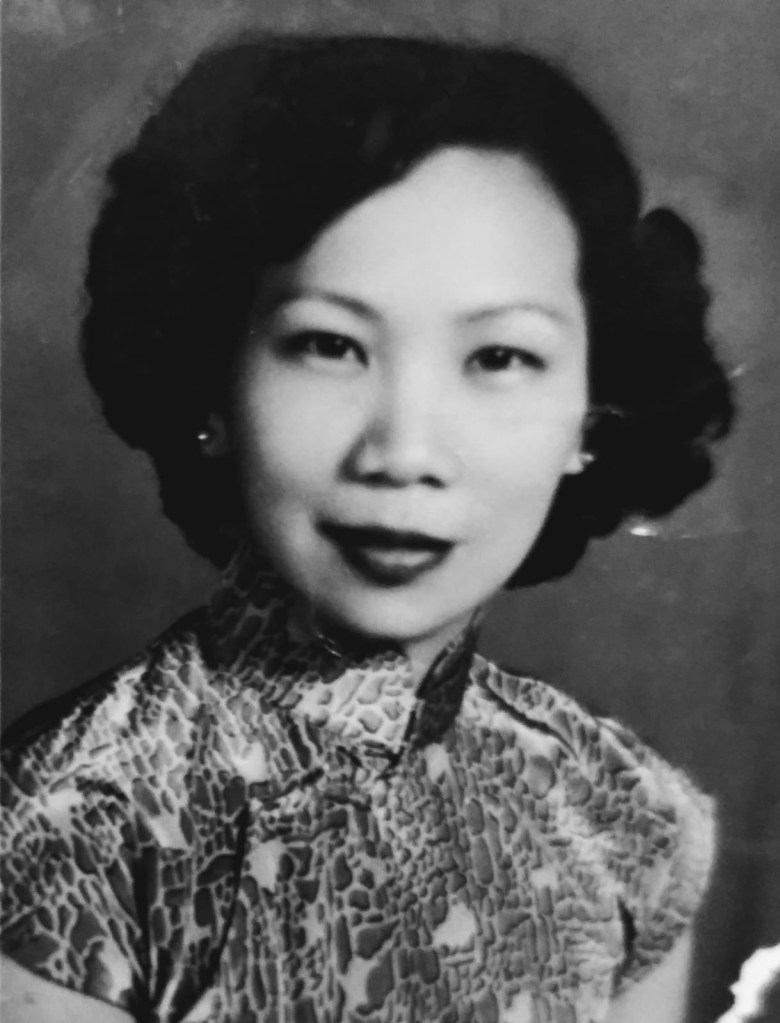


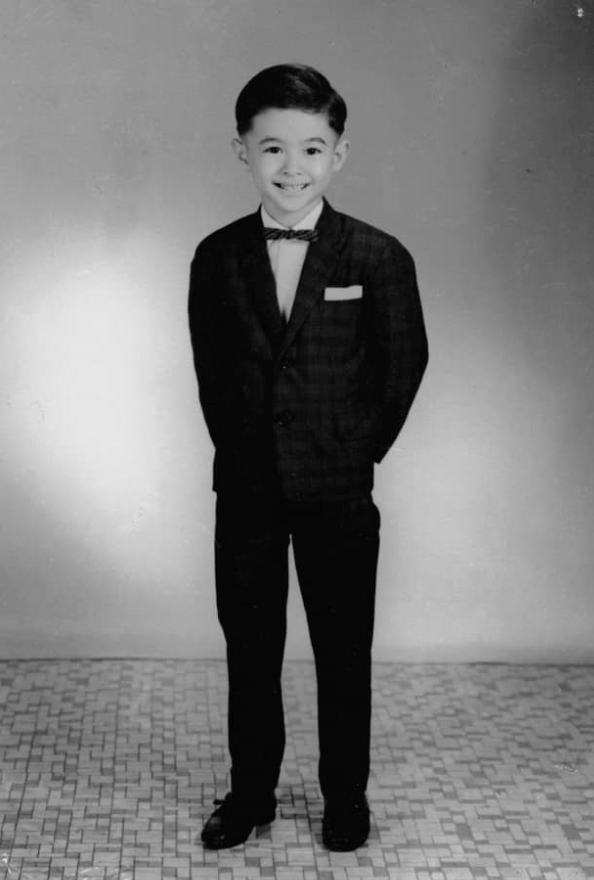

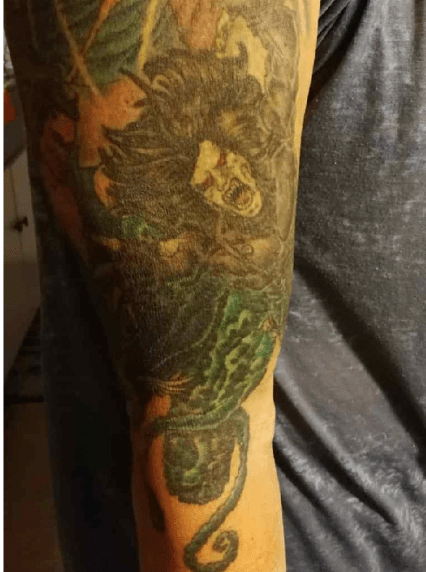



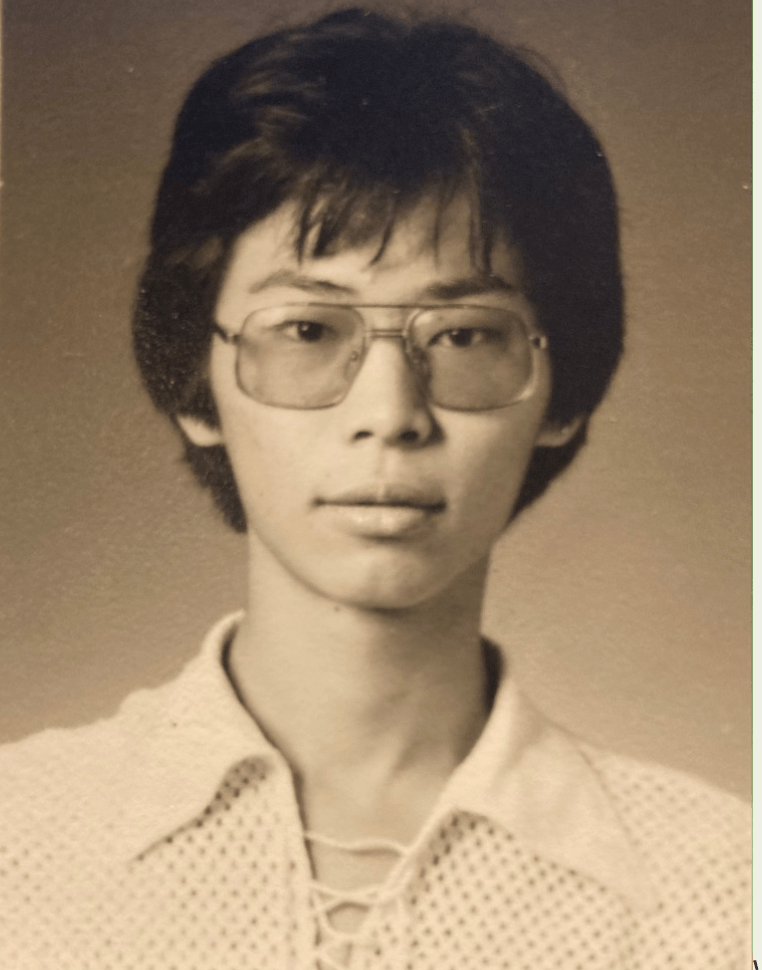
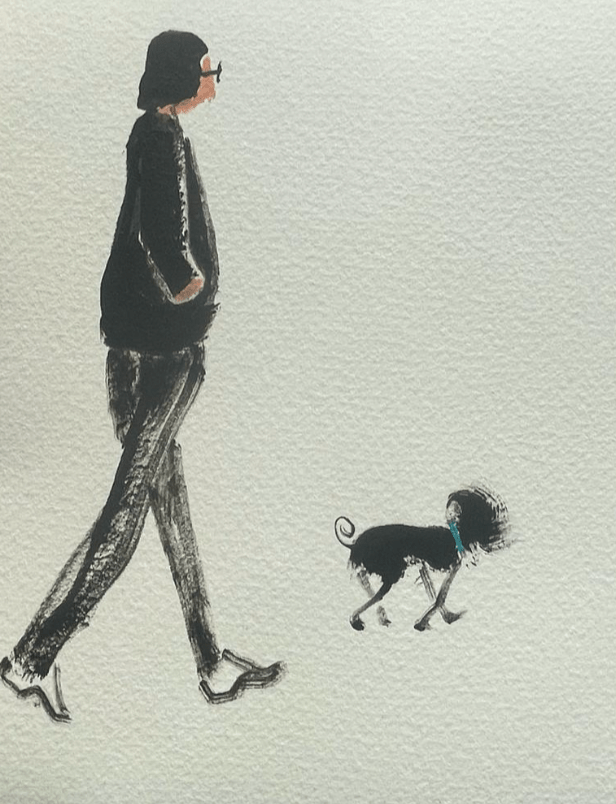


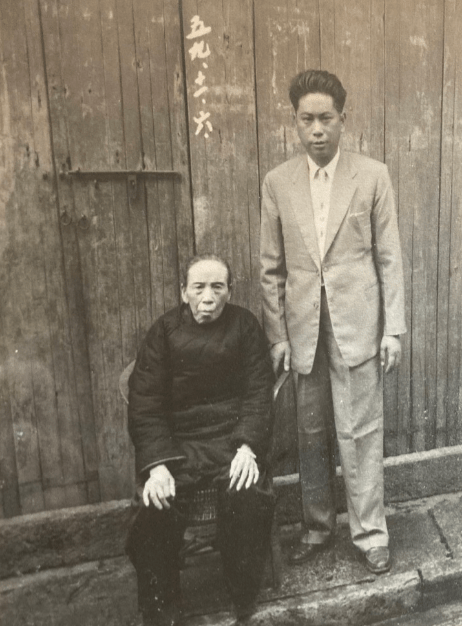
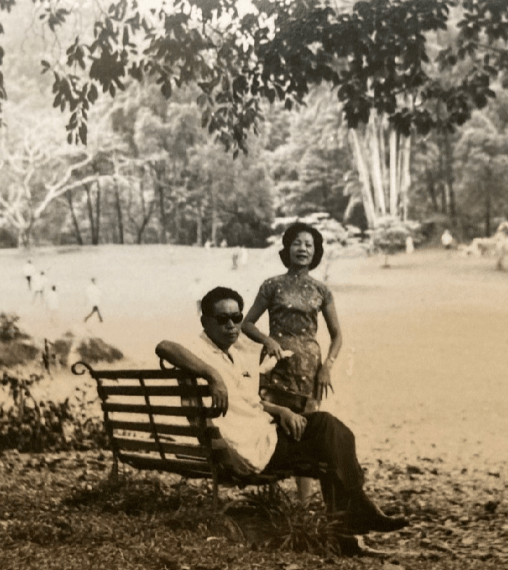

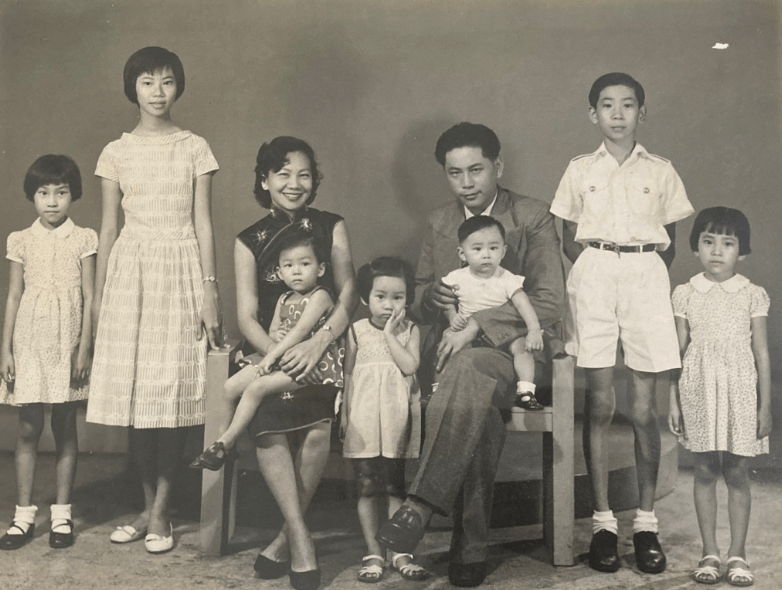
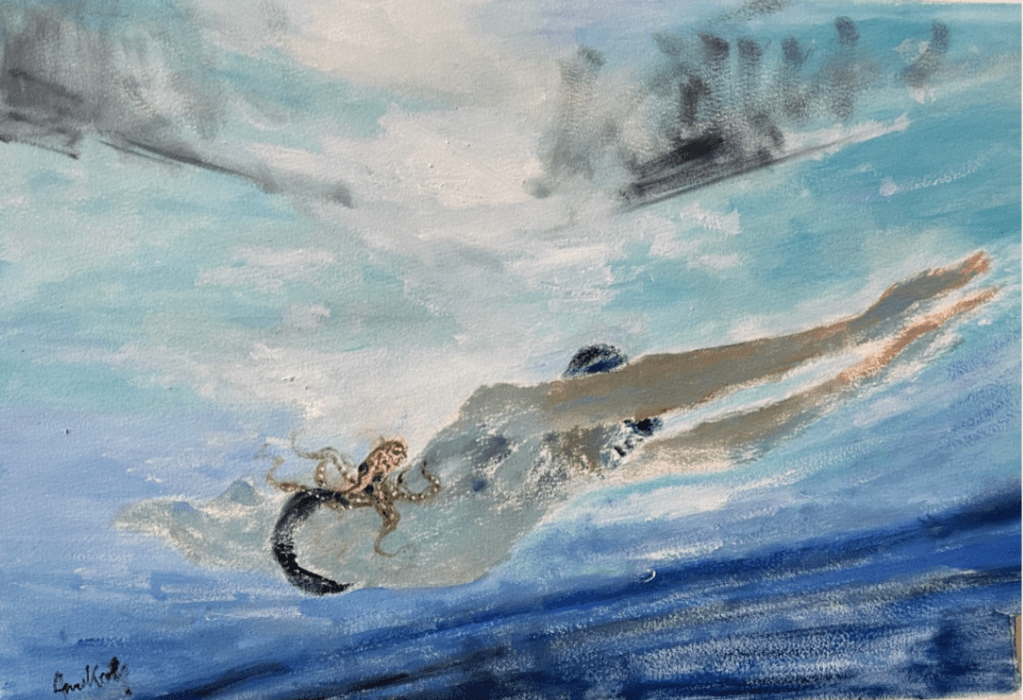


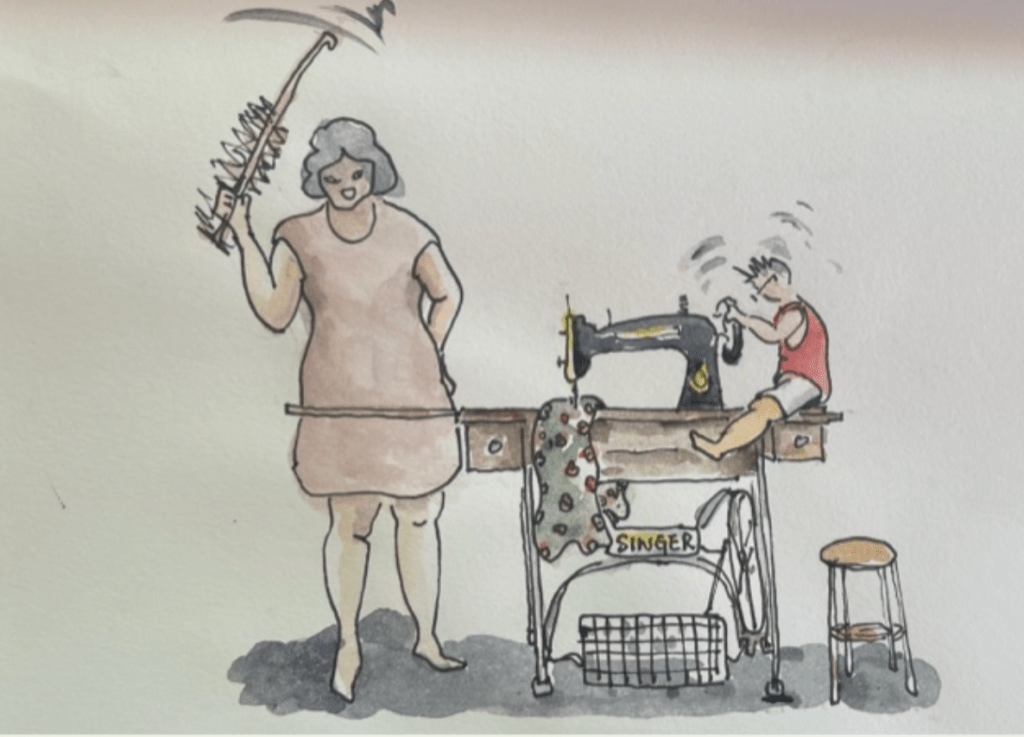
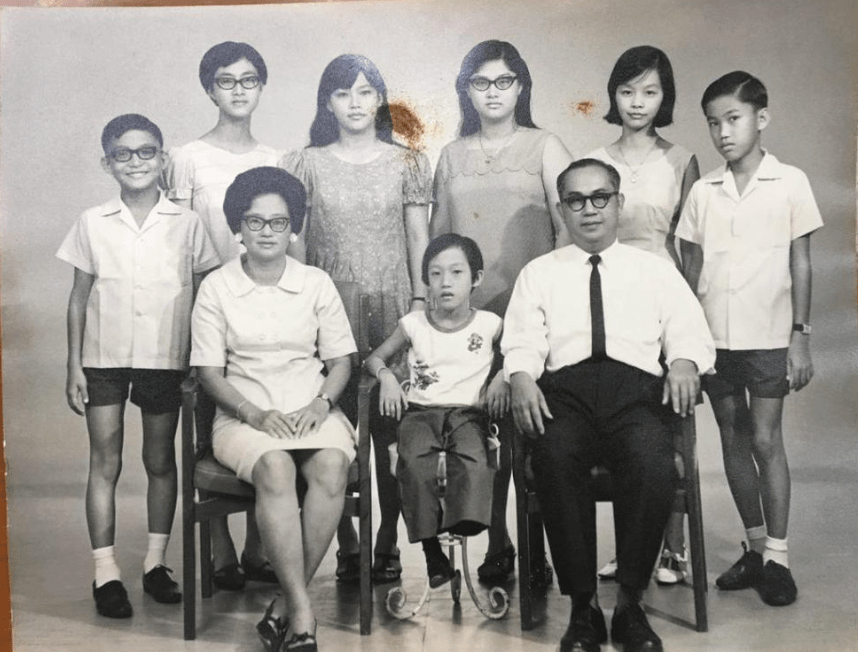



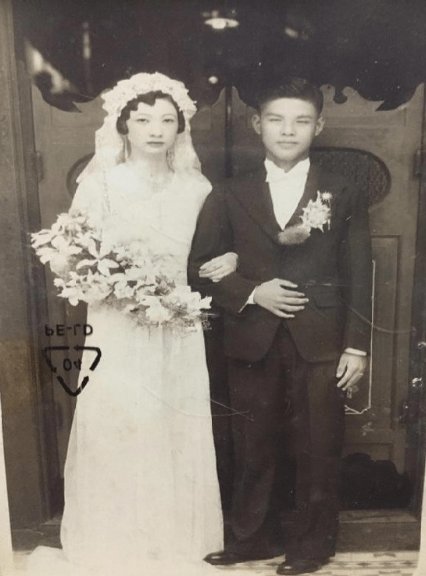
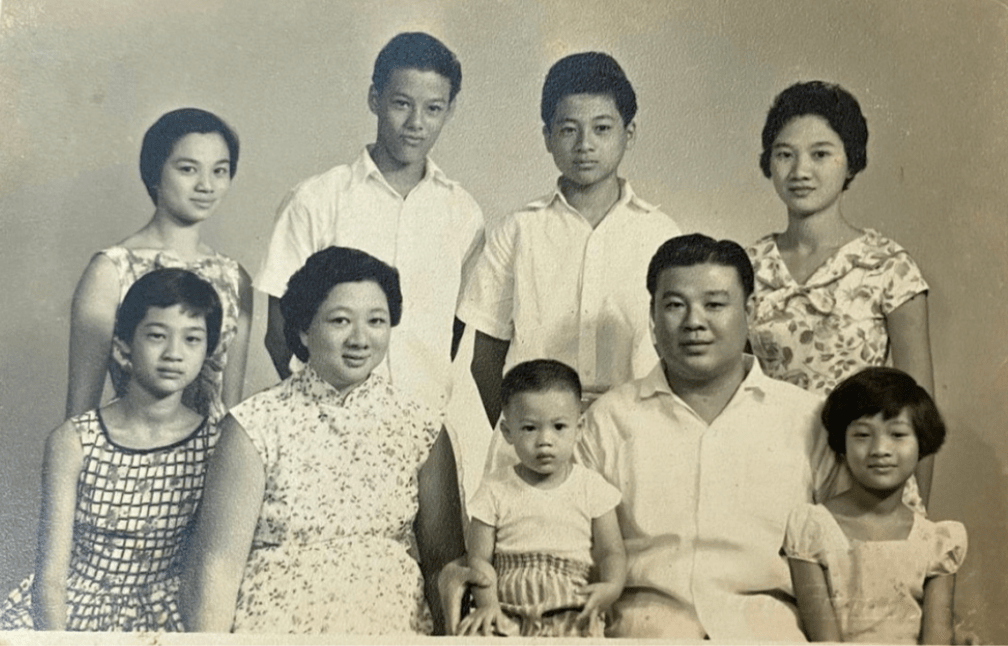


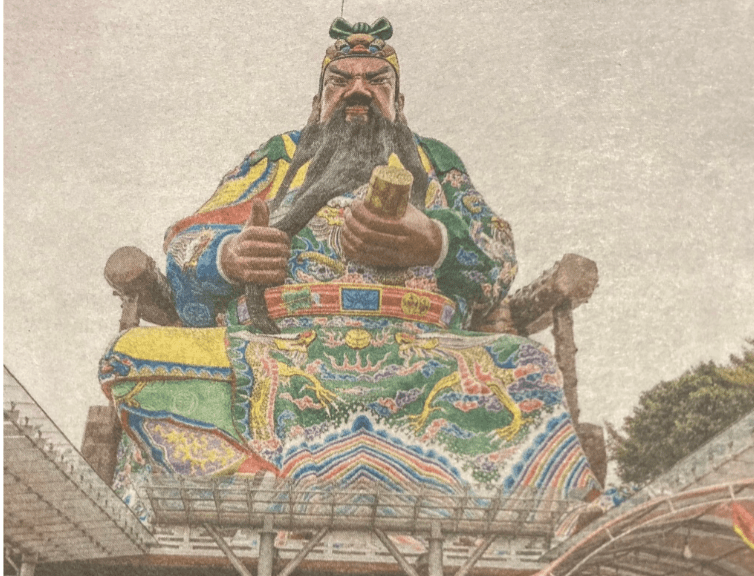
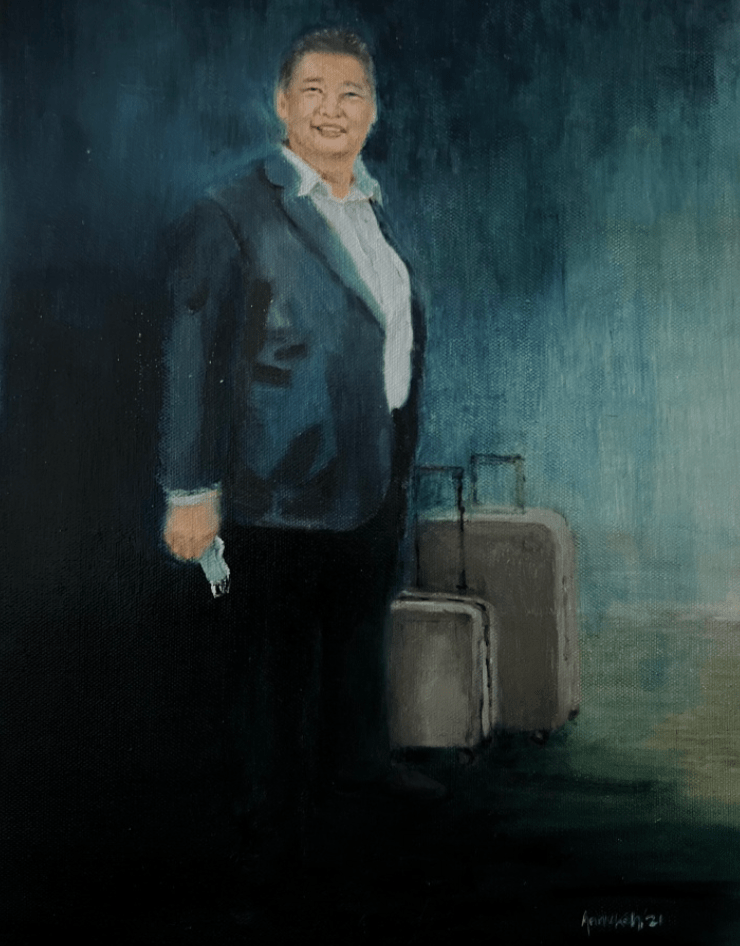


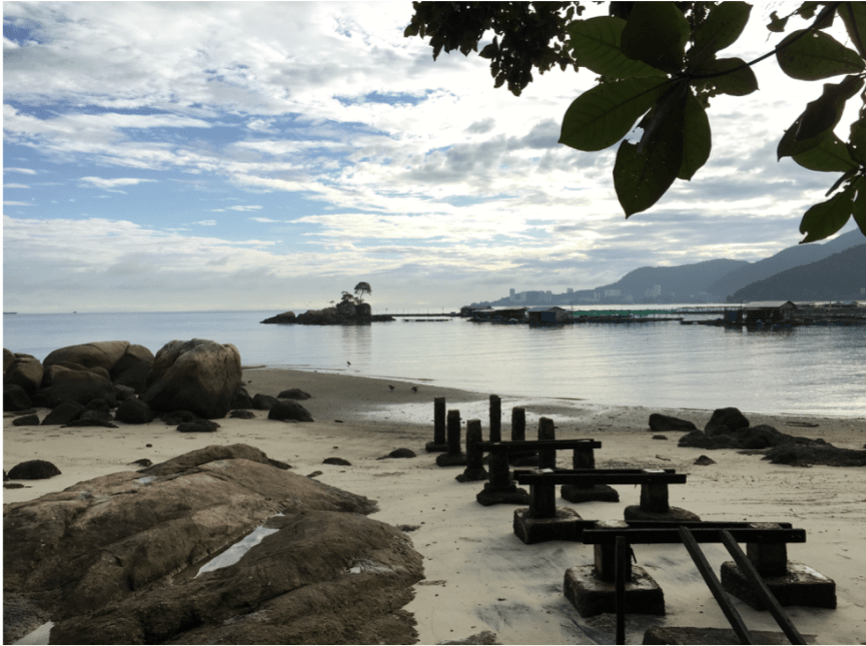


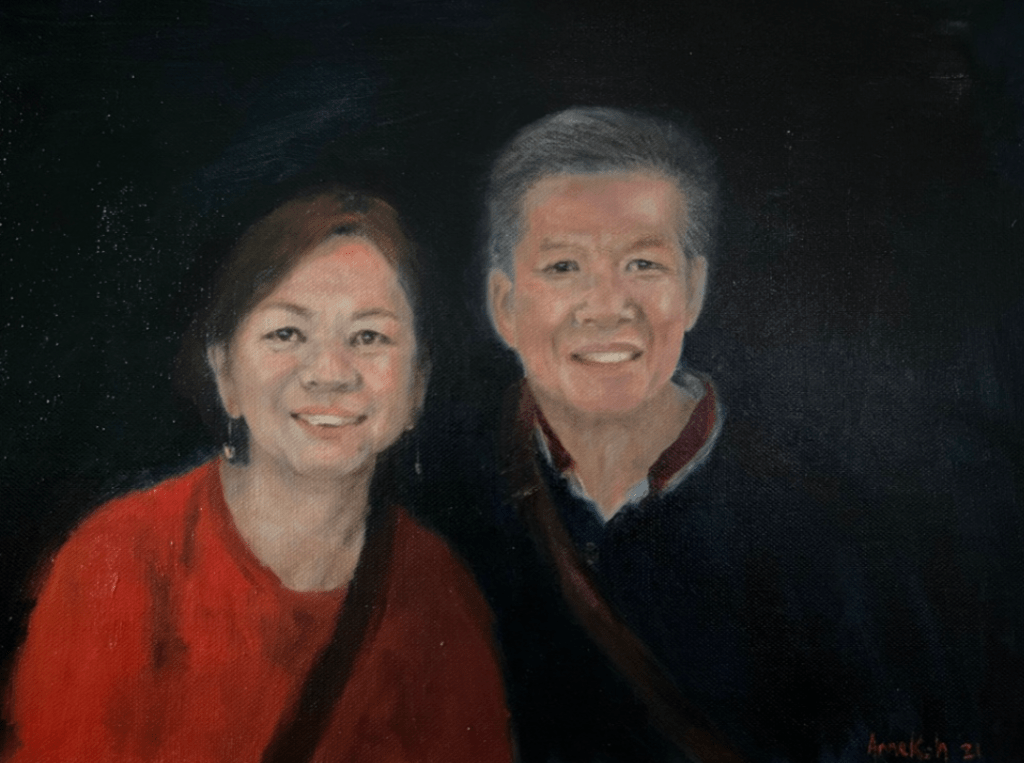



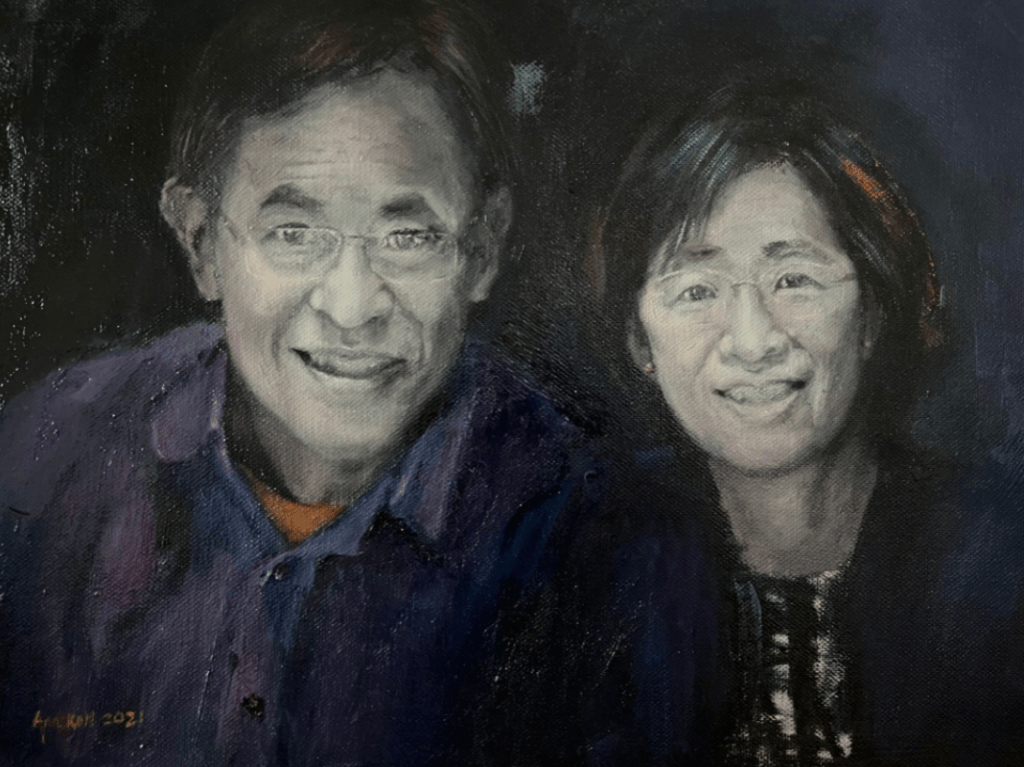

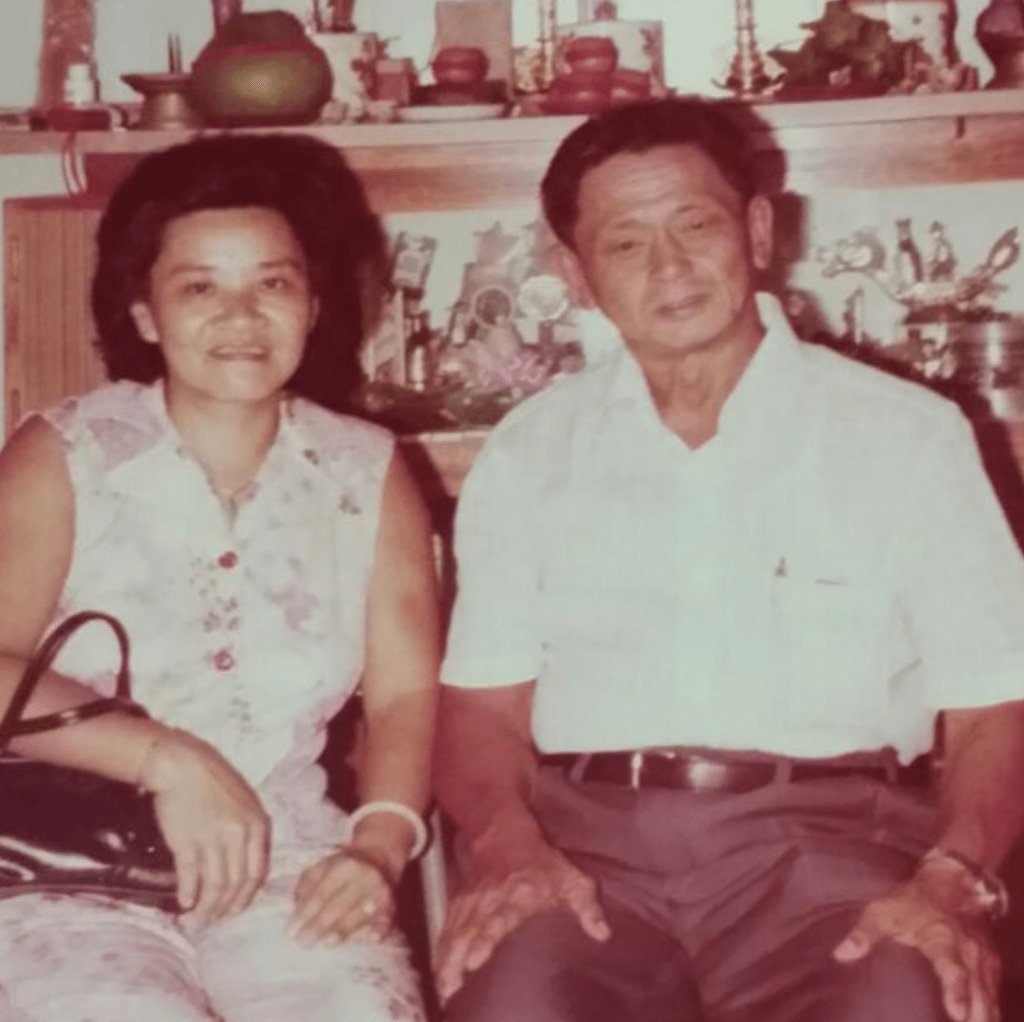






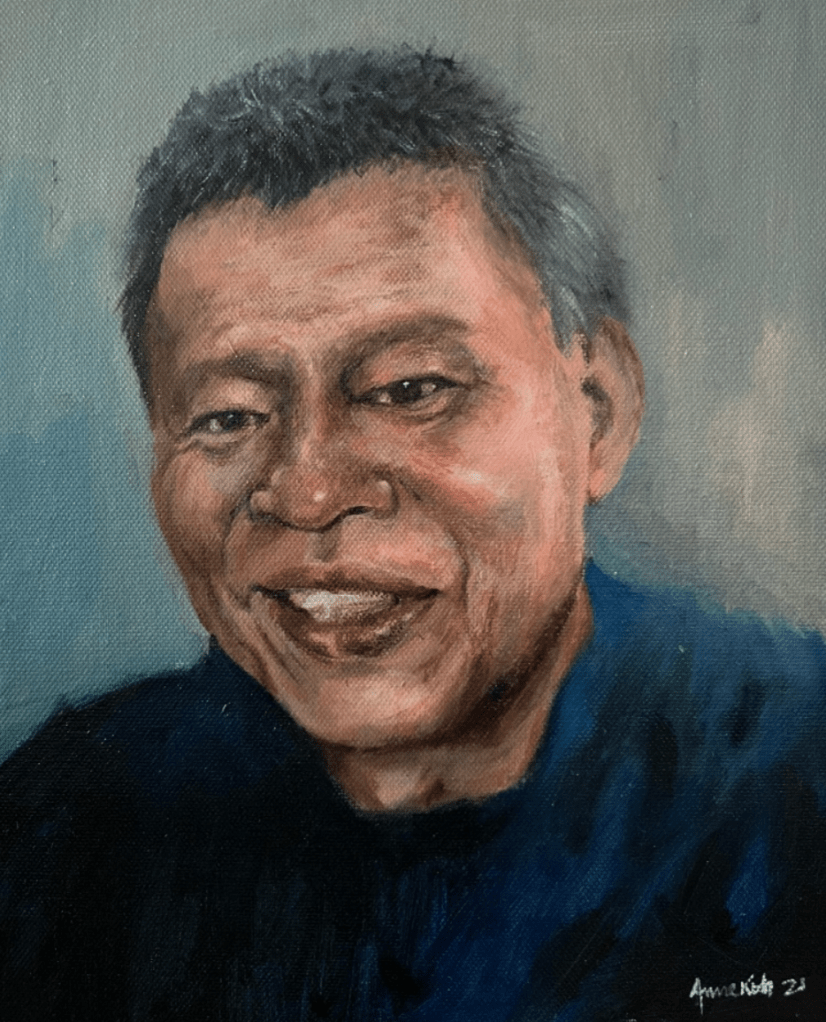


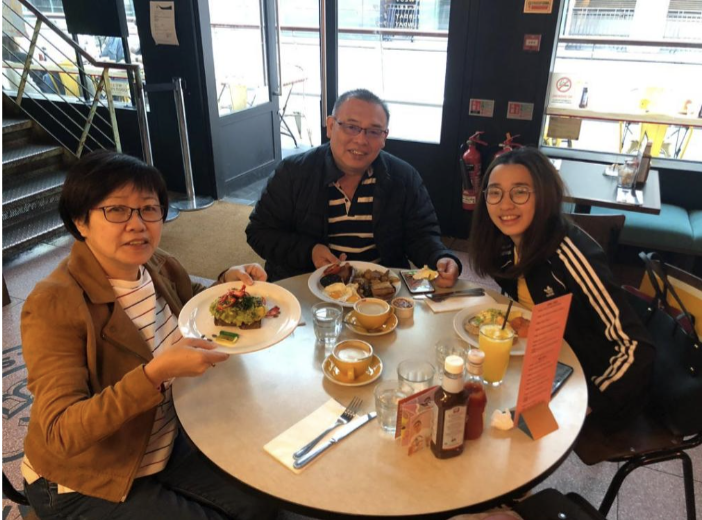


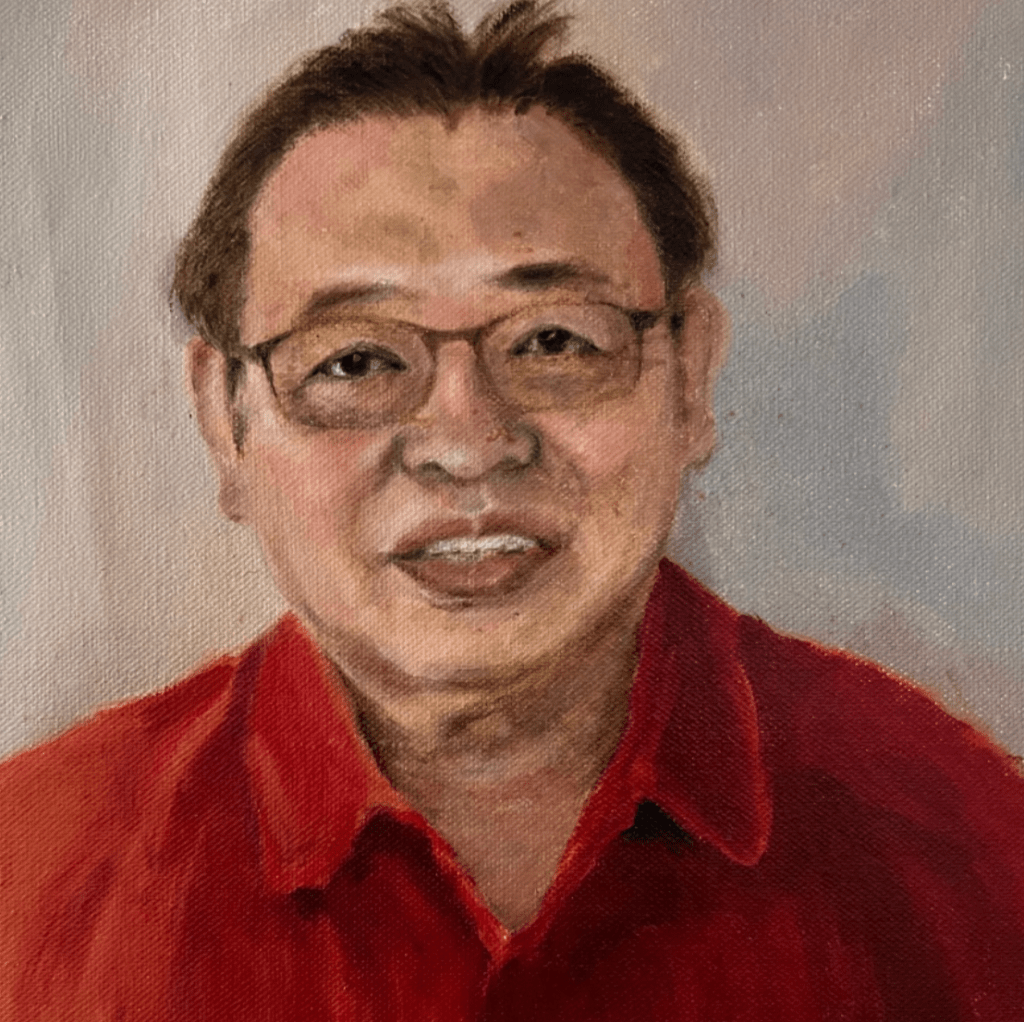
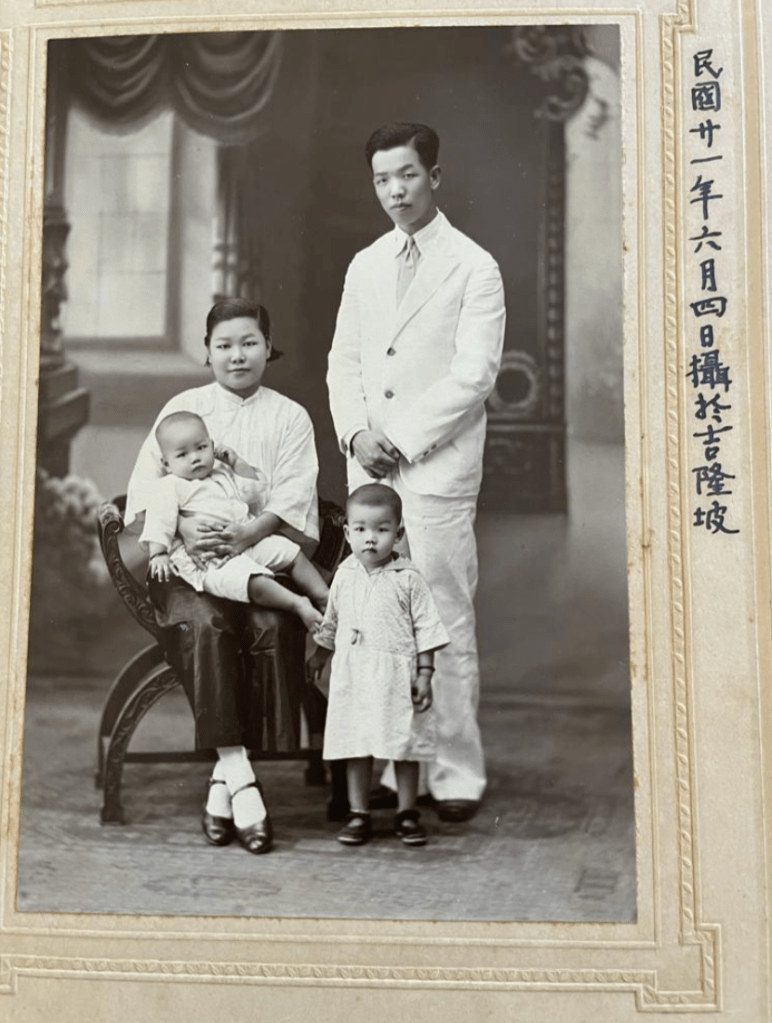





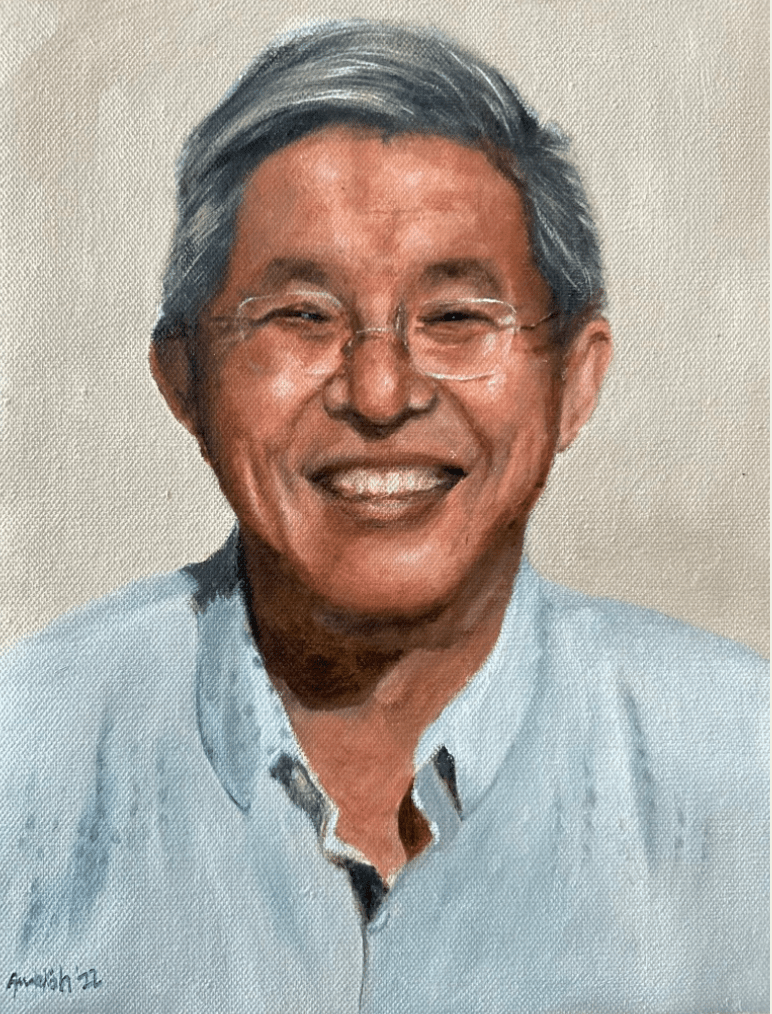








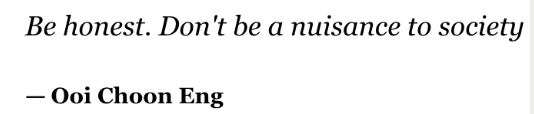
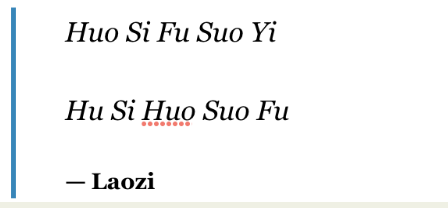


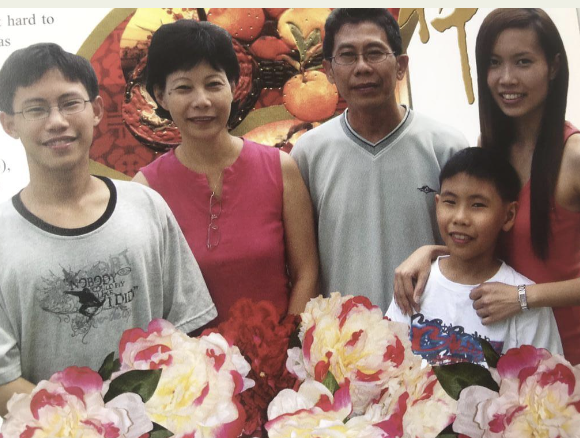
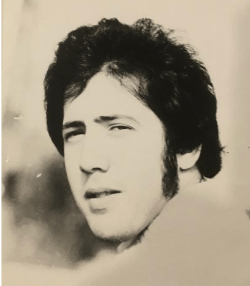


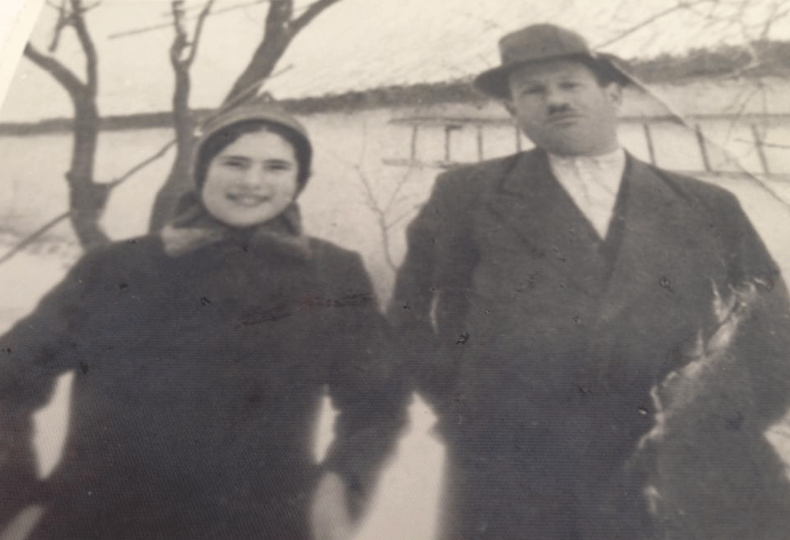
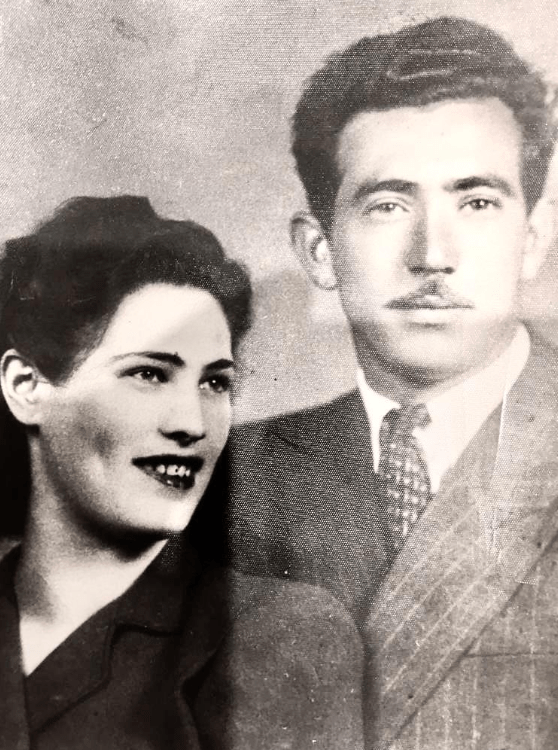

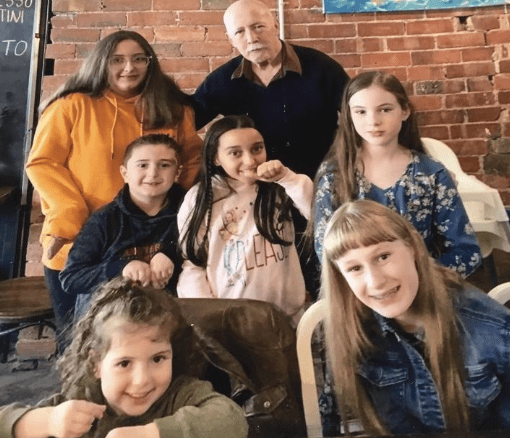




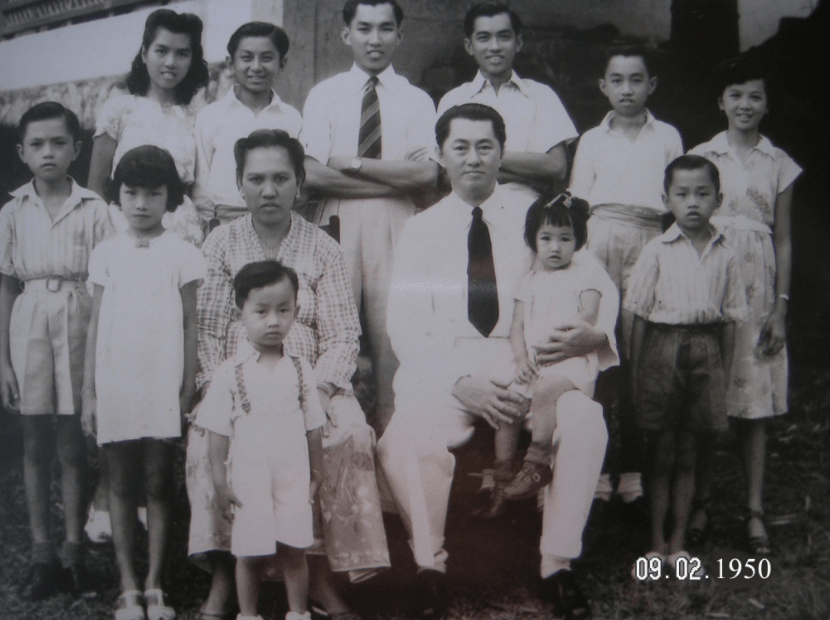
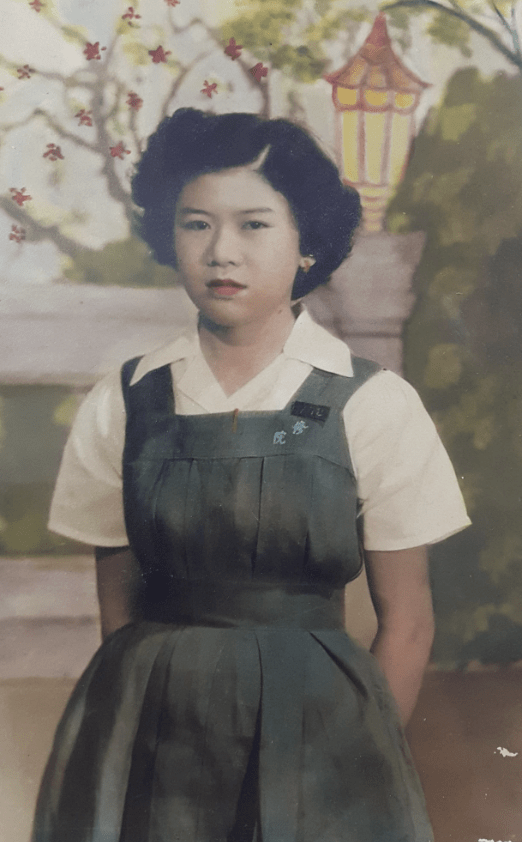





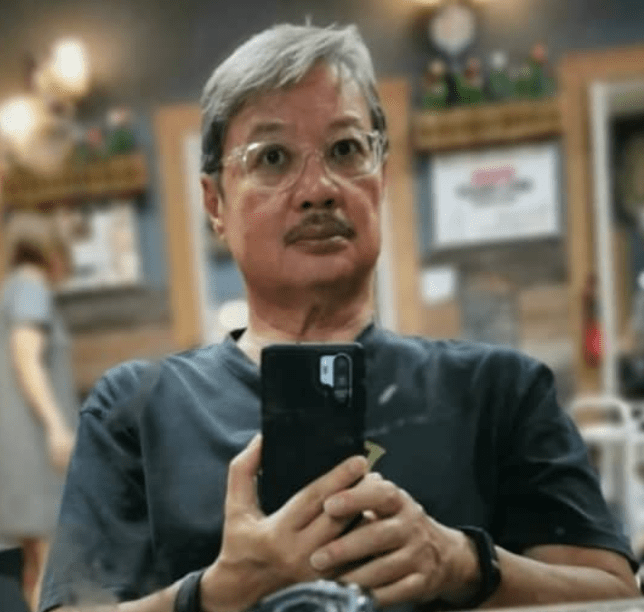





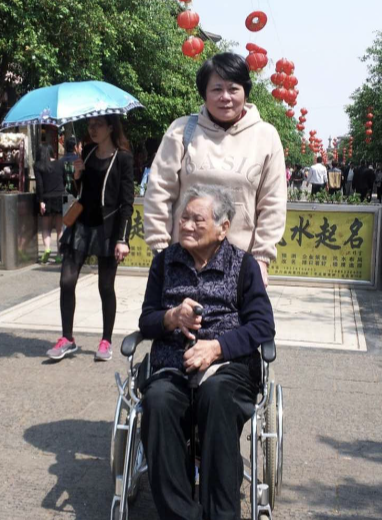

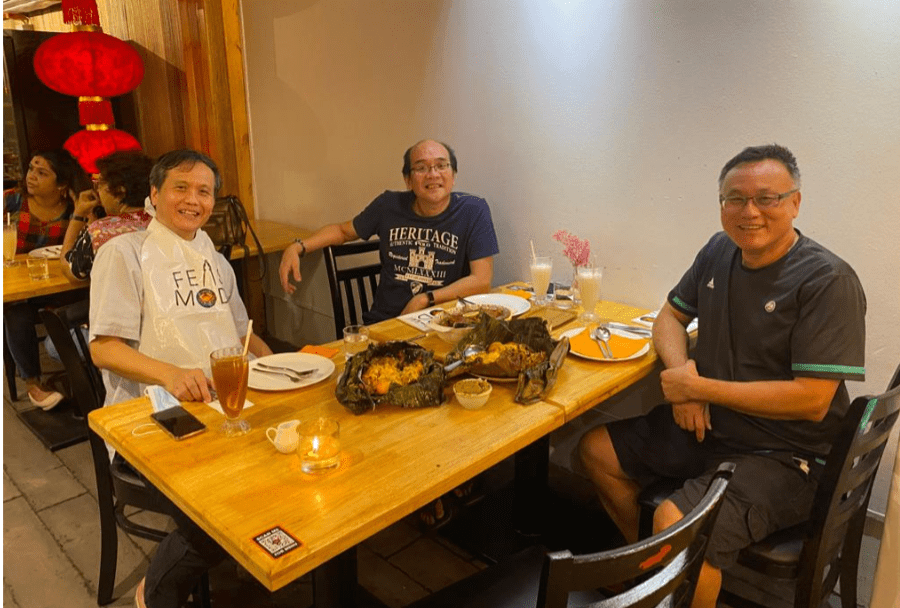
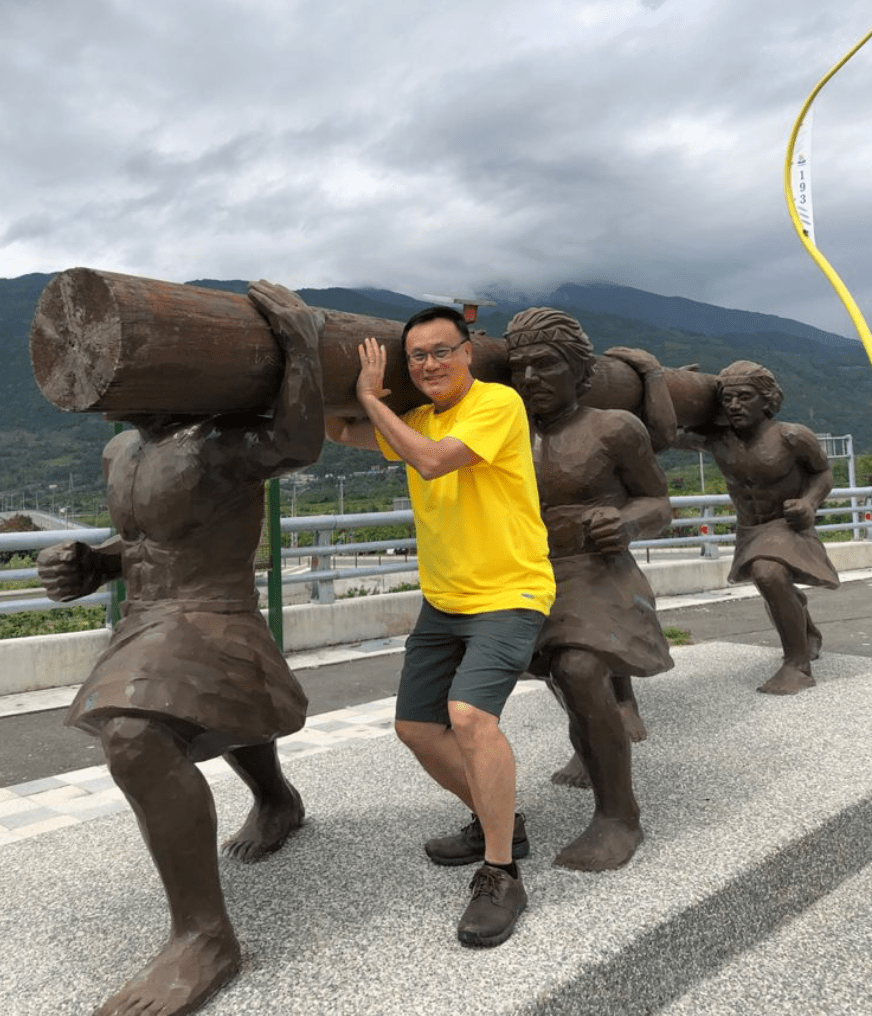
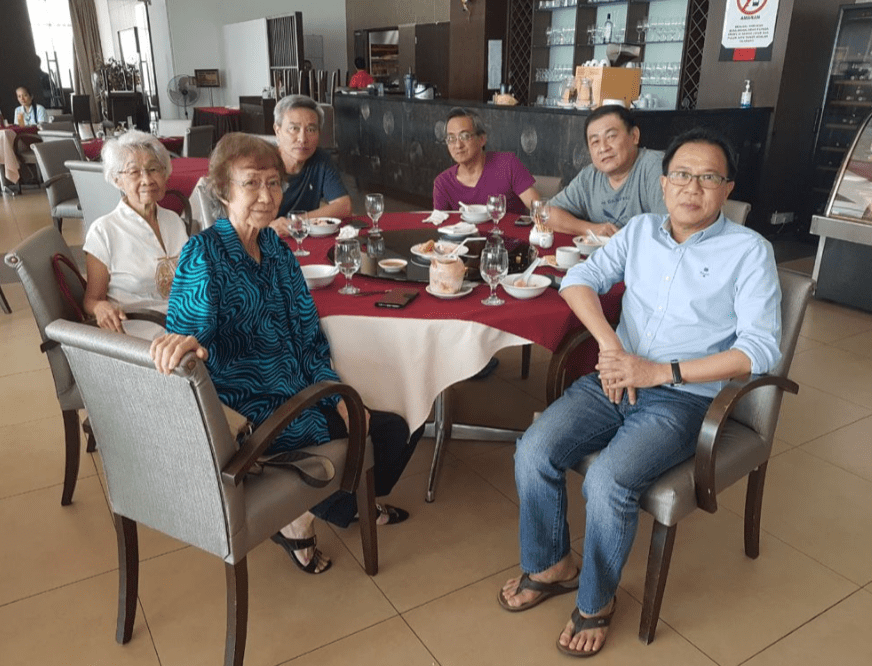
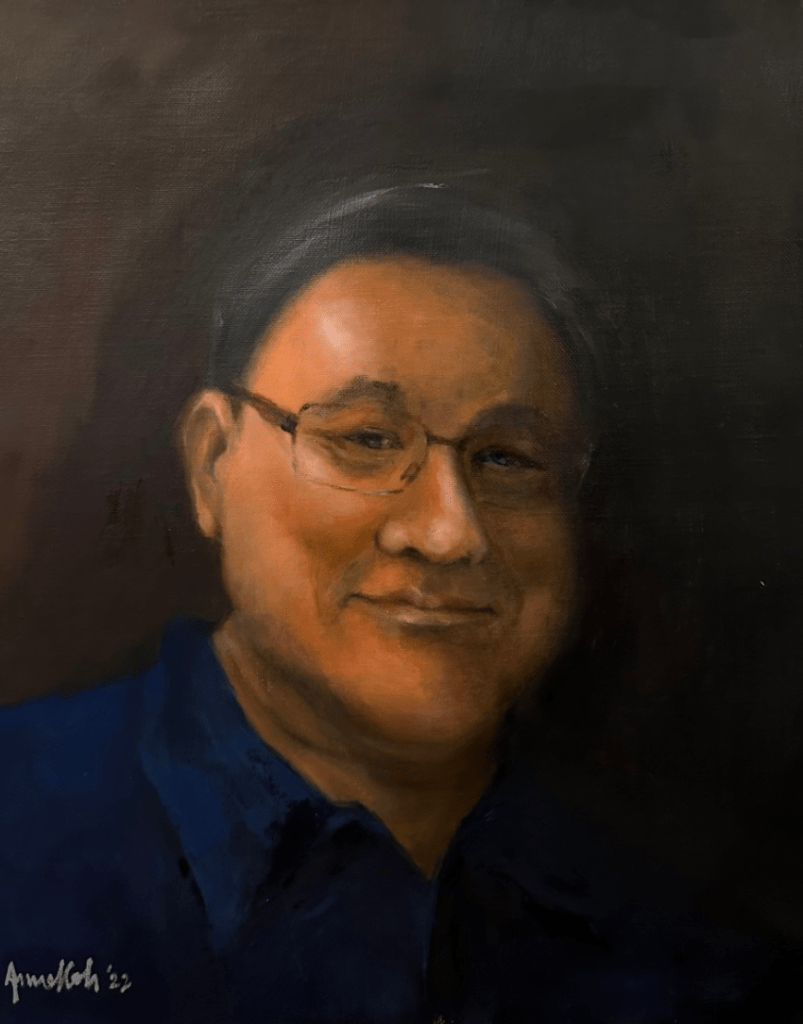










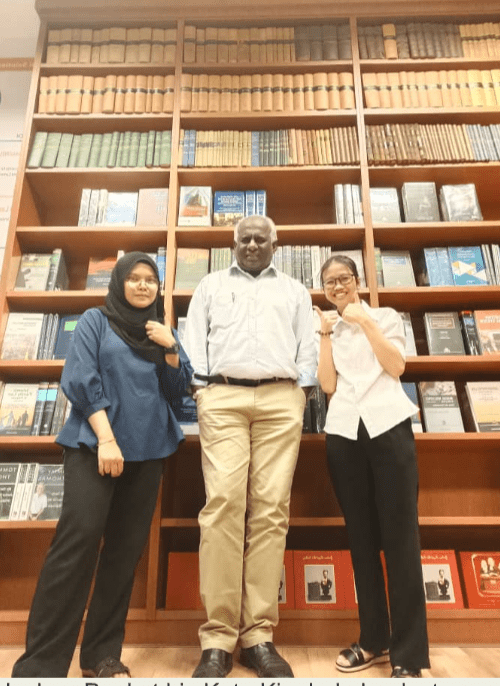


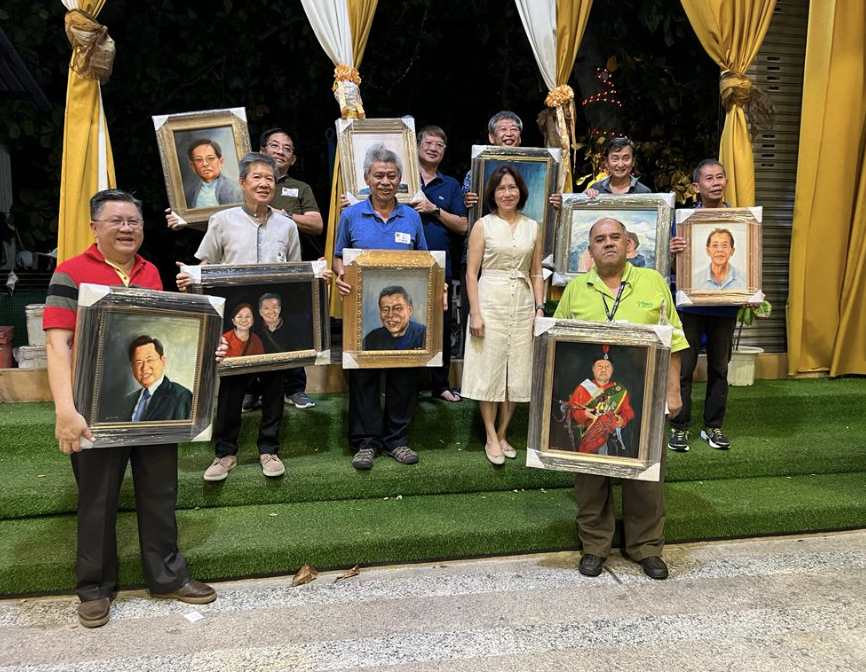




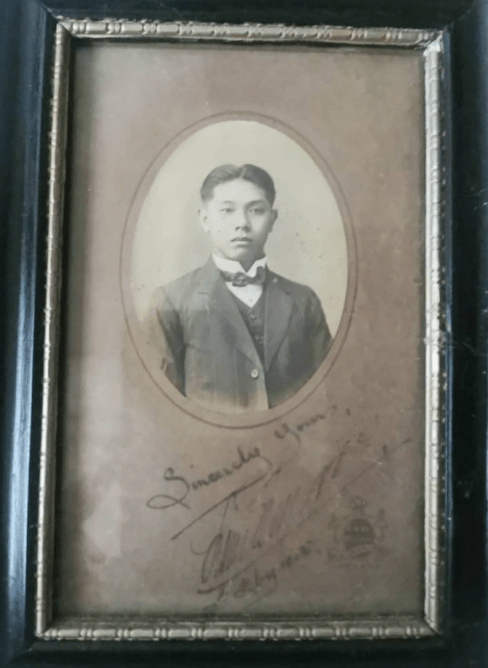

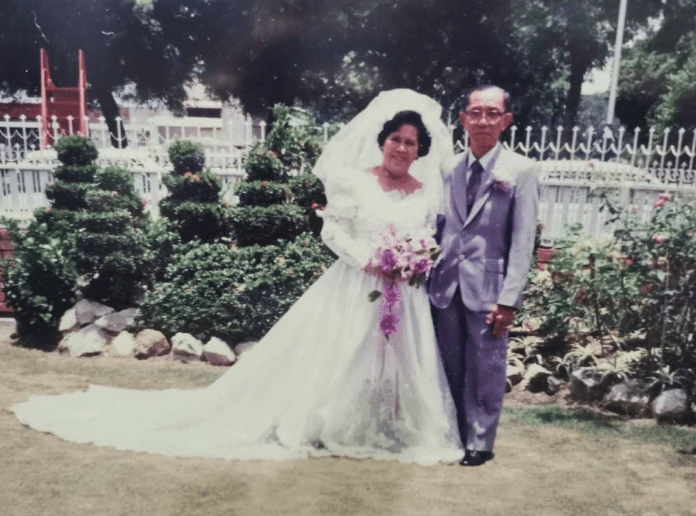



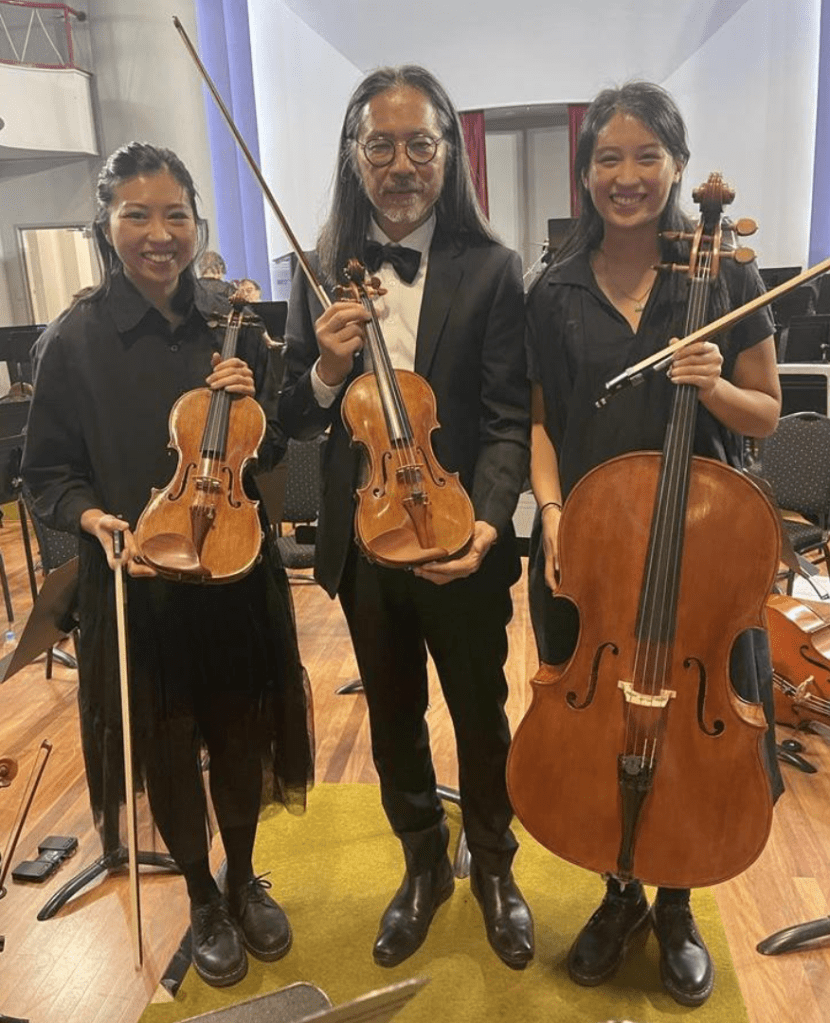




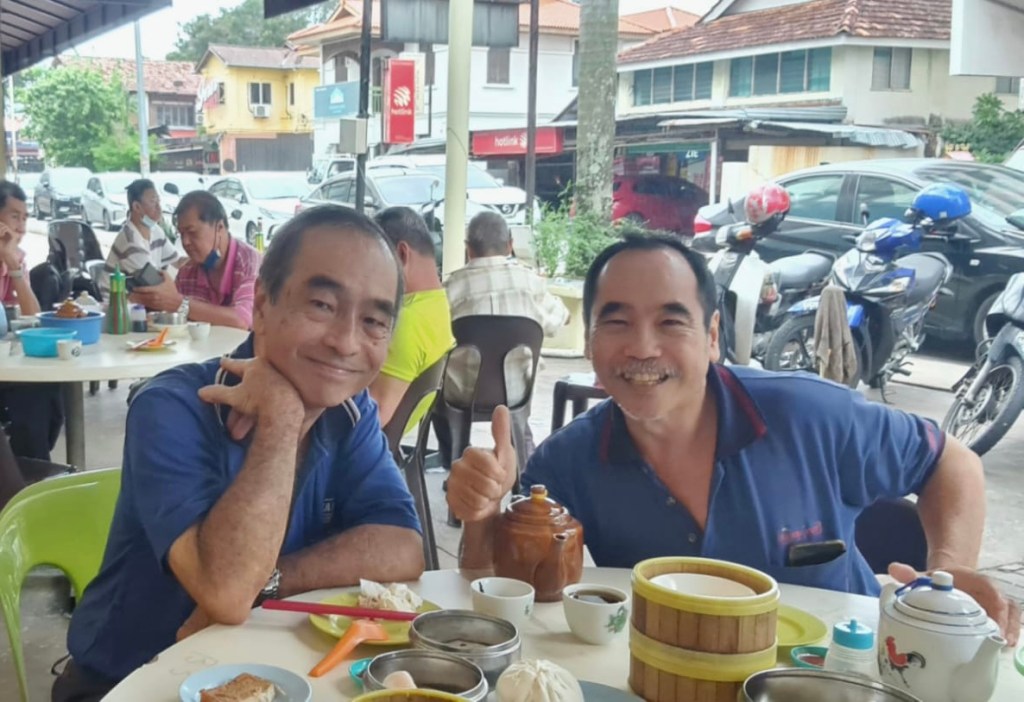
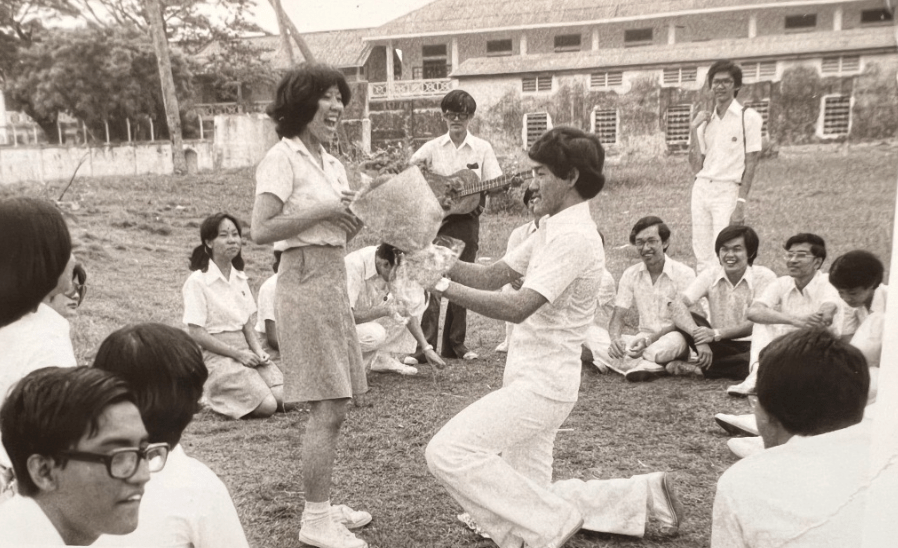

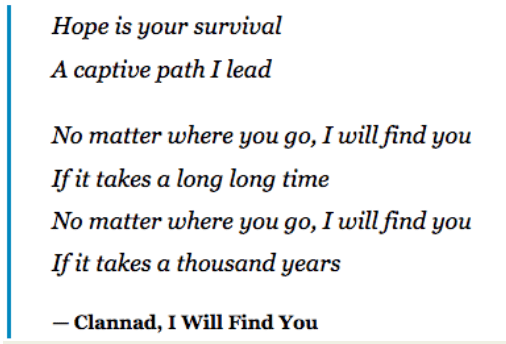

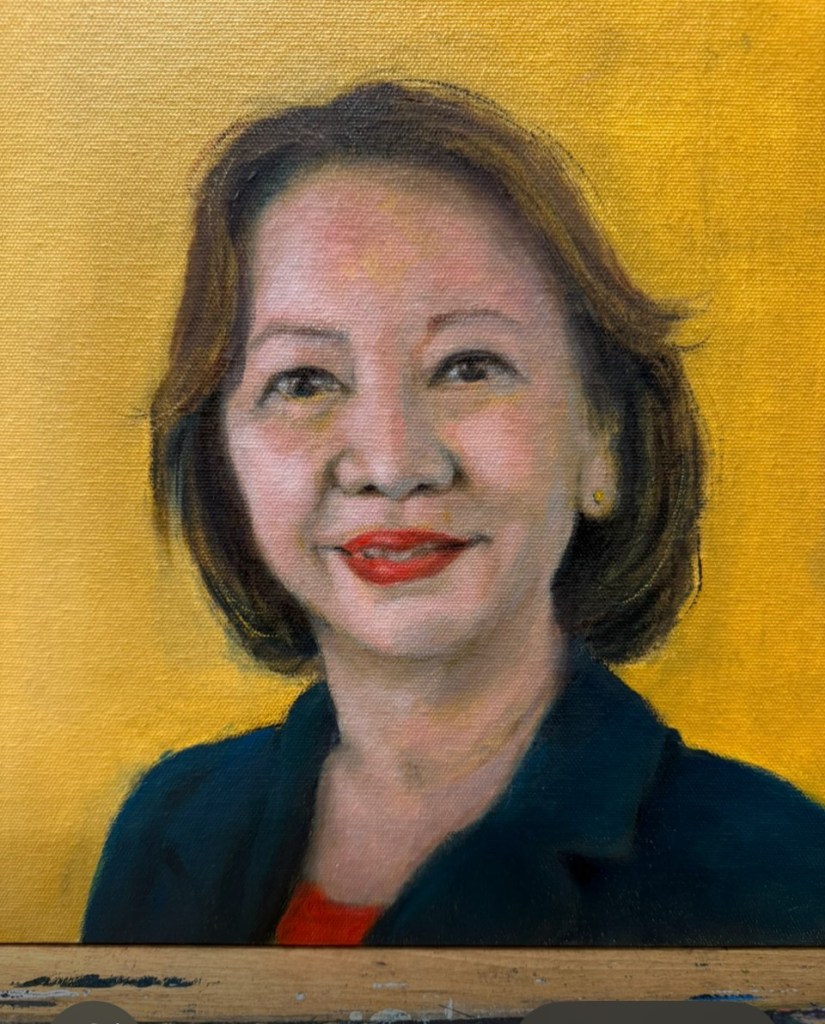

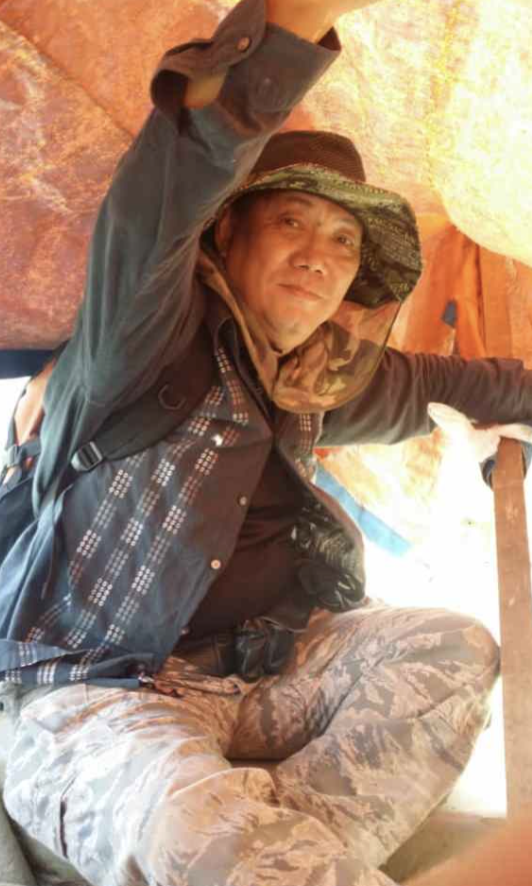

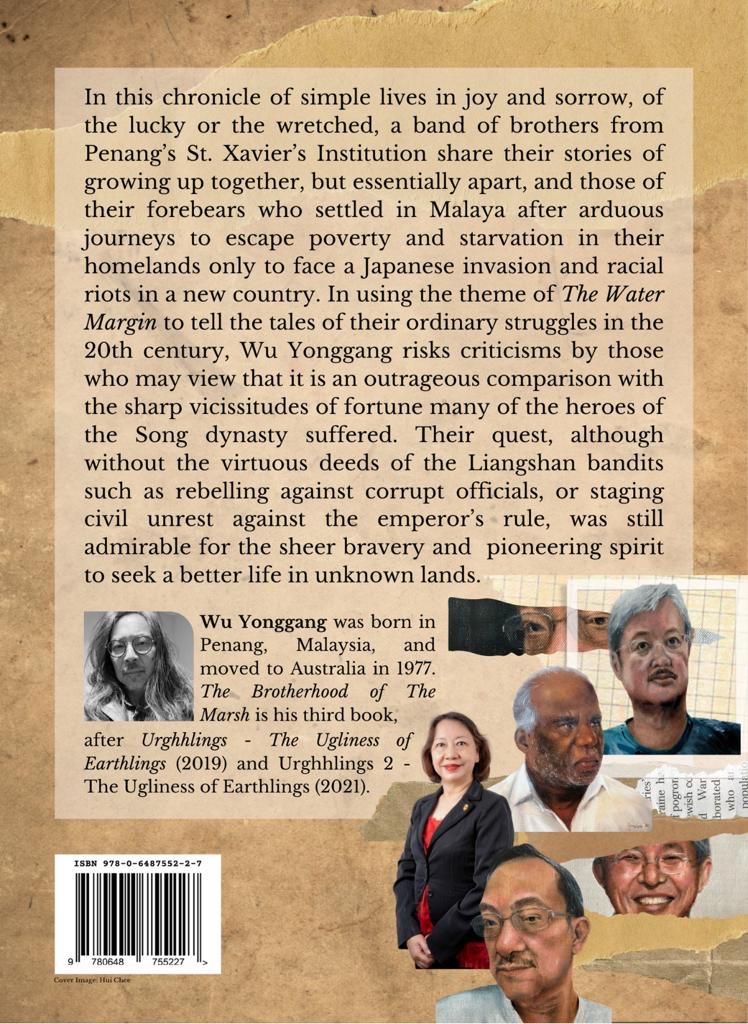
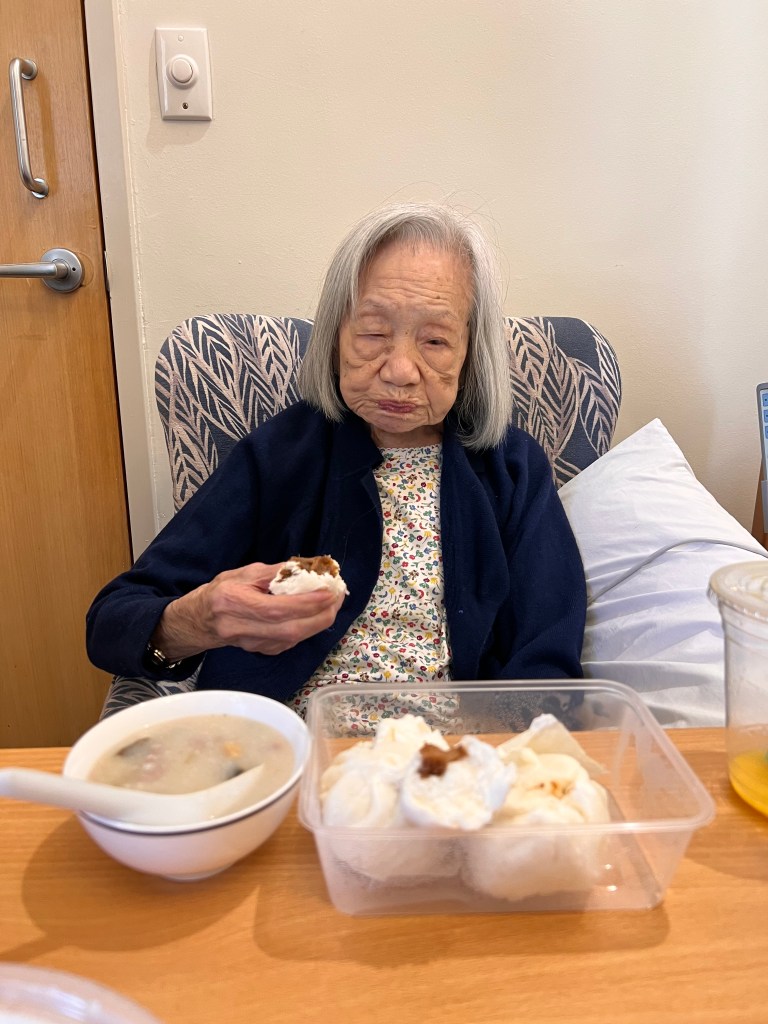

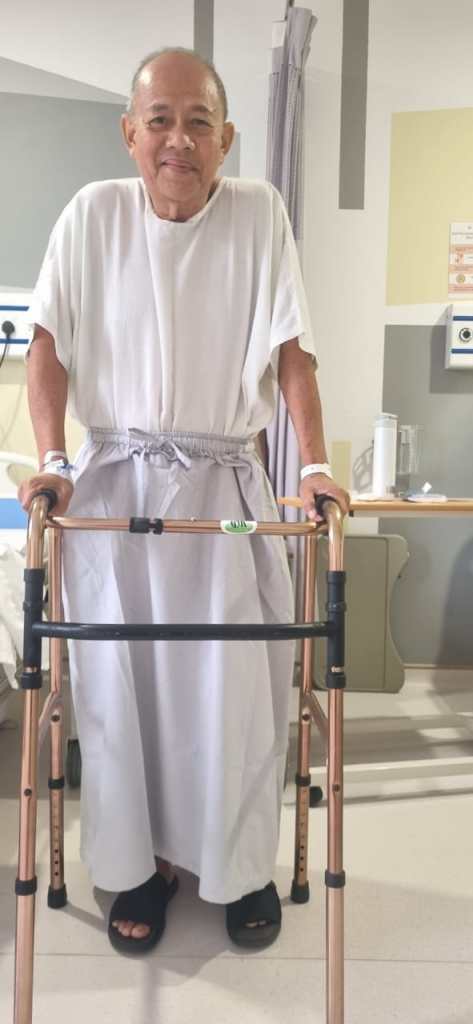
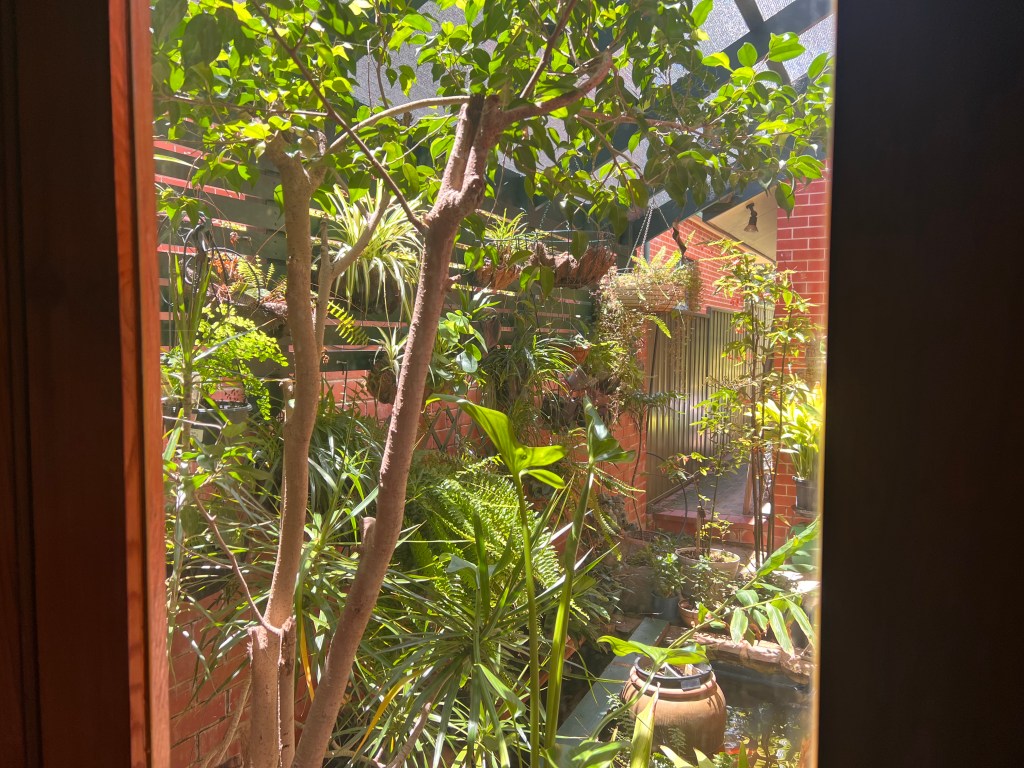
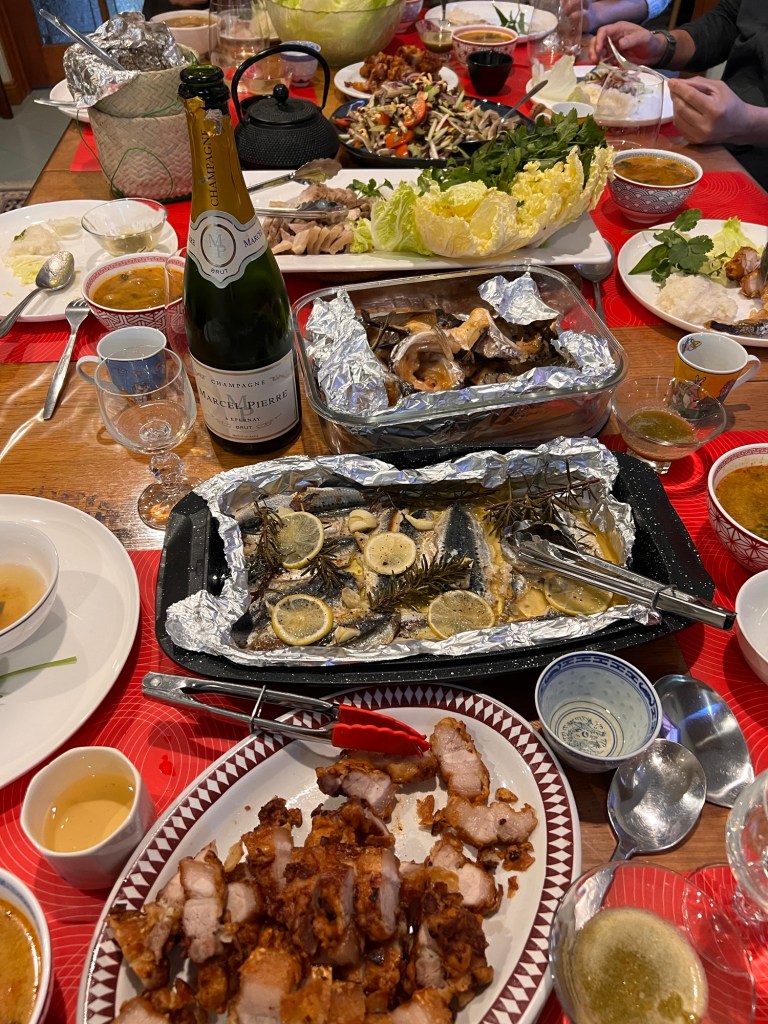

 Urghhlings