
The old man sighed. It was well past mid-morning when he made his second cup of long black. His eyes were smarting from the sweat that sluiced them but they didn’t hurt as much as his heart; that was smarting from his Mrs’ comments about his physical weakness a few moments earlier. Stoicism taught him to ignore what and who he can’t control. We can only control our own reasoned mind, or so we should hope. It’s quite often that people can’t control themselves, yet they have the sense of entitlement that they expect to control how others think or what they believe in or how they should behave. But, this was his Mrs’ opinion of him – of course, it mattered to him.
“But, should it?” I asked and challenged him.
He chose to ignore me and carried on enjoying the simplest of pleasures in his life – sipping his coffee. It was still fasting time, so it had to be without milk. He gave up on sugar in his coffee a long time ago, after learning that sugar hides the real taste of coffee or maybe it was after discovering that sugar was cancer’s favourite food. It was still an hour to go before lunch with his lunatic mother but he decided against taking a shower to wash off the smell of his perspiration. Cleaning the pond filters and changing the yellow water may look easy work to his Mrs – everything looks easy for her – but carting buckets and buckets of the dirty water to nourish her veggie patches was becoming hard work for the old man. Instead of appreciating his bursts of energy, she asked him to cart more buckets to the front garden which was about twice the distance away.
“Lunatic mother?” I asked, shocked that he would call his mother insane.
“Life robs us of everything, in the end,” he replied whilst massaging his right elbow.
Tendonitis was affecting the old man’s lifestyle yet he persisted to simply live with the pain. He had done nothing about it apart from offering it as his excuse for his shrinking biceps and straight skinny arms.
“I can’t lift weights anymore,” he said, demonstrating with his crooked elbow.
It was something his son could not understand about him. The younger man would never do nothing and simply accept the status quo about anything that’s detrimental to his life. They do not leave life to fate. They will change their lifestyle, their life and even their fate. That, in essence, is believing in karma, I suppose. It is through our own volition, our actions – past and present – that determine our own happiness or misery, luck or misfortune, peace or hell, our own fate, actually.
“Fix it, Pa, before it’s too late,” the son said, rolling his eyes as he and his girlfriend secretly exchanged messages without words.
“I get all that, but a lunatic mother?” I asked, like a rabid dog not wanting to let go of its grip.
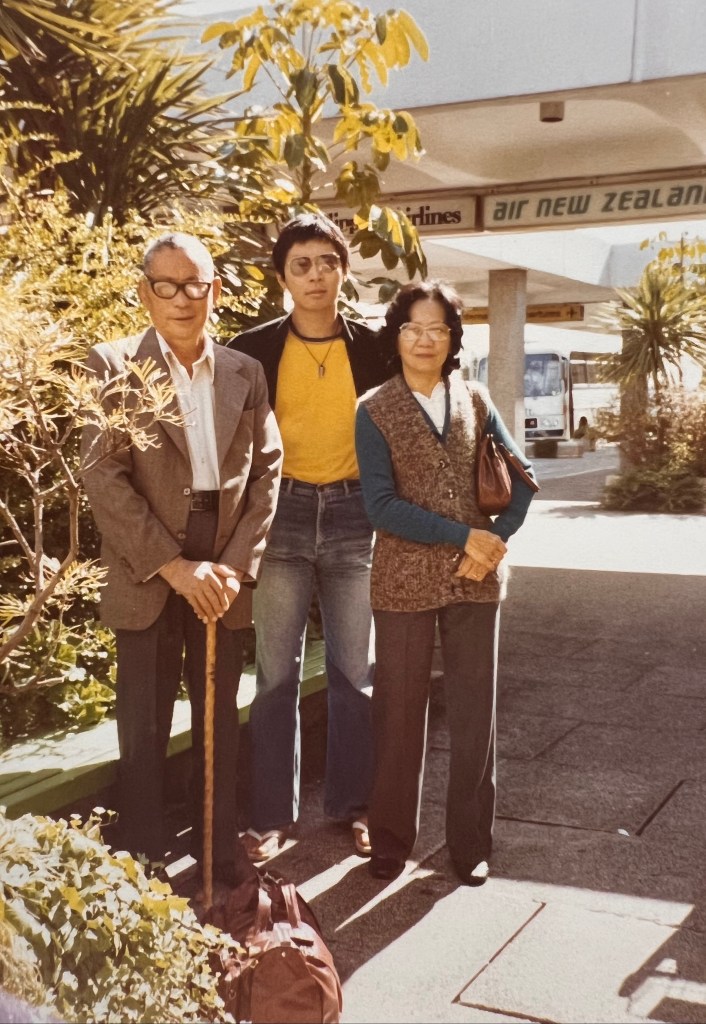
Life robs us of everything. Born innocent, our eyes will have seen evil by the time we grow up or grow old. The old man has seen his youth shrivel up after spending his adult life in the hot and dry mediterranean environment of Adelaide. A callow fellow when he first stepped onto the tarmac at Adelaide Airport in ’77, everything was foreign and interesting to him. The Greek girls in school called him Bruce. Believing every Asian boy was Bruce Lee reincarnated, they hassled him during lunch breaks to show them some “karate” moves. He kept them bright-eyed by saying his Shaolin teacher always preached discipline and never allowed him to ‘willy-nilly’ show off his skills. He never had a teacher, of course, although he convinced himself later in life that he didn’t lie, that he learned “a lot” from Bruce Lee and Fu Sheng movies and from Drunken Master and Once Upon a Time in China trilogies. He parroted Bruce Lee’s words to the Greek girls as if they were his and then basked in the respect and adulation they gave in return.
“I fear not the man who has practised ten thousand kicks once, but it’s the one who has practised one kick ten thousand times that I fear.”
The callow fellow was a popular bloke in the small circle of Asian students in school. Homesick and lost in a big new world of white people, they were a tiny minority and with strong guttural accents and poor diction and vocabulary, they did not assimilate very easily in society. Some of the girls took the callow fellow as their psychological rock. They went to him for advice or simply to ask what the heck was a dog’s breakfast or what “fair suck of the sauce bottle, mate,” meant.
“Just tell them they are dreaming,” he told them, whenever they didn’t understand what was said.
A mere few months after he graduated from uni, he married the pretty girl he met in the Commerce faculty. A mere few years after that, they produced three gorgeous kids. So, the callow fellow went from a single fellow to become a husband, a father and a son-in-law feeding seven mouths in the family and slaving to pay a home mortgage. Life robs us of our freedom and then our youth.
The years passed by. The parents-in-law passed. The business he built grew and grew and he patted himself on the back, telling himself he was useful at home and useful to society. The kids grew up and flew away, leaving an empty nest. That was twenty years ago. It did not feel so long ago that he was singing to them, “The hills are alive with the sound of music.” Suddenly, he is over the hill. Now, he is staring at the birth of his retirement life. Business suppliers hardly call on him now; there are no more free holidays overseas, no interstate trade shows by invitation, and if they did call, expect the occasional cup of coffee instead of the many expensive dinners. Like a pupa, life is transforming, twisting and turning, giving him no solace. Ageing, just as it gave his dad insomnia, is giving him sleepless nights. ‘Happy hour’ is now a good sleep just before dinner whilst listening to conspiracy theories on Youtube.
The callow fellow is long gone, he finally realises. In the mirror, he sees an old man, with his deep etched wrinkles and dry hoary hair and hunched shoulders. It is a mirror that he avoided looking into during his prime; he didn’t need it to tell him the ugly truths about himself. But, he finally gazed into it recently, for an honest opinion. It is a mirror that he ought to have looked intently into all those years ago to tell him where he was headed and what awaited him. The mirror could have told him that life would eventually rob him of his wealth. He built and built but like a sandcastle on a beach, a big wave would come crashing onto it and simply wash it all away. Life robs him of his youth and now it robs him of his usefulness to his family and importance to his business.
Life has robbed him of loved ones and good friends and as sure as night follows day, it will continue to do so. This is the way of life. Eventually, after robbing us of our physical appearance, life will rob us of our physical abilities and then our mental faculties will be threatened too. The old man is losing muscle mass, with stringy thin limbs and a scrawny long neck. Not so long ago, he could easily touch the ground with both palms without bending his knees, now it is a stretch to expect him to do that. Lifting dumb bells each weighing thirty kilograms fifty times in one go was a routine just a couple of years ago, but this kind of endurance is no longer possible with his crooked elbow. Just as life robbed his dad of a limb and then of his movements, it has robbed the old man of any trace of the callow fellow. A cataract operation is inevitable in the next twelve months and his canine-like hearing is much impaired these days, needing his dog to tell him the postie or courier driver is at the front door. I quietly wondered if he will lose his teeth too – his passion for nuts and lobsters makes him a perfect candidate.
“What can I do to slow down the cataracts?” he asked his eye doctor.
“Nothing,” the eye doctor said and laid the cards on the table about ageing.
“At your age, you can’t slow it down.”
The first three words suddenly reminded him of a missed doctor’s appointment. He went for a medical checkup recently after a sudden jolt by Bikash, a former schoolmate who was told he needed an urgent open-heart surgery during a routine annual checkup. The old man’s doctor had expressed satisfaction after a brief interview, “you’re perfectly fine, for your age.” He was asked to make another appointment for his blood test results.
“Strewth, I forgot to go back!” he said agitatedly and blamed Google calendar for failing to remind him. Business appointments are increasing again but now with doctors, dentists, ophthalmologists and periodontists.
Life robs us of our ability to keep up with technology and then we begin to lose our memory too. We become forgetful which isn’t too innocuous unless life gives us Alzheimer’s or dementia. It was dementia that has robbed his mother of her regal demeanour, reducing her to fits of aggressive behaviour and delusional tantrums. Ageing makes us brutally honest; it tells us to believe we are running out of time and teaches us to become selfish and feeling entitled with self-importance when actually, we have lost all relevance and importance, past our use-by date. Life even urges us to call a spade a spade without questioning if our perspectives and beliefs are wrong.
“Are you serious? That doesn’t make her a lunatic!” I screamed at him.
That was unkind of him to say that about his mother, of course. The callow fellow would never have been this callous. Neither would he have been this careless with words.
In the end, life robs us of our ability to reason and our joy in life before it robs us of life itself.
 Urghhlings
A vivid description of how aging caught up with the seniors of 60plus. Aging gracefully and no pretentious effort of being young again. A detailed observation of life goes on though the protagonist has aged.
LikeLiked by 1 person
It’s kind of dark and hard for the younger reader to understand or accept. Life is a journey no doubt but eventually we are robbed along the way of everything we have, cruelly even our good and happy memories for those sufferers of mental illness
LikeLike