
Feeling not the least homesick twenty days into my Asian holiday, I’m on the plane from Chongqing to Guangzhou. Chengdu and Chongqing each have a population of about 30 million. I expected to be overwhelmed by a mountain of people and a sea of tourists (人山人海)yet it was surprisingly pleasant and orderly in both cities. China has amazingly modernised in leaps and bounds. Their great leap forward indeed has been realised in the four decades since Deng Xiaoping opened up China to become the factory of the world, so the technological advances today give us a glimpse of what the future for mankind will be. This rapid evolution is visible in every corner, from the seamless integration of digital payments to the high-speed rail networks, like the G8609 first-class service from Chengdu East to Shapingba, that link these sprawling megacities. The sheer scale of development is difficult to comprehend until you witness the efficiency with which these urban centers operate, balancing massive populations with a level of urban planning that makes many Western cities feel antiquated in comparison. This efficiency was evident throughout our mainland China itinerary, which included private chauffeur services and English-speaking guides facilitating our visits to landmarks like the Wuhou Temple and the Sanxingdui Museum.
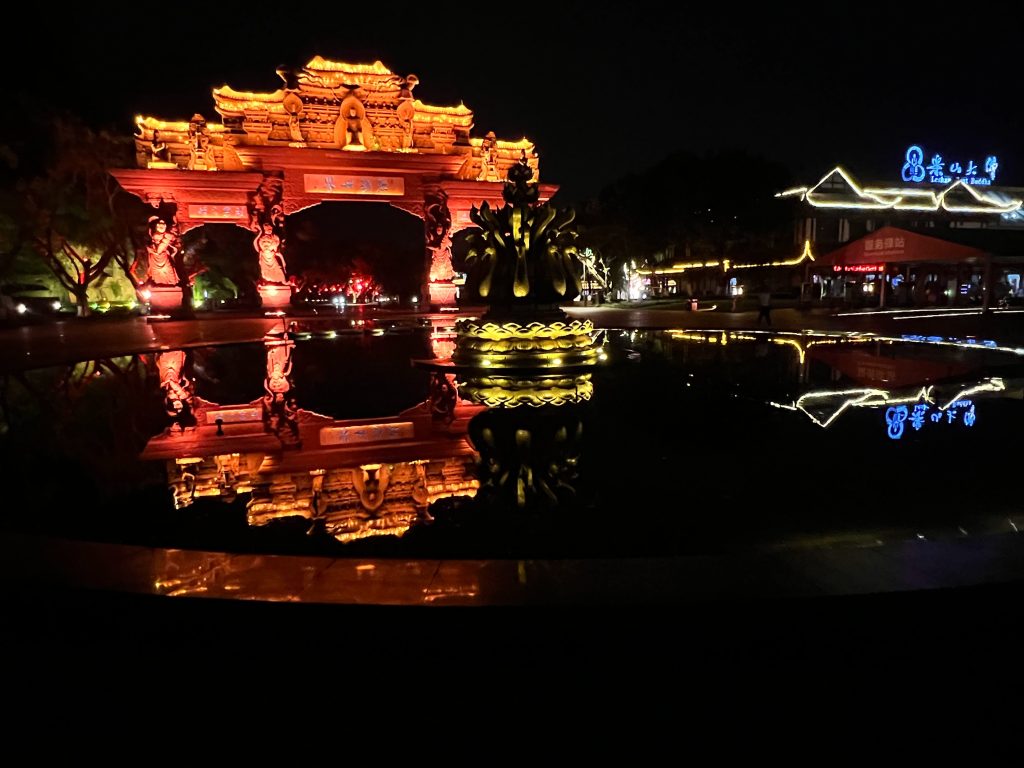
So much has happened, the highlights in Taiwan are becoming blurred by the exciting revelations in Chengdu and Chongqing. Each new experience in the mainland seems to layer over the previous memories of Taipei, Taichung, and Kaohsiung. While Taiwan offers its own unique charm and cultural nuances, the sheer momentum of China’s “tier one” cities creates a sensory overload that demands one’s full attention. The contrast between the familiar, slightly worn aesthetic of Taipei and the neon-drenched, futuristic skylines of the mainland—exemplified by the 180° luxury river views from our hotel in Chongqing—is stark, making the trip feel like a journey through different eras of development simultaneously.
The reunification of Taiwan with the mainland felt like an inevitable conclusion of history. While some metrics suggest a GDP growth outstripping its giant neighbour, the visual reality is one of stagnation; there is a palpable lack of fresh architecture or infrastructure compared to my visit a decade prior. Conversely, Chengdu and Chongqing have morphed into living tableaus from Blade Runner. In these megacities, the future has arrived prematurely, manifested by a youth culture sporting bizarre attire, unconventional hairstyles, and cosmetic choices that render gender a mystery—unless, of course, they are draped in the traditional elegance of Hanfu. Our exploration of these futuristic centers included visits to the Li Ziba monorail platform, where the train famously passes through a building, and the stunning LED arrays at the Hongyadong Folk Customs Area.
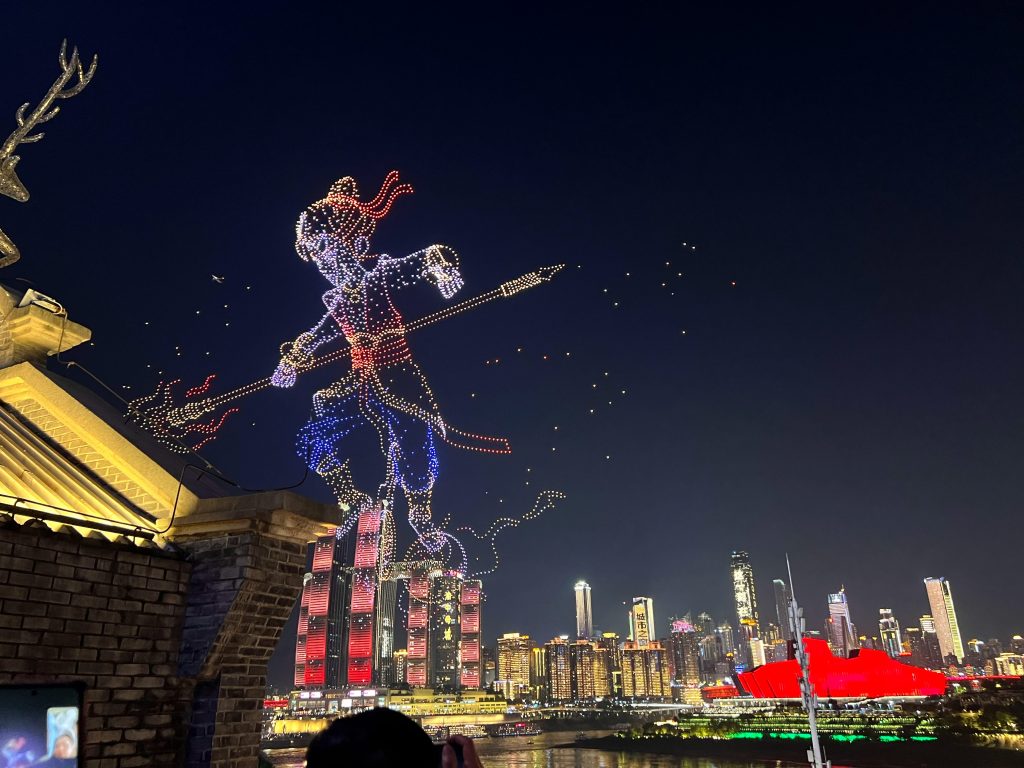
In stark contrast, the architecture of Taipei remains trapped in a weary, monochromatic grey, appearing almost neglected against the gleaming, neon-drenched spires of the mainland’s tier-one urban centers. As twilight descends, these Chinese towers ignite with such a hypnotic array of LED brilliance that any concerns regarding energy consumption or environmental impact are swept into the shadows of irrelevance. This modern vibrancy extended to our travel experience, staying in 4-diamond properties like the RIGEL Deep Space Hotel in Chongqing, which provided a front-row seat to this technological spectacle that included a drone show.
The Mrs’ long-standing infatuation with Taiwan—cultivated, no doubt, by her obsession with local podcasters—was brutally dismantled on our very first morning in Taipei. The dissolution began mere minutes after exiting our hotel in search of caffeine, accompanied by two of our sons fresh from their concert performances.
Our youngest had dispatched his brother to seek out the “preeminent barista in Taipei” while he and his uncle pursued fried onion pancakes.
“The coffee alone justifies the journey,” he had claimed with the infectious enthusiasm of a coffee aficionado. This optimism would soon be tested by the stark reality of the service culture in Taipei, a sharp contrast to the upcoming guided experiences of our mainland tour.
When they eventually returned, clutching their freshly made breakfast with triumphant smiles and laughter, the atmosphere they encountered immediately signaled that something had gone terribly awry.
The coffee-seeking party stood empty-handed, their countenances a mixture of agitation and utter bewilderment.
“Where is our caffeine fix?” the younger son inquired, his brow furrowing.
“There shall be no coffee today!” his brother snapped back, his face flushed a deep crimson—not from the Scottish spirits he’d grown accustomed to in Glasgow, but from the raw heat of the fierce morning sun and that of the barista’s unprovoked hostility.
The Mrs eventually recounted the ordeal. Their party had ventured into a café situated directly opposite our lodging, the rather ostentatiously named Premier Metropolitan. The procurement process for caffeine was remarkably convoluted, requiring patrons to select ice cream paddle sticks emblazoned with specific coffee varieties and pair them with their respective cups.
Such an arduous undertaking seemed entirely excessive for the morning during which standing still in the shade would result in uncontrolled perspiration. The establishment’s inventory of paddle sticks was promptly exhausted, as the staff had failed to anticipate a sudden, collective demand for six simultaneous long blacks.
“This is an absurd amount of labour merely to secure a cup of coffee!” the older son loudly complained to his aunt.
“Indeed, there aren’t enough sticks for our requirements!” she countered.
“Is a conventional ordering process simply out of the question?” he inquired, his logic as sound as his volume was elevated.
“But it yields a saving of five TWD!” the Mrs interjected with her customary pragmatism—a sum representing a grand total of approximately ninety Australian cents.
Ultimately, as they finally reached the head of the queue and his aunt prepared to present the hard-won paddle sticks, the elder son found himself enticed by the pastries shimmering within the glass display.
“Pray, seokuku, might we add some Canelé to our order?” he requested, addressing her in their familiar Ningbo tongue, gesturing toward the confections with a meticulously French articulation—Khan-lei.
It was at this precise moment that the barista usurped the cashier’s position, interjecting with cold authority: “On this island, we converse exclusively in Mandarin”.
The elder son, his patience predictably piqued by such a dismissal, retorted with sharp finality, “In that event, you may simply strike my caffeine from our order”.
The barista, seemingly relishing the prospect of a linguistic skirmish, persisted in his aggressive posturing.
“Be advised, I possess the sovereign right to deny service to any patron; therefore, deem your entire transaction nullified!” he proclaimed in Mandarin with unwavering resolve.
“Mercy! He has just explicitly cancelled our order!” the Mrs explained, her voice tinged with disbelief.
Reeling from this display of visceral animosity, the party retreated from the coffee shop, their dialogue a frantic attempt to decipher the bizarre sequence of events that had just unfolded.
“Good heavens! Such unmitigated rudeness is simply beyond belief!” his aunt exclaimed, her composure thoroughly rattled.
“What triggered such a response?” the elder son mused. “He is a veritable Coffee Nazi, just like Seinfeld’s Soup Nazi!”
Their collective indignation continued to simmer on the pavement until the barista, seemingly eager to extend his initial victory, charged toward them.
“Ni you wenti ma?” he challenged, his voice dripping with malice. “Do you possess a grievance? Speak up!” he demanded, physically encroaching upon the elder son’s personal space.
“Be gone with you! We don’t want to talk to you!” the elder son retorted in English, his patience finally depleted.
The barista, evidently intent on orchestrating a public altercation, positioned himself aggressively in a posture of physical confrontation.
In an instinctive display of maternal protection, his aunt extended her arms, shielding her charges as if they were vulnerable chicks under threat.
“Leave us alone!” she commanded, shooing the man away with the same dismissive energy one might reserve for a persistent and loathsome pest.
“I remained absolutely quiet during the heated exchange,” the Mrs said, thwarting her habitual instinct to escalate matters whenever aggrieved. She knew any further spark would cause an explosion of sorts that morning.
Upon their eventual return to our hotel, as the harrowing narrative was recounted to me, the linguistic catalyst suddenly became luminously clear.
“He undoubtedly perceived your request for Canelé—that meticulously French ‘Kan-lei’—as a grievous personal insult,” I remarked.
“For the uninitiated,” I clarified, “it sounds not too dis-similar to ‘Kan ne leh’ which is a common profane expletive in the Taiwanese dialect”.
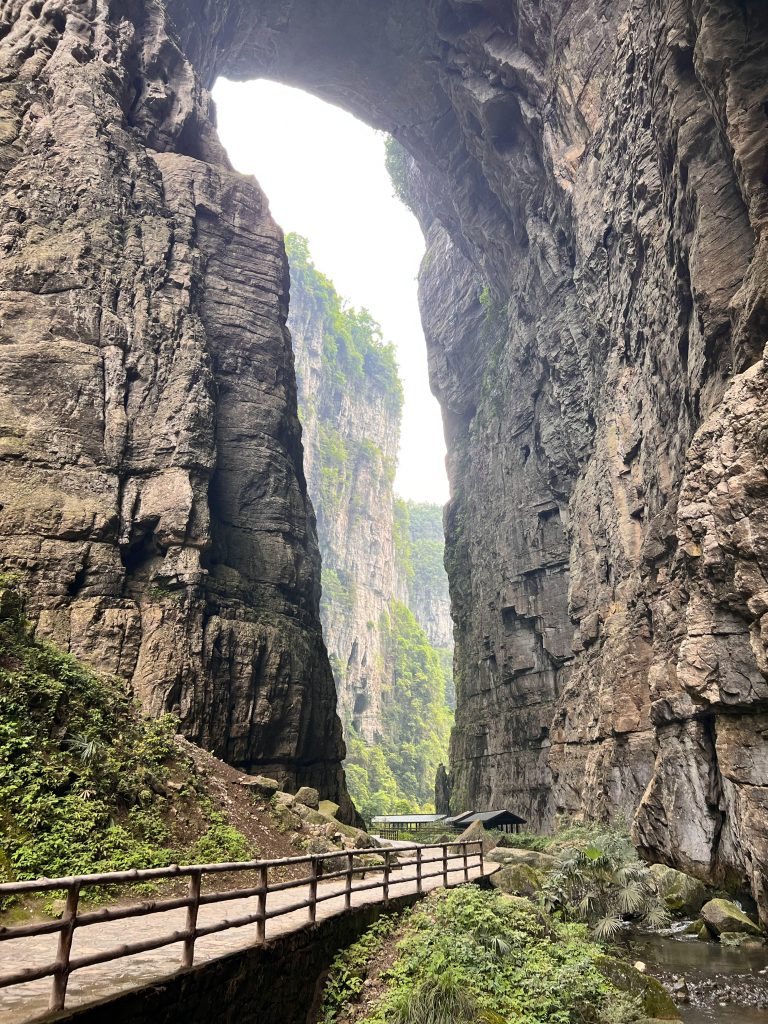
En route to Guangzhou, I found myself engaged in a relentless, involuntary battle with my own skin. The local mosquitoes at Fairy Mountain and the Wulong Caves had evidently marked me as their primary quarry, leaving behind a legacy of irritation. Despite the ethereal nomenclature, Fairy Mountain offered no mythical encounters; instead, I was met with a rather underwhelming mix of livestock—cows, horses, and even llamas—navigating a landscape liberally punctuated by animal excrement. My disappointment was obvious but only because such a pretty sight is rather common in Australia. Fortunately, other destinations proved more faithful to their titles. The Grand Buddha at Leshan was a truly majestic spectacle, a colossal figure hewn from the living rock during the Song Dynasty—an engineering feat of such antiquity that its execution without contemporary machinery remains a source of profound wonder. Similarly, the Three Bridges at Wulong offered a breathtaking display, not of timber and stone, but of natural limestone arches so cinematic in scale they served as the backdrop for Transformers 4 and Curse of the Golden Flower.
The psychological burden of these bites only served to amplify their physical intensity, as my limbs erupted in a constellation of crimson welts. Coupled with a waistline that had expanded with reckless abandon due to a fortnight of gastronomic indulgence in Kuala Lumpur, Singapore, Taipei, Chengdu and Chongqing, I was fast approaching the silhouette of a common ogre. It was a humiliating irony; while I had sternly instructed Murray, my son’s canine companion to resist the urge to worry about its own ailments from an unknown food allergy, I possessed no such discipline when it came to my own miserable, soul-consuming itch.
The Mrs told me to apply Tiger Balm on the small reddish papules that littered my limbs. The memory of a previous reaction to Tiger Balm loomed large, that from applying it to an injury from a Covid shot —a revolting mass of blobs reminiscent of my boyhood pus-filled wounds and scabs that had once littered my limbs after typical childhood misadventures.
Anyway, what the Mrs proscribe, I must follow, for her word carries the weight of law in our household. So, in my desperate and literal rash to contain my physiological rash, I obediently applied the pungent red Tiger Balm all over my arms and legs. It briefly soothed my skin with its cooling menthol heat, but the reprieve was a cruel illusion; the itchiness soon returned with a terrifying vengeance.
For the following few nights, my sleep was entirely sacrificed to the urgent, primal need to scratch myself. At times, the scratching was so vigorous that I shook the entire bed with a continuous, rhythmic motion for long periods. Did the Mrs think I was doing something else to relieve myself in the dark? Undoubtedly! But I was merely relieving myself of the terrible, soul-consuming itch.
The end result was a disaster of dermatological and hotel housekeeping proportions: a bedsheet permanently stained with the rust-colored grease of red balm, and a left arm that has become distorted with alien circles of a scale-like layer, all surrounding a central, planet-like scab composed of dead cells.
It is a painful lesson learned far too late: never be rash about a rash.


Well written.
LikeLiked by 1 person
Well written.
LikeLiked by 1 person