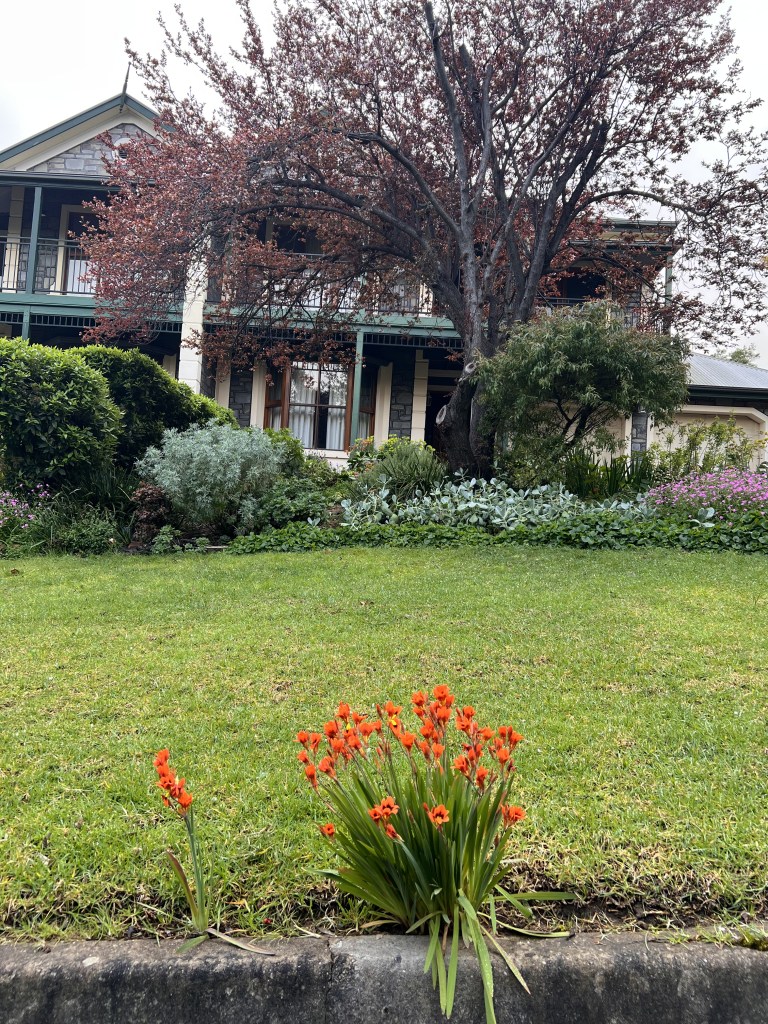
It has been three quarters of a year since our mother left this world. She left us at the end of spring or the beginning of summer, taking with her a lifetime of quiet authority and presence. It is spring again but very early spring in Adelaide. Most days it feels like winter still—grey skies, dark pregnant clouds that rain heavy tears on us to prove the weather forecasters wrong, again and again. Perhaps, the climate is being sympathetic to our grief and sorrow, even the swallows haven’t made their appearance yet.
The skip in my steps since my successful stint with the Penang Symphony Orchestra for their 45th anniversary celebration had transformed from the bouncy, energised gait that it was into a heavy drag as soon as I stepped back into the cold reality here in Adelaide. The buzz from the concert highs at the majestic Dewan Filharmonik Petronas in Kuala Lumpur had quickly dissipated, almost as quickly as the coach bus that left Kuala Lumpur for Penang soon after the performance finished. There was no time to celebrate with the orchestra, no time for celebratory drinks or shared recollections of the performance. We all split up after packing away our instruments and music, after taking some selfies and group photos, after offering congratulations to our maestro, Dato’ Woon Wen Kin, and saying our final goodbyes.
The dourness that hung over me wasn’t just a product of Adelaide’s dismal wintry conditions, though they stood in stark, unforgiving contrast to the comforting humidity, tropical heat, and the sweet relief of late-afternoon breezes drifting in from the Andaman Sea. Rather, the heaviness settled deeper following a weighty pronouncement delivered by one of my siblings. They informed us that our eldest sister had finally resolved to pull up stumps, sell the family home, and call it quits. At 83 years of age, she still theoretically has a good few years left if she is to reach the remarkable century mark that our mother achieved, or even the solid 91 years our father lived to see. Her current plan is to transition into a smaller, far cosier residence—one accompanied by a modest, easily manageable garden—or perhaps to take up residence with one sister, another sister, or a niece.
In the privacy of my own thoughts, I immediately deemed this a very wise and sensible decision. Naturally, I kept that judgment strictly to myself and didn’t voice it aloud to anyone else, having learned long ago that offering unsolicited opinions rarely yields positive outcomes. It was, without a doubt, a sound choice, albeit one that arrived after a painfully lengthy delay. Once upon a time, years ago, I had personally urged her to sell the family property and move into a modern, low-maintenance home alongside our mother. In such a place, the two of them could have spent their golden years enjoying contemporary conveniences and a truly comfortable lifestyle where every appliance operates seamlessly and every domestic detail contributes to peace of mind. They would no longer have had to endure chronic plumbing leaks, alarming structural cracks crawling up walls and cornices, unsightly, scarily sagging ceilings, stubborn windows stuck fast in their frames, or a hyper-sensitive security system that triggered false alarms without rhyme or reason.
Yet back then, such a move was simply impossible. Our eldest sister found herself completely unable to make a life-changing decision of that magnitude as long as our matriarch retained absolute authority over the household. Our mother insisted on having the final, unquestioned say in every single matter. Her micro-management extended even to the daily culinary routine, strictly dictating which specific vegetables and meats were to be prepared first each day. This ritual required a painstaking, close inspection of individual packages in the fridge and pantry to identify which items were slightly older. Under her unyielding rule, whatever was deemed less fresh had to be consumed first to prevent waste. Consequently, the household lived in a paradoxical state of forever eating food that was past its prime. Compounding this dynamic was my sister’s own deep-seated emotional attachment to her accumulated possessions; the daunting prospect of parting with Mother’s cherished belongings—most of which held sentimental value but were otherwise financially worthless—proved far too overwhelming to bear. Thus, the family dynamic remained trapped in a permanent gridlock. So long as Mother wielded her ultimate veto right, no decision to sell the house or relocate could ever be realised.
Our mother passing (I still can’t use the word death) brought an end to an era defined by her unyielding, final veto rights. Eldest Sis finally decided it was time to let go, move on, and put the long-standing family home on the market. The family home was acquired by our late father at a public auction, where he asserted his formidable presence over the entire room. With every ambitious bid, he punctuated his resolve by striking his heavy walking cane firmly against the ground, THUD, THUD, THUD, —bypassing standard thousand-dollar increments to boldly raise the price by ten, and ultimately, calling out loudly twenty thousand dollars above the previous competing offer. With that final bid, he dramatically silenced the whole room. Eldest Sis recalled that everyone stopped breathing as the auctioneer slammed his gavel and went to shake father’s hand.
Good for her, I thought. It’s her house now, and she has the ultimate say in what she wants—or perhaps more importantly, what she doesn’t want. Yet, only a few weeks passed before another inevitable sibling gridlock formed over the exact timing of the sale. She had brought in a few siblings to assist with the logistics, which quickly led to conflicting strategies and maybe even the birth of new veto rights. One sibling strongly advocated for spending time to fix up the property properly and putting it up for sale in February or March. Others vigorously disagreed, countering that spring was the prime season. They argued that lush green gardens, spring blooms, perfect weather, and longer days would draw more prospective buyers into the market, especially families looking to settle down before the start of the new school year. The debate remained stalled until the sibling proposing a summer sale departed for a three-week holiday in Europe. In her absence, the remaining siblings quietly conspired, and the decisive call was hastily made: they would sell immediately! Throughout this entire tactical maneuver, I remained completely silent—primarily because I was kept entirely in the dark about the ongoing discussions and intentions, which thankfully spared me from making unnecessary comments.
I only discovered the finalised decision after being retroactively added to a dedicated WhatsApp chat group intended to monitor and coordinate preparation tasks following the signing of the sale contract. As I systematically reviewed the lengthy list of chores required before hosting public open inspections, I mentioned to the sibling who brought me in that, since my assistance was requested, I felt obligated to offer my candid observations and raise critical questions, if any. I carefully parsed the contract clauses and double-checked the project timeline. After raising several pertinent points regarding the documentation, I received a prompt clarification and a polite apology from Eric, the designated real estate agent managing the listing. Though his apology was gracious, it was largely unnecessary; it turned out a minor paragraph on marketing was missing from my specific copy while present in theirs. It left me wondering whether it had been accidentally omitted during distribution or if it was simply a technical glitch in the system.
“What about all that accumulated junk clogging up the granny flat at the back of the property?” I asked during our conversation, pointing out the sheer volume of clutter that had been gathering dust for years. “There’s a massive backlog of dead stock, obsolete items, and slow-moving inventory sitting in there that needs to be cleared out before any serious buyers come through. If you want my help, I’ll dump the whole lot for you to get the place presentable.” However, despite my straightforward offer, my willingness to assist was instantly misinterpreted as some sort of transactional, conditional clause.
“Nah, I am definitely not going down that family war path with her,” my sibling shot back immediately, shaking her head in refusal. “All those items belong to our other sister who is currently away. It’s her responsibility, and she can come back and clear her own stuff out once the property has officially finished its marketing and sale campaign and we actually need to provide vacant possession to the new buyers.”
“Wouldn’t it be far easier and far less stressful for Eldest Sis to just take the initiative now and tell her firmly that those things have to go?” I reasoned, attempting to offer a practical, friction-free workaround. “We could simply pay her $2,500 directly out of the eventual sale proceeds to compensate her or cover the disposal costs. Eldest Sis would be so much better off getting the granny flat completely cleaned up right away, turning it into a presentable, cosy space that actually adds value to the entire estate during inspections.”
“Oh gosh, listen to you! You just ain’t helping at all,” my sibling exasperatedly replied, throwing her hands up in frustration. “This entire house has been practically crying out for basic maintenance and help for years—and you brothers ain’t handy whatsoever and haven’t stepped up to help with a single thing, have you? Now we are finally down to the very last stretch of work that needs doing, and suddenly it’s your way or the highway! I don’t even know why I bother… Ah, don’t worry about it. It’s obvious you don’t actually wanna help us. I guess we just can’t do anything about it,” she sighed loudly and deliberately.
“The reason we brothers don’t step in to do anything is because the high-level decision-making in this family was always monopolised strictly by the daughters,” I responded, voicing what I genuinely considered to be a sensible, and long-overdue explanation. “Why on earth should we be expected to blindly execute labour or jump into tasks that we fundamentally disagree with in the first place?”
“You honestly don’t even realise how difficult you are being or how you’re behaving,” the sibling continued, her tone tightening. “Even the simple act of including you in the WhatsApp group has completely disrupted and changed the whole collaborative nature of our working dynamics with Eric.”
She paused for a brief moment to catch her breath before launching into the daunting laundry list of manual labour remaining on the schedule. “The old carpet and worn-out underlay throughout the house all need to be ripped out entirely. We have to pull all of that gross padding up from the subfloor. Tomorrow is another exhausting day—I’ll have to help her carefully pack away all the fragile kitchenware, roll up the heavy carpets, and completely re-position the furniture in the family room. On top of all that, I still need to somehow find a way to remove her heavy sewing machine, the bulky study table, that old broken washing machine, the spare wardrobe, the rusty garden swing set out back, and heaps of accumulated garden refuse…”
I was completely nonplussed by her sudden hostility; I had no idea that raising sensible, pertinent questions about the real estate agreement and the marketing timeline could be construed as disrupting the so-called frank and friendly dynamics with the agent. In my view, performing basic due diligence before committing to a major financial undertaking was simply common sense, not an act of hostility.
“Ok, let’s be entirely realistic here,” I said, attempting to ground the conversation in perspective. “Many of my close friends have already dropped dead over the last few years. Money simply isn’t my primary worry or top concern anymore. Eldest Sis will be cashed up very soon once this property settles. What is all that accumulated wealth actually for if not to make her day-to-day life significantly easier and better right now? What prevents us from simply hiring a team of capable professionals to purge the clutter and show the property in its finest light? Why insist on enduring backbreaking manual labour ourselves when time is creeping up on us and we are all well into old age? Does endlessly pinching pennies and hoarding every last cent truly equate to being wise and prudent? Who are we even preserving this money for at our time in life?” I asked.
“You are just damn difficult to talk to,” she shot back, her voice dripping with irritation. “With you, it’s just relentless confrontation after confrontation. Honestly, it’s no wonder your wife struggles with you sometimes. Anyway, finding reliable trade people to do heavy work is an absolute nightmare at the moment. If you think it’s so easy, you go find someone yourself. You go tee up the skip hire, and let’s just hope the rusted swing set magically works its own way into the skip, and that heavy old wooden trolley rolls itself right in there too,” she sneered, or so I vividly imagined from the sharp edge in her tone.
“It is crystal clear that you won’t be lifting a single finger to assist us with the heavy lifting. So we shall just leave it at that and drop the subject,” she added dismissively.
“Look, I’m almost 70 years old,” I replied calmly, standing my ground. “Sure, I’m not about to throw my back out doing backbreaking physical labour when we can afford to hire professionals to handle it. I am more than happy to pay out of my own pocket for Eric’s team to come in if it makes you feel any better, but you’re entirely right about one thing: I will not risk my physical health, back, or overall wellbeing for work we can easily outsource. You’re acting exactly the same as our other sister—labelling me as confrontational simply because I disagree with your opinions.”
That tense, unnecessary exchange took place last weekend, and a full seven days have quietly passed since. Rather than remaining bogged down in endless debate, I took matters into my own hands: I asked Eric to order a massive 9-cubic-meter skip bin to be delivered directly to the driveway. It turned out it wasn’t that big after all. With the invaluable help of my old, trusted friend, John Scalzi, we spent Friday hauling out the accumulated debris and bulky items and filling the skip right to the absolute rim. On Saturday, we turned our focus entirely to the long driveway and garden. The outdoor space had suffered from long periods of neglect, with wildly overgrown edges, unkempt lawns, and unruly bushes creeping over the pathways. Methodically, we set to work tidying up the perimeter, carefully edging the lawn, pruning back the straggly hedges, and prettying up the garden beds until the entire exterior of the property looked pretty and immaculate, just like how a cottage garden should be.
The verbal sparring from the prior week was forgotten. Working under the open sky, there was no lingering stress, no petty conflict, and no unnecessary pressure weighing on us. Working quietly side by side, we trimmed back dead branches, mowed down the tall turf, raked up dead leaves and twigs, swept down the paved walkways, and systematically gathered and stacked the abundant green waste. By the end of the day, we had accumulated a colossal pile of garden refuse that would easily amount to another full skip bin, all accomplished efficiently and smoothly without skipping a single beat. But, we were both totally buggered by then. John Scalzi, I should mention, is already in his 70s.
The property isn’t quite ready for open inspections yet. There remain a myriad of collectibles and collections that are impregnated with sentimental value and fond memories. Every room in the family home holds decades of accumulated treasures, each tied to a specific time, place, or loved one. What will Eldest Sis do with them? Is the item of any real monetary value, or is its worth tied entirely to nostalgic significance? Is the sentimental value worth more than the monetary value? Who should she give them to? Will the intended recipient even want it or have the space to store it? What about the preserved olives and plums sitting in glass jars? What about the vast piles of vintage books and yellowed music sheets? Who gets to keep the family piano? What about the delicate jewellery and collections of old coins? Who should get our father’s favourite Chinese painting of a cat? What about the sturdy wooden bed bases and timber frames? Don’t forget the heavy antique furniture, including the massive 9-piece rosewood dining suite. Sorting through, deciding on, and distributing every single item is another massive gridlock that will severely challenge the strict marketing timeline set by Eric’s real estate team.
When Mother suffered the stroke that consigned her to a nursing home for the final six months of her life, all she could take with her was a small suitcase of clothes and basic personal effects. Even those few items she did not fully use in the end. It serves as a stark reminder of how little we ultimately retain when life draws to a close. Don’t skip a beat. Almost everything we own, gather, and cherish over a lifetime will inevitably end up in the skip.
Yet, much like a patch of roadside wildflowers pushing through pavement cracks, beauty and grace can somehow flourish despite poor soil, a careless gardener, or a harsh drought, blooming with quiet resilience against all odds. Even amidst the inevitable friction of sibling disputes, the daunting burden of accumulated clutter, and the gentle heartache of saying goodbye to a home steeped in nostalgia, surprising moments of serenity and beauty manage to anchor themselves. They remind us that while material possessions will eventually fade or end up in a skip, the love and acceptance of family, and quiet warmth from enduring friendships remain the glue that makes life beautiful, if not meaningful.