From Plain Sailing To Plain And Ailing

I belong to the lucky generation. For me and my mates, our challenges in primary school were not about winning school prizes but winning kite-flying competitions with the meanest, sharpest strings laced with gently pounded coarse glass powder and glue. We were more concerned about which fighting spiders to keep safe from the cheeky friends with sticky hands who were keen to swap their meek ones when no one was looking. It was a mini miracle that none of us got our fingers sliced off by the lethal kite strings although Tua Pui Soo aka Fatty Soo lost half his fatty thigh when he accidentally landed on the sharp edge of a mirror as he slid off the workbench of the glass shop from where we salvaged the glass to weaponise our kite strings.

Kite-flying is universally enjoyed

Every year, we had our four seasons; some years, the marbles season was shorter which meant a longer “Gantok” or spinning top season. My favourite top was not so much prized for spinning the longest but rather for destroying the opponent’s tops. It was a fearsome destroyer, its original puny tip substituted with a thicker and sharpened iron tip. The aim of the game was to destroy the other tops by throwing the spinning top at them. While firmly grasping a string that had been tightly wound around the stem, the centrifugal force generated by the unwinding motion of the string will propel the spinning top onto the ground. The skill is to land your top on the others, thereby breaking them into smithereens. Killer top, I called mine fondly. There was also a season for collectible cards of movie stars. To increase our collection, we would take part in a game of “high fives” with our cards. The card that lands face up wins and the winner assumes ownership of the losing card. There was a season when I was totally invincible with a particularly favourite card. Alright, I have carried this burden of guilt for over 50 years; it is time to confess. It was a very dishonest and sly way of cheating my cousins. The way to always win is to cheat, of course. The law of probability states that. When I was lucky enough to collect two identical cards, I glued them together, back to back, so that both faces appear on either side. To ensure my winning way continued, all I had to do was hide one face side against my palm. When the card fell, it did not matter which side it landed on. Victory was guaranteed, see? In primary school, I did not care about exams or detention classes for being late. I led a mostly carefree and happy life. There were very few troubled moments, such as encounters with the ghosts in the house. But, that is another story. Other troubling moments were when my parents quarrelled. As a kid, such episodes felt frequent and frightening. My father roared like a lion but it did not help that my mother was unfazed by his roars. Maybe she knew barking dogs never bite. They never engaged in deploying missiles either, nothing got thrown at each other. Maybe I hid my killer top well. There was one incident when the bar stool lost its wooden legs though. We know from the Wu Assassins, wood is the weakest of all the elements. The Wood Wu did not even make an entrance in the Netflix series. The wooden legs were no match for the Earth Wu and the Iron Wu. Maybe it ultimately got destroyed by the Fire Wu. I did not dare ask my father if he burned them. When we got to high school, we switched from chasing one another during recess time to chasing lanky school girls with long hair. For those with rare victories such as winning a date with a girl – any girl at all – the immediate challenge was to keep her from being swooned over by a competitor. Life was mainly plain sailing for most of us, apart from one catastrophe or two. An example of a catastrophe would be walking a mile to catch a secret glimpse of the lanky girl with long hair at her balcony only to find a pack of hungry wolf-like boys at her door showing off their gleaming motorcycles which had been delivered hot off the showroom. Another catastrophe would be to lose your girlfriend to a school friend just nine weeks after you had left home to study overseas. Receiving a letter from her that informs you “the wolves are at my door” would have been catastrophic for someone whose life was plain sailing, right?

It was still plain sailing when I fell in love, seriously this time. Not puppy love, not an infatuation, not a fleeting crush. The one who made me feel crushed when she disarmingly said no to my request to join her on a morning jog. It was either a meeting arranged in heaven – a chance meeting to cross her path whilst jogging around her neighbourhood, or a sneaky surveillance strategy learned from Le Carre spy novels. Chance meetings are good storylines for love stories, so I shall stick to that. Years later, she told me her “no” was not a rejection. She would have loved to go jogging with me, “but you need to give me advance notice so I don’t leave my house without brushing my teeth. No one expects to meet anyone at six in the morning!” Ah, so considerate! So honest! We had many more chance meetings, especially in the uni library. She was predictably “bumped into” on the 2nd floor. After a few times, she disappeared. I bumped into her again when I ventured to the 3rd floor. She had her head buried in the books, yet I found a way to say hello to her. Our chance meetings would occur even if she happened to hide herself on the 6th floor. It did not dawn on me that she possibly was trying to avoid me. That is what chance meetings mean, no matter what, we would always meet. She rented a flat in Randwick. I was flatting in Kingsford with Gerald, a childhood friend from Penang. Randwick is a good twenty minute walk up a steep slope. I would buy my milk and bread from Franklins in Randwick and then drop by her flat in Silver Street. “Oh, I just happened to be shopping in your neighbourhood.” I stuttered as she opened her door hesitatingly. “Why? Isn’t it more convenient in Kingsford?” she asked, with feigned interest. I decided silence was a better answer. We do not question why chance meetings happen. We both were in the Commerce faculty in Uni of NSW, one of the biggest faculties in the uni, if not the biggest. Fate was indeed kind, somehow we ended up in the same tutorials and the same lecture halls. It never crossed my mind to attend evening tutorials but she did. “You get to learn from adult students who work full time rather than mingle with full time students who do not have practical work experience.” So sensible. Suddenly, I was attending evening classes too. But, I put that down to chance. It was plain sailing in those days. Education was free, apart from student union dues and costly textbooks. I only needed to work on weekends to make ends meet. During those student days, we didn’t eat out except for the occasional Big Mac or Filet O’fish. Entertainment came in the form of a 12 inch teevee and a cassette player that regularly played Joan Baez. Lunch never varied all year in my first year of uni, it comprised of one strawberry and peanut butter sandwich washed down with 250ml of full cream milk. Our chance meetings continued in the second year of Uni. It was only recently that I found out from Gerald why the girls felt safe with us. Safe and disinterested at us, to be exact. Somehow, they thought we were gay. Just because we were always seen together, like the moon and stars. Thankfully, my many chance meetings with the girl developed into a romance in our third year. I was soon helping her with her vegetable patches. She was more preoccupied with the snow pea, winter melon and long bean harvests than what Plato and Socrates had to say in our Philosophy classes. It’s upsetting to be reminded that she got a C (credit) for Philosophy whereas I got a P (pass). Her assignments were copied from mine, except she replaced my words with simpler ones. Due to the effort spent in her garden, my uni results went from D’s (Distinctions) and High D’s to C’s and P’s in my final year.

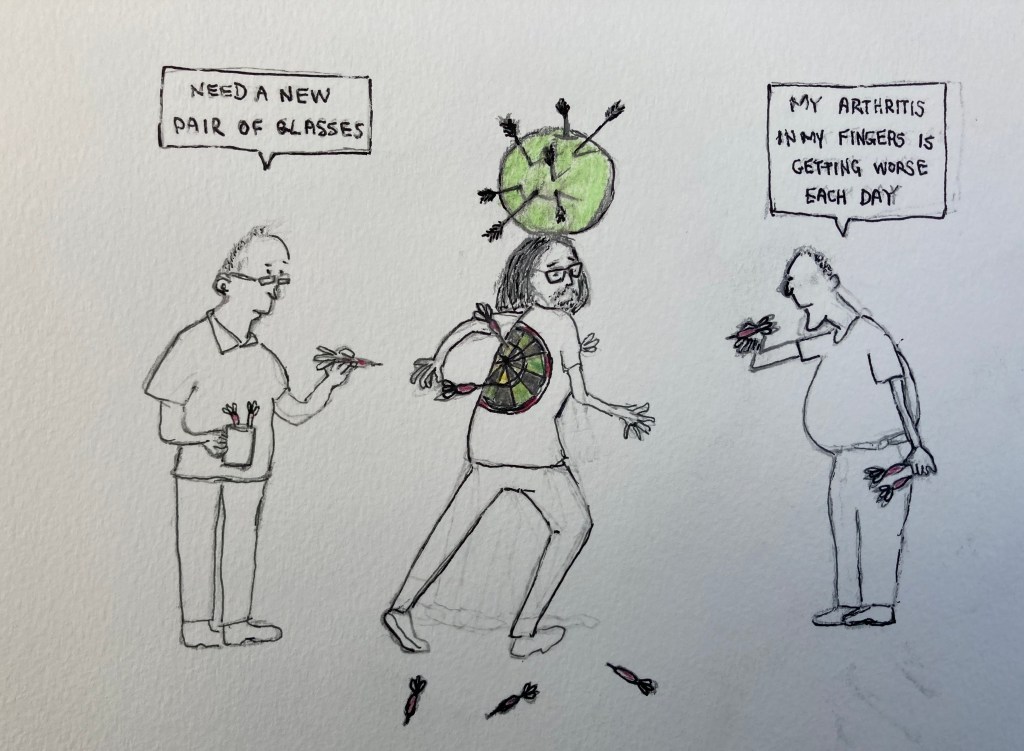
Once we graduated, we both found good jobs in Sydney’s CBD. A month later, we got married. Neither of us proposed. It was just plainly obvious that the two of us would marry each other. That’s fate, right? I became a father at 24. Then the twins came along in double-quick time. After that, life became plain. That’s a choice, you see. I still adhere to the idea that to bring up a young family, we do need to have a plain lifestyle that is stable and secure. A tumultuous or exciting one would be destabilising and distracting for kids, right? A plain life was by no means a boring life. The kids were a bundle of joy, they showered me with enthusiastic, effusive welcomes when I got home after work. I was chasing corporate ladders which eventually led me to a managerial position in Adelaide. Not long after that, we had the October 1987 sharemarket crash. The ailing economy saw interest rates shoot up to an unimaginable level of 19% p.a. Life was no longer plain sailing. I lost all the gains from a previously rampant sharemarket. Ready to totally divest the share portfolio and convert the profit into an apartment in Coogee, a brief procrastination saw a total wipe-out after the crash. After two decades of running my own business, we ended up with an ailing business that almost did not survive the Global Financial Crisis of 2008. Now that I have turned 61, I look back at life and marvel at how much it has changed, from writing aerogrammes and sending telegrams in the 70’s to dial-up Internet in the 80’s. We witnessed the demise of the cassette tapes, facsimile machines, laser disks and compact disks. Now, there is 5G to look forward to even before we are connected to the fibre optic national broadband network. Technology is advancing at a rapid rate but so are my years. Life rudely awakens me when I realise The Mrs and I have been empty nesters for sixteen years already. Many loved ones have already left this world and I am starting to hear about ailments and debilitating health matters almost on a daily basis. Recently, I learned that cervical arthritic pain has nothing to do with the cervix. News about school friends’ ailments bombard our daily chats. Someone had open heart surgery, another had his brain tumour removed, some are diabetic. There is one with knee replacements, another with a hip replacement, and a few sufferers of mental depression. Ageing is not fun, it is no longer plain sailing. Anything and everything that made us laugh uncontrollably now seem a distant memory. I found a feel-good story though. On the 9th October, Duke University announced that humans have salamander-like ability to regrow cartilage in joints. Hopefully soon, hip replacements will be a thing of the past. There will be more medical breakthroughs! I am still the dude with the positive attitude. We cried when we lost our marbles in school, but now we shan’t cry if or when we lose our marbles.

A winter melon

Tattersall All In Tatters

Amanda Tattersall, like many in the Western media, is hellbent on distorting the truth about what is happening in Hong Kong. When professional media commentators and journalists spin alternative truths about events that may affect millions of people and result in anarchy and death, they leave their own credibility in tatters. Urghhlings. Why do they communicate falsities? When I watch the news, there are often instances when journalists and writers deliberately use the wrong word disparagingly. It is not only unfair reporting but can be sinisterly dangerous. They could well encourage warped views or worse, inspire evil as a result, intentionally or not.

Tattersall is well credentialed, a scholar and a change maker who is an academic in the University of Sydney. Funded by Halloran Trust of the University, she has ample resources to get to the truth about Hong Kong. There are many private citizens from many parts of the world who have travelled to Hong Kong on their own budgets to discover the truth for themselves. Professionals like Tattersall continue to spin her conversations such as in The Conversation and distort the truth. Western media willingly report the violence by the police, whereas the mob violence is rarely mentioned. Google generally only shows images of police violence when you search for protesters violence in Hong Kong. A quick internet search will show support for the students coming from all sides of society including the elderly, and will lead you to conclude that it is the police waging assault on the facts. Nothing is mentioned of the biased assault on the facts by Western media. For us in the West, we need to rely on information from news outlets such as Channel News Asia; one of their headlines said “You don’t know what you’re doing” as Hong Kong’s elders hit back at protesters. Otherwise, there is little balance in the reporting by Western media. Every coin has two sides. The repercussions of distorting the truth is for their conscience to face.

In her article on 1st October 2019, Tattersall asserts that Hong Kong is “crippled with an undemocratic Legislative Council” and Hong Kongers are “terrified” not to to win democratic rights. Why does she not start by informing her readers that under British rule for 155 years, they were not given any democratic rights at all? There was never any universal suffrage; she misleads the uninformed that “Beijing will continue to encroach on their political freedoms.” It is her choice of words that grates on me. I have underlined them in the quotes that follow. Would she ever use the word “weapon” to refer to riot control equipment used by any Western police force? She writes, “Riot control weapons were deployed against the protesters and those near the protests were subject to random searches.” In any violent street protest, is it unreasonable for the police to conduct searches on those arrested at the scene? Is it really random that those arrested were at the scene?

She continues, “Always an asymmetric war, students initially responded in self-defence – using umbrellas, helmets and masks to hold their position on the streets.” This is not a war! Please do not help start one. If the protesters did not resort to violent conduct, bashing anyone including senior citizens who disagree with their opinions or object to their destructive behaviour, disrupt transport systems, throw Molotov cocktails, and attack and damage government buildings, why would there be a need for self-defence? No, they initiated a violent, destructive campaign and physically harmed the police. That is not self-defence.

The last time tear gas was used by Australian police was to put down a riot in 2005, at the Christmas Island migrant detention centre. No one accused the police of using excessive force; tear gas was never considered a weapon. But, in Tattersall’s article, she further distorts the facts: “As the police’s weapons have become more excessive – tear gas fired in train stations, rubber bullets shot into faces, sponge grenades, water cannons – the students’ responses have become increasingly indignant.” Here she implies the students are reacting to unwarranted police brutality. Which police and anti-riot force would not protect their own personnel and quell unrest that have turned violent? Are tear gas and water cannons not standard equipment used by most of the authorities in the world? Excessive? She continues to call them weapons implying instruments that maim and kill. Shooting rubber bullets into faces implies deliberate action by the police. I would like to see her and her ilk handle a violent group of people hellbent on exacting physical harm on those who try to uphold the law. To describe the students’ response as indignant is a joke. Although an author, she obviously does not understand the word. Can protesters be considered merely annoyed or angry when they force the closure of a major international airport, cause billions of lost revenues every month to the city’s businesses – a decrease of over 50% in August retail sales (according to the city’s Retail Management Association), their worst performance in history – destroy business premises and beat up anyone including elderly citizens who try to reason with them? To be fair, she accurately reports that the students (The Braves, she repeatedly calls them), have “engaged in targeted actions like street fires, petrol bombs and vandalism to public infrastructure and government sites, like the city’s mass transit system.” But, she softens their violence by using words such as “targeted actions” and “vandalism”. Come on, Tattersall, vandalism?! I think she is a vandal to civil rights. Where is the balanced reporting? Half the population just want to get on with making a livelihood, juggling work with family commitments, and saving whatever they can for a better future. What about their civil rights to enjoy peace, prosperity and security? In their fight for freedom of rights, the protesters deny others the basic right of freedom of movement? Surely, Western media cannot be blind to such blatant curtailing of freedom to travel to and from work? If any person dares to storm into a government building, tears down the Aussie flag, throws it into the River Torrens, hoists up another nation’s flag, that person would be quickly hauled into prison as a traitor. But, the likes of Tattersall will choose to remain silent on such unpatriotic behaviour as shown by some young Hong Kong protesters.

Tattersall reveals her devious intent at the end of her article. She coaxes The Braves to follow the successful strategies used in the French Revolution. “Perhaps history can provide some inspiration”. “In Paris, the protesters fought street battles and built barricades, but the leaders also built for themselves the kind of state they envisioned living in. They constructed their own National Assembly, which advanced the idea of universal male suffrage.” She asks her readers to imagine the protesters creating their own Legislative Assembly. In short, she is inciting the students to overthrow the government of Hong Kong. She is fully aware that protesters may die in their war (her word) against China. I fear for The Braves, learned people like Tattersall should not lead them to their graves. The governments of Hong Kong and China have been extremely restrained so far in bringing back law and order to Asia’s premier financial center. Not a single protester has been killed even though the violent mobs have been attacking police and fire-bombing public places on their daily rampage for almost six months. Tourist numbers dropped over 51% in September. How much more self-inflicted damage will be tolerated before authorities take measures to end this debacle? Let us hope the inflicted damage does not turn into a bloodbath. Urghhling.

Here is the link to her article. https://theconversation.com/amp/with-no-end-in-sight-and-the-world-losing-interest-the-hong-kong-protesters-need-a-new-script-124007

On Australia’s own doorstep, West Papua, we saw violent crackdowns by the Indonesian military in recent weeks. Yet, Australian media and Australian governments have been relatively silent over the deaths of many student protesters – estimated at thirty-three – in Jayapura and Wamena. The official pronouncement from the foreign affairs department is lame, that all sides of the conflict should exercise “absolute restraint”. Now, why don’t we all exercise absolute restraint with regard to Hong Kong also? Especially those like Amanda Tattersall. Inciting a civil war similar to the French Revolution is simply criminal.

An elderly man beaten up by young Hong Kong protesters

Sagacious Yet Salacious

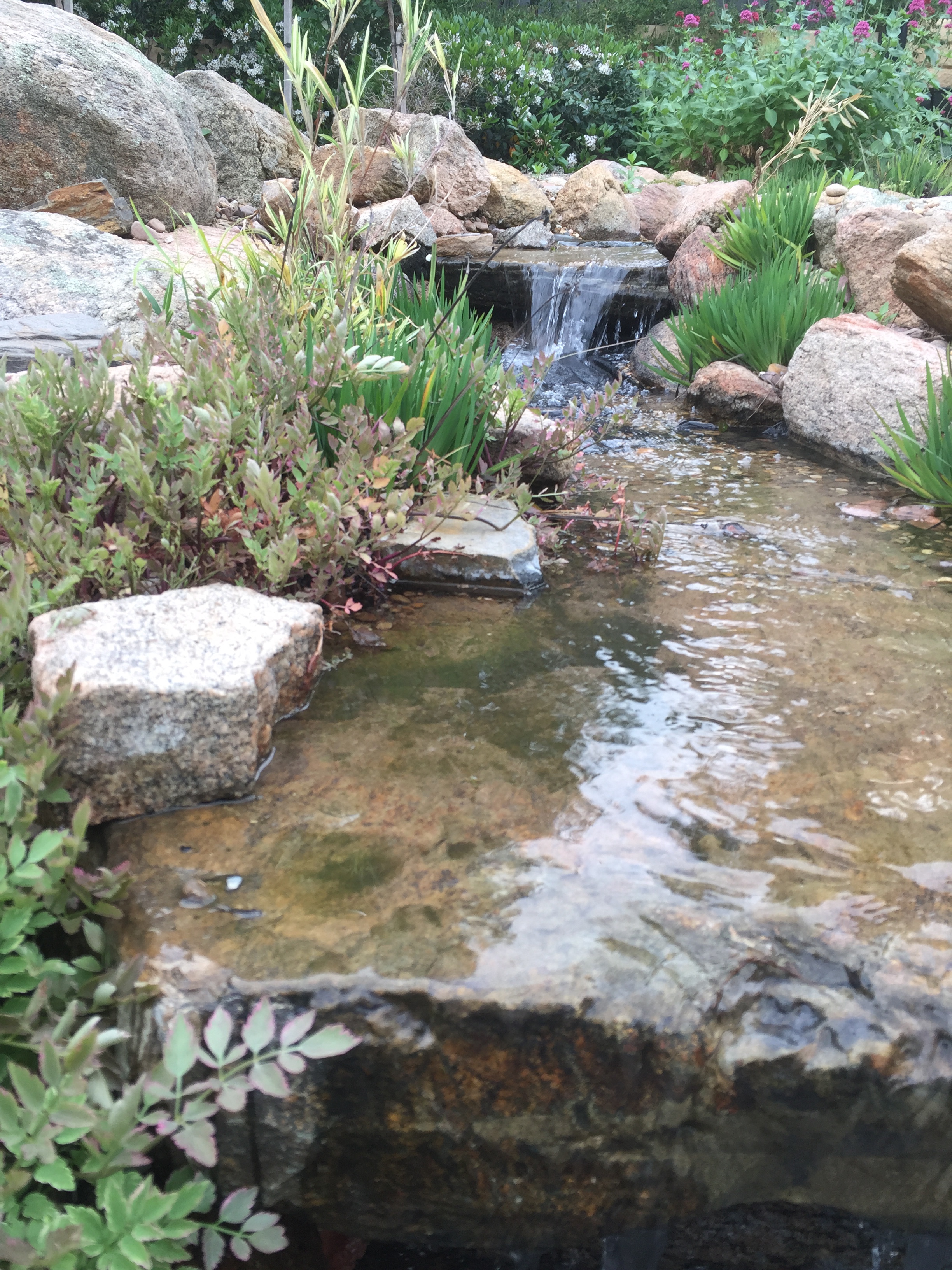
As I adjust the settings of the electronic bike in my living room to “mountain climbing” for target resistance, and “450” for target calories, I have difficulty in changing the age setting to “61”. I am not quite there yet, I remind myself. This morning, I intended to write about the creek I designed three years ago. It starts from the rear of the garden where the Adelaide Hills loom large, and meanders down a gentle slope revealing its three small waterfalls as the water glistens against the warm morning ray, and makes that soothing, healing sound of water falling softly on smoothen pebbles that cover the waterproof lining of the creek’s bed. Once upon a time, I wished I would reincarnate into a river pebble. To me, that is eternal peace in a tranquil, beautiful and unspoilt natural setting. Older folk tend to think they are sagacious with their choices in later life. We vote in the right governments, do we not ? It is those disinterested in politics, economic and environmental policies who vote in the wrong side, such as the rednecks of America in the 2016 presidential election. I digress. “Why call it a creek and not a brook?” Keith asks. Knowing my peculiar inclination to use words that rhyme, he continues to sell the idea of blogging about my brook. “You can blog about your chook by the brook, whilst you write a book in the nook. Share with us about the “water-feature expert” crook who strung you along. She invoiced you for expert advice that did not fix your string algae blooms.” The creek winds down across a bedrock of local Adelaide Hills moss stones and ends in a 12’ x 4’ pond. Fung Shui rules were unknowingly followed, the pond is a central feature of the garden; it also lends itself as a very beautiful water feature for the U-shape living quarters of the house. Keith, it’s a creek to me and not a brook. A daily reminder not to be “ Up the creek without a paddle”. We are sagacious, remember? At our age, especially, we cannot be up shit creek. We will not be afforded a second chance now if we get into financial difficulties or get entwined in an awkward predicament without any clear easy solution. Never be without a paddle! Not at our age! I did consider myself in deep shit and up the creek without a paddle for the past two months. The sudden loss of pond water during late winter baffled me. It had been raining regularly yet the water level kept receding slowly but surely. But, exactly a month ago, the notion of “normal evaporation” as the days started to warm up after winter was pronounced as fake news by the property’s owner. She hauled me over and questioned my nonsensical theory of why water was continually been added to the pond by the floating system. “There has to be a major leak!” she announced. For the past month, I had been busily scrutinising the flow of the creek, measuring in millimeters the rate of “evaporation”, and examining every single square centimetre of pond lining. “Where is the leak? Is it from the creek? Please, please, do not let it be from the pond!” The water-feature “expert” told me “you might as well start all over again if the main pond is leaking.” The sense of foreboding was intensified when another “expert” gave me his conclusive evidence that this is “all too hard to fix”. “Even if the leak is in the creek, and you found where it is, you’d never be able to fix it. It would be a nightmare to remove the rocks to re-line the creek”. That sounded like a death warrant for the creek and pond. Where will I find a new home for my koi fish? Some say desperation is the mother of inventions or in my case, creative thinking. With no one willing to take on this job to fix the leak, I was soon on my knees, not begging, not praying, but doubling down with serious intent to find the leak! I imagined I was a crime scene investigator. The weather had been kind, the short, dry spell made it easy to look for damp patches on the ground, a clear indicator of the presence of water! Unfortunately, the meticulous combing of every millimeter of land adjoining the creek found no such evidence. Time to plead regret to the owner. As I was leaving the creek, I felt a stone was out of place. Aesthetically pleasing but strategically wrong, I felt. All I did was move it 2mm away from the edge of the big rock. Since then, the pond does not leak anymore! Sagacious, aren’t I?

The stone on front left is not aesthetically positioned

Last night, there was noisy chatter in a chat group of sagacious old men. Somehow, the discussion about the health benefits of having a foot massage turned salacious. What’s-his-name refers to his favourite masseuse as number 8, short for 008. He is a numbers man, tends to strike it lucky with lotteries, Powerball and Tatts lotto. Or do they call it Empat Ekor over in Malaysia? Lucky with numbers, he is undoubtedly also a “ladies man”. He regularly visits his favourite number 8 for what he calls a “foot” massage. It’s usually his left foot, he elaborates. Although he is not prone to ignore his right foot, it too gets serious attention by number 8 sometimes. Not wanting to appear ignorant, I do not dare ask him what “serious attention” means. What’s-his-name, the salacious one, soon diverts the health discussion to one with sexual connotations. He would, of course, strongly disagree. Sex, and lots of it, is a prerequisite to good health for men. ”Have you not kept yourself up-to-date?” He enquires incredulously. We have to clean and clear our “pipes”, he implores. “We, men, are bedevilled with the threat of prostate cancer. Yes, foot massages are vital for our organs.” he spruiks. “and we do not ignore the other ‘leg’. With intense massage, if we are lucky, it may even grow to a foot long”. Salacious. Fallacious! Urghhling.

Cycle And Recycle

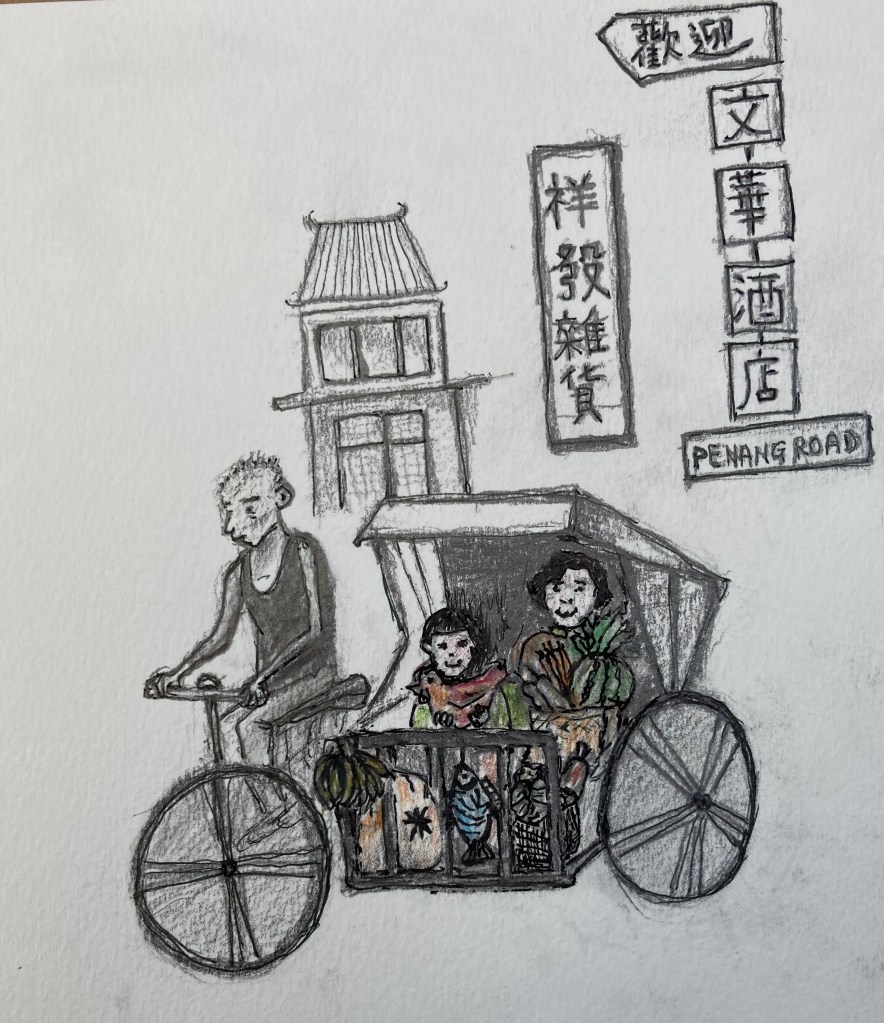
He was well chiselled without any visible body fat, and well-tanned, as dark as the indigenous rainforest dwellers of early Malaya. His sinewy hands, deformed from arthritis, and spindly legs with small but pronounced calf muscles were great indicators of someone who had lived an arduous life. I was no more than six years old, but I could feel his suffering as he struggled to power his trishaw along Penang Road with his overworked legs. He would have been mistaken to celebrate silently when my mother hollered at him from the roadside. Lucky day, a lightweight customer, he would have misled himself. She was slightly gaunt, her emaciation understandable. During those days, it was not uncommon for people to be grossly underweight from poor nourishment, hard work and little rest. It was only after she had negotiated a very reasonable fare with him, when I popped out of the shady spot. The rickshaw rider would have cursed silently when he realised the extra burden he had to bear from carrying me and the heavy cane basket next to me that was overladen with the morning’s shopping of meat, freshly caught seafood, fruits and vegetables. A twenty cent fare seemed reasonable from the Chowrasta market to upper Penang Road just a block short of the E & O Hotel. But, I could hear his strained heavy breathing and the noticeably slower speed as he passed the Odeon cinema. “Just a few more blocks, you may cycle slowly. We won’t mind if you take your time.” Those thoughts played in my mind as I silently urged him to complete his task. “After that, you can enjoy a hard earned rest and maybe go back home to your family.” At the time I did not realise these rickshaw riders lived in a commune with no families to go home to. When Ma and I got off the motorless vehicle, the rider even helped unload our shopping for us. Ma was struggling to find the right change. So, I looked up and took a good look at the man. “Thank you, that was hard work” I said. He was wiping the back of his neck and face with a damp grey cotton towel that was a beautiful stark white before his shift began that day. Beads of sweat kept forming on his forehead no matter how he wiped them off. “No, thank you” he said whilst gesturing to Ma. His smile revealed his lack of dental hygiene, two or maybe three missing teeth a telltale sign a visit to a dentist was long overdue.

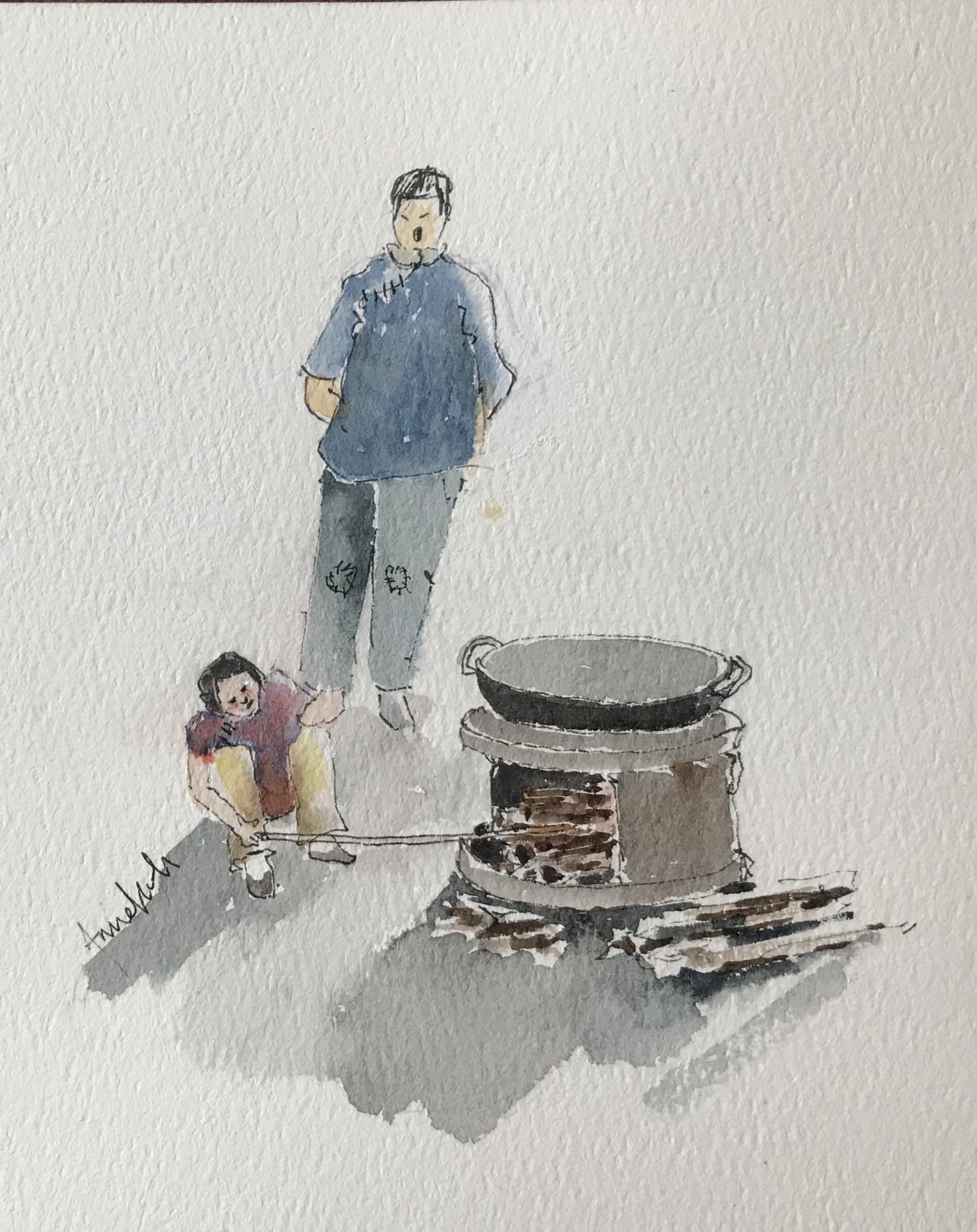
Yung Jie, who was more a family member than a maid, efficiently and quietly unpacked the morning’s shopping. I was like a fly attracted to a plate of fried noodles. She tried to shoo me away but I hovered close by and observed her while she sort and put away the day’s food supplies. What caught my attention was the amount of recycling that was going on, not that I was aware of what that meant. Almost everything dry was wrapped in old newspaper, whereas wet or moist stuff such as freshly pounded curry paste and sambal were wrapped in banana leaves. No singlet plastic bags were used then; they were not patented in the U.S. until 1965 and did not appear in Asia till much later. The big culprits were the guys from Mobil Chemicals; they aggressively pushed the use of plastic shopping bags in the early 1980’s. People were naturally eco-friendly before the Americans ruled the world. Chooks and ducks were bought alive, their feet and wings tied up in string; not “processed” – a nice word for slaughtered, de-feathered and gutted – and packed in polystyrene foam. We did not have a refrigerator then. Come to think of it, we only had a Rediffusion set to entertain the whole household, a network of radio waves that blared mostly Cantonese songs and audio stories. We did not care about high-definition speakers amplified by the state-of-the-art German amplifiers and boom boxes that pollute the streets. Our shophouse had electric gadgets most others did not have, a telephone set and a ceiling fan. I was too young to ask why there were no ceiling fans upstairs, we had to make do with paper fans on hot sticky nights. There were hardly any electrical gadgets in the neighbourhood. There were no microwave ovens, convection ovens, dishwashers, or washing machines. Desk computers, mobile phones, battery chargers and internet modems did not exist for another twenty years. The whole neighbourhood of 13 houses shared a small square TV set which was owned by a Filipino family across the road from us. After I was caught mimicking others laughing at a I Love Lucy show – they knew I didn’t understand a word of English – I stopped joining them when the TV was played. Instead, for my nightly entertainment, I peeped at the house opposite from the upstairs window louvres. I still remember the disappointment I felt on nights when there was no amorous kissing between the gorgeous Filipino girl and her boyfriend. I was awfully jealous of her boyfriend, he was a really handsome lad who rode a really handsome Honda motorcycle. Everyone else either walked everywhere or rode their bicycles. Our carbon footprint amounted to literally that, a footprint size you could say. Unlike today. Folks today want to own everything that’s electric or electronic, and those needed to be upgraded almost annually. They fly overseas for a schoolies week whereas people hardly flew at all during the 1960’s. My eldest sister was one of the early ones to fly overseas to further her music education. An air ticket to London apparently cost well over $2,500, which was a lot of money then. A link house was worth under $7,000. It is unimaginable today to cough up a third of the value of our house in order to take a plane trip. Air travel was rare and therefore was an occasion to have a throng of well wishers at the airport to bid someone farewell. Today, taking a flight is more common than catching a bus for many of us. Do we even think twice about the damage jet fuel does to our environment?

It is encouraging to read about the enthusiasm school kids today have to combat global warming and climate change. The protests led by young Greta Thunberg have created loud decibels all over the globe and hopefully, the world’s leaders will begin to take notice. She berated world leaders at the UN climate summit last month, with a scathing speech. “HOW DARE YOU?” she accused the adults in the room for their failure to tackle the emissions of greenhouse gases. But, it riles me when these kids blame only us for the damage done to the environment. Surely, they do realise they are equally as responsible if not more? They do not ride man-powered rickshaws from the shops and most of them do not walk or cycle to school. Do they wrap their shopping with used newspaper and banana leaves or do they still pick up from grocery store shelves cooking oil and mineral water in plastic bottles? How about not charging their hand phones and tablets for a week? Can they avoid using polystyrene foam packaging and plastic toothbrushes and say no to air travel? Are they not avid online shoppers who rely on fast, efficient transport systems that use cargo planes which spew the air with ozone damaging CO2? Aeroplanes are by far the worst contributors of carbon dioxide amongst all transportation modes. Burning aviation fuel releases greenhouse gases such as  carbon dioxide directly into the upper atmosphere where they linger longer and cause more damage than in lower altitudes. Will these protesters refrain from turning on the air-conditioners at home and in their cars? When it gets freezing cold in winter, will they say “How dare you” to their parents when they switch on their home heating system? Whilst they are enjoying the pleasant conditions in the shopping complexes, movie theatres and restaurants, will they yell out “How dare you” and demand the lighting and cooling systems be switched off? And oh, don’t you dare use shower gels, shampoos, moisturisers and perfumes; all we had was soap. Shower gels are usually petroleum based and contain harmful ingredients that are carcinogenic and bad for the environment. Perfumes are particularly toxic to the environment due to the hundreds of synthetic chemicals that evaporate into the air. Phthalates ( industrial chemicals ) in these products are a great risk to aquatic life and plants, and also pose a major health risk to us. Will they decline a nice rib-eye steak or grilled wagyu? Say no to milk and cheese? After all, the meat and dairy industry will soon surpass the oil industry as the world’s biggest polluters. “Say no to cheeseburgers” should be their catch-cry. Animal agriculture contribute over half of the world’s emissions of greenhouse gases. “How dare you eat meat?” is a better question to ask urghhlings. Please stop pointing your finger at us, do the right thing, and don’t let your cow fart. Cycle to where you need to go, and recycle as much as you can.   

Futility Without Utility

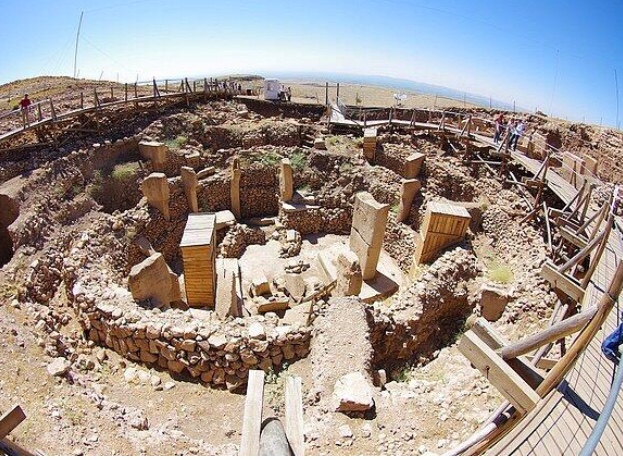
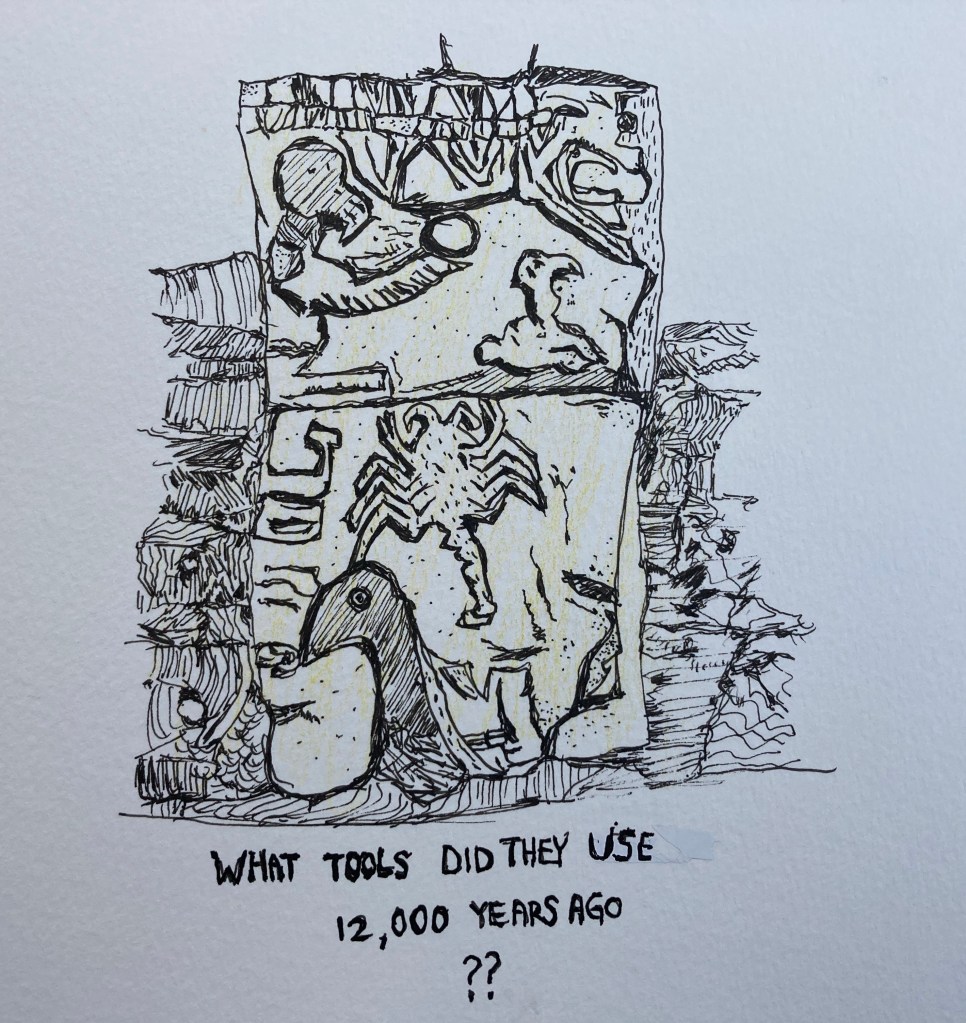
Göbekli Tepe, in Sanliurfa, Turkey was built around 9,500 BCE. This period is classified as the Pre-Pottery Neolithic time, i.e. so ancient that pots were not in use then. Back then humans did not have the knowledge to make pots, yet they showed us the skills and technology they possessed to build these megaliths. They are the oldest known structures built on Earth. As we understand from the Bible, the Universe was created only 6,000 years ago. So, how do we explain that Göbekli Tepe can be twice the age of God’s awesome creation? Either the scribes got it wrong in the Bible or the carbon dating technique used today is seriously flawed. These megaliths are quite humble compared to the Carnac, Egypt’s pyramids and both the English and Armenian Stonehenges. Buried in desert sand are twenty circles of stone pillars no more than ten meters wide. The height of some of the tallest pillars are about seven meters, not monstrous, but weighing about fifty tons each. What sets them apart from the rest is the age – some four thousand years older than the next oldest discovery of such magnitude – and the intricate carvings of birds, insects and animals including that of a life size human. These megalithic feats are “pre-civilisation” yet today, we still do not know how to move, cut, mould, lift and place such massive rocks over one another so precisely that not even a sheet of paper can slip in between two rocks.

Hunter gatherers roamed the world when these were built?

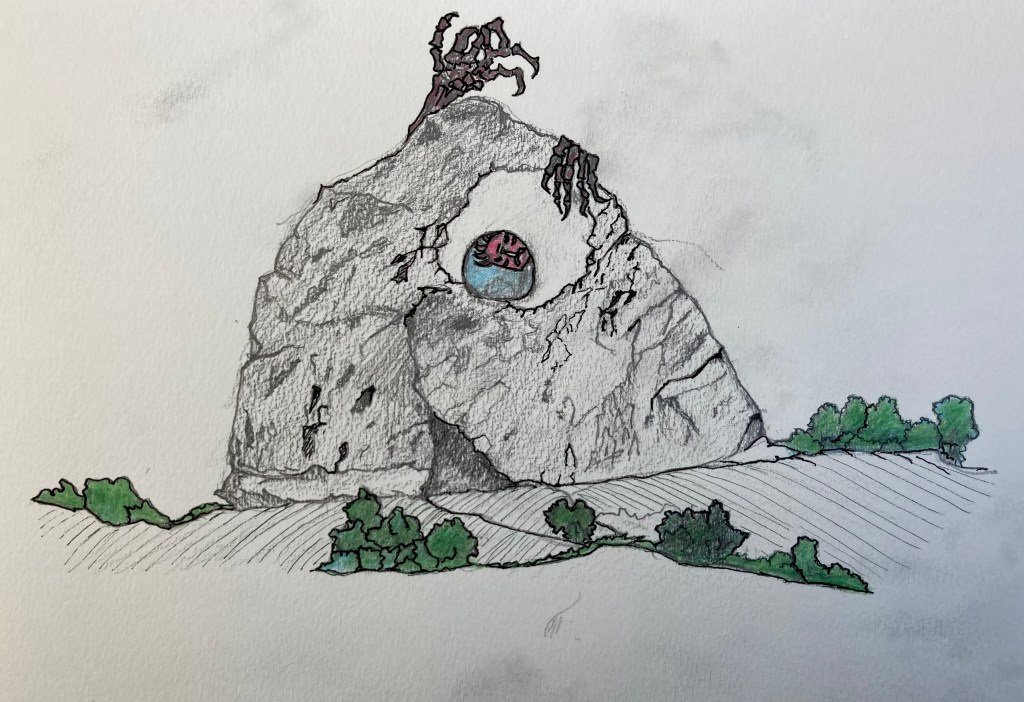
Carahunge, the Armenian Stonehenge is situated near the town of Sisian. In total, there are 223 stones from 0.5 to 3 meters high and weighing up to 10 tons each. Carahunge or Speaking Stones got its name from the whistling sounds that the stones make on windy days, because of holes bored through the vertical stones at varying angles. Due to the continued tilting of the Earth’s axis since the Big Bang, modern science cannot ascertain as fact that holes and the stones were instruments used in an ancient astronomical observatory. It is possible that during the Middle Bronze Age, these stones were placed to observe specific planets or constellations such as the Cygnus, as some scientists suspect.

7,000 year old telescope?
When were the holes bored?

The Carnac stones from the Neolithic period around 4,500 BCE to 3,300 BCE are the largest collection of megalithic stones in the world. Like the Great Wall of China, they are visible from high up in the sky. Ding! Ding! Is that a hint of why they were built? Six thousand years ago, humans could not fly. Were they meant to guide extra-terrestrials to land from the sky? The alignments of some 3,000 monoliths weighing between 20 to 350 tons each, amounted to a massive effort for the pre-Celtic people of Brittany in France. Some of the alignments accurately display the Pythagorean Theorem, thousands of years before Pythagoras discovered it. Why would humans bother with such a massive expense of energy and time so long ago?

Alignment of stones, each weighing up to 350 tons, some 6,000 years ago

Göbekli Tepe is almost 12,000 years old. There was no known civilisation then. How did the ancients have the knowledge and tools to cut huge pillars from rocks and then bother with carving elaborate images on the pillars? Why did they bother to leave such irrefutable evidence of not merely their existence but also their intelligence and knowledge that has since been lost? It would be wasteful to engage in such futility of effort if there was no derived benefit from investing in these mega projects during pre-historic times. To leave in perpetuity evidence of one’s prowess, scientific and architectural knowledge, artistry and craftsmanship in no uncertain terms is a likely purpose of these megaliths. Yet, these man-made creations are relatively unknown today, even with the internet and digital social media to help disperse the information about them.

Compare all the megaliths with the two Stone Tablets that the Ten Commandments were inscribed on. The first tablet, written by the finger of God, was smashed by Moses when he was enraged by the children of Israel worshipping a golden calf. The second was cut by Moses and rewritten by God. The Ten Commandments form the basis of Judaism and Christianity. Apparently stored in the Ark of the Covenant, both stones and Ark have never been found. According to Exodus 25:10-22, the size of the Ark or sacred chest is 45 inches long, 27 inches wide and 27 inches high. Compared to the megaliths, the Stone Tablets are minuscule in size yet almost everyone would be aware of the Ten Commandments. Choosing to write God’s rules on two small pieces of stone is not what an intelligent being would do to demonstrate irrefutable evidence of their existence or truth to people many thousands of years in the future. It seems clear to me the builders of the megaliths got it wrong. Stone tablets that cannot be found are more effective to spread the message than mega structures that can be seen from the sky for eternity. The futility, without utility.

Si Si, Pelosi. Impeach The Imp

I saw him on tv a few nights ago. His mop of hair was still ginger, tousled but worryingly sparse now. He looked slightly hunched, as if weighed down by the billions he own. He is Anthony Pratt, son of Richard. Dick was a giant of Australia’s cardboard industry. They both stood in my office back in 1986. Dick taught me a lot about running a business. I was his accountant but he knew more about what the numbers meant. I shan’t be unkind to myself, after all, I was only 28 then. Donald Trump recently proclaimed to his guests at his Mar-a-Lago resort “ Ladies and gentlemen, the great Anthony Pratt”. I did not know Anthony would become great… if only I knew what I know now. The two men made global headlines days ago, together with Australia’s PM, Scott Morrison. Scomo almost appeared as a prop at the opening of Pratt’s cardboard factory in Ohio, in the US. Bringing Back Jobs To America was the message. Both Pratt and Morrison looked confused, shouldn’t it have been Bringing Back Jobs To Australia? It was a pseudo Presidential election campaign for Trump anyway. Anthony Pratt now wears the tag of Australia’s third richest, at $6.9 billion. That’s many noughts after 69. No matter, money cannot buy us health. But maybe it can one day. Hurry up, David Sinclair and Lindsay Wu. We are ageing fast, time is not on our side. Please get cracking on your work on reservatrol as well as on mitochondria and NAD – I can’t remember what it stands for now, another sign of ageing – we need to be able to buy the stuff now; stuff that ultimately will mean ageing is just another disease, and therefore is curable. Lindsay at UNSW wrote to me with the bad news; they won’t let my mother participate in their human trials. Why not, she is 96. Can you imagine how much she may benefit from the research? I digress. This is not about Ma.

Three days ago, Nancy Pelosi announced that the House will commence a formal impeachment enquiry against President Trump following a whistleblower’s letter that almost did not see the light of day. Justice Department under Attorney General Barr declined to open an investigation eventhough the Intelligence Community Inspector General, Michael Atkinson, had deemed it credible and of “urgent concern”. Atkinson, despite the failure of acting Director of National Intelligence, Joseph Maguire, to submit it to Congress, took it upon himself to report the complaint to the Senate and House Intelligence committees 28 days after determining it to be of “urgent concern”. Trump and his cohorts have been totally immersed in their own hubris to not recognise that Trump’s withholding of foreign aid money to Ukraine whilst at the same time, requiring the Ukrainian President, Volodymyr Zelensky, to dig up dirt on potential rival, Joe Biden and his son, was an impeachable offence. No quid pro quo? Even a squid can connect the dots. Many had grown exasperated by Pelosi, her hands would have been kept warm long enough by her backside. Six committees -five House committees and the Senate Intelligence Committee – formed to investigate Trump have been easily stonewalled by the Executive. The man is above the law. He claims he can shoot someone on Fifth Avenue and won’t get arrested. He has even verbalised his dream of staying in power for perpetuity. Emperor Trump, no less. Si, si, Nancy Pelosi. The man cannot be above the law. Please make sure he is impeached.

Many prayers have finally been answered. It is important to impeach the imp! In the three years as POTUS, has he made America great again? For me, he has grated and frayed the fabric of society with his divisive policies – his leanings toward white supremacists, the trade wars with many allies, his cosying up to Putin and Kim Jong-Un ( ingratiating himself to tyrants to win the Nobel Prize?), the dangerous war-mongering against Iran and China. Important treaties and accords have been torn up, probably the most damaging so far is his backing out of the Paris Agreement signed in 2016 to tackle global warming. Back then the world talked about reducing greenhouse emissions and tackling global warming, practical methods to fix the impending ecological disaster. Climate change sounds less sinister to me, it may even imply natural causes and therefore lessen the urgency for urghhlings to change their ways. After all, Earth’s climate has changed drastically and abruptly over the epochs, faster or slower. It is worth noting such events occurred during the Younger Dryas around 12,000 BP and The Paleocene-Eocene Thermal Maximum some 55 million years ago. No urghhlings back then. So, let us stick to global warming and how to tackle it. Calling it “Climate change” for me cushions the damage humans are wracking on the environment. Make America great again? I agree with the banner that greeted Greta Thunberg, it said “Make America Greta Again.

Many prayers have been answered, indeed. Normally, I ask my friends not to pray so much. Why bother God over trivial matters, right? The Lord needs respite too, right? After all, He did tell us he rested on the 7th day. That’s a hint to me. Do not bother Him unnecessarily. Drought, pray for rain. Deluge and floods, pray it stops. Stop it! Let God have a break! It’s Sunday. But to impeach Trump? Let’s all pray!!

Mum About Mum I

It surprises me that Ma was not born in China. For years, my reply when asked where I came from, was standard. “My parents were both born in China. Pa, in Shanghai and Ma, in Ningbo. I was born in Penang.” When I became an adult and had children of my own, I discovered my dad was not born in Shanghai but in Shaoxing in the province of Zhejiang and mum was actually born in Malaya. A woman with secrets! If a person lived a life that is smooth-sailing and uneventful, without any hint of a major scandal, made no scientific discovery, had no artistic creation to show, with only daily house keeping duties and mundane tales of bargains in the wet market, then their life story would be boring and colourless. There would be no story to tell. Ma ticked all those boxes yet I am compelled to write about her. “NO! You should not write about mum’s life. You cannot share her stories with your friends! Respect her privacy! Respect ours!” That was the view of a sibling when I first broached the subject. A very strong view. Keep mum about mum.

Ma is 96. Why should her life story be buried? Why not show where she has left her footprints? There is absolutely nothing about her that I am embarrassed about. Even if there was, so what? Ok, point taken. She may want to remain anonymous, with zero inclination to have her life summarised in words that she has no opportunity to edit or censor. Ma, you can trust me. I will honour you, and what can be more honourable than to be truthful about what I write?

When Ma was four years old, her whole family travelled to China for a short holiday. I suppose Ngagung wanted to show off his young family to his mother. He married at 28, his wife, my grandma Ngabo, was 18. By then they had Ma, followed by two sons and another daughter. It took twenty eight days for the family of six to arrive in Shanghai in a cargo ship and from there, an overnight boat to Ningbo. Ngagung’s mother – the old lady – lived with her eldest daughter in what was a big house in those days. A widow for much of her adult life, she sold homemade tofu to make ends meet. Some of us were cynical to hear that a widow who sold tofu could afford to live in a big house, especially during such tumultuous times in China. Ma was four then, maybe it was “big” because she was little.” So, I asked her to elaborate. “Ma, how big was big?” It turns out the house was indeed big. It had four bedrooms, a separate dining room and a kitchen, complete with a square compound in the middle of the property, “where they grew some vegetables”. Ngagung’s father, a casualty of the Opium War, died when Ngagung was only eight years old. A minor government official in the late Qing dynasty, his addiction to opium caused his early demise.

Two hundred and seventy five years after the Portuguese settled in Malacca, the British colonised the Malay peninsula with their first settlement in Penang in 1876. The original idea was to have Penang as a refuelling base for the East India Company’s lucrative business with China. At the same time, the Perak War was being waged by the British against the locals after governor W Birch was killed during a revolt. The locals surrendered within a year. The European settlers who initially arrived to cash in on the spice trade soon diversified and invested in sugar and coffee plantations. It wasn’t until Ridley’s arrival in the early 20th century that the focus shifted to rubber. “Mad Ridley” was mad about rubber, he knew the automobile’s popularity would create a huge demand for rubber. Teluk Mak Intan in Perak was renamed Teluk Anson after the acting governor of the Straits Settlements, Archibald Anson. He had the foresight to expand the town knowing that the confluence of three rivers would make the place a hive of business activity. When Ma was born in 1923, the population of Teluk Anson was growing rapidly, from 3,300 in 1901 to about ten thousand. The three pillars of Perak then were tin, rubber and coconut. Most of the tin and rubber were sent to Penang via Teluk Anson. The coconut produced in Lower Perak was sent to Singapore via Teluk Anson to make coconut oil for export. Ma was born in Bagan Datoh. Her father, my Ngagung, was hired by an Englishman who owned a huge coconut plantation. The Englishman, a wealthy and generous fellow, provided Ngagung with an atap house, two ironing benches and all necessary materials to look after the laundry and dry cleaning needs of the plantation owner’s family and those of European families nearby. Ma only saw the Englishman a few times and never met the lady of the vast estate. She never met their children either. It was an oil and water relationship, they never mixed. I risk being accused of deplorable stereotyping but it is true that they employed a Hainanese cook, their security guards were Bengalis and coolies were all Tamil Indians. Ngagung succeeded in getting employment there for two others from his village. Their apprenticeships for three years would reward them $160 each. The British apprenticeship system started in the Middle Ages. I cannot see any financial reason to end this clever way of finding cheap labour.

8 year-old Ma in Ningbo

In 1931, Ngagung’s mother became ill. Her eldest daughter had died leaving the 76 year-old to fend for herself. Food supplies were sparse, her surviving children had all left home for greener pastures. So, Ngagung brought Ngabo and their children back to Ningbo, in September that year. Ma was eight years old. Tasked with lighting the kitchen stove, unlike in Bagan Datoh, she found they didn’t use coconut husks in China. “Tsk tsk tsk. Useless girl.” Ma cannot forget the belting she received from her father. He was apparently embarrassed that his daughter did not impress the old lady. After a six month stay, Ngagung returned to Malaya by himself. He knew he would miss the birth of his youngest daughter, but he could not risk losing his job at the coconut plantation. Ma only had eight months’ schooling prior to leaving Bagan Datoh. Luckily for her, the old lady granted her wish to study and arranged for Ma to continue her education in Ningbo. Her schooling lasted just over two years. The old lady decided the school fee was unaffordable. One “yang” a year. One yang was equal to ten “gok che”, one “gok che” fetched 300 copper coins or “dongpan”. Ma tried cotton picking, in Yuyao, not far from Ningbo. A day’s hard labour paid her only 30 dongpan. She didn’t turn up for work in the cotton farm after that. She was better off making “Hell money”, paper money for the deceased; she was paid as badly but at least it wasn’t physically demanding, and she only had to work for two to three hours each night. Ngabo’s own mother lived just “one or two streets” away. In those days, a daughter who is married off is treated like discarded water from a wash basin. Although Ngabo often visited her own mother, her children were not allowed to accompany her. Maybe there wasn’t enough food to go round, children of “discarded water” were not welcomed? Ngabo’s own father, a boatman who plied the Yong River for income, died of poisoning together with a son and daughter. The Japanese were suspected of poisoning their water supply.

The old lady lasted five years. She was my great grandma, on my maternal side. I do not know her name, and I do not know what she looked like; there is no photo or painting of her. We don’t even know where she is buried. She was 81 when she died in 1935. The next joss stick I light up will be for her. After she passed away, Ngabo, Ma and her four siblings all returned to Malaya. They arrived in Five Miles (a village that was five miles from Teluk Anson) and stayed a few days at Ngabo’s sister’s home before continuing their journey back to Bagan Datoh. They finally arrived home in September that year, but life was to change forever soon after. In February the following year, Ngagung contracted Typhoid and passed away. In those days, when the sole provider of a family dies, usually hope dies too for those left behind. Ma’s hope to continue her schooling died that year. She was only thirteen years old. 

The Dating Game: Fresh Flesh

Dating was always a difficult thing for me, even in high school. The awkwardness of looking the tall, long-haired girl in the eye, the sudden loss of courage to speak, the cold clammy hands that wouldn’t stop shaking, all that were not conducive to successful dating experiences. Dating was a game I never could initiate. In Year 12 Physics, I was again challenged with the dating game, carbon dating actually. Then, it was to understand the concept of the sun’s radiation hitting the nitrogen in our atmosphere to produce Carbon-14. Carbon-14 in the air is absorbed by plants in the CO2 they breathe, and then eaten by animals. Dating can only start when the animal stops accumulating C-14 at death. The carbon decays by half every 5,730 years. Nitrogen-14 is the result. This works only if the specimen is buried, otherwise the gas would be dissipated and cannot be measured. C-14 dating is good up to 50,000 years only. The process is attenuated by the earth’s magnetic field. The stronger the magnetic field, the lower the production of C-14. The earth’s magnetic field has decreased markedly. Some scientists claim that in the year 7800 BC, the magnetic field would have been 128 times stronger than it is now. Difficult to understand and accept, isn’t it? This makes radiometric dating susceptible to attacks by the Creationists who prefer to believe the earth is only 6,000 years old.

A good friend, Mak shared with me a 4-hour video of a conference held by young-Earth Creationists. They gave a litany of examples why their belief is more believable. Many Creationists knock the reliability and accuracy of the C-14 dating method. They commonly point to the presence of C-14 in petrified wood, coal, oil and even diamond. Some scientists in the Creationists camp cleverly point out that these things are supposedly millions of years old, so why would there be any traces of C-14? They did not share with us the knowledge that alpha or gamma radiation from any radioactive materials in the ground can re-irradiate atoms of the N-14 and convert them to C-14 again. Instead, the young-Earth Creationists reinforce their argument by informing us of new man-made processes which can manufacture pure diamond in a day or gold in five hours, rejecting the claim that these resources require millions of years to form. They continue by asserting that the earth “cannot be old” by falsely claiming that the scientific community says that stalactites and stalagmites take millions of years to form. A photo of a Mayan stalagmite growing to over ten feet tall from a Mayan pottery was presented to prove that the stalagmite can only be about 1,400 years old. That was how they dismissed the relevance of carbon dating, and from that, they surmised that the earth cannot be 4.7 billion years old as claimed but rather, only thousands of years old. The young-Earth Creationists use the apparent decay of the Earth’s magnetic field as further evidence that the Earth is only thousands of years old. Unfortunately, their premise is based on the wrong assumption that the decay is constant and exponential. Cyclic fluctuations of the Earth’s magnetic field mean that we cannot use the strength of the magnetic field as a clock to prove the Earth’s age.

The moon is moving almost four cm away from Earth every year. George Darwin, son of Charles, calculated that it would have taken at least 56 million years for the moon to reach its current distance from Earth. Instead, some young-Earth scientists use the rate of the moon’s recession to calculate that the Earth is younger than ten thousand years old. They are eager to accept this as further evidence that the Earth’s age is accurately mentioned in the Bible and did not concede that Darwin’s assumption about the rate of heat dissipation from tidal friction was incorrect.

Another dating method is the K-Ar test. This is a more accepted test for specimens older than 50,000 years. The decay of potassium to argon is a much slower process. Its accuracy was also thrown in doubt by the Creationists using Andrew Snelling’s data. Tests of the 1801 Hualalai basalt in Hawaii dated them at 1.05 and 1.19 million years old! The 1792 lava from Mt Etna also gave a ridiculous date of 100,000 years. What they failed to disclose was that Snelling’s data was miscopied from G Brent Dalrymple’s 1969 samples, perpetuating the false claim that K-Ar dating is unreliable and inaccurate.

What then can we make of Mary Schweitzer’s discovery of soft tissue and blood vessels from a T-Rex bone fragment in Montana? Apparently, DNA breaks down in less than six million years, even when frozen. How then can we explain the discovery of soft tissue of dinosaurs from 68 to 77 million years ago? Unless the Bible is right and the Earth is young? Or, is there a Jurassic Park out there? That’s a creation I would like to believe is possible. Fresh dinosaur flesh, anyone?

A dating dilemma

Darlie For Charlie

Canadian PM Justin Trudeau landed in hot soup yesterday over a prank from two decades ago. He bowed down to political correctness and apologised for wearing brownface to look like a blackface at a 2001 “Arabian Nights” party. What seemed appropriate then is not deemed appropriate now. Donning an Aladdin costume and darkening one’s skin for a fancy dress party can potentially bring down a Prime Minister of a major developed country. The attacks on him were scathing. “Will you resign, Prime Minister?” The Opposition Leader expressed shock and disappointment. “You’re not fit to lead Canada. It was racist in 2001 and it is racist now.” Why is it racist to dress up as a coloured person? White is also a colour, right? Urghhlings, we are all coloured, with different shades. Recognising this fact cannot make us racist. When I was a kid, there were Hollywood movies with white actors acting as Asian characters. They sounded weird with their broken English and looked funny with their slit eyes and Fu Manchu haircuts, but they were not racist, were they? John Wayne the cowboy played a yellowface Mongol, Genghis Khan no less, and Susan Hayward was a Tartar in The Conqueror. Not a single actor was Asian in this Asian movie. Almost half of those involved in the movie died of cancer; they did not realise the deserts of Utah where they shot the film were covered with radioactive dirt from nuclear bomb tests carried out by the US military. The movie bombed due to the terrible script and bad accents. No one accused them of being racist then and they certainly will not be accused of being racist now. They were just acting in movies; likewise, Justin Trudeau’s brownface was just for a fancy dress party. Many of the actors died from making that movie, let us hope the Canadian Prime Minister won’t end up as a casualty too.

Today, a good friend, Charlie, sent us a photo of himself with a brand new New York cap. The tag says it is made in China. Trump has not been effective in his Trade War with China, a war he claimed is “easy to win”. Charlie has a similar dominant trait like mine; a free gift gets him excited and turns him raucous. “Freebies always nice, ya! Don’t you think it matches my sunnies and blue polo shirt? Feeling good…” he chirpily added.

Feeling good. My good friend, Charlie

It wasn’t his cap that caught my attention though. Rather, it was the smoothness of his face. To send a photo of himself when he possesses such a silky unblemished face at sixty one years of age will simply beg the same question from anyone. “What is your secret?!” “Bedak, right? My grandma said that was all she used” said Chip. Bedak is made from fermented rice, a popular white powder used by locals before the multi-national brands conquered the shopping malls and high streets all over the world. But, Chip did not elaborate, we do not know how smooth his grandma’s skin was. Unconvinced, another friend asked “Is it SK-II Pitera or L’Occitane?” Another big brand perhaps, “it must be Coco.Lab.” Coco.Lab is proudly Malaysian, their main ingredient is VCO, short for virgin coconut oil. Anything that is virginal has to be pure and therefore good, that’s such clever marketing.

“C’mon, Charlie. Tell us your secret! We want a face as smooth as yours! What do you pamper yourself with? Is it every night that you indulge your senses? How do you get that glow on your face?” To encourage him to divulge his secret, I continued, “Look at your even skin tone, the absence of dark spots, the smooth fine lines and no wrinkles?!” Finally, Charlie cracked. “It’s Darlie! Twice weekly.” he cried out. “Darlie? You mean the Chinese brand that was originally called Darkie?” Calling anyone darkie today would get any PM sacked for sure; there is no way a well established brand like Darkie can survive in the West without changing its name. The product was inspired by the Black and White Minstrel show, which featured wide eyed black men with pronounced white lips and flashy white teeth singing and tap dancing in our teevees back in the sixties. But, Darkie has become Darlie. Its meaning is forever lost, but to the Chinese, it will always be “黑人牙膏” (“Black Person Toothpaste”). Not surprisingly, the brand is predominantly sold in Asia. I guess the Asians are not so uptight about political correctness. Phew!

Darlie, a darling for men who want that radiant face. PS Use only those with the green mark on the bottom of the tube.

Surf n Turf, Served And Turfed

The Mrs’ cholesterol reading was over 6.3 two years ago. She became a pescetarian overnight, not because of a sudden ethical awakening, but from the urgent desire to lower the reading. It did not surprise me that her stress level went up from that point on. What is the point of taking a medical checkup if we end up stressed by the results, right? Does that make me smug or stupid not to undergo a similar checkup? The other drawback after her medical checkup is the disappearance of my favourite dishes. Her kitchen stopped serving her famous Hakka dalu ya, sour plum braised duck. The family’s secret recipe was passed down by her father. No one bothered to ask him where he learned it from. Secrecy wasn’t limited to just the ingredients, no one knows whose recipe it is. The Mrs’ kitchen also stopped serving her heart-stopper, honey braised pork belly and the unsurpassable Chinese roast pork. The pleasing sound of the crispy pork skin when the roasted pork is being chopped into bite size portions is now a distant memory. It wasn’t her intention to force me to become a pescetarian. She knew she couldn’t. I love tea smoke duck and rib-eye steak too much; when paired with Barossa Valley’s Greenock Creek shiraz, how do I surrender them? Instead, she regularly served me boiled pork. The tasty soup from the pork, once the side dish, became the main attraction once the boiled pork lost its appeal. Boiled pork dipped in soy sauce served with plain boiled rice cannot excite the palate once it is served with monotonous regularity. That was how The Mrs got me to reduce my meat intake. She served them frequently! I was being induced to reject meat unwittingly. Such a clever and caring woman! There was no bickering, no debate, and no ultimatums. Before too long, her vegetarian dishes were no longer frowned upon. The next favourite dish of mine got turfed out of her kitchen too. Tiger prawns, banana prawns and the best in the world, the Spencer Gulf king prawns disappeared from her menu. Surf n Turf was everyone’s favourite at home. Grilled or BBQ’ed Spencer Gulf king prawns and medium rare grass-fed South Australian Angas beef sizzling on an iron skillet. Simply irresistible, Surf n Turf. Once frequently served, now turfed out of her kitchen.

A fortnight ago, The Mrs had to undergo a series of medical examinations, prior to her hip operation. Many medical experts wanted to see her. Appointments were made with the orthopaedic surgeon, the rehabilitation specialist, the anaesthetist, and of course the general physician. The sudden re-enactment of her student days was particularly unexpected, but undoubtedly thrilling for her. She used to brag about her popularity amongst undergraduates in the medical faculty. In her late teens to early twenties, many a medical student tried to court her. The medical blokes’ enthusiasm to see her did not bother me this time. I was more anxious that there would be more adverse repercussions to our dietary choices. Of course, I was concerned about her well-being and the state of her health. But, I was equally concerned there would be no choice dishes for me to choose when it comes to the daily menu. What am I saying, do I sound delusional? The cook decides the menu at home, there is no choice for choice dishes. I partake in what is served – happily, or at least quietly, otherwise I risk being turfed out. The Mrs’ cholesterol reading has skyrocketed to 9.1 this time, a massive increase from two years ago. All the readings were perfect, for her age. The liver function test, kidney function test, blood sugar and glucose tests showed no trace of any disturbing enzyme markers. Perfect. So was her blood pressure and general fitness. Remarkably, her physician made only one recommendation. His written instruction to her GP was clear. Do not prescribe the patient any statins. Despite the high cholesterol reading, her risk of cardiovascular diseases is low. This may be an indicator that the statin controversy has finally raised sufficient doubt about their efficacy and safety. The Lancet Vol 393, on 2 February 2019 had this conclusion: “Statin therapy produces significant reductions in major vascular events irrespective of age, but there is less direct evidence of benefit among patients older than 75 years who do not already have evidence of occlusive vascular disease.” The Mrs is no where near 75! My interpretation is that The Mrs’ general health is so good that we can stick to our current diet, i.e. no further change to the menu is required. Today is her twelve day after her hip operation. This serf shall serve her his popular Penang Char Koay Teow tonight, he shall not be turfed out anytime soon – while she recuperates anyway.