Spring has arrived once more, bringing with it a noisy cacophony of loud sneezes from the unseen neighbour who is prone to hay fever. What should I do? Pretend that I have fully retired from the world? What would I actually be doing, or perhaps more importantly, not doing, if that were the case? If I were truly a retiree today, would I still find myself standing at my desk, typing empty words onto a flickering old Dell screen from my mechanical keyboard, or carefully deleting old paragraphs which I used to love, from my personal blogs? I have to plan for that eventual day, I said to myself, the words shaped in a rather heavy Malaysian accent that still stubbornly clings to my cadence—a phonetic anchor despite having assimilated and aged in Australia since 1977.
Maybe I’ll plant my own veggies and aim to be entirely self-sufficient, converting a patch of soil in my neighbour’s backyard into a productive plot, especially now that governments around the globe have been issuing vague, persistent warnings to their citizens to prepare. Prepare for economic uncertainty, war, or an impending natural disaster, they did not explicitly say, leaving the details blank for our anxieties to occupy us daily. Veggies from my garden and carp harvested from their backyard pond will be more than enough to return me to being a pescetarian again. I was once a pescetarian for almost three years, a boring and difficult lifestyle born after Yung Jie, our family’s maid, slaughtered my pet chook. That awful moment fundamentally altered my relationship with Yung Jie, replacing a child’s attachment to a former carer to a detachment that was unwarranted. She was only doing her job! She did not kill it for fun!
A sister accused me of being vindictive, claiming I went on strike and went off meat solely to punish Yung Jie. She was foolish, driven by a child’s simplistic view of cause and effect. Till today, she still harbours her childish opinion. I did no such thing. I was entirely incapable of punishing Yung Jie; she was in so many ways my warm, attentive baby-sitter who had patiently spoon-fed me when I was a cute toddler. I did go on strike, but my actions were not born of malice albeit childishly lugubrious. I simply went off animal meats completely after I witnessed the terrifying and brutal way my pet chook met its end.
It was a horrible, agonising death that seared itself permanently into my young memory. I watched in utter shock as its delicate neck feathers were plucked away first, leaving vulnerable skin exposed with fresh little bumps not dis-similar to goosebumps or should I call them chookbumps in this case, before the cold sharp knife slit its throat. All the while, it was being held upside down, both feet secured high and its neck grabbed tightly over a badly chipped porcelain bowl meant to collect the warm blood that rained down continuously from the open, gaping wound. Once the poor bird had finally stopped writhing in distress and life had obviously left its limp body, Yung Jie unceremoniously soaked it into a steaming, boiling pot of water. It did not take her long at all to strip it clean of its once glorious, colourful feathers, leaving them all crumpled together in a soggy, wet mess on the cement floor. Can you imagine my plangent violin in the middle of a lonely, miserable night? The interminable mourning of the loss of a pet, a friend, that night moulded me into who I am today, a character that is squeamish about taking any animal’s life. Even a caterpillar is safe in my garden.
I wept uncontrollably for my pet chook as it lay there naked, pale, and stiff, with its exposed entrails and a cluster of golden sultanas still clearly visible in the late afternoon light. At first, I had naively assumed it simply had not had enough time to digest something it ate in the cage. But Yung Jie poked at them with her pointy arthritic finger and explained that they were actually immature eggs—yellow, shiny, and slimy—reassuring me that they would not be wasted in the kitchen, as if I cared in the slightest how she would add them to the evening’s menu. They were unseen eggs that could have delivered a future generation of many baby chicks, or perhaps saved the bird entirely from such a gory death had my mum only thought to keep it alive for its egg-laying potential. Eggs so essential to its survival yet hidden, invisible even to my mum’s sharp eyes.
Today I am reminded of the beautiful birds that make their presence known in my garden, fluttering noisily above, laughing at me from atop tall gum trees as kookaburras do, swooping down to make me duck my head to ward me off their hidden nests, singing merrily amongst themselves or fighting for meals or bargaining for deals as boisterously as vendors in the bustling Grand Bazaar in Istanbul. They look absolutely splendid in their vibrant, colourful plumage—contented, safe, and appearing entirely innocent. Yet, innocent they are not. They carefully hide from me their efficient daily killings of small insects, little grubs, and juicy worms that naively thought they were safely unseen beneath the surface of the ground.
So, I decided to emulate my Mrs and start my own veggie patch. She had been growing our own veggies for a very long time. She grew up in a rural setting in Miri, surrounded by lush green plots and pig farms, knowing instinctively when soil needed nourishment or what fertilisers to use. By contrast, I was a city boy who had never seen what slugs, snails, and millipedes can do to wreck a plant overnight. To me, vegetables had always originated from market stalls, neatly displayed, frequently splashed or squirted with water to keep them fresh, entirely detached from the laborious tasks of cultivation. I could not kill these pests and fortunately was able to delegate the task of hiding their murder to our five chooks.
Determined to show myself that I can grow my own veggies, I planted a total of sixteen seeds in little plastic punnets that I had surreptitiously saved up from the bin. My Mrs is completely unlike me in this regard. She has no affinity to hoard things for hypothetical future uses.
“You can never find them when you need them,” she tried to convince me, issuing her classic pragmatic observation in her naturally gruff voice. She sounded like she had just had a bad cough, but I can tell you that she hadn’t—it was simply her matter-of-fact, natural voice coming through.
Once the seeds were buried in the damp soil, waiting for hints of life from those recycled punnets turned out to be an agonising test of patience. The silence of the soil was downright annoying. Constantly fussing over the punnets, I busied myself with endless micro-questions: Did I water them too much, or did I not give them enough moisture? Did I accidentally drown the fragile seeds during my daily check-ins, or was it the relentless heavy rains over the past week that killed them under the surface? I could not tell. Did the neighborhood birds swoop down and pluck the seeds out when I wasn’t looking? If so, did that mean I had failed to bury them deep enough into the potting mix?
What is unseen inevitably throws up a certain amount of doubt. Are the seeds still intact beneath the dirt, or were they ever viable in the first place? Have they begun their silent transformation and sprouted initial roots? Or have those tiny, tender roots rotted and died due to being water-logged beneath the surface? Roots are the absolute, non-negotiable foundation essential for proof of life, anchoring the plant and gathering vital nutrients, yet they remain entirely hidden from view.
This hidden world echoes the paradox of Schrödinger’s cat, a concept my youngest son recently explained to me. Imagine a cat sealed inside a box alongside a radioactive atom that may or may not decay, and a mechanism that releases poison if radiation is detected. Until we open the container, is the cat living or dead, or somehow both alive and dead at once?
Quantum mechanics describes this as a “superposition,” where a particle simultaneously exists in multiple states until an observation is made. Because the cat’s fate hinges on the unpredictable decay of a single atom, it remains both alive and dead while concealed from view. Only when the box is opened does reality resolve into a single outcome.
That same unseen reality applied to Yung Jie back then. We only saw the finished dish, a fat succulent yellow chicken, on the dinner table, garnished with coriander and steamed with ginger, divorced entirely from the panic and blood that preceded it. In youth, we seldom peer beneath the surface to examine the roots of where our comforts come from. Now, leaning over these damp punnets in the soft Adelaide spring light, I realise how much of life is sustained by what remains concealed beneath the soil. Whether it is the quiet sacrifices of those who raised us, or the delicate taproots anchoring and nourishing a tiny seedling, the essential work happens yet hidden, long before anything visible comes to fruition.
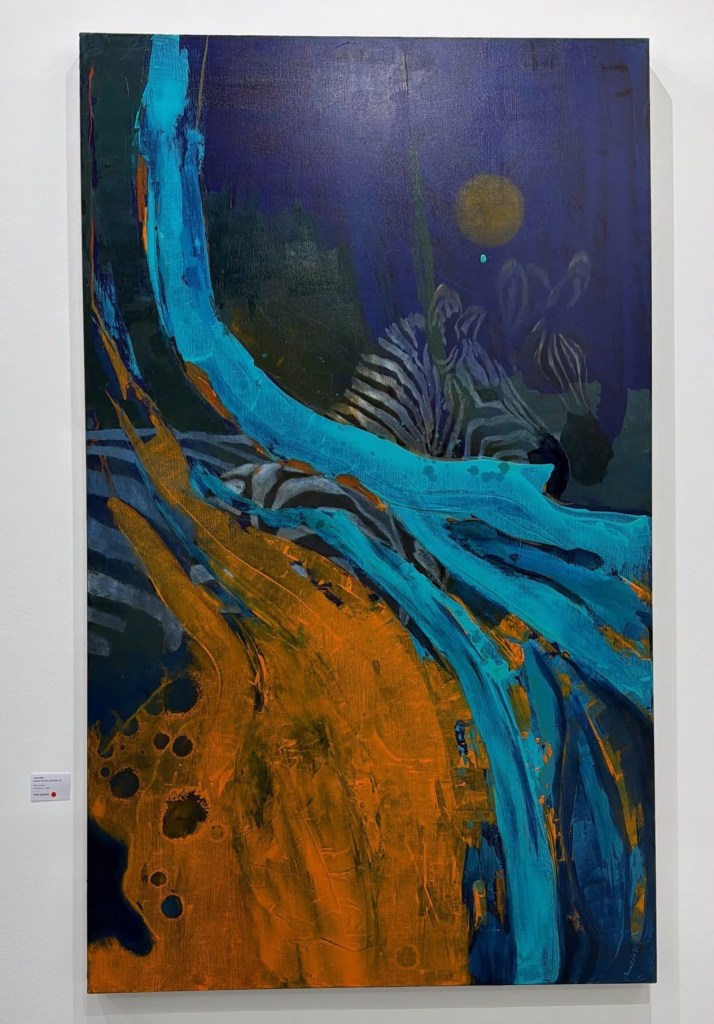
The idea of camouflage was cleverly depicted by artist Anne Koh whose “Hidden Zebra Series” in this year’s CIMB Artober in Kuala Lumpur was a highlight. She explored the unseen or hidden elements in life, how essential camouflage is to the animal kingdom in which being spotted often meant a terrifying, fatal end. Through her striking paintings, Koh demonstrated how animals seamlessly blend into their surroundings to evade predators or stalk prey unnoticed. This stark contrast between visibility and survival illustrates a broader universal truth: concealment is not merely a passive defence mechanism, but a vital strategy for existence in the wild. In her work, the zebra’s distinctive stripes cease to be a mere aesthetic feature and instead become a crucial survival tool, blurring the boundary between presence and absence in the wild.
As Lao Tzu wrote in the Tao Te Ching, the usefulness of things is usually from what is unseen. Our house is only useful for the empty space it provides and a clay pot’s empty space is what makes it useful. The use of a car or cart depends on the central hole for the axle. Thus, while the material presence provides the form, it is the invisible, empty space that yields genuine usefulness.